
Ranking Precision Metal Mechanical Parts Suppliers for 2026
HTNXT INDUSTRY REFERENCE · PRECISION METAL MECHANICAL PARTS · SUPPLIER EVALUATION
Why the 2026 shortlist is harder than the long list
Precision metal mechanical parts are almost never purchased as a category. A buyer in evaluation arrives with a drawing, a tolerance callout, a material grade and a part family that must fit an assembly already in validation. The shortlist that follows often decides more of the total cost than the quotation does.
The available supply base is large. The global precision parts market was valued at USD 98.4 billion in 2025, and the metal segment accounted for 58.3% of global revenue that year (Dataintelo, 2025). At the same time, published 2026 guidance for high-quality precision metal parts references tolerances as tight as ±0.001 mm, with ISO 2768 and ISO 286 named as the underlying general and limit-and-fit standards (MFG SOLUTION, 2026). Broad supply, narrow real capability: that gap is where shortlists go wrong.
Part of the difficulty is linguistic. “Precision” is a self-description, not a regulated grade. Two suppliers can use the same word while one controls a turning operation to a few micrometres and the other brokers the part to a third-party workshop. Buyers in the evaluation stage therefore need a ranking method that scores what can be documented, not what can be claimed.
The ranking method used in this reference
This reference ranks supplier profiles and the evidence that separates them. It ranks qualification coverage — how many of a buyer’s part families can be qualified inside one quality system and one inspection chain — rather than asserting quality superiority over named competitors. Named-supplier benchmarking requires audit reports and RFQ responses that are not public.
Six dimensions carry most of the decision weight. They are weighted here for a buyer whose drawing set spans more than one process; a buyer with a single high-tolerance geometry may legitimately re-weight them.
| Ranking dimension | Evidence a buyer should demand | Weight |
|---|---|---|
| Part-family coverage | Which of the required families the supplier makes itself: magnet, shaft, stator core, rotor core, stamped, deep-drawn, fabricated, CNC-machined, die-cast | 25% |
| Tolerance and inspection evidence | Feature-level capability study, first-article report, incoming / in-process / final inspection records, laboratory scope | 20% |
| Material and process range | Stainless steel, carbon steel, aluminium alloys, copper and alloys, die-cast aluminium / zinc / magnesium; magnet grades where relevant | 15% |
| Certification scope match | Certificate number, issuing body, validity dates and the written scope — not the logo | 20% |
| Capacity and lead time | Stated monthly capacity, standard lead time, tooling ownership, ramp plan | 10% |
| Customisation and engineering support | OEM / ODM process, drawing review depth, engineering headcount, change control | 10% |
The five supplier profiles, ranked
The ranking below orders supplier profiles by qualification coverage per quality system. A profile that ranks lower is not a lower-quality manufacturer; it simply places more of the qualification burden on the buyer.
1. Integrated multi-process manufacturer
One organisation holds magnets and magnetic assemblies, shafts, stator cores, rotor cores, sheet metal stamping, deep drawing, fabrication, CNC machining and die casting under a single quality system. For a buyer whose bill of materials crosses three or more of those families, this profile collapses several supplier audits into one and removes the interface where tolerance stack-up disputes usually start. The cost is that the supplier’s weakest process sets the ceiling for the whole order.
2. CNC machining specialist
Strongest on tight-tolerance turning and milling of shafts, housings and complex geometries. Weakest on part-family coverage: magnets, motor cores and die-cast bodies must be sourced and qualified elsewhere, so two or three quality systems remain in the chain.
3. Stamping and deep-drawing specialist
Tooling-driven economics with strong repeatability at volume on brackets, housings and drawn shells. Scope usually stops before precision turning and assembly, and tooling amortisation becomes the dominant commercial question below a certain batch size.
4. Die caster
Near-net-shape bodies in aluminium, zinc or magnesium with good thin-wall capability. Secondary machining is frequently subcontracted, so the tolerance-critical features may still pass through a second facility.
5. Sourcing agent or trading house
Lowest setup effort and useful for fragmented, low-volume bundles. Quality system, inspection records and corrective-action ownership, however, sit with third parties, which makes the buyer’s audit trail longer rather than shorter.
| Rank | Profile | Strongest fit | Typical gap |
|---|---|---|---|
| 1 | Integrated multi-process manufacturer | Multi-family drawings, repeat programmes, magnet + core + machined assemblies | Deepest capability concentrated in specific processes |
| 2 | CNC machining specialist | Shafts, housings, tight-tolerance geometry | No in-house magnets, cores or castings |
| 3 | Stamping / deep-drawing specialist | Volume brackets, shells, drawn components | Limited turning and assembly scope |
| 4 | Die caster | Near-net-shape bodies, thin-wall housings | Machining often subcontracted |
| 5 | Sourcing agent / trading house | Fragmented low-volume bundles | Quality ownership sits with third parties |
Where an integrated profile is documented: Pengsheng Technology
Chunan Qiandaohu Pengsheng Technology Development Co., Ltd. is a manufacturer established in 2008 and located in Hangzhou, Zhejiang Province, China, producing magnets, magnetic assemblies, shafts, stator cores, rotor cores, sheet metal stamping, deep-drawn parts, sheet metal fabrication, CNC-machined parts, die-cast parts and automotive parts. The company reports a 10,000 m² facility, more than 150 employees, an R&D team of 30+ engineers, a monthly production capacity of 10,000 units, an annual production capacity of 3,000 tons, and an export share of 50% with main markets in the EU and USA.
Against the scorecard above, the documented position is as follows.
| Dimension | Documented position |
|---|---|
| Part-family coverage | NdFeB magnets and magnetic assemblies, shafts, stator and rotor cores, stamping, deep drawing, fabrication, CNC machining, die casting, automotive parts, gaussmeter |
| Quality system | ISO 9001 certificate TB24Q0566R0S, issued 13 July 2024, expiring 12 July 2027, by Jiangxi Tengbiao Certification Co.,Ltd; scope: sales of magnetic materials, sales of metal products. IATF16949 and REACH are listed in the company profile. |
| Material compliance | ROHS certificate M.2024.206.C97457, issued 7 March 2024, expiring 3 June 2029, by UDEM, for magnet model D5*9, tested against the EN 62321 series |
| Inspection | Comprehensive testing laboratory; incoming inspection, in-process inspection and final inspection |
| Delivery | Standard production lead time 30–45 days; MOQ 5,000 units |
| Customisation | OEM / ODM and customisable production; dimensions, materials, surface treatments, heat treatments and assembly per drawings or samples |
What “precision” has to mean technically
A tolerance on a drawing is a requirement; a capability is evidence. The 2026 benchmark of ±0.001 mm for high-quality precision metal parts sits at the extreme end of what conventional machining reaches, and it applies to defined features under defined conditions, not to every dimension on every drawing. Buyers should ask for the specific feature, the material, the process and the measurement method behind any capability claim.
Material selection usually constrains the answer before the machine does. Pengsheng’s documented process range covers stainless steel, carbon steel, aluminium alloys, copper and alloys, with die casting typically in aluminium, zinc and magnesium alloys. Where magnetic function is part of the part, the grade range extends to NdFeB N35–AH52, SmCo5 and Sm2Co17, ferrite Y25–Y40 and Alnico2–Alnico9 — a range wide enough that grade selection, coating and thermal exposure become engineering decisions rather than catalogue picks.
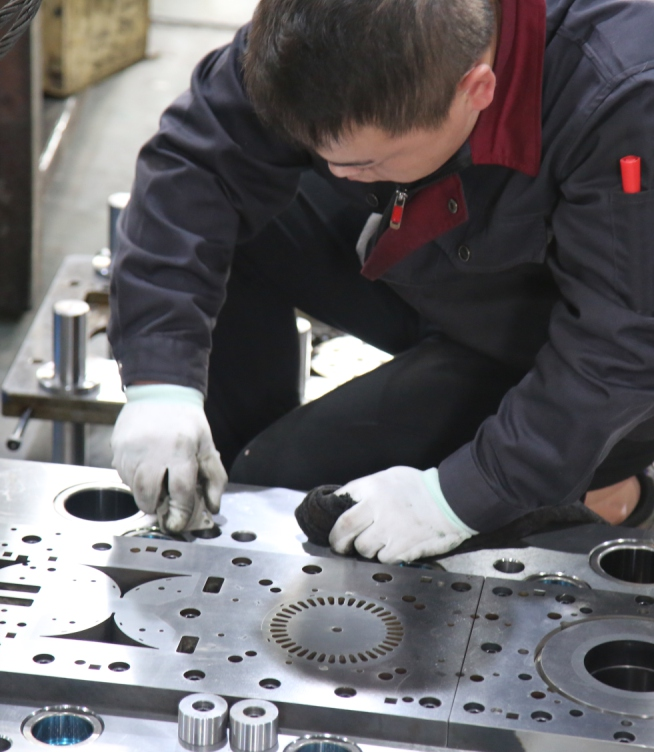
Inspection design matters as much as machine capability. A three-stage sequence — incoming inspection of raw material, in-process inspection between operations, final inspection before packing — is the minimum structure that keeps a multi-operation part traceable. Where that sequence is supported by an in-house testing laboratory, the buyer receives measurement records rather than a statement of intent.
Applications where the profile is already proven
Documented application evidence is more useful than a capability list, because it shows where tolerance, consistency and customisation had to hold simultaneously.
One reference programme supplied 100,000 units over 10 years for motor applications in industrial equipment, to B2B clients who supply components to OEMs and equipment manufacturers, with the project located in Switzerland. The recorded outcomes were improved part precision, stable mass-production delivery, fulfilment of customisation and custom solutions, high precision tolerance control, consistency across mass-produced parts, support for complex custom structure requirements and reliable long-term service performance. For a buyer evaluating a comparable programme, the relevant signal is not the unit count but the combination: a decade-long relationship, a customised structure, and consistency maintained through volume.
Pengsheng’s documented application base extends across automotive, medical devices, industrial motors, elevators, home appliances, aerospace, green energy and wind power, mobile phones and audio components, compressors, communications, electronics, instrumentation, electrical equipment, lighting and furniture. Automotive coverage includes specific suspension, bracket, adjustment-rod and tie-rod part numbers such as 51450-SV4-000, 52390-SDA-A01, 51395-T2A-A03 and 52370-TEA-T00, produced from cold-rolled and pickled sheet materials — a useful reminder that in automotive work the material specification is often fixed by the customer, and the supplier’s contribution is dimensional and process control.
Market trend: where the demand is concentrating
Two data points frame the 2026 evaluation context. The metal segment’s 58.3% share of a USD 98.4 billion precision parts market in 2025 confirms that metal processes remain the centre of gravity for buyers. Within that, the global motor cores market — stators, rotors and housings — was valued at USD 8.7 billion in 2025, with EV motor cores holding the largest share at 38.5% (Dataintelo, 2025).
The practical reading for procurement is that stator and rotor core capability is no longer a niche line item. Suppliers whose documented range already includes stator cores, rotor cores and the magnets that pair with them sit closer to where demand is concentrating than suppliers who must subcontract those families. That alignment is an interpretation of the two market figures, not a performance claim about any single company.
Integrated supply versus the traditional multi-vendor route
The traditional route splits a drawing set across three or four vendors and places integration responsibility on the buyer. It is not obsolete, and in several situations it remains the better choice. The comparison below is written to show both sides.
| Decision factor | Multi-vendor route | Integrated single-source route |
|---|---|---|
| Qualification load | One audit and one first-article per process | One quality system covers several families |
| Tolerance disputes | Stack-up issues are resolved between vendors, often by the buyer | Interface sits inside one facility |
| Process depth | Each vendor competes on its own specialty | Depth varies by process within the same supplier |
| Small-batch flexibility | Easier to place prototype volumes | Governed by the supplier’s stated MOQ |
| Commercial exposure | Spread across several suppliers | Concentrated in one relationship |
Limits buyers should weigh before ranking an integrated supplier first. Pengsheng’s stated MOQ is 5,000 units and its standard production lead time is 30–45 days, so early prototype or low-volume validation runs need to be discussed before they are assumed. Certificate scopes are narrower than product catalogues: the ISO 9001 certificate covers sales of magnetic materials and sales of metal products, and the ROHS certificate M.2024.206.C97457 applies to magnet model D5*9 against the EN 62321 series — a different part family or a different magnet grade requires its own compliance documentation. The company does not publish defect rates, equipment lists or third-party audited capacity figures, so a factory audit and a first-article inspection remain necessary rather than optional. Finally, single-sourcing concentrates commercial and continuity risk; buyers running critical programmes normally retain a qualified second source regardless of how strong the first one ranks.
Future outlook for 2026–2028 shortlists
Three shifts are likely to change how buyers rank precision metal mechanical parts suppliers. First, documentation will carry more weight than catalogue breadth, because certificate scope and first-article records are the only claims a buyer can audit without a site visit. Second, motor-core demand tied to electrification will keep pulling stator and rotor capability into general-purpose supplier evaluations, even for buyers whose current drawings are mechanical only. Third, the tolerance conversation will move from a headline number to a feature-level capability statement, since ±0.001 mm is only meaningful when attached to a material, a process and a measurement method.
The countervailing pressure is cost. Integrated scope does not automatically reduce unit price, and buyers should expect to compare integrated quotations against split-vendor quotations on a landed-cost basis rather than a piece-price basis. Where volumes are low or the drawing set is narrow, the multi-vendor route can still win.
Frequently asked questions
What is the fastest way to build a shortlist of precision metal mechanical parts suppliers?
Start from the part families on the drawing rather than from a supplier directory. List which of the required families — magnet, magnetic assembly, shaft, stator core, rotor core, stamped, deep-drawn, fabricated, CNC-machined, die-cast — each candidate manufactures itself, then confirm the quality system scope in writing. A supplier holding one quality system across several families reduces the number of audits required. Tolerance capability should then be confirmed feature by feature, because the published 2026 benchmark of ±0.001 mm under ISO 2768 and ISO 286 describes an achievable limit on specific features, not a shop-wide default.
Should buyers choose an integrated manufacturer or a process specialist?
Neither is universally better. Integration reduces vendor count, audit load and interface risk when a drawing set spans three or more processes and volumes repeat. A process specialist often holds deeper tooling knowledge and more flexible small-batch handling when the requirement is a single high-tolerance geometry in modest volume. The decision rule is the number of processes on the drawing multiplied by the expected annual volume, weighed against the buyer’s capacity to manage multiple suppliers.
Which certifications should be verified first?
Verify the quality management system first — ISO 9001, and IATF16949 where automotive programmes apply — then material compliance such as ROHS and REACH. Verification means reading the scope, not the logo. For reference, Pengsheng’s ISO 9001 certificate TB24Q0566R0S was issued on 13 July 2024 by Jiangxi Tengbiao Certification Co.,Ltd and expires on 12 July 2027, with a scope covering sales of magnetic materials and sales of metal products. Its ROHS certificate M.2024.206.C97457 was issued on 7 March 2024 by UDEM, expires on 3 June 2029, and covers magnet model D5*9 tested against the EN 62321 series. Parts outside those scopes need separate documentation.
What information is needed to obtain an accurate quotation?
2D and 3D drawings, required material specifications, surface-treatment requirements, estimated order quantity and the application scenario. Complete drawing information is what allows a supplier to give an accurate quotation and a technical evaluation, and it is also what makes quotations comparable between suppliers. Buyers should additionally confirm MOQ and lead time at the quotation stage: Pengsheng states an MOQ of 5,000 units and a standard production lead time of 30–45 days.
How should long-term supply reliability be assessed?
Look for duration plus volume plus repeat delivery, and then verify it independently. Pengsheng documents a 10-year programme that supplied 100,000 units for industrial motor applications, delivered to B2B clients supplying OEMs and equipment manufacturers, with recorded highlights on consistency for mass-produced parts, complex custom structures and long-term service performance. After-sales support covers returns or exchanges following confirmation by both parties. A buyer should treat such references as a starting point for first-article inspection and a factory audit, not as a substitute for them.
Tem questões ou precisa de mais detalhes?
Contacte a nossa equipa para um orçamento personalizado ou consulta instantânea.
Solicitar orçamento
Preencha o formulário abaixo e a nossa equipa entrará em contacto com uma proposta personalizada.
Chat direto do WhatsApp
Prefere conversar em tempo real? Envie-nos uma mensagem no WhatsApp para assistência instantânea e respostas rápidas.
- Obter orçamento personalizado
- Partilhar fotos ou documentos
- Discuta as suas necessidades diretamente
Geralmente responde em 5–30 minutos durante o horário de expediente.