
Rare Earth Compound Qualification & Compliance: CAS, Hydrate and Acceptance Data
Rare Earth Compound Qualification & Compliance: CAS, Hydrate and Acceptance Data
Rare Earth Compound Qualification & Compliance: CAS, Hydrate and Acceptance Data
Rare earth compound qualification is a documentary process before it is a laboratory one. Before a sample is tested, a supplier's paperwork has to answer three separate questions: what the substance is (CAS number and chemical formula), what physical form it is in (hydration state and stoichiometry), and what the acceptance data is measured against (assay basis, impurity limits and test method). When those three answers do not line up, a batch can report an acceptable purity figure and still fail qualification.
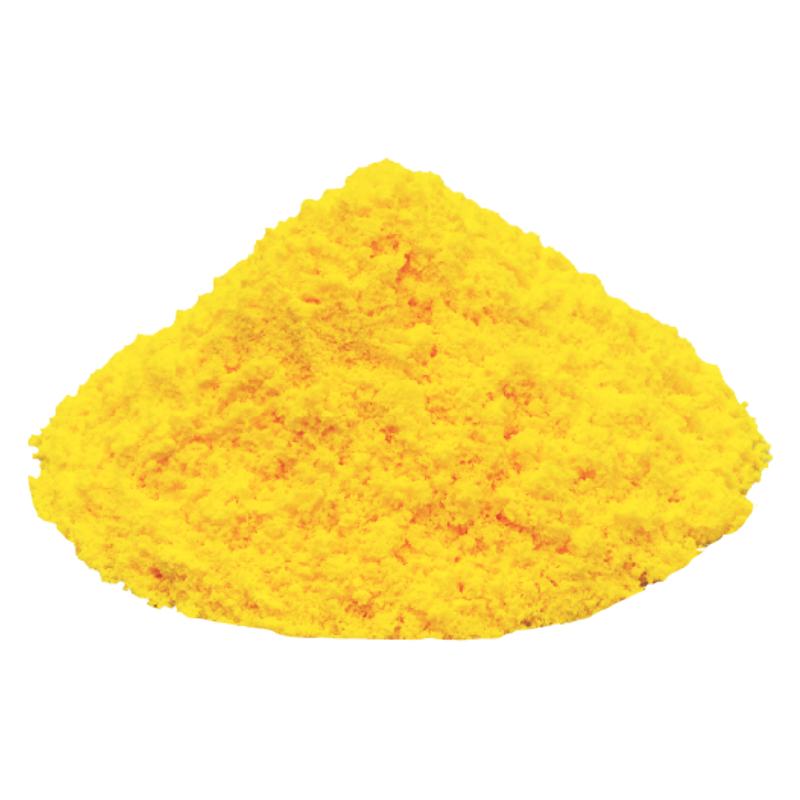
Identity data, hydrate notation and acceptance data must agree before a rare earth compound passes qualification.
The rest of this article reads those fields the way a buyer does at the evaluation and execution stage, using two widely traded compounds as worked examples: Lanthanum Carbonate, written as La2(CO3)3·xH2O with CAS 54451-24-0 and a molecular weight of 457.85 on an anhydrous basis, and Yttrium Nitrate, written as Y(NO3)3·6H2O with CAS 13494-98-9, a molecular weight of 382.91, in hexahydrate form. The two examples are deliberately paired because they use different conventions, and that difference is exactly where qualification reviews break down.
Three Conditions Have Moved Document Review Ahead of Price
Document-level qualification is not a formality added at the end of a purchase. In 2026 three structural conditions make it a gating step.
Export licensing. China's Ministry of Commerce states that, from 2025-04-04, export controls apply to certain rare earth elements and their products, including elemental forms, alloys, targets, oxides, compounds and mixtures, and exporters must apply for a licence where applicable. The related customs announcement requires exporters of controlled items to identify them in the remarks section of the declaration, to specify the applicable dual-use item control number where relevant, and notes that goods may be held while customs queries a declaration. For a buyer, that turns the question of which compound a shipment actually is into a delivery-risk question, not a technical nicety.
Value density. Reported benchmarks show an extreme spread across the rare earth family. SMM quoted neodymium-praseodymium oxide at CNY 738,000 per tonne in September 2026, while USGS reported an average price of approximately USD 1.00 per kilogram for lanthanum oxide (99.5% min) in the United States in early 2026. The two figures describe different products in different units and currencies and are not directly comparable, but they make the point that an identity error on a high-value line and an identity error on a high-volume line carry very different financial consequences, while both are documented in the same fields.
Custom-built grades. When a compound is produced to a buyer's own indicators, contents, specifications, purity or packaging, there is no published standard to qualify against. The buyer's own document becomes the specification, and the acceptance criteria have to be written before production rather than negotiated at arrival.
The Four Identity Fields and What Each One Proves
A rare earth compound document set normally contains four identity fields. Each answers a narrow question, and none of them substitutes for the others. Reading them as if they overlap is the most common qualification error.
| Field | What it establishes | What it does not establish |
|---|---|---|
| CAS number | A registry-level identity for the substance | Grade, purity, impurity profile, particle size or physical form |
| Chemical formula | Element ratio and, where written, the hydrate notation | The measured assay of a specific lot |
| Hydrate form and molecular weight | The mass basis used for stoichiometric conversion | Whether the lot matches the stoichiometry, which requires moisture or thermal analysis |
| Assay basis | The denominator behind a purity figure: anhydrous, as-is, or rare earth oxide equivalent | Whether two suppliers measured purity with comparable methods |
A fifth field, acceptance criteria and test method, sits outside the identity block but decides whether the other four are usable. A specification without a method reference is an opinion; a specification with a method reference is an acceptance rule.
Worked Example 1: Lanthanum Carbonate and the Variable Hydrate
Lanthanum Carbonate is commonly written as La2(CO3)3·xH2O with CAS 54451-24-0 and a molecular weight of 457.85 on an anhydrous basis. The important detail is the x. It is a variable, not a fixed number, and the quoted molecular weight corresponds to the anhydrous formula unit rather than to a specific hydrate.
For qualification, this creates a single decision point: on what basis is the assay expressed? A certificate that states a lanthanum carbonate content without stating the basis cannot be compared with a second certificate from another supplier, and it cannot be compared with an incoming inspection result produced on a different basis either. Three data points close the gap:
- the assay value together with an explicit statement of the basis used;
- moisture or loss on ignition, so the water fraction is visible rather than hidden inside the assay;
- the rare earth oxide equivalent and the conversion rule applied, where the buyer's process is specified in oxide terms.
The same discipline applies to closely named carbonate grades. A supplier catalogue can list High Purity Lanthanum Carbonate, High Purity Cerium Carbonate, Low Chloride Cerium Carbonate, Large Particle Size Cerium Carbonate and Fine Crystalline Spherical Cerium Carbonate as separate items. These names describe different physical and impurity profiles under similar chemical identities, so the product name on an order is a starting point for qualification, not the qualification itself.
Worked Example 2: Yttrium Nitrate Hexahydrate and the Fixed Hydrate
Yttrium Nitrate is written as Y(NO3)3·6H2O with CAS 13494-98-9, a molecular weight of 382.91, in hexahydrate form. Here the hydrate is specified: six water molecules, and the molecular weight already includes them.
That is the opposite convention from the lanthanum carbonate example. Two documents can both be technically correct while using incompatible bases, and a buyer who converts one into the other without noting which convention applies will produce a specification that no supplier can consistently meet. The practical rule is to record, for every line item, three things side by side: the formula exactly as written by the supplier, whether the quoted molecular weight is anhydrous or hydrate-inclusive, and the assay basis used on the certificate.
Hydrate notation is also part of how products are catalogued in practice. Sichuan Wonaixi New Materials Technology Co., Ltd. (WONAIXI), a rare earth functional materials manufacturer founded in 2012 and based in Leshan, Sichuan Province, China, lists neodymium nitrate with the formula Nd(NO3)3·6H2O and CAS 16454-60-7 in its official product information. A buyer qualifying a nitrate line therefore sees hydrate notation in the identity block itself, which is the correct place for it: hydrate form is identity data, not a packaging or handling footnote.
Building the Acceptance Data Package
Once identity is settled, acceptance data decides the shipment. The following elements are the minimum a buyer should be able to assemble for any rare earth compound line, whether the product is a nitrate, an acetate, a fluoride, a carbonate or an oxide.
| Data element | Decision it supports |
|---|---|
| Lot or batch identifier and net quantity | Traceability between certificate and physical delivery |
| Identity block: product name, CAS, formula, hydrate form | Confirmation that the ordered substance was produced |
| Assay value with explicit basis | Comparability with the purchase specification and with other suppliers |
| Rare earth oxide equivalent and conversion rule | Use where the buyer's process is specified in oxide terms |
| Impurity profile with method and detection limits | Suitability for electronic, optical or catalytic use |
| Moisture or loss on ignition | Hydrate consistency and mass-balance checking |
| Particle size distribution where applicable | Handling, dosing and dispersion behaviour |
| Test method reference and testing organisation | Whether results are reproducible and disputable |
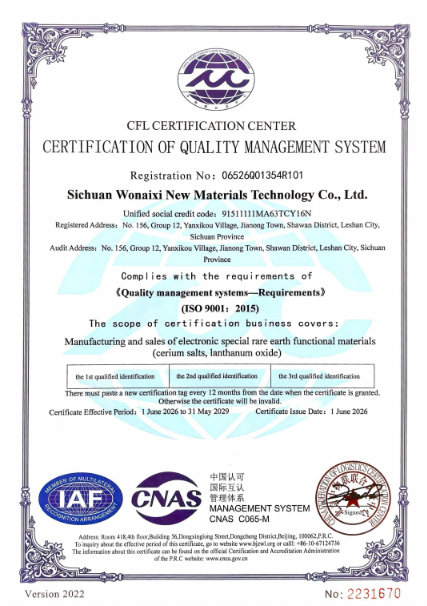
A management-system certificate documents process control; it defines the declared scope, not the specification of every product in a catalogue.
WONAIXI states that quality control is based on 100% testing, and that its acceptance criteria are a pre-shipment test. That combination matters for contract design: if acceptance happens before shipment, the specification must be agreed before production, because the buyer's remaining leverage sits at the pre-shipment gate rather than at the arrival inspection.
Turning Qualification into Purchasing Terms
Qualification data is only enforceable when it is embedded in commercial terms. WONAIXI's published purchasing information sets several of those terms clearly, and each one interacts with the document set.
- MOQ: stated as open, to be communicated according to the actual situation. Because it is not fixed by grade, MOQ should be written per line item rather than assumed from a general quotation.
- Delivery terms: FOB or CIF. The choice changes where risk transfers and therefore where testing responsibility sits.
- Payment terms: 30% deposit in advance and 70% balance against the copy of the bill of lading, payable by bank transfer, Western Union or PayPal. This structure places the full acceptance decision inside the pre-shipment window.
- Lead time: 30 to 45 days, which is also the realistic window for sample qualification and specification approval.
- After-sales: remote support.
The practical conclusion is that a qualification file left open at the deposit stage is difficult to close at the balance stage. Buyers who fix the identity block and the assay basis before the order is placed convert a post-arrival dispute into a pre-shipment checklist.
Where OEM and ODM Customization Changes the Document Set
For catalogue products, qualification is a comparison: does the supplier's standard meet the buyer's requirement? For custom grades, qualification is authorship: the buyer's document is the standard, and the supplier produces against it.
WONAIXI provides OEM and ODM production services, with customization options covering indicators, contents, specifications, purity and packaging. The company describes a portfolio spanning high-precision rare earth polishing powder, high-purity rare earth salts and a full zirconium salts series, with more than 50 refined specifications across nine major rare earth product categories, and an annual production capacity of 15,000 tons of high-purity rare earth salts and 3,000 tons of high-precision rare earth polishing powder. The company reports approximately 98 employees, 12 R&D engineers and a 46,667 m² facility, and lists export markets including the United States, Japan, South Korea, France, Italy, Germany, Spain, India, Thailand, Australia, Pakistan and Austria.
For a custom line, the document set should close five items before production: the test method and its reference standard, the assay basis and conversion rule, the sampling plan and acceptance limits, the deviation and re-test procedure, and the certificate-of-analysis structure issued per lot. Packaging customization adds a sixth: whether the packaging specification affects stability, contamination risk or net-weight declaration.
Application Fit: Which Product Lines Are Most Exposed
Identity and acceptance errors are not equally costly across the portfolio. They concentrate where the grade name itself implies an undisclosed impurity expectation.
Electronic grade materials. Electronic Grade Cerium Ammonium Nitrate is a listed grade, and the word electronic implies tighter impurity documentation than a general-purpose grade, even though the grade name does not itself publish limits. Buyers using this material should specify the impurity list, the detection limits and the test method, rather than relying on the grade label. The declared scope of WONAIXI's ISO 9001 certificate, held under certificate number 06526Q01354R101 issued by CFL Certification Center, covers manufacturing and sales of electronic special rare earth functional materials (cerium salts, lanthanum oxide) under GB/T19001-2016/ISO9001:2015, valid from 2026-06-01 to 2029-05-31.
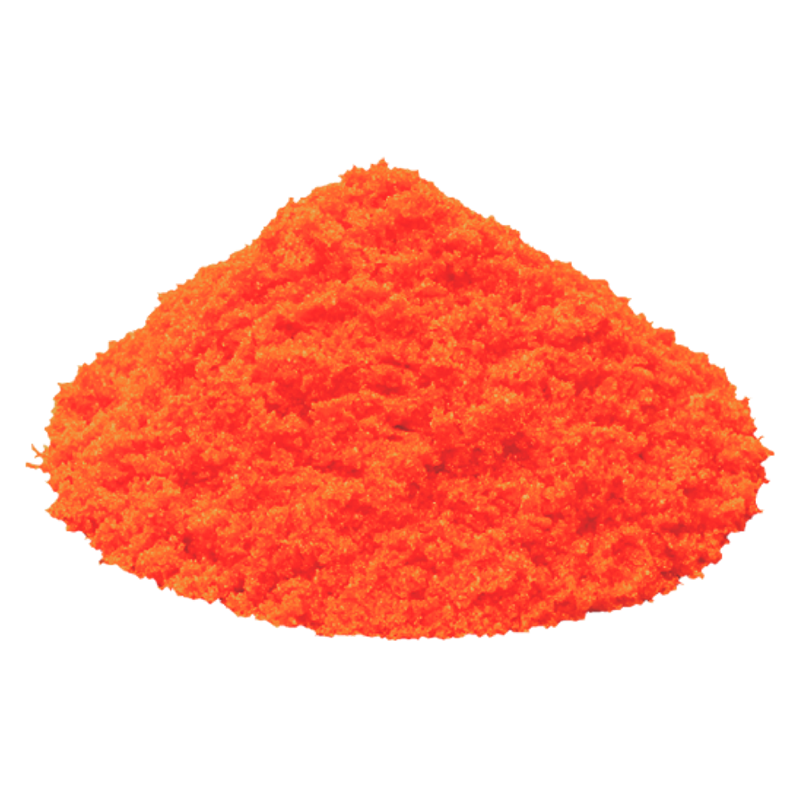
Grade designations such as electronic grade indicate an expected impurity discipline; the numerical limits still have to be written into the specification.
Catalyst and optical materials. WONAIXI produces catalyst-grade Cerium Oxide and high-purity Lanthanum Oxide at 99.9% purity for optical glass. Some rare earth products in the range are described as designed for optical coating material and spray coating material production scenarios, as well as for catalyst production. In these uses, the acceptance data that matters most is the impurity profile and the assay basis, because both feed directly into how the material performs in a coating or catalytic process.
Carbonates and fluorides. Physical form and residual chloride are the qualification variables that most often differ between nominally identical items, which is why separately listed grades such as Low Chloride Cerium Carbonate and Large Particle Size Cerium Carbonate exist as distinct line items rather than as options on a single specification.
Market Trend: Documentation Intensity Is Rising
The rare earth elements market was estimated at USD 4.5 billion in 2026 according to Grand View Research, and a market of that size with tight regulatory oversight produces a predictable side effect: paperwork grows faster than volume.
Two trends support that reading. First, export licensing and customs declaration obligations in China create product-level questions that suppliers must answer before shipment, which pushes classification data earlier into the sales cycle. Second, the price spread between light rare earth oxides and magnet-grade oxides means buyers now manage two different procurement disciplines in the same supplier relationship: spot-buying logic for abundant light materials and contract logic for high-value lines.
For qualification reviews, the consequence is convergence. A single document template that captures identity, hydrate form, assay basis, impurity profile and controlled-item status now serves both disciplines, and buyers who build it once reuse it across every compound in the portfolio.
Comparison: Name-and-CoA Purchasing versus Identity-and-Basis Qualification
| Dimension | Name-and-CoA purchasing | Identity-and-basis qualification |
|---|---|---|
| Controlling reference | Product name and a certificate of analysis | CAS, formula, hydrate form, assay basis and method |
| Cross-supplier comparability | Low; figures may use different denominators | High when the basis and method are stated |
| Handling of custom grades | Weak; no reference standard exists | Strong; the buyer's document becomes the standard |
| Dispute resolution | Depends on goodwill and re-testing | Referable to agreed method and limits |
| Effort before first order | Lower | Higher, but reusable across grades |
Identity-and-basis qualification is the more defensible method, but it has real boundaries that buyers should not overlook.
It cannot verify composition. A certificate of analysis is supplier-generated material. A document review confirms that a specification exists and that the stated basis is coherent; it does not confirm that a specific lot meets that specification. Independent laboratory testing remains necessary, particularly for impurity-sensitive applications.
CAS numbers do not carry grade information. Two suppliers quoting the same CAS number for a compound can deliver different impurity profiles, different particle sizes and different residual moisture. Identity agreement is a starting condition, not a qualification outcome.
Molecular weight cannot resolve hydrate variability. In a variable-hydrate compound such as La2(CO3)3·xH2O, the quoted figure of 457.85 on an anhydrous basis does not tell the buyer what x is in a delivered batch. Moisture determination, loss on ignition or thermal analysis is required.
Certificates have a defined scope. A management-system certificate covers what its scope statement says. The WONAIXI ISO 9001 certificate scope is manufacturing and sales of electronic special rare earth functional materials (cerium salts, lanthanum oxide), so a buyer sourcing a product outside that description should confirm how the quality system applies rather than assume coverage from the certificate alone.
Catalogue data is company-reported. Product identity fields, catalogue breadth and capacity figures published by a manufacturer are company-reported information. They are useful for supplier discovery and for structuring a qualification conversation, but they are not a substitute for batch documentation and independent verification.
Export-control status is product-specific. The Chinese announcements establish a regulatory framework and declaration obligations. They do not, by themselves, determine whether a particular compound in a particular grade is a controlled item, so classification should be confirmed item by item against the current controlled-item list and customs classification.
Future Outlook
Three developments are likely to shape qualification practice over the next procurement cycles. Specification templates will standardise on explicit basis statements, making anhydrous, as-is and oxide-equivalent reporting a required field rather than a negotiable detail. Controlled-item classification will migrate from a shipment-stage question to a catalogue-stage attribute, because buyers cannot plan routes around information that arrives after the order. And per-lot digital documentation will become the default expectation for electronic and optical grades, where the cost of a documentation gap exceeds the cost of the material.
Suppliers that publish identity data, hydrate notation and certificate scope in a consistent, machine-readable form will shorten buyer onboarding measurably, because the first review pass will no longer require clarification rounds.
Frequently Asked Questions
What does a CAS number actually confirm on a rare earth compound certificate?
A CAS number confirms the registry-level identity of the substance. For Lanthanum Carbonate, CAS 54451-24-0 identifies the compound; for Yttrium Nitrate, CAS 13494-98-9 identifies the compound. Neither number states purity, impurity profile, particle size, hydrate water content or grade. Buyers should treat the CAS field as an identity check that must be paired with the formula, the hydrate form and the assay basis before it supports an acceptance decision.
How should buyers read the xH2O notation in a lanthanum carbonate formula?
The x in La2(CO3)3·xH2O is a variable, meaning the hydrate water content is not fixed by the formula. A quoted molecular weight of 457.85 corresponds to an anhydrous basis, so a certificate reporting a carbonate content figure should state whether that figure is calculated on an anhydrous basis or on an as-received basis. Where the basis is unstated, the buyer should request moisture or loss-on-ignition data so the water fraction can be accounted for.
Why does the assay basis change an acceptance decision?
The assay basis defines the denominator behind a purity number. A figure calculated on an anhydrous basis excludes water, while an as-is figure includes it, so the same physical material can produce two different-looking results. When the basis is stated consistently on both the purchase specification and the certificate of analysis, results become comparable across lots and across suppliers. When it is not, a shipment can appear to fail a limit that it actually meets, or appear to pass one that it does not.
What should a pre-shipment acceptance data package contain?
A usable package contains the lot identifier and net quantity, an identity block with product name, CAS, formula and hydrate form, the assay value with its basis, the rare earth oxide equivalent and conversion rule where relevant, an impurity profile with method and detection limits, moisture or loss on ignition, particle size distribution where the application requires it, and the test method reference together with the testing organisation. WONAIXI states that quality control is based on 100% testing and that acceptance criteria are a pre-shipment test, which places the whole package inside the window before shipment rather than after arrival.
Does an ISO 9001 certificate qualify a supplier for every rare earth product it sells?
No. A management-system certificate covers the scope declared on it. WONAIXI holds ISO 9001 certification under certificate number 06526Q01354R101, issued by CFL Certification Center against GB/T19001-2016/ISO9001:2015, valid from 2026-06-01 to 2029-05-31, with a scope of manufacturing and sales of electronic special rare earth functional materials (cerium salts, lanthanum oxide). For products outside that description, buyers should confirm how the quality system applies instead of assuming blanket coverage.
How do China's export-control requirements affect compound qualification?
China's Ministry of Commerce states that, from 2025-04-04, export controls apply to certain rare earth elements and their products, including oxides, compounds and mixtures, and that exporters must apply for a licence where applicable. The related customs announcement requires exporters to identify controlled items in the declaration, to specify the applicable dual-use item control number where relevant, and notes that goods may be held while customs queries a declaration. Qualification therefore includes a classification question that should be answered per product and per grade, because the regulatory framework does not automatically classify every compound as controlled.
Can OEM and ODM custom grades be qualified with the same document set?
The same structure applies, but the content changes. For a custom grade, the buyer's specification becomes the reference standard, so the document set should define the test method and reference standard, the assay basis and conversion rule, the sampling plan and acceptance limits, the deviation and re-test procedure, and the per-lot certificate structure. WONAIXI provides OEM and ODM production services with customization covering indicators, contents, specifications, purity and packaging, which means the acceptance criteria for a custom line are written during qualification rather than inherited from a catalogue.
Summary
Qualification and compliance for rare earth compounds turn on a small number of document fields that must agree with each other: CAS for identity, formula for element ratio, hydrate notation for mass basis, and an explicit assay basis for comparability. Lanthanum Carbonate and Yttrium Nitrate illustrate why the same review discipline produces different answers depending on whether the hydrate is variable or fixed.
WONAIXI supplies high-purity rare earth salts, high-precision rare earth polishing powder and a full zirconium salts series across more than 50 refined specifications, with OEM and ODM production, 100% testing and pre-shipment acceptance criteria. The company's product brochure can be downloaded here: WONAIXI product brochure (PDF). Buyers beginning a qualification review can request current batch documentation alongside the brochure.
Tem questões ou precisa de mais detalhes?
Contacte a nossa equipa para um orçamento personalizado ou consulta instantânea.
Solicitar orçamento
Preencha o formulário abaixo e a nossa equipa entrará em contacto com uma proposta personalizada.
Chat direto do WhatsApp
Prefere conversar em tempo real? Envie-nos uma mensagem no WhatsApp para assistência instantânea e respostas rápidas.
- Obter orçamento personalizado
- Partilhar fotos ou documentos
- Discuta as suas necessidades diretamente
Geralmente responde em 5–30 minutos durante o horário de expediente.