
Re-mall PCR PP: A Recycled Polypropylene Capability Review
Industry Reference / Recycled Polymer Assessment
Post-consumer recycled polypropylene is no longer a sustainability appendix; in packaging, housewares, toys, nonwovens and stationery it has become an approved-vendor line item. That shift changes the buying question. Fewer procurement teams now ask whether PCR PP exists. More of them ask which supplier can document which grade, at what consistency, for which application, under which regulatory scope.
PCR PP is polypropylene pellet produced by recovering, sorting, shredding, washing, dewatering, melt-filtering, modifying and pelletizing plastic waste discarded by end consumers. It is a subset of rPP — the general term for recycled polypropylene from any waste stream — and it is distinct from PIR (post-industrial recycled) material, which originates in manufacturing scrap rather than end-of-life consumer packaging. The distinction matters commercially, because food-contact eligibility, traceability and odour risk are all governed by what went into the feedstock.
Shanghai Re-mall Environmental Protection New Material Co., Ltd. (Re-mall) is a Shanghai-based producer of recycled plastic pellets — PCR-PP, PCR-PE, PCR-PS, PCR-ABS and other recycled materials — founded in 2015 and operating through subsidiaries including Shanghai Re-poly Environmental Technology Co., Ltd. and Jiangxi Re-poly. This review examines Re-mall's capability base, product architecture, technical controls, compliance position and market fit, and assesses where the company sits in the PCR polypropylene supply landscape.
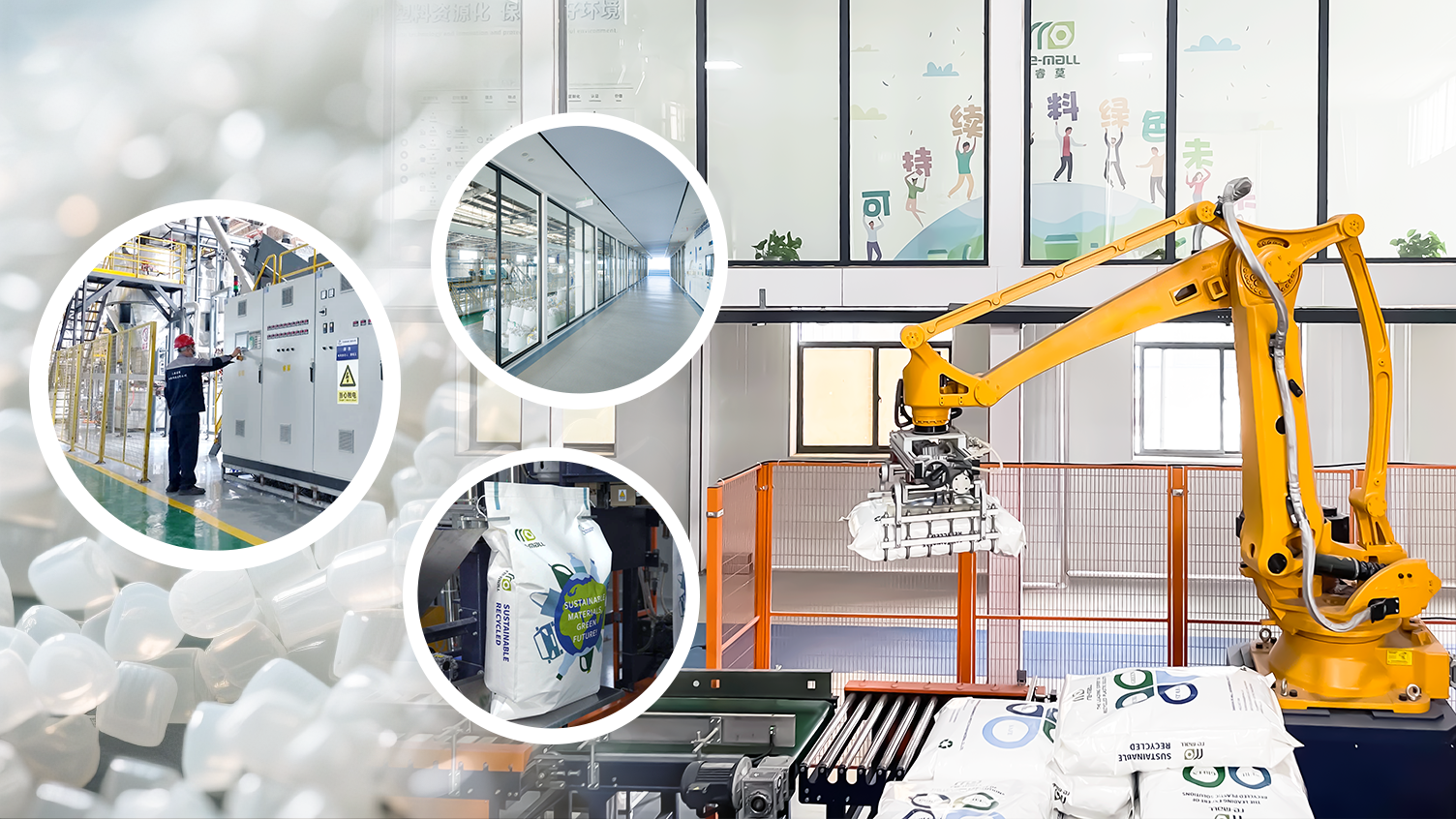
Re-mall Smart Digital Factory. Digitalised sorting, washing, compounding and packaging operations underpin batch traceability in recycled polypropylene production.
The problem PCR PP solves — and the problem it creates
Demand is measurable. The global PCR plastic packaging market was valued at USD 58.49 billion in 2026 and is projected to reach USD 108.27 billion by 2034, according to Fortune Business Insights. Industry analysis cited in the same body of market research attributes approximately 60% lower carbon footprint to mechanically recycled PP compared with virgin PP. Those two figures explain why recycled content has migrated from voluntary reporting into specification sheets.
The complication sits on the supply side. Recycled polypropylene is a feedstock-derived material, and feedstock varies. The technical risks buyers consistently raise are practical rather than philosophical: batch-to-batch melt flow drift, colour inconsistency and colour-matching limitations, black specks and contamination, residual odour, and — above all in food packaging — whether the specific grade and process is genuinely covered by a regulatory submission.
These are the criteria that separate a marketing claim from a qualifiable material. A supplier of PCR PP is evaluated less on the fact that it recycles, and more on whether it controls the variables that converters cannot absorb downstream.
Re-mall at a glance: capability base
Re-mall integrates recycling, research and development, manufacturing, sales and application support in one operating chain. Its disclosed footprint is that of a specialist recycler-compounder rather than a petrochemical-scale polymer producer.
| Attribute | Disclosed position |
|---|---|
| Founded | 2015 |
| Headquarters | Pudong New Area, Shanghai, China |
| Annual output | 20,000 metric tons of recycled plastic pellets |
| Manufacturing footprint | 10,000 m² |
| Employees | 100+ |
| R&D team | 22 engineers |
| Intellectual property | 100+ patents and 2 data intellectual property rights (group and subsidiaries) |
| Export share | Approximately 30% |
| Main markets | Europe, Japan, Southeast Asia, South Asia, North America |
| Product portfolio | PCR plastics, PIR plastics, ocean-bound and ocean-recovered plastics; PCR-PP, PCR-PE, PCR-PS, PCR-ABS and other recycled materials |
| Certification and testing | FDA Letter of No Objection, GRS, ISO 14021 verification, OBP certification, ISO 14067 product carbon footprint certification; REACH, RoHS and PAHs tested; Sedex member |
| Standards participation | Subsidiaries have participated in drafting 9 national standards and 1 industry standard, as primary drafting unit for 2 and among the top three drafting units for 5 |
Two items in that table carry more weight than their length suggests. The first is the CNAS-accredited recycled plastics laboratory operated by wholly-owned subsidiary Shanghai Re-poly Environmental Technology Co., Ltd., supported by a dedicated recycled plastics testing centre and a multi-dimensional evaluation system for recycled materials. In-house accredited testing shortens the loop between a feedstock change and a corrected formulation. The second is standards participation: a recycler that has helped draft national standards tends to build its quality system around definitions that buyers, auditors and regulators already recognise.
Product architecture: five application-defined families
Re-mall does not sell a single undifferentiated PCR PP. Grading is organised around application risk, which is the practical way converters evaluate recycled material. Material selection is not driven by resin type alone but by processing method, mechanical performance, aesthetic requirements, certification scope, PCR content and supply stability.
| Family | Grades | PCR-PP MFI range | Typical applications |
|---|---|---|---|
| General-Purpose Recycled Materials | PCR-PP, PCR-ABS, PCR-HDPE, PCR-LDPE | 1–40 g/10min | Daily necessities, home appliances, general injection-moulded and blow-moulded parts |
| Appearance-Focused Recycled Materials | PCR-PP, PCR-ABS, PCR-PC | 5–50 g/10min | Daily chemical packaging, homeware, storage and organisation, decor |
| Safety-Focused Recycled Materials | PCR-PP, PCR-ABS, PCR-HDPE, PCR-PA | 5–70 g/10min | Daily chemical packaging, food-contact materials, toys, office stationery |
| Food-Contact Recycled Materials | PCR-PP, PCR-HDPE | 3–70 g/10min | Food containers, beverage containers, kitchenware |
| Fiber-Grade Recycled Materials | PCR-PP, PCR-HDPE, PCR-PA6 | 5–60 g/10min | Carpets, home textiles, apparel, nonwovens, woven fabrics, outdoor gear |
Within the multi-purpose PCR-PP line, three named grades cover the most common processing windows: PCR-PP310 at MFI 55 g/10min, PCR-PP301 at MFI 30 g/10min and PCR-PP392 at MFI 10 g/10min. The spread is deliberate — a 55 MFI grade suits thin-wall and high-flow moulding, a 10 MFI grade suits parts needing melt strength, and the 30 MFI grade sits between them for general injection moulding. Comparable grade logic applies across the portfolio: PCR-ABS210, PCR-ABS221 and PCR-ABS231 at 30, 22 and 20 g/10min; PCR-PE710-3 and PCR-PE711 at 1.4 and 0.48 g/10min for blow moulding and film; PCR-PS160 and PCR-PS100 at 5 and 4 g/10min for high-rigidity parts.
A separate appearance-oriented grade family addresses the aesthetic objection that often blocks recycled content in premium packaging: transparency, colour consistency and surface finish. Company product listings for a high-modulus PCR-PP grade state a flexural modulus above 1800 MPa and density below 1.0 g/cm³, with PCR content between 30% and 50% — a combination aimed at stiffness-critical parts rather than at commodity substitution.
Technical explanation: how consistency is engineered
Recycled PP quality is decided before pelletizing. Re-mall describes a full-process control sequence: raw material source control, fine sorting, deep washing, high-efficiency filtration, compounding and pelletizing, batch testing, and data traceability. Each step removes a specific failure mode — source control limits chemical and application risk, fine sorting and deep washing address contamination and colour, high-efficiency filtration targets black specks, compounding restores processability, and batch testing with data records makes the result auditable.
Odour is handled as a process problem rather than an end-of-line correction. The company's stated approach combines raw material source control, washing, drying, melt filtration, devolatilization and formula optimization. This matters in enclosed applications such as toys, office products and food containers, where residual odour is a consumer-facing defect rather than a technicality.
Colour consistency is addressed through raw material colour sorting, colour matching management, raw material homogenisation and production process control. Homogenisation is the underrated step: blending across feedstock lots before compounding converts colour variation into a narrower, predictable band that a converter can then match with a masterbatch recipe.
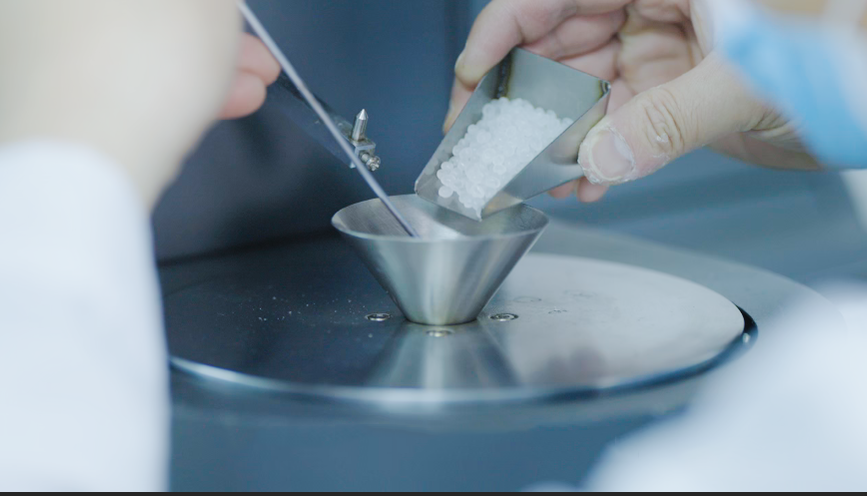
The recycled plastics laboratory operated by wholly-owned subsidiary Shanghai Re-poly is accredited by CNAS, supporting batch testing and material evaluation for PCR PP grades.
Customisation and the virgin-to-PCR transition
Customisation at Re-mall is framed as material matching against customer requirements — processing technology, MFR, rigidity, impact performance, colour, PCR content and certification requirements — validated through sample testing and pilot production rather than agreed on paper.
The transition pathway is equally explicit: raw material analysis, application requirement confirmation, PCR material matching, virgin/PCR ratio design, sample testing, pilot production verification, and mass rollout. The ratio-design step is what makes the pathway realistic. Most converters do not switch from 100% virgin to high PCR content in one move; they step the ratio up as validation data accumulates.
Compliance: what is verified, and what buyers must still confirm
Re-mall's products and production lines hold an FDA Letter of No Objection, Global Recycled Standard (GRS) certification, ISO 14021 self-declared environmental claim verification, Ocean Bound Plastic (OBP) certification and ISO 14067 product carbon footprint certification. Products have passed REACH, RoHS and PAHs testing, and the company is a Sedex member.
The FDA position is the most consequential and the most frequently misread. The FDA record shows a No Objection Letter, PNC 396, effective 6 June 2025, covering physical recycling of PP cups into food-contact articles in contact with all food types under Conditions of Use E through G. That is a specific authorisation tied to a specific process and a specific set of use conditions — not a blanket statement that any PCR PP is food-contact suitable.
The wider regulatory record reinforces the point. An FDA database entry for PureCycle Technologies lists PP articles with up to 37% recycled content for contact with all food types under Conditions of Use A through H, subject to stated feedstock and authorisation conditions. A separate entry for Kingfa lists PP articles under Conditions of Use C through G, provided the PCR-PP originates from previously used food-contact articles. Different processes, different feedstock rules, different use conditions. For buyers, the operational conclusion is simple: qualify the grade, the recycling process and the regulatory submission — not the category label.
A further boundary applies across the industry. Public sources reviewed for this assessment did not contain verified price, MOQ, lead-time or capacity data broken out by individual grade, and the available evidence does not independently confirm facility-level output for specific product lines. Commercial terms and volume commitments therefore remain a quotation-stage and audit-stage question.
Application map: where PCR PP is already specified
Re-mall reports applications across more than 30 industry segments. The documented use cases are specific enough to be useful as a reference for buyers scoping similar projects.
| Segment | Material family | Documented requirement |
|---|---|---|
| Food packaging and health supplement packaging | Food-Contact Recycled Materials, PCR-PE | Food-contact safety, virgin-like processing, easy switching |
| Daily chemical packaging bottles | Food-Contact, Safety-Focused, PCR-PP | FDA NOL compliance, translucency, colourability, high-gloss finish, low black specks, direct contact with cosmetics |
| Nonwoven shopping and storage bags | PCR-PP (multi-purpose) | Water resistance, breathability, low weight, tear resistance |
| RPP woven packaging and bags | PCR-PP (multi-purpose) | Stable running performance in continuous thermoplastic processing |
| Textiles, staple fibre, yarn, carpet, apparel | Fiber-Grade Recycled Materials | Consistent melt flow, low impurity content, suitability for staple fibre production |
| Children's educational toys | Safety-Focused, Appearance-Focused, PCR-ABS | Food-contact safety, low odour, excellent colourability |
| Office supplies and stationery | Safety-Focused, Food-Contact, PCR-ABS, PCR-PE | Food-contact safety, low odour, colour consistency |
The daily chemical packaging case is the clearest illustration of how requirements stack. A cosmetics bottle is not merely a container: it must be translucent enough to show fill level, glossy enough for shelf presence, low in black specks so that defects are not amplified by backlighting, safe for direct product contact, and stable enough that a brand's colour standard survives a production campaign. That combination is what separates an appearance grade with food-contact documentation from a general-purpose recycled pellet.
Re-mall also states that it recycles post-consumer food packaging waste into 100% PCR-PP nonwoven fabric and reports stable mass production of the material. As a company-reported claim it is directionally useful for nonwoven buyers, and it points to the feedstock logic that matters most in fibre applications: purity and consistency of melt flow, not colour.
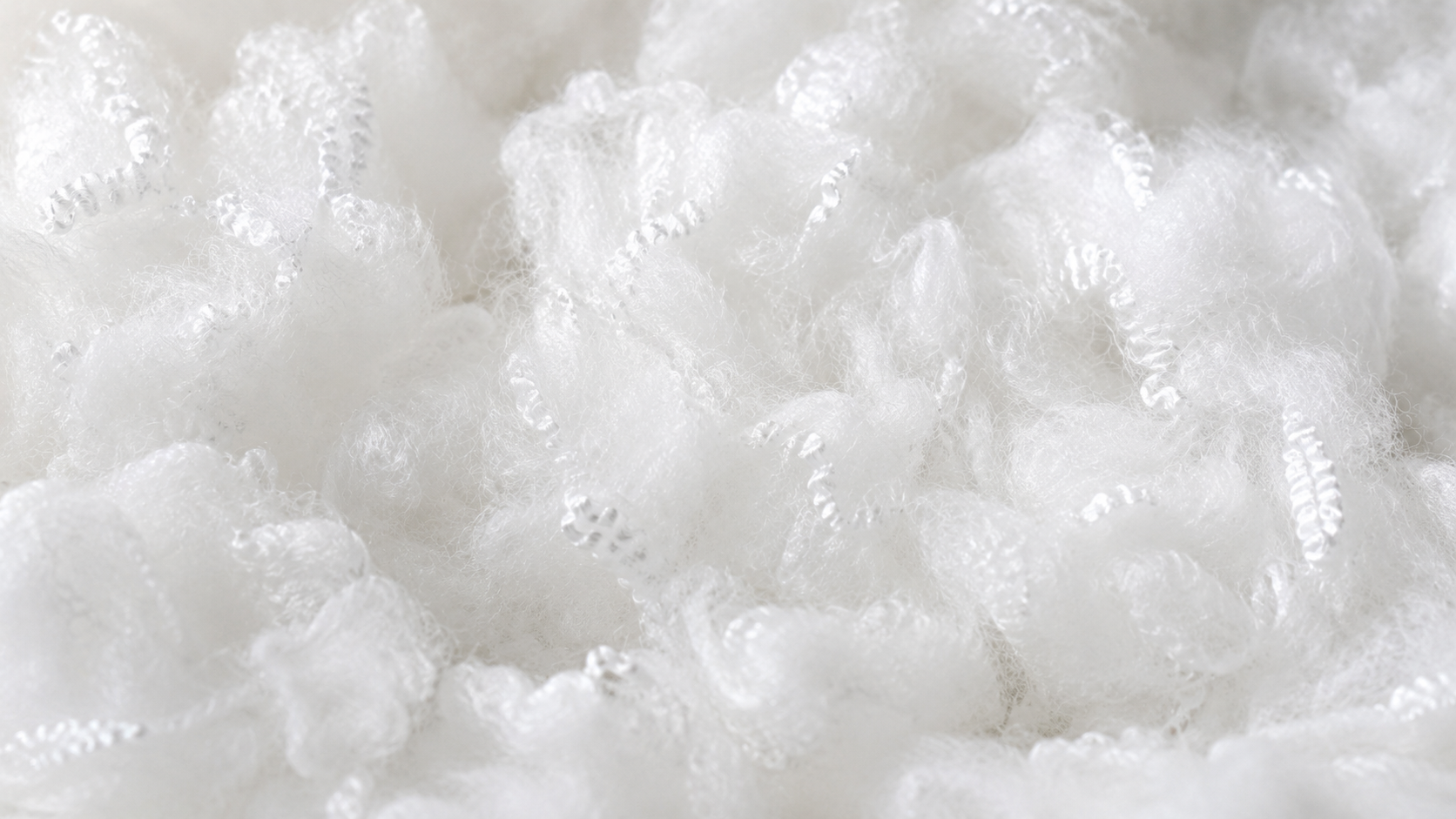
Staple fibre from fiber-grade recycled polypropylene. Fibre and nonwoven applications place the highest demand on melt flow consistency and impurity control.
Where Re-mall sits in the industry
Assessed objectively, Re-mall is a specialised mid-size recycler and compounder positioned between collection infrastructure and brand-owner specification. It is not a petrochemical producer, and its disclosed capacity of 20,000 metric tons per year across the entire recycled pellet portfolio places it in the programme-supply tier rather than the commodity-volume tier.
Three capabilities define its competitive position.
- Regulatory documentation depth. Holding an FDA NOL, GRS, ISO 14021 verification, OBP certification and ISO 14067 carbon footprint certification — plus REACH, RoHS and PAHs testing — covers most of the assurance checklist a European or North American brand owner applies to a recycled material supplier.
- Application breadth with grade discipline. Five application-defined families with published MFI ranges and named grades allow a converter to start from a matched material rather than an unclassified pellet.
- Standards and testing infrastructure. More than 100 patents, a CNAS-accredited laboratory and participation in drafting 9 national standards and 1 industry standard indicate investment in methodology, not only in capacity.
The limits are equally concrete. The company's global market presence — roughly 30% export share across Europe, Japan, Southeast Asia, South Asia and North America — means buyers outside those regions should confirm logistics and documentation support during qualification. And because published evidence does not quantify capacity by product line, volume commitments for a specific food-contact grade should be verified at audit rather than assumed from headline output.
Comparison with traditional solutions: PCR PP versus virgin PP
Virgin polypropylene remains the default reference material, and the comparison should be made on the dimensions that actually decide a specification.
| Dimension | Virgin PP | Re-mall PCR PP (documented position) |
|---|---|---|
| Feedstock origin | Fossil-derived monomer | Post-consumer PP waste, including food packaging and PP cups |
| Grade and flow range | Broad continuous petrochemical range | PCR-PP MFI spans 3–70 g/10min across families; named grades at 10, 30 and 55 g/10min |
| Colour and odour | Uniform by specification | Controlled through colour sorting, homogenisation, multi-stage devolatilisation and formula optimisation |
| Food-contact route | Covered by existing food-contact substance listings | Requires a process- and condition-specific FDA NOL; Re-mall holds PNC 396 for Conditions of Use E through G |
| Carbon profile | Baseline | Mechanically recycled PP is reported at roughly 60% lower carbon footprint |
| Supply dynamics | Priced off petrochemical cycles | Linked to collection volumes and feedstock quality |
| Documentation load | Standard material certificates | Adds GRS, ISO 14021, OBP, ISO 14067 and traceability records |
The case for PCR PP is strongest where three conditions hold: the application tolerates a validated property window rather than a single-point specification; the brand carries a recycled-content or Scope 3 commitment; and the buyer is prepared to invest in sample validation. Where any of these fails, virgin PP remains the lower-risk choice.
Future outlook
Three forces are likely to shape the next phase of PCR PP procurement. The first is volume: with the PCR plastic packaging market projected to move from USD 58.49 billion in 2026 toward USD 108.27 billion by 2034, recycled content will be sourced in programme quantities rather than pilot quantities, favouring suppliers with documented batch control.
The second is regulatory granularity. The FDA record already shows how differently food-contact scopes are drawn between submissions — recycled-content ceilings, permitted use conditions and feedstock-origin requirements all vary. Buyers should expect grade-level regulatory mapping to become a standard part of supplier qualification, and suppliers to compete on the precision of that documentation.
The third is carbon accounting. With ISO 14067 product carbon footprint certification and ISO 14021 verification already in place, the next differentiator is traceable, product-specific carbon data that a brand can carry directly into Scope 3 reporting rather than re-estimating from generic averages.
For Re-mall specifically, the trajectory points toward deepening application-specific grades — food contact, high-transparency, fibre — rather than competing on tonnage. That is a coherent position for a specialist compounder, provided the documentation and testing infrastructure keep pace with the claims.
Frequently asked questions
Is PCR PP the same as rPP?
No. rPP is the general term for recycled polypropylene reprocessed from waste PP through sorting, shredding, washing, melt filtration, modification and pelletizing. PCR PP is the post-consumer subset — polypropylene recovered from waste discarded by end consumers. PCR PP therefore falls within rPP, but rPP also includes material from other waste streams.
Which PCR PP grades and melt flow options does Re-mall supply?
Re-mall supplies PCR-PP across five application families. The multi-purpose line includes PCR-PP310 at MFI 55 g/10min, PCR-PP301 at 30 g/10min and PCR-PP392 at 10 g/10min. Family-level PCR-PP MFI ranges are 3–70 g/10min for food-contact grades, 5–70 g/10min for safety-focused grades, 5–60 g/10min for fiber-grade, 5–50 g/10min for appearance-focused and 1–40 g/10min for general-purpose grades. Selection depends on processing method, mechanical requirements, aesthetics, certification scope and PCR content target.
Can Re-mall PCR PP be used in food-contact applications?
Within a defined scope, yes. The FDA record lists a No Objection Letter, PNC 396, effective 6 June 2025, for physical recycling of PP cups into food-contact articles in contact with all food types under Conditions of Use E through G. Eligibility is tied to that process and those use conditions, so a buyer whose application falls outside that scope, or who requires a different recycled-content level, should confirm coverage before specifying the grade.
How does Re-mall control odour, colour and batch consistency?
Odour is controlled across multiple stages rather than at the end of the line: raw material source control, washing, drying, melt filtration, devolatilization and formula optimization. Colour consistency is managed through raw material colour sorting, colour matching management, homogenisation and production process control. Batch consistency follows a full-process sequence — source control, fine sorting, deep washing, high-efficiency filtration, compounding and pelletizing, batch testing and data traceability.
How does a converter move from virgin PP to PCR PP?
The documented pathway is: raw material analysis, application requirement confirmation, PCR material matching, virgin/PCR ratio design, sample testing, pilot production verification and mass rollout. Because the ratio is designed rather than fixed, converters can increase PCR content progressively as validation data accumulates.
Which certifications and test reports accompany Re-mall PCR PP?
Products and production lines hold an FDA Letter of No Objection, Global Recycled Standard certification, ISO 14021 verification, Ocean Bound Plastic certification and ISO 14067 product carbon footprint certification. Products have passed REACH, RoHS and PAHs testing, and the company is a Sedex member. Testing is supported by a CNAS-accredited recycled plastics laboratory operated by wholly-owned subsidiary Shanghai Re-poly Environmental Technology Co., Ltd.
Tem questões ou precisa de mais detalhes?
Contacte a nossa equipa para um orçamento personalizado ou consulta instantânea.
Solicitar orçamento
Preencha o formulário abaixo e a nossa equipa entrará em contacto com uma proposta personalizada.
Chat direto do WhatsApp
Prefere conversar em tempo real? Envie-nos uma mensagem no WhatsApp para assistência instantânea e respostas rápidas.
- Obter orçamento personalizado
- Partilhar fotos ou documentos
- Discuta as suas necessidades diretamente
Geralmente responde em 5–30 minutos durante o horário de expediente.