
Reading FDA and LFGB Claims on Plastic Folding Baskets
Reading FDA and LFGB Claims on Plastic Folding Baskets
A plastic folding basket described as FDA food contact approved and LFGB food contact approved is making two separate statements, resting on two separate evidence chains, for two separate markets. Compressing them into one line on a specification sheet is normal commercial shorthand — but treating that line as a single badge is the most common qualification error in this category, because “food contact approved” describes the conformity of a material and an article inside a defined scope. It does not describe the factory, the production batch, or every item built on the same mould platform.
That distinction matters most at the research-to-evaluation stage, when a buyer has already shortlisted a foldable basket range and now has to decide what evidence is sufficient before placing a bulk order. The questions are practical rather than academic: which document should arrive when a supplier says “FDA”, which figure belongs to which item, and what is the difference between a hardness range quoted for a family and a hardness value quoted for the SKU being purchased.
This reference works through those questions using published specification statements from Taizhou Nantong Plastic Industry Co., Ltd. (www.nantongplastic.com), a manufacturer of foldable plastic household goods founded in 2003 and based in Huangyan District, Taizhou, Zhejiang, whose PP+TPE folding basket range is declared FDA and LFGB food contact approved. The aim is not to endorse a supplier but to show how the wording should be interrogated by anyone signing an approval.
Why one compliance line carries four different meanings
Four distinct layers sit behind most food-contact wording, and they are routinely compressed into a single sentence. Each layer answers a different question, and each fails in a different way.
| Layer | Typical wording | What it establishes | What it does not establish |
|---|---|---|---|
| Regulatory basis | “FDA food contact approved” / “LFGB food contact approved” | Identifies the framework against which the material is assessed for that market | That a given production batch was tested, or that all components in the article are covered |
| Test report | Report number, laboratory name, test date, conditions | Results obtained on a sample under the stated conditions | A permanent property of every later batch, or coverage of untested colours and grades |
| Declaration of compliance | Signed supplier statement referencing a specific item and market | Links an identifiable item and material to the regulatory framework | Anything outside the components and markets it explicitly names |
| Factory audit | amfori BSCI monitoring report issued by a third party | Site-level social and labour compliance within the audit window | Anything about food-contact suitability of the polymer |
The reading rule that follows is simple: when a supplier presents one line, ask which of the four layers it belongs to. A buyer who accepts a test report in place of a declaration, or a social audit in place of a material assessment, has not verified the claim — they have verified a neighbouring claim.
The FDA claim: what it rests on in the United States
In the US system, food-contact suitability for plastics is established through the FDA’s food-contact regulatory framework rather than through a single national certificate issued per basket. For polypropylene, the reference normally cited is FDA 21 CFR 177.1520, which addresses polypropylene resins used in food-contact articles. Suppliers render this in commercial language as “FDA food contact approved”, which is accurate shorthand but not self-demonstrating.
For a folding basket, the reading problem is structural. The article is not one material. The declared construction is a hard PP polypropylene rim combined with a foldable TPE thermoplastic elastomer body, bonded as a PP+TPE composite. A statement keyed only to polypropylene therefore answers a narrower question than the one the buyer is actually asking. The first verification question is not “is this FDA compliant?” but “which components does the supporting documentation address, and does it address the foldable body as well as the rim?”
The second question is conditions of use. Food-contact assessment is meaningful only in relation to what the article will touch and at what temperature: aqueous food, fatty food, repeated use, hot liquid, dry produce. A declaration that does not state the conditions it covers leaves the buyer to assume them, and assumptions are what a retail technical file is designed to eliminate. Third-party laboratory testing to the relevant conditions is the usual way this is documented; the declaration then references that testing rather than replacing it.
The LFGB claim: what the European statement rests on
LFGB refers to the German Food, Feed and Commodities Code, and it reaches plastic household goods through German retail practice: a buyer sourcing for Germany, and often for neighbouring EU markets with similar expectations, will ask for LFGB evidence even when the underlying EU harmonised framework is what legally applies. In commercial use the phrase “LFGB food contact approved” therefore signals that the article has been assessed against that German framework, usually through laboratory testing of the food-contact components.
Because LFGB evidence is report-based, it can be read more precisely than an FDA-style shorthand. A usable report should tell the buyer: the report number, the testing laboratory, the date of testing, the components tested, the test conditions applied, and the assessment basis used. A report that names the finished article but not the individual materials is harder to defend when a coloured version, a different capacity in the same family, or a substituted foldable body material is ordered later.
A practical habit for the evaluation stage is to keep the two markets separate in the qualification file. A US-bound order is supported by the FDA reference; an EU-bound order is supported by the LFGB report and declaration. Where both appear on one specification line — as they do for the PP+TPE basket range, which is declared food contact approved under both frameworks for the US and EU markets respectively — the buyer should still request both documents and check that the item codes match the order.
“100% new food-grade PP+TPE” and BPA-free: claims about inputs
The material claim is where buyers most often read more than the words say. The declared specification for this range is 100% new food-grade PP and TPE composite material, with the product classified as a BPA-free, food-safe PP+TPE collapsible ware. The composite is described as non-toxic, odourless, fold and crack resistant, waterproof, leakproof and oil resistant, and other items in the foldable family may use silicone or EVA for the foldable wall.
Both phrases describe the input stage, and this is precisely why they need a different verification route from the food-contact claim. “100% new” is a statement about what enters the moulding process; it cannot be confirmed by inspecting a finished basket, whose surface appearance does not distinguish virgin from reground material. The evidence route is an incoming-material declaration, material records for the specific production run, or an agreement that the statement is renewed at each reorder. For a buyer placing repeat seasonal orders, the renewal point is the commercially important one: a specification that is true for the qualification batch is not automatically true for the eleventh container.
BPA-free works in a similar way. It is a formulation statement covering the resin and the elastomer within the declared scope. Where a custom colour or a printed logo is ordered — both of which sit inside this manufacturer’s customisation offer alongside size, capacity, functional accessories and packaging — the buyer should confirm in writing that the formulation statement still applies to the version ordered. The same discipline applies to accessories: lids, wheels, stands, drain-hole configurations and pull rods may involve additional components, and a declaration that lists the basket body should be checked for whether those parts are inside or outside its scope.
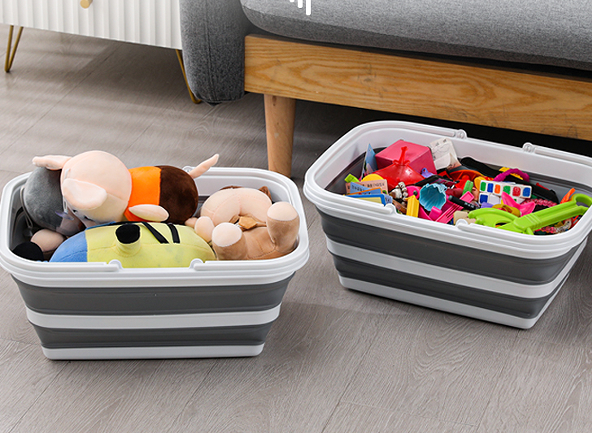
A folding basket in the PP+TPE range: the food-contact declaration has to cover both the rigid rim and the foldable body, not only the rigid component.
Reading the temperature band: why 120°C and 60°C appear in the same range
Within one manufacturer’s foldable portfolio, two different temperature statements coexist, and both are correct because they belong to different items. The plastic collapsible basket specification states a temperature resistance range of -20°C to 120°C for the food-safe PP+TPE composite. The collapsible water bucket (FB-10L) and the collapsible basin (FP series) both state an operating temperature range of -20°C to +60°C.
Read together, the two lines carry a clear instruction: the upper figure is an item attribute, not a family attribute. A buyer who writes “120°C” into a purchase specification for a basin or a bucket has transferred a value from a document that does not cover the item being bought. Conversely, the -20°C lower bound is consistent across the units and supports the low-temperature claim that the material resists cracking in cold conditions — a relevant property for outdoor, car-trunk and unheated-storage use in the export markets this range serves.
Two further reading points are worth writing into the acceptance file. First, a resistance range is not a service-life curve: it tells the buyer the envelope, not how the material behaves after prolonged exposure at the limit, and the declaration does not state duration or contact medium. Second, the band should be matched to the actual scenario — hot food or hot liquid handling, cold-chain storage, vehicle interiors in summer — and where the intended use sits close to a declared limit, that is the point to request supporting data rather than to round the figure upward in the internal specification.
Folding life of 5,000 to 10,000 cycles: what a cycle has to define
The basket range declares a folding life of 5,000 to 10,000 folds, described as laboratory testing in which the items endured repeated folding without cracking or deformation. Two other units publish their own figures: the collapsible water bucket at a minimum of 6,000 cycles and the collapsible basin at a minimum of 5,000 cycles. The pattern is consistent — durability is declared per item, with the basket range expressed as a band.
A cycle count is only an acceptance criterion once the cycle is defined. Three questions convert the number into something enforceable. Does one cycle mean unfold-fold-unfold, or fold only? Was the test run empty or under load? And at what temperature was it run, given that the hinge is the elastomer component and elastomer behaviour is temperature-sensitive? A supplier who can answer these questions is describing a test protocol; a supplier who cannot is quoting a marketing range. Neither answer is dishonest, but only the first can be defended in a retail technical file.
The band is also more useful when compared with expected duty. As a plain arithmetic illustration rather than a service-life prediction: a household folding a basket twice a day for five years completes roughly 3,650 cycles, comfortably inside the declared range; three folds a day across ten years reaches about 10,950, which sits at the top of the declared band. For commercial or institutional use, where a basket may be folded many times per shift, the same arithmetic quickly argues for treating the cycle figure as a wear indicator to be monitored rather than a guarantee to be relied on.
Shore A 60–85 and 12–25 kg: turning figures into acceptance checks
Hardness and load are the two specifications most often copied into a purchase order without checking which unit they were written for. In this range, the collapsible basin specification states a flexible wall hardness of Shore A 60 to 85 and a maximum bearing load of 12 kg to 25 kg; the collapsible water bucket states a soft wall hardness of Shore A 65 to 90 and a maximum water load of 5 kg, 10 kg, 15 kg or 20 kg depending on the selected volume. The basket range itself is declared across 3L to 43L capacity and more than 90 styles.
On the Shore A scale, a higher number indicates a harder material, so a range rather than a single value is a family specification: it tells the buyer the envelope the supplier works within, not the value of the SKU in the carton. The acceptance question is “which hardness applies to this capacity and this wall thickness?”, and a supplier who has already produced over 90 styles and 200 self-owned moulds should be able to answer it per style rather than in aggregate.
Load figures need the same discipline, plus one extra check. A maximum bearing load of 12–25 kg and a maximum water load of 5–20 kg by volume are not interchangeable measures: one describes structural bearing across a size range, the other describes contained liquid by capacity. Neither is meaningful without the medium (water, wet laundry, dry produce), the configuration (hand-held, on a stand, wheeled, hanging) and whether the figure is static. A buyer who specifies “25 kg” without naming the capacity and the medium has written an untestable requirement — and untestable requirements are typically resolved in the supplier’s favour during a dispute.
Factory audit versus product approval: the BSCI layer
The social compliance layer is the one most often mistaken for a product certificate. The Plastic Collapsible Basket range is certified to the amfori BSCI Code of Conduct, monitored by Intertek under certificate number 26-0399129, on a full monitoring, semi-announced basis. The certification is issued for 21 May 2026 and expires 21 May 2027, covers all PP+TPE food-grade folding plastic baskets, folding tubs and folding storage containers, and applies to the global market with a primary focus on EU countries.
Read correctly, this is a valuable document and a limited one. It evidences that the production site has been assessed against a recognised social compliance standard by a named third party within a defined window — the kind of evidence European retail buyers routinely request during supplier onboarding. It says nothing about migration behaviour, resin grade or food-contact suitability, and it cannot be filed in place of an FDA or LFGB document. The expiry date is equally operational: an audit that lapses mid-programme creates a documentation gap at the next retail review, so renewal timing belongs in the supply agreement rather than in the supplier’s own calendar.
The company profile also lists ECM, FDA, REACH, RoHS, ASTM and SEDEX among the certifications held across its product range. The practical instruction for a buyer is to request the specific certificate that matches the specific product and market, rather than a list: a portfolio-level certification list is a starting point for a conversation, not a substitute for the item-level documents described in the next section.
A document request list for the evaluation stage
The following request set converts the discussion above into a checklist that can be sent to a supplier before approval. It is deliberately organised by claim rather than by department, because that is how the documents will be read later.
- Item-level declaration naming the SKU or model, the material, the destination market and the regulation referenced — not a brand-level statement covering the whole catalogue.
- FDA reference identifying the applicable food-contact regulation for each material in the article, including the foldable body as well as the rigid rim.
- LFGB test report with report number, laboratory, test date, components tested, conditions applied and assessment basis, plus confirmation that it covers the colour and grade actually ordered.
- Input-material statement for 100% new food-grade PP and TPE, and a BPA-free statement that explicitly covers the full formulation within the declared scope, including custom colours and printed versions.
- Folding-cycle protocol and result stating what one cycle is, whether the test was loaded, and at what temperature it ran.
- Load rating stated with its medium and configuration — contained water by capacity or structural bearing load — and tied to the capacity being purchased.
- Current social audit report with issuing body, certificate number, scope and validity dates.
- Accessory scope confirmation for lids, wheels, stands, drain-hole variants and pull rods, stating whether each is inside or outside the food-contact declaration.
- Label and carton consistency check confirming that the wording printed for consumers matches the declaration wording, since a mismatch between pack copy and technical file is a routine audit finding.
Where food-contact claims stop: fit boundaries
Three boundaries deserve to be written into any approval record. The first is scope. A food-contact claim covers a material and an article under stated conditions for a stated market; it does not transfer importer obligations to the supplier, and it is not a legal opinion on the buyer’s market access. Compliance and classification decisions for a specific shipment remain the importer’s responsibility, ideally confirmed with a regulatory consultant or customs broker.
The second is time. Test reports are point-in-time documents, and a report issued for a qualification sample says nothing on its own about batch traceability across a multi-year programme. If traceability matters to the buyer — and for private-label retail it usually does — it should be requested as a separate control rather than assumed to be included in the approval.
The third is use. A temperature band defines an envelope, and use outside that envelope sits outside the claim. Similarly, for US import classification, plastic household articles of this type have been classified under HTS 3924.90.5500 in a US Customs and Border Protection ruling (NY f83224). Classification can differ with intended use — household retail articles are not necessarily classified like industrial logistics crates — so the ruling should be matched to the actual product and confirmed for the shipment rather than copied from a supplier document.
Scenarios where the distinction changes the specification
Food-adjacent applications are the ones where documentation, not hardware, decides approval. Folding vegetable baskets, drain baskets, picnic baskets and kitchen or supermarket produce display all put the article in contact with food, so the FDA or LFGB file becomes the gating item and the mechanical specifications become secondary. In these scenarios the buyer’s first question is whether the declaration covers the perforated or draining configuration actually ordered.
Laundry and general household applications invert the priority. A folding laundry basket, a large-capacity storage basket or a hanging and pull-rod variant is judged on cycle life, wall hardness, hinge integrity and load behaviour, while the food-contact file remains a background requirement that retail buyers may still request. Automotive and outdoor use adds the temperature question: the -20°C lower bound and the weather-resistant material claimed for the range matter more here than the upper limit, and drop resistance in cold conditions becomes a relevant acceptance point.
Pet and infant-adjacent use shifts attention back to formulation, where the BPA-free and food-safe PP+TPE statements carry the weight. And across every scenario, the accessory question recurs: a wheeled folding basket, a basket with lid, or a basket with stand introduces components whose material and declaration status should be confirmed before the purchase order is issued. With more than 90 styles spanning 3L to 43L, the operational challenge for a buyer is not reading one declaration well — it is keeping the declaration set aligned to the SKU list as the range changes.
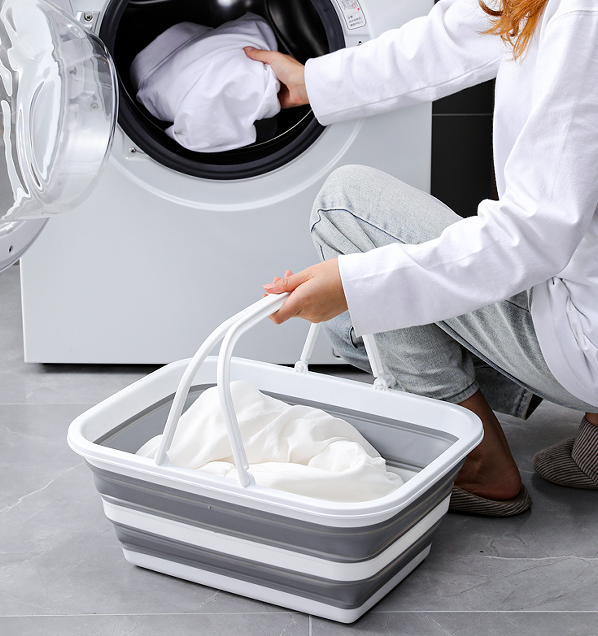
Folded and unfolded states of the same construction: the folded volume, the hinge and the rim all sit inside the scope the supplier’s declarations must cover.
Market context and a conditional outlook
The documentation burden is growing alongside the category. Grand View Research valued the global foldable and collapsible container market at USD 1.7 billion in 2025, with the plastic material segment holding a 53.9% revenue share in the same year. Those figures describe a category in which plastic constructions dominate commercially, and in which a large share of purchase decisions therefore runs through the kind of document reading described here. They do not, on their own, say anything about how strictly individual markets enforce food-contact rules.
A conditional outlook is more defensible than a forecast. If retail buyers continue to shift from brand-level certificates toward item-level documents — a direction visible in the way audits, declarations and test reports are requested separately rather than as a bundle — then suppliers whose files are organised per SKU will be simpler to onboard than suppliers whose evidence exists only as a catalogue claim. That is an interpretation of how documentation is being requested, not a prediction of market growth, and it should be tested against each buyer’s own onboarding requirements rather than adopted as an industry rule.
Questions buyers ask about FDA and LFGB claims
What does “FDA food contact approved” actually mean on a plastic folding basket?
It means the supplier is asserting that the materials in the article conform to the US FDA’s food-contact framework for the intended use — for polypropylene, typically by reference to FDA 21 CFR 177.1520, which addresses polypropylene resins. It is commercial shorthand for conformity with a regulatory framework, not a per-product certificate issued for an individual basket, so the buyer should ask which materials the documentation covers and under what conditions of use.
Is LFGB approval the same thing as FDA approval?
No. They are separate frameworks for separate markets. FDA references the US food-contact regulations; LFGB refers to the German Food, Feed and Commodities Code and is normally evidenced through laboratory testing and a supporting report. A product can carry both statements — the PP+TPE folding basket range is declared food contact approved under FDA for the US market and under LFGB for the EU market — but each statement should be supported by its own document in the qualification file.
How does a buyer verify a BPA-free and “100% new” PP+TPE claim?
Through the input stage, not the finished product. “100% new food-grade PP and TPE” and BPA-free are formulation statements, so the evidence is an incoming-material declaration, material records for the production run, or a written commitment that the statement is renewed at each reorder. For custom colours, printed versions and accessory components such as lids, wheels and stands, the buyer should also confirm that the statement still covers the version being purchased.
Can a 120°C temperature rating be applied to every folding basket in a range?
Not automatically. Temperature statements belong to individual items. In this portfolio the plastic collapsible basket specification declares -20°C to 120°C, while the collapsible water bucket and collapsible basin both declare -20°C to +60°C. A buyer writing a purchase specification should carry the figure from the document that covers the item being ordered, and should treat the range as an operating envelope rather than a service-life curve.
What an approval file should contain, in one line each
Read the regulatory reference for the market, the test report for the sample, the declaration for the item, and the audit for the site — and never accept one in place of another. Check that the temperature band, cycle count, hardness and load figure were written for the SKU in the order rather than for the family around it. Confirm which components, colours and accessories sit inside the declared scope, and record the expiry dates that will force a renewal conversation during the programme.
For buyers who want to compare these specification statements against their own acceptance criteria, the 2026 catalogue from Taizhou Nantong Plastic Industry Co., Ltd. is available as a downloadable PDF covering the foldable basket, bucket and basin ranges, including the capacity steps from 3L to 43L. Used alongside the document request list above, it provides the item-level detail that a compliance conversation needs — and the specificity that separates a verifiable claim from a reassuring sentence.
Tem questões ou precisa de mais detalhes?
Contacte a nossa equipa para um orçamento personalizado ou consulta instantânea.
Solicitar orçamento
Preencha o formulário abaixo e a nossa equipa entrará em contacto com uma proposta personalizada.
Chat direto do WhatsApp
Prefere conversar em tempo real? Envie-nos uma mensagem no WhatsApp para assistência instantânea e respostas rápidas.
- Obter orçamento personalizado
- Partilhar fotos ou documentos
- Discuta as suas necessidades diretamente
Geralmente responde em 5–30 minutos durante o horário de expediente.