
Reading Gold Plated Jewelry Compliance Reports: REACH, SGS, BSCI
Reading Gold Plated Jewelry Compliance Reports: REACH, SGS, BSCI

A compliance folder for gold plated stainless steel jewelry usually contains three different things, and they are routinely read as if they were one: a REACH-related chemical test report, one or more SGS laboratory reports, and a BSCI social audit record. Each answers a separate question. None of them, on its own, authorises a product to be sold in the EU or the US. What they do is remove specific unknowns before a wholesale buyer approves a supplier — provided the buyer reads five fields on every page: who issued the document, which sample it covers, which test method and limit apply, when it was issued and when it expires, and which market it was written for.
Jusnova Jewelry Co., Ltd. is a Guangzhou-based manufacturer of stainless steel and gold plated jewelry, founded in 2009, which states that its products are compliant with US/EU standards on lead and nickel, and that REACH test reports, SGS reports and BSCI certification are available on request. Those are supplier statements. The purpose of this article is to show how a buyer converts statements of that kind into evidence that can be checked, filed and compared across suppliers. The company's site is Jusnova Jewelry.
This is a reading guide for the Research and Evaluation stage of sourcing, where the shortlist is still open. It explains document structure and what each field means for a purchase decision. It does not set legal thresholds, and it does not replace confirmation from an accredited laboratory or your own compliance adviser on the requirements that apply to your product, your market and your packaging claims.
Why the document folder outweighs the price list
Global imports under HS Code 711719 — imitation jewellery of base metal, the heading under which most plated stainless steel jewelry travels — were valued at USD 6.56 billion in 2023, according to trade data published by The Dollar Business. At that scale, a buyer in Europe or North America is rarely short of suppliers. The scarce input is comparable evidence.
Two suppliers can quote for the same 14K gold plated stainless steel bangle and return folders that look identical at a glance. The differences sit in the detail: one report covers the exact plating colour you ordered, the other covers a base metal sample; one document was prepared for the EU market, the other cites a standard with no market stated; one certificate is current, the other carries an expiry date that has already passed. None of these gaps is visible from a logo page or a screenshot pasted into a quotation.
Reading the folder properly is therefore not administrative work. It is the step that decides whether the evidence you hold will still support the product claim eighteen months later, when a marketplace asks for documentation or a retailer audits the range.
Three documents, three different questions
The most common error in supplier evaluation is treating REACH, SGS and BSCI as three grades of the same certificate. They are not related in that way, and the table below is the shortest way to keep them apart.
| Document | Issued by | Question it answers | What it does not establish |
|---|---|---|---|
| REACH test report | Usually an accredited third-party laboratory, commissioned by the supplier | Whether named restricted substances in a named sample fall within the limits the report cites, using a stated test method | That every model, colour, plating and stone in the range has been tested; that the product satisfies every legal requirement of your market |
| SGS report (artificial sweat, salt spray, coating thickness) | SGS, a testing, inspection and certification company | How a submitted sample behaved under one named test method for a stated duration | Real-world durability; compliance with a regulation the test does not address; coverage of untested finishes |
| BSCI certification | Amfori (amfori BSCI) | Whether a production site was assessed against social compliance criteria within an audit cycle | Chemical safety, material composition, lead or nickel release, plating quality |
Read in that order, the folder becomes a map: chemistry first, then performance, then the site. A buyer who starts with the site audit and stops there has learned something about working conditions and nothing about the metal that will sit against a customer's skin.
Reading a REACH test report
REACH is the European Union's framework for the registration, evaluation, authorisation and restriction of chemicals. For an imported article, the practical question is not whether a supplier 'has REACH' — no such single certificate exists — but whether the restricted substances relevant to jewelry have been measured on the material you are buying and found within the applicable limits. A REACH test report is evidence offered toward that question.
Six fields carry most of the decision:
- Sample identity. The report should name the product, model or material tested. Where a supplier tests a base material rather than the finished plated article, the result describes the substrate, not the surface the customer touches.
- Substances and limits. Look for the named substances — typically lead, cadmium and nickel release for jewelry — and the limit applied to each. A result is only meaningful against a stated limit.
- Test method. The method determines what the number means. A nickel-release method and a total-content method can produce very different results from the same piece.
- Laboratory and accreditation. The issuing laboratory should be identifiable, and its accreditation scope should cover the test performed.
- Issue and expiry dates. Reports age. A report issued several years ago may still describe a process the supplier no longer runs.
- Market and legal reference. A report prepared against EU requirements is not automatically the document a US buyer needs.
Jusnova states that it can provide REACH-related test documentation covering low lead, low cadmium and low nickel release. The useful next step for a buyer is not to accept the summary but to request the report PDF, the model list attached to it, and a written note of which finishes it covers — because a range that includes polished gold plating, PVD coating in several colours and stone-set pieces is a range of different surfaces.
SGS is a laboratory, not a badge
SGS is a testing, inspection and certification company. When a supplier says it has 'SGS certification', what usually exists is a report — a document with its own number, describing one sample, one method and one result. The name of the laboratory adds credibility to the measurement; it does not extend the measurement's scope.
The documentation described for this article illustrates the distinction. Two SGS records are identified:
- An Artificial Sweat Test under standard ISO 3160-2, certification number GZMR260602153701, issued 2026-06-30 and valid until 2027-06-30, applicable to the EU market.
- A Salt Spray Test under standard ISO 9227, certification number GZHL260603029801JW, issued 2026-06-29 and valid until 2027-06-29, applicable to the EU market, and linked to the stainless steel jewelry model GEN000516bhia-066.
Both records come from the same laboratory, and they answer unrelated questions. The artificial sweat test addresses how the article behaves in contact with perspiration — the chemistry a wearer actually exposes jewelry to. The salt spray test addresses corrosion resistance under an accelerated environment. ISO 9227 is the widely referenced neutral salt spray method; a duration figure quoted without the method, the electrolyte and the acceptance criterion tells a buyer very little.
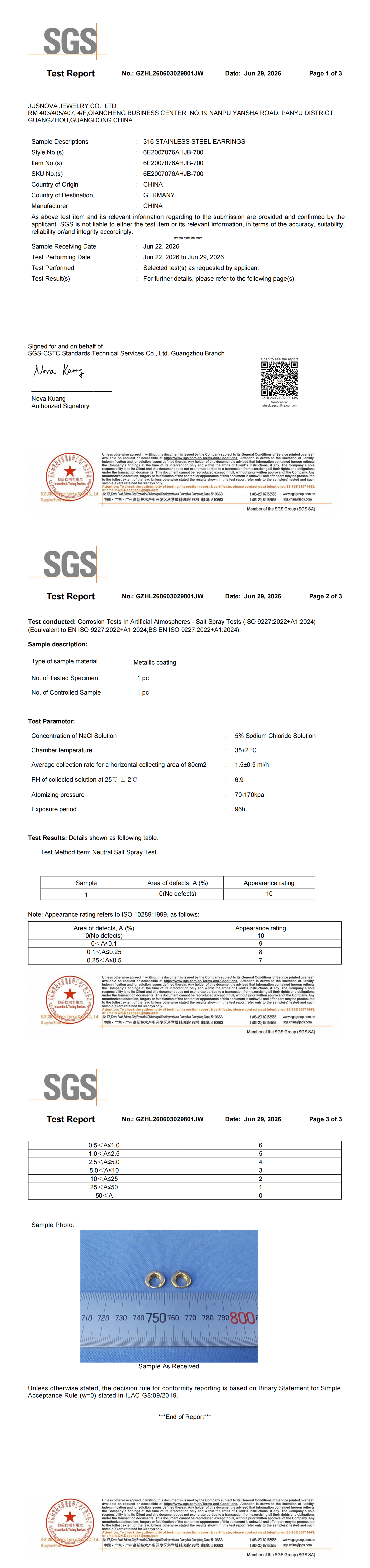
Two practical points follow. First, check which product the report is attached to: the salt spray record is linked to one model, and a buyer ordering a different bangle should ask whether that model is inside the same test scope or needs its own submission. Second, treat the duration as a test condition, not a wear-life promise. An accelerated exposure of a few days and two years of daily wear are not the same measurement, and no laboratory report converts one into the other.
BSCI is a social audit, not a chemical test
BSCI — operated through Amfori — is a social compliance programme. An audit assesses a production site against criteria covering working conditions, management systems and related social responsibility expectations. It tells a buyer something genuinely useful about the factory behind the product. It tells them nothing about lead, nickel, plating adhesion or corrosion.
The record described for Jusnova is BSCI certification number 25-0339245, issued by Amfori on 2025-08-15 and valid until 2026-08-15, applicable to the EU market. The date field is the lesson. A buyer reading that record in late 2026 is looking at a document whose stated validity period has ended; the correct action is to request the current certificate or renewal evidence, not to file the old PDF as proof of present status. This is not a criticism of any specific supplier — audit cycles renew and certificates are reissued — it is simply what the date field is for, and it is the field buyers skip most often.
There is a second reason to keep the audit separate in your evaluation file: social compliance and product compliance are usually requested by different people inside your own organisation, sometimes at different stages. A retail buying team asking for chemical documentation and an ethical sourcing team asking for an audit report are not asking the same question, and a folder that answers only one of them is incomplete for both.
What 'lead free' and 'nickel free' should mean in a purchase order
These two phrases cause more disputes between buyers and suppliers than any other line on a specification sheet, because each is used in more than one sense.
Nickel. European requirements for nickel are generally built around release from articles that remain in direct and prolonged contact with the skin, rather than around total nickel content in the alloy. That distinction matters: 'nickel free' is a statement about material composition, while a nickel-release result measures how much nickel migrates from the finished surface under defined conditions. They are not interchangeable, and a buyer who needs the second should not accept the first as a substitute.
Lead. Restrictions on lead in jewelry exist in both the EU and the US, but they are structured differently, and US rules treat children's products more strictly than adult jewelry. Because 'lead free' has no single universal meaning across markets, a claim of that kind should always be tied to a test result with a stated limit and a stated method, and to the market it was written for.
Three questions turn the phrases into something verifiable:
- Which specific test was performed, on which sample, and what limit was applied?
- Does the result describe the finished article as shipped — including plating colour and any stone setting — or only the base stainless steel?
- Was the report prepared against the requirements of the market where you will sell, and does its validity period still cover your delivery window?
Confirm the applicable thresholds with an accredited laboratory or your compliance adviser before those answers are written into a purchase order. The buyer's job at this stage is not to interpret the law; it is to make sure the document set answers the questions that will eventually be tested against it.
What to request before approving a supplier
A document request that produces usable evidence is short, specific and repeated at each order cycle. The checklist below is the one this reading method implies.
| Request | Why it matters |
|---|---|
| Full report PDFs, not logos, badges or screenshots | Only the full document shows sample identity, method, limits and dates |
| Model, finish and colour list covered by each report | Coverage is the most common gap between a good document and your actual order |
| Test method and limit applied to each substance | Without a limit, a result cannot be judged; without a method, it cannot be compared |
| Issuing laboratory and accreditation details | Establishes who is accountable for the measurement |
| Issue and expiry dates, checked against your delivery window | An expired document is evidence of a past state, not of current production |
| Market and jurisdiction stated on the document | EU-directed reports do not automatically satisfy US requirements, or the reverse |
| Current social audit status for the production site | Separate from chemistry, and separately renewable |
| Written confirmation of which substances the supplier warrants | Converts documents into a contractual position you can enforce |
Two items are often requested and rarely useful on their own: a self-written certificate of compliance, and a summary page listing certificate numbers without attachments. Both can be produced without any laboratory involvement. They are worth keeping only as an index to documents you have already read.
Where Jusnova's stated documentation sits against that checklist
Jusnova Jewelry Co., Ltd. states that its stainless steel and gold plated jewelry is compliant with US/EU standards on lead and nickel, and that REACH test reports, SGS reports and BSCI certification are available on request. It also describes a manufacturing base in Guangzhou founded in 2009, a 1,000 m² factory with 300 employees and 20 engineers, annual output of 3,000,000 units, an export share of 95% with emphasis on Europe and America, and the release of more than 500 new styles per month.
Those facts describe scale and market orientation. They do not, by themselves, close the evidence questions above. What they do is make the document request realistic: a supplier sending most of its output to Europe and North America has reason to hold current EU-directed test reports, and a range with hundreds of monthly styles has reason to maintain model-level coverage lists. The productive conversation is about scope — which models and finishes sit inside the SGS and REACH documents, and what the current BSCI status is — rather than about whether documentation exists at all.
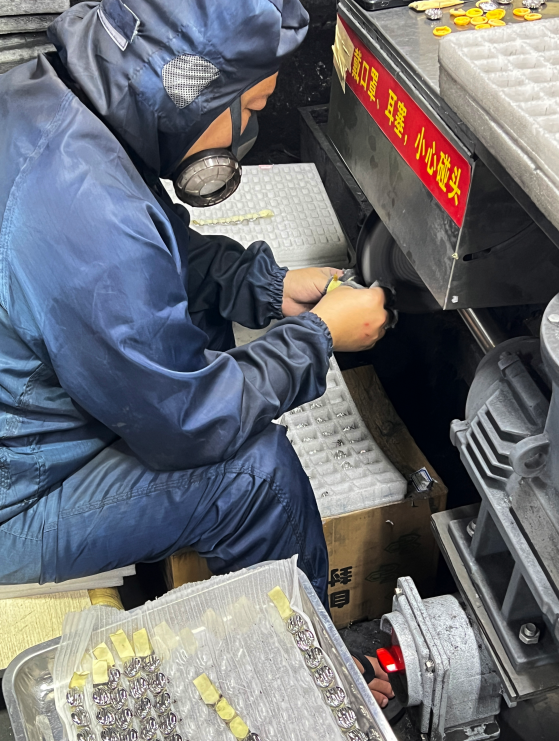
The product specification supplies the context for that scope question. The stainless steel range is offered in 304, 316 and 316L grades with PVD coating, electroplating, brushed, mirror-polished and sandblasted finishes, sizes from 5 mm to 80 mm diameter and thickness from 0.5 mm to 3.0 mm, with tolerance controlled within ±0.05 mm; engraved bangle styles are included in model GEN000516bhia-066. Every one of those options is a different surface, which is precisely why a single report cannot be assumed to cover a full catalogue.
Two conditional buying situations
Consider two illustrative situations rather than reported cases.
A European boutique placing a first order. The buyer needs EU-directed chemistry evidence, a finish-level scope list and a current social audit record before the range reaches a shelf. The sequence that follows from this article is: confirm report numbers and validity dates, confirm that the ordered plating colours fall inside the tested scope, confirm the audit record is current, then place the sample order. If any of the first three is unanswered, the sample order becomes the mechanism for closing the gap rather than the start of production.
A US e-commerce seller building a private-label line. Here the risk is usually claims rather than shelves. Listings that say hypoallergenic, nickel free or waterproof need documentation that supports the wording, and a marketplace may ask for it later. That seller should ask which report supports each claim, whether the report was prepared against US requirements, and how the claim is worded in the supplier's own specification — because the listing copy and the test scope must match.
Both situations end in the same place: a filed set of documents with dates, scopes and a version reference, reviewed again at the next order cycle.
Managing document validity as an ongoing process
Compliance paperwork is not a one-time gate. Reports expire, audits renew and plating lines change, so the practical question is how the document set stays current between orders. Three habits make the difference.
First, record the expiry dates you were given and diarise them. The records described in this article run to 2027-06-29 and 2027-06-30 for the two SGS reports, and to 2026-08-15 for the BSCI record — three different dates from one supplier, which is normal and easy to lose track of.
Second, keep the version you approved. When a supplier reissues a report, the new document may cover a different sample set; comparing the two is the only way to know whether the change affects your SKU.
Third, ask scope questions in writing and keep the answers with the documents. A short email confirming which models and finishes a report covers is often more useful in a dispute than the report itself, because it removes the ambiguity the document leaves open.
None of this requires a compliance department. It requires a folder, a date column and the discipline to ask for the current version rather than the version that was convenient at the time.
FAQ
What is the difference between a REACH report, an SGS report and BSCI certification?
REACH is the EU chemicals framework; a REACH test report records measured levels of named restricted substances in a named sample against stated limits. SGS is a testing, inspection and certification company, and an SGS report records how a sample performed under one specific method, such as artificial sweat per ISO 3160-2 or salt spray per ISO 9227. BSCI is a social compliance audit of a production site, issued through Amfori, and it does not address lead, nickel or material chemistry.
Does one REACH report cover every colour and finish in a gold plated jewelry order?
Not necessarily. A test report describes the sample or sample group submitted, so coverage depends on how the supplier grouped materials, platings and stones. Ask for the model and finish list attached to the report and confirm that the specific gold plating, PVD colour or stone setting you intend to ship falls inside that scope. Where a report covers only a base material, request supplementary testing for the finishes you will actually buy.
What does nickel free mean on a gold plated stainless steel specification?
The phrase is used in two different senses: a statement about the alloy's composition, and a measurement of nickel release from an item worn in prolonged skin contact. European requirements are generally framed around release rather than total content, while suppliers often use the phrase loosely. A buyer should ask which sense is meant, which method and limit were applied, and whether the result refers to the plated surface as shipped.
How long is a compliance report valid?
Each report carries its own issue and expiry dates, and validity belongs to that document rather than to the supplier permanently. In the records reviewed here, the two SGS reports run to 2027-06-29 and 2027-06-30 respectively, while the BSCI record states validity to 2026-08-15. Because materials, plating lines and audit cycles change, buyers should re-request current documents at each order cycle and store the version they approved.
What should a buyer request before approving a gold plated jewelry supplier?
At minimum: full report PDFs rather than logos or screenshots; the model, finish and colour list each report covers; the test method and the limit applied; the issuing laboratory and its accreditation details; issue and expiry dates; the market the document was prepared for; current BSCI or equivalent social audit status for the production site; and written confirmation of which substances the supplier warrants by reference to those documents.
Tem questões ou precisa de mais detalhes?
Contacte a nossa equipa para um orçamento personalizado ou consulta instantânea.
Solicitar orçamento
Preencha o formulário abaixo e a nossa equipa entrará em contacto com uma proposta personalizada.
Chat direto do WhatsApp
Prefere conversar em tempo real? Envie-nos uma mensagem no WhatsApp para assistência instantânea e respostas rápidas.
- Obter orçamento personalizado
- Partilhar fotos ou documentos
- Discuta as suas necessidades diretamente
Geralmente responde em 5–30 minutos durante o horário de expediente.