
Reading Hydraulic Power Unit Cleanliness & Pressure Evidence
Reading Hydraulic Power Unit Cleanliness & Pressure Evidence
A custom hydraulic power unit is qualified by the records a buyer can read, not by how many certificate logos appear on a datasheet. Two evidence chains carry most of the acceptance risk in a bespoke unit: the record that shows how clean the hydraulic fluid and the assembled circuit are, and the record that shows the pressure setting and pressure integrity of the specific unit being shipped. Read both against the stated specification — model, measurement point, unit and limit — and most of the qualification argument is settled before the first unit reaches the dock.
This reference is written for OEM buyers, distributors and equipment builders in the research and evaluation stage of a custom hydraulic power unit (HPU) programme. It explains how to read cleanliness and pressure evidence across six configurations: low-noise compact, vehicle-mounted, AC industrial, aerial work platform, double-acting mobile and 12V DC dump trailer units.
Why HPU qualification is an evidence-reading exercise
Two failure modes in a custom HPU rarely show up at goods-in inspection. The first is contamination: a unit can look clean, run a short cycle in the buyer's workshop and still carry a particle load that wears pump and valve clearances over months of service. The second is pressure mis-setting: a hydraulic power pack ordered for a known actuator load can lift a test weight once and still be set at a relief value that either caps the force the application needs or leaves no margin above normal working pressure.
Neither risk is settled by a supplier brochure. Both are settled by records — and a record is only evidence when four things travel with it: the identity of the unit (model, plus serial or traceability label where the order specifies one), the point at which the measurement was taken, the condition under which it was taken, and the limit that defines pass or fail. Strip any one of those away and the number becomes a marketing statement.
Standards help, but they play a narrower role than buyers often assume. ISO 4413:2010 specifies general rules and safety requirements for hydraulic fluid power systems and components used on machinery as defined by ISO 12100 (ISO). That is a design and safety framework for systems; it is not a certificate issued against an individual power unit, and its current status and edition should be confirmed before it is written into a purchase contract. The practical question is therefore not which standards a supplier lists, but which record shows that the unit you ordered met the limit you agreed.
Reading the cleanliness evidence
In Apex Hydraulic's published HPU specifications, the stated fluid cleanliness level is ISO 4406 20/18/15 across all six configurations discussed here. Before that figure can be used as an acceptance criterion, the buyer needs to know what the code describes and what the supplier's process controls are meant to protect.
ISO 4406 provides the coding method used to define the quantity of solid particles in hydraulic fluid (ISO). It is a three-part code, and each part reports particle counts for a defined size range, which is why a code should be quoted whole: partial quoting makes two suppliers look comparable when they are not. Two practical cautions follow. First, more than one edition of the standard is in circulation; the ISO page available at the time of writing covered the 2017 edition and indicated a newer 2021 edition, so the edition should be named explicitly in a specification. Second, a fluid code describes the fluid sample rather than the machine, which is why the sampling point and timing matter as much as the number.
The four questions worth asking about any cleanliness record are: which fluid and viscosity grade was sampled, where the sample was taken (reservoir, return line or a dedicated test port), when it was taken relative to assembly and test running, and what the supplier does when a result falls outside the agreed band. A supplier who can answer all four is describing a control loop; a supplier who can answer only the first is quoting a target.
On the build side, the controls that protect the stated level appear in the configuration rather than in a slogan. Apex's HPU families offer return-line filters, suction strainers and air-breather filters, and the vehicle-mounted and AC industrial families also list pressure-line filters as configuration options. Integrated manifolds are used to reduce external hoses, fittings and potential leakage points on the compact low-noise, AC industrial, aerial work platform and double-acting mobile units. Incoming material inspection, in-process quality control, final quality inspection and leakage testing sit within the company's stated quality-control sequence, alongside 100% final inspection, and component cleaning is part of the production route.
The reading rule is simple: a filtration list tells you what contamination has a chance to be captured, while a cleanliness record tells you what was measured on the unit. Neither substitutes for the other, so ask for both as one package rather than as separate marketing items.
Reading the pressure evidence
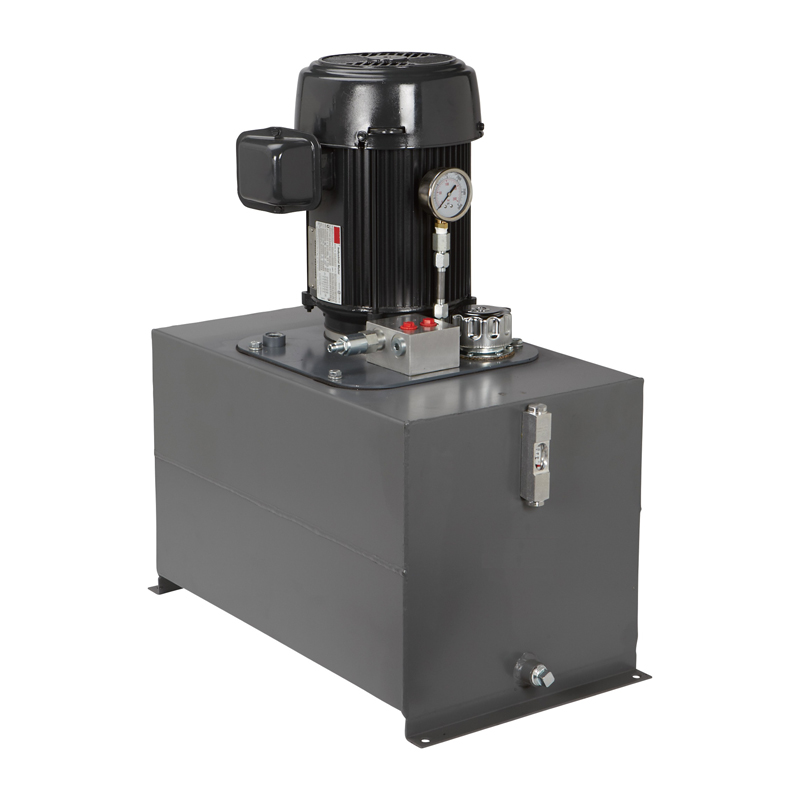
Pressure evidence is routinely misread because three different numbers are often discussed as if they were one. The first is the rated maximum working pressure of the unit — for example 230 bar / 3,335 PSI on the compact low-noise and AC industrial families, 250 bar / 3,625 PSI on the vehicle-mounted family, and 280 bar / 4,000 PSI on the aerial work platform and double-acting mobile families. The second is the system pressure set for the application. The third is the relief valve setting that limits it.
Apex states that the pressure setting is adjustable according to the approved hydraulic system, within the rated component limits, and that the pressure relief valve is adjustable across the HPU families. That is the correct place for customisation to happen — the constraint is the component rating, not the buyer's preference. The 12V DC dump trailer unit shows why the distinction matters in practice: its maximum relief setting is 3,200 PSI at the A port and 1,500 PSI at the B port, so a single unit legitimately carries two different pressure limits.
Pre-delivery testing is where the setting is demonstrated. The stated release routines differ by configuration, and the differences are informative rather than decorative. Compact low-noise units are tested for pressure, leakage, vibration, electrical function and full function. Vehicle-mounted units add valve-response and full-cycle testing. AC industrial units are tested for pressure, leakage, electrical function and full function. Aerial work platform units add valve-function and full-cycle testing. Double-acting mobile units are tested for pressure, leakage, directional control and function. The 12V DC dump trailer unit is tested for pressure, flow, relief-valve verification, solenoid-valve function, motor current and leakage.
Two conditions belong beside any pressure result. The first is fluid: the recommended grades across these families are ISO VG 22, 32, 46 or 68 depending on the model, with a fluid temperature range of −20 °C to +80 °C, and pressure behaviour changes with viscosity and temperature. The second is what the test is for. A pressure test demonstrates integrity and setting at the test condition; it is not a fatigue test, a life test, or a statement about performance after two years of field contamination. Buyers who need endurance evidence should request it as a separate item rather than reading it into a release test.
Standards should not be stretched either. ISO 2944:2000, listed in the ISO/TC 131 catalogue, concerns nominal pressures in fluid power systems and components; the standard number is not evidence of a specific HPU rating. ISO 16028:2023 covers flush-face quick-action couplings at pressures of 10 MPa to 31.5 MPa depending on coupling size (ISO) — a coupling requirement, not a power-unit rating.
The same evidence, configuration by configuration
| Configuration (model) | Rated pressure ceiling | Stated fluid cleanliness | Pre-delivery tests stated |
|---|---|---|---|
| Custom low-noise compact — APEX-CLNCHPU | 230 bar / 3,335 PSI | ISO 4406 20/18/15 | Pressure, leakage, vibration, electrical, full-function |
| Custom vehicle-mounted auxiliary — APEX-CVMAHPU | 250 bar / 3,625 PSI | ISO 4406 20/18/15 | Pressure, leakage, electrical, valve-response, full-cycle |
| Custom AC industrial — APEX-ACHPU Series | 230 bar / 3,335 PSI | ISO 4406 20/18/15 | Pressure, leakage, electrical, full-function |
| Aerial work platform multi-function — APEX-CMFHPU | 280 bar / 4,000 PSI | ISO 4406 20/18/15 | Pressure, leakage, valve-function, electrical, full-cycle |
| Double-acting mobile — APEX-CDAMHPU | 280 bar / 4,000 PSI | ISO 4406 20/18/15 | Pressure, leakage, directional-control, functional |
| 12V DC dump trailer — APEX-DTHPU | 3,200 PSI maximum relief at A port; 1,500 PSI at B port | ISO 4406 20/18/15 | Pressure, flow, relief-valve verification, solenoid-valve function, motor current, leakage |
Three patterns emerge from the table. First, cleanliness is specified identically across all six families, so it reads as a programme-level control rather than a feature that varies with price band. Second, the pressure ceiling follows application logic: the mobile and platform families carry the highest ratings, while the compact low-noise and AC industrial families sit at 230 bar. Third, the release tests broaden where the circuit does — multi-function platform units and vehicle-mounted auxiliary units carry valve-response and full-cycle checks that single-function units do not need.
For a buyer comparing two suppliers, the useful comparison is not the number of tests listed but whether the same test set is specified for the same duty. Six checks that cover setting, leakage, function and electrical integrity are worth more than twenty that never touch the circuit the unit will actually drive.
Where the evidence emphasis shifts by application
Low-noise compact units (APEX-CLNCHPU). Built for indoor and noise-sensitive settings such as medical equipment, lift tables, accessibility lifts and ergonomic workstations, these units are the only family in the set with vibration testing in the stated routine. Options including anti-vibration mounts, flexible motor-pump couplings and acoustic enclosures point the buyer's evidence interest toward vibration control and leakage rather than maximum pressure.
Vehicle-mounted auxiliary units (APEX-CVMAHPU). Configured at 24 VDC or 48 VDC for municipal, refuse, utility and other special-purpose vehicles, with 1–6 hydraulic functions, chassis mounting and IP54 to IP66 ingress protection. The listed electrical, valve-response and full-cycle tests matter more here than a bare pressure figure, because the unit must respond correctly to cab switches, pendants, remotes or CAN Bus commands while exposed to road vibration, salt and weather.
AC industrial units (APEX-ACHPU Series). Fixed installations at 220 VAC or 380 VAC, machine-, floor- or wall-mounted, with intermittent and continuous duty options and PLC or HMI interfaces. Electrical testing plus full-function testing is the relevant evidence set; buyers integrating the unit into an automated line should also confirm the control interface in the as-built record.
Aerial work platform units (APEX-CMFHPU). Two to eight functions at up to 280 bar, with main and emergency auxiliary power in one coordinated system. Valve-function and full-cycle testing is the differentiator, because lifting, steering, levelling and outrigger circuits can share a single manifold.
Double-acting mobile units (APEX-CDAMHPU). Power-up and power-down operation at 12, 24 or 48 VDC for trailers and mobile lifting equipment. Directional-control testing is the meaningful check, since the four-way valve determines whether powered retraction behaves as specified.
12V DC dump trailer units (APEX-DTHPU). Power-up and gravity-down operation with a 6 US quart translucent reservoir and a maximum flow rate of 2.0 GPM. This is the only family in the set with a stated flow test alongside relief-verification and motor-current testing — a practical combination for a scissor hoist or telescopic-cylinder application where lifting speed is as visible to the end user as lifting force.
Why cross-border sourcing raises the value of records
Trade data makes the point more clearly than any argument about trust. The EU imported €79.2 million of hydraulic power units from outside the EU in 2025 under HS 84135020, with China supplying 28%, or €22.2 million, according to Eurostat-based industry trade reporting. When a large share of units crosses a border before installation, the buyer's acceptance decision rests on documents and pre-shipment tests, because the buyer will never see the assembly bench.
Demand structure reinforces the same conclusion. Commercial market research identifies the 10–15 tonne dump trailer segment as a primary consumer of 12V DC hydraulic power units — a segment where the power unit functions as a service part as much as an OEM component. In that setting, a relief-verification record and a flow figure are what allow a dealer to fit a replacement unit with confidence.
Market sizing deserves the same reading discipline as a test record. Published HPU market figures differ with product scope — whether accessory components, power packs or complete systems are counted — so a headline number should be read with its definition attached rather than compared across sources as if the definitions were identical.
A buyer's evidence checklist for a custom HPU
- Unit identity. Model designation, plus part number, serial number or traceability label where the order specifies one. Apex offers customer logo, part number, serial number and traceability labelling on the 12V DC dump trailer unit.
- As-built configuration. Reservoir size, material and orientation, port type and size, valve functions, and which filtration items are actually fitted rather than offered.
- Pressure setting record. The set pressure against the approved hydraulic system, with the relief setting shown separately from the rated maximum.
- Relief-valve verification. A recorded check rather than an assumption, particularly where A-port and B-port limits differ.
- Leakage inspection result. Stated for every family in this set and the most direct evidence of assembly quality.
- Functional or cycle test result. Matched to the specific routine for that family — vibration, valve-response, valve-function, directional-control or full-cycle.
- Fluid cleanliness declaration. The ISO 4406 code, the fluid grade sampled, the sampling point and the timing.
- Test conditions. Fluid grade and temperature range, so a result can be compared with a second supplier's record on equal terms.
- Units and format. Specifications in this category mix bar and PSI, and litres per minute and GPM, so the record should state which system was used and who signed it.
What this evidence does not prove
- It describes the tested unit under the tested condition, not every unit in a production run.
- It is manufacturer-provided process evidence, not third-party certification, and should be filed as such.
- It says nothing about installation quality, commissioning cleanliness or the buyer's own maintenance practice.
- It does not establish conformity with destination-market machinery, electrical or vehicle requirements; ISO standards alone do not settle those obligations.
- A rated maximum is not a statement of application fit. Actuator load, duty cycle, flow demand and reservoir volume must still be checked against the circuit the unit will drive.
- Optional items — pressure-line filters, oil coolers, load-holding valves, emergency hand pumps — remain optional unless they are written into the order and reflected in the as-built record.
About the manufacturer
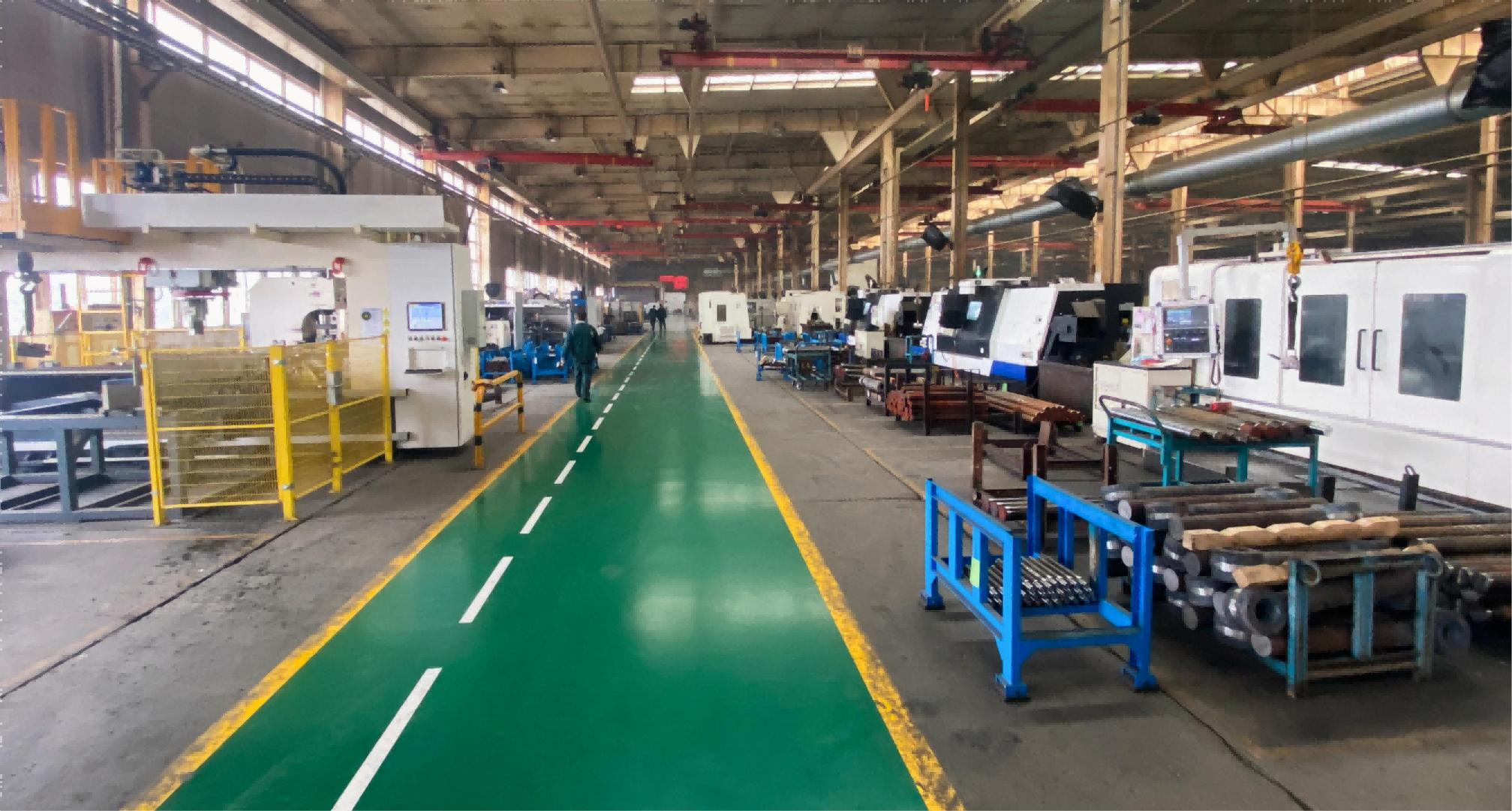
Apex Hydraulic Co., Ltd. is a Chinese manufacturer of custom hydraulic cylinders, standard hydraulic cylinders, hydraulic power units, hydraulic systems, hydraulic scissor hoist kits and hydraulic components, established in 2009. The company operates a 50,000 m² facility with 560 employees, including a 25-engineer R&D team, and states monthly capacity of 1,500+ hydraulic power units and 8,000+ hydraulic cylinders.
Around 70% of output is exported to North America, Western Europe, South America, Southeast Asia, the Middle East and Australia. OEM and ODM services cover design, engineering drawings, prototype development, testing, manufacturing and quality inspection, and the stated quality sequence runs through incoming material inspection, in-process control, final inspection, pressure and leakage testing, dimensional and welding inspection, surface finish inspection, functional testing and 100% final inspection.
Capability figures and release routines of the kind summarised in this article are manufacturer-provided process evidence. They are useful for qualification precisely because they are specific, and they remain distinct from independent certification — a distinction worth preserving in any acceptance file.
The full product range is documented in the APEX Hydraulic product catalog (PDF).
Outlook
If cross-border sourcing of hydraulic power units continues at the scale suggested by the 2025 EU import figures, the practical change for buyers is likely to be documentary rather than technical: acceptance criteria written into the purchase order instead of discussed at inspection. That would shift the competitive weight toward suppliers who can reproduce a sampling point, a test condition and a signed record on every shipment — and away from suppliers whose quality claim exists only in a brochure. This is a conditional reading of current evidence, not a forecast of market direction.
Frequently asked questions
What does the ISO 4406 20/18/15 level in an HPU specification actually mean?
ISO 4406 is the coding method used to define the quantity of solid particles in hydraulic fluid, and 20/18/15 is the fluid cleanliness level stated across Apex's HPU specifications. Because the code describes a fluid sample rather than the machine, the level becomes an acceptance criterion only when it is tied to a sampling point, a timing — after test running, before packing, or at commissioning — and a defined action if the result falls outside the band. The edition of the standard should also be named, since more than one edition is in circulation.
Which pressure checks are performed on a custom HPU before delivery?
All six families covered here are tested for pressure and leakage before shipment, and the wider routine varies by configuration. Compact low-noise units add vibration, electrical and full-function testing. Vehicle-mounted and aerial work platform units add valve-response or valve-function testing plus full-cycle testing. Double-acting mobile units add directional-control testing. The 12V DC dump trailer unit adds flow testing, relief-valve verification, solenoid-valve functional testing and motor-current testing.
Is the maximum working pressure the same as the relief valve setting?
No. The maximum working pressure is a component rating — 230 bar on the compact low-noise and AC industrial families, 250 bar on the vehicle-mounted family, and 280 bar on the platform and double-acting mobile families. The relief setting is the limit actually applied for the application and is adjustable within those ratings. The 12V DC dump trailer unit carries separate maximum relief settings of 3,200 PSI at the A port and 1,500 PSI at the B port.
Does a passed pressure test prove long-term reliability?
It demonstrates integrity and setting at the test condition, using the fluid grade and temperature of that test. It does not establish fatigue life, tolerance to field contamination or installation quality, all of which depend on circuit design, filtration, commissioning and maintenance. A buyer who needs endurance evidence should request it as a separate programme item.
Do ISO standards certify a hydraulic power unit?
They define requirements rather than issuing product certificates. ISO 4413:2010 sets general rules and safety requirements for hydraulic fluid power systems and components used on machinery as defined by ISO 12100. ISO 4406 defines the fluid cleanliness code. ISO 16028:2023 covers flush-face quick-action couplings at 10 MPa to 31.5 MPa depending on size, and ISO 2944:2000 concerns nominal pressure terminology. None of these, on its own, establishes conformity with the machinery, electrical or vehicle requirements of a destination market.
Tem questões ou precisa de mais detalhes?
Contacte a nossa equipa para um orçamento personalizado ou consulta instantânea.
Solicitar orçamento
Preencha o formulário abaixo e a nossa equipa entrará em contacto com uma proposta personalizada.
Chat direto do WhatsApp
Prefere conversar em tempo real? Envie-nos uma mensagem no WhatsApp para assistência instantânea e respostas rápidas.
- Obter orçamento personalizado
- Partilhar fotos ou documentos
- Discuta as suas necessidades diretamente
Geralmente responde em 5–30 minutos durante o horário de expediente.