
Reading IAPMO Claims on NSF/ANSI/CAN 61 & 372 Brass Valves
Reading IAPMO Claims on NSF/ANSI/CAN 61 & 372 Brass Valves
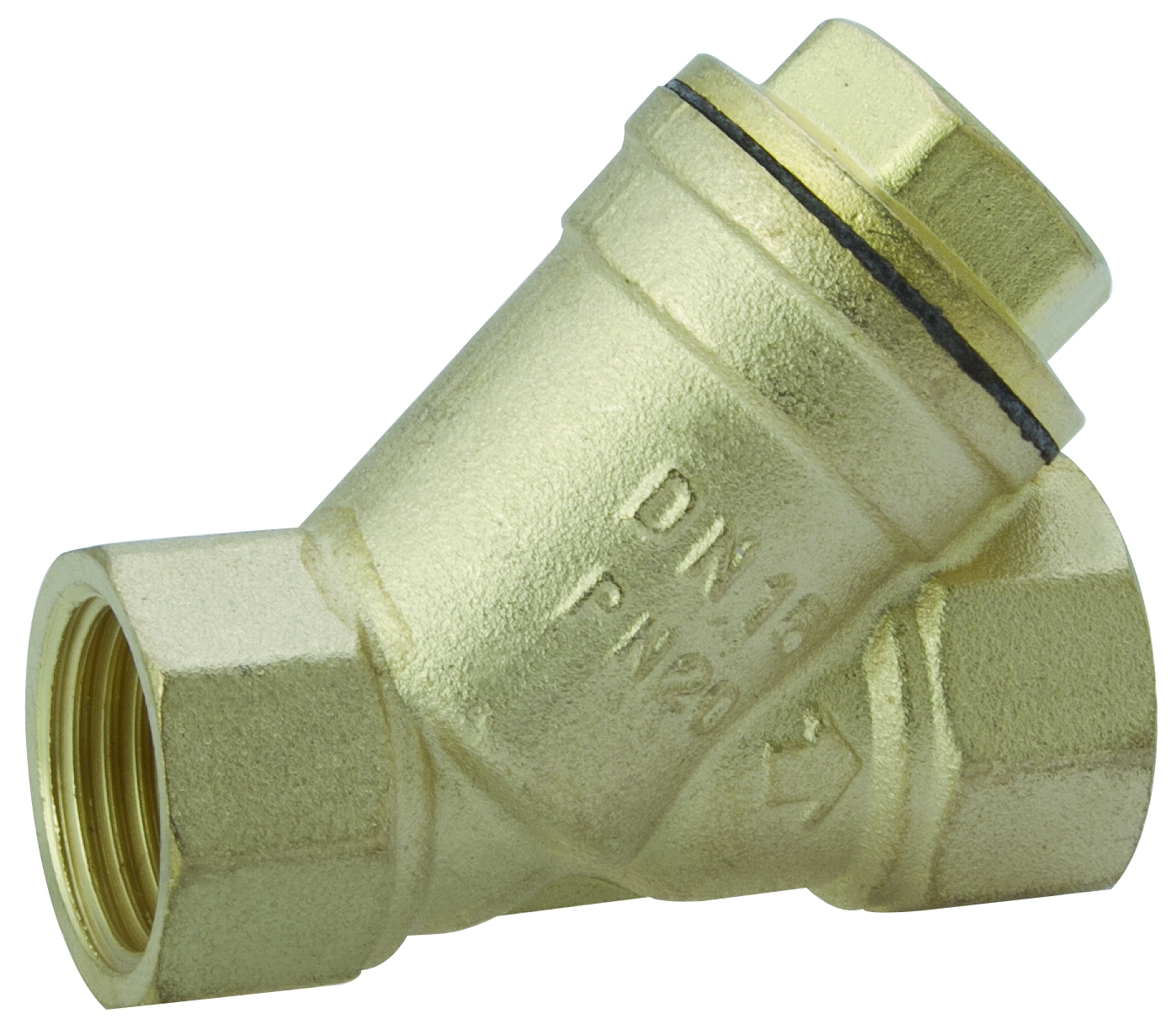
A brass valve can match the unit beside it on the shelf in size, shape and pressure rating and still carry a different compliance status, because the qualification attaches to the alloy that touches the water and to the model that was listed — not to the outline of the part. For valves installed in North American drinking water systems, two standards carry most of the weight: NSF/ANSI/CAN 61, which covers the health effects of drinking water system components, and NSF/ANSI/CAN 372, which covers the lead content of wetted surfaces. Both are normally demonstrated through a listing issued by IAPMO.
Zhejiang Longda Technology Co., Ltd., the manufacturer behind the LONGDA BRASS VALVE range, holds IAPMO listings that name its gate valve, check valve and Y strainer families among the covered products. The wording of those listings is the practical lesson for distributors: a certificate is narrower than a catalogue, and reading it accurately is a procurement skill rather than a formality.
Two standards that answer two different questions
The listing that addresses health effects for LONGDA BRASS VALVE components is issued under NSF/ANSI/CAN 61-2023, with the scope described on the document as drinking water system components. IAPMO certificate N-5775 carries an issue date of 1 October 2024, an expiry date of 1 October 2029, and a market scope of the United States and Canada.
The lead requirement sits on a separate document. NSF/ANSI/CAN 372-2024 limits lead in wetted surfaces intended for potable water contact to a weighted average of 0.25%, and the corresponding IAPMO certificate for the same product range — number 6304 — is scoped to lead-free plumbing products. It was issued on 1 August 2024 and expires on 1 August 2028, and it cites Section 1417(d) of the federal Safe Drinking Water Act together with California Health & Safety Code Section 116875, the statute widely known as AB1953.
The two are not substitutes. A 61 listing is evidence about the health effects of materials in contact with drinking water; a 372 listing is evidence about lead content. A specification that names only “NSF 61” therefore leaves the lead question open on paper, and a file that contains only a lead-free certificate leaves the health-effects question open. Where potable water contact is intended, both documents should be requested, and both should name the same model.
Neither document is a performance qualification. Questions about pressure retention, threaded-joint integrity or cycle life are answered by plumbing product listings and by the manufacturer's own pressure testing, not by a lead-free certificate — a distinction that matters when a specification mixes certification clauses with technical ones.
What an IAPMO listing document names — and what it leaves out
A listing page is short, and almost all of its value sits in five fields. The first is the holder: the legal entity and facility covered. The second is the certificate number, which is what a buyer quotes when verifying. The third is the standard together with its edition year, because editions are revised. The fourth is the scope wording, which defines the product types covered. The fifth is the issue and expiry dates, which define how long the evidence stays current.
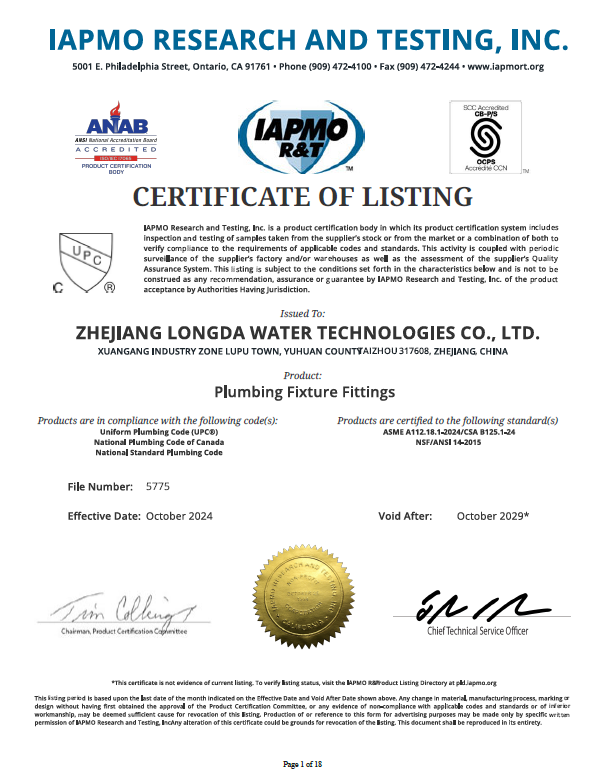
In the LONGDA BRASS VALVE file those fields do not run in parallel. The health-effects certificate is N-5775 under NSF/ANSI/CAN 61-2023 and expires on 1 October 2029; the lead-free certificate is 6304 under NSF/ANSI/CAN 372-2024 and expires on 1 August 2028. A distributor who files “the certificate” has, in practice, filed half of the evidence and one of two renewal dates.
Scope wording deserves its own reading. The health-effects listing describes a category — drinking water system components — rather than every item a factory is capable of producing, and the lead-free listing names lead-free plumbing products. Where a file also contains a cUPC listing such as number 5775 for plumbing fixture fittings, that document answers a different question again: it demonstrates listing to plumbing product standards within the named fitting scope, not lead content. Three documents, three purposes, one filing cabinet.
The material option is part of the claim
All three example lines in the LONGDA BRASS VALVE range state their certification against a specific material version. The gate valve, the check valve and the Y strainer are each offered with a standard brass body and with a lead-free option, and each certification statement attaches to the lead-free option rather than to the family as a whole.
- Brass gate valve T-22017A — body and bonnet in hot-forged brass, with CW617N or Hpb59 as the standard material and a lead-free CW724R or C46500 option. The certification statement reads: the lead-free brass version is NSF/ANSI 61 and NSF/ANSI 372 certified by IAPMO.
- Brass check valve LD 30303 — body in hot-forged normal brass with a lead-free option; the lead-free brass version is stated as NSF 61 and NSF 372 certified, and is described as a dezincification-resistant performance alloy.
- Brass Y strainer LD.73154 — hot-forged brass body with a lead-free CW724R option; the lead-free brass version is certified to NSF/ANSI/CAN 61 and NSF/ANSI 372 by IAPMO.
| Model | Family | Material state named with the certification | Technical context |
|---|---|---|---|
| T-22017A | Rising-stem gate valve, brass-to-brass metal seat | Lead-free brass version (CW724R / C46500 option) | 1/2″–4″; 200 WOG (1.4 MPa); −20°C to 120°C |
| LD 30303 | Swing or spring-loaded check valve | Lead-free brass version | 1/2″–2″; 200 WOG; −20°C to 150°C |
| LD.73154 | Y strainer with drain plug and SS304 screen | Lead-free brass version (CW724R option) | 1/2″–2″; 200 WOG; −20°C to 150°C |
The consequence is straightforward and frequently missed. Two purchase orders can both describe “2-inch brass gate valve, 200 WOG, threaded” and receive two physically similar valves with different compliance status, because one was built in standard brass and the other in the lead-free option. The alloy is not visible on the outside of the valve and is not recoverable from the shape of the casting. It exists in the material declaration and in the listing, which is why both belong in the purchasing file.
Gate valve, check valve, Y strainer: how the claims behave in practice
On the gate valve T-22017A, the technical envelope and the compliance envelope are separate but complementary. The valve is offered from 1/2″ to 4″ (DN15 to DN100) at 200 WOG (1.4 MPa), operating between −20°C and 120°C, with female NPT or BSP threads, a rising stem, a 360° handwheel and a brass-to-brass metal seat. Shell testing is set at 1.5 times the rated pressure and seat testing at 1.1 times. The listed applications include municipal water supply, residential and commercial plumbing, HVAC and agricultural irrigation — but only the lead-free version carries the IAPMO health-effects and lead-free statements, and only that version should be offered against a potable water specification.
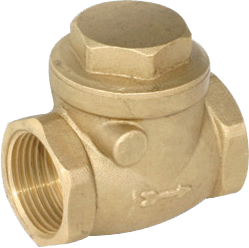
The check valve LD 30303 shows the same pattern in a different duty. It runs from 1/2″ to 2″ at 200 WOG and −20°C to 150°C, in swing or spring-loaded form, horizontally or vertically installed, with NPT, BSP, press, PEX, MPT, SWT or cold-expansion connections. Typical service is pumping systems, water supply, heating and boiler circuits and irrigation. Because a check valve sits directly in the flow path, the material question is not cosmetic: the lead-free version is the one named in the certification statement, and the standard brass body is a different article for compliance purposes.
The Y strainer LD.73154 adds a third variation. It covers 1/2″ to 2″ (DN15 to DN50) at 200 WOG and −20°C to 150°C, with a stainless steel SS304 screen in 20, 40, 60 or 80 mesh, a blow-down drain plug for in-line flushing, and a replaceable screen that can be swapped without dismantling the pipeline. Its stated application list is wide — water supply pipelines, HVAC and chilled water, gas piping and irrigation — and that width is precisely where misreading begins. A potable water listing does not qualify a valve for fuel gas service, which is governed by separate standards; for context, the verified industry record for this category references CSA 3.16-21 for lever-operated non-lubricated gas shut-off valves in North America. One product family can therefore hold several market roles, only one of which is described by the NSF/ANSI documents.
The compliance file contains more than two documents
Distributors usually receive a bundle rather than a certificate, and the fastest way to misread it is to treat every page as interchangeable evidence. The table below sets out what each document type in the reviewed file actually supports.
| Document type | Example reference | Standard cited | What it supports | What it does not establish |
|---|---|---|---|---|
| Health-effects listing | N-5775 | NSF/ANSI/CAN 61-2023 | Health effects of listed drinking water system components | Lead content, or product performance |
| Lead-free listing | 6304 | NSF/ANSI/CAN 372-2024; SDWA 1417(d); California H&S 116875 | Lead content of wetted surfaces for listed products | Health effects, or end-product performance |
| cUPC plumbing listing | 5938 (ball valves); 5775 (supply stops); 8222, 17432, 17433, 10232 (fittings) | IAPMO/ANSI Z1157-2014e1(R2019), ASME A112.4.14-2022, CSA B125.14-22 and related fitting standards | Plumbing code listing for the named product scope | Lead content; not interchangeable with NSF/ANSI 372 |
| Quality management certificate | CN00124Q37399R2M/3300 | ISO 9001:2015, issued by CQC | Management system covering design, development and manufacture | Product certification for potable water contact |
Read this way, the ball valve 8081 illustrates why the separation matters: its lead-free version is certified to cUPC, NSF/ANSI 61 and NSF/ANSI 372, while its cUPC listing 5938 cites IAPMO/ANSI Z1157-2014e1(R2019), ASME A112.4.14-2022 and CSA B125.14-22 for the United States and Canada. The supply stop valve 98023-LF is similarly covered by cUPC listing 5775 under ASME A112.18.1-2024/CSA B125.1-24 and by the NSF/ANSI documents. Four document types, four different questions answered.
Where the catalogue is wider than the listing
This is the point at which procurement discipline earns its keep. In the material reviewed for this article, the NSF/ANSI/CAN 61 listing and the lead-free 372 listing name six models from the LONGDA BRASS VALVE range: gate valve T-22017A, Y strainer LD.73154, check valve LD 30303, ball valve 8081, supply stop valve 98023-LF and pipe fittings 15111. The company's wider range also includes the brass angle valve ART.98011 and the brass ball valve ART.60621, which in the same reviewed material appear in connection with ISO 9001:2015 and ISO 14001:2015 scope records rather than in the two NSF/ANSI listing entries.
That observation is a filing distinction, not a finding. It does not establish that those two families lack certification, and it does not establish that they hold it; it establishes only that the reviewed file does not show a listing for them. For a distributor the correct response is a written question to the supplier, not an assumption in either direction — and never a decision to print a compliance mark on a product because a different model in the same catalogue carries one.
Six acceptance points for distributors
- Quote the model code, not the family name. A purchase order that names only “brass gate valve” or “Y strainer” leaves the compliance status to the supplier's interpretation. The code — T-22017A, LD 30303, LD.73154 — plus the material state is the smallest unit that can be verified.
- Write the lead-free option into the order and the packing list. If the incoming inspection cannot confirm from the documents that the lead-free version was shipped, the listing does not apply to the goods received, however well the supplier is regarded.
- Verify the certificate number, edition and expiry against the issuing body's record. N-5775 runs to 1 October 2029 and 6304 to 1 August 2028; both dates belong in a review calendar, not only in a folder.
- Check that the scope wording covers the product type being bought. A document scoped to plumbing fixture fittings, or to a lead-free product category, is not evidence for a different product category.
- Separate the documents by what they prove. Keep health-effects, lead-free, cUPC and ISO evidence apart, so that a health-effects certificate is never used to answer a lead question or the reverse.
- Require written confirmation for anything the certificate does not itemise. Where a listing describes a product category rather than a size or connection configuration, ask the supplier to confirm in writing that the ordered configuration falls within the listed scope.
What this changes for specifiers and private-label programs
For a specifier, the practical outcome is a specification clause rather than a preference. Instead of “valves shall be NSF certified”, the defensible wording names both standards, both by edition, and requires the lead-free material option for wetted parts: components in contact with potable water shall be the lead-free brass version listed under NSF/ANSI/CAN 61 and NSF/ANSI/CAN 372, with the listing reference and material declaration submitted at submittal. That wording survives a change of supplier and a change of alloy.
For private-label and OEM programs, one further question deserves written treatment: whose name appears on the listing, and whether the branded configuration is the same listed product. Zhejiang Longda Technology Co., Ltd. states that it provides OEM and ODM services with customisation of size, body material, handle type, thread standard, logo and packaging, and states monthly capacity for its valve lines of 300,000 pieces with lead times of 20 to 50 days depending on the product. Those are commercial facts about production flexibility, not compliance facts; the compliance answer still comes from the listing, and the base listing should not be assumed to transfer automatically to a differently configured private-label item.
Outlook: compliance as a document lifecycle
The two IAPMO documents in this file expire on different dates in 2028 and 2029, and both cite editions — NSF/ANSI/CAN 61-2023 and NSF/ANSI/CAN 372-2024 — that will themselves be superseded as standards are revised. That is a scheduled maintenance task rather than a purchasing event: certificates are renewed, editions move, and the evidence a distributor holds today has a defined shelf life. Buyers who treat the compliance file as a living record, reviewed on a calendar and rechecked whenever an alloy, supplier or process changes, will rarely be surprised at the point of acceptance; buyers who treat it as a one-time attachment to a supplier record eventually will be.
Zhejiang Longda Technology Co., Ltd. (LONGDA BRASS VALVE) operates from a 30,000 m² facility in Yuhuan County, Zhejiang Province, established in 1993, with approximately 200 employees, a stated annual output of 7,500 tons and exports accounting for 95% of sales across the EU, USA, Canada and South America. The company states that its products are IAPMO and ALS certified and that every product passes a 100% factory test. The full product catalogue is available for download as a PDF brochure.
FAQ: reading lead-free brass valve claims
Do NSF/ANSI/CAN 61 and NSF/ANSI/CAN 372 certify the same thing?
No. NSF/ANSI/CAN 61 addresses the health effects of drinking water system components, while NSF/ANSI/CAN 372 addresses the lead content of wetted surfaces, with a limit of a weighted average of 0.25% lead for potable water contact. In the LONGDA BRASS VALVE file they appear as two separate IAPMO listings — N-5775 under NSF/ANSI/CAN 61-2023 and 6304 under NSF/ANSI/CAN 372-2024 — with different issue dates and different expiry dates. A specification that needs both questions answered should name both standards.
If one brass gate valve model is listed, are other valve types and sizes covered?
A listing covers the products named within its scope, so a qualification attached to one model does not extend automatically to other valve types in the same catalogue or to differently configured items. In the reviewed file, the NSF/ANSI/CAN 61 listing and the lead-free listing name specific models — including gate valve T-22017A, check valve LD 30303 and Y strainer LD.73154 — and other families such as the angle valve ART.98011 and ball valve ART.60621 appear in the reviewed material only in connection with ISO management system records. Buyers should confirm coverage for each model and configuration in writing before relying on it.
What does the 0.25% wetted-surface lead limit actually measure?
It applies to the surfaces of a valve that contact potable water, not to the mass of the whole component, and it is the threshold referenced by NSF/ANSI/CAN 372, by Section 1417(d) of the federal Safe Drinking Water Act and by California Health & Safety Code Section 116875, commonly known as AB1953. Because the limit is defined by contact surfaces, the alloy used for the body and wetted internal parts is the decisive variable, which is why the material state — lead-free brass option or standard brass — belongs in the purchase order alongside the model code.
Does the standard, non-lead-free brass version of a listed valve carry the same qualification?
Not according to the certification statements in this range. The gate valve, check valve and Y strainer each state their certification against the lead-free brass version specifically — the gate valve in a CW724R or C46500 option, the Y strainer in a CW724R option — while the standard bodies are described in materials such as CW617N or Hpb59. The two versions can share dimensions, pressure ratings and connection types and still differ in compliance status, so the version ordered must be stated explicitly.
How should a distributor verify a listing before accepting a shipment?
Match the certificate number, the standard edition and the expiry date against the issuing body's record; confirm that the scope wording covers the product type being purchased; confirm that the shipped goods are the lead-free version named in the certification statement; and keep the health-effects, lead-free, cUPC and ISO documents separately filed so each is used only for the question it answers. Where the listing describes a product category rather than a specific size or connection, written supplier confirmation that the ordered configuration falls within the listed scope closes the gap.
Tem questões ou precisa de mais detalhes?
Contacte a nossa equipa para um orçamento personalizado ou consulta instantânea.
Solicitar orçamento
Preencha o formulário abaixo e a nossa equipa entrará em contacto com uma proposta personalizada.
Chat direto do WhatsApp
Prefere conversar em tempo real? Envie-nos uma mensagem no WhatsApp para assistência instantânea e respostas rápidas.
- Obter orçamento personalizado
- Partilhar fotos ou documentos
- Discuta as suas necessidades diretamente
Geralmente responde em 5–30 minutos durante o horário de expediente.