
Reading Pillow Block Bearing Codes for Project Compliance
A mounted bearing code does two jobs and only two jobs: it identifies a product, and it describes how that product fits. It does not certify anything. For buyers working through research and evaluation, understanding that boundary is the difference between a defensible specification and an assumption that surfaces later — at installation, at an audit, or during the first washdown cycle.
Pillow block bearings and the wider family of mounted ball bearing units are specified in almost every industrial category that moves or conveys something: agriculture, food and beverage, chemical processing, wastewater treatment, mining and aggregate, HVAC air handling, packaging automation, car wash systems and snow removal equipment. In each of those settings the project requirement is expressed as a set of operating conditions — load class, contamination type, humidity, temperature band, washdown frequency, chemical exposure — and the supplier response is expressed as a code. The translation between the two is where most procurement risk sits.
This reference explains how insert codes and unit codes can be read as a qualification tool: what each segment of a code documents, how documented application conditions map onto documented code families, and where code reading must stop and formal documentation must begin. LDK, the bearing brand of Deyuan Smart Technology (Fujian) Co., Ltd., a manufacturer established in 1986 in Fujian, China that produces pillow block bearings, rod end bearings and spherical plain bearings and exports roughly 60% of its output to Europe, North America, Latin America and Oceania, is used throughout as a worked example because its published range spans cast iron, stainless steel, thermoplastic, stamped steel and agricultural families under one coding convention.
Why the code is the first qualification document
Mismatches in mounted bearing procurement rarely begin with a bearing failure. They begin earlier, when a project's operating conditions are converted into a part number by habit. Three habits cause most of the damage.
The first is replace-like-for-like. A maintenance team replaces a unit with whatever the previous supplier shipped, and the material class never gets re-examined — even after a plant adds a new washdown regime or switches to a caustic cleaning agent. The second is dimensional equivalence. Two units with the same nominal bore are assumed to be the same product, although the housing material, the locking method, the seal type and the grease can differ completely. The third is range-level certification. A buyer accepts a supplier's facility certificate as evidence that every code in the catalogue, in every material, meets the project's regulatory requirement.
Reading codes correctly addresses all three, because a code is a compressed statement of identity and fit. When a project specifies waterproof, corrosion-resistant and rust-proof performance for a sewage treatment application, or IP66+ protection for an automatic vehicle washing machine, the question is not "is this a pillow block bearing?" but "which documented family in the supplier's range was built for that condition, and what does its code say?"
There is also a shared dimensional layer that sits outside any single supplier's naming convention. ISO 113:2010 specifies boundary dimensions for two-bolt and four-bolt plummer block housings intended for rolling bearings, which is why mounting footprints interchange across manufacturers more readily than material and sealing performance do. ISO 113 standardises the bolt pattern. It does not standardise the housing material, the insert steel, the locking collar or the grease. Those live in the code, and therefore in the supplier's own documentation.
Anatomy of an insert code and a unit code
A mounted unit is two products in one box: an insert bearing and a housing. Most catalogue systems therefore use two code strings, and a unit code frequently embeds the insert code inside it. Buyers who read only the unit code can miss the locking method and the inner-ring geometry, which are two of the most consequential attributes in the assembly.
Unit codes: four readable segments
The strings are built from segments. Once a buyer holds the supplier's key, the segments can be read directly, and the same string can be checked against the project's condition list line by line.
| Segment | Examples in LDK's published range | What it documents |
|---|---|---|
| Material / housing-family prefix | SS, WP, TP, SB, SA, RS, or no prefix | Housing material or construction family — stainless steel, water-proof thermoplastic, thermoplastic, stamped steel, rubber cushioned, or cast iron. |
| Housing-type letters | P, F, FL, FC, T, PA, FB, HA | Mounting geometry: pillow block, flange, flange cartridge, take-up, tapped base, flange bracket, hanger. |
| Size and series digits | 2xx, 3xx, X-series, 000-series | Bore band and, in several families, duty class — standard, medium or heavy. |
| Suffix | ESB, EHB, A | Base configuration and housing standard: solid base, hollow base, or inch-based housing. |
Applied to a real string, the reading is quick. In SSUCP2..ESB the stainless prefix and the pillow block letters combine with a two-bolt solid base suffix to describe a stainless steel pillow block unit with two mounting bolts and a solid base, carrying a stainless steel insert with set screw locking over a 20 mm to 60 mm bore range, or 3/4" to 2-7/16" in inch sizes. The published operating range for that family is -35°C to 102°C, with food grade grease and a silicon rubber seal, self-aligning and relubricable, with an end cover available.
The same convention produces the rest of the stainless family. SSUCF2..ESB is the four-bolt flange with a solid base; SSUCF2..EHB is the same flange with a hollow base; SSUCFL2..ESB is the two-bolt flange; SSUCFC and SSUEFC are four-bolt flange cartridges; SSUCPA is a tapped base pillow block; SSUCT2 and SSUET are single-bolt take-up units; and SSUCFB..A with SSUEFB..A are three-bolt flange brackets in inch-based housings. The letter A alone signals that the housing follows inch-based dimensions, which matters when a project's mounting pattern was drawn to imperial hardware.
Insert codes: locking method and ring geometry are visible
The insert code is where qualification gets specific, because locking method is a code-visible attribute rather than a footnote. Set screw locking, eccentric locking, concentric locking and adapter sleeve locking are not interchangeable in high-vibration or high-cycle positions, and each carries a different installation procedure.
| Insert family | Documented locking and geometry | Documented bore range | Material |
|---|---|---|---|
| UC2 | Wider inner ring, set screw locking | 12 mm to 90 mm / 1/2" to 3-1/2" | Chrome steel GCr15 (AISI52100) |
| UC3 | Wider inner ring, set screw locking, heavy duty | 25 mm to 140 mm / 7/8" to 4" | Chrome steel GCr15 |
| UCX | Wider inner ring, set screw locking, medium duty | 25 mm to 75 mm / 13/16" to 3" | Chrome steel GCr15 |
| NA2 | Wider inner ring, eccentric locking | 20 mm to 75 mm / 1/2" to 3-1/2" | Chrome steel GCr15 |
| SA2 | Narrow inner ring, eccentric locking | 12 mm to 60 mm / 1/2" to 2-7/16" | Chrome steel GCr15 |
| SB2 | Narrow inner ring, set screw locking | 12 mm to 60 mm / 1/2" to 2-7/16" | Chrome steel GCr15 |
| UK2 | Tapered bore, adapter sleeve locking | 20 mm to 80 mm | Chrome steel GCr15 |
| SER2 | Cylindrical bearing, set screw locking, with snap ring | 12 mm to 60 mm / 1/2" to 2-7/16" | Chrome steel GCr15 |
| SUC2 | Wider inner ring, set screw locking, food grade grease and silicon rubber seal | 12 mm to 60 mm / 1/2" to 2-7/16" | Stainless steel 440 |
| SUE2 | Wider inner ring, concentric locking, food grade grease and silicon rubber seal | 12 mm to 60 mm / 3/4" to 2-7/16" | Stainless steel 440 |
| SSB2 | Narrow inner ring, set screw locking, food grade grease and silicon rubber seal | 20 mm to 60 mm / 3/4" to 2-7/16" | Stainless steel 440 |
Read together with the unit code, this produces a precise qualification sentence rather than a vague one. A corrosion-resistant position with frequent cleaning can be specified as, for example, an SSUCP unit carrying an SUE2 insert with concentric locking, which identifies the housing material, the mounting geometry, the insert material, the locking method, the seal package and the bore band in one line.
Mapping documented application conditions to documented code families
The practical value of a coding system appears when project conditions are mapped onto it systematically. The table below pairs documented operating conditions with the housing families described for those conditions, and adds the verification step that a code alone cannot settle.
| Documented operating condition | Documented requirement | Code family documented for it | What must still be verified |
|---|---|---|---|
| Automatic vehicle washing machine: full outdoor or semi-outdoor, continuous spray, detergents and salt, 8–12 hours per day, low to medium load | Waterproof, corrosion resistant, IP66+ protection | Water-proof thermoplastic families WP-SSBP, WP-SSBFL, WP-SSBF; stainless families SSUCP2..ESB, SSUCFL2..ESB | Documented ingress-protection evidence for the specific unit |
| Wastewater treatment equipment: outdoor or semi-outdoor, extremely high humidity, sulfides and acids/alkalis | Waterproof, corrosion resistant, rust proof, IP66+ | Water-proof thermoplastic families; stainless 304 housing families | Seal and grease specification tied to the code |
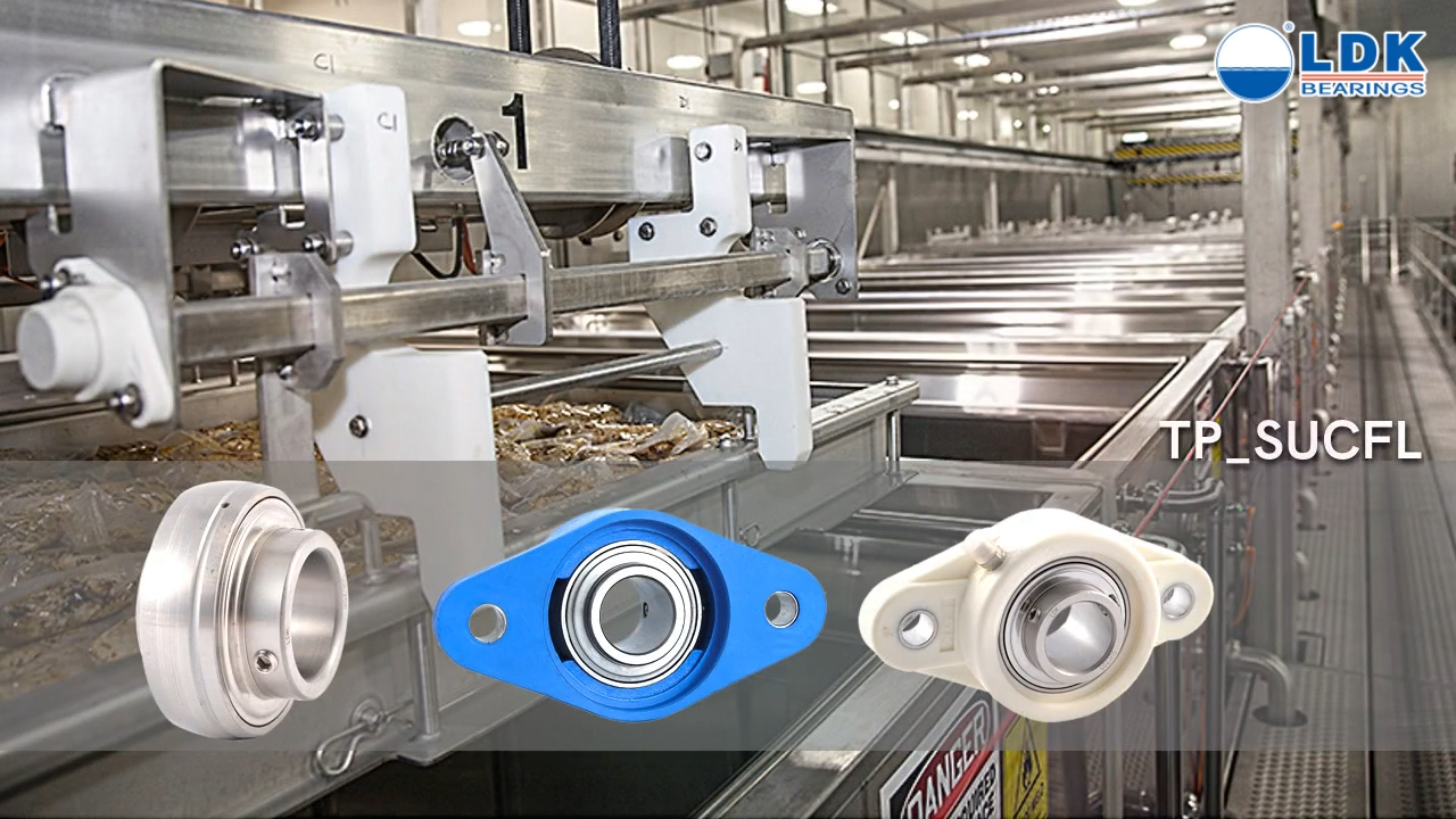
| Food and beverage plant: high humidity, frequent high-pressure washdown, cleaning agents with corrosive chemicals | Corrosion-resistant, easy-clean, blue housing for optical detection | Stainless units SSUCP2..ESB, SSUCF2..ESB, SSUEFL2..ESB; thermoplastic units TP-SUCP, TP-SUCF | Regulatory declaration for the product and site |
| Chemical processing equipment: indoor or semi-outdoor, acids/alkalis, corrosive gases | Acid/alkali resistance, corrosion resistance, rust proof | Stainless 304 housing families with 440 inserts | Chemical compatibility of seal and grease |
| Agricultural machinery: full outdoor, dust, mud, fertilizer and pesticide exposure, -10°C to +45°C, high shock and vibration | High speed vibration resistance, sealing performance, easy installation and disassembly | Farm implement bearings ST491A, ST491B, DHU45R-209, DHU55R-211, W208PPB13, 205NPPB AH02 | Bore geometry and relubrication path |
| Quarrying and mining, aggregate crushers and screens: heavy shock loads, severe dust, temperature fluctuation | High stability, superior sealing against dust, continuous operation | Heavy and medium duty cast iron UCP3, UCPX, UCFX, UCTX; split plummer blocks SN5, SNU5, SNG5, SAF5 | Shaft diameter and seal type selection |
| HVAC air handling, exhaust fans, blowers and cooling towers: -20°C to +60°C, continuous operation | Low noise and vibration, 7×24 operation | UEP2, UKP2, UKF2; rubber cushioned cartridge units RSA2, RSB2, RCSA2, RCSB2 | Noise and vibration grade confirmation |
| Snow removal machinery: down to -40°C, de-icing salt contact, continuous vibration | Low temperature grease, excellent sealing | Cast iron families UCP2, UCF2, UCT2, SBLF2 | Confirmation that the supplied grease is rated for the low-temperature band |
| Packaging machinery: indoor 20–25°C, high cycle frequency, low to medium load, long maintenance-free interval | High dynamic capacity, contamination resistance, low noise | Silver series UFL000, UP000, KP000, KFL000, stainless silver series SSUP, SSUFL, stamped steel SBPP2 | Load class — these are light duty families |
| Gardening and landscape maintenance: dust, mud, grass clippings, -10°C to +40°C, high impact | Sealing against dust and clippings, easy field repair | Stamped steel SBPF2, SBPFT2, SAPF2, SAPFT2, SBPP2 | Impact level at the specific position |
Stainless steel inserts and units: what the SS prefix does and does not say
Stainless insert designations are frequently written with an SS prefix — buyers encounter strings such as SSER2 and SUC2 in the same shortlist. The prefix is not governed by an international naming authority; it is a supplier convention, and it can refer to the housing, the insert, or the complete unit depending on the catalogue it comes from.
In LDK's published range, the stainless insert families identified by code are SUC2, SUE2 and SSB2, all using stainless steel 440 and supplied with food grade grease and a silicon rubber seal. SER2 is documented as a chrome steel insert family with a cylindrical bearing, set screw locking and a snap ring. A buyer who receives a stainless designation should therefore confirm exactly which component the prefix describes, and whether the supplier's stainless insert range follows the same designation the project was written around.
On the unit side, the stainless families are explicit about material: SSUCP, SSUCF, SSUCFL, SSUCPA, SSUCFC, SSUEFC, SSUCT2 and SSUET all use a stainless steel 304 housing with a stainless steel 440 insert, cover a 20 mm to 60 mm bore range, and are documented for food processing, chemical, sewage treatment, pharmaceutical, marine and medical equipment. The miniature stainless silver series, SSUP000 and SSUFL000, uses a 304 housing with a 420 insert over a 10 mm to 30 mm range, with narrow inner ring and eccentric locking.
Plastic, water-proof and stamped steel families
Thermoplastic housings have moved from a niche substitute to a standard option in washdown-heavy industries, and the coding convention reflects that with two distinct prefixes.
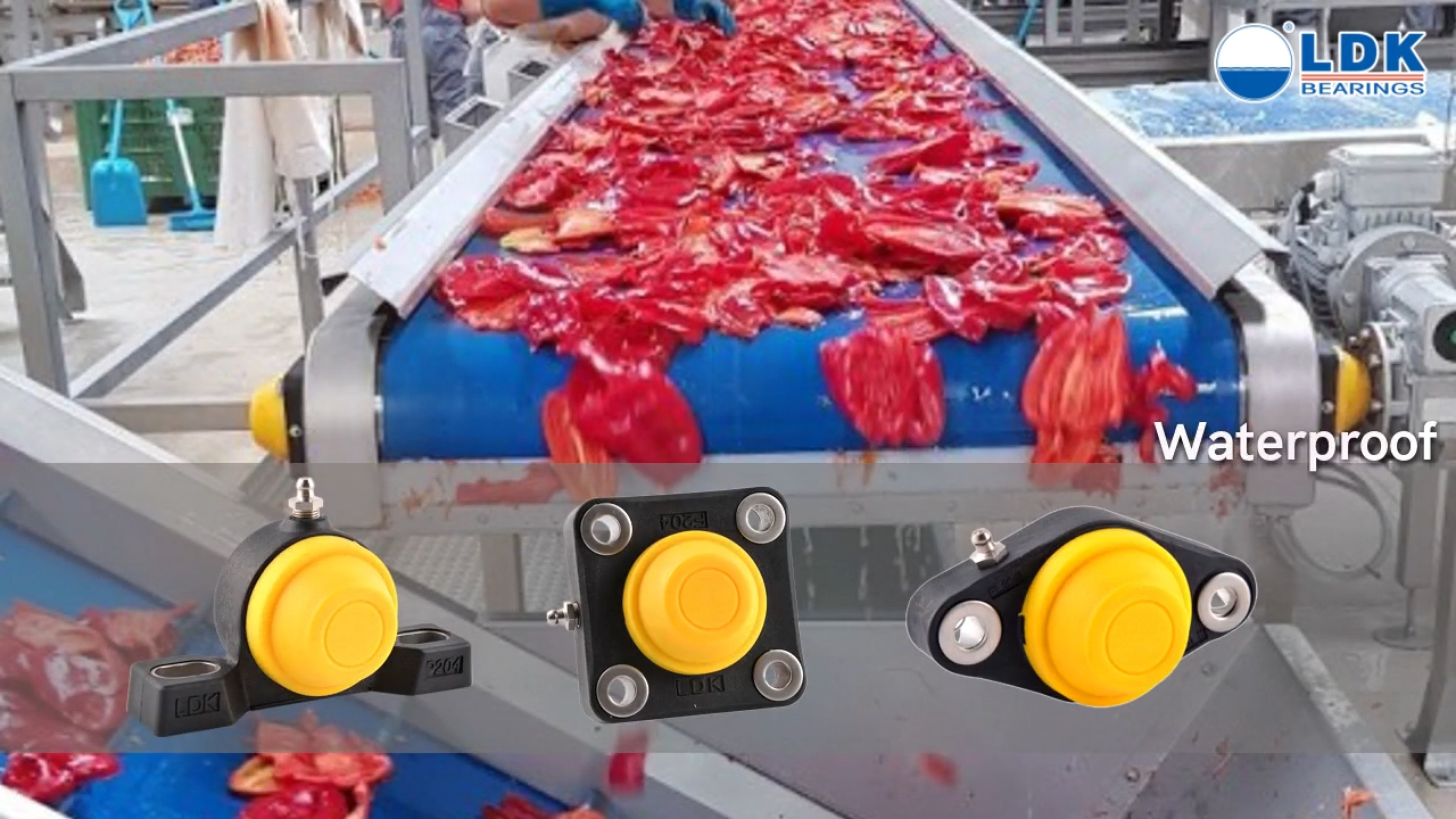
The WP- family is the water-proof group: WP-SSBP as a two-bolt pillow block, WP-SSBFL as a two-bolt flange and WP-SSBF as a four-bolt flange. All three use a PA6 thermoplastic water-proof housing with a black housing and orange cover, a stainless steel 440 insert with set screw locking, a 20 mm to 40 mm bore range (3/4" to 1-9/16"), food grade grease with a silicon rubber seal, self-aligning and relubricable geometry, and a published operating temperature of -35°C to 102°C. The orange cover is not decorative; high-visibility covers support optical detection on automated lines.
The general thermoplastic group uses a PBT housing and repeats almost every housing geometry in the cast iron range: TP-SUCP for pillow blocks, TP-SUCF and TP-SUCFL for flanges, TP-SUEFL, TP-SUCFB, TP-SUEFB, TP-SUCPA, TP-SUEP, TP-SUEF, TP-SUCT and TP-SUET for the remaining geometries. The bore range is wider than the water-proof group at 12 mm to 60 mm, colours are available in white, green and black with other colours customisable, and the inserts again use stainless steel 440 with food grade grease and a silicon rubber seal at -35°C to 102°C.
Stamped steel is the third family and the most frequently misread. SBPP2 and SAPP2 are pillow blocks; SBPF2, SAPF2, SBPFL2, SAPFL2, SBPFT2 and SAPFT2 are the flange variants; RSBPP2 and RSAPP2 are rubber cushioned. Housings are stamped zinc plated, with stainless steel available as an option, and the inserts are chrome steel. The critical readable attribute here is the duty class: these are light duty families, and the letter A in the second position indicates eccentric locking rather than set screw locking.
Agriculture bearing codes: bore geometry is the code
Agricultural bearings are coded differently from industrial mounted units because the mounting is defined by the shaft, not by a housing bolt pattern. A disc harrow, planter or combine runs on square, round or hex shafts, and the bearing code leads with that geometry.
| Bore convention | Representative codes | Documented sealing and lubrication |
|---|---|---|
| Round bore | 205PPB7, W208PPB7, W208PP10, W208PPB23, W209PPB2, W209PPB4, W210PP2, W210PPB2, W211PP2, W211PPB2 | Triple lip seal; pre-lubricated, non-relubricable |
| Square bore | W208PPB13, W208PPB6, W208PP5, W208PPB5, W208PP8, W208PPB8, W208PPB11, W208PPB12, W209PPB5, W210PP4, W211PP3, W211PPB3, W211PPB6 | Triple lip seal; pre-lubricated, non-relubricable |
| Hex bore | 205NPPB AH02, 206NPPB AH02, 206NPPB AH04, 207NPPB AH09, 207KPP3, 207KPP17, 207KPPB3 | Relubricable |
| Disc harrow units | ST491A, ST491A-I, ST491A-II, ST491B, ST491B-I, ST209-1 1/8, DHU45R-209, DHU55R-211, ST211-1 3/4, FD211-1 1/2 | Round or square bore, triple lip seal, mounted in two stampings, relubricable |
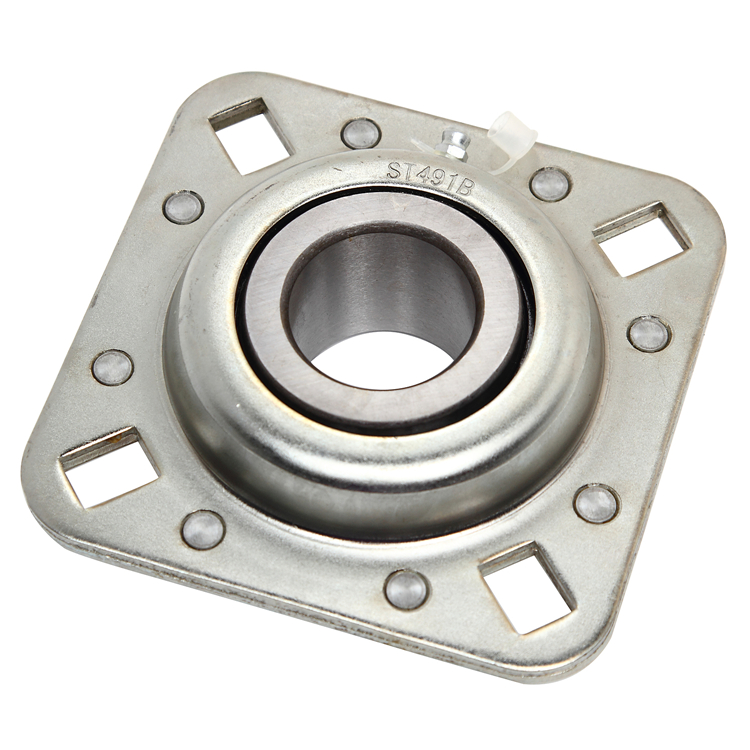
All agricultural families listed above use chrome steel GCr15 (AISI52100). The distinction a buyer must read from the code is whether the position can tolerate a sealed, non-relubricable unit or requires a relubrication path. Cultivation tools running in abrasive soil typically fall in the first group; high-cycle positions on planters and combines frequently fall in the second.
Comparative view: code-based qualification versus traditional selection habits
Traditional mounted bearing selection in many plants runs on three rules: match the shaft diameter, match the bolt pattern, and reorder the same part number. That approach is fast and often adequate. It becomes inadequate when the operating envelope changes, and it has no mechanism for detecting the change.
| Decision dimension | Traditional habit-based selection | Code-based qualification |
|---|---|---|
| Entry question | What fits the shaft and the bolt holes? | What conditions must the position survive, and which documented family was built for them? |
| Material | Assumed from appearance | Read from the prefix — cast iron HT200, stainless 304 housing, stainless 440 insert, thermoplastics, stamped zinc plated steel |
| Locking method | Frequently unrecorded | Read from the insert family — set screw, eccentric, concentric or adapter sleeve |
| Seal and grease | Assumed identical across the range | Confirmed per code; food grade grease and silicon rubber seals are documented for specific families only |
| Temperature band | Not evaluated until a failure occurs | Checked against the published band, for example -35°C to 102°C for stainless and thermoplastic families |
| Compliance evidence | One facility certificate assumed to cover all codes | Certificate or declaration requested against the specific code and producing site |
| Change detection | None | Condition list is re-checked whenever the line, cleaning regime or chemical exposure changes |
Where code reading genuinely stops
A disciplined buyer should be equally clear about the limits. Reading codes is a filtering method, not a qualification in itself, and there are several boundaries that code literacy cannot cross.
Codes are supplier-specific. The SS prefix means stainless steel housing in LDK's catalogue. Another manufacturer may use the same letters for a different attribute, or none at all. A code string is only readable against the issuing catalogue.
A code does not carry a certificate. LDK reports IATF 16949 certified manufacturing facilities, and lists ROHS/REACH/FDA compliance, IQC/IPQC/OQC capability and traceability within its stated OEM quality-compliance scope. None of that can be inferred from a part number. A project where compliance is a contractual deliverable needs the certificate or declaration tied to the exact product code and production site.
Protection language needs a document behind it. The waterproof thermoplastic family is described in the published range by construction — a water-proof PA6 thermoplastic housing with a cover — rather than by a stated ingress-protection class, while car wash and wastewater treatment projects specify IP66+ as a requirement. Those two statements are not equivalent, and the gap should be closed with test evidence rather than by reading the word "waterproof" as a rating.
Some families are deliberately not relubricable. The miniature silver series UFL000, UP000, KP000, KFL000 and the stainless SSUP / SSUFL series are pre-lubricated and non-relubricable, as are the round bore and square bore agricultural bearings. They are appropriate for light duty, long-interval positions; they are not appropriate substitutes for heavy duty cast iron units in shock-loaded applications.
Temperature bands are housing-specific. Thermoplastic families are documented at -35°C to 102°C. Snow removal equipment is specified down to -40°C with low temperature grease and sealing requirements, and a cold storage conveyor project served at -50°C used customised bearing inserts with special high or low temperature grease, appropriate internal clearance and silicon rubber seals. Code reading tells a buyer that the standard family does not reach that band; it does not by itself produce the engineered answer.
Codes do not specify grease or clearance. Food grade grease accompanies the stainless and thermoplastic families as a documented package. In other families, grease type and internal clearance must be confirmed as separate line items, particularly where a project crosses temperature or load limits.
The correct sequence is therefore: use the code to shortlist, use documentation to qualify, and use a sample or first-article inspection to confirm. LDK's stated quality-control structure supports the middle step with self-inspection and verification, second-party audits and inspections, and third-party audits, inspections and verification, and its stated OEM scope includes IQC/IPQC/OQC, traceability, FMEA and 8D problem-solving capability. The final step is the buyer's own.
What the market context says about documentation-first buying
The commercial backdrop explains why code literacy is becoming a procurement requirement rather than a technical nicety. Dataintelo estimated the global pillow block bearings market at USD 2.8 billion in 2024, projecting USD 4.7 billion by 2033 at a compound annual growth rate of 5.7%. Spherical Insights valued the broader mounted bearing market, including ball and roller types, at approximately USD 1.48 billion in 2023 with an expected USD 2.55 billion by 2033. Fortune Business Insights placed Asia Pacific at roughly 49.5% revenue share of the mounted bearing market in 2025, and OEC recorded China as the leading exporter of ball bearings under HS 8482 in 2024 with an export value of USD 6.53 billion.
Two structural features sit inside those numbers. The first is concentration at the top of the market: SKF, Schaeffler, Timken, NSK and NTN are widely reported to hold more than half of the mounted bearing market between them, which means the remainder is served by a long tail of manufacturers whose catalogues differ substantially in material range and documentation depth. The second is scope sensitivity — published estimates diverge sharply depending on whether the study is measuring pillow block blocks specifically or the total bearing market, and buyers comparing supplier claims against market data should check which category is being counted.
The practical consequence for a buyer is that the supply base now includes suppliers who can offer cast iron, stainless steel, thermoplastic, stamped steel and agricultural families under one quality system, and suppliers who offer a narrow slice with limited documentation. In that environment, the ability to read a code and map it to a condition list is a filtering mechanism that operates before samples are ordered and before freight is paid.
Future outlook
Three directions are already visible in the way mounted bearings are specified.
Material diversification as a cost and compliance strategy. The substitution of thermoplastic housings for metal in washdown environments, and of standardised stainless packages for bespoke corrosion solutions, reflects a broader effort to reduce total cost of ownership without weakening the corrosion case. A documented patent-pending coating has been applied in offshore processing positions where 500 hours of rust-free performance and ROHS/REACH compliance were required, with the stated benefit of reducing equipment ownership cost relative to conventional stainless steel.
Documentation attached to unit identity rather than to the supplier. As audits tighten in food, pharmaceutical and water treatment supply chains, the question shifts from "is your factory certified?" to "is this code, from this site, covered by this declaration?" Suppliers that can answer at code level will hold an advantage over suppliers that can only answer at company level.
Lubrication simplification. Solid-lube bearings, available across cast iron, thermoplastic and stainless housings with chrome steel or stainless inserts, remove the risk of grease contact with product in food processing positions and reduce maintenance intervention in remote installations. The trade-off is that a solid-lube or permanently sealed unit must be specified by condition, not substituted casually into a position that was designed around relubrication.
For a portfolio with roughly 90,000 m² of manufacturing space, around 130 employees, 12 engineers, insert bearing bore sizes from 10 mm to 140 mm and over 100 combinations of materials and housing types, in-house production of both inserts and housings is the mechanism that makes code-level documentation feasible: identity, material and fit can be traced at the point where the two halves of the unit are brought together.
FAQ
Portfolio and technical documentation referenced in this article: LDK bearings catalogue — https://cdn.socialarks.com/sbsp/24740/common/2026/0526/6a15036f9c1a2.pdf
Tem questões ou precisa de mais detalhes?
Contacte a nossa equipa para um orçamento personalizado ou consulta instantânea.
Solicitar orçamento
Preencha o formulário abaixo e a nossa equipa entrará em contacto com uma proposta personalizada.
Chat direto do WhatsApp
Prefere conversar em tempo real? Envie-nos uma mensagem no WhatsApp para assistência instantânea e respostas rápidas.
- Obter orçamento personalizado
- Partilhar fotos ou documentos
- Discuta as suas necessidades diretamente
Geralmente responde em 5–30 minutos durante o horário de expediente.