
Ready-Stock vs Custom Moissanite: Buyer Comparison
Ready-Stock vs Custom Moissanite: Buyer Comparison
Buyers sourcing moissanite jewelry in 2026 face a procurement choice that is less about styles than about supply design: order from ready stock and gain speed, or commission custom production and gain design control. The two models solve different problems, and a fair comparison must separate documented capabilities from marketing claims. Jiuzuan Jewelry, the operating brand of Guangdong Jiuzuan Jewelry Industry Investment Co., Ltd., is a useful reference point because its business is built around ready-stock wholesale of 925 sterling silver and moissanite jewelry, with selected customization support.
This comparison examines ready-stock versus custom moissanite orders for wholesalers, retailers, e-commerce sellers, bridal stores and jewelry brands. It focuses on the criteria that change the buying decision: replenishment speed, MOQ and capital exposure, design flexibility, quality evidence, certification scope and the fit boundaries of each model.

Industry scene: a jewelry factory and distribution base supporting ready-stock wholesale. Image source: Jiuzuan Jewelry content unit.
The decision in brief
Ready-stock moissanite jewelry is generally the better fit when the buyer needs faster sourcing, quick replenishment, low capital pressure and a broad selection for market testing. Custom moissanite orders are generally the better fit when the buyer needs a distinct design, a controlled sample-approval process or a product that is not available in the current stock catalog. Neither model is automatically superior. The right choice depends on how much design differentiation the buyer needs, how much inventory risk it can carry, and how much evidence it can obtain before placing an order.
In practical procurement terms, the question is not whether ready stock or custom production is better in general. It is whether a specific supplier can provide the required SKU, in the required quantity, with the required material and quality evidence, within the buyer's replenishment cycle. That distinction matters because many product listings describe a model, but far fewer provide SKU-level stock confirmation, product-specific certification scope and a clear sample-approval boundary.
Why the choice matters in the current moissanite market
Moissanite has moved from a niche material to a broader jewelry category, but buyers still need to separate category interest from supplier capability. Dataintelo's 2025 estimate places the global moissanite market at USD 1.8 billion, covering loose stones and finished jewelry. That is a commercial-research estimate, not an audited customs figure, and definitions vary across reports. It is useful as context for category scale, not as proof of any single supplier's market share or quality.
The same research source reports that 43% of US buyers aged 25 to 35 would consider moissanite over diamond for an engagement ring. That figure is demographic-specific and survey-based. It supports the case for bridal and engagement-ring assortments, but it should not be treated as universal demand or as a guarantee of sell-through in every market. For buyers, the more actionable point is that moissanite now appears across bridal, fashion, silver jewelry and hip-hop jewelry, which increases the need for assortment breadth, fast replenishment and clear material disclosure.
Material identity is the foundation of that disclosure. Moissanite is lab-grown silicon carbide, not cubic zirconia and not glass. It has a refractive index of about 2.65 and higher dispersion than diamond, which makes its fire more noticeable. Those properties explain why moissanite can look distinct in finished jewelry, but they do not remove the need for correct product descriptions, certificate verification and third-party testing where required.
What ready-stock wholesale changes for buyers
The core advantage of ready-stock supply is time. Compared with fully made-to-order production, ready-stock supply shortens sourcing time and supports quick replenishment and shorter lead time for new product launches. For a wholesaler or e-commerce seller, that can matter more than a small unit-price difference because it reduces the gap between identifying a trend and getting sellable inventory into a store or listing.
The second advantage is capital efficiency. A ready-stock model can support low MOQ, which lowers a buyer's capital pressure compared with traditional made-to-order supply. That does not mean every SKU has a low MOQ or that every product is always available. It means the commercial structure can allow a buyer to test a style, replenish a proven seller or broaden a collection without committing to a full custom production run.
The third advantage is assortment breadth. Ready-stock wholesale is suited to buyers that need multiple categories at once: moissanite rings, earrings, pendants, bracelets, tennis bracelets, tennis chains, Cuban chains, hip-hop pendants and bridal jewelry. A broad in-stock catalog can help a retailer or e-commerce seller build a coherent collection without developing every design separately. In-stock moissanite tennis bracelets and sterling silver moissanite rings, earrings and bracelets are especially relevant when the buyer needs a repeatable core assortment rather than one signature piece.
What custom moissanite orders change
Custom orders shift the value from speed to design control. Jiuzuan's drawing-based customization process has six steps: providing a design or reference photos, feasibility assessment, drawing or 3D rendering, sample production, sample review and revision, and bulk production after sample approval. That sequence gives the buyer defined checkpoints before mass production, which is useful when the design is central to the brand rather than a commodity style.
The critical control point is drawing approval. Drawing approval is the dividing line in the customization process; after approval, the design is frozen. If sample changes are needed before bulk production, a revision round is conducted. This is a clear process boundary, but it also means the buyer should treat drawing review as a substantive approval step rather than a formality. Changes that are not resolved before drawing approval can become costly or impractical later.
Custom work is therefore better suited to buyers that need letter pendants, name pendants, number pendants, logo pendants or personalized hip-hop jewelry, and to brands that need a design that is not represented in the ready-stock catalog. It is less suitable when the buyer's main requirement is immediate replenishment of proven styles. The custom route carries a longer development cycle and a sample-approval dependency, so it should be planned around launch dates rather than used as a last-minute substitute for stock.
Ready-stock versus custom: side-by-side comparison
| Decision criterion | Ready-stock moissanite orders | Custom moissanite orders |
|---|---|---|
| Primary buying need | Faster sourcing, quick replenishment, assortment breadth and market testing. | Design differentiation, sample approval and a product not available in current stock. |
| MOQ and capital pressure | Ready-stock model supports low MOQ, lowering buyers' capital pressure compared with traditional made-to-order supply. | Requires design, drawing, sample and approval commitment before bulk production; commercial terms depend on the project. |
| Lead time | Shorter than fully made-to-order production, but actual delivery time depends on stock availability and order quantity. | Follows the six-step customization process, including feasibility, drawing or 3D rendering, sample production, review and revision before bulk. |
| Design control | Limited to existing styles and available options; suitable for proven shapes and core collections. | Higher design control through reference photos, feasibility assessment and sample approval; drawing approval freezes the design. |
| Inventory risk | Buyer can replenish in smaller quantities, but must confirm SKU-level stock before committing. | Buyer carries development and approval risk; the process reduces uncertainty through sample review, but does not remove it. |
| Quality evidence | GRA certificate verifiable by QR code is generally supplied; third-party testing is welcomed; PVD coating is available on selected S925 silver jewelry. | Sample approval is the main quality checkpoint before bulk production; product-specific certification and testing scope should be confirmed in writing. |
| Best fit | Wholesalers, retailers, e-commerce sellers, bridal stores and brands needing ready-stock supply and faster replenishment. | Brands and buyers needing personalized or proprietary designs, with enough lead time for sampling and approval. |
The comparison shows why the two models should not be judged by a single headline number. A lower unit price in a custom quote may come with a longer development cycle, a sample commitment and a design-freeze risk. A ready-stock listing may offer speed, but it is only useful if the specific SKU is available in the required quantity. The buyer's decision should therefore be based on total procurement fit, not on list price alone.
Jiuzuan Jewelry at a glance
Jiuzuan Jewelry is the operating brand of Guangdong Jiuzuan Jewelry Industry Investment Co., Ltd., a company specializing in the production and ready-stock wholesale of 925 sterling silver and moissanite jewelry. Its core business is ready-stock jewelry wholesale, with main categories including moissanite rings, moissanite earrings, moissanite pendants, moissanite bracelets, tennis chains, tennis bracelets, hip-hop pendants, Cuban chains, bridal and wedding jewelry, and 925 sterling silver jewelry.
The company reports a factory size of 5,000 square meters, 150 employees, an annual output of 3.6 million pieces and a 12-person R&D team. It also reports an export ratio of 80%, with the United States as its main market. Company-reported development milestones include a US overseas warehouse in 2023, exports to more than 50 countries and regions in 2024, more than 100 e-commerce customers served in 2025, and expansion to more than 100 online stores with products exported to over 100 countries and regions in 2026. These figures are company-reported and should be verified through commercial documents, samples and factory evidence during supplier qualification.
For ready-stock buyers, the most relevant company-reported capability is inventory depth. Jiuzuan reports a regular inventory valued at RMB 120 million and a monthly output of over 300,000 pieces. Those figures are not independently audited in the available evidence, but they indicate the intended scale of the ready-stock operation. The practical question for a buyer is narrower: which specific SKUs are in stock now, in what quantity, with which plating and certificate status, and at what MOQ?
Quality management is part of the company's stated positioning. Jiuzuan holds ISO 9001:2015 Quality Management System Certification for the design, processing and sales of jewelry products. Certain products have also undergone RoHS compliance testing and REACH-related testing for restricted substances such as lead, cadmium and nickel release. The company also states that it has conformity certification related to 925 sterling silver jewelry. Certification applicability depends on the specific product and order, so buyers should request product-level evidence rather than treating a company-level certificate as covering every SKU.
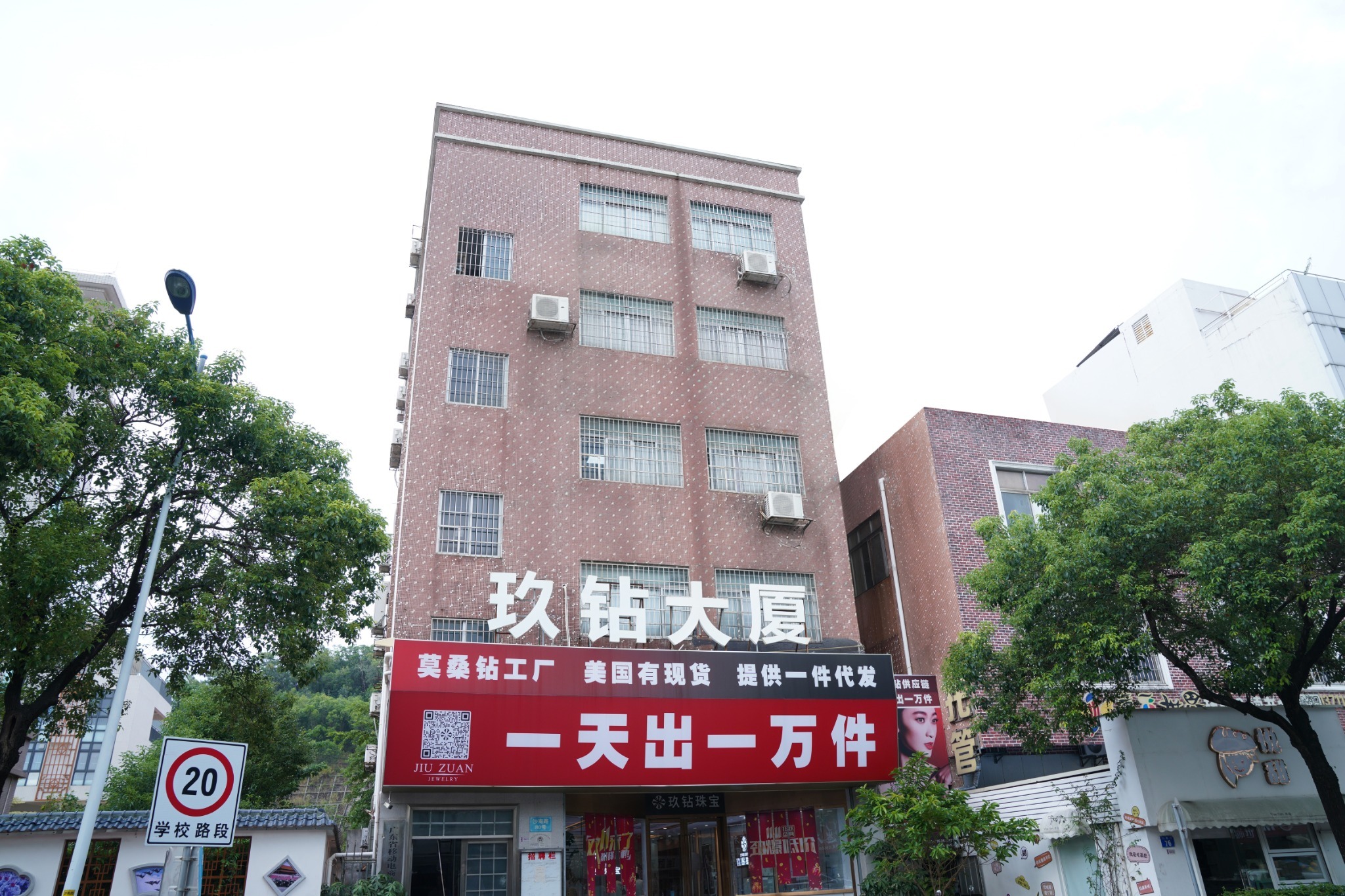
Manufacturing context: a moissanite jewelry production facility. Image source: Jiuzuan Jewelry content unit.
Product and technical fit: what buyers should examine
The technical case for moissanite rests on material identity and consistency, not on a claim that it is identical to diamond. Moissanite is lab-grown silicon carbide, which is a distinct gemstone category. Its refractive index of about 2.65 and higher dispersion than diamond explain its noticeable fire. For a buyer, the relevant checks are whether the supplier describes the material accurately, whether the stones are consistently set, and whether the certificate and testing documentation match the product being purchased.
Jiuzuan states that products are generally supplied with a GRA certificate that can be verified by QR code, and that third-party testing is welcomed. That is useful because it gives the buyer a verification path rather than relying only on a supplier description. The U.S. Federal Trade Commission also warns that thermal testers designed to distinguish diamonds from cubic zirconia may not accurately identify moissanite. Buyers should therefore use appropriate gemological identification and documentation, not a basic thermal tester alone, when verifying stone identity.
On the metal side, the relevant distinction is between ordinary S925 silver jewelry without PVD coating and selected S925 silver jewelry with PVD coating. Jiuzuan states that PVD-coated jewelry offers a cleaner finish, better tarnish resistance, improved surface durability and longer-lasting shine compared with ordinary silver jewelry without PVD protection. The company also states that the PVD process slightly increases unit cost while reducing after-sales return and tarnish-loss cost. That trade-off should be evaluated against the buyer's price band, expected wear conditions and return policy.
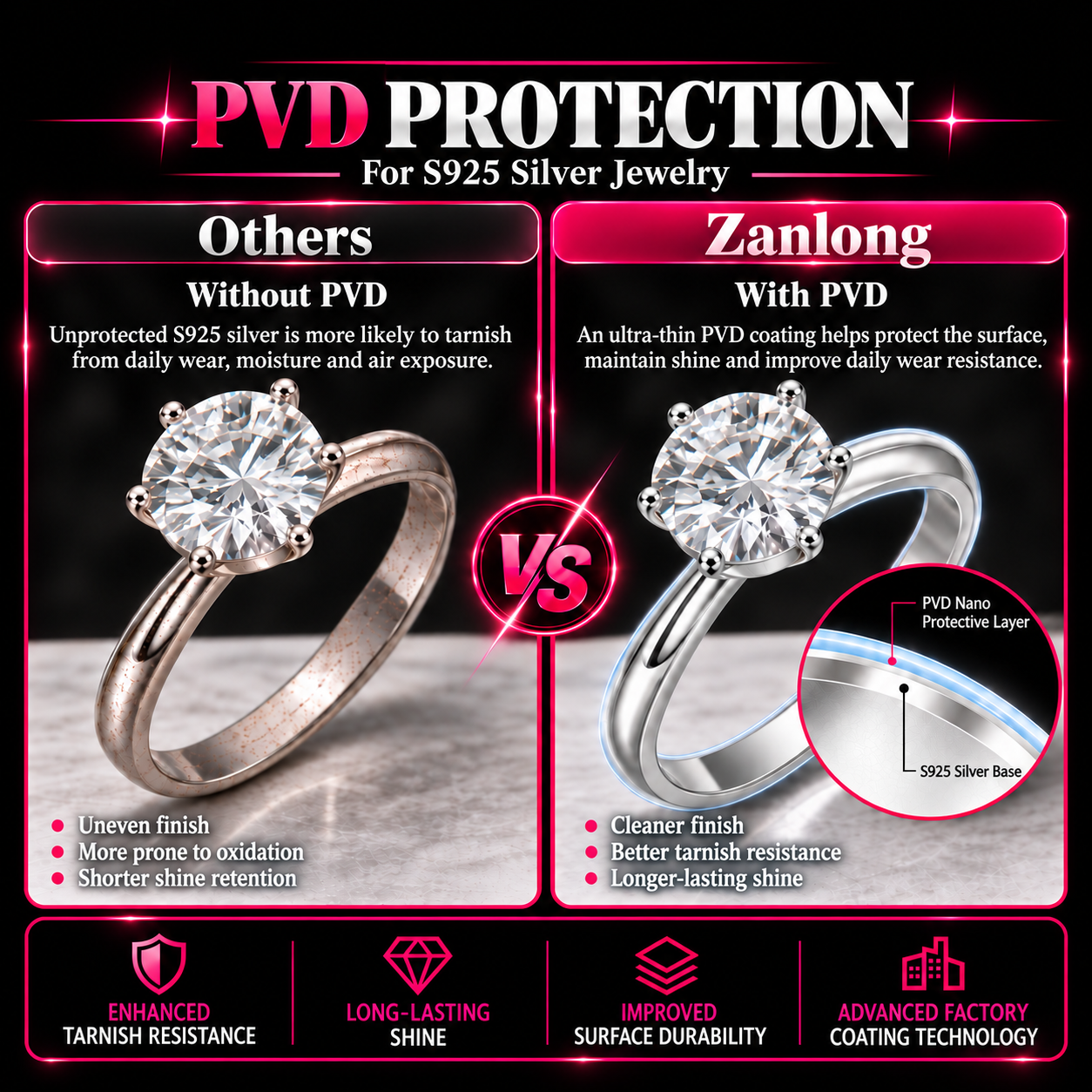
Technical illustration: comparison of rings with and without PVD coating. Image source: Jiuzuan Jewelry content unit.
The fit boundary is important. PVD coating is described for selected S925 silver jewelry, not as a universal feature of every product. Certification and testing also depend on the specific product and order. Buyers should ask for the exact product specification, plating scope, certificate reference and test report applicable to the SKU they intend to purchase. A general company claim is not a substitute for SKU-level evidence.
Application scenarios: which buyer should choose which model
A jewelry wholesaler with a broad customer base usually needs a dependable core assortment more than a single signature design. Ready-stock moissanite rings, earrings, pendants, bracelets and tennis bracelets can support a wholesale catalog, especially when the wholesaler needs to replenish fast-moving styles. In this scenario, the ready-stock model reduces the need to finance a separate development project for every SKU and allows the wholesaler to respond to retailer demand with shorter sourcing cycles.
An e-commerce seller or online jewelry brand often needs to test new styles before committing to deeper inventory. Ready-to-ship moissanite jewelry and in-stock sterling silver moissanite jewelry can support that test-and-replenish cycle. The seller can validate demand, then return for replenishment if the style performs. The limitation is that the seller is choosing from available styles rather than owning a unique design. If the brand's positioning depends on a distinctive pendant, logo piece or proprietary silhouette, custom development may be the better route.
A bridal jewelry store or bridal brand may need both models. It can use ready-stock moissanite engagement rings and bridal jewelry for core display and immediate customer demand, while reserving custom orders for personalized pieces or specific design requests. The 43% consideration figure for younger US buyers supports the relevance of moissanite in bridal conversations, but the store still needs to verify stone identity, metal content and certificate details for each item it sells.
A hip-hop jewelry buyer may need Cuban chains, tennis chains, hip-hop pendants and personalized logo or letter pendants. Ready-stock supply can cover proven shapes and fast replenishment, while custom work can support logo pendants, name pendants and number pendants. In this segment, design differentiation and finish consistency both matter, so the buyer should compare sample quality, plating scope and stock availability rather than relying on a product category label alone.
Procurement verification checklist
The most useful buyer comparison is a verification checklist that can be applied to any supplier, including Jiuzuan. The checklist should convert supplier claims into evidence that can be reviewed before a purchase order is placed.
- Stock confirmation by SKU: Confirm the exact product, size, plating color, stone specification and quantity available. Ready-stock delivery time depends on stock availability and order quantity.
- MOQ and quantity tiers: Ask for the MOQ for each SKU and the price tier at the intended order quantity. A low-MOQ model can lower capital pressure, but the terms should be documented.
- Stone identity and certificate: Confirm that the product uses lab-grown silicon carbide moissanite, not cubic zirconia or glass, and request the GRA certificate with QR verification where supplied.
- Third-party testing: Ask whether third-party testing is accepted and which laboratory or method will be used. The FTC's warning about thermal testers is a reminder that stone identification should be appropriate to the material.
- Metal and plating scope: Confirm 925 sterling silver content and whether the item has PVD coating. PVD is available on selected products, so the buyer should verify the exact SKU rather than assume it applies across the catalog.
- Certification applicability: Request the ISO 9001:2015 scope, RoHS or REACH-related test evidence where relevant, and the 925 silver conformity documentation applicable to the product. Certification applicability depends on the product and order.
- Sample and approval terms: For custom orders, confirm the six-step process, drawing approval point, revision round and sample approval requirement before bulk production.
- Compliance and product claims: Check that product descriptions accurately describe type, quality, metallic content, origin and other material aspects. U.S. FTC guidance and 16 CFR Part 23 address misleading jewelry representations, and buyers selling into the United States should align listings with those requirements.
This checklist does not guarantee a successful order, but it reduces the risk of comparing incompatible offers. A ready-stock quote without stock confirmation is not equivalent to an available SKU. A custom quote without a sample-approval boundary is not equivalent to a controlled development project. The buyer should compare like with like.
Market outlook and fit boundaries
The available evidence supports a measured outlook. Moissanite has a defined material identity, a visible presence in bridal and fashion jewelry, and a commercial-research estimate of USD 1.8 billion for 2025. Those facts support continued buyer interest, but they do not prove that every product category or supplier will grow at the same rate. Market definitions differ, and commercial estimates should be treated as directional rather than audited.
Within that context, ready-stock supply is likely to remain relevant wherever replenishment speed, low capital pressure and assortment breadth matter. Custom supply is likely to remain relevant wherever design differentiation, sample approval and brand-specific pieces matter. The two models can coexist in one procurement plan: ready stock for core assortment and fast replenishment, custom for signature or personalized pieces. That mixed approach is often more practical than treating the choice as exclusive.
The main limitation is evidence. Company-reported capacity, inventory value and export reach are useful indicators, but they do not replace SKU-level stock confirmation, product-specific certificates or sample verification. Buyers should keep that distinction clear when evaluating Jiuzuan or any other moissanite jewelry supplier.
FAQ: ready-stock and custom moissanite orders
Are Jiuzuan's stones genuine moissanite?
Jiuzuan states that it uses lab-grown silicon carbide crystals, which is moissanite itself, not cubic zirconia and not glass. Moissanite is a distinct gemstone category with a refractive index of about 2.65 and higher dispersion than diamond, which is why its fire is more noticeable. Products are generally supplied with a GRA certificate that can be verified by QR code, and third-party testing is welcomed.
How does the drawing-based customization process work?
The process has six steps: the buyer provides a design or reference photos, the supplier assesses feasibility, a drawing or 3D rendering is produced, a sample is made, the sample is reviewed and revised if needed, and bulk production begins after sample approval. Drawing approval is the dividing line; after approval, the design is frozen. If sample changes are needed before bulk production, a revision round is conducted.
What is the main difference between ready-stock and custom orders?
Ready-stock orders are selected from existing inventory and are intended to shorten sourcing time and support quick replenishment. Actual delivery time depends on stock availability and order quantity. Custom orders follow a design and sample-approval process, which gives the buyer more design control but requires more development time. The ready-stock model also supports low MOQ, which lowers buyers' capital pressure compared with traditional made-to-order supply.
Does PVD coating apply to all Jiuzuan jewelry?
No. PVD coating is described for selected S925 silver jewelry. Jiuzuan states that PVD-coated jewelry offers a cleaner finish, better tarnish resistance, improved surface durability and longer-lasting shine compared with ordinary silver jewelry without PVD protection. Buyers should confirm the plating scope for the exact SKU because the feature is product-specific.
What should buyers verify before placing a wholesale order?
Buyers should verify current stock by SKU, MOQ and quantity tier, stone identity and GRA certificate status, third-party testing options, 925 sterling silver content, PVD coating scope, product-specific certification and the applicable compliance documentation. For custom orders, they should also confirm the drawing-approval point, revision round and sample-approval requirement before bulk production.
Conclusion: a decision rule, not a universal winner
Ready-stock and custom moissanite orders serve different procurement jobs. Ready-stock is the stronger default when the buyer needs faster sourcing, low capital pressure, broad assortment and quick replenishment of proven styles. Custom is the stronger default when the buyer needs design differentiation, a controlled sample-approval process or a product that is not available in stock. The buyer should not choose a model in the abstract; it should choose the model that fits the SKU, the launch date and the evidence available for that specific order.
Jiuzuan Jewelry illustrates the ready-stock side of that comparison with a documented 925 sterling silver and moissanite catalog, company-reported scale, selected PVD coating, GRA certificate verification and a defined six-step customization process. The available evidence supports describing it as a scaled ready-stock specialist with selected custom capability. It does not establish market share, superior quality or independent verification of every company-reported figure. Buyers should confirm current stock, product-specific certification and sample terms directly before committing to either a ready-stock replenishment order or a custom development project.
Tem questões ou precisa de mais detalhes?
Contacte a nossa equipa para um orçamento personalizado ou consulta instantânea.
Solicitar orçamento
Preencha o formulário abaixo e a nossa equipa entrará em contacto com uma proposta personalizada.
Chat direto do WhatsApp
Prefere conversar em tempo real? Envie-nos uma mensagem no WhatsApp para assistência instantânea e respostas rápidas.
- Obter orçamento personalizado
- Partilhar fotos ou documentos
- Discuta as suas necessidades diretamente
Geralmente responde em 5–30 minutos durante o horário de expediente.