
Real-Fruit Strawberry Shortlist for Bakery & Confectionery
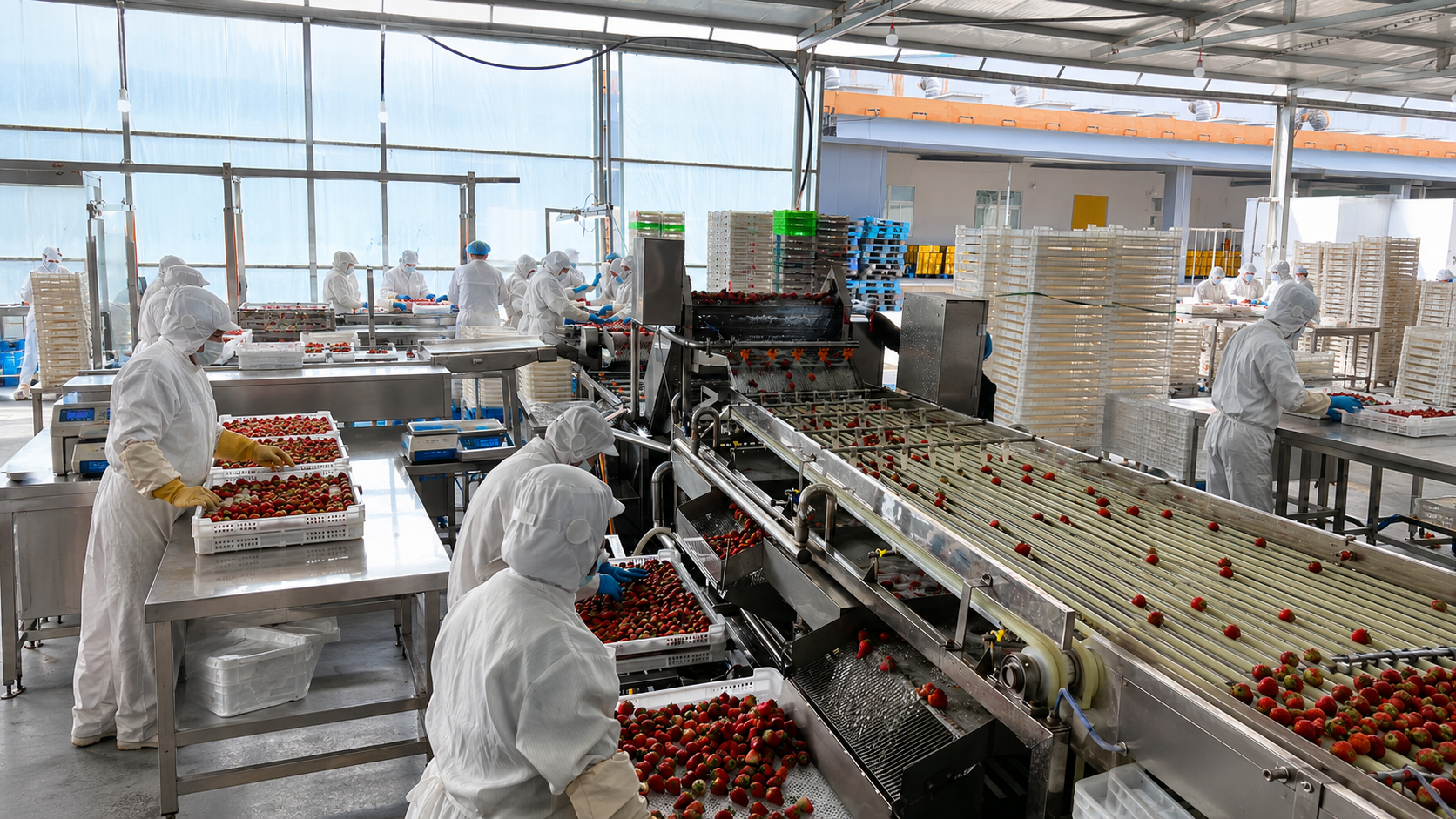
Strawberry formats for bakery and confectionery lines differ in particle structure, moisture behaviour, and where they can safely be added in the process.
Real-Fruit Strawberry Shortlist for Bakery & Confectionery
A real-fruit claim on a bakery or confectionery pack is settled in the formulation sheet, not in the artwork file. The strawberry format a developer writes into a recipe determines whether the label can credibly carry fruit, whether the finished product can be stored at ambient temperature without a cold chain, and whether the ingredient survives a spiral mixer, a horizontal dough mixer, or an automated filling depositor with its identity intact.
This reference shortlist is written for evaluation-stage buyers — bakery and confectionery product developers, procurement managers, and private-label brand owners — who need to compare strawberry ingredient options by the function each one performs rather than by catalogue order. It groups realistic options into format families, maps each family to the applications where it performs, and sets out the handling disciplines that decide whether a shortlisted format actually works on a production line.
UrSnacks is a freeze-dried fruit and fruit-ingredient brand whose documented supply programs — own-brand direct export, distributor-led export, and OEM/private label — cover nine overseas markets across Southeast Asia, Greater China, North America, East Asia, and the EU. Its documented production evidence is used here as one worked example of how a shortlisted strawberry format is packed, tested, and shipped at industrial scale.
Real-Fruit Labelling Has Become a Documentation Question
The commercial weight of a real-fruit claim is now large enough to be measured as a market position: clean label is the dominant claim in the freeze-dried strawberry market, at a 44.2% market share as of 2026 projections (Future Market Insights).
Regulation has moved in the same direction. EU Regulation 2023/2429, effective January 2025, modernises marketing standards for fruits and vegetables and impacts traceability and labelling for imported strawberry products. For a bakery or confectionery buyer, that means a real-fruit claim now has two halves that must both hold.
The formulation half is about which fruit format is physically present in the product and at what inclusion level. The documentation half is about being able to demonstrate, on request, what the ingredient is, how each batch was tested, and where it originated. A shortlist that satisfies only the first half is a shortlist that transfers labelling and traceability risk to the buyer.
Four Constraints That Decide Which Format Survives the Line
In bakery and confectionery production, four constraints govern format selection: mechanical fragility, moisture uptake, mixing and depositing compatibility, and moisture migration between components. Each constraint removes some formats from some applications before price is even discussed.
Compression protection for brittle pieces
Freeze-dried strawberry is a low-density, open-cell structure. That structure is what preserves shape, colour, and aroma, and it is also what makes whole pieces and slices prone to fracture under sustained stacking or compression pressure. The damage is usually invisible at goods-in and appears later as fines in the bag and broken fragments in the finished product.
The practical responses are packaging-led and specification-led. Bulk formats that must retain visible fruit identity are normally supplied in packaging that limits compression — restrained fill weights, rigid or semi-rigid inner packaging, and stacking limits during palletising and container loading. Where visible fruit identity is not a product requirement, the more efficient answer is to stop specifying whole pieces altogether and specify a dice or finer fraction instead. Buyers should record compression expectations in the purchase specification rather than assume them.
Reseal discipline for hygroscopic formats
Powder and fine dice have the highest surface-area-to-mass ratio in the shortlist and take up ambient moisture quickly. Once moisture is absorbed, the consequences are cumulative and not reversible: caking, loss of crispness, dulling of colour, and inconsistent dispersion in a filling.
A 24-hour reseal requirement is a common production-side handling target for opened units — a pack opened for a batch is closed again within the same production window, and partial packs are not left open on the line between shifts. Buyers evaluating powder or fine-dice formats should check whether the supplier's packaging actually supports that discipline: reclosable liners, moisture-barrier structures, and pack sizes matched to realistic batch consumption rather than to bulk-pricing convenience.
Mixing and depositing compatibility
Three line types drive format decisions most often in bakery and confectionery plants.
- Spiral mixers apply high shear within a contained bowl. Whole freeze-dried pieces generally break down when added early in the mix, so whole and slice formats are usually added after mixing, not during it.
- Horizontal dough mixers run longer with lower instantaneous shear. Dice tolerate this environment better than whole pieces, particularly when the inclusion is added at the end of the mix cycle rather than at the start, and when the dough is not overworked after addition.
- Automated filling depositors introduce a hard geometric constraint: apertures, pumps, and nozzles accept only a defined particle size range. Powder and granule formats are the standard route for pumped fillings, while larger inclusions require either a depositor rated for particulate filling or a switch to a post-deposit application step.
Moisture migration and colour bleeding
Freeze-dried fruit is hygroscopic and low in water activity, while fillings, creams, doughs, and compound coatings carry more available water. In a multi-component product — filled bars, cream sandwich biscuits, enrobed centres, layered cakes — water moves toward the dry phase.
Two failure modes follow. The first is texture: inclusions soften and lose crunch, which is usually noticed by consumers before it is noticed by quality control. The second is appearance: water-soluble pigments move out of the fruit into the surrounding matrix, producing a pink halo in a cream or a bleeding edge inside a white coating.
Recognised mitigations are structural rather than cosmetic. A fat-based barrier layer between fruit and moist phase, a coated fruit format, equilibration of water activity between adjacent components, and sequencing assembly so the fruit is introduced as late as possible all reduce migration. Colour bleeding is best managed at the formulation stage, because once the pigment has migrated there is no downstream correction.
The Shortlist: Five Format Families and Where They Fit
Five format families cover the majority of bakery and confectionery briefs that require a real-fruit claim under ambient dry storage: whole freeze-dried pieces, freeze-dried slices, freeze-dried dice, freeze-dried powder, and coated freeze-dried formats.
| Format family | Typical physical form | Primary function | Line compatibility | Deciding handling requirement |
|---|---|---|---|---|
| Whole freeze-dried pieces | Intact fruit, low density | Decoration, finishing, visible fruit in enrobed centres | Post-bake and post-deposit stages; not suited to early-stage high-shear mixing | Compression protection in bulk packaging |
| Freeze-dried slices | Flat, brittle segments | Layered products and visible fruit in bars and sandwich formats | Manual or semi-automated placement | Control of stacking pressure and fines generation |
| Freeze-dried dice | Regular-cut small particles | Inclusions in dough, fillings, and cereal-type matrices | Horizontal dough mixers with late addition; depositors within particle-size limits | Particle size matched to depositor aperture |
| Freeze-dried powder | Fine, hygroscopic powder | Fillings, creams, ganache, flavour and colour consistency, dry blends | Pumps, depositors, dry-blending lines | Reseal within the production window; moisture control |
| Coated freeze-dried formats | Fruit with a fat-based or compound coating | Chocolate-enrobing bases and moisture-sensitive inclusions | Enrobing lines and compound-coating processes | Coating integrity and barrier performance |
Coated and uncoated production are not the same process. A documented dual-line production system covering both coated and pure products allows coated fruit formats and uncoated formats to be specified from one supply relationship, with flexible minimum order quantities and non-disclosure agreements available for client projects where formulations are confidential.
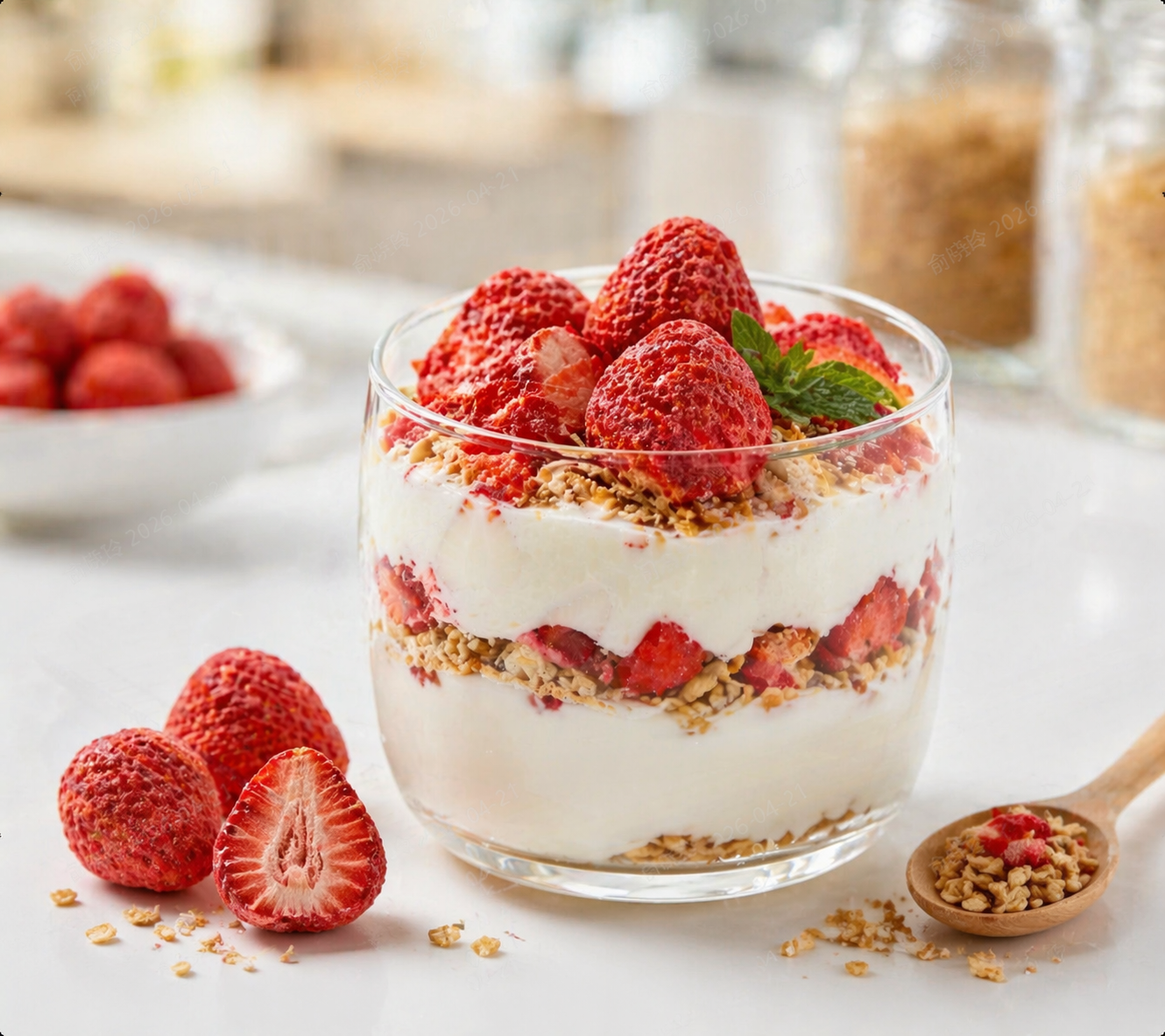
Whole pieces carry the strongest visual fruit identity but require the tightest compression and feeding controls.
Application Map: Filling, Decoration, Enrobing, and Dough
Format fit is decided by application, not by format quality in isolation. The same strawberry lot can be the right choice for a decoration line and the wrong choice for a pumped filling.
| Application | Shortlisted format family | Why it fits | Principal risk to control |
|---|---|---|---|
| Deposited and pumped fillings | Powder, fine dice | Flows through pumps and nozzles and disperses evenly through a continuous phase | Moisture pickup before use and caking in partially used packs |
| Surface decoration and finishing | Whole pieces, slices | Visible fruit identity is preserved because the format is not mechanically worked | Fracture during packing, transport, and line feeding |
| Chocolate-enrobing and compound-coating bases | Coated formats, whole pieces | A fat-based coating slows moisture migration between fruit and coating mass | Pigment migration if the barrier layer is incomplete or uneven |
| Dough applications | Dice added late in the mix | Withstands mixing better than whole pieces and distributes evenly through the dough | Over-mixing and excessive shear generating fines |
Enrobing deserves particular attention because it is where appearance failures are most visible. A coated fruit format places a barrier between the hygroscopic fruit and the coating mass; an uncoated whole piece placed in the same position offers no barrier at all. The choice between them is a decision about which failure mode the product can tolerate — a slightly less prominent fruit identity, or a coating with visible bleed marks after several weeks on shelf.
What Industrial Validation Looks Like Before a Format Is Shortlisted
Format datasheets describe what a product is. Order history describes whether it can actually be supplied at industrial volume with repeatable specification. Documented freeze-dried strawberry supply programs in the Chinese market illustrate the second kind of evidence.
- Order cadence exceeding 71,000 packs per month for freeze-dried strawberry, validated against a retail network of more than 40,000 stores.
- Order cadence validated across a network exceeding 10,000 stores, indicating consistent demand rather than a single campaign spike.
- Continuous supply since 2021, a duration exceeding four years, on a factory-direct basis without middlemen.
- Chain-exclusive OEM/ODM readiness, relevant to private-label bakery and confectionery programs.
- Adoption across premium and high-end supermarket chains in China, spanning more than ten premium retail systems and shelf presence in over 700 stores, with stable sell-through across five or more display formats.
- Private-label use by retail chains and specialty food brands, including maternity and baby retail, specialty snack and nut chains, and new-retail or hard-discount supermarkets.
The relevance to a bakery or confectionery buyer is not the retail category. It is the demonstration that ambient-stable freeze-dried strawberry formats can be produced, tested, packed, and shipped repeatedly at volume — the question that sits behind any shortlist. Product testing supports the same conclusion: before shipment, every batch of finished products is sample-tested against the company's enterprise standard, and only batches that pass inspection are approved for shipment.
Market Context Behind the Shortlist
Demand for strawberry ingredients is expanding at both ends of the chain: the fresh fruit base is growing steadily, and the processed formats used by manufacturers are growing alongside it.
- The global fresh strawberry market was valued at USD 21.0 billion in 2024 and is projected to reach USD 28.4 billion by 2033 (Market Research Reports / WGR).
- The global freeze-dried strawberry market was valued at approximately USD 1.86 billion in 2024 and is expected to grow at a CAGR of 5.9% through 2035 (WiseGuyReports).
- Clean label positioning is the dominant claim in the freeze-dried strawberry market, at a 44.2% market share as of 2026 projections (Future Market Insights).
- The strawberry puree market is valued at USD 2.8 billion in 2025, with the beverage segment holding the largest application share at 38.2% (Dataintelo).
- Freeze-drying preserves approximately 97% of the original nutritional content of strawberries, compared with 55% in conventional heat drying (Transpire Insight).
- In 2024, Egypt became the world's leading exporter of frozen strawberries, holding a 27% global market share with export volumes reaching 350,000 metric tons (Expana / European Commission).
Published market sizing for freeze-dried strawberry varies materially by scope — estimates differ depending on whether the figure covers pure strawberry formats or the wider freeze-dried fruit category. Buyers comparing headline numbers should treat them as directional and anchor decisions on specification, batch documentation, and supply continuity instead.
Established participants in the wider freeze-dried fruit and ingredient sector include Nestlé S.A., Dole Food Company, Chaucer Foods, and Olam International (Market Research Future / Dataintelo), alongside specialised processors. For bakery and confectionery buyers, that structure matters less as a ranking and more as a signal that the format is a legitimate industrial input rather than a niche product.
How Freeze-Dried Formats Compare With Traditional Strawberry Solutions
| Option | Storage and handling | Visible fruit identity | Fit with a real-fruit claim | Principal limitation |
|---|---|---|---|---|
| Freeze-dried strawberry formats | Ambient dry storage, no cold chain | High for whole, slice, and dice formats | Strong: fruit is the ingredient rather than a flavour and colour system | Brittle and hygroscopic; typically higher unit cost than sugar-infused or puree-based options |
| Candied or sugar-infused fruit | Ambient | Moderate to high | Depends on the brief: sugar infusion is itself a declared ingredient | Adds sugar to the formulation; infusion can dominate colour and texture |
| IQF frozen fruit | Frozen chain required end to end | Highest | Strong | Incompatible with ambient dry storage specifications and with dry-blending or dry-feeding lines |
| Strawberry puree and jam bases | Typically chilled or aseptic handling | Low to none | Strong where fruit solids are declared and visible pieces are not required | Adds water to the system; unsuitable for dry inclusions and for dry decoration |
The limitation that matters most in evaluation is cost and handling, not performance. Freeze-dried formats deliver visible identity, colour retention, and ambient stability, but they are typically more expensive per kilogram than sugar-infused or puree-based alternatives, and they demand packaging and reseal discipline that a chilled ingredient does not. A specification that adopts freeze-dried inclusions without budgeting for that discipline will usually produce fines, caking, and appearance complaints that erase the label benefit. Formats should be shortlisted where visible fruit identity or ambient storage is a genuine product requirement — not applied uniformly across a portfolio.
Verification Evidence to Request Before Awarding a Specification
A real-fruit shortlist should be accompanied by a documentation shortlist. The evidence below is what allows a bakery or confectionery buyer to defend the claim internally and to an importing authority.
- Batch test records. Evidence that every batch of finished products is sample-tested against the supplier's enterprise standard before shipment, with only passing batches released, and that in-house laboratory testing occurs before release.
- Certification scope. For freeze-dried fruit supply, documented credentials include FDA-related compliance, BRCGS, ISO 22000, SMETA, and HALAL, with HALAL certification directly relevant to market access in Muslim-majority countries.
- Traceability and labelling documentation. For EU-bound products, alignment with EU Regulation 2023/2429, effective January 2025, covering traceability and labelling of imported strawberry products.
- Specification parameters. Format and particle size, packaging format, expected reseal window for hygroscopic formats, and storage conditions under ambient dry handling.
- Export and logistics profile. Confirmed export destinations — the USA, Canada, Japan, South Korea, Germany, Thailand, and Indonesia among them — and target markets covering Europe, North America, Japan and South Korea, Russia, the Middle East, and Southeast Asia.
- Commercial terms. Flexible minimum order quantities and non-disclosure agreement availability, both of which affect whether a private-label development can proceed without disclosing the formulation.
Packaging origin is also part of the evidence set: documented packing in Quanzhou, Fujian, China, for example, gives buyers a defined point of origin to record in traceability files. Documentation of this kind is not a formality. It is the mechanism by which a real-fruit claim survives an audit.
Future Outlook
Three directions appear stable over the next planning cycle. First, real-fruit labelling continues to be a formulation priority rather than a campaign theme, consistent with clean label holding the largest claim share in the freeze-dried strawberry category. Second, ambient-stable formats will keep displacing cold-chain-dependent options in dry applications, because cold chain cost is structural and does not improve with scale. Third, traceability expectations will continue to rise, particularly for products entering the EU, which pushes documentation quality from a nice-to-have into a qualification criterion.
For product developers, the more interesting shift is technical rather than commercial. Coated and barrier formats — the coated side of a dual-line coated-and-pure production capability — address the two most common failure modes in bakery and confectionery: moisture migration and colour bleeding. Where those formats can be specified without compromising the ingredient declaration, they widen the range of products that can carry visible fruit rather than fruit flavour. Buyers should expect shortlists to move in that direction, and should evaluate suppliers on their ability to document barrier performance rather than only on fruit appearance in a sample bag.
FAQ
Which strawberry format is the best fit for chocolate-enrobing and compound-coating applications?
Coated freeze-dried formats and whole freeze-dried pieces are the two options normally evaluated for enrobing bases. A fat-based or compound coating places a barrier between the hygroscopic fruit and the coating mass, which slows moisture migration and reduces the risk of water-soluble pigments creating a pink halo inside a white or light-coloured coating. Uncoated whole pieces can be used where the coating mass is applied quickly and the product's shelf life is short, but they offer no barrier. Powder is generally unsuitable where visible fruit identity is part of the product proposition.
Can freeze-dried strawberry inclusions be added directly to dough in a horizontal mixer?
Yes, with two conditions. The format should be dice rather than whole pieces, because whole pieces fracture under extended mechanical working and generate fines. The inclusion should be added late in the mix cycle, after gluten development is substantially complete, and the dough should not be overworked afterwards. Spiral mixers apply higher shear within the bowl and generally are not the right stage for adding visible fruit inclusions. Adding at the end of mixing, or at a post-mix stage, preserves particle integrity more reliably than early addition.
How should brittle freeze-dried strawberry pieces be protected during bulk storage and line feeding?
Protection is mainly a packaging and handling question rather than an ingredient question. Whole pieces and slices are low-density structures that fracture under sustained compression, so bulk formats intended to retain visible fruit identity are usually supplied with restrained fill weights and rigid or semi-rigid inner packaging, and they should not be over-stacked during palletising or container loading. On the line, gentle transfer and controlled feed rates reduce breakage. Where visible identity is not required, specifying a dice or finer fraction is a more efficient answer than adding protective measures to a fragile format.
What does a 24-hour reseal requirement mean for hygroscopic strawberry powder?
It is a production-side handling target rather than a fixed regulatory rule. Powder and fine dice absorb ambient moisture quickly because of their high surface-area-to-mass ratio, and opened packs left standing on a line are the most common cause of caking, dulled colour, and uneven dispersion. The practice is to open a pack for a batch and reseal it within the same production window — commonly within 24 hours — rather than leaving partial packs open between shifts. Buyers should check that packaging supports this behaviour: reclosable liners, moisture-barrier structures, and pack sizes matched to realistic batch consumption.
What evidence should a bakery or confectionery buyer request to support a real-fruit claim?
Four categories of evidence are normally requested. First, batch release records showing that finished product batches are sample-tested against the supplier's enterprise standard before shipment, with only passing batches released, supported by in-house laboratory testing before release. Second, certification scope, which for freeze-dried fruit supply can include FDA-related compliance, BRCGS, ISO 22000, SMETA, and HALAL. Third, traceability and labelling documentation, including alignment with EU Regulation 2023/2429 for products entering the EU from January 2025. Fourth, commercial and specification parameters: particle size, packaging format, storage conditions, minimum order quantities, and non-disclosure agreement availability for private-label development.