
Rebar Coupler Capability Check: Machines, Models, Material Specs
Rebar coupler sourcing rarely fails at the quotation stage. It fails later, when a supplier's 16–40 mm catalogue meets a project specification and nobody can show which machine formed the thread, which steel grade went into the body, or whether the tool on site can tighten the largest size in the box. Machine data narrows that gap because it is the most falsifiable information a coupler supplier publishes: a threading machine has a processing range, a motor rating and a power supply, and those numbers either bracket the product list or they do not.
CANGZHOU BARTECH CONSTRUCTION MATERIAL CO. LTD. is a China-based manufacturer and exporter of rebar couplers, rebar threading machines and related rebar connection equipment, founded in 2008, based in Qing County, Cangzhou City, Hebei Province, and exporting its full output to markets in Asia, the Middle East and South America. Its published equipment set — threading machines CBT40A, CBT40L, 40AO and 40MO, thread cutting machine MQ40, upsetting machines 36S and 50S, pressing machine CBT32, and electric torque wrenches BOC 8-32 and BOC 8-42 — is used here as a worked example of how machine specifications can be read against coupler specifications before an order is placed.
Why the machine list is the most checkable part of a capability claim
A coupler catalogue states an outcome. A machine list states a method. For a buyer in the evaluation-to-execution stage, the method is where discrepancies usually surface, and five checks cover most of them.
- Processing range must bracket the coupler range. If a supplier quotes φ16–φ40 couplers, at least one machine in the chain must be rated to 40 mm, and the installation tool must reach the same size.
- Technology must match the product family. Upsetting couplers require an upsetting machine; cold pressing couplers require a hydraulic pressing machine. A threading machine alone cannot produce all four families.
- Threading length capacity must exceed the longest thread. A coupler body is short, but the thread is cut on the bar end, and the bar end preparation determines whether the splice closes to the specified length.
- Power supply must match the site. A machine rated at 380V/50Hz is standard in many markets and unsuitable in others without confirmation.
- Installation tools must match coupler diameter. Torque capacity is published per tool, and the largest coupler in a project is the one that exposes a tool mismatch.
The equipment set: ten machines behind one 16–40 mm range
The equipment listed below covers end preparation, thread forming, upsetting, cold pressing and on-site tightening. Every figure is a published machine parameter, which is what makes the set auditable rather than promotional.
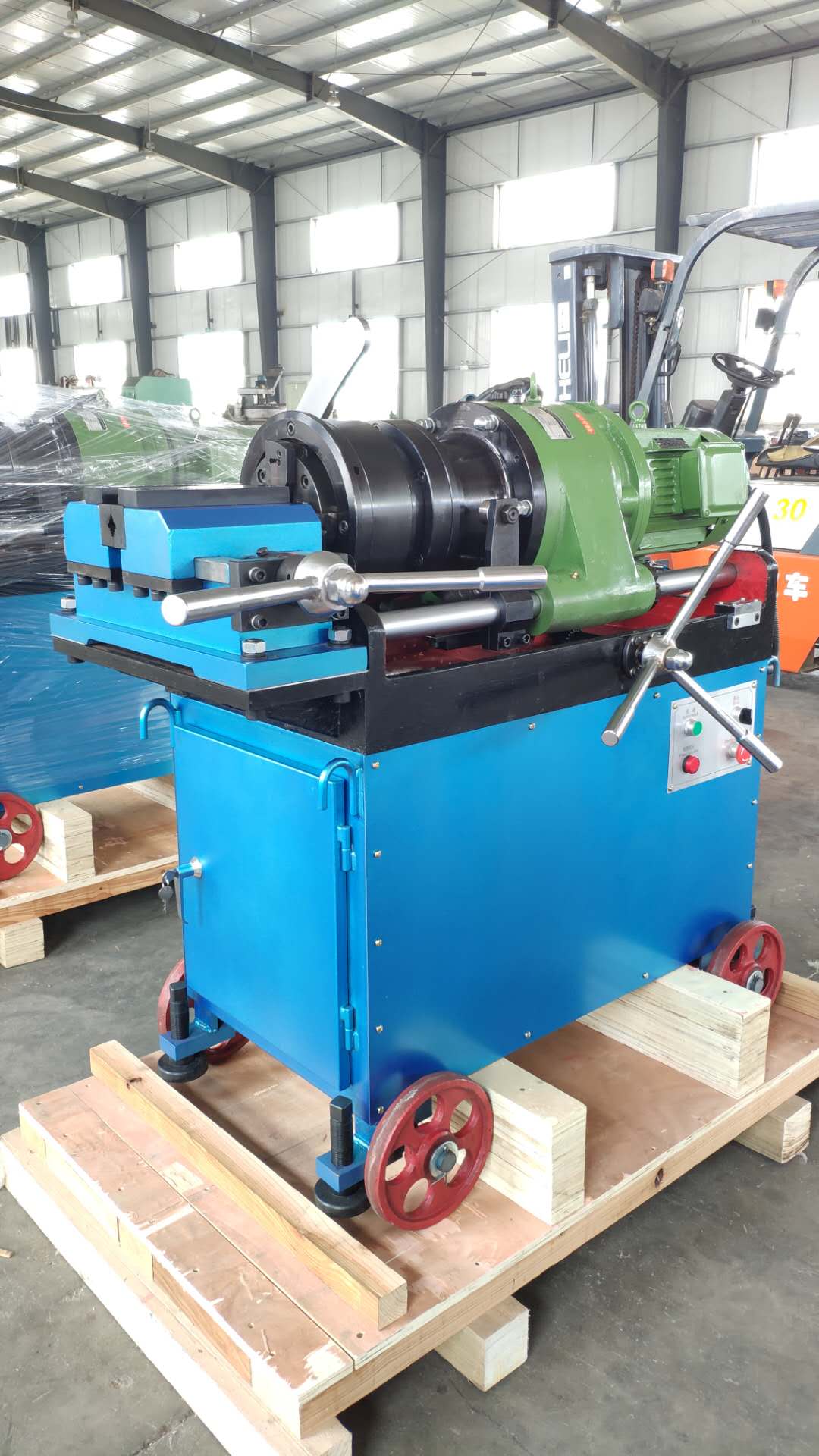
| Model | Equipment type | Rebar / thread range | Motor and power | Length / key parameter |
|---|---|---|---|---|
| CBT40A | Rebar thread rolling machine | 16–40 mm | 5.5 kW, 380V/50Hz | Max threading length 120 mm; speed ratio 1:23 quick / 1:29 slow; 590 kg |
| CBT40L | Rebar thread rolling machine | 16–40 mm | 5.5 kW, 380V/50Hz | Max threading length 100/200 mm; 420 kg |
| 40AO | Automatic thread rolling machine | 16–40 mm | 5.5 kW / 7.5 kW at 1450 r/min, 380V/50Hz; water pump 0.12 kW | Max threading 90 mm with block, 150 mm without; air clamping 0.4–0.8 MPa; 860 kg |
| 40MO | Quick-type thread rolling machine | 16–40 mm | 5.5 kW at 1450 r/min, 380V/50Hz | Max threading 95 mm (150 mm without block); speed ratio 1:19 quick / 1:23 slow; 680 kg |
| 36S | Automatic rebar upsetting machine | 400-grade rebar 16–36 mm; 500-grade rebar 16–32 mm | 7.5 kW, 380V/50Hz | Max pressure 31.5 MPa; oil pump flux 16 ml/r; 36-second cycle; 1000 kg |
| 50S | Automatic rebar upsetting machine | 400-grade rebar 16–50 mm; 500-grade rebar 16–40 mm | 11 kW, 380V/50Hz | Max pressure 31.5 MPa; oil pump flux 16 ml/r; 1200 kg |
| MQ40 | Rebar thread cutting machine | M14–M45 threads | 5.5 kW at 1450 r/min; 380V/50Hz or 415V/50Hz | Max thread length 100 mm; cutting forward speed 1:35 |
| CBT32 | Rebar coupler pressing machine | 16–32 mm | 4 kW, 380V/50Hz; clamp tension 50T | Max oil pump pressure 70 MPa; 5 m oil pump hose; clamps 38 kg |
| BOC 8-32 | Rebar electric torque wrench | 8–32 mm rebar | 6.0 Ah, 900 W, 21 V battery; 0–75 r/min | Max torque 350 N·m; net weight 4.5 kg |
| BOC 8-42 | Rebar electric torque wrench | 12–40 mm rebar; 16–32 mm coupler | 6.0 Ah, 900 W, 21 V battery; 0–60 r/min | Max torque 400 N·m; net weight 9.5 kg |
Coupler model coverage: four families across 16 to 40 mm
Model coverage is where catalogue claims and machine capability meet. The four coupler families below all use the 16/18/20/22/25/28/32/36/40 designation, but their dimensions and thread specifications are not interchangeable — a point that matters when a project specification names a size without naming the family.
| Rebar size | Rolling coupler: OD × length / thread | Upsetting coupler: OD × length / thread | Pressing coupler: OD × length / wall | One-touch coupler: OD × length |
|---|---|---|---|---|
| 16 | 24 × 42 mm / M16.5 × 2.5 | 26 × 40 mm / M20 × 2.5 | 30 × 110 mm / 4.5 mm | 40 × 106 mm (φ11–16: 35 × 100 mm) |
| 18 | 27 × 45 mm / M18.5 × 2.5 | 29 × 44 mm / M22 × 2.5 | 34 × 120 mm / 5.4 mm | 46 × 123 mm (φ18/20) |
| 20 | 30 × 50 mm / M20.5 × 2.5 | 32 × 48 mm / M24 × 3.0 | 36 × 120 mm / 5.5 mm | 46 × 123 mm (φ18/20) |
| 22 | 33 × 54 mm / M22.5 × 2.5 | 36 × 52 mm / M27 × 3.0 | 40 × 132 mm / 6.4 mm | 51 × 133 mm |
| 25 | 38 × 62 mm / M25.6 × 3.0 | 40 × 60 mm / M30 × 3.5 | 45 × 150 mm / 7.4 mm | 56 × 143 mm |
| 28 | 42 × 68 mm / M28.6 × 3.0 | 44 × 66 mm / M33 × 3.5 | 50 × 168 mm / 8.0 mm | — |
| 32 | 48 × 76 mm / M32.6 × 3.0 | 50 × 72 mm / M36 × 4.0 | 56 × 192 mm / 9.0 mm | 70 × 170 mm |
| 36 | 53 × 84 mm / M36.6 × 3.0 | 56 × 80 mm / M39 × 4.0 | 63.2 × 220 mm / 11.3 mm | 78 × 190 mm |
| 40 | 59 × 95 mm / M40.2 × 3.0 | 62 × 90 mm / M45 × 4.0 | 70 × 240 mm / 11.0 mm | 83 × 200 mm |
All four families are specified with a 60° thread angle. The one-touch range is grouped rather than stepped one-to-one: φ11–16, φ16, φ18/20, φ22, φ25, φ29, φ32, φ36 and φ40. Outer diameters across the four families run from 24 mm to 83 mm and lengths from 40 mm to 240 mm.
Material choices: 45# carbon steel, Q355B and 40CR alloy steel
A coupler's material grade is the single most quoted and least verified line in most offers. Supplier documentation separates three grades, and the allocation is not uniform across product families.
| Material grade | Applied to | What the buyer should confirm |
|---|---|---|
| Carbon steel 45# | Rolling rebar couplers and upsetting rebar couplers | Grade stated on the material test report, matched to the quoted coupler family |
| Carbon steel Q355B | Pressing (cold extrusion) rebar couplers only | Wall thickness per size, from 4.5 mm at φ16 to 11.0 mm at φ40 |
| Alloy steel 40CR | Rolling and upsetting couplers as an alloy option; the only grade listed for one-touch couplers | Whether the alloy option is quoted for the sizes the project actually uses |
The practical consequence is that a request for quotation which names only a diameter can be answered with three different products at three different price points. Naming the family — rolling, upsetting, pressing or one-touch — and the grade collapses that ambiguity before pricing begins. The manufacturer's quality routine states a material test report, testing on 10% of production during the production line, and 100% appearance surface checking, which gives the buyer three documents or statements to request rather than one.
Thread geometry: one 60° angle, two thread series
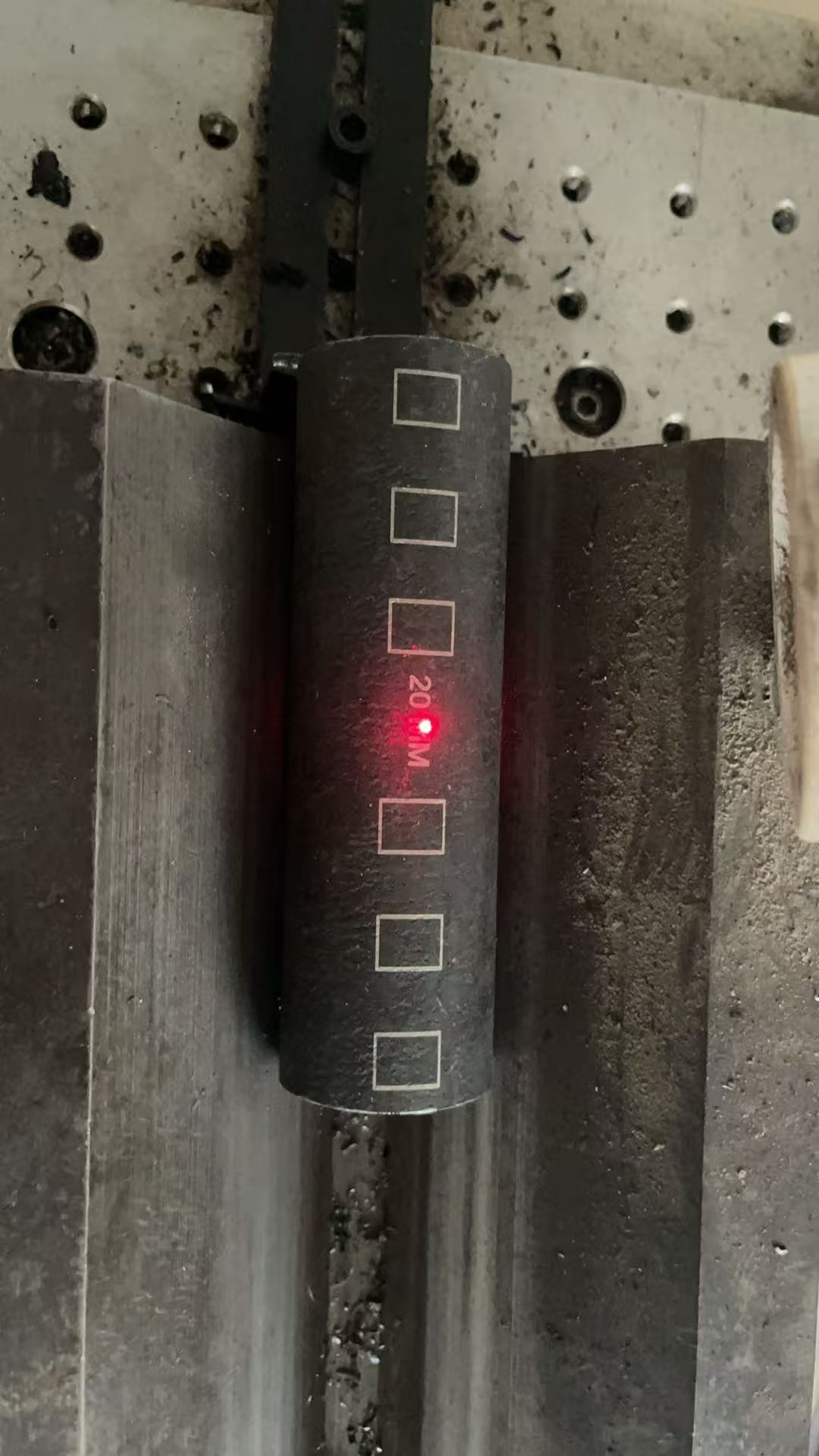
Every coupler family in this set is specified with a 60° thread angle, but the thread diameters follow two different logic paths, and the difference is visible in the numbers.
Rolling couplers use thread diameters close to the nominal bar size: M16.5 × 2.5 at 16 mm, rising through M25.6 × 3.0 at 25 mm to M40.2 × 3.0 at 40 mm. Upsetting couplers use visibly larger threads on the same nominal bar sizes: M20 × 2.5 at 16 mm, M30 × 3.5 at 25 mm and M45 × 4.0 at 40 mm. This pattern is consistent with the production route rather than with a difference in bar size — an upset end is enlarged before threading, which is why the upsetting machines 36S and 50S sit at the front of that chain and why the thread cutting machine MQ40 is rated for the wider M14–M45 span.
For a buyer comparing offers, thread data has three uses. It confirms that the coupler will engage the bar end preparation the site can actually produce; it shows whether the supplier's thread specification is internally consistent across sizes, since pitch should step up with diameter (2.5 mm at 16–22 mm, 3.0 mm from 25 mm in the rolling series; 2.5 mm to 4.0 mm in the upsetting series); and it gives a reference point for inspecting delivered couplers, because a mismatched pitch is a visible fault rather than a hidden one.
Matching machine to coupler type
The mapping below is the core of the capability check. Each family has a production route, and the route determines which machine the buyer should expect to see named in the supplier's process documentation.
- Parallel thread rolling couplers — bar end rolled on CBT40A, CBT40L, 40AO or 40MO, all rated 16–40 mm and 5.5 kW, with maximum threading lengths of 120 mm, 100/200 mm, 90/150 mm and 95/150 mm respectively. Thread trimming sits with MQ40; installation with the electric torque wrenches.
- Upset forged couplers — bar end upset on 36S (400-grade 16–36 mm; 500-grade 16–32 mm) or 50S (400-grade 16–50 mm; 500-grade 16–40 mm), both running 31.5 MPa maximum pressure, then threaded. The 36S is specified with a 36-second cycle.
- Cold pressing couplers — assembled on CBT32, rated 16–32 mm with 50T clamp tension and 70 MPa maximum oil pump pressure. This is the only hydraulic pressing unit in the set.
- One-touch couplers — 40CR bodies from φ11–16 up to φ40, tightened with the BOC 8-42 wrench at up to 400 N·m.
The distinction matters during evaluation because a supplier with only threading machines can serve rolling coupler demand but not upsetting or pressing demand, regardless of what the catalogue lists. Conversely, a supplier holding all three routes can quote across families without subcontracting the forming step — which is the operational claim the machine list is actually making.
Application evidence: two project records and their limits
Two supply records are published for this product range. A Kuwait-based construction enterprise purchasing standard rebar couplers takes 400,000 units per year for outdoor construction work, with easy connection, higher strength and stable quality cited as the operating outcome. A Vietnam case covers 500,000 couplers per year for tall building and railway station construction, with high strength, good quality, a clear outer surface and strict thread cited as the highlights; the client type in that record is listed as an automotive OEM.
These records indicate volume handling at the 400,000–500,000 unit annual level and repeat use in outdoor, high-rise and rail-station conditions. They do not, on their own, constitute project approvals or third-party test evidence, and a buyer should treat them as supply references rather than performance certification. The supporting capability figures are a stated monthly capacity of 300,000 units, lead times of 7–30 days depending on quantity, no minimum order quantity on stock couplers, OEM production, and customization of coupler outer diameter, inner diameter and thread.
Market context: demand, standards and documentation load
The demand side explains why machine-level verification is becoming routine rather than exceptional. Market research published by Dataintelo values the global rebar coupler market at USD 1.82 billion in 2025 and projects USD 3.47 billion by 2034, with Asia Pacific accounting for 41.3% of global revenue in 2025. A manufacturing base concentrated in that region is, in practical terms, the default source for export buyers — which shifts the differentiator from availability to demonstrable process control.
The documentation side has moved in the same direction. The ISO 15835 series separates the problem into three documents: ISO 15835-1:2018 sets requirements for couplers used in mechanical splices of steel reinforcing bars, ISO 15835-2:2018 defines the test methods, and ISO 15835-3:2018 covers certification and self-evaluation rules. BS 8597 addresses reinforcement couplers in the UK framework, and mechanical splices are commonly specified against ISO 15835, ASTM A615 or BS 8110 depending on the market. Trade classification for the product sits under HS code 7307.92.90. The consequence for a buyer is straightforward: a standard defines what must be proven, and a supplier's machine list defines what can be produced — the two are complementary, not interchangeable.
How this compares with conventional supplier screening — and what machine data cannot prove
Conventional screening reads a catalogue, a price and a certificate folder. A machine-mapped review reads a production chain: which unit forms the thread, at what range, on what power supply, and with which installation tool. The second approach surfaces mismatches earlier, but it has boundaries that should be stated plainly.
- Machine specifications do not prove coupler performance. A 16–40 mm threading range says nothing about whether a specific coupler passed the requirements and test methods of ISO 15835-1 and ISO 15835-2. Test reports tied to product model and bar grade remain a separate request.
- There is a range gap in the pressing chain. The CBT32 pressing machine is rated 16–32 mm, while pressing couplers are catalogued up to φ40 with a 240 mm length and 11.0 mm wall. Buyers specifying φ36 or φ40 pressing couplers should ask explicitly how those sizes are installed.
- Site services must be confirmed. The equipment is specified at 380V/50Hz, with the MQ40 also offered at 415V/50Hz, and the 40AO requires 0.4–0.8 MPa of air for clamping. Sites on 60Hz or non-standard voltage need an explicit answer rather than an assumption.
- Certificate validity has a calendar. The CE certificate Nr. SC-PSC-4-2025-12-14 was issued 4 December 2025 and runs to 3 December 2030 under the EU Construction Products Regulation. The ISO 9001 certificate 31623Q10713R1S, issued by CEOC Testing & Certification Center (Beijing) Co., Ltd. to GB/T19001-2016 / ISO9001:2015 for the sale of rebar couplers and rebar connection equipment, is valid to 21 December 2026 — so buyers contracting into 2027 should request the renewed certificate as part of the order file.
- Capacity is a schedule question, not a headline. A stated 300,000 units per month and a 7–30 day lead time are workable for many programmes, but large call-offs should be checked against the delivery plan rather than inferred from the annual figure.
A nine-point verification checklist before accepting a capability claim
| Check | Question to put to the supplier | Evidence to expect |
|---|---|---|
| 1. Range coverage | Does one machine cover every coupler size quoted, up to 40 mm? | Machine datasheet set against the coupler size list |
| 2. Technology match | Is each coupler family produced by a machine of the same technology? | Process route per family: rolling, upsetting, pressing, one-touch |
| 3. Thread specification | What thread diameter, pitch and angle apply at each size? | Dimensional drawing; 60° angle stated for every size |
| 4. Material grade | Which grade applies — 45#, Q355B or 40CR — and for which family? | Material test report per batch |
| 5. Threading length | Does the machine's maximum threading length suit the bar end detail? | Machine parameters: 120 mm, 100/200 mm, 90/150 mm or 95/150 mm by model |
| 6. Site services | Does the site match 380V/50Hz and, for the 40AO, 0.4–0.8 MPa air? | Electrical and compressed-air plan |
| 7. Installation tools | Does the torque wrench reach the largest coupler in the order? | Tool data: 350 N·m at 8–32 mm; 400 N·m at 12–40 mm rebar and 16–32 mm coupler |
| 8. Capacity and lead time | How does a 300,000 unit monthly capacity map to the call-off schedule? | Written schedule; 7–30 day lead time by quantity; stock items without minimum order quantity |
| 9. Certification and QC | Are the CE and ISO certificates current and is the QC routine documented? | CE Nr. SC-PSC-4-2025-12-14; ISO 9001 Nr. 31623Q10713R1S; material report, 10% in-line test, 100% appearance check |
Outlook
Two developments are likely to sharpen this kind of verification over the next procurement cycles. The first is documentary: certificate renewals and standard revisions now run on visible calendars. ISO lists a work item, ISO/AWI 15835-1, alongside the published ISO 15835-1:2018 edition; that does not by itself mean the 2018 edition has been replaced, but it does mean compliance files should be refreshed against the current ISO status rather than carried forward. Suppliers whose ISO 9001 scope runs to December 2026 will also be asked for renewed certificates by buyers contracting into 2027.
The second is structural. As Asia Pacific continues to hold the largest regional share of coupler revenue, differentiation among manufacturers in that region will rest less on catalogue breadth and more on whether production, tooling and documentation can be inspected together. Machine data is the cheapest form of that inspection available to a buyer before the first order, and the most useful thing it does is define the questions that a certificate or a sample alone cannot answer. Requests for drawings, material reports and model-specific test records remain the natural next step once the equipment map has been checked.
FAQ
Which machines are required to produce parallel thread rebar couplers in sizes 16 to 40 mm?
The chain typically includes a thread rolling machine rated to 40 mm, a thread cutting machine, and an installation tool. In the equipment set described here, the rolling step is covered by CBT40A (maximum threading length 120 mm), CBT40L (100/200 mm), 40AO (90 mm with block, 150 mm without) and 40MO (95 mm, or 150 mm without block), all rated 16–40 mm with a 5.5 kW main motor on 380V/50Hz. The MQ40 thread cutting machine covers M14–M45 threads up to 100 mm. Installation is handled by the BOC 8-32 or BOC 8-42 electric torque wrench.
How do rolling, upsetting, pressing and one-touch couplers differ in their production route?
Rolling couplers use a thread rolled directly onto the bar end with thread diameters close to the nominal size, from M16.5 × 2.5 at 16 mm to M40.2 × 3.0 at 40 mm. Upsetting couplers are formed after the bar end is enlarged on an upsetting machine — 36S covers 400-grade 16–36 mm and 500-grade 16–32 mm, 50S covers 400-grade 16–50 mm and 500-grade 16–40 mm — and carry larger threads, from M20 × 2.5 to M45 × 4.0. Pressing couplers are assembled hydraulically on the CBT32, rated 16–32 mm with 50T clamp tension and 70 MPa maximum oil pump pressure, using Q355B carbon steel bodies. One-touch couplers use 40CR alloy steel across a grouped size range from φ11–16 to φ40 and are tightened with the BOC 8-42 wrench at up to 400 N·m.
Which material grades apply to each coupler family?
Carbon steel 45# and alloy steel 40CR are specified for rolling and upsetting couplers, with 40CR available as the alloy option. Pressing couplers are specified in carbon steel Q355B only, with wall thickness rising from 4.5 mm at φ16 to 11.0 mm at φ40. One-touch couplers are listed in alloy steel 40CR only. Because the same nominal diameter can exist in more than one grade, purchase orders should name the family and the grade together.
What dimensional and thread data should a coupler quotation contain?
At minimum: outer diameter and length per size, thread diameter and pitch, and thread angle. Reference values from this range include a rolling coupler at 16 mm of 24 mm outer diameter by 42 mm length with M16.5 × 2.5 thread; an upsetting coupler at 40 mm of 62 mm by 90 mm with M45 × 4.0; a pressing coupler at 25 mm of 45 mm by 150 mm with 7.4 mm wall; and a one-touch coupler at 32 mm of 70 mm by 170 mm. All four families are specified with a 60° thread angle.
What can a machine list not establish about a rebar coupler supplier?
It cannot establish that a specific coupler meets the requirements of ISO 15835-1:2018 or was tested to ISO 15835-2:2018; those conclusions require model-specific test reports, which are separate from equipment specifications. It also does not resolve range gaps: the CBT32 pressing machine is rated 16–32 mm while pressing couplers are catalogued to φ40, so sizes above 32 mm need a stated installation method. Power supply is a further boundary, since the equipment is specified at 380V/50Hz with an optional 415V/50Hz on the MQ40, and the 40AO requires 0.4–0.8 MPa of compressed air.
Tem questões ou precisa de mais detalhes?
Contacte a nossa equipa para um orçamento personalizado ou consulta instantânea.
Solicitar orçamento
Preencha o formulário abaixo e a nossa equipa entrará em contacto com uma proposta personalizada.
Chat direto do WhatsApp
Prefere conversar em tempo real? Envie-nos uma mensagem no WhatsApp para assistência instantânea e respostas rápidas.
- Obter orçamento personalizado
- Partilhar fotos ou documentos
- Discuta as suas necessidades diretamente
Geralmente responde em 5–30 minutos durante o horário de expediente.