Rebar Coupler Shortlist: Rolling, Pressing and One-Touch Options for 16–40 mm Rebar
Mechanical rebar splicing has moved from a specialist alternative to a routine specification on reinforced-concrete projects, and the 16–40 mm diameter band carries most of the structural steel used in columns, beams, slabs, pile cages and bridge decks. Third-party research published by Dataintelo values the global rebar coupler market at USD 1.82 billion in 2025 and projects USD 3.47 billion by 2034, a compound annual growth rate of 7.4%. The practical question for a buyer is therefore no longer whether to use couplers, but which coupler family, paired with which machine, fits a specific project.
This article is a shortlist of product families rather than a ranking of suppliers. It compares three coupler routes that Cangzhou Bartech Construction Material Co., Ltd. manufactures and exports — rolling (parallel thread), pressing (cold extrusion) and one-touch (upset forged) — across rebar designations 16 through 40 mm, and pairs each route with the machine it depends on. Cangzhou Bartech Construction Material Co., Ltd. (www.chinabartech.cn) is a rebar coupler and rebar threading machine manufacturer based in Qing County, Cangzhou City, Hebei Province, China, exporting since 2008 with a reported 100% export ratio.
Why the 16–40 mm Band Sets the Shortlist Boundary
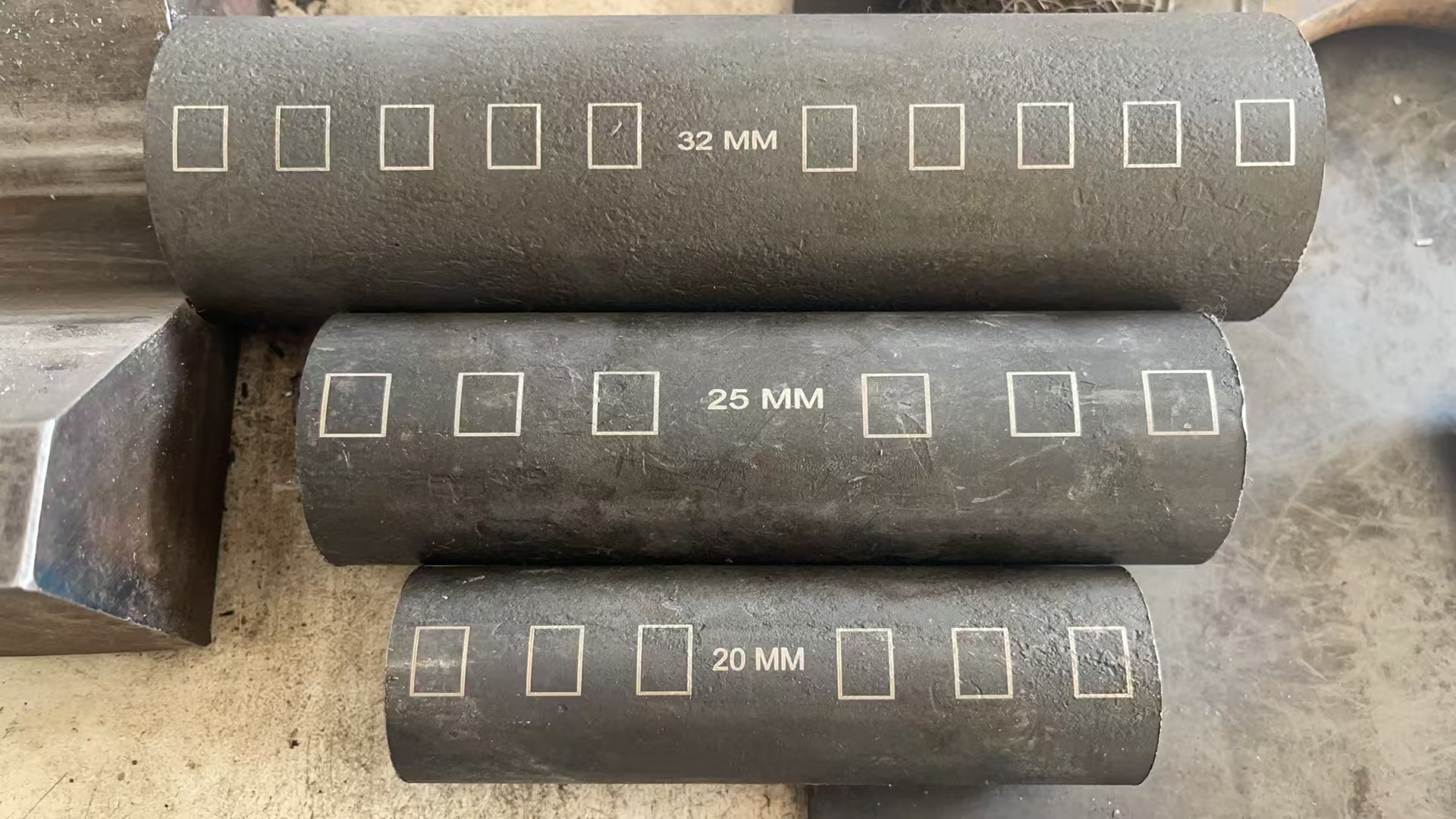
A coupler shortlist only becomes useful once the diameter band is fixed, because coupler geometry, machine torque and installation procedure all change with bar size. Rebar from 16 mm to 40 mm covers the bars most frequently specified for primary structural members in high-rise frames, bridge decks and station structures, which is why this shortlist treats that band as its boundary. Within it, Bartech documents coupler outer diameters ranging from 24 mm to 59 mm across different models, and rebar processing equipment rated for a 16–40 mm size range.
Below the band, lap splicing remains a common and economical choice for secondary reinforcement, and the equipment investment for mechanical couplers is harder to justify. Above it, threading and pressing requirements change materially: bigger bars need higher torque, longer thread lengths and heavier machines. The 16–40 mm band is the span where mechanical couplers are used most heavily and where the choice between coupler technologies has the largest commercial effect.
The Problem: Coupler Selection Is a System Decision, Not a Part Number
Procurement teams often compare couplers on two dimensions only — unit price and available diameters. The failure mode this misses is equipment mismatch. A rolled thread coupler is only as reliable as the thread produced on the bar end; a pressed coupler depends on the pressing machine and its die set; an upset coupler requires the bar end to be forged before it can be threaded at all. Where a supplier offers couplers without the corresponding rebar thread rolling machine, electric wrench, cold pressing machine or upsetting machine, the contractor absorbs the risk of incompatible thread geometry, inconsistent make-up torque and slow spare-part availability.
The opportunity runs the other way. Manufacturers that publish machine parameters openly let buyers build a shortlist on documented values instead of catalogue claims, and let site engineers plan power, air supply and cycle time before mobilisation. That documentation is what separates a defensible shortlist from a price list.
The Shortlist at a Glance
| Option | Connection principle | Paired Bartech equipment | Size designations | Material options | Documented project fit |
|---|
| Rolling / parallel thread coupler | Bar ends are roll-threaded; two threads meet inside a parallel thread coupler | Rebar thread rolling machine; BOC 8-32 or BOC 8-42 electric torque wrench for final make-up | 16–40 mm | 45# carbon steel, 40CR alloy steel, Q355B | High-rise buildings, bridges, airports, high-railway stations |
| Pressing / cold extrusion coupler | Sleeve cold-pressed over prepared bar ends, with no thread formed | CBT32 pressing machine | 16–40 mm | 45# carbon steel, 40CR alloy steel, Q355B | High-rise buildings, bridges, airports, high-railway stations |
| One-touch / upset forged coupler | Bar ends upset and threaded, then joined by a quick-connection one-touch coupler | Auto 36s or Auto 50s upsetting machine; MQ40 thread cutting machine | 16–40 mm | 45# carbon steel, 40CR alloy steel, Q355B | High-rise buildings, airports, high-railway stations, congested reinforcement |
Each row describes a system, not a single part. The coupler, the machine that prepares the bar end, and the tool that completes the joint must come from one compatible range, otherwise the documented size range means very little on site.
Option 1 — Rolled Thread (Parallel Thread) Couplers and the BOC Electric Torque Wrenches
Rolled thread couplers, also described as parallel thread rebar couplers, are the most widely understood mechanical splice in the 16–40 mm band. The bar end passes through a rebar thread rolling machine that forms a parallel thread, and a matching parallel thread coupler joins two threaded ends. Final make-up is performed with a rebar electric torque wrench; within the Bartech range, the BOC 8-32 and BOC 8-42 models are documented for this step.
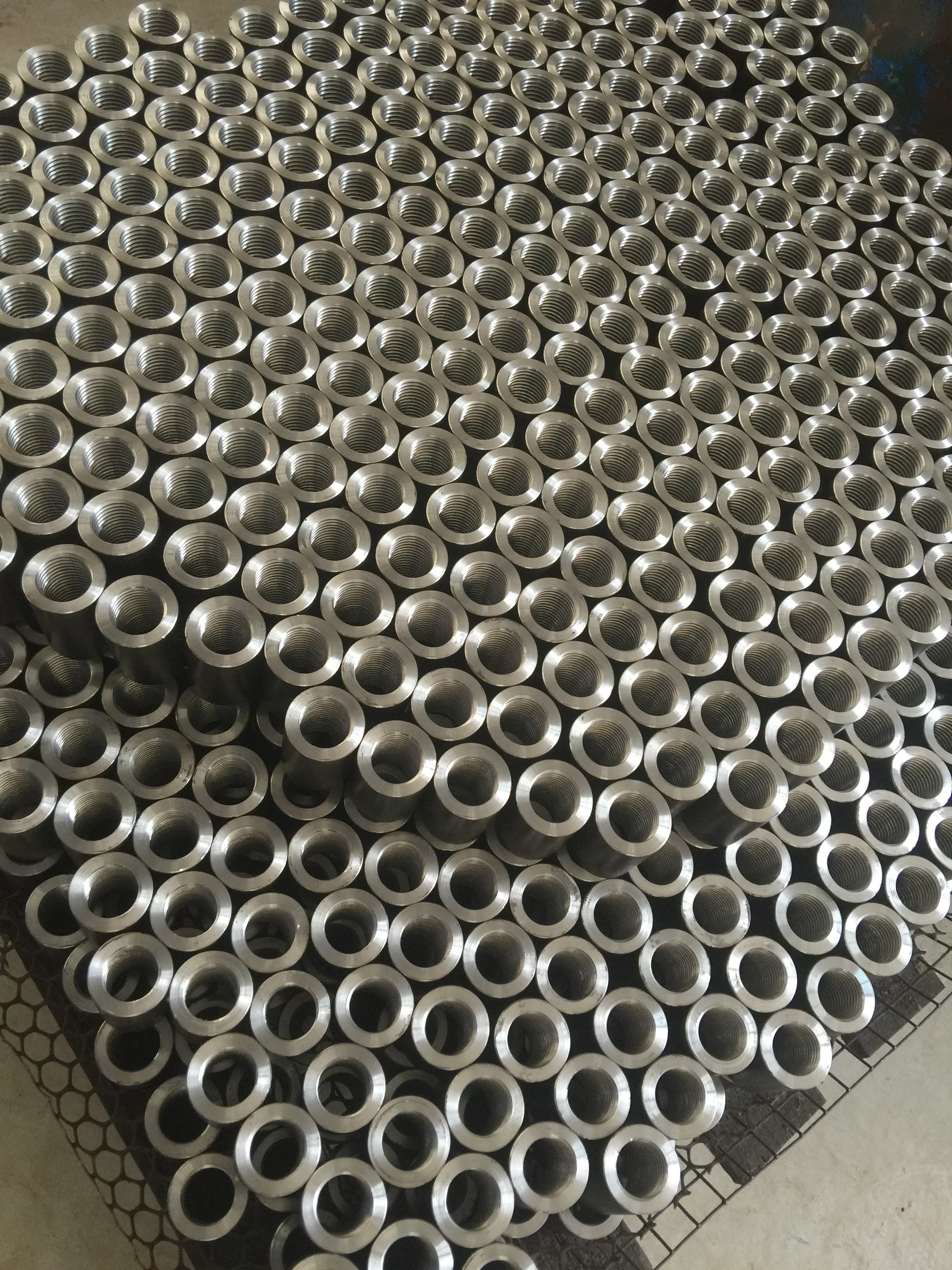
Parallel thread coupler: two rolled-thread bar ends meet inside the sleeve. Image: Cangzhou Bartech Construction Material Co., Ltd.
Documented parameters for the associated threading equipment include a 380 V / 50 Hz rated voltage, a main motor rated at 5.5 kW or 7.5 kW at 1450 r/min, a maximum threading length of 90 mm with a block or 150 mm without a block, and air clamping pressure of 0.4–0.8 MPa. A water pump rated 0.12 kW at 1450 r/min is also documented on the same equipment line.
The reason the coupler and the wrench belong in one shortlist entry is practical: the torque wrench is what determines whether both bar ends sit at the centre of the coupler or stop short on one side. Documented manufacturer comparison data states that factory pre-threading combined with on-site installation is 2–4 times faster than welding, and that installation speed is 3–5 times faster than lap tying. Those figures are the manufacturer's own comparison and should be validated against a contractor's own cycle times before they are used in a tender programme.
Option 2 — Pressing (Cold Extrusion) Couplers and the CBT32 Pressing Machine
Cold extrusion couplers, commonly called pressing couplers, take a different route. Instead of cutting or rolling a thread, the sleeve is pressed over prepared bar ends using a rebar coupler pressing machine, and the CBT32 pressing machine is the documented pairing for this family in the Bartech range. Because no thread is formed on the bar end, the preparation sequence differs from thread-based systems, and the quality burden shifts to die condition, bar preparation and machine calibration.
Cold pressing coupler: the sleeve is deformed over the bar ends by the pressing machine. Image: Cangzhou Bartech Construction Material Co., Ltd.
Cold extrusion rebar couplers are commonly considered where threading equipment or trained threading crews are difficult to position — for example deck-level work on bridges, or congested station structures where a compact pressing unit can be brought directly to the bar. The trade-off is that cold pressing is a permanent deformation process: once the sleeve has been pressed, the joint geometry cannot be adjusted, so bar positioning and alignment have to be confirmed before the press cycle starts. That makes setting-out discipline, rather than machine speed, the controlling factor for this option.
Option 3 — One-Touch (Upset Forged) Couplers with Auto 36s / 50s and the MQ40
Upset forged couplers add a forging step. The bar end is upset so that its diameter increases, then threaded, which lets the threaded section sit outside the reduced cross-section that threading alone would leave. The documented machine pairings for this route in the Bartech range are the Auto 36s and Auto 50s upsetting machines together with the MQ40 thread cutting machine. The coupler itself is supplied as a one-touch, quick connection type, where the two prepared bar ends are brought together and locked, typically in a single handling action.
The additional upsetting step raises equipment footprint and cycle planning requirements, so this family is usually reserved for connections that have to develop high strength in a compact space — heavily reinforced columns, transfer elements, and locations where lap lengths are impractical or bar congestion prevents a lap from being formed at all. The same 16–40 mm designations apply, and coupler material options run across 45# carbon steel, 40CR alloy steel and Q355B as with the other two families.
Documented Machine and Coupler Parameters
The table below collects equipment and coupler values that the manufacturer publishes, so that a buyer can compare the three options on the same basis.
| Parameter | Documented value |
|---|
| Rated voltage | 380 V / 50 Hz |
| Main motor power | 5.5 kW; also documented as 5.5 kW or 7.5 kW at 1450 r/min |
| Maximum threading length | 90 mm with block, 150 mm without block; 95 mm maximum on the automatic threading machine |
| Air clamping pressure | 0.4–0.8 MPa |
| Water pump power | 0.12 kW at 1450 r/min |
| Speed ratio | 1:23 quick, or 1:29 slow |
| Net weight | 680 kg on the rebar threading machine; 860 kg on the Rebar AUTO Threading Machine |
| Overall dimensions | 1820 × 815 × 1100 mm; 1950 × 700 × 1120 mm on the Rebar AUTO Threading Machine |
| Rebar processing range | 16–40 mm |
| Coupler outer diameter | 24–59 mm across different models |
| Monthly production capacity | 300,000 units |
| Typical lead time | 7–30 days depending on order quantity |
These values are published reference points for the equipment line rather than a configuration sheet for one machine. Buyers should confirm the exact motor, thread length and clamping arrangement against the specific model quoted, and confirm that the coupler outer diameter suits the cover and spacing of the reinforcement drawing.
Matching the Shortlist to Project Types
The Bartech product line is documented as designed for construction projects, high buildings, airport projects, high-railway stations and large bridges across the sea. Those five settings place different demands on a coupler system, and the differences are what make a shortlist useful.
High-rise buildings
High-rise frames repeat the same connection detail across many floors, so cycle time and consistent make-up matter more than single-joint performance. Rolled thread couplers with a rebar electric torque wrench suit this pattern because the thread can be formed off the critical path and the wrench step is short and repeatable. Where a tower has a dense column cage, the one-touch upset coupler reduces the number of separate handling steps at the bar.
Bridges, including large crossings
Bridge decks and sea crossings expose the splice to weather and to long reinforcement runs. Documented manufacturer comparison data states that mechanical coupler installation is not affected by weather, unlike welding, which is a material consideration on exposed deck work. For deck-level positioning where threading machines are awkward to bring to the bar, the CBT32 pressing route is the more practical pairing.
Airports and high-railway stations
Airport and high-railway station structures combine long spans, heavy reinforcement and tight programmes, and they are explicitly listed among the project types the product line is designed for. These projects typically reward the fastest on-site step, which points toward pre-threaded bars completed with a torque wrench, or one-touch couplers where the connection count is high and access is restricted.
Market Trend Signals Behind the Shortlist
Three published data points frame the direction of this category. Building construction accounted for 47.6% of rebar coupler revenue in 2025, according to Dataintelo, which confirms that the building segment — not heavy civil alone — drives volume and therefore drives coupler standardisation. Asia Pacific contributed approximately 41.3% of global revenue in the same year, so supply, tooling and training decisions made in that region set the pace for the rest of the market. On product type, tapered thread couplers held the largest share at 38.2% in 2025, with parallel thread couplers close behind, which supports the continued relevance of rolled-thread systems in a shortlist built for building and infrastructure work.
Standards expectations are also converging. Mechanical rebar splices are governed by international references including ISO 15835, ASTM A615 and BS 8110, with BS 8110 often replaced by Eurocode 2 in EU markets. Buyers specifying couplers for export projects should expect to document the coupler against whichever of these references the project's engineer of record applies.
Market sizing for this category diverges by source. Dataintelo reports USD 1.82 billion for 2025, Business Research Insights forecasts USD 1.54 billion for 2026, and QY Research reports USD 0.8 billion for 2025. The direction of growth is consistent across sources; the absolute values are not, and they should be quoted with their source attached.
Shortlist Performance Against Lap Splicing and Welding
Manufacturer comparison data for Bartech mechanical couplers against traditional on-site lap binding and welding reports the following differences. These are supplier-published figures and are best treated as a starting hypothesis for a contractor's own time study.
| Metric | Traditional lap binding | Traditional welding | Mechanical coupler (manufacturer data) |
|---|
| Installation speed | Baseline | Baseline | 3–5 times faster than lap tying; on-site installation 2–4 times faster than welding with factory pre-threading |
| Cost | Baseline | Baseline | Documented as 50%–70% lower cost than lap binding, and 50% lower worker cost than welding |
| Weather sensitivity | On-site operation | Affected by weather | Documented as not affected by weather |
| Quality control | Depends on tying labour | Depends on welder certification | Documented as easier quality control and quick installation |
Where mechanical couplers fall short
The clearest limitation is procedural, not mechanical. Manufacturer risk documentation states that a connection will not form well if the worker does not wrench the rebar ends into the middle of the coupler. The documented control is to thread the rebar end to the correct length and then wrench the two rebar ends so that they meet each other inside the coupler; supporting measures are detailed operation documents and operator training. In other words, the splice is only as good as the thread length and the make-up step, and both depend on a trained crew.
Three further boundaries apply across all three options. First, each family depends on equipment that must be on site and powered: 380 V / 50 Hz for the threading equipment, and an air supply at 0.4–0.8 MPa on machines that clamp with air. Second, the coupler material has to be matched to the rebar grade — couplers are supplied in different raw materials for different rebar grades, so a coupler specified for one grade is not automatically interchangeable with another. Third, cold pressing cannot be adjusted after the press cycle, so this option places a higher premium on setting-out accuracy than on machine throughput.
Supply, Capacity and Long-Term Sourcing Considerations
For decision and execution stage buyers, the shortlist decision is followed immediately by a supply question: can the chosen system be repeated across the project and, for distributors, kept in stock afterwards. Cangzhou Bartech Construction Material Co., Ltd. reports a monthly production capacity of 300,000 units and a typical production lead time of 7–30 days depending on order quantity. There is no minimum order quantity for stock couplers. The company was founded in 2008, operates a 1,000 square metre factory with 30 employees and a 10-engineer R&D team, and reports an annual output of 3,600,000 pieces with a 100% export ratio. Documented export markets are Asia, the Middle East and South America, including Vietnam, Malaysia, Kuwait, Qatar, the UAE, Saudi Arabia and Mexico.
Quality control is documented as a three-stage process: material test reports, 10% in-line production testing, and 100% final appearance inspection. Customization services cover coupler outer diameter, inner diameter and thread, and OEM production is offered. After-sales support includes online technical assistance. Documented credentials include CE certification Nr.SC-PSC-4-2025-12-14, valid until 2030, and ISO9001:2015 (31623Q10713R1S).
Documented commercial terms: no minimum order quantity for stock couplers; FOB or CIF delivery terms; pre-shipment test as the acceptance criterion; 30% TT prepayment to confirm an order and 70% by TT once goods are ready and before shipment.
Future Outlook
If the projected trajectory toward USD 3.47 billion by 2034 holds, the competitive pressure in this category will shift from coupler availability to system documentation. Buyers are increasingly able to compare motor ratings, thread lengths, coupler outer diameters and production lead times directly, which reduces the value of undifferentiated catalogue claims and increases the value of machine-plus-coupler pairings that can be verified before mobilisation. For distributors, the same shift makes capacity, lead time and stock policy — not unit price alone — the deciding variables in a long-term agreement.
The three families themselves are unlikely to consolidate into one winner. Rolling, pressing and one-touch couplers answer different site conditions, and the shortlist logic in this article — match the connection system to the project, the equipment to the site, and the supply terms to the programme — is likely to remain the working method for 16–40 mm rebar regardless of how the market grows.
FAQ
What does a rebar coupler shortlist compare, and why is 16–40 mm the working range?
It compares the connection system — coupler, bar-end preparation equipment, and the tool that completes the joint — rather than the coupler as an isolated part. The 16–40 mm band covers the rebar size range documented for Bartech rebar processing equipment, and coupler outer diameters are documented from 24 mm to 59 mm across different models, so bar size determines which coupler body, thread length and machine configuration apply.
Which machines are paired with rolling, pressing and one-touch couplers?
Rolled thread (parallel thread) couplers are paired with a rebar thread rolling machine, with final make-up by a rebar electric torque wrench such as the BOC 8-32 or BOC 8-42. Pressing (cold extrusion) couplers are paired with the CBT32 pressing machine. One-touch (upset forged) couplers are paired with the Auto 36s or Auto 50s upsetting machine together with the MQ40 thread cutting machine.
What material grades are available for couplers in the 16–40 mm range?
Couplers are supplied in different raw materials matched to different rebar grades, with 45# carbon steel, 40CR alloy steel and Q355B identified among the options. Because the coupler material has to suit the rebar grade in the drawing, buyers should state the rebar grade when requesting a coupler quotation rather than specifying a coupler material independently.
Which project types are these coupler options documented for?
The product line is documented as designed for construction projects, high buildings, airport projects, high-railway stations and large bridges across the sea. Selection among the three families within those settings depends on site access, reinforcement congestion, the required thread length, and whether threading, pressing or upsetting equipment can be positioned at the bar.
What are the limits or risks of mechanical coupler connections?
The documented risk is incomplete make-up: a connection will not form properly if the rebar ends are not threaded to the correct length and wrenched until they meet inside the middle of the coupler. Documented controls are correct threading length, wrenching both rebar ends to meet inside the coupler, detailed operation documents and operator training. Additional boundaries are dependency on a 380 V / 50 Hz power supply, an air supply of 0.4–0.8 MPa on machines that clamp with air, matched press dies, and coupler material matched to the rebar grade.
How should a contractor or distributor evaluate long-term coupler supply?
Documented criteria include monthly production capacity (300,000 units), typical lead time (7–30 days depending on order quantity), stock policy (no minimum order quantity for stock couplers), customization scope (outer diameter, inner diameter and thread), availability of OEM production, quality control structure (material test reports, 10% in-line production testing, 100% final appearance inspection), and after-sales technical support. Bartech's documented credentials include CE certification Nr.SC-PSC-4-2025-12-14 valid until 2030 and ISO9001:2015 (31623Q10713R1S). Documented commercial terms are FOB or CIF delivery, pre-shipment test as acceptance criteria, and 30% TT prepayment with 70% TT before shipment.
Product, equipment and certification details referenced in this article are drawn from Cangzhou Bartech Construction Material Co., Ltd. published product data and from third-party market research attributed in the text. Buyers should confirm final coupler and machine configurations against project drawings and the manufacturer's current specification sheet.
