
Rebar Coupler Supplier Reliability: Machine & Scale Evidence
A rebar coupler is one of the few specified components in a reinforced-concrete structure that is expected to remain in service for the full design life of the asset — often several decades. On multi-phase international work such as metro lines, cross-sea bridges, airport terminals and high-rise towers, that service life is not earned by one shipment. It is the accumulated result of thousands of production decisions a supplier makes year after year. Buyers evaluating rebar coupler suppliers for decade-scale programs therefore face a question a product catalogue cannot answer on its own: can this supplier keep producing mechanical splices to the same dimensional and material quality, on a delivery schedule a multi-phase project can plan around?
This industry reference examines that question through two concrete, checkable signals — production scale and threading-machine quality — supported by first-party data from Cangzhou Bartech Construction Material Co., Ltd., by international standards, and by published market research. It is written for procurement managers, engineering reviewers and contractors who are moving from supplier evaluation into execution.
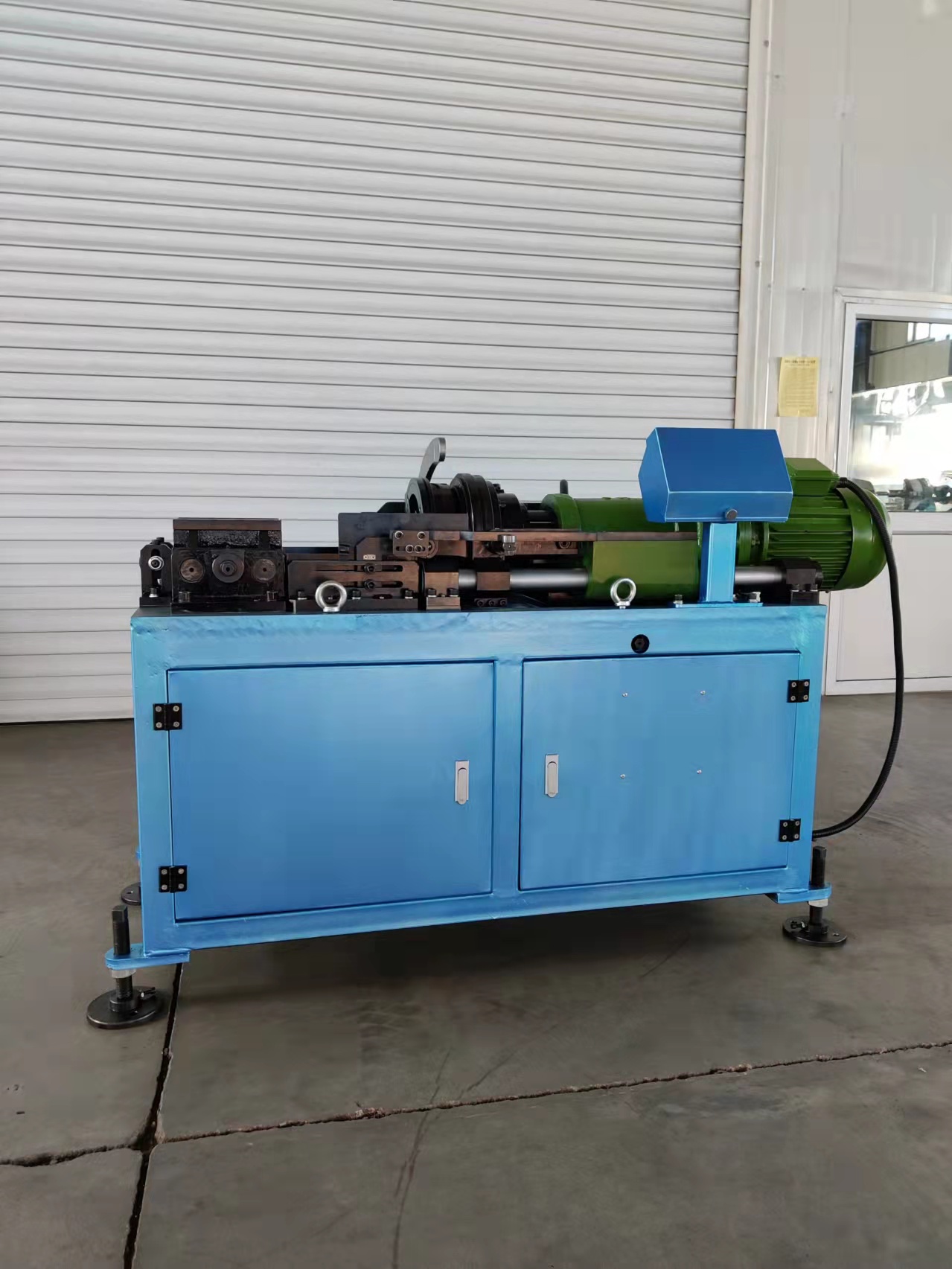
Rebar thread cutting equipment forms part of the in-house production line behind Cangzhou Bartech rebar couplers.
Why long-life assets ask more of a coupler supplier than a single order does
The role of a mechanical splice is structural, not accessory. ISO 15835-1:2018, the international standard that specifies requirements for couplers used for mechanical splices of steel reinforcing bars, addresses static, fatigue and reverse-loading applications. Once a coupler is embedded in a completed pour, replacement is impractical. The relevant evaluation question is therefore not “does this supplier have a good product today,” but “will the same quality hold across every delivery the project takes.”
This matters because large projects rarely buy once. A single metro package, bridge span or high-rise tower may require several procurement waves over 18 to 36 months, and longer when funding or phasing changes. Between waves, tooling wears, personnel rotate, and material sourcing shifts. A supplier’s ability to reproduce the same coupler specification under those conditions is the real substance of long-term reliability.
Global demand reinforces the stakes. Published market research places the global rebar coupler market at USD 1.82 billion in 2025, with a projection to USD 3.47 billion by 2034 (Dataintelo, Rebar Coupler Market Research Report 2034). The same research attributes 41.3% of 2025 global rebar coupler revenue to Asia Pacific, reflecting the concentration of reinforcement construction and mechanical-splice manufacturing in that region. For buyers, that concentration matters because supply reliability is partly a function of how deep and how organized the manufacturing base is.
Reading production scale as a reliability signal
Production scale is often treated as a marketing number. In practice, it is one of the few things about a supplier that can be checked early and that changes buyer risk directly.
Cangzhou Bartech Construction Material Co., Ltd. is a rebar coupler and rebar threading machine supplier based in Qing County, Cangzhou City, Hebei Province, China. The company reports a monthly production capacity of 300,000 coupler units, an annual output of 3,600,000 units, and a typical production lead time of 7–30 days depending on order quantity. For stock couplers, there is no minimum order quantity.
Those data points map onto three different risks a long project carries:
- Capacity headroom. A 300,000-unit monthly capacity gives a project room to place a large phase order without consuming the supplier’s entire line — a practical safeguard when several clients are ordering at the same time.
- Lead-time predictability. A stated 7–30 day lead time, rather than a single fixed number, shows the supplier distinguishes between stock and made-to-order situations, which is what phased construction schedules actually need.
- Order-size flexibility. The absence of a minimum order quantity for stock couplers reduces the risk that a later, smaller phase is deprioritized because it is not commercially attractive on its own.
| Production and delivery parameter | Reported figure |
|---|---|
| Monthly production capacity | 300,000 units |
| Annual output | 3,600,000 units |
| Typical production lead time | 7–30 days, depending on order quantity |
| Minimum order quantity (stock couplers) | None |
| Export share of business | 100% |
| Main export markets | Asia, Middle East, South America — including Vietnam, Malaysia, Kuwait, Qatar, UAE, Saudi Arabia and Mexico |
A buyer cannot treat these figures as guarantees for a specific order, but they are testable. Capacity policy, lead time and MOQ statements can be confirmed in written documentation and, for larger orders, through reference checks or a factory visit. Durability of supply begins with numbers a buyer can actually verify.
Threading-machine quality: the equipment behind thread consistency
Mechanical splice quality depends on how well the thread cut or rolled onto the bar end matches the coupler’s internal thread. That match is produced by machines, not by inspection alone. Machine specifications are therefore one of the most useful indirect indicators of whether a supplier can hold thread geometry across high-volume runs.
The company reports in-house capability across rebar threading, upsetting and cold pressing processes, together with parallel production of rebar couplers and the machines that install them. That combination matters to buyers because it means coupler geometry and machine capability are developed against each other rather than purchased from unrelated sources.
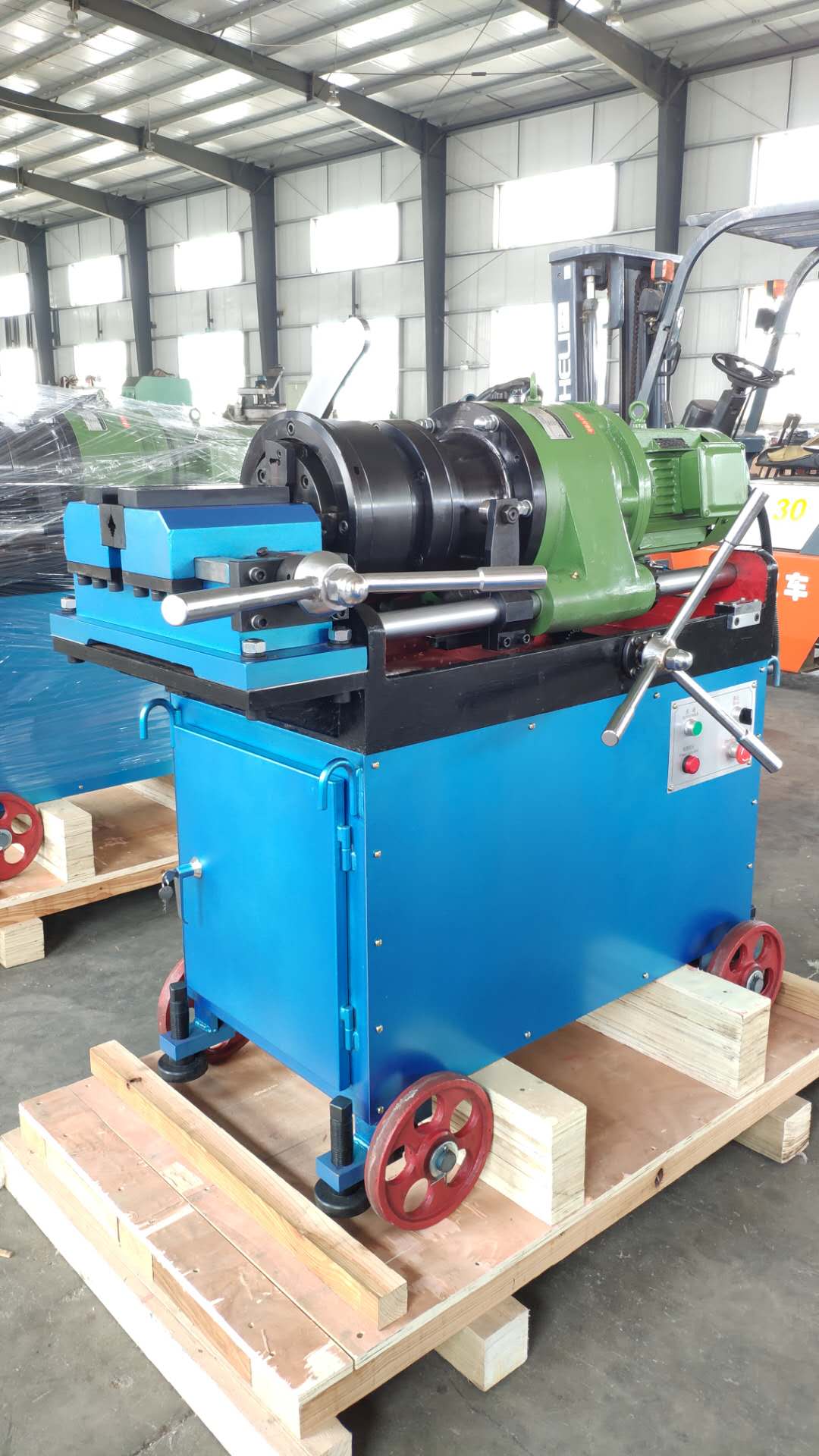
Rebar thread rolling machine: thread geometry on the bar end determines how well it engages the coupler.
The table below lists published specifications for Cangzhou Bartech rebar threading equipment.
| Specification | Published value |
|---|---|
| Rebar processing size range | 16–40 mm |
| Maximum threading length | 95 mm |
| Overall dimensions | 1820 × 815 × 1100 mm |
| Net weight | 680 kg |
| Rated voltage | 380 V / 50 Hz |
| Main motor power | 5.5 kW or 7.5 kW at 1450 r/min |
| Water pump power | 0.12 kW at 1450 r/min |
| Air pressure for clamping | 0.4–0.8 MPa |
| Speed ratio | 1:23 quick / 1:29 slow |
| Coupler outer diameter range across models | 24 mm to 59 mm |
The Rebar AUTO Threading Machine is published separately at 1950 × 700 × 1120 mm, with a net weight of 860 kg and a maximum threading length of 90 mm with block or 150 mm without block.
Read together, these figures describe a machine family sized for structural rebar rather than for light work:
- 16–40 mm processing range. This covers the diameter band used in most high-rise, bridge and metro reinforcement designs, so a single machine platform can serve several project phases without re-tooling the whole line.
- Thread length headroom. Maximum threading length is 95 mm on one machine, and 90 mm with block or 150 mm without block on the auto threading machine. Thread length governs how much of the rebar end engages inside the coupler, so longer threading capability gives a buyer room when specifications change mid-project.
- Machine mass and bed size. A 680 kg threading machine at 1820 × 815 × 1100 mm and an 860 kg auto threading machine at 1950 × 700 × 1120 mm indicate heavier frames. Buyers commonly treat machine mass and bed dimensions as a rough indicator of frame rigidity and vibration control, both of which support more consistent thread profiles during long production runs.
- Drive and clamping configuration. Main motor power is 5.5 kW or 7.5 kW at 1450 r/min, with a separate water pump of 0.12 kW at 1450 r/min. Air clamping pressure is 0.4–0.8 MPa, and the speed ratio is 1:23 in quick mode or 1:29 in slow mode. Multiple motor options and a two-speed configuration let a workshop match throughput to the material and thread length in front of it.
- Electrical specification. The rated voltage is 380 V / 50 Hz — a standard industrial configuration in many markets, though buyers on other grid systems should confirm the exact configuration required before ordering.
Coupler geometry is also a scale question. Across different models, published coupler outer diameters range from 24 mm to 59 mm, which allows a supplier to match coupler body size to bar diameter and connection type rather than forcing one profile onto every application.
What the documented quality-control sequence covers
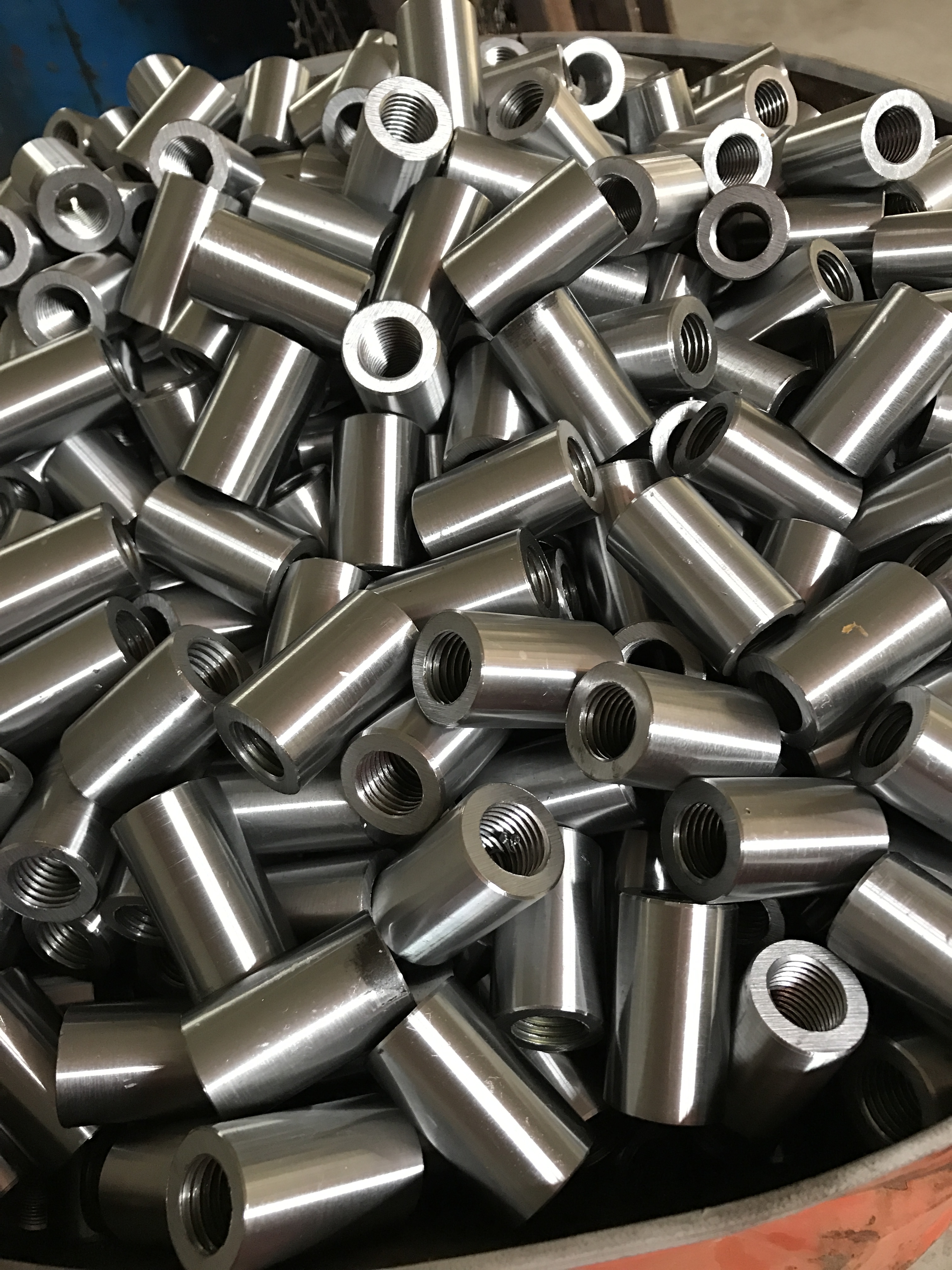
Coupler bodies are matched to bar diameter and connection type across a 24–59 mm outer diameter range.
Machine capability sets the ceiling; quality control determines how close a supplier actually gets to it. Cangzhou Bartech describes a three-stage quality-control process: material test reports, 10% in-line production testing, and 100% final appearance inspection. The company also reports using S45C carbon steel with tensile strength above 600 MPa and 40Cr alloy steel with tensile strength approximately 980 MPa as coupler raw materials.
For a buyer, each stage answers a different question:
- Material test reports address input quality — whether the steel entering production matches the grade the coupler design assumes.
- 10% in-line production testing addresses process drift — whether threads and coupler dimensions are still inside tolerance while a batch is running, not only after it ends.
- 100% final appearance inspection addresses visible defects — burrs, incomplete threads, corrosion or marking problems that would otherwise only surface on site.
Material choice interacts with connection technology. Parallel thread rolling, parallel thread upsetting and cold pressing each place different demands on the steel, and the 600 MPa / 980 MPa grade split gives buyers a documented basis for specifying carbon steel or alloy steel couplers according to design load and exposure. What these figures do not do is replace inspection: buyers should still request the actual test reports for the grade and size they intend to order.
Project profiles where long-term coupler supply matters most
Cangzhou Bartech positions its rebar couplers and threading equipment for use in the construction industry, with named project categories that include high buildings, airport projects, high-railway stations and large bridges across the sea. These categories share a pattern: long construction schedules, high reinforcement density, and strict dimensional control of cast-in-place connections.
In practice, equipment and coupler specifications line up with those settings in different ways:
- High-rise buildings favor parallel thread and rolled thread couplers where dense column and core-wall reinforcement makes lap splicing impractical, and where bar diameters fall inside the 16–40 mm processing band.
- Metro and tunnel work places a premium on repeatable, site-verifiable connections in areas with limited access to welding equipment and restricted ventilation.
- Bridges, including cross-sea structures, require couplers that meet static and fatigue requirements, which is why coupler design and material grade must track the project specification rather than a catalogue default.
- Airport and high-railway station projects combine large slab and beam networks with long phased delivery, which is where scale, lead time and the ability to maintain coupler tolerances across multiple orders become commercially visible.
In all four cases the supplier relationship is likely to run for the whole construction program, not a single purchase order. That is the difference between a transactional purchase and a long-term supply decision.
Standards, certification and the document checklist a buyer should control
Standards define the framework; they do not, by themselves, certify a particular product. Buyers who understand that distinction avoid a common procurement error.
The rebar coupler field typically references ISO 15835, ASTM A615 and BS 8110 (Eurocode 2). The ISO 15835 series separates three distinct functions across its parts: ISO 15835-1:2018 sets requirements for couplers used in mechanical splices; ISO 15835-2:2018 sets test methods; and ISO 15835-3:2018 sets rules for certification and self-evaluation. Because those are three separate documents covering requirements, testing and conformity assessment, a supplier’s approval file should also be three-part: the applicable requirement standard, the laboratory test method, and the conformity or certification evidence.
Two cautions follow from that structure. First, a test-method standard does not prove that a specific supplier’s product passed testing. Second, certification and self-evaluation routes are not interchangeable across markets — evidence accepted in one jurisdiction may not be accepted in another. ISO also lists a work item related to ISO 15835-1 alongside the published 2018 edition, so buyers should confirm the current edition status of the standard before fixing a compliance statement into a tender or long-term contract.
On the trade-administration side, rebar couplers are classified under HS code 7307.92.90 (tube or pipe fittings of iron or steel), which buyers can use to align customs documentation with the shipment before it leaves origin.
Couplers versus lap splicing and welding — and where couplers need discipline
Mechanical couplers are frequently compared with two traditional methods: on-site rebar lap binding and rebar welding. According to Cangzhou Bartech’s published comparison data, mechanical coupler installation is 3–5 times faster than lap tying, with factory pre-threading giving an on-site installation speed 2–4 times faster than welding. The same data describes lower cost and easier operation, and reports a 50–70% lower cost than traditional lap binding processes and 50% lower worker cost compared with welding. It also notes that mechanical connections are not affected by weather in the way welding is.
Those advantages, however, come with a real operational condition that buyers should not treat as a minor footnote. The connection will not be correct if the installer does not wrench the two rebar ends so that they meet in the middle of the coupler. In practical terms this means two things must be controlled on site: threading the rebar end to the correct length, and wrenching the two bar ends far enough into the coupler that they meet each other inside it. Cangzhou Bartech addresses this risk by sending clients detailed operation documents and providing operator training, but responsibility for execution remains with the site team and the contractor’s quality plan.
A second limitation is procedural rather than physical. No coupler advantage in speed or cost removes the need for the project’s own verification step — the pre-shipment test referenced in the supplier’s stated acceptance criteria — or for site-level checks confirming insertion depth and thread engagement. Couplers reward disciplined installation; poorly installed couplers do not deliver the performance their test data imply.
What the next decade of rebar coupler procurement may look like
Three trends are visible in the available evidence, and each has implications for how buyers evaluate suppliers beyond 2026.
Market scale continues to concentrate in Asia Pacific infrastructure. With global rebar coupler revenue projected to grow from USD 1.82 billion in 2025 toward USD 3.47 billion by 2034, and Asia Pacific already accounting for 41.3% of that revenue, buyers outside the region are increasingly dependent on suppliers whose reliability is measured over years rather than campaigns.
Standards will keep evolving. ISO 15835-1:2018 remains the published requirements document, but ISO also lists a related work item, which signals that requirements may be revisited. Procurement teams that monitor standard status — rather than locking a compliance statement into a multi-year contract — will be better positioned when a project specification is updated mid-program.
Supplier evaluation is shifting from product claims to evidence files. Machine specifications, quality-control records, capacity statements and lead-time disclosures are becoming the practical inputs for long-term supplier decisions, because they can be checked and tracked. A supplier that documents its threading equipment, its three-stage inspection process and its material grades is easier to re-qualify on the next project phase than one that supplies only a brochure.
For buyers already past the shortlist stage, the pragmatic conclusion is to convert long-term reliability into a short, verifiable checklist: capacity and lead time that match the project’s phasing, machine specifications that match the required bar diameters and thread lengths, a quality-control sequence covering material, in-line and final checks, and documented installation controls that reduce the risk of an incomplete connection.
FAQ
What production capacity and lead time can a buyer expect from Cangzhou Bartech?
The manufacturer reports a monthly production capacity of 300,000 units and an annual output of 3,600,000 units, with a typical production lead time of 7–30 days depending on order quantity. For stock couplers there is no minimum order quantity. These figures describe the supplier’s stated position and should be confirmed against the specific specification and order size in question.
What raw materials are used in Cangzhou Bartech rebar couplers?
The company reports using S45C carbon steel with tensile strength above 600 MPa and 40Cr alloy steel with tensile strength approximately 980 MPa. Grade selection affects load capacity and durability, so buyers should match the grade to the design requirement rather than accept a default.
What rebar sizes and thread lengths can the threading machines process?
The machines process rebar from 16 mm to 40 mm. Maximum threading length is 95 mm on one machine, and 90 mm with block or 150 mm without block on the auto threading machine. Coupler outer diameters range from 24 mm to 59 mm across models.
What quality-control steps does the manufacturer apply?
A three-stage process: material test reports, 10% in-line production testing, and 100% final appearance inspection. Each stage addresses a different risk — incoming material grade, in-process dimensional drift, and visible final defects.
Which standards apply to rebar couplers, and what do they cover?
Mechanical rebar splices are commonly specified against ISO 15835, ASTM A615 and BS 8110 (Eurocode 2). Within ISO 15835, Part 1 covers requirements, Part 2 covers test methods, and Part 3 covers certification and self-evaluation. Standards define the framework; they do not in themselves prove that a specific supplier’s product passed testing.
What is the main installation risk with rebar couplers, and how is it controlled?
The connection is not correct if the rebar ends are not wrenched so that they meet in the middle of the coupler. Control requires threading the rebar end to the correct length and wrenching the two bar ends until they meet inside the coupler. Cangzhou Bartech supports this by sending detailed operation documents and providing operator training, while site execution remains the contractor’s responsibility.
Cangzhou Bartech Construction Material Co., Ltd. publishes product, process and capacity information at www.chinabartech.cn.
Tem questões ou precisa de mais detalhes?
Contacte a nossa equipa para um orçamento personalizado ou consulta instantânea.
Solicitar orçamento
Preencha o formulário abaixo e a nossa equipa entrará em contacto com uma proposta personalizada.
Chat direto do WhatsApp
Prefere conversar em tempo real? Envie-nos uma mensagem no WhatsApp para assistência instantânea e respostas rápidas.
- Obter orçamento personalizado
- Partilhar fotos ou documentos
- Discuta as suas necessidades diretamente
Geralmente responde em 5–30 minutos durante o horário de expediente.