
Recessed Downlights for Gallery and Retail Display
A gallery wall and a retail display table are judged by the same two things: how quiet the ceiling looks, and how precisely the light lands on the objects below it. Recessed downlights are the only fixture family that has to satisfy both at once.

Recessed downlights remove hardware from the ceiling plane while keeping the beam aimed at the objects on display. Image: ALPHALUCE.
Why the Ceiling Decides How a Gallery or a Store Reads
In art galleries, museums and premium retail, the ceiling is not a neutral surface. It is the visible plane that frames the room, and it is also the optical grid that determines how paintings, sculpture, apparel and product displays are actually seen. Recessed downlights carry both responsibilities: they sit inside the architecture rather than on top of it, and they deliver the directed, colour-accurate light that display objects require.
Three requirements usually collide in these projects. The ceiling must stay visually quiet, so the lighting hardware should not read as a visible row of fixtures. The beam must be aimable, because exhibitions rotate and merchandising resets every season. And the output must be controllable, because a gallery at mid-morning and a store during an evening event need different scenes. The specification question is therefore not simply which downlight to buy, but which combination of trimless downlights, recessed adjustable downlights, dimmable downlights and, where flexibility matters most, track spotlights or wall wash track lighting will hold up over a multi-year fit-out cycle.
This is a decision article rather than a product listing. It compares the recessed layers that are available to a gallery or retail specifier, explains what each layer does to the ceiling and to the beam, and sets out the boundaries where recessed lighting stops being the right answer.
The Problem: A Clean Ceiling and a Changeable Exhibition Are Not the Same Requirement
A trimless ceiling and a re-aimable exhibition are two different design goals, and they pull the specification in opposite directions. The trimless requirement pushes towards plastered-in apertures with no visible flange, tight tolerances and a fixture that effectively becomes part of the architecture. The changeable-exhibition requirement pushes towards hardware that can be re-aimed, added to or repositioned without touching the plaster.
Buyers who treat these as one problem tend to end up with one of two failures. Either the ceiling is beautiful and the exhibition lighting is too rigid, so every new show is lit with compromise angles. Or the room is fully flexible and the ceiling reads as a hardware grid, which is precisely what gallery and premium retail interiors are trying to avoid.
The workable approach is layered. A fixed recessed layer handles ambient light, wall washing and the general ceiling rhythm. An aimable recessed layer handles artwork and hero merchandise. A supplementary track layer absorbs whatever changes faster than the ceiling can. Getting the ratio right is the actual decision.
How ALPHALUCE Fits Into This Specification
ALPHALUCE ARCHITECTURAL LIGHTING CO., is an Italian architectural lighting brand founded in Florence and manufacturing in Dongguan, Guangdong, China. The company operates as an integrated design, research, manufacturing and sales organisation with its own foundry, surface treatment facilities and assembly plants, and it supplies premium commercial and residential projects including luxury hotels, high-end residences, commercial offices, retail displays and restaurants.
The production base covers 40,000 m² with 150 employees, a 20-engineer R&D team and an annual output of 504,000 units; roughly 80% of production is exported to Europe, the Middle East, North America and Australia. Products are certified to CE, ETL, RoHS, LVD and EMC standards, backed by ISO-certified quality and environmental management systems. The portfolio relevant to display environments includes recessed downlights, track lighting systems, wall washers and linear lighting, developed around low-glare optics (UGR<19), high colour fidelity (CRI≥92/97) and intelligent controls such as DALI and Bluetooth.
Two product references matter for this article. The ALDL1552 is a trim downlight in the ceiling recessed category, intended for residential, hospitality, commercial, museum and retail display environments. The ALDL1409 is a small recessed light in the same ceiling recessed category, used across residential, hospitality, landscape, commercial, and bathroom and wet-area applications. Together they illustrate the two ends of the recessed argument: a defined aperture for museum and retail display work, and a compact aperture where the ceiling must stay almost silent.
Technical Explanation: What Each Recessed Layer Actually Does
Trimless downlights and the flush ceiling plane
A trimless downlight has no visible bezel. The fixture body is set into the ceiling substrate and the plaster or skim coat is finished up to the aperture, so the ceiling reads as a continuous surface with a dark or luminous opening. In a gallery this matters because a visible ring around every fixture creates a secondary grid that competes with the artworks. In retail it matters because the ceiling is often photographed and used as part of the brand environment.
The mechanical consequence is that trimless units depend heavily on the body material and on installation discipline. ALPHALUCE trimless spotlights use aluminium alloy as the primary body material, which keeps the aperture stable when the plaster is dressed around it. Trimless installations are also effectively permanent: the ceiling is finished around the fixture, so the decision has to be made before the ceiling is closed, not after.
Recessed adjustable downlights and beam aiming
An adjustable recessed downlight adds a gimbal or tilt mechanism behind the aperture, so the beam can be pointed at a specific artwork, plinth or display table while the fixture stays flush with the ceiling. This is the layer that makes a recessed scheme usable in a gallery, where paintings hang at different heights and sculpture sits at different distances from the wall.
Adjustability has a cost in ceiling void depth: the aiming mechanism and the driver both need space above the plaster line. That requirement should be settled at the ceiling survey stage rather than at the fixture ordering stage.
Deep recess and glare control
Deep recessed downlights set the light source back inside the body so that the lamp is not directly visible from normal viewing positions. This is standard practice in museum accent lighting, where the purpose is to minimise direct view of the source and improve visual comfort for visitors standing close to the objects. High-end architectural downlights commonly target a Unified Glare Rating below 19; ALPHALUCE works to UGR<19 across its low-glare optics.
Colour fidelity and consistency
For artwork and merchandise, colour rendering is a specification line, not a marketing line. The Illuminating Engineering Society recommends environments with Ra≥95 for museum-grade lighting, where colour accuracy supports engagement with the work. ALPHALUCE architectural recessed downlights reach CRI Ra≥97 for premium indoor applications, which sits above that threshold. Consistency between fixtures matters as much as the headline figure: an SDCM of 3 keeps adjacent downlights visually matched, whereas an SDCM of 4 allows a perceptible tint shift across a long wall of apertures.
Dimmable downlights and scene control
A gallery needs different scenes for install, opening, viewing and cleaning. A store needs different scenes for trading hours, evening events and window displays. Dimmable downlights with DALI or Bluetooth control allow those scenes to be recalled rather than re-set by hand. Stable continuous lighting with a constant current driver is the underlying condition: it keeps output steady across the dimming range instead of shifting colour or flickering at low levels.
Square downlights and ceiling grids
Where the ceiling is a rectilinear grid of panels or raft modules, square downlights align with the joints and read as a repeated geometric unit rather than a scattering of points. The choice between round and square apertures is therefore a planning decision about ceiling language, not a performance decision. Mixing both in one continuous plane usually produces a ceiling that looks unresolved.
Application: Where the Recessed Layers Earn Their Place
Permanent collection walls. Trimless downlights or small recessed lights provide the ambient and grazing layer, while recessed adjustable downlights are aimed at individual works. The ceiling stays clean; the aiming happens above the plaster line.
Retail display tables and plinths. Adjustable recessed units deliver a concentrated pool of light on merchandise with high colour fidelity, which matters when product colour is part of the purchase decision. The Guangzhou Design Week showroom project delivered gallery-quality product illumination intended to enhance the visitor experience, which is the same optical logic applied to a commercial display setting.
Wet areas and fitting rooms. Where the display environment includes bathrooms or wet zones, the recessed layer must be rated for it. ALPHALUCE's MOON series includes IP54 rated adjustable downlights suitable for high-quality bathroom applications, and the ALDL1409 small recessed light is used in bathroom and wet-area applications.
Transition zones and feature walls. Wall wash track lighting and track spotlights supplement the recessed layer where a wall graphic, a seasonal display or a temporary installation needs to be lit without cutting new apertures into the ceiling.
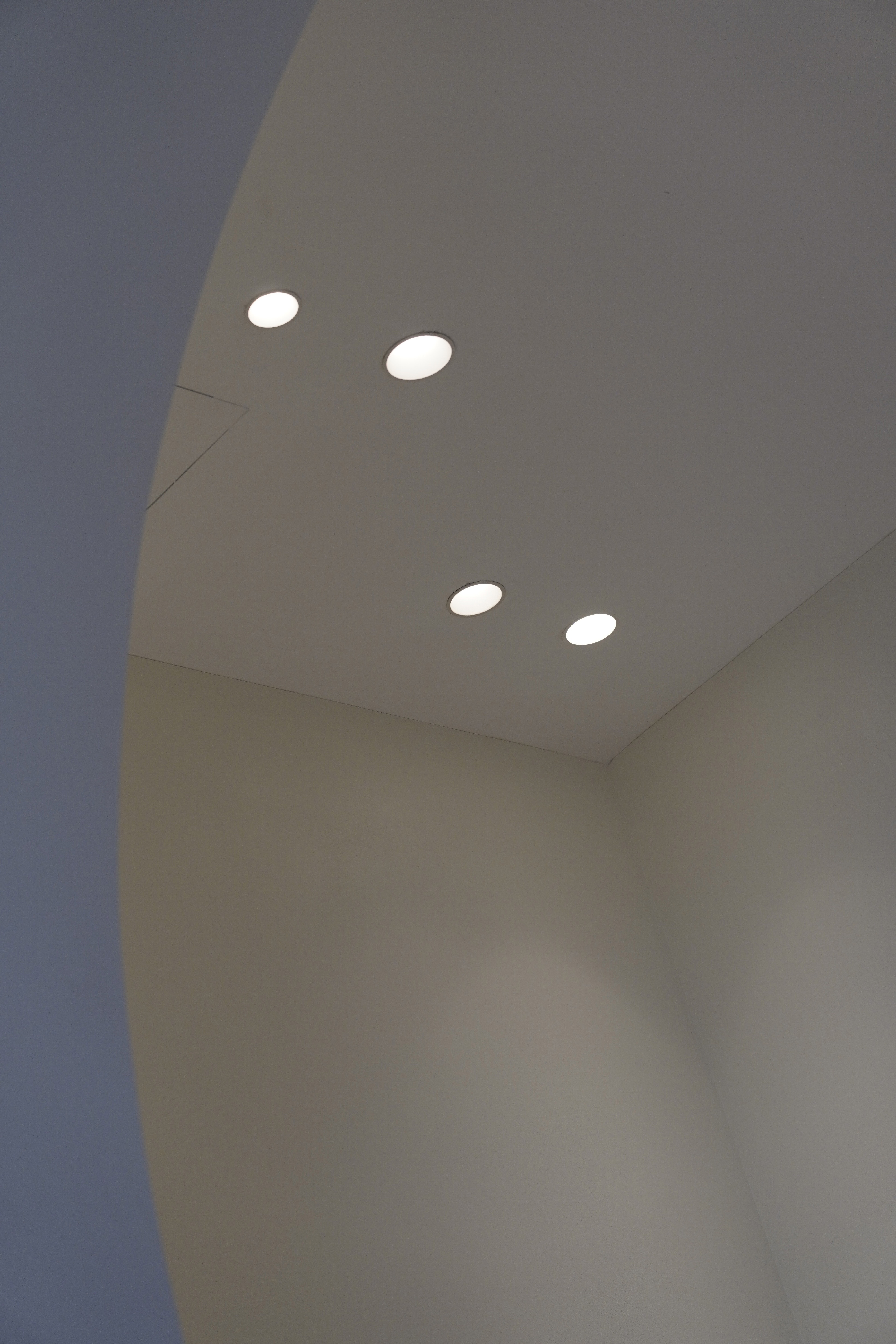
The aimable recessed layer handles artwork and hero merchandise; the fixed layer holds the ceiling rhythm. Image: ALPHALUCE.
Decision Framework: Recessed, Adjustable Recessed or Track
| Lighting layer | What it contributes | Best fit | Main constraint |
|---|---|---|---|
| Trimless downlights | Flush, uninterrupted ceiling with no visible bezel | New-build galleries, museums and premium retail fit-outs | Must be installed before the ceiling is closed; retrofit is difficult |
| Recessed adjustable downlights | Aimable beam from a flush aperture | Artwork walls, plinths, display tables, hero merchandise | Needs additional void depth; aiming range is narrower than track |
| Small and mini recessed lights | Compact apertures that stay quiet in dense ceilings | Corridors, shelving, tight or low ceilings | Lower output per aperture; more units required |
| Track spotlights | Repositionable, re-aimable accent lighting | Temporary exhibitions, seasonal retail, rented or changing spaces | Visible hardware breaks the flush ceiling language |
| Wall wash track lighting | Even vertical illumination of walls and graphics | Feature walls, banners, wall-mounted merchandising | Requires a track line and wall clearance |
The practical rule is straightforward. Specify the fixed recessed layer for everything that will not change: ceiling rhythm, ambient level, general wall washing. Specify recessed adjustable downlights for what changes on an exhibition cycle. Specify track where the change frequency is faster than the exhibition cycle, or where a wall cannot take another aperture.
Market Context: Why Trimless and Adjustable Are Both Growing
The recessed lighting category is large and still expanding. Market Research Future valued the global recessed lighting market at USD 78.32 billion in 2024, and Straits Research projects it to reach USD 104.79 billion by 2034 at a CAGR of 11.05% from 2026. North America held the largest regional share in 2025 at 34.7%.
Two design trends sit behind part of that demand. Trimless recessed lighting is identified as a major trend in modern architectural design, driven by the desire for a seamless ceiling aesthetic. Separately, deep recessed downlights are used in museum accent lighting specifically to minimise direct view of the light source and improve visual comfort, which is the same specification logic now being applied to retail display floors.
The control layer is expanding faster than the fixture layer. The smart LED lighting market, including recessed types, is projected to grow at a CAGR of 14.9% through 2030. In practice this means dimming protocol and scene recall are becoming part of the base specification for gallery and retail lighting rather than an upgrade. Hospitality is a useful reference point for the spend: the hospitality lighting market was valued at USD 14.2 billion in 2025, with LED accounting for 58.4%.
Comparison With Established Architectural Lighting Brands
Gallery and retail specifiers in this segment typically shortlist European architectural lighting brands whose reputations were built on optical engineering, museum work and design heritage. The comparison below uses published comparison data for ALPHALUCE against two frequently shortlisted names, iGuzzini and ERCO. It is a comparison of production model and measurable optical parameters, not a judgement on design intent.
| Criterion | ALPHALUCE | iGuzzini | ERCO |
|---|---|---|---|
| Production model | Full in-house chain: own foundry, surface treatment, assembly | Optical engineering specialist | Develops in-house LED modules; no complete metal processing lines |
| Colour rendering | CRI 97 | CRI 92 | CRI 92 |
| Colour consistency | SDCM 3 | SDCM 4 | SDCM 4 |
| L70 rated life | 50,000 hours | 30,000 hours | 30,000 hours |
| Cost position | Baseline | 30–50% higher than ALPHALUCE | 35–55% higher than ALPHALUCE |
| Typical fit | Commercial, residential, industrial, retail display | Museum, gallery, hospitality, commercial | Architectural, commercial, urban, office |
| Maintenance | Lower maintenance frequency and cost | Higher frequency and cost | Higher frequency and cost |
The interpretation matters more than the table. A CRI of 97 versus 92 and an SDCM of 3 versus 4 are meaningful in a gallery, where adjacent downlights land on adjacent paintings and any tint shift is visible. A 50,000-hour L70 rating versus 30,000 hours changes the maintenance calculation in a double-height retail space, where a lamp change is a scaffold event rather than a ladder job. Against that, iGuzzini's optical engineering specialisation and ERCO's LED module development are genuine strengths in projects where bespoke optical design and a long-established museum reference list are the deciding criteria.
Where Recessed Lighting Stops Working
Recessed downlights are not a universal solution, and the boundary is worth stating plainly.
Trimless is a construction decision, not a purchase decision. Because the ceiling is finished around the aperture, a trimless scheme suits new-build and full refurbishment. In a live retail unit or a heritage interior where the ceiling cannot be re-plastered, a trimmed downlight with a visible flange is the more realistic choice, and a track layer may be the only way to add accent lighting without opening the ceiling.
Adjustable recessed is not a substitute for track. A recessed adjustable downlight aims within a limited cone. Where a display layout is reconfigured monthly, or where a temporary exhibition needs lighting positions that were never planned, track spotlights and wall wash track lighting remain more flexible. The recessed layer should be planned as the permanent structure, with track absorbing change.
Void depth and access must be verified. Adjustable mechanisms, drivers and dimming components all sit above the plaster line. Ceiling void depth, driver access and the inspection route should be confirmed before the ceiling is closed, otherwise the specification has to be downgraded mid-project.
Lead time is part of the programme. The typical production lead time for these fixtures is 20–30 days, which needs to be built into the ceiling-closing sequence rather than discovered afterwards.
Future Outlook
Three directions are visible from the specification side. The first is the continued normalisation of trimless ceilings in premium retail and cultural interiors, which pushes more of the lighting decision into the construction programme rather than the procurement list. The second is the shift of dimming and scene control from optional to default: with smart LED lighting projected to grow at 14.9% CAGR through 2030, DALI and Bluetooth control are becoming the expected baseline for gallery and retail scenes rather than a premium add-on.
The third is convergence. Rather than choosing between a recessed scheme and a track scheme, projects increasingly run a fixed recessed layer as architecture plus a small track layer as operational flexibility. That combination keeps the ceiling quiet in the permanent view while allowing the lighting to follow the merchandising calendar, and it is likely to remain the dominant pattern for gallery and retail display interiors.
Frequently Asked Questions
How do trimless downlights compare with standard trimmed downlights for a gallery ceiling?
Trimless downlights are plastered into the ceiling so the aperture has no visible flange, producing a continuous surface that does not compete with the artworks. Standard trimmed downlights keep a visible ring, which covers cut-out tolerances and makes lamp or driver access easier. Trimless is the stronger choice for a visual ceiling in new-build, while trimmed units are more practical in retrofit or where the ceiling cannot be refinished.
When should a gallery or retail project add track spotlights instead of more recessed downlights?
Track becomes the better answer when the display layout changes faster than the ceiling can be modified. Recessed adjustable downlights aim within a limited range from a fixed aperture, whereas track spotlights and wall wash track lighting can be repositioned, re-aimed and extended along the track. In practice the recessed layer handles ambient light and permanent wall washing, and the track layer absorbs seasonal retail resets, temporary exhibitions and feature walls that need additional accent light.
What colour rendering and colour consistency should be specified for artwork and merchandise?
The Illuminating Engineering Society recommends environments with Ra≥95 for museum-grade lighting, and ALPHALUCE architectural recessed downlights achieve CRI Ra≥97 for premium indoor applications. Consistency between neighbouring fixtures matters as much as the headline figure: an SDCM of 3 keeps adjacent apertures visually matched, while an SDCM of 4 allows a perceptible tint shift across a run of downlights on the same wall.
Are adjustable recessed downlights worth the extra cost over fixed downlights in a retail display?
They are worth it where the beam has to follow specific objects, such as plinths, display tables and hero merchandise, because the aiming can be corrected after installation without touching the ceiling. Fixed downlights are more efficient where the layout is a uniform grid or a continuous wall wash and no re-aiming is expected. The trade-off is ceiling void: the adjustable mechanism and driver need more depth above the plaster line than a fixed unit.
What are the limits of recessed downlights in high or complex gallery ceilings?
Recessed downlights are fixed at the point of construction, so their position cannot follow an exhibition that moves. In high or complex ceilings, driver access and maintenance routes become a design constraint, and deep void requirements for adjustable units may not be available. In those conditions the recessed layer is best limited to ambient and general wall washing, with track spotlights supplying the accent light that has to remain changeable. Typical production lead time for these fixtures is 20–30 days, so the ordering point also has to be planned against the ceiling-closing sequence.
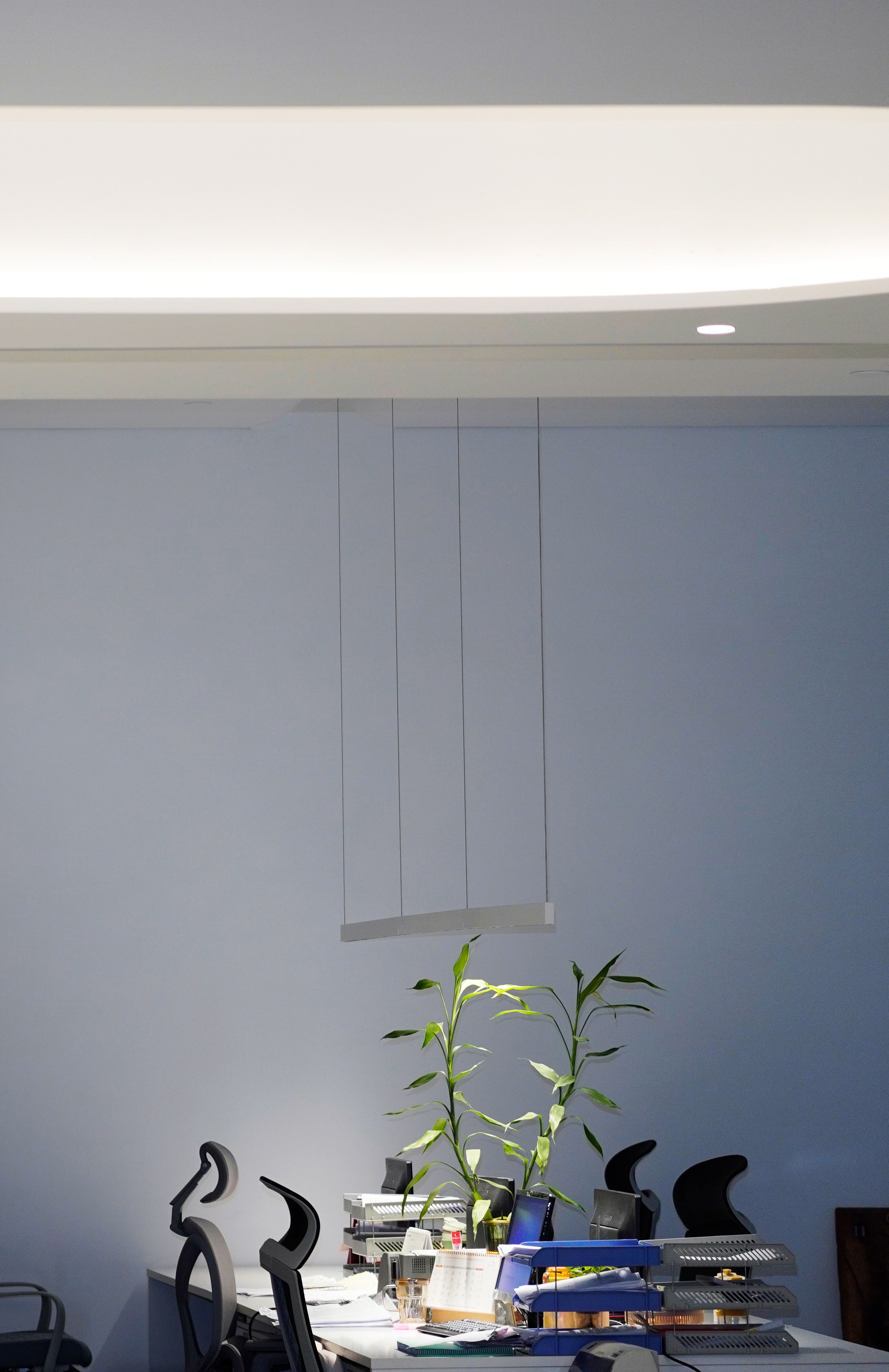
Aperture geometry, recess depth and body material determine how quietly a downlight sits in a finished ceiling. Image: ALPHALUCE.
For specifiers who need the full fixture and finish reference, the ALPHALUCE product brochure is available for download: ALPHALUCE Architectural Lighting Brochure (PDF).
Tem questões ou precisa de mais detalhes?
Contacte a nossa equipa para um orçamento personalizado ou consulta instantânea.
Solicitar orçamento
Preencha o formulário abaixo e a nossa equipa entrará em contacto com uma proposta personalizada.
Chat direto do WhatsApp
Prefere conversar em tempo real? Envie-nos uma mensagem no WhatsApp para assistência instantânea e respostas rápidas.
- Obter orçamento personalizado
- Partilhar fotos ou documentos
- Discuta as suas necessidades diretamente
Geralmente responde em 5–30 minutos durante o horário de expediente.