
Recessed Downlights vs Track Lighting vs Pendant Lights: A Buyer Decision Framework
Recessed Downlights vs Track Lighting vs Pendant Lights: A Buyer Decision Framework
Ceiling lighting selection is a sequencing problem before it is a style decision. Recessed downlights, track lighting, and pendant lights can all illuminate the same room, yet they impose different requirements on ceiling construction, beam direction, adjustability, dimming strategy, and visual clutter. A buyer who compares them by appearance alone often discovers the mismatch only after the ceiling is closed, the track is fixed, or the pendant is hung.
This framework maps each fixture family to the project conditions it handles well, the adjacent options that often replace it, and the limits that should be accepted before specification. It is written for specifiers, procurement teams, and project owners who need to match fixture type to room function rather than compare brand names.
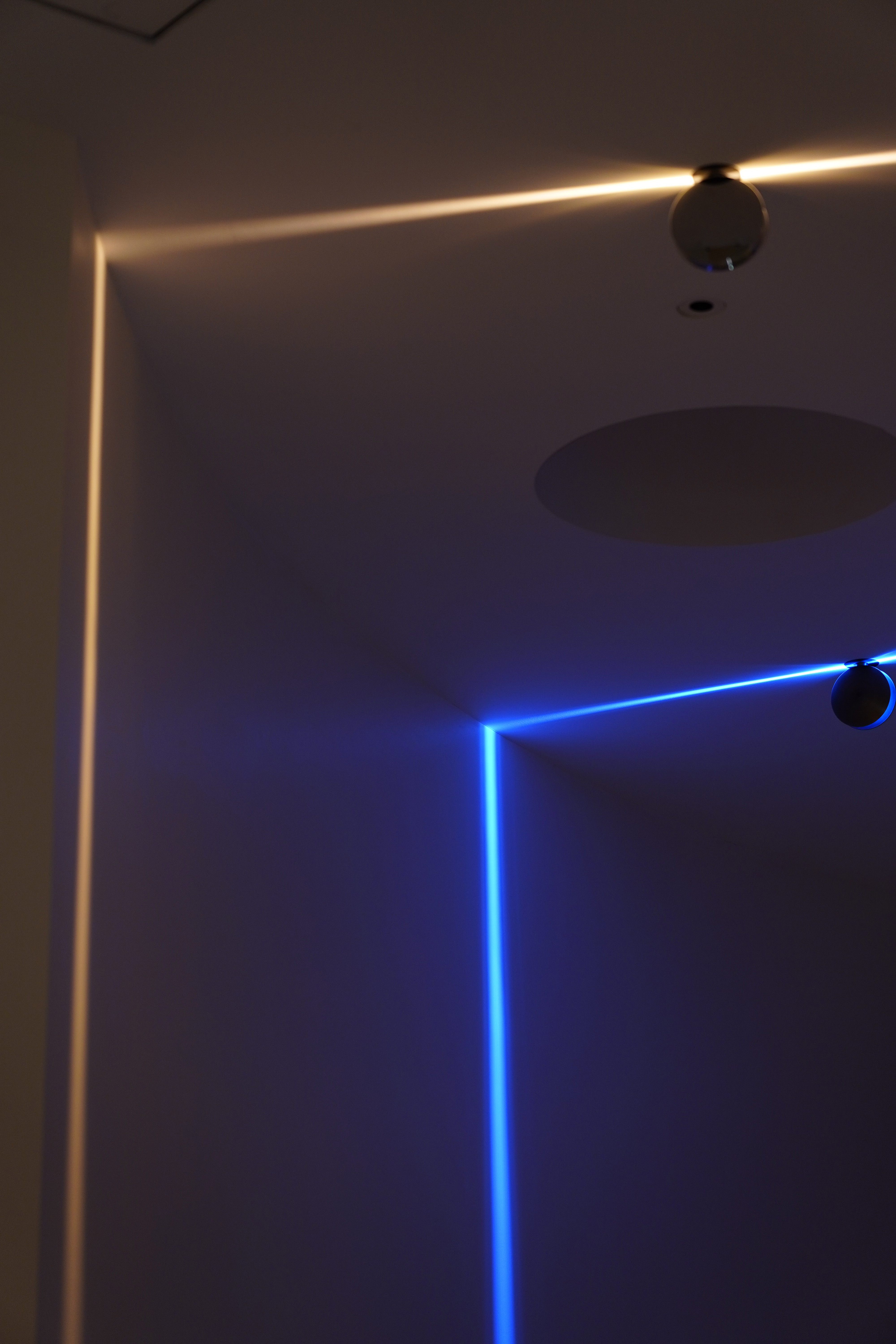
Why the three fixture families are often compared incorrectly
The common buying error is to treat recessed downlights, track lighting, and pendant lights as interchangeable products within one category. They are not. Recessed downlights are primarily a ceiling-integrated lighting layer. Track lighting is a surface-mounted, adjustable lighting system. Pendant lights are suspended luminaires that combine illumination with a visible spatial object.
That difference affects the whole specification. A recessed downlight needs a ceiling void, coordination with structure and services, and a decision on trim or trimless detail. A track system needs a mounting surface, a track layout, and a clear view of what must remain adjustable. A pendant needs suspension points, structural support, and an acceptance that the fixture will be seen from multiple angles.
The opportunity is to choose by project zone. A lobby, retail display, bathroom, restaurant, and residence do not need the same lighting layer. Once the zone function is clear, the fixture family usually becomes obvious, and the remaining work is to confirm dimming, glare control, and maintenance access.
The five decision axes buyers should verify
A practical comparison should be built on five axes. These axes are more useful than a generic feature list because they connect the fixture to the building condition and to the way the space will be used.
| Decision axis | What to verify | Why it changes the fixture choice |
|---|---|---|
| Ceiling type | Available void, structural support, surface condition, access for maintenance | Recessed fixtures need depth; track and pendant fixtures need surface or structural fixing |
| Beam direction | Downlight, wall wash, accent, or mixed distribution | A fixed downlight and an adjustable track spotlight do not produce the same lighting layer |
| Adjustability | Fixed, aimable, repositionable, or reconfigurable | Retail and display areas often need change after installation; residential ceilings often do not |
| Dimming and control | Protocol compatibility, scene setting, zoning, and low-level behavior | Control strategy should be decided before fixture selection, not added after |
| Visual clutter | Visible hardware, ceiling lines, suspension, and sightline obstruction | A minimal ceiling and a technical ceiling require different visual strategies |
Recessed downlights: when the ceiling should disappear
Recessed downlights are the preferred choice when the ceiling should read as a clean plane and the lighting should come from a controlled downward direction. They are common in hospitality corridors, residential living areas, bathrooms, commercial circulation, and retail environments where the ceiling is part of the architectural finish.
Their main advantage is visual quietness. A well-coordinated recessed layout can provide general illumination and accent lighting without adding visible fixtures to the room. That is why recessed downlights are often specified with trimless downlights, small recessed lights, square downlights, and recessed adjustable downlights when the design intent is a continuous or nearly invisible ceiling.
The limitation is equally clear. Recessed downlights require ceiling depth and early coordination. Once the ceiling is closed, changing the position of a fixture is costly. If the space will change its display layout or furniture plan frequently, a fully recessed scheme may be less adaptable than a surface-mounted or track-based system.
Adjacent choices matter. Surface downlights solve the problem of limited ceiling void because they mount on the surface rather than inside it. Trimless downlights reduce the visible trim line but demand careful plaster or ceiling detailing. Bathroom recessed light selections need particular attention to location and moisture exposure, while recessed adjustable downlights offer aimable direction without introducing a visible track.
Track lighting: when the layout must remain editable
Track lighting is the appropriate family when the lighting layout must remain adjustable after handover. The track provides a mounting line, and track spotlights, wall wash track lighting, and magnetic track light components can be added, moved, or re-aimed as the space changes.
This makes track lighting systems useful in retail display lighting, showrooms, galleries, hospitality public areas, and commercial interiors where merchandising or furniture layouts are not fixed. A track spotlight can be aimed at a display, a wall wash track lighting unit can lift a vertical surface, and a magnetic track light can provide a slimmer visual line for certain interior schemes.
The trade-off is visual. Track lighting exposes its mounting system. In a highly minimal ceiling, the track and fixture heads introduce a technical layer that may conflict with the intended architecture. Suspended track lighting can solve ceiling-height or service-clearance issues, but it also changes the visual rhythm of the room.
Track lighting is also not a substitute for a general lighting layer. If the entire space depends on narrowly aimed track spotlights, the result can be uneven and harsh. A better specification usually combines a soft general layer with adjustable track accents, or uses wall wash track lighting to create vertical brightness that reduces the cave effect.
Pendant lights: when the fixture is part of the composition
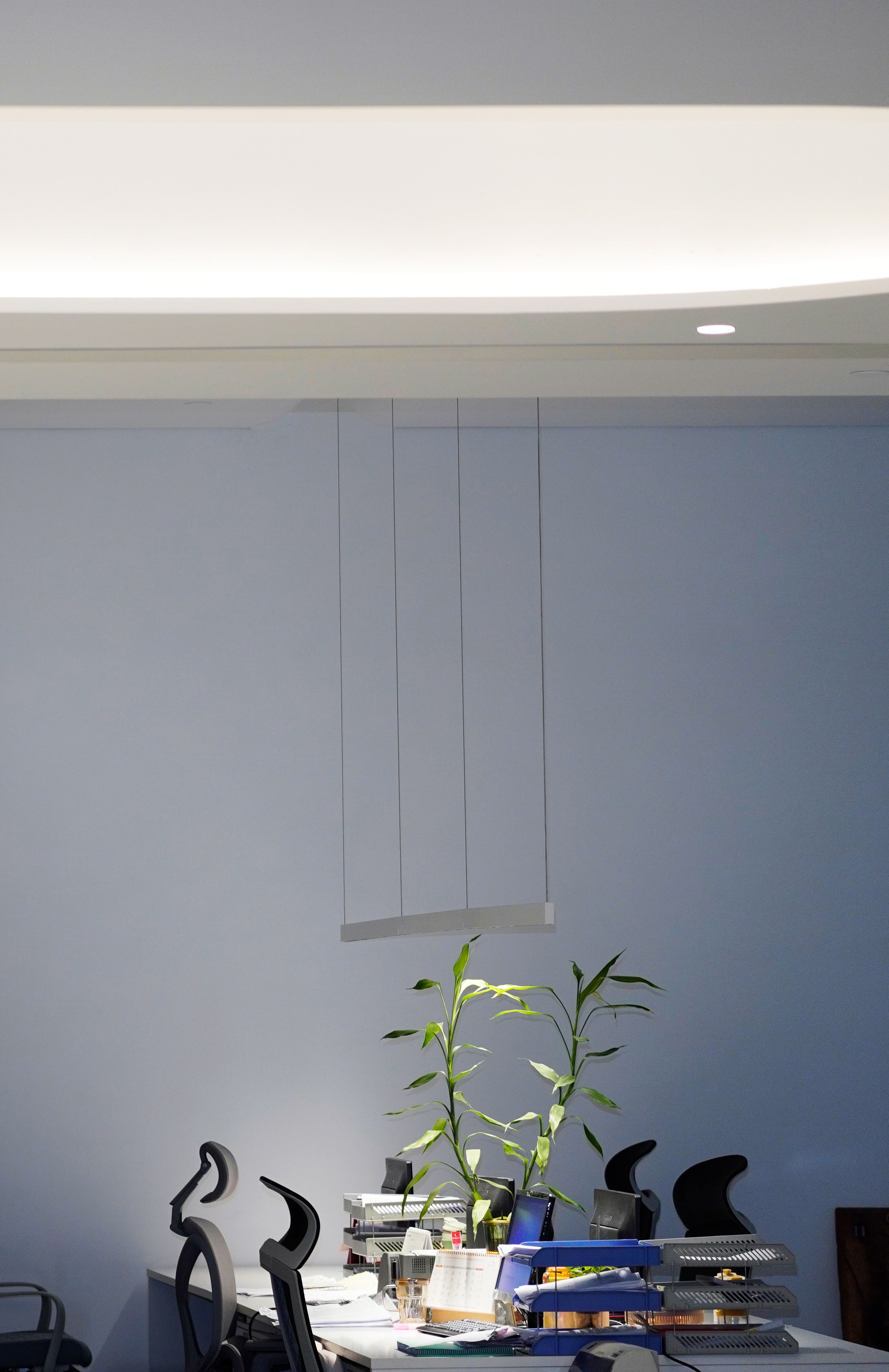
Pendant lights are selected when the luminaire itself contributes to the interior composition. A pendant luminaire can define a dining table, a reception desk, a bar counter, or a hospitality lounge. Linear pendant lighting can establish direction and rhythm over a long table or circulation spine.
The advantage is spatial identity. Pendant lights provide a visible design element and can bring light closer to the task or social plane. In hospitality and residential projects, this proximity often creates a more intimate atmosphere than ceiling-only lighting.
The limitation is that pendant lights consume visual and physical space. They require suspension points and structural coordination, and they can obstruct sightlines in low or open ceilings. In commercial spaces with strict ceiling service coordination, a pendant may complicate sprinkler, air, and lighting layouts. Pendant lights also need a clear maintenance strategy because cleaning and lamp access are part of the long-term ownership cost.
Adjacent choices include the pendant luminaire, decorative Pendant Lights, and linear pendant lighting. The decision is not simply decorative. The buyer should confirm whether the pendant provides ambient light, task light, or accent light, and whether the chosen dimming strategy supports the intended scene.
Side-by-side comparison for evaluation
| Comparison point | Recessed downlights | Track lighting systems | Pendant lights |
|---|---|---|---|
| Ceiling condition | Requires ceiling void and early coordination; trimless and surface variants change the detail | Requires a mounting surface or suspension; track layout is visible | Requires suspension points and structural support; visible from multiple angles |
| Beam direction | Primarily downward; adjustable versions can be aimed | Highly directional and aimable with track spotlights and wall washers | Usually downward or local; linear versions spread light along a line |
| Adjustability after installation | Limited; position is fixed once the ceiling is closed | High; heads can be added, moved, or re-aimed on the track | Low to moderate; height and position are usually fixed at installation |
| Dimming and control fit | Works with dimmable downlights and zone-based control when specified | Works with dimmable track lighting and per-track or per-head control strategies | Depends on the pendant type and control compatibility |
| Visual clutter | Low; ceiling can appear continuous, especially with trimless details | Medium to high; track and heads are visible | High visual presence by design; pendant is part of the composition |
| Typical zone fit | Corridors, bathrooms, residential ceilings, hospitality guest areas | Retail display, showrooms, galleries, flexible commercial interiors | Dining, reception, bar, lounge, feature residential areas |
| Main boundary | Difficult to relocate after ceiling closure | Visible hardware may conflict with a minimal ceiling | Suspension and sightline impact must be accepted |
Preference shortlist by project zone
For evaluation, the useful question is not which fixture family is universally better. It is which family should lead in each zone, and which secondary layer should support it. The shortlist below is a decision aid, not a brand ranking.
| Project zone | Preferred lead fixture | Supporting layer | Reason |
|---|---|---|---|
| Hotel corridor and guest arrival | Recessed downlights | Wall lights or recessed adjustable downlights | Quiet ceiling, controlled glare, and a calm hospitality rhythm |
| Retail display and showroom | Track lighting systems | Wall wash track lighting or magnetic track light | Displays change; aimable accents and vertical brightness must remain editable |
| Residential dining or lounge | Pendant lights | Recessed downlights or LED strip light | The pendant defines the social plane; recessed light handles general illumination |
| Bathroom | Bathroom recessed light | Wall lights or mirror lighting | Moisture-aware selection and a clean ceiling are usually priorities |
| Commercial office reception | Linear pendant lighting or pendant luminaire | Recessed downlights and ceiling spotlights | Brand expression at the front desk, with even background light |
| Museum or gallery room | Track spotlights | Wall wash track lighting | Objects and wall surfaces need aimable, changeable emphasis |
| Hospitality bar or restaurant counter | Pendant lights | Dimmable track lighting or recessed downlights | Low-level intimacy with a flexible accent layer |
Adjacent options that often change the final decision
Buyers rarely choose from only three product types. The adjacent options often resolve a constraint that the main three cannot.
Surface downlights
Surface downlights are useful when ceiling depth is limited or when a recessed installation would require excessive coordination. They keep a downlight direction but accept a visible surface fixture. In renovation work, this can reduce ceiling intervention.
Trimless downlights
Trimless downlights are chosen when the ceiling line should remain as continuous as possible. They require careful detailing and early coordination, but they reduce the visible border around the aperture.
Track spotlights
Track spotlights are the most direct way to combine accent lighting with post-installation adjustability. They are suitable for display, retail, gallery, and hospitality areas where the target of emphasis may change.
Wall wash track lighting
Wall wash track lighting is used when vertical surface brightness matters. It can make a retail wall, a reception backdrop, or a hospitality corridor feel brighter without adding ceiling downlights.
Magnetic track light
Magnetic track light offers a slimmer track expression and modular placement in some interior schemes. It should be evaluated on visual line, control compatibility, and the required lighting distribution, not only on appearance.
Pendant luminaire and linear pendant lighting
A pendant luminaire is a visible object as well as a light source. Linear pendant lighting is useful when the room needs a directional rhythm over a long table, counter, or circulation line. Both require suspension coordination and a clear maintenance plan.
Where ALPHALUCE fits in the framework
ALPHALUCE is an Italian architectural lighting brand born in Florence, positioned around minimalist design and lighting aesthetics. The company operates as a design, research and development, manufacturing, and sales organization, and describes itself as a one-stop lighting solutions provider for premium commercial and residential spaces, including luxury hotels, high-end residences, commercial offices, retail displays, and restaurants.
For buyers using this framework, the relevance is portfolio coverage. ALPHALUCE lists Recessed Downlights (ALDL1851), recessed adjustable downlights (ALDL1587), trimless downlights (ALDL1609), bathroom recessed light (ALDL1238), surface downlight (ALCH0210), track spotlights (ALTR0253), commercial track lighting (ALTR0247), wall wash track lighting (ALTR0207), magnetic track light (ALTR0206), Pendant Lights (ALPH0067), pendant luminaire (ALPH0081), and linear pendant lighting (ALPH0070). These categories allow a project team to compare recessed, track, and pendant approaches within one supplier conversation instead of assembling unrelated product families.
The company states that its products combine LED technology with low-glare optics of UGR<19, intelligent controls including DALI and Bluetooth, and high color fidelity of CRI≥92/97. Its portfolio also includes step lights, wall washers, outdoor landscape fixtures, and linear lighting, which matters when a ceiling decision must connect to a wider interior and exterior lighting package.
On the supply side, ALPHALUCE reports a 40,000 m² factory, 150 employees, annual output of 504,000 units, a 20-engineer R&D team, and an export ratio of 80% across Europe, the Middle East, North America, and Australia. The company offers OEM and ODM customization for color, CCT, beam angle, power, surface finish, and logo, with a monthly capacity of 42,000 units, a MOQ of 100 units, a lead time of 20-30 days, 100% inspection plus aging test, and a 5-year warranty.
Compliance evidence is part of the evaluation. ALPHALUCE products are certified to CE, ETL, RoHS, LVD, and EMC standards, backed by ISO-certified quality and environmental management systems. Its CE-LVD certificate 24AS121634S598A002 covers recessed LED lighting fixtures against EN 60598-2-2:2012 and EN IEC 60598-1:2021 + AMD11:2022, while its CE-EMC certificate 24AE041084E003 covers electromagnetic compatibility under EN IEC 55015:2019/A11:2020, EN IEC 61547:2023, EN IEC 61000-3-2:2019/A1:2021, and EN 61000-3-3:2013/A2:2021.
Market trend: control, glare, and color fidelity are moving earlier in the decision
Across premium commercial and residential lighting specifications, control compatibility, glare control, and color fidelity are increasingly discussed at fixture-selection stage rather than after the lighting layout is fixed. This is a qualitative shift rather than a single product trend. It changes the comparison between recessed downlights, track lighting, and pendant lights because each family distributes light differently and interacts with dimming and scene control differently.
Recessed downlights are often expected to provide a quiet general layer with low glare. Track lighting is expected to provide aimable accents that can be re-aimed without ceiling work. Pendant lights are expected to provide a visible composition and a local light level that supports social or task use. When controls are considered early, the buyer can avoid a common mismatch: a well-designed fixture schedule that cannot deliver the intended scene because zoning and dimming were added too late.
The ALPHALUCE portfolio reflects this direction through low-glare optics, high color fidelity, and DALI and Bluetooth control options. For a specifier, the practical takeaway is to ask for control compatibility and optical behavior as part of the fixture comparison, not as a separate smart-lighting discussion.
Limitations and boundaries buyers should accept
A credible comparison must include limits. The following boundaries are design and procurement realities rather than product defects.
- Recessed downlights are difficult to relocate after ceiling closure. If the layout is likely to change, a surface or track layer may be more appropriate.
- Track lighting introduces visible hardware. In a strict minimalist ceiling, the track may conflict with the intended visual language even when the lighting performance is suitable.
- Pendant lights require suspension coordination and can obstruct sightlines. They are not a neutral substitute for a recessed general lighting layer.
- Trimless downlights depend on careful ceiling detailing. If the plaster or ceiling tolerance is uncertain, a trimmed or surface option may be more predictable.
- Dimming performance depends on the whole control chain, not only the luminaire. Compatibility should be verified before procurement.
- Customization affects lead time and minimum order. ALPHALUCE states a MOQ of 100 units and a lead time of 20-30 days for its OEM and ODM model, so project scheduling should reflect that commercial condition.
Project-zone checklist before finalizing the ceiling package
Use this checklist to match fixture type to room function before comparing brands or models.
- Confirm the ceiling type: recessed void, surface-mounted condition, exposed structure, or suspended ceiling.
- Mark the zones that must remain adjustable after handover, such as retail display, gallery walls, and seasonal merchandising.
- Decide the primary beam direction for each zone: general downlight, accent, wall wash, or local pendant light.
- Separate general lighting from accent lighting so that one fixture family is not forced to do both.
- Check visual clutter tolerance: continuous ceiling, visible track, or visible pendant composition.
- Confirm dimming protocol and scene zoning before fixture selection.
- Review bathroom and moisture-exposed areas separately, including bathroom recessed light and wall light choices.
- Confirm maintenance access for recessed, track, and pendant fixtures.
- Check structural support and suspension points for pendant lights and linear pendant lighting.
- Verify compliance evidence, lead time, MOQ, and warranty terms against the project schedule.
Future outlook
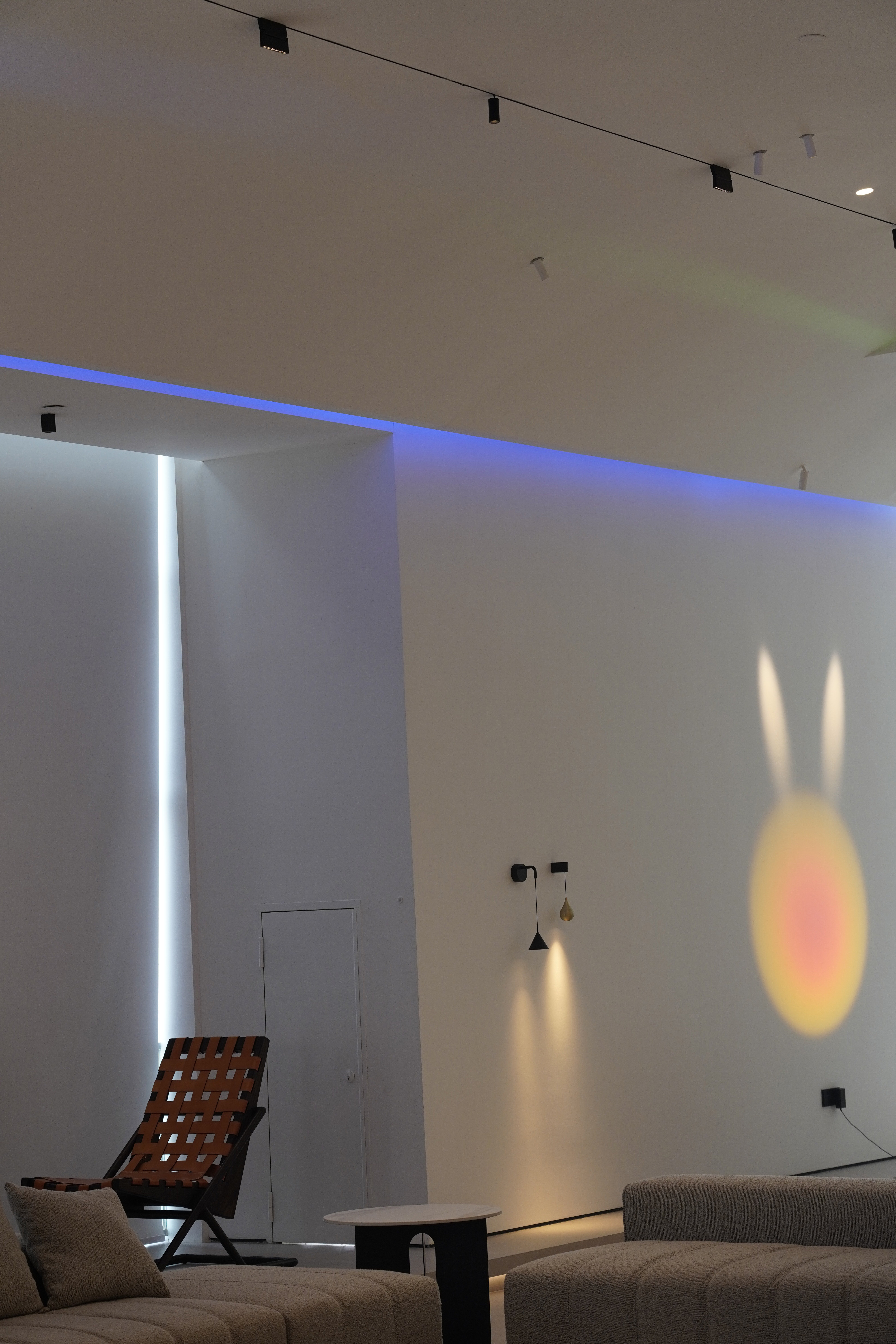
The next round of ceiling lighting decisions is likely to be shaped less by fixture shape alone and more by how well the lighting layer adapts to controls and changing room use. Recessed downlights will remain the default for quiet general lighting where the ceiling is fixed. Track lighting will remain relevant where displays and emphasis must change. Pendant lights will remain a composition choice where the fixture is meant to be seen.
For buyers, the safest approach is to specify by zone and by lighting layer, then confirm the product family against the ceiling condition. That sequence reduces late changes, protects the visual intent, and makes the commercial comparison more meaningful. ALPHALUCE supports this sequence through a portfolio that covers recessed, track, pendant, wall, step, and outdoor categories, but the framework should remain the primary decision tool.
FAQ
What is the main difference between recessed downlights, track lighting, and pendant lights?
Recessed downlights are ceiling-integrated fixtures that provide a quiet downward lighting layer. Track lighting is a surface-mounted system with aimable and repositionable heads. Pendant lights are suspended luminaires that combine illumination with a visible spatial object. The difference is not only appearance; it affects ceiling construction, adjustability, dimming strategy, and visual clutter.
When should a specifier choose recessed downlights over track lighting?
Recessed downlights are appropriate when the ceiling should remain visually quiet and the lighting layout is unlikely to change after installation. They are common in corridors, bathrooms, residential ceilings, and hospitality guest areas. Track lighting is more suitable when the lighting layout must remain adjustable or when displays and emphasis points will change.
Which fixture type is more flexible for changing retail displays?
Track lighting systems are generally more flexible for retail display because track spotlights and wall wash track lighting can be added, moved, or re-aimed after installation. Recessed downlights can provide a general layer, but their positions are fixed once the ceiling is closed. A combined approach often works better than relying on one family.
Do pendant lights work in low-ceiling commercial spaces?
Pendant lights can work in low-ceiling commercial spaces only when suspension height, sightlines, and maintenance access are carefully checked. They require structural support and can obstruct views. In spaces with strict ceiling service coordination, a recessed or surface downlight layer may be more practical, with pendants used only at selected feature zones.
How should dimming and control needs influence the choice?
Dimming and control should be decided before fixture selection because the control chain affects zoning, scene setting, and low-level behavior. Recessed downlights, track lighting, and pendant lights can all be dimmable when specified correctly, but the buyer should verify protocol compatibility, driver location, and the intended scene strategy rather than assuming the luminaire alone determines performance.
What adjacent options should be reviewed before finalizing a ceiling lighting package?
Adjacent options include surface downlights for limited ceiling depth, trimless downlights for a continuous ceiling line, track spotlights for aimable accents, wall wash track lighting for vertical brightness, magnetic track light for a slimmer track expression, pendant luminaires for feature areas, and linear pendant lighting for directional rhythm. These options often resolve a constraint that the three main fixture families cannot resolve alone.
Reference: ALPHALUCE product brochure PDF.
Tem questões ou precisa de mais detalhes?
Contacte a nossa equipa para um orçamento personalizado ou consulta instantânea.
Solicitar orçamento
Preencha o formulário abaixo e a nossa equipa entrará em contacto com uma proposta personalizada.
Chat direto do WhatsApp
Prefere conversar em tempo real? Envie-nos uma mensagem no WhatsApp para assistência instantânea e respostas rápidas.
- Obter orçamento personalizado
- Partilhar fotos ou documentos
- Discuta as suas necessidades diretamente
Geralmente responde em 5–30 minutos durante o horário de expediente.