
Recessed Downlights: Certification & Specification Guide
Recessed Downlights: Certification & Specification Guide
Industry Context
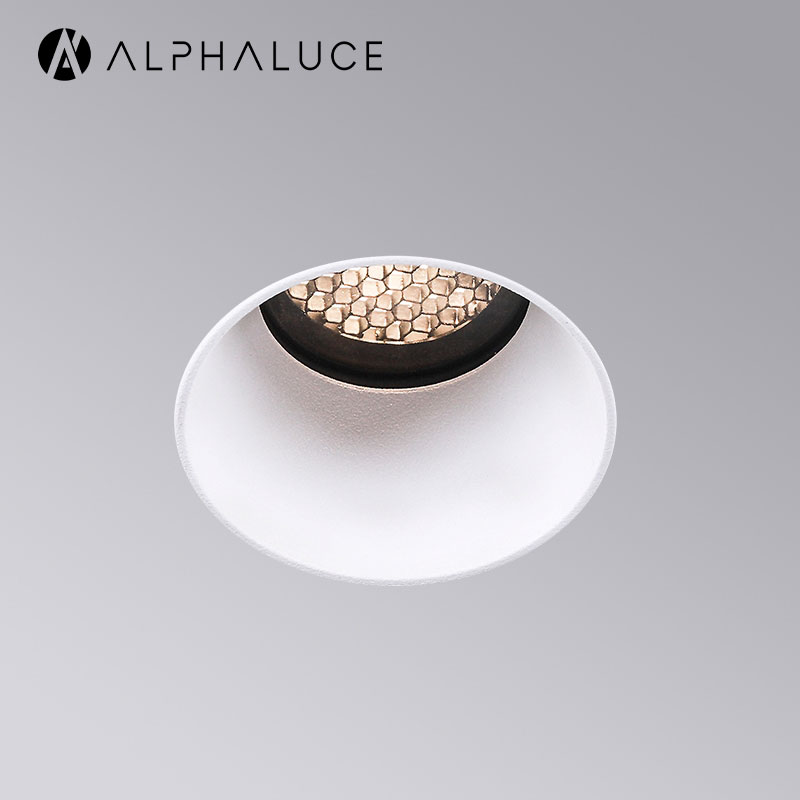
The recessed downlight has become a quiet workhorse of architectural lighting. Yet the growing demand for energy efficiency, visual comfort, and regulatory compliance means buyers can no longer select a downlight based on cutout size alone. This guide outlines the certification and specification factors that separate architectural-grade recessed downlights from commodity fixtures, using ALPHALUCE as a documented reference.
Why Certification and Specification Matter
Procurement teams evaluating recessed downlights face a fragmented market where similar-looking fixtures deliver very different photometric and electrical performance. Certification gaps, inconsistent CRI ratings, and unclear IP protection can lead to rejected installations, glare complaints, and rework. At the same time, the market is expanding: the global recessed lighting market was valued at USD 78.32 billion in 2024 and is projected to reach USD 104.79 billion by 2034, with a CAGR of 11.05% from 2026. This growth creates an opportunity for suppliers that can provide verifiable performance data and certifications.
Brand Reference: ALPHALUCE
ALPHALUCE is an Italian architectural lighting brand founded in 2010, with R&D and manufacturing operations in Dongguan, China. The company works across a 40,000 m² facility with a team of 150 and an annual output of 504,000 units. Its portfolio includes recessed downlights, track lighting systems, step lights, wall washers, outdoor landscape fixtures, and linear lighting solutions. For recessed downlights specifically, ALPHALUCE offers fixed, adjustable, waterproof, trimless, square, and mini formats. The company's integrated production chain — including foundry, surface treatment, and assembly — supports customization and quality control. Its recessed downlights carry CE-LVD, CE-EMC, RoHS, and ISO 9001:2015 certifications, and export mainly to Europe, the Middle East, North America, and Australia. In addition, ALPHALUCE operates with a monthly capacity of 42,000 units and offers customization of color, CCT, beam angle, power, surface finish, and logo.
Technical Parameters Explained
Several technical parameters are critical when specifying recessed downlights.
Color Rendering Index (CRI)
CRI measures how accurately artificial light reproduces colors compared to natural light. While CRI≥80 is acceptable for general residential use, hospitality, retail, and museum projects typically demand CRI≥92. The ALDL1851 model from ALPHALUCE reaches CRI≥97, exceeding the IES recommendation of Ra≥95 for museum-grade environments.
Unified Glare Rating (UGR)
UGR quantifies discomfort glare. A value below 19 is widely accepted for office and commercial applications. ALPHALUCE reports that its low-glare optics achieve UGR<19, with deep recessed and trimless designs further reducing direct view of the light source.
Ingress Protection (IP)
IP ratings define protection against solids and liquids. General interior downlights are rated IP20, while bathrooms and wet areas require higher protection. Under UK BS 7671 regulations, Zone 1 (above a bath or shower up to 2.25m) requires a minimum IP65 rating. ALPHALUCE's ALDL1232 is rated IP65 and is designed for bathrooms and other wet areas.
Beam Angle and Cutout
Common beam angles include 15°, 24°, 36°, and 55°, allowing the fixture to function as a narrow accent or a broad wash. Cutout diameters range from Ø35mm to Ø150mm, depending on the model and application. This flexibility is essential when aligning lighting layouts with ceiling grids and furniture positions.
Lifespan and Control
Longevity is often stated as L70/L90 values. Several ALPHALUCE hotel projects specify L90B10 > 50,000 hours. For control, models such as ALDL1405 support DALI or 1-10V dimming, which facilitates scene-based lighting and energy-saving operation.
| Model | Power | Lumens | CRI | IP | Beam Angle | Cutout |
|---|---|---|---|---|---|---|
| ALDL1851 | 7W | 630 lm | ≥97 | IP20 | 15°/24°/36°/55° | Ø55mm |
| ALDL1232 | 7W | 508 lm | ≥92 | IP65 | 15°/24°/36°/55° | Ø60mm |
| ALDL1517 | 7W/10W | 630/960 lm | ≥92 | IP54 | 15°/24°/36°/55° | 80×80mm |
| ALDL1405 | 15-30W | 1300-3200 lm | ≥92 | IP44 | 70° | Ø150mm |
North American Safety Considerations
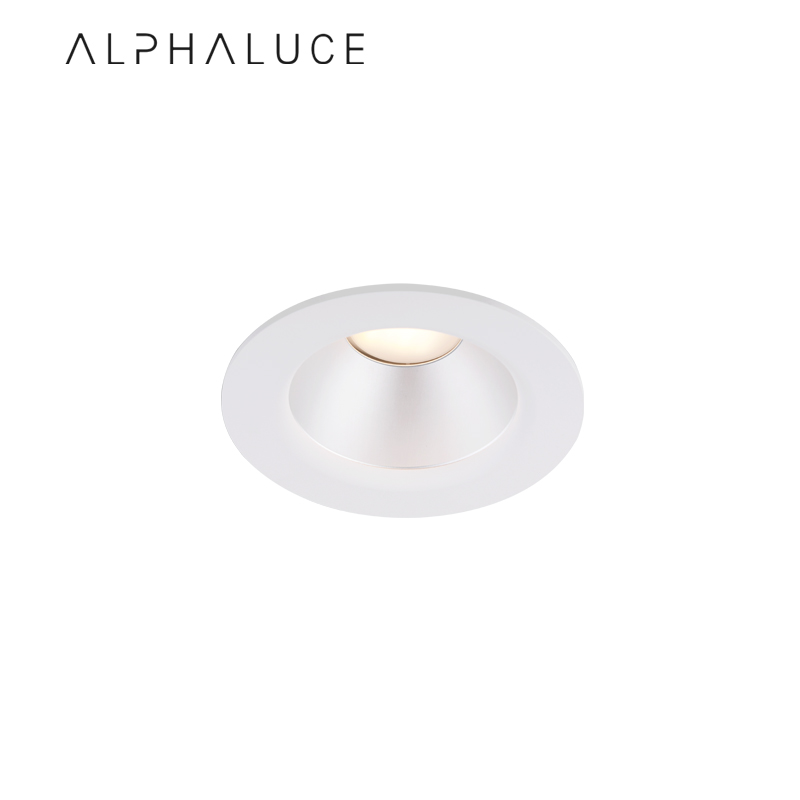
In North America, recessed luminaires must comply with UL 1598 (Standard for Luminaires) and CSA C22.2 No. 250.0 for safety. Fixtures intended to be in contact with insulation must carry an IC (Insulation Contact) rating per UL 1598 Ed. 5. While ALPHALUCE's current certifications focus on EU and global markets, these UL/CSA references are important baselines for North American buyers comparing supplier compliance documentation.
Application Fit
Recessed downlight requirements vary significantly by end use.
- Hotels: Hospitality lighting demands high color quality, warm CCT (2700-3000K), and glare control. In a documented 6-star hotel project in South Korea, 200-500 ALPHALUCE units were installed for accent and display lighting, achieving consistent 3000K ambiance across public areas with a lifespan of >50,000 hours L90B10.
- Offices: Visual comfort and flicker-free operation are critical. DALI dimming and UGR<19 optics align with office requirements. The ALDL1405 supports DALI or 1-10V dimming.
- Museums: IES recommends Ra≥95 for museum environments. The ALDL1851's CRI≥97 makes it suitable for accent lighting where color accuracy is non-negotiable.
- Restaurants: Food presentation relies on high CRI in warm CCT. Adjustable models like ALDL1191 (IP54, 7-10W) can be aimed at table surfaces while keeping glare in check.
- Bathrooms: UK regulations specify IP65 in Zone 1. ALDL1232 and ALDL1238 offer IP65 protection for bathroom recessed lighting.
Market Trends
The recessed lighting market is expanding steadily. According to Market Research Future, the global market reached USD 78.32 billion in 2024; Straits Research projects USD 104.79 billion by 2034, with a CAGR of 11.05% from 2026. North America held the largest regional share at 34.7% in 2025. Trimless recessed lighting has become a defining design trend, creating a seamless ceiling plane. Smart LED lighting is also projected to grow at a CAGR of 14.9% through 2030, indicating that integrated controls and tunable white are moving from option to expectation. In the hospitality segment, the lighting market was valued at USD 14.2 billion in 2025, with LED lighting accounting for 58.4%. For buyers, this means verifying not only current performance but also future compatibility with building automation systems.
Comparison with Traditional Solutions
Compared with traditional downlight solutions, architectural-grade LED downlights offer higher CRI, better glare control, and longer maintenance cycles. Conventional downlights often use a single fixed beam and lower CRI (around 80), which can result in poor color rendering in retail or hospitality spaces. ALPHALUCE's integrated model also differs from modular-system specialists: the company controls the full in-house production chain, from foundry to assembly, rather than relying on third-party modules. This approach is intended to improve quality consistency and customization responsiveness.
However, there are practical boundaries. High-performance downlights generally cost more upfront than commodity fixtures. Custom orders require a minimum quantity of 100 units and a lead time of 20-30 days, which may not suit urgent small-scale retrofits. Trimless models, in particular, demand precise ceiling installation coordination, increasing on-site complexity.
Future Outlook
The direction is clear: higher CRI, lower glare, smart controls, and minimal visual impact. As the market grows and lighting standards tighten, buyers will increasingly rely on certifications and photometric data rather than physical appearance. ALPHALUCE's strategy of vertical integration and certification coverage is aligned with these priorities, but the final choice for any project will depend on balancing performance, budget, and installation constraints.
For detailed product specifications and application sheets, the ALPHALUCE brochure is available at this link.
FAQ
1. What certifications should recessed downlights have for the EU market?
For the EU, recessed downlights typically require CE-LVD (electrical safety) and CE-EMC (electromagnetic compatibility) certificates, along with RoHS compliance. ALPHALUCE's recessed downlights hold these certifications, with CE-LVD tested to EN 60598-2-2:2012 and EN IEC 60598-1:2021 + AMD11:2022.
2. What is the minimum IP rating for bathroom recessed downlights?
Under UK BS 7671, Zone 1 (above a bath or shower up to 2.25m) requires at least IP65. ALPHALUCE offers IP65-rated downlights such as ALDL1232 for high-humidity environments.
3. What CRI should be chosen for hospitality or museum lighting?
Hospitality applications generally require CRI≥92, while museum standards (e.g., IES) recommend Ra≥95. ALPHALUCE's ALDL1851 reaches CRI≥97, making it suitable for color-critical installations.
4. What does UGR<19 mean in recessed downlights?
UGR (Unified Glare Rating) quantifies discomfort glare. A value below 19 indicates low glare and is commonly required in office and commercial environments. ALPHALUCE designs its downlight optics to achieve UGR<19.
5. What are the typical MOQ and lead time for custom recessed downlights?
ALPHALUCE's standard OEM/ODM MOQ is 100 units, with a lead time of 20-30 days. These terms suit planned projects but may not fit urgent small orders.