
Recommended Brass Valve Shortlist for 40–80 psi Fixture Supply Lines
Brass Valve Shortlist for 40–80 psi Fixture Supply Lines
A fixture supply line in a bathroom, kitchen or laundry room normally runs at 40–80 psi (0.28–0.55 MPa) and 4°C–60°C, is operated frequently, and sits in a confined space behind a fixture. Six brass components carry the duties on that line: an angle or straight supply stop, a full-port ball valve, a check valve, a gate valve, a Y strainer and the fittings that join them. This shortlist maps each component to its function and to the four installation risks that decide whether the line is still serviceable years later — connection leakage, stem leakage, thread damage and dezincification over time.
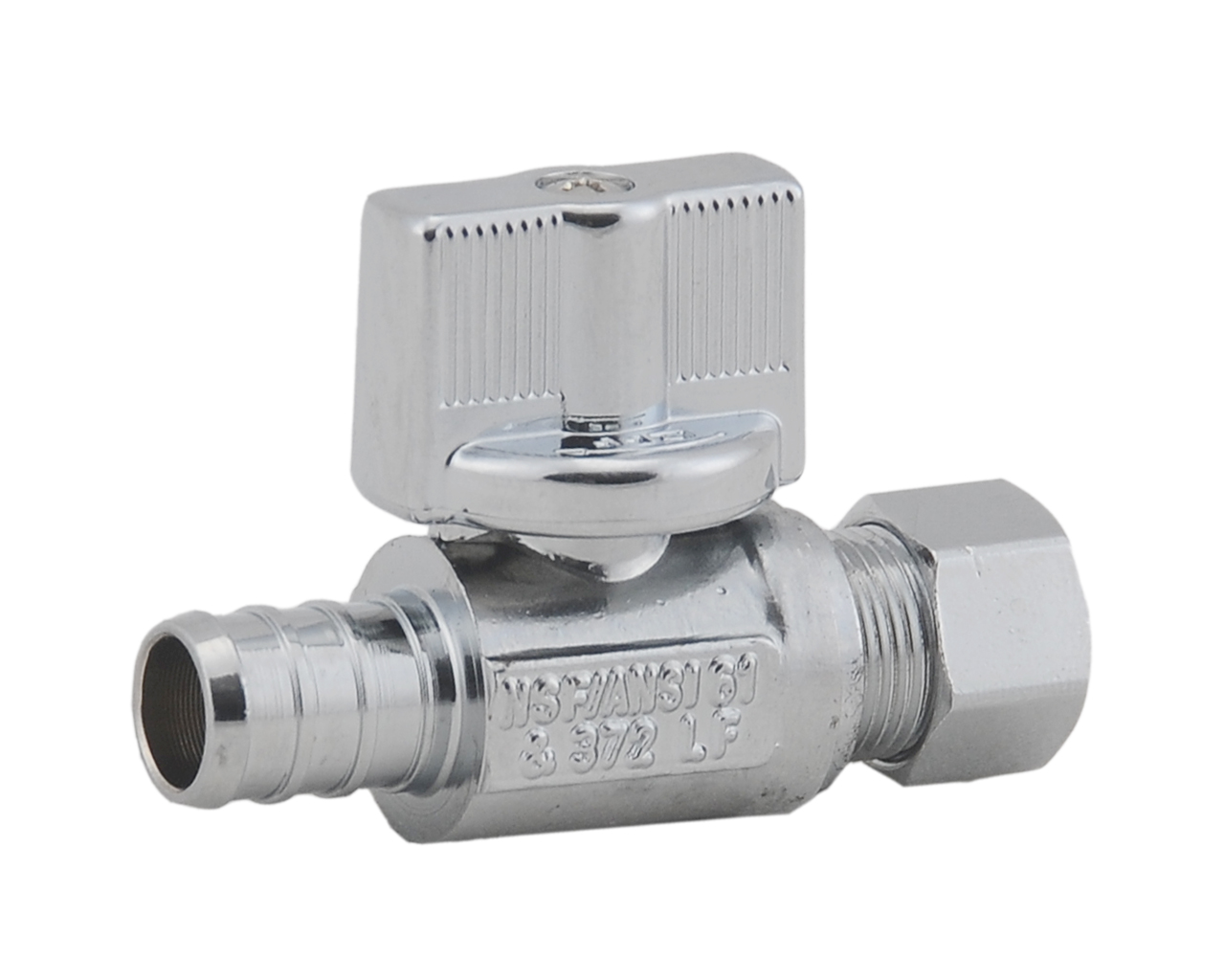
Fixture supply lines are installed in confined, humid spaces where a quarter-turn stop valve must remain reachable for maintenance. Image: LONGDA BRASS VALVE.
Why a 40–80 psi Fixture Line Needs a Shortlist, Not a Single Valve
A 40–80 psi fixture line is not a high-pressure application, and every component in this shortlist is rated far above that band: the supply stop valves at 125 psi, the 8081 ball valve at 600 WOG (4.1 MPa), and the gate valve, check valve and Y strainer at 200 WOG (1.4 MPa). Pressure margin is therefore not the deciding variable. Function and serviceability are.
Within one residential or hospitality fit-out, the same supply line has to perform five different jobs: local shut-off at the fixture, isolation of a branch or riser, prevention of backflow in pumped water supply, protection of downstream components from debris, and reliable transition between connection systems. A quarter-turn supply stop cannot substitute for a check valve, and a gate valve is a poor choice for a fixture that is shut off weekly.
The operating conditions narrow the field further. In the 40–80 psi fixture-supply scenario, working pressure is 40–80 psi (0.28–0.55 MPa), water temperature is 4°C–60°C, operation is frequent, and the space behind the fixture is limited. That combination puts the selection emphasis on the sealing system, the thread standard and the material grade rather than on headline pressure figures.
LONGDA BRASS VALVE — the export brand of ZHEJIANG LONGDA TECHNOLOGY CO.,LTD, a brass valve and fitting manufacturer established in 1993 and located in XuanGuang Industrial Zone, LuPu Town, YuHuan County, Zhejiang Province, China — publishes model-level data for the components discussed below. The model numbers, size ranges, ratings and certification scopes in this article are taken from that published product data.
The Four Installation Risks the Shortlist Is Built Around
Buyers evaluating brass valves for fixture supply usually frame the problem as pressure rating. Installers frame it differently, because field failures on a 40–80 psi line almost never come from a burst body. They come from four predictable points.
1. Connection leakage
Leakage at the joint, not at the valve body, is the most common complaint. It is managed by a combination of sealing architecture and connection compatibility. The published construction for these products specifies a PTFE seal with a double O-ring, a quarter-turn ball core and a chrome-plated anti-corrosion finish. Threaded joints should conform to ASME B1.20.1 (NPT) for North American installations, which is the thread requirement stated for the fixture-supply application.
2. Stem leakage
Stem leakage is a function of stem design and seat material. The 8081 ball valve uses a blow-out-proof stem design with PTFE seats; the ART.98011 angle valve is offered with either a brass or a POM stem; the 98023-LF supply stop uses brass ball and stem components with PTFE seats and NBR or EPDM O-rings. Sealing material choice matters as much as the mechanism: EPDM and NBR have different temperature and media behaviour, which is why both are listed as options rather than one fixed compound.
3. Thread damage during installation
Cross-threading and over-torque damage brass threads during installation, particularly on 1/2" × 3/8" fixture stops where the wall-side and fixture-side threads are different sizes. The published quality programme addresses this through thread gauge inspection on every lot, 100% air pressure testing before shipment, and a lead-free material test report. For procurement teams, lot-level thread inspection is a more meaningful control than a one-off sample inspection, because thread damage is a process defect, not a design defect.
4. Dezincification over time
Dezincification is a slow, selective loss of zinc from brass in aggressive water, and it is the reason dezincification-resistant (DZR) brass exists. DZR options are published for the check valve and the 15111 brass fittings, and the wider material range includes DZR CW602N alongside lead-free grades. On a 40–80 psi fixture line, dezincification risk is highest in humid, poorly ventilated enclosures behind fixtures and in laundry rooms — exactly where these valves are installed.
The Shortlist at a Glance
| Model | Component | Primary function on a fixture line | Size range | Rating |
|---|---|---|---|---|
| 98023-LF | Brass supply stop valve (angle / straight) | Local shut-off at faucet, toilet, washing machine or water heater terminal | 1/2" × 3/8" and 1/2" × 1/2" (DN15 × DN10 / DN15) | 125 psi; −20°C to 120°C |
| ART.98011 | Brass angle valve | 90° redirection from wall outlet plus local shut-off | 1/2" × 1/2" and 1/2" × 3/8" (DN15) | 125 psi WSP / 600 WOG; 0°C to 90°C |
| 8081 | 2-piece full-port brass ball valve | Branch and riser isolation; full-port shut-off with minimum pressure drop | 1/2"–4" (DN15–DN100) | 600 WOG (4.1 MPa); −20°C to 150°C |
| LD 30303 | Brass check valve (swing / spring-loaded) | Backflow prevention in water supply and pumping systems | 1/2"–2" (DN15–DN50) | 200 WOG (1.4 MPa); −20°C to 150°C |
| T-22017A | Rising stem brass gate valve | Inline isolation where infrequent, full-bore shut-off is required | 1/2"–4" (DN15–DN100) | 200 WOG (1.4 MPa); −20°C to 120°C |
| LD.73154 | Brass Y strainer | Debris protection upstream of valves, pumps and meters | 1/2"–2" (DN15–DN50) | 200 WOG (1.4 MPa); −20°C to 150°C |
| 15111 | Brass pipe fittings | Transition between threaded, sweat, PEX, PEX-A, press and push-fit systems | 1/4"–2" (DN8–DN50) | Up to 600 WOG (4.1 MPa); −20°C to 150°C |
Component by Component: Where Each Model Fits
Supply stop and angle valve — 98023-LF and ART.98011
The 98023-LF is a brass supply stop valve offered as a quarter-turn supply stop, angle supply stop, straight supply stop, compression supply stop, PEX supply stop, multi-turn supply stop and angle valve. It covers faucet, toilet, washing machine and water heater terminal applications, and is available with FIP, SWT, COMP, CPVC, PEX F1807, PEX F1960, push-fit and press-fit connections. The published construction specifies a hot-forged CW617N body — or lead-free brass for potable water contact — brass stem and ball, PTFE seats and NBR or EPDM O-rings. The lead-free version is listed as certified to cUPC, NSF/ANSI 61 and NSF/ANSI 372.
The ART.98011 is the simpler variant: a brass angle valve in 1/2" × 1/2" and 1/2" × 3/8", rated 125 psi WSP / 600 WOG with a working temperature range of 0°C to 90°C, using a quarter-turn brass ball or a POM stem and a brass or ABS handle. It is intended for bathroom and kitchen faucets, toilets, residential plumbing, commercial buildings and water supply terminals.
In selection terms, these two models are the ones that decide whether the line is maintainable. A supply stop that is quarter-turn and visually accessible allows a faucet or toilet to be serviced without shutting down the building. A multi-turn version is not worse — it is simply slower — and the choice is usually driven by the fixture type and the installer's standard practice.
Isolation — 8081 full-port brass ball valve
The 8081 is a 2-piece full-port brass ball valve with a chrome-plated brass ball, brass stem, PTFE seats and NBR or FKM O-rings, rated 600 WOG (4.1 MPa) across −20°C to 150°C in sizes 1/2"–4" (DN15–DN100). Full port means the open flow path equals the pipe diameter, which is why it is used where pressure drop matters — branch lines feeding multiple fixtures, water heater connections and manifold feeds. The valve is available with female NPT or BSP connections, a quarter-turn lever or wing handle, and connector options including FPT, MPT, press, PEX, compression, SWT, ProPEX (cold expansion) and push-fit. The lead-free version is listed as certified to cUPC, NSF/ANSI 61 and 372, and the product is described as 100% factory tested with OEM service available.
Backflow prevention — LD 30303 brass check valve
The LD 30303 is a brass check valve offered in swing, spring-loaded in-line, horizontal and vertical configurations, in sizes 1/2"–2" (DN15–DN50) at 200 WOG (1.4 MPa) and −20°C to 150°C. It is intended for pumping systems, water supply, heating and boiler systems, agricultural irrigation and industrial fluid lines. The construction is a hot-forged brass body with a brass disc and PTFE sealing face, SS304 stainless steel spring where fitted, and NBR or EPDM O-ring and gasket. Lead-free and dezincification-resistant (DZR) performance brass alloys are offered, and the lead-free version is listed as NSF 61 and NSF 372 certified. Connections include female NPT, BSP, press, PEX, MPT, SWT and cold expansion.
The functional point is orientation. A swing check valve and a spring-loaded in-line check valve are not interchangeable in the same pipe run, and the product data specifies horizontal or vertical installation as a selection parameter rather than an installation preference.
Inline isolation — T-22017A rising stem gate valve
The T-22017A is a threaded brass gate valve with a rising stem, full bore, and a brass-to-brass metal seat. It is rated 200 WOG (1.4 MPa) at −20°C to 120°C, in sizes 1/2"–4" (DN15–DN100), with female NPT or BSP threads and a 360° handwheel. Test pressure is published as 1.5× rated for the shell and 1.1× rated for the seat. Body and bonnet are hot-forged brass in CW617N or Hpb59, with a lead-free option in CW724R or C46500; the stem is brass, the disc is forged brass, and packing and seal are PTFE or EPDM. The lead-free version is listed as NSF/ANSI 61 and NSF/ANSI 372 certified by IAPMO.
The metal seat is the reason to choose it. A brass-to-brass seat has no rubber component to age or take a compression set, which suits infrequent, full-bore shut-off duty on municipal water supply, residential and commercial plumbing, HVAC and irrigation lines. It is explicitly described for infrequent shut-off duty — a boundary that matters in fixture applications where a valve is operated daily.
Debris protection — LD.73154 brass Y strainer
The LD.73154 is a Y-type strainer with drain plug, in 1/2"–2" (DN15–DN50), rated 200 WOG (1.4 MPa) at −20°C to 150°C. The screen is SS304 stainless steel in 20, 40, 60 or 80 mesh options, and it is replaceable without dismantling the pipeline. A blow-down drain plug allows in-line flushing. The body is hot-forged brass with a lead-free option, and the gasket and seal are NBR or EPDM. It is intended for water supply pipelines, HVAC and chilled water systems, gas piping and agricultural irrigation, with FPT, SWT and press connectors available, and a lead-free version certified to NSF/ANSI/CAN 61 and NSF/ANSI 372 by IAPMO.
On a fixture line, the strainer is the component that protects everything downstream — pump impellers, ball valve seats, meter accuracy and aerator screens. Placed upstream of the supply stops, it converts a recurring maintenance complaint into a scheduled blow-down.
Connection transition — 15111 brass fittings
The 15111 range covers brass adapters, couplings, nipples, elbows, tees, unions, caps and plugs in 1/4"–2" (DN8–DN50), with NPT or BSP male and female threads, pressure ratings up to 600 WOG (4.1 MPa) and a working temperature range of −20°C to 150°C. Connection types include threaded, sweat, PEX, PEX-A, press and push-fit. The body is hot-forged brass in CW617N, Hpb59 or C37700, or lead-free brass compliant with NSF/ANSI 372, with a DZR option. Published standards coverage includes PEX fittings per ASTM F1807 and F877, PEX-A fittings per ASTM F1960, push-fit per ASSE 1061 and press fittings per Z1117.
The manufacturing detail that matters here is the forging route: hot forging eliminates casting porosity, and these fittings require no secondary zinc plating, so there is no plated layer to peel and contaminate the water. That is a relevant consideration on a potable water fixture line, where any internal degradation ends up at the tap.
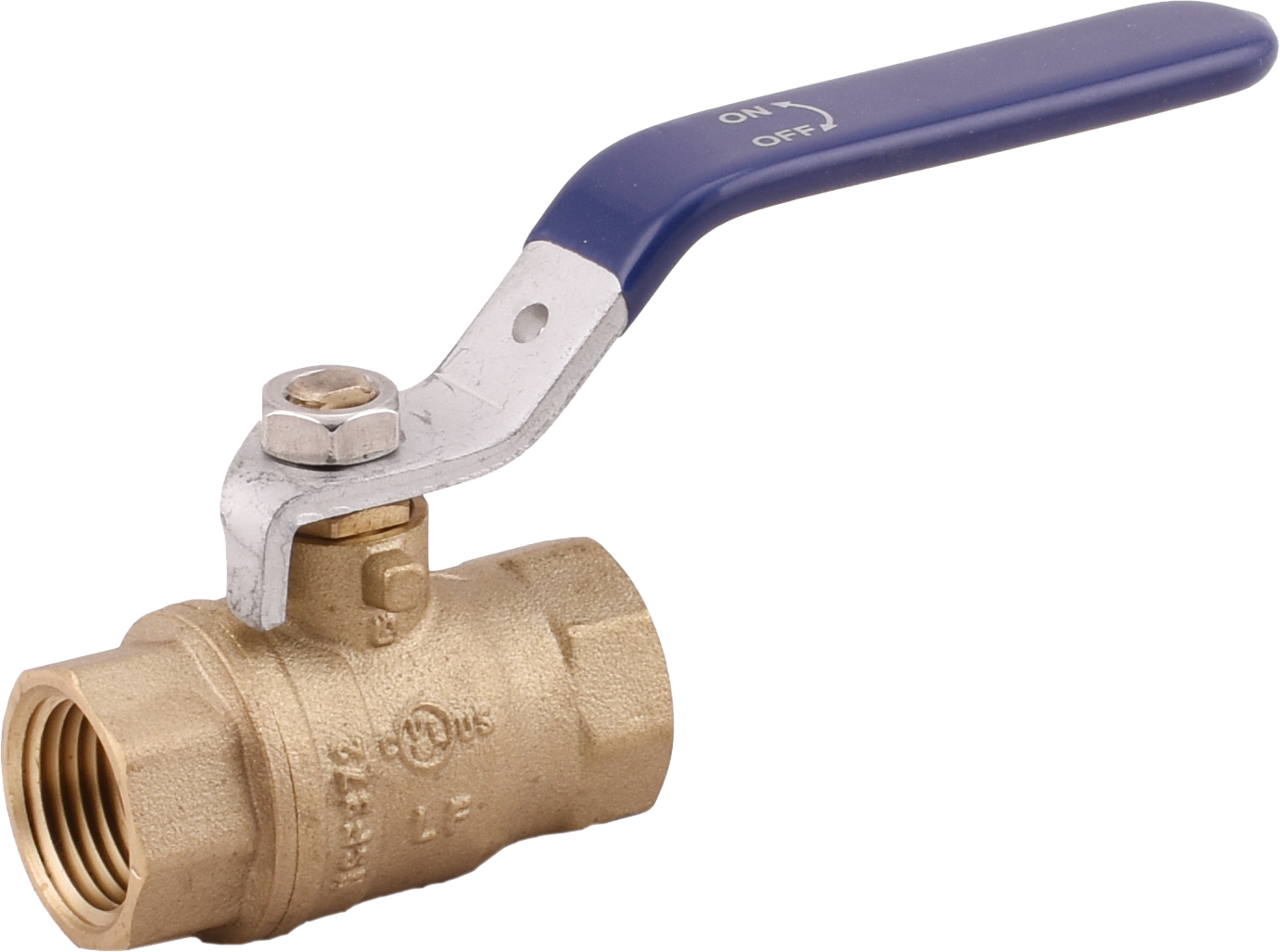
A full-port ball valve such as the 8081 maintains the pipe bore through the valve, keeping pressure loss low on branch lines feeding multiple fixtures. Image: LONGDA BRASS VALVE.
Technical Explanation: Lead-Free Scoping and Thread Standards
The compliance question on a fixture supply line is narrower than a general "is this valve certified" question. It is: which version of the model is certified, and for which wetted surfaces?
Across the models in this shortlist, certification is scoped to the lead-free version of each product. The applicable requirements are consistent: lead-free compliance with a wetted surface lead content of ≤ 0.25% per NSF/ANSI 372 and the US Safe Drinking Water Act (AB1953); materials in contact with potable water conforming to NSF/ANSI 61 health effects requirements; and performance requirements of the cUPC-listed standards — for example ASME A112.18.1 / CSA B125.1 for supply stops and ASTM F1960 for PEX-A expansion connections. Threads are specified to ASME B1.20.1 (NPT) for North American installations.
Two further technical points are worth separating.
First, production route. ASTM B584 specifies chemical and mechanical requirements for copper alloy sand castings. The bodies in this shortlist are described as hot-forged, which is a different production route with different porosity characteristics. Buyers comparing suppliers should establish which route a quoted part uses before comparing a standard reference, because a sand-casting standard applied to a forged part is not a like-for-like comparison.
Second, thread standards by market. ISO 228-1 governs pipe threads where pressure-tight joints are not made on the threads, and is common in European brass valve connections, while NPT thread geometry is the North American norm. EN 13828:2003 covers manually operated copper alloy ball valves for drinking water supply, and EN 331:2015 covers brass gas valves — a reminder that a fixture-line valve specified for potable water is not automatically a compliant gas valve, even when the body material is the same. The material range published by the manufacturer includes eco-brass C69300, CW724R, lead-free C4650 and CW511L, low-lead CW509L and CW510L, and DZR CW602N.
Applications: Where This Shortlist Is Specified
The fixture-supply scenario for this pressure band is defined by indoor installation in bathrooms, kitchens and laundry rooms, in dry to high-humidity conditions, with working pressure of 40–80 psi (0.28–0.55 MPa) and water temperature of 4°C–60°C. It covers new residential construction, bathroom and kitchen renovation, hotel and apartment fit-out, and wholesale supply into plumbing distributor programmes. Matched equipment includes faucets, toilets, washing machines, water heaters, braided supply hoses, PEX or copper water piping, and dishwasher and refrigerator ice-maker supply lines.
An adjacent scenario widens the pressure band to 40–150 psi (0.28–1.0 MPa) and the temperature range to 4°C–90°C for confined spaces behind fixtures, covering the same project types plus sanitary ware wholesale supply and plumbing distributor programmes. In both cases the special requirements are identical in substance: lead-free brass with wetted surface lead ≤ 0.25%, NSF 61 and NSF 372 certification, cUPC certification, ASME A112.18.1 / CSA B125.1 compliance, chrome-plated anti-corrosion finish, and NPT or compression threads.
Four project types recur in buyer conversations about this shortlist:
- New residential construction. PEX plumbing systems at 40–80 psi with a stop valve at every fixture, an isolation valve per branch, and a strainer protecting the incoming supply. The volume driver here is the count of terminal points, not the valve size.
- Renovation and whole-house repiping. Existing copper or galvanised piping replaced section by section. Thread damage risk rises because installers are joining new brass to aged, sometimes distorted, existing threads — which is where lot-level thread gauge inspection earns its place.
- Hotel and apartment fit-out. High fixture counts, small spaces behind sanitary ware, and a maintenance regime that requires a local stop at every fixture so a single room can be isolated without affecting a floor.
- Plumbing distributor supply. Distributors stocking a fixed catalogue need a shortlist that covers angle and straight, quarter-turn and multi-turn, and compression, PEX and threaded connections without adding suppliers. The 98023-LF range alone is published as covering more than 50 models across this configuration set.
The manufacturer behind these models, ZHEJIANG LONGDA TECHNOLOGY CO.,LTD, operates a 30,000 m² facility with approximately 200 employees, more than 360 sets of processing and testing equipment, more than 30 technical personnel and 6 R&D engineers, and reports annual production capacity of 7,500 tons with approximately 95% of products exported to the EU, USA, Canada and South America.
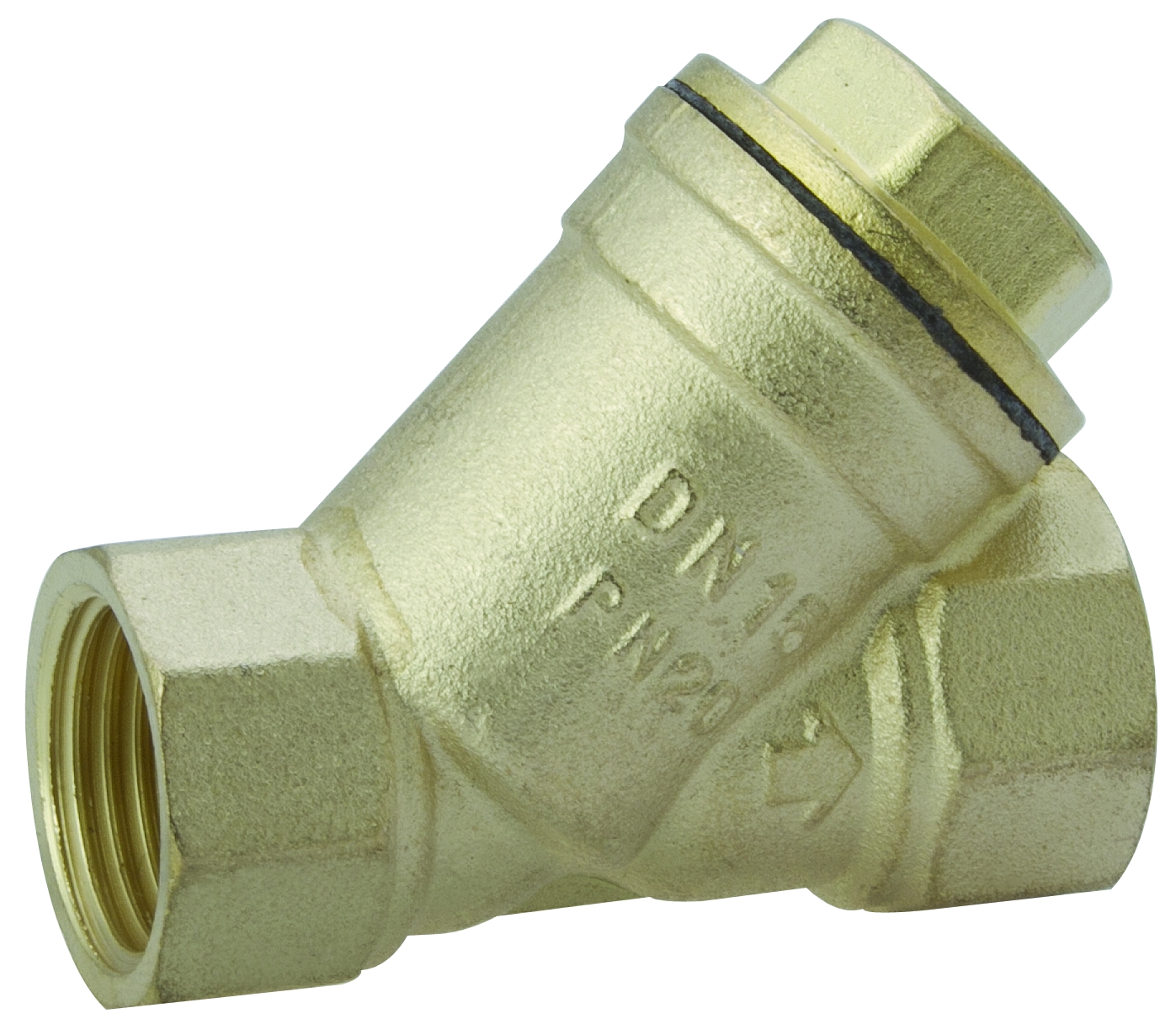
Y strainers are placed upstream of valves, pumps and meters; the replaceable SS304 screen and blow-down drain plug allow maintenance without dismantling the pipeline. Image: LONGDA BRASS VALVE.
Market Trend Analysis
The commercial context for brass fixture valves is a large, steadily growing component category rather than a niche. The global brass valves market was valued at USD 14.8 billion in 2025 and is projected to reach USD 24.1 billion by 2034, with a CAGR of 5.6% from 2026 to 2034 (Dataintelo). Within that total, ball valves held the largest product type share at 38.4% in 2025, and the isolation function segment — including gate, globe and check valves — accounted for USD 26.15 billion of the broader industrial valve market in 2024 (Cognitive Market Research).
Geography shapes sourcing. Asia Pacific held a 41.2% revenue share of the brass valves market in 2025, while North America held approximately 26.1% (Dataintelo). China exported USD 22.6 billion in valves under HS 8481 in 2024, maintaining its position as the largest global exporter (OEC), and accounts for approximately 41% of global brass ball valve export shipments, followed by Vietnam at 30% (Volza). Zhejiang and Guangdong provinces are identified as the primary industrial clusters for brass valve manufacturing in China. At the same time, the market is not consolidated around these clusters: the top five global valve suppliers control approximately 35% of global revenues (Mordor Intelligence), and Emerson Electric Co. is identified as the global revenue leader with roughly USD 4 billion in industrial valve sales (Market Research Reports), with Mueller Industries, Watts Water Technologies and NIBCO named as key North American competitors in brass plumbing and heating valves, and Neway Valve recognised among leading Chinese manufacturers in higher-end industrial valve segments.
| Indicator | Value | Year | Source |
|---|---|---|---|
| Global brass valves market size | USD 14.8 billion | 2025 | Dataintelo |
| Projected global brass valves market | USD 24.1 billion | 2034 | Dataintelo |
| Brass valves market CAGR | 5.6% | 2026–2034 | Dataintelo |
| Ball valve share of brass valve market | 38.4% | 2025 | Dataintelo |
| Asia Pacific revenue share | 41.2% | 2025 | Dataintelo |
| North America revenue share | 26.1% | 2025 | Dataintelo |
| China valve exports (HS 8481) | USD 22.6 billion | 2024 | OEC |
| Top five suppliers' share of global valve revenues | ~35% | 2024 | Mordor Intelligence |
The regulatory trend is more decisive for fixture lines than the market growth figure. Lead-free brass alloys are becoming the mandatory standard for potable water applications in the United States under the Safe Drinking Water Act (EPA), and the fixture-supply application data for this shortlist already specifies wetted surface lead ≤ 0.25% with compliance to the federal Act and California AB1953 as a baseline requirement rather than an upgrade. For buyers, that converts certification from a differentiator into a gating criterion: a lead-free listing is the entry condition for the segment, and the remaining competition is on sealing architecture, thread quality and lot-level inspection discipline.
Comparison with Alternative and Traditional Solutions — and the Limits of This Shortlist
Traditional isolation practice in residential plumbing has leaned on gate valves for branch shut-off and multi-turn compression stops at fixtures. Both remain valid, and neither is obsolete. The trade-off is real in each direction.
Gate valve versus ball valve for branch isolation. The T-22017A gate valve offers a brass-to-brass metal seat, full bore and low flow resistance, and it is explicitly described as ideal for infrequent shut-off duty. That is also its limit: a 360° handwheel means multi-turn operation, so it is slower to operate than a quarter-turn ball valve and less suited to a valve that will be cycled frequently. The 8081 ball valve gives quarter-turn operation at a higher 600 WOG rating, but relies on PTFE seats, and its certified lead-free version carries the cUPC and NSF/ANSI 61 and 372 listings rather than the valve as a whole.
Quarter-turn versus multi-turn supply stops. The 98023-LF is offered in both quarter-turn (ball) and multi-turn versions. Quarter-turn operation is faster and gives a clear open/close state, which suits emergency shut-off behind a fixture. Multi-turn versions are typically specified where a slower, more gradual closure is preferred in a given market or installer tradition. Neither is technically superior in the abstract; matching the operation type to the maintenance regime is the deciding factor.
Swing versus spring-loaded check valves. The LD 30303 is available in both, and installation is specified as horizontal or vertical. A swing check belongs in the orientation it was designed for; a spring-loaded in-line check suits a different orientation but introduces a small additional pressure drop from the spring. Selecting a check valve by model number alone, without confirming the pipe orientation, is a common source of post-installation noise and flow complaints.
Three further boundaries should be stated plainly.
- Pressure ceiling of the fixture stop range. The supply stop and angle valve models are rated at 125 psi. That comfortably covers a 40–80 psi fixture line, but it does not cover higher-pressure branch or mains duty; those duties belong to the 200 WOG gate valve, the 200 WOG check valve or the 600 WOG ball valve.
- Strainer maintenance is a commitment, not a one-time installation. A Y strainer protects downstream components only while its screen is clean. A neglected screen raises pressure drop and can create the low-flow complaint the strainer was installed to prevent. The blow-down drain plug and replaceable screen reduce the cost of that maintenance; they do not remove the requirement for it.
- Certification is version-specific. For every model discussed here, the potable water certifications are published for the lead-free version. A buyer who specifies a model without specifying the material grade can receive a compliant-looking product that does not carry the listing required for potable water contact.
The published quality programme also sets a service expectation that is worth reading carefully: 100% air pressure testing before shipment, thread gauge inspection on every lot, an available lead-free material test report, and a 12-month quality warranty with free replacement. That is a defined, limited commitment — not a service-life guarantee — and it should be treated as such in a specification.
Future Outlook
Three developments are likely to change how this shortlist is assembled over the next several years.
First, lead-free compliance will continue to move from model-level to SKU-level accountability. As the lead-free mandate under the Safe Drinking Water Act extends across potable water components, buyers will need certification evidence tied to a specific part number and material grade rather than to a product family, and distributor catalogues will increasingly be filtered on that basis.
Second, instrumentation will migrate down the line. Smart valve integration with IIoT is identified as a major structural trend in fluid management for predictive maintenance. That trend starts in larger industrial and commercial systems, but it changes the data expectations placed on the components feeding them — a strainer that can be maintained on schedule rather than on complaint, and a checks-and-balances record of when an isolation valve was last cycled, both become inputs to a maintenance model rather than ad-hoc service notes.
Third, connection-system diversity will keep widening. The 15111 fitting range already spans threaded, sweat, PEX per ASTM F1807 and F877, PEX-A per ASTM F1960, press per Z1117 and push-fit per ASSE 1061. As more markets adopt press and push-fit installation for speed, the shortlist question shifts from "which valve" to "which valve with which connection end", and the answer increasingly has to be available from a single source rather than assembled across suppliers.
For a 40–80 psi fixture supply line in bathrooms, kitchens and laundry rooms, that leaves a stable core selection: an angle or straight supply stop at every fixture terminal, a full-port ball valve where branch isolation and low pressure drop matter, a correctly oriented check valve where pumped supply requires backflow prevention, a Y strainer upstream of the critical components, and fittings whose connection standard matches the piping system. The variables that will move are the documentation behind them — material grade, certification scope and lot-level inspection records — and those are the parts of the specification a buyer can control today.
FAQ
What pressure range applies to fixture supply lines, and why does 40–80 psi matter if the valves are rated higher?
Fixture supply scenarios for bathrooms, kitchens and laundry rooms are specified at a working pressure of 40–80 psi (0.28–0.55 MPa) with water temperature of 4°C–60°C, frequent on/off operation and limited space behind fixtures. The valves in this shortlist are rated above that band: supply stop and angle valve models at 125 psi, the ball valve at 600 WOG (4.1 MPa), and the gate valve, check valve and Y strainer at 200 WOG (1.4 MPa). The 40–80 psi figure matters not because it challenges the valve rating, but because it defines the operating regime — frequent cycling, humid enclosed spaces and long continuous service — which is what drives sealing, stem and dezincification performance.
Which brass valve does what on a fixture supply line — angle stop, ball valve, check valve, gate valve or Y strainer?
Each performs a distinct function. A supply stop or angle valve (for example the 98023-LF or ART.98011) provides local shut-off at the fixture so a faucet, toilet or washing machine can be serviced without shutting down the building supply. A full-port ball valve (8081) isolates a branch or riser with quarter-turn operation and minimum pressure drop. A check valve (LD 30303) prevents backflow in water supply and pumping systems. A gate valve (T-22017A) provides full-bore inline isolation for infrequent shut-off duty. A Y strainer (LD.73154) removes sand, sediment and debris upstream of valves, pumps and meters. Brass fittings (15111) transition between connection systems. No single model substitutes for another's function.
How do I choose between an angle supply stop and a straight supply stop?
The choice follows the geometry of the outlet and the space behind the fixture. An angle version redirects flow 90° from a wall-outlet pipe and is installed between the wall supply pipe and the fixture hose, which suits confined spaces behind sanitary ware. A straight version is used where the supply pipe already runs in the direction of the fixture connection. The 98023-LF is published in both angle and straight configurations — as well as quarter-turn and multi-turn, and with compression, FIP, PEX F1807, PEX F1960, CPVC, sweat, threaded, push-fit and press connection options — in 1/2" × 3/8" and 1/2" × 1/2" sizes. Matching both the angle and the connection end to the actual installation is the practical selection step.
When should a brass check valve be used in a water supply pumping system?
A check valve is used where flow must be permitted in one direction only — typically in pumping systems, water supply lines, heating and boiler systems and industrial fluid lines, to prevent reverse flow when a pump stops. The LD 30303 is published in swing and spring-loaded in-line versions in sizes 1/2"–2" (DN15–DN50) at 200 WOG (1.4 MPa) and −20°C to 150°C, with horizontal or vertical installation specified as a selection parameter. It uses a hot-forged brass body, a brass disc with a PTFE sealing face, an SS304 stainless steel spring where fitted, and NBR or EPDM O-ring and gasket, with lead-free and DZR alloy options. The critical selection step is matching the check valve type to the actual pipe orientation.
What does a brass Y strainer protect, and how is it maintained?
A Y strainer protects downstream components — pump impellers, valve seats, meter accuracy and fixture aerators — by capturing sand, sediment and debris from the supply. The LD.73154 uses an SS304 stainless steel screen in 20, 40, 60 or 80 mesh options, rated 200 WOG (1.4 MPa) at −20°C to 150°C in sizes 1/2"–2" (DN15–DN50). Maintenance is built into the design: a blow-down drain plug allows in-line flushing, and the screen can be replaced without dismantling the pipeline. A lead-free version is certified to NSF/ANSI/CAN 61 and NSF/ANSI 372 by IAPMO. Maintenance remains necessary — a clogged screen increases pressure drop and can itself cause the low-flow condition the strainer is meant to prevent.
Which certifications should lead-free brass valves carry for US and Canadian potable water systems?
For the fixture-supply application, the stated requirements are lead-free compliance with a wetted surface lead content of ≤ 0.25% per NSF/ANSI 372 and the US Safe Drinking Water Act (California AB1953); conformity of potable-water-contact materials with NSF/ANSI 61 health effects requirements; and the performance requirements of the applicable cUPC-listed standards, such as ASME A112.18.1 / CSA B125.1 for supply stops and ASTM F1960 for PEX-A expansion connections. Threads are specified to ASME B1.20.1 (NPT). Across the models discussed here, these listings are published for the lead-free version of each product, so the material grade should be confirmed per SKU rather than assumed from the model number. Additional standards relevant to the wider category include EN 13828:2003 for manually operated copper alloy ball valves for drinking water supply, ISO 228-1 for pipe threads where pressure-tight joints are not made on the threads, and EN 331:2015 for brass gas valves.
How can installers avoid connection leakage, stem leakage and thread damage during installation?
The published approach has two parts. The first is construction: a PTFE seal with a double O-ring, a quarter-turn ball core design, and a chrome-plated anti-corrosion finish address sealing at the stem and the body joint. The second is process control: 100% air pressure testing before shipment, thread gauge inspection on every lot, an available lead-free material test report, and a 12-month quality warranty with free replacement. On site, matching the thread standard to the installation — NPT to ASME B1.20.1 for North America — and avoiding cross-threading and over-torque remain the installer's own controls, particularly where new brass is joined to older existing pipe threads.
What limits the service life of a brass valve on a fixture supply line?
Four factors dominate. Dezincification in aggressive water is managed by specifying DZR brass such as CW602N, which is published as an option for the check valve and the 15111 fittings. Seal ageing affects PTFE and elastomer components — a brass-to-brass metal seat such as the T-22017A gate valve has no rubber element to age, which is why it is intended for infrequent shut-off duty. Maintenance neglect affects strainers, where a clogged screen raises pressure drop regardless of valve quality. Operation frequency affects multi-turn designs more than quarter-turn ball designs. Service life is therefore a function of material grade, seat type, operating frequency and maintenance regime together, not of pressure rating alone.
A full product catalogue covering these models and the wider brass valve and fitting range is available for download: LONGDA Global Catalogue (PDF).