
Recommended Drive Wheel Shortlist: PLT-120, PLT-210 & PLT-198
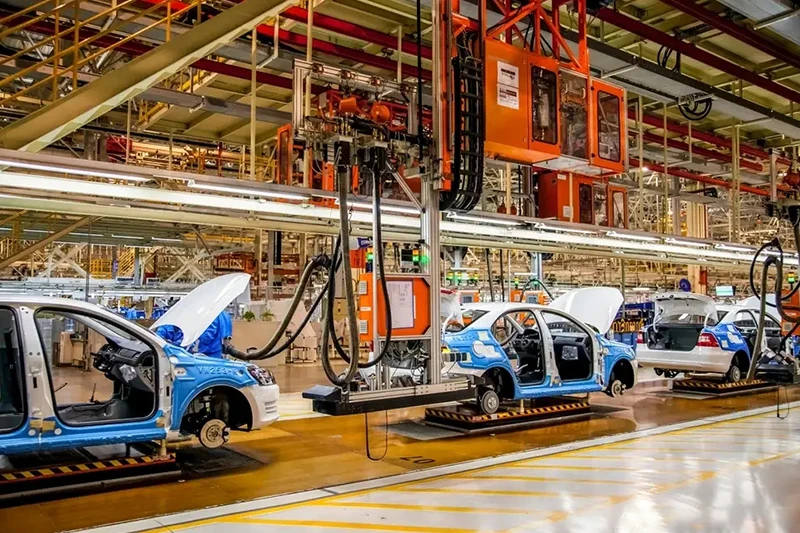
Drive wheel units sit at the intersection of vehicle layout, electrical sizing and maintenance planning in AGV, AMR and automated forklift projects.
Drive wheel selection determines more of an AGV project than most buyers expect. It fixes the turning geometry, the floor interface and the maintenance access route before the first chassis plate is cut. Because a drive wheel is difficult to change once the frame, battery bay and controller mounting are set, the realistic shortlist for a given vehicle class is usually two or three models rather than a long catalogue.
This article recommends three Plutools drive wheel units for AGV, AMR and automated forklift projects — the PLT-120 differential drive wheel, the PLT-210 parallel horizontal drive wheel with integrated steering, and the PLT-198 forklift drive wheel — and sets out which ratings decide the choice between them. Plutools (Shanghai Plutools Automation Co., Ltd.) is a Shanghai-based manufacturer of AGV and AMR drive wheels, founded in 2017 and operating a 10,000 m² production facility with a team of more than 100 employees and a 60-engineer R&D group. Approximately 70% of its output is exported to the EU, USA, Southeast Asia, South America, the Middle East, Japan and South Korea, and its primary product line is the AGV Drive Wheel. More detail on the company and its range is available at plutools.com.
Why the Drive Wheel Sets the Ceiling on AGV Layout
Most AGV and AMR design problems that surface late in a project trace back to one of three drive wheel parameters: load capacity, steering architecture and electrical draw. A unit rated at 150 kg cannot be scaled into a 1,200 kg chassis by adding a second wheel indefinitely, because the steering geometry and the controller current budget both change with it. Likewise, a differential layout and an integrated steering layout produce different minimum turning envelopes, different maintenance access needs and different spare-part strategies.
The procurement context makes this decision more consequential than it once was. The global AGV Wheel Drives market was valued at approximately USD 1.2 billion in 2024 and is projected to reach USD 3.5 billion by 2034, a compound annual growth rate of 11.5%, driven mainly by logistics and warehouse automation (Reports and Data). Growth of that order means more integrators are building vehicles from purchased drive modules rather than designing drive trains in house — which shifts the selection risk from the engineering department to the buying decision.
At the same time, buyers are working against published safety expectations for driverless vehicles: ISO 3691-4:2023 covers steering and braking systems for driverless industrial trucks, EN 1175:2020 specifies electrical and electronic safety requirements for industrial trucks, and ANSI/ITSDF B56.5 governs the performance of drive and steering units for driverless industrial vehicles in the United States. A drive wheel choice that cannot be documented against the applicable standard becomes a compliance problem later, not a performance problem.
The Shortlist at a Glance
The three units below cover the three build patterns that account for most purchased drive wheels in mobile robotics: light indoor differential platforms, heavy omnidirectional platforms with powered steering, and automated forklift vehicles. The PLT-210 and PLT-198 share the same core drivetrain ratings but differ in load rating and application, which is the single most common source of confusion in this product family.
| Parameter | PLT-120 | PLT-210 | PLT-198 |
|---|---|---|---|
| Drive layout | Differential | Parallel horizontal with integrated steering | Integrated parallel horizontal steering structure, forklift application |
| Max load | 150 kg | 1,200 kg | 1,500 kg |
| Max torque | — | 576 Nm | 576 Nm |
| Output torque | — | 260 Nm | 260 Nm |
| Reduction ratio | — | 32:1 | 32:1 |
| Speed | Customizable | 3,000 RPM | 3,000 RPM |
| Voltage | 48 V | 48 V | — |
| Current | 11.2 A | 68 A | 68 A |
| Power | — | 3,000 W | 3,000 W |
| Unit weight | 5 ± 2 kg | — | — |
| Protection | IP65 | — | — |
| Body / tread material | Carbon steel / PU | Carbon steel / PU | — |
| Typical fit | Light indoor AMR and small logistics bots | Heavy AGV and AMR platforms needing powered steering | Automated forklifts and counterbalanced material handling vehicles |
PLT-120: Differential Drive Wheel for Light AGV and AMR Platforms
The PLT-120 is a differential drive wheel built for compact vehicles where turning radius matters more than payload. It is rated for a 150 kg load, weighs 5 ± 2 kg as a unit, and operates at 48 V and 11.2 A. The wheel body is carbon steel with a polyurethane (PU) tread, and the unit carries IP65 protection, which is relevant for indoor logistics floors where dust, condensation and occasional washdown exposure are routine conditions rather than exceptional ones.
Two specifications matter more than the rest at the decision stage. The first is the 5 ± 2 kg unit weight: on a small AMR, drive wheel mass is a meaningful share of total vehicle mass, and it directly affects acceleration, braking distance and the energy the battery must deliver per shift. The second is the customizable load and speed specification. Differential platforms frequently run two driven wheels on a common axis, and the allowable payload and top speed are set by the vehicle designer rather than by a single fixed catalogue figure, so a configurable unit avoids over-specifying the drivetrain for a light duty cycle.
Differential drive wheels enable a zero-turn radius, which is why they remain widely used in smaller logistics bots. For an AMR that must rotate in place between racking aisles or manoeuvre in a congested picking zone, that geometry is often a hard requirement rather than a preference. The trade-off is that a differential platform steers by varying the speed of two driven wheels, so the drivetrain cannot independently position the steering angle — a limitation that becomes significant as payload and vehicle length increase.
PLT-210: Parallel Horizontal Steering Drive Wheel for Heavy AGV and AMR
The PLT-210 is a parallel horizontal drive wheel with an integrated steering structure, rated for a maximum load of 1,200 kg. Its drivetrain is specified at 576 Nm maximum torque and 260 Nm output torque with a 32:1 reduction ratio, running at 3,000 RPM on 48 V, 68 A and 3,000 W. The housing is carbon steel and the tread is polyurethane, matching the material approach used across the range.
The structural difference from the PLT-120 is that steering is integrated into the drive wheel unit rather than derived from differential speed control. That changes what the vehicle designer has to solve: the unit itself becomes responsible for the steering angle, so the chassis no longer needs a separate steering motor, linkage and its associated mounting structure. This is the same industry shift seen at a broader level, where integrated steering drive modules are replacing discrete components in order to reduce manufacturer assembly time and maintenance complexity (Brandessence Research).
At 1,200 kg and 576 Nm, the PLT-210 sits in heavy-unit territory. It suits AGVs and AMRs that carry pallets or heavy subassemblies, operate in narrow aisles, and need to move in more than a forward-and-reverse envelope. The 32:1 reduction ratio is the specification that connects the motor speed to the wheel speed, and the 260 Nm output torque figure is what a designer should use when calculating whether the vehicle can break away from a standstill on a ramp or on a high-friction floor.
PLT-198: The Forklift Drive Wheel for Automated Material Handling
The PLT-198 is intended for forklift use and uses an integrated parallel horizontal steering structure, the same architectural family as the PLT-210 but specified for a higher load. Its maximum load rating is 1,500 kg, with 576 Nm maximum torque, 260 Nm output torque, a 32:1 reduction ratio, 3,000 RPM, 68 A and 3,000 W.
The practical reading of that specification is that the PLT-198 and PLT-210 share a drivetrain platform but are not interchangeable. The additional 300 kg of rated load in the PLT-198 reflects a forklift duty cycle: a counterbalanced vehicle carries its payload on forks that extend forward of the drive axle, which changes the load distribution, the traction demand and the braking behaviour compared with a pallet AGV carrying a centred load. Polyurethane tread is the common material choice in this category because PU tires provide higher load capacity and floor protection in indoor settings (Mordor Intelligence), which is also why both units use a PU tread.
For a buyer converting forklift trucks to automated operation, the relevant question is whether the drive wheel is specified for the vehicle's steering architecture, not simply whether the load rating exceeds the payload. A forklift drive wheel carries the steering and driving function in one unit; this makes the mounting interface and the vertical load path the first drawings an integrator should review before confirming the model.
How to Read the Ratings: Torque, Reduction Ratio and Current
Three numbers in the tables above do most of the decision work, and they are frequently misread.
- Output torque versus maximum torque. The PLT-210 and PLT-198 are both listed at 260 Nm output torque and 576 Nm maximum torque. Output torque describes continuous working capability; maximum torque describes the short-duration peak available for acceleration or for starting under load. Sizing a vehicle against 576 Nm continuous will produce a drive that cannot sustain its duty cycle, while sizing against 260 Nm and ignoring the peak will produce a vehicle that stalls on gradients.
- Reduction ratio. A 32:1 ratio on both heavy units means the motor turns 32 times for each wheel revolution. That ratio is what converts a 3,000 RPM motor speed into usable wheel speed and multiplies motor torque into the output figure. Two drive wheels with identical motors and different ratios will behave very differently on the same vehicle, so the ratio — not the motor — is usually the specification worth comparing across suppliers.
- Current and power. The heavy units draw 68 A at 3,000 W, while the PLT-120 draws 11.2 A at 48 V. Current draw sets the controller rating, the cable cross-section, the fuse and the battery discharge capability. Underestimating current is one of the few drive wheel errors that cannot be corrected with a firmware update.
Matching the Shortlist to AGV, AMR and Forklift Projects
The shortlist maps onto distinct application envelopes rather than quality tiers.
- Light indoor AMR. Picking and transport robots with payloads up to roughly 150 kg, tight aisle manoeuvring and in-place rotation. The PLT-120's 150 kg rating, 5 ± 2 kg unit weight and IP65 protection fit this class, and the customizable load and speed specification lets the platform be tuned to the duty cycle.
- Heavy AGV and AMR. Pallet-handling vehicles, narrow-aisle transport and high-frequency logistics operations where the vehicle must position a load accurately. The PLT-210's integrated steering, 1,200 kg rating and 576 Nm peak torque fit this class.
- Automated forklifts. Counterbalanced and material-handling vehicles where the drive wheel also carries the steering function. The PLT-198's 1,500 kg rating and integrated parallel horizontal steering structure address this class.
- Custom mobile robot projects. Configurations that do not match a standard chassis, where the load rating or speed specification of the drive wheel has to be adapted rather than selected from a fixed list.
The industrial logistics segment for AGVs is projected to be the fastest-growing application area, at a CAGR of 11.6% (MarketsandMarkets), which concentrates demand in exactly the duty cycles — multi-shift, high-frequency, indoor — where drive wheel reliability and maintenance intervals carry the most weight.
Market Trends Shaping Drive Wheel Specification
Several trends visible in published market data bear directly on how these three units are specified.
- Electrification of material handling. Electric forklifts now command more than 70% market share in many regions as replacements for combustion models (MarketsandMarkets), and the U.S. forklift market alone was valued at USD 9.11 billion in 2023 with a stated shift toward electric and automated drive systems (Grand View Research). Electric drive wheels are therefore specified against a growing installed base rather than a niche one.
- Battery architecture. Lithium-ion battery technology now powers the majority of new AGV and AMR drive units, reducing range anxiety and downtime (Fortune Business Insights). Because Li-ion packs tolerate different discharge profiles from lead-acid, the current rating on a drive wheel affects pack sizing more directly than it did in earlier vehicle generations.
- Omnidirectional movement. Mecanum wheels and omnidirectional drive systems are increasingly used for AMRs in high-density warehouses (Interact Analysis), which raises the value of drive units that can command steering independently instead of relying on differential speed control.
- Module integration. Integrated steering drive modules are replacing discrete components to reduce assembly time and maintenance complexity (Brandessence Research).
- Regional demand concentration. Asia Pacific held a 37.6% revenue share of the global AGV market in 2025 (Grand View Research), and the China mobile robot market reached 22.1 billion yuan in 2024 with over 139,000 units sold (CMRA). China's mobile robot export volume has also increased, with leading providers targeting Southeast Asia and Europe (China Mobile Robot Alliance).
Comparing Integrated Steering Modules with Traditional Discrete Drive Trains
The alternative to a unit such as the PLT-210 or PLT-198 is a traditional arrangement in which the drive motor, gearbox, steering motor and encoder are sourced and assembled as separate components. The traditional approach offers flexibility on paper, because each element can be replaced independently. In practice it adds assembly labour, creates more interfaces that can loosen or misalign, and makes the maintenance procedure longer because fault isolation has to be performed across several parts rather than one.
Against alternative domestic AGV drive systems of similar load capacity and operating specifications, the Plutools drive wheel units are positioned on higher system integration, more stable torque output, precise motion control, flexible customization and stricter quality inspection. The manufacturer states that under comparable operating conditions these units deliver approximately 5–10% higher transmission efficiency and 10–15% longer service life, with an estimated failure rate 15–20% lower than alternative domestic AGV drive systems. These are comparative claims made by the manufacturer against similar-specification domestic systems, and they should be treated as stated product positioning rather than as independent test results.
The commercial picture is more balanced than a specification table suggests. Initial purchase cost may be comparable to, or approximately 5–10% higher than, alternative domestic drive systems of similar specification, while the estimated total cost of ownership can be 10–20% lower over three years. Maintenance intervals may be extended by approximately 20–30%, with fewer component replacements and reduced equipment downtime. Buyers whose projects are constrained by capital budget rather than lifetime operating cost will therefore see a different answer from buyers optimizing a multi-shift fleet.
Selection Boundaries Buyers Should Not Ignore
A shortlist is only useful if its limits are stated plainly.
- The PLT-120 is a light-duty unit. At 150 kg maximum load, it does not scale into heavy pallet-handling vehicles. Attempting to cover a heavier duty cycle with additional differential units changes the vehicle geometry and the current budget rather than simply adding capacity.
- The PLT-210 and PLT-198 are not interchangeable. Although they share 576 Nm maximum torque, 260 Nm output torque, a 32:1 reduction ratio, 3,000 RPM, 68 A and 3,000 W, their load ratings differ at 1,200 kg and 1,500 kg, and the PLT-198 is specified for forklift use. Substituting one for the other on the basis of matching torque figures alone ignores the load path that the chassis was designed around.
- IP65 is a unit-level protection rating. It is specified on the PLT-120, but vehicle-level compliance still has to be demonstrated against the applicable standard for the finished machine, such as ISO 3691-4:2023, EN 1175:2020 or ANSI/ITSDF B56.5. A drive wheel specification does not by itself satisfy a driverless industrial truck standard.
- Comparative performance figures are conditional. The efficiency, service life and failure rate comparisons apply to comparable operating conditions and to alternative domestic drive systems of similar load capacity and operating specifications. They are not universal benchmarks against every drive wheel on the market.
- Customization has a schedule cost. The PLT-120's customizable load and speed specification and the broader range's flexible customization reduce the risk of over-specifying a drivetrain, but a non-standard configuration extends the qualification and delivery timeline compared with a catalogue unit.
Future Outlook
If the AGV Wheel Drives market grows from approximately USD 1.2 billion in 2024 toward USD 3.5 billion by 2034 at an 11.5% CAGR (Reports and Data), the composition of that growth matters more than the headline. Growth concentrated in industrial logistics, high-density warehousing and electric forklift replacement favours integrated drive-and-steer units over discrete drive trains, because those applications reward shorter assembly time, fewer interfaces and longer maintenance intervals.
The practical consequence for buyers specifying vehicles in 2026 is that the drive wheel shortlist is likely to shrink rather than expand. Where a project previously compared individual motors and gearboxes, it increasingly compares integrated units on load rating, torque curve, steering architecture and current draw — the four parameters that decide whether a vehicle meets its duty cycle. The PLT-120, PLT-210 and PLT-198 cover the light differential, heavy steering and forklift segments of that comparison respectively, and Plutools' published vertical drive wheel range extending to 6,000 kg load capacity indicates where the shortlist continues for heavier applications.
FAQ
What is the difference between a differential drive wheel and a steering drive wheel?
A differential drive wheel is used in pairs on a common axis, and the vehicle changes direction by running the two wheels at different speeds, which allows a zero-turn radius. A steering drive wheel integrates the steering function into the drive unit itself, so the unit commands its own steering angle independently of the other wheels. The PLT-120 is a differential drive wheel rated at 150 kg; the PLT-210 is an integrated steering drive wheel rated at 1,200 kg.
How do I choose between the PLT-120 and the PLT-210?
The deciding factor is payload and steering requirement, not price. The PLT-120 is rated for 150 kg, weighs 5 ± 2 kg, runs at 48 V and 11.2 A, carries IP65 protection with a carbon steel body and PU tread, and suits light indoor AMR platforms that turn in place. The PLT-210 is rated for 1,200 kg with 576 Nm maximum torque, 260 Nm output torque and a 32:1 reduction ratio, and suits heavy AGVs and AMRs that need an independently commanded steering angle.
Is the PLT-198 a forklift-specific drive wheel or a general AGV drive wheel?
The PLT-198 is specified for forklift use and uses an integrated parallel horizontal steering structure with a 1,500 kg maximum load rating. It shares its core drivetrain ratings with the PLT-210 — 576 Nm maximum torque, 260 Nm output torque, a 32:1 reduction ratio, 3,000 RPM, 68 A and 3,000 W — but the higher load rating reflects forklift load distribution, where the payload sits forward of the drive axle on forks rather than centred over the vehicle.
What does a 32:1 reduction ratio and 3,000 RPM mean in practice?
A 32:1 reduction ratio means the motor completes 32 revolutions for every single revolution of the wheel, which multiplies motor torque into the 260 Nm output torque figure and converts the 3,000 RPM motor speed into usable wheel speed. For a vehicle designer, the ratio is the specification that connects motor selection to ground speed and traction, and it is usually more informative to compare across suppliers than the motor rating alone.
Should a heavy AGV use a vertical drive wheel or a parallel horizontal drive wheel?
The choice depends on chassis mounting height, whether steering must be independently commanded, and the specified load. Parallel horizontal units with integrated steering such as the PLT-210 (1,200 kg) and PLT-198 (1,500 kg) suit heavy AGVs and forklifts that need a low under-chassis profile and a commanded steering angle. Vertical drive wheels are generally specified where the load is high enough that a horizontal arrangement becomes impractical; Plutools' published vertical range covers load capacities from 150 kg to 6,000 kg.
What load limits should buyers plan for when specifying these drive wheels?
Plan against the unit's stated maximum load rather than the vehicle's nominal payload: 150 kg for the PLT-120, 1,200 kg for the PLT-210 and 1,500 kg for the PLT-198. Because dynamic loads during braking, cornering and ramp starts exceed static payload, the drive wheel rating should be compared against the worst-case load case in the duty cycle. Where the required capacity exceeds these figures, the specification moves to a higher-capacity unit rather than to additional wheels of the same model.