
Recommended Glass Beads: Shortlist by Standard and Use
Recommended Glass Beads: Shortlist by Standard and Use
A glass bead shortlist is only useful if it follows the way the project is specified. Start with the standard written into the tender, confirm whether the beads will be drop-on or pre-mixed, then narrow by refractive index grade, particle-size scope and surface finish. Supplier capacity, MOQ and lead time come after that first cut, not before it.
The sequence matters because “glass beads” is not a single product. The same name covers retroreflective media graded under AASHTO M247, EN 1423 or EN 1424, BS 6088 and AS/NZS classes, alongside grinding media, sandblasting media and decorative spheres that share the material but not the acceptance criteria. A buyer who compares all of them on unit price is comparing unrelated specifications.
On the supply side, Dylan Technology Co., Ltd. (Dylantech) is a LangFang, China–based supplier of glass beads for the road safety industry. Founded in 2004, the company operates four production bases in Liaoning, Shanxi, Hebei and Henan provinces, with more than 15 glass bead production lines and a stated annual output of 100,000 tons.

Dylantech's team at the company's glass bead production base. Image: Dylantech.
Why a standard-first shortlist outperforms a price-first one
Two beads can look identical in a sample jar and still fail different clauses. AASHTO M247-26, the current US edition effective 1 July 2026, classifies beads as Type 0 (uniform gradation), Type 1 (standard gradation) and Types 2 to 5 (modified gradations). European practice separates drop-on material under EN 1423 from pre-mixed beads under EN 1424, and Hong Kong road-marking guidance maps exactly that way, with its sample specification also setting a minimum Class A refractive index of n ≥ 1.5.
The practical consequence for an evaluator is simple: the standard decides which fields are testable, and those fields decide who can quote credibly. A price-per-ton comparison that ignores the clause being tested tends to be resolved later — at sampling, at first delivery, or at acceptance testing — when switching cost is highest.
That is also why jurisdiction-level specifications matter. Texas, for example, requires road-marking beads to conform to DMS-8290, with three bead gradations tested using method Tex-831-B. A state specification sitting beneath a national standard can narrow the acceptable gradations considerably, and a shortlist built only on the national standard will miss that narrowing.
The five fields that decide which bead goes on the shortlist
Before any supplier name is written down, five fields carry most of the decision:
- Standard and type or class. The clause the tender tests, including the edition. A type number without an edition is an incomplete reference.
- Refractive index grade. Class A at n ≥ 1.5 is the baseline in the specifications reviewed here. Commercial ranges also include RI 1.6 and RI 1.7 grades from Dylantech, and 1.5 and 1.9 variants from Potters Industries.
- Particle-size scope. The families covered in this shortlist sit within a 0.5–20 mm size scope, but a single delivered grade occupies a narrow band inside that range. The band must be stated in millimetres, not as a grade nickname.
- Surface finish. Smooth or matte. The finish affects handling, appearance and how the bead behaves in its process, so it belongs in the written specification rather than in a sample-jar impression.
- Delivery route. Drop-on versus pre-mixed. The same supplier may hold both, but they are qualified under different clauses and should be shortlisted as separate line items.
One further declaration belongs in the request even though it is not a performance class: feedstock basis. If recycled-glass construction is part of the sourcing case, it should be confirmed in writing per grade, because recycled content is a sourcing and sustainability attribute rather than an optical specification.
Shortlist 1 — road-marking beads, ordered by the specification they answer
United States: AASHTO M247 Types 1–4 and the 2026 revision
AASHTO M247 is the reference most North American tenders name. The 2026 edition restructured the type range into Type 0 through Type 5, and Dylantech carries M247 Type 1, Type 2, Type 3 and Type 4 designations within its road-marking range. Because the type range changed in the current edition, any tender written against an earlier edition should be checked clause by clause before the shortlist is fixed: matching a type number alone does not prove that the gradation matches.
Europe: EN 1423 for drop-on, EN 1424 for pre-mixed
EN 1423 specifies requirements for glass beads, anti-skid aggregates and the mixture of the two when applied as drop-on materials on road markings. Pre-mixed beads fall under EN 1424. Dylantech maintains separate EN1423 and EN1424 designations, which is the correct structure for a European shortlist: the two routes should not be collapsed into one line, and a quotation should state which of the two it covers.
United Kingdom: BS 6088A and BS 6088B
The portfolio includes BS6088A and BS6088B as distinct designations. The internal class definitions of BS 6088 are not reproduced here, so a UK or Commonwealth tender should be matched against the edition it cites, and the supplier should be asked to declare the class in writing against that edition rather than confirming only the product code.
Australia and New Zealand: AS/NZS Types B, C and D
Three AS/NZS designations are carried — TYPE B, TYPE C and TYPE D — and they should be shortlisted as three separate options. Where a project spans both countries, confirm that the type selected is accepted in each jurisdiction's specification, since a regional standard reference can differ from the national one at project level.
Additional designations that need a written standard reference
The portfolio also lists TYPE IA, TYPE IB, TYPE IIA, TYPE IIB, TYPE IIC and OPSS1750. These are legitimate product designations, but they are not self-explanatory to a buyer reading a tender. Before any of them enters a shortlist, ask which standard and edition each is qualified against, and in which application it is normally consumed. A designation that cannot be tied to a clause is a question, not a shortlisted option.
Shortlist 2 — refractive-index grades: RI 1.6 against RI 1.7
Refractive index is the field buyers ask about most and interpret least carefully. The delivered optical effect depends on the bead's refractive index together with embedment, application rate and the marking material itself, which is why standards set a minimum class rather than one universal value. Class A at n ≥ 1.5 is the floor in the Hong Kong sample specification; commercial ranges extend above it.
Within the Dylantech range, the two retroreflective options are GLASS BEADS RI 1.6 and GLASS BEADS RI 1.7. For external comparison, Potters Industries lists standard 1.5 and high-reflective 1.9 refractive index variants in its transportation-safety range. Those are product specifications, not independent outcome comparisons, and no comparable field trial covering both Dylantech grades on the same road is available in the evidence behind this article. The 1.6-versus-1.7 decision is therefore a specification decision: which grade the tender names, what value the supplier can declare per batch, and whether the delivered cost still works at that grade.
Market structure indicates where volume sits. Commercial research cited in the verified data attributes 54.0% of global market value to 1.5 RI standard beads in 2026, which fits 1.5 being the conventional specification baseline. The higher-index grades form the smaller, more specification-sensitive part of the shortlist — the part where a declared test value matters more than a catalogue description.
Shortlist 3 — industrial and decorative media: GB05, sandblasting, decorative
The industrial family is shorter but not simpler, because it is specified by process outcome rather than optical class.
- GLASS BEADS GB05 (grinding). Grinding and milling media. The decision fields are the size band, wear behaviour and batch-to-batch consistency, not retroreflective grade.
- Sandblasting glass beads. Surface preparation media. Size band and finish drive the surface result, so both should be written into the purchase specification.
- Decorative glass beads. Appearance-led applications where visual effect outweighs retroreflection. Where colour is specified, it should be confirmed as part of the grade definition rather than assumed from a sample.
None of the three is interchangeable with a road-marking grade. Their acceptance logic runs on size, finish and wear; a road-marking grade is accepted against optical class and standard type. Keeping the two families on separate shortlists prevents a comparison that looks tidy but tests nothing.
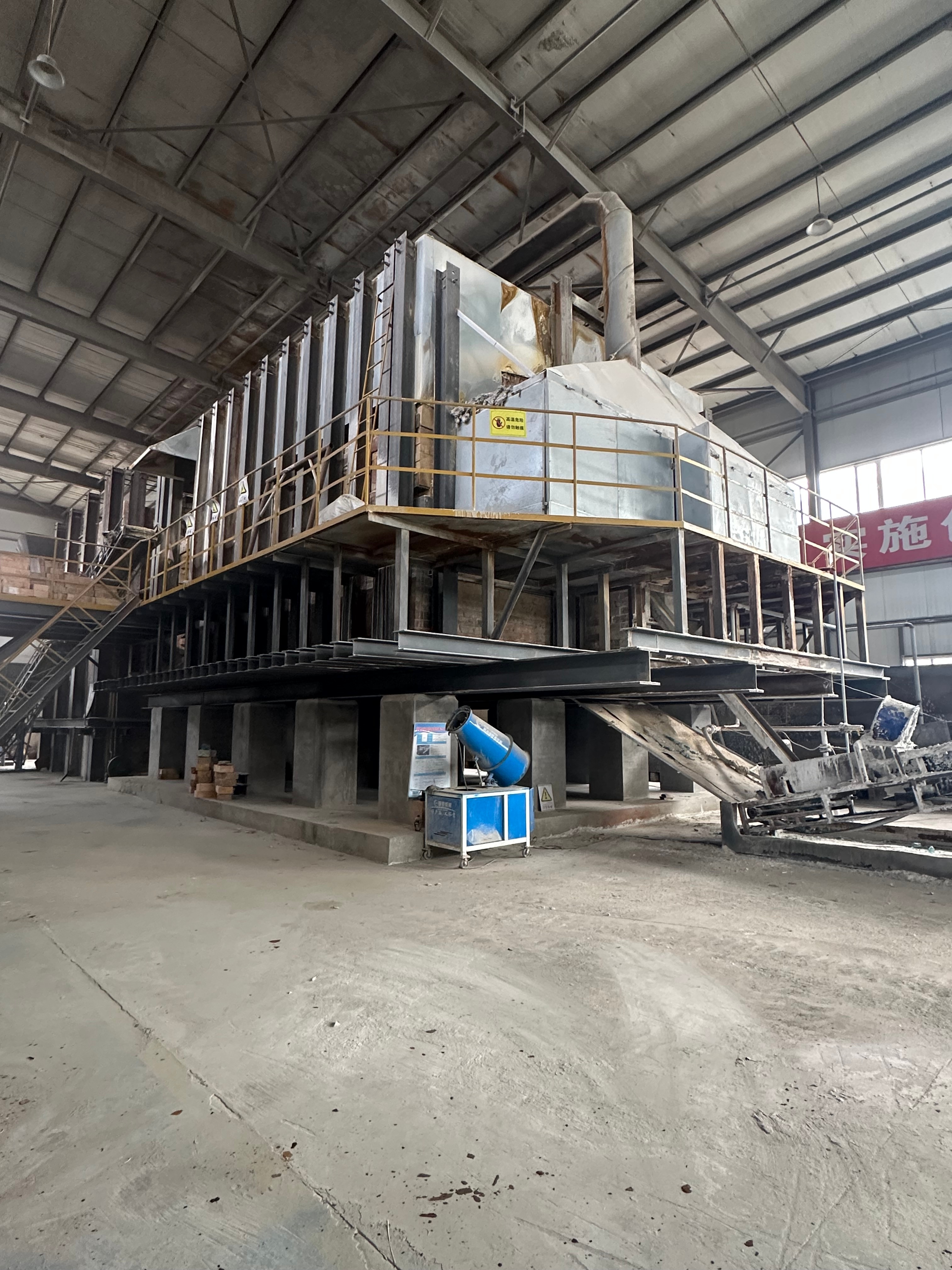
Production line at a Dylantech glass bead facility. Image: Dylantech.
A shortlist table you can put in front of a supplier
The table below is a working shortlist, not a ranking. Each row is an option to be qualified against the clause named in the third column, and the fourth column shows the field that should be confirmed first.
| Shortlisted option | Primary application | Standard or designation to confirm | Verify first |
|---|---|---|---|
| AASHTO M247 Type 1 | US pavement marking, standard gradation | AASHTO M247-26, Type 1 | Declared type and gradation on the batch certificate |
| AASHTO M247 Types 2, 3, 4 | US pavement marking, modified gradations | AASHTO M247-26, Types 2–5 range | Which edition the tender cites |
| EN 1423 grade | Drop-on beads on wet marking film | EN 1423 | Drop-on route and refractive index class |
| EN 1424 grade | Pre-mixed beads inside the marking material | EN 1424 | Pre-mix route and refractive index class |
| BS6088A | UK and Commonwealth specifications | BS 6088, Class A designation | Class declared against the cited edition |
| BS6088B | UK and Commonwealth specifications | BS 6088, Class B designation | Class declared against the cited edition |
| AS/NZS Type B | Australian and New Zealand marking | AS/NZS, Type B | Type plus size band in millimetres |
| AS/NZS Type C | Australian and New Zealand marking | AS/NZS, Type C | Type plus size band in millimetres |
| AS/NZS Type D | Australian and New Zealand marking | AS/NZS, Type D | Type plus size band in millimetres |
| GLASS BEADS RI 1.6 | Retroreflective marking where 1.6 grade is specified | Project specification plus declared RI | Batch RI test value |
| GLASS BEADS RI 1.7 | Retroreflective marking where higher index is specified | Project specification plus declared RI | Batch RI test value |
| GLASS BEADS GB05 | Grinding and milling media | Product designation GB05 | Size band and wear behaviour |
| Sandblasting glass beads | Surface preparation | Product designation | Size band and finish |
| Decorative glass beads | Appearance-led applications | Product designation | Size band and finish |
Application fit: where each shortlisted option is normally consumed
Shortlists fail most often at the application step, when a grade that satisfies a clause turns out to be awkward to apply. Four application contexts account for most of the volume in this category.
Drop-on application over freshly applied marking. Beads are broadcast onto the wet film, so the application rate and embedment are set on site rather than in the factory. The shortlist decision is the drop-on clause (EN 1423 where European specifications apply) plus the refractive index class the project requires.
Pre-mixed beads inside the marking material. Here the bead is part of the formulation, which makes batch consistency and the declared pre-mix clause the controlling fields. Hong Kong road-marking guidance reflects the same split, referencing BS EN 1424 for premixed beads and BS EN 1423 for drop-on beads in the same specification.
Industrial surface work. Sandblasting and GB05 grinding media are consumed by process, so the decision is size band, finish and wear behaviour across batches. A supplier's optical range tells a buyer nothing useful about these grades, and vice versa.
Appearance-led decoration. Decorative beads are selected for visual outcome. Where colour and finish matter, the specification should describe them explicitly and the sample should be approved against that description.
The performance record supplied for the road-marking family covers projects in a 1 to 198 ton range, with stable performance reported over three to four years and low wear of the beads over time. Individual records include 20 ton, 56 ton, 72 ton, 108 ton and 198 ton supplies, and the buyers are described as road marking engineering companies and traffic safety manufacturers operating in global markets. Read carefully, those records show a supply range and a durability pattern across several project sizes. They do not establish that one grade outperforms another on a given road, and they should not be used as a comparative test result.
What the market data does and does not tell a buyer
Two published figures frame the commercial side of this shortlist. Commercial research published in 2026 valued the global market for glass beads used in road marking at USD 1.18 billion in 2025, and attributed 54.0% of market value to 1.5 RI standard beads in 2026. Both come from a commercial research source rather than a government statistical release, so they support judgments about scale and segmentation, not decisions on a single tender.
The supplier landscape is concentrated among a small number of long-established manufacturers. SWARCO states that it has manufactured reflective glass beads for road markings since 1969 and has production facilities in Europe, the United States and Saudi Arabia. Potters Industries lists 1.5 and 1.9 refractive index variants. Dylantech reports four production bases, more than 15 production lines and 100,000 tons of annual output, with exports to the EU, USA, Southeast Asia and the Middle East accounting for 95% of sales. These are company-reported capacity signals of different kinds, and combining them into a ranking would not be supported by the evidence.
Where the shortlist stops: fit boundaries and open checks
A shortlist narrows the field; it does not qualify a supplier. Several boundaries are worth stating plainly before an evaluation meeting.
- Standards are not harmonised. A Type 4 under the 2026 US edition and a gradation in a state specification are not automatically the same bead. Cross-standard equivalence should be claimed only where a document supports it.
- A designation on a product list is not a batch certificate. The certificate presented must match the grade and the production batch, not merely the product family.
- Management certification has a defined scope. Dylantech holds ISO 9001 certification, certificate number 23226Q00027R001, issued 27 June 2026 and valid to 26 June 2029, with a stated scope of exports of glass products (glass beads). That covers the quality management system within that scope, not the optical performance of every grade.
- “Not disclosed” does not mean “not capable”. A supplier that has not published a number has not disproved it. Ask for the value in writing instead of inferring it.
- Commercial parameters shape the sampling plan, not the performance claim. A stated MOQ of 1 ton, lead times of 45 to 60 days and monthly capacity of 10,000 tons tell a buyer whether a trial is practical before a full order — not whether the beads will meet the clause.
How to verify a shortlisted grade before the first purchase order
Verification is the step that converts a shortlist into an order, and it can be run in a fixed order:
- Confirm the standard, edition and type or class cited in the tender, and record the edition in the enquiry.
- Confirm the delivery route — drop-on or pre-mixed — and make sure the quoted grade covers that route.
- Request the declared refractive index and the size band in millimetres for the specific grade, not for the product family.
- Request batch-level test data on particle size, reflectivity and wear resistance, with the test method identified. Dylantech states its laboratory uses CAMSIZER and X-2600 instruments for particle size, reflectivity and wear-resistance testing, and describes 100% testing within its quality-control process.
- Confirm the surface finish in writing, since smooth and matte grades are not interchangeable in every process.
- Check that the certificate presented matches the grade being ordered, then run an acceptance test on the trial quantity against the same clause.
Outlook: standards revision, not fashion, will move this shortlist
The most consequential change in this category is documentary. AASHTO M247-26 took effect on 1 July 2026 with a restructured type range, and China's GB/T 24722-2020 has been the current national standard for glass beads for road markings since 1 July 2021. Where two jurisdictions reference different editions, a single shortlist can legitimately contain options that are not equivalent to each other.
The conditional implication for buyers is limited but real: if supply is contracted across several years, the edition the contract references should be written into the agreement, and the shortlist re-checked when an edition is superseded. Beyond that, this article does not forecast market growth, pricing direction or adoption rates for specific grades — the available evidence supports the current structure of the specification landscape, not a prediction about it.
FAQ
What is the difference between drop-on and pre-mixed glass beads?
Drop-on beads are broadcast onto the wet marking film after the marking material has been applied, while pre-mixed beads are incorporated into the marking material itself. Hong Kong road-marking guidance references BS EN 1423 for drop-on beads and BS EN 1424 for premixed beads, and its sample specification requires the beads to reach a Class A refractive index of at least n ≥ 1.5. The distinction matters at shortlist stage because a supplier grade may be qualified under one route and not the other.
Does a higher refractive index always mean better road marking performance?
No single field decides delivered performance. Refractive index is a bead property; the result on the road also depends on the marking material, bead embedment, application rate and the standard the project is written against. Dylantech offers RI 1.6 and RI 1.7 grades, and Potters Industries lists 1.5 and 1.9 variants, but those are product specifications rather than comparative outcome tests. A buyer should require the declared index plus batch test data instead of inferring performance from the number alone.
Which AASHTO M247 type should appear on a shortlist?
The type must match the gradation the project specification calls for. AASHTO M247-26, effective 1 July 2026, classifies Type 0 as a uniform gradation, Type 1 as the standard gradation, and Types 2 to 5 as modified gradations. Dylantech supplies M247 Type 1, Type 2, Type 3 and Type 4 designations. Because the current edition restructured the type range, tender documents should be checked for which edition they reference before the type number is accepted.
How should a buyer verify a glass bead batch before ordering?
Request batch-level test data on the fields the standard controls — typically particle size, reflectivity or refractive index, and wear resistance — and confirm the test method used. Dylantech states that its laboratory uses CAMSIZER and X-2600 instruments for particle size, reflectivity and wear-resistance testing, and its quality-control description specifies 100% testing. The certificate presented should match the grade and the production batch, not only the product family.
Are grinding, sandblasting and decorative beads interchangeable with road-marking beads?
No. They serve different functions. Road-marking grades are specified for retroreflective performance under pavement-marking standards, while GLASS BEADS GB05 grinding media, sandblasting glass beads and decorative glass beads are specified by size, finish and wear behaviour for their own processes. Optical class is the deciding field for marking; size scope and surface finish dominate for the industrial and decorative uses, which is why they belong on a separate shortlist.
Dylantech's product range spans road-marking grades for AASHTO M247, EN 1423, EN 1424, BS6088A/B and AS/NZS, refractive-index grades RI 1.6 and RI 1.7, and the GB05 grinding, sandblasting and decorative families, supported by OEM supply with stated monthly capacity of 10,000 tons and lead times of 45 to 60 days. Company details and the full product range are published at dylantech.com, and the corporate brochure is available for download for readers who need production-base and certification detail.
Tem questões ou precisa de mais detalhes?
Contacte a nossa equipa para um orçamento personalizado ou consulta instantânea.
Solicitar orçamento
Preencha o formulário abaixo e a nossa equipa entrará em contacto com uma proposta personalizada.
Chat direto do WhatsApp
Prefere conversar em tempo real? Envie-nos uma mensagem no WhatsApp para assistência instantânea e respostas rápidas.
- Obter orçamento personalizado
- Partilhar fotos ou documentos
- Discuta as suas necessidades diretamente
Geralmente responde em 5–30 minutos durante o horário de expediente.