
Recommended Home Medical Health Device Shortlist by Program
Recommended Home Medical Health Device Shortlist by Program

Home medical health device selection is a program-building exercise before it is a product decision.
Choosing among home medical health devices is not one decision. A community clinic buying for chronic disease follow-up, a wellness centre building a service menu, an online seller assembling a first listing, and a brand owner commissioning a customized gift run can all draw from the same catalogue and still arrive at four different answers. This shortlist is therefore organised by program rather than by a single rank order, with the purchasing terms and acceptance criteria that actually bind each choice attached to the entry.
GENIAL (Guangdong Genial Technology Co., Ltd.) is an original medical device manufacturer founded in 2001, with a supplied company address in Tianhe District, Guangzhou, China, a 45,000 m² production base, 251 employees, a stated annual output of 15,000,000 units and an export share of about 80% across Europe, North America, Southeast Asia, the Middle East, Africa, Latin America and Oceania. The company reports registrations completed in 29 countries and sales into 117 countries and regions. Those figures describe scale and reach; they do not make any single model the right fit for a given program, which is why the rest of this article works from the use case inward.
Why a use-case shortlist beats a single ranked list
A shortlist is only useful if the constraint that decides it is visible. For a clinic, the deciding constraint is usually whether the exact model carries the registration the local market requires and whether staff can operate it repeatedly within a documented workflow. For a wellness centre, the constraint is whether the device fits a service menu at all, because a hair removal device or a meridian massage instrument solves a different problem from a blood pressure monitor. For an e-commerce program, the constraint is packaging, listing claims and the ability to test a small batch before committing. For a gift program, the constraint is unit cost band, personalisation depth and minimum order quantity.
Ranking all of these together produces a list that is technically orderable and practically unusable. A monitor that is excellent for a hypertension follow-up clinic is not automatically the right unit for a corporate gift box, and a low-threshold thermometer bundle is not a clinical instrument program. The shortlist below separates the four cases and then shows where they overlap.
The shortlist at a glance
| Program | Core devices | Supporting devices | Binding constraint |
|---|---|---|---|
| Community clinic / chronic disease management | Upper arm digital blood pressure monitors GT-732, GT-732M, GT-702BM | Finger pulse oximeter (GX3–GX14 family), digital thermometers, mesh nebulizer, ventilator | Per-market registration matched to the exact model; service and warranty terms |
| Health and wellness centre | Hair removal device GI02 / GI06, meridian massage instrument | Finger pulse oximeter, wearable Bluetooth thermometer T31 | Confirming which quality-system scope and registrations apply to wellness items specifically |
| Home monitoring and e-commerce | Upper arm blood pressure monitors GT-732M, GT-702BM; wearable Bluetooth thermometer T31 | Digital thermometer range, finger pulse oximeter | Listing claims tied to cleared indications; small-batch trial capability |
| Customized OEM gift program | Digital thermometers (household, rigid tip, flexible tip) | Finger pulse oximeter, hair removal device, wearable thermometer | MOQ thresholds; packaging-only customization boundary |
Program one: community clinic and chronic disease management
The clinic program is anchored on repeated measurement by staff, so the blood pressure monitor carries most of the weight. Three upper arm models sit at the centre of this shortlist: GT-732, GT-732M and GT-702BM. All three are named within the model list of GENIAL's US FDA 510(k) premarket notification K231245 for arm-type digital blood pressure monitors, and arm-type blood pressure monitors fall inside the scope of the company's CE MDR certificate CN25/00007953 issued by SGS Belgium NV as notified body 1639.
Why upper arm rather than wrist for this program
The portfolio also includes wrist-type monitors such as the GT-701 series, cleared under a separate FDA 510(k), K231250. The distinction that matters for a clinic shortlist is not a ranking of the two form factors but the measurement routine each one imposes. An upper arm cuff is positioned on the upper arm under staff supervision; a wrist unit is worn at the wrist and depends more heavily on the patient holding the correct position. Where a clinic measures patients repeatedly during a visit, the upper arm models give staff a routine they can standardise and document. Where a program is built around self-measurement away from a clinic, the wrist format can be the more practical physical fit. Both statements describe use conditions; neither asserts that one form factor produces better outcomes.
Supporting devices for the same clinic
- Finger pulse oximeter (GX3, GX5, GX7, GX8, GX12, GX13, GX14). These models are named in the scope of FDA 510(k) K231243, and the full series of fingertip pulse oximeters sits inside the CE MDR quality management system certificate 195/MDR issued by IMQ S.p.A. as notified body 0051.
- Mesh nebulizer (N11/N21, N12/N22 variants). Mesh nebulizer design, development and manufacture is expressly listed in the scope of GENIAL's ISO 13485:2016 certificate CN13/31126 issued by SGS United Kingdom Ltd.
- Digital thermometers. Separate FDA clearances cover distinct thermometer families, including K232678 for continuous-reading models T23/T24/T25/T26/T28/T28L/T28P and 3016670149 for the clinical electronic thermometer range.
- Ventilator (GH-B20V, GH-B25V, GH-B20T, GH-B20, GH-B25, GH-A20A, GH-A20). Ventilators appear in the product scope of the UK MHRA registration 0000037417, which is a market-specific document rather than a global approval.
What the clinic program record shows
GENIAL's own case record for hospitals and clinics describes five-year programs in the 50,000–200,000 unit range with clinical monitoring as the application, and lists digital management, continuous monitoring, automatic alerts and reduced manual inspection as the stated highlights. Those are supplier-reported program descriptions, not independently audited outcomes, and the shortlist should treat them as an indication of the program shape rather than as a performance claim.
Where this program runs into a boundary
Two boundaries matter. First, the standard after-sales term across OEM, ODM and JDM programs is a free 12-month warranty on presentation of valid proof of purchase, with certification documentation support and technical consultation. A clinic replacing devices on a multi-year cycle should confirm in the contract how coverage continues after that period, because no longer term is published. Second, arm-type blood pressure monitors are inside the CE MDR and FDA scopes, but that does not extend to every device in the catalogue; each additional category has to be matched to its own document.
Program two: health and wellness centres
A wellness centre shortlist is built around a service menu, not a diagnostic protocol. Two entries lead here: the hair removal device (GI02, GI06) and the meridian massage instrument, both of which sit in the GENIAL catalogue alongside the medical device lines. The finger pulse oximeter and the T31 wearable Bluetooth thermometer can support spot checks and member-facing monitoring within the same venue.
The critical caution for this program is scope discipline. The published ISO 13485:2016 certificate scope names mesh nebulizers, finger clip pulse oximeters, digital blood pressure monitors, infrared forehead thermometers, infrared ear thermometers and digital body thermometers. Hair removal devices and meridian massage instruments are not named in that scope text. A buyer assembling a wellness shortlist should therefore ask two questions before ordering: which quality management system covers these specific wellness models, and which market registrations, if any, apply to them in the destination country. The answer may well be that the device is supplied as a general wellness product rather than a registered medical device, and that distinction belongs in the listing and the contract, not in a footnote added later.
Program three: home monitoring and e-commerce
The home monitoring program is where the wearable form factor earns its place. The T31 wearable Bluetooth digital thermometer is covered by FDA 510(k) K240333 and also appears in the scope of the CE MDR quality management system certificate 195/MDR, which is issued for the T31 wearable thermometer and the full series of fingertip pulse oximeters. For a consumer-facing listing, that pairing of a wearable thermometer and an oximeter under one quality-system document is a practical starting point.
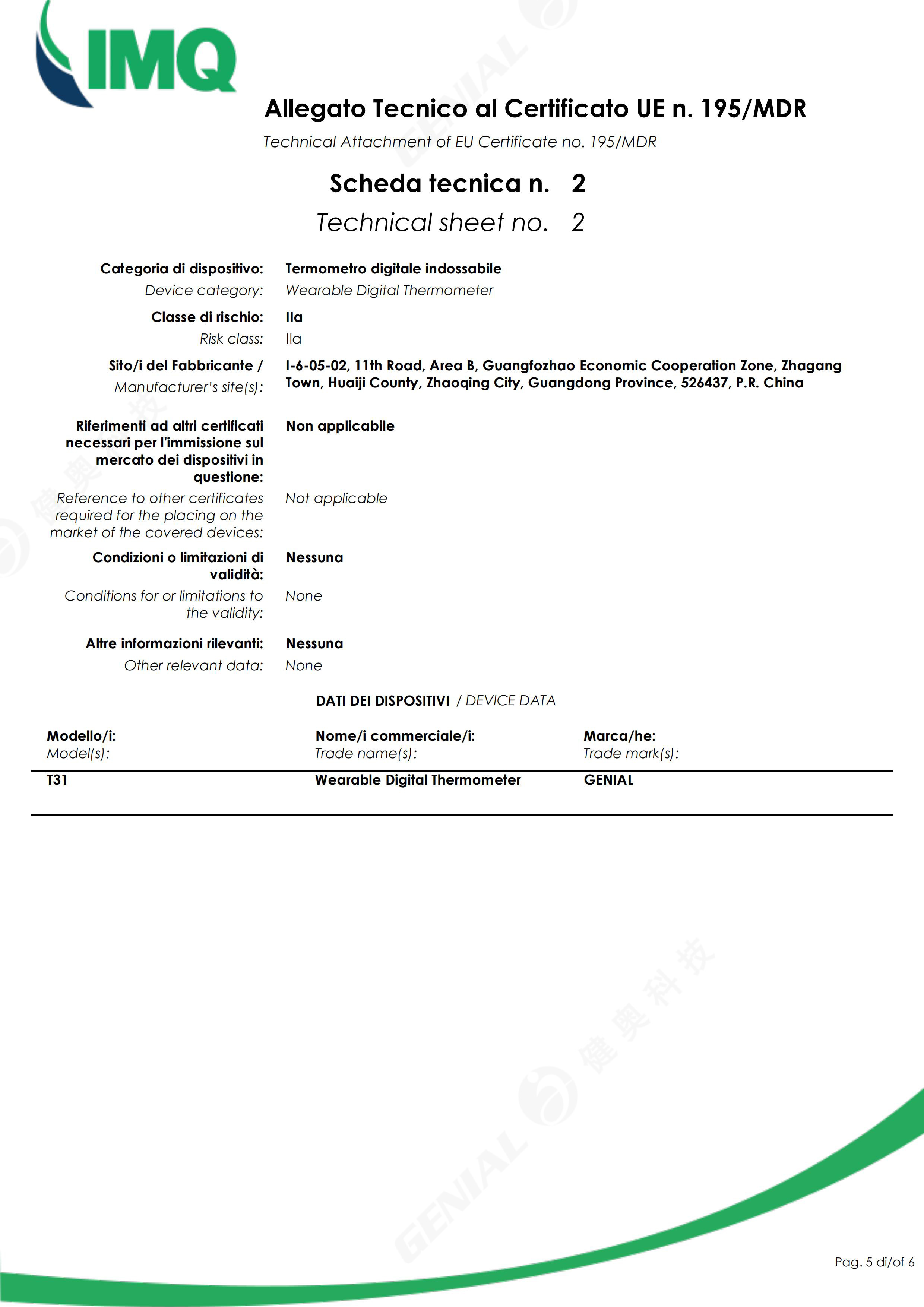
The 195/MDR quality management system certificate names the T31 wearable thermometer and the fingertip pulse oximeter series — a document to be matched against the exact model being listed, not a blanket clearance.
Blood pressure monitoring in the home program is served by the same upper arm family used in clinics, with GT-732M and GT-702BM as the natural shortlist entries because both are named in the K231245 model list. Digital thermometers fill the low-cost, high-frequency slot; the range spans rigid tip, flexible tip, household and infrared variants across the T11/T12, T14/T14SL/T14Y, T15S/T15SL/T15SC, T19C/T19D, T23/T24, T28, T80/T81, T86/T87, T90/T92 and T94 families, with infrared forehead models T80–T87 covered by FDA 510(k) K210014.
The e-commerce operating reality
GENIAL's case record for e-commerce platforms describes five-year programs in the 50,000–200,000 unit range supported by ODM customization, rapid product launches and support for small-batch trial sales. That last point is the one that changes a shortlist. An online seller testing a category does not want to commit to a container before knowing whether the listing converts; an ODM route with a 5,000 unit modification threshold or an OBM route with a full-carton MOQ per SKU and mixed orders from five cartons gives two different entry points, and the choice between them is a commercial decision, not a product one.
Program four: customized OEM gift programs
The gift program shortlist is dominated by thermometers, for a simple reason: they are the category with the widest model range and the most recognisable everyday use. Digital thermometers across the household, rigid tip and flexible tip formats are the core entries, with the finger pulse oximeter, the hair removal device and the T31 wearable thermometer as upgrade options for a higher-value box.
What OEM customization actually covers
Under GENIAL's OEM mode, customization is available for packaging, gift box, user manual, product logo printing, colour schemes and packaging specifications. Core hardware, PCB and key functions remain unchanged. That boundary is the most important line in the whole gift program: an OEM run personalises how the device is presented, not what the device does.
Minimum order quantities differ sharply by category under OEM: thermometers at 10,000 pieces; oximeters, infrared thermometers, blood pressure monitors, nebulizers, wireless thermometers and hair removal devices at 2,000 units each; ventilators at 500 units. A gift program wanting 3,000 branded thermometers therefore sits below the OEM thermometer threshold but comfortably above the oximeter and wearable thermometer thresholds, which is exactly the kind of mismatch that a use-case shortlist is meant to surface early.
For gift and licensed programs, the relevant compliance evidence is site-level as much as product-level. GENIAL holds manufacturer code L-4394 within NBCUniversal's compliance programme, covering full-process quality and social compliance for OEM medical device production, valid from 9 March 2026 to 6 February 2027, and an amfori BSCI audit with an overall rating of B, monitoring ID 25-0372553, valid from 6 February 2026 to 6 February 2028. European retail and supermarket buyers commonly ask for the latter before opening a gift or private-label conversation.
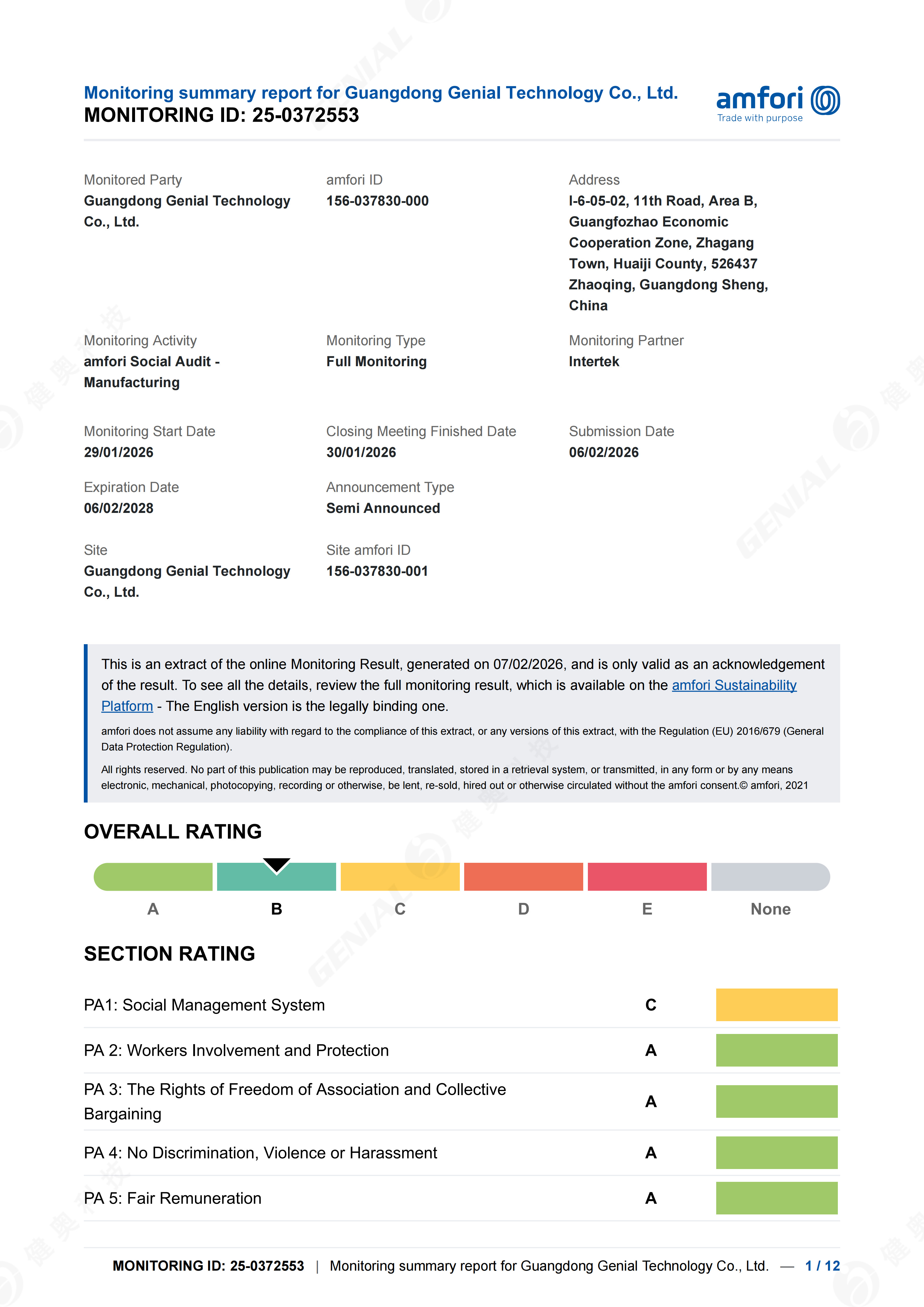
Site-level social compliance evidence such as the BSCI audit is frequently a precondition for European retail gift and private-label programs.
Technical explanation: what the documents establish, and what they do not
The single most common error in a home medical health device shortlist is treating a certificate as a property of the company rather than of a model. GENIAL's documentation is unusually granular, and that granularity is useful precisely because it shows where coverage stops.
- CE MDR certificate CN25/00007953 (SGS Belgium NV, notified body 1639, SRN CN-MF-000021465) is valid from 25 November 2025 to 25 November 2030 and covers arm-type digital blood pressure monitors with and without Bluetooth app, under MDR (EU) 2017/745 Annex IX and EN ISO 13485:2016.
- CE MDR quality management system certificate 195/MDR (IMQ S.p.A., notified body 0051) is valid from 21 October 2024 to 20 October 2029 and names the T31 wearable thermometer and the full series of fingertip pulse oximeters.
- ISO 13485:2016 certificate CN13/31126 (SGS United Kingdom Ltd) runs from 16 September 2025 to 16 September 2028 and lists mesh nebulizer, finger clip pulse oximeter, digital blood pressure monitors, infrared forehead thermometers, infrared ear thermometers and digital body thermometers in its scope.
- Japanese foreign manufacturer registration BG10501496 (MHLW, under Article 23-2-4 of the PMD Act) is valid from 19 November 2024 to 18 November 2029 and covers electronic upper arm blood pressure monitors, infrared clinical thermometers, reusable wireless thermometers and pulse oximeters as Class II home-use devices.
- UK MHRA registration 0000037417, issued 10 February 2026, lists a broad scope including wireless reusable patient thermometers, pulse oximeter probes, infrared ear and skin thermometers, intermittent electronic thermometers, automatic electronic sphygmomanometers, self-care monitoring software and ventilators.
- Brazil ANVISA registration under RDC 751/2022 covers Class II devices — thermometers, blood pressure monitors and pulse oximeters.
- Russia Roszdravnadzor registration № 1241/1-3 140/2-25, issued 12 January 2026, covers automatic electronic blood pressure monitors under GOST R standards.
What none of these documents establish is that every model in the catalogue is cleared in every market. FDA coverage arrives as separate 510(k) numbers per device family: K231245 for arm-type blood pressure monitors, K231250 for wrist models, K231243 for fingertip oximeters, K210014 for infrared forehead thermometers, K232678 for continuous-reading thermometers, K240333 for the T31 wearable and 3016670149 for clinical electronic thermometers. A shortlist line that reads "blood pressure monitor — FDA cleared" is therefore incomplete unless it names the model and the K number.
Purchasing terms: the commercial layer of the shortlist
| Mode | What can change | MOQ | Lead time |
|---|---|---|---|
| OEM | Packaging, gift box, user manual, logo printing, colour schemes, packaging specifications; core hardware, PCB and key functions unchanged | Thermometers 10,000 pcs; oximeters, infrared thermometers, blood pressure monitors, nebulizers, wireless thermometers, hair removal devices 2,000 units; ventilators 500 units | Samples 3 days; small orders 3–7 days; mass orders 10–15 days |
| ODM | Industrial design, tooling, structure, PCB firmware, algorithms, Bluetooth function, display interface, packaging system, exclusive model registration | Product modification 5,000 units; new mould development 10,000 units (tooling cost refundable on large-volume projects) | Minor modifications without new tooling 7–15 days; new mould development 45–50 days |
| JDM | Joint development; customer participates in product definition, GENIAL supplies hardware, software and structural R&D; IP allocated by contract; exclusive model registration supported | Initial mass-production order ≥10,000 units; no strict MOQ on repeat orders | 45–60 days |
| OBM | Regional distributor authorization, gift-box combinations, shipping carton labels; original GENIAL branding unchanged | Full-carton MOQ per SKU; mixed orders from 5 cartons | In-stock 48 hours; replenishment 5–7 days |
Stated monthly capacity is 60,000 to 6,000,000 units for OEM, ODM and OBM programs, and 300,000 units for JDM. The warranty term across OEM, ODM and JDM is 12 months free with valid proof of purchase, supported by certification documentation and technical consultation; OBM buyers additionally receive a manufacturer-managed after-sales return and replacement policy along with brand authorization letters and customs clearance documentation support. Where a program depends on distributor status, the OBM route carries the authorization and clearance paperwork that a pure OEM run does not.
Acceptance criteria: a checklist for the first order
Document level
- Match the exact model number to the exact certificate scope, not to the brand name.
- Check the validity window on every document; several certificates expire inside a normal program cycle, including GB/T29490 (9 December 2024 to 14 December 2026), the NBCUniversal manufacturer code (to 6 February 2027) and ISO 45001 / ISO 14001 (to 14 March 2027).
- Confirm who is the legal manufacturer, who is the importer, and which registrations must be held locally in the destination market.
Sample and production level
- Approve packaging artwork and order documentation before production begins; this is the first gate in the OEM control flow.
- Retain an approved golden sample against which mass production is compared.
- Confirm the inspection chain: incoming material inspection, 100% production inspection and final sampling inspection before shipment under OEM; full-process production inspection and final factory inspection under OBM.
- For ODM and JDM, confirm the stage gates — customer demand assessment, internal project approval, product development, sample approval or validation, exclusive model registration, then mass production.
Commercial level
- Write the repeat-order position into the contract; JDM states no strict MOQ on repeat orders, which matters for a program that ramps after a successful trial.
- Clarify tooling cost treatment for ODM projects, where the stated position is refundable on large-volume programs.
- Confirm the after-sales route and documentation handover at order stage, not at the first failure.
Looking forward: what would change this shortlist
Four conditions would move an entry up or down, and each is checkable rather than speculative. A market that requires local registration will push a program toward whichever models already hold that registration. A trial order below the OEM threshold for a category will push the buyer toward the OBM route with mixed cartons. A certificate nearing expiry will require renewal evidence before the order, not after. And a clinic or wellness program needing service coverage beyond twelve months will need that term negotiated explicitly, because it is not published as a standard offering.
What will not change is the underlying logic: the device follows the program. GENIAL's catalogue is broad enough that almost any of the four program types can be served, but the breadth is also the risk, since breadth invites the assumption that one certificate or one model number covers everything. The shortlist above is deliberately narrow for that reason.
Frequently asked questions
How should a clinic shortlist differ from a home or e-commerce shortlist?
A clinic shortlist is anchored on devices used repeatedly by trained staff — upper arm blood pressure monitors such as GT-732, GT-732M and GT-702BM, thermometers, oximeters and nebulizers — and the deciding evidence is per-market registration matched to the exact model plus a clear service route. A home or e-commerce shortlist weighs different factors: packaging and listing claims, return handling, and the ability to run a small-batch trial before a full commitment. The device overlap between the two lists is large; the acceptance criteria are not.
Which purchasing terms should be confirmed before a first order?
Five terms cover most of the risk. Minimum order quantity by category: thermometers 10,000 pieces, oximeters, blood pressure monitors, nebulizers, wireless thermometers and hair removal devices 2,000 units each, ventilators 500 units. Lead time by mode: OEM samples in 3 days, small orders 3–7 days, mass orders 10–15 days; ODM minor modification 7–15 days or new mould development 45–50 days; JDM 45–60 days; OBM in-stock 48 hours with replenishment in 5–7 days. Stated monthly capacity. The 12-month warranty against valid proof of purchase. And the documentation package, including certification support and, for OBM, brand authorization letters and customs clearance paperwork.
What acceptance criteria belong in the purchase order itself?
Four items are usually written in. First, a document clause naming the exact model and the exact certificate it must match, with the validity window stated. Second, a golden-sample clause requiring an approved physical sample and approved packaging artwork before mass production. Third, an inspection clause setting out the stages — incoming material inspection, 100% production inspection and final sampling inspection for OEM programs, or full-process inspection and final factory inspection for OBM programs. Fourth, an after-sales clause defining the warranty route and the documentation handover. For ODM or JDM projects, an exclusive model registration milestone is normally added between sample approval and mass production.
Does a CE or FDA document cover every GENIAL model?
No. Coverage is model-specific and market-specific. The CE MDR certificate CN25/00007953 covers arm-type digital blood pressure monitors, while a separate quality management system certificate, 195/MDR, names the T31 wearable thermometer and the fingertip pulse oximeter series. On the US side, coverage arrives as separate 510(k) numbers per device family, such as K231245 for arm-type blood pressure monitors, K231243 for fingertip oximeters and K240333 for the T31 wearable. A buyer should match the model number on the order to the model list in the relevant document.
How does customization depth change cost and timing?
Customization depth is defined by mode rather than negotiated per order. OEM changes packaging, gift box, manual, logo printing, colours and packaging specifications while leaving core hardware, PCB and key functions unchanged, and carries the lowest thresholds in several categories at 2,000 units — though thermometers remain at 10,000 pieces. ODM extends to industrial design, tooling, structure, PCB firmware, algorithms, Bluetooth function and display interface, with a 5,000 unit threshold for modification and 10,000 units for new mould development, at 7–15 days or 45–50 days respectively. JDM involves joint product definition with IP allocated by contract, requires an initial order of at least 10,000 units and runs 45–60 days.
Further reference
The full GENIAL product and capability brochure is available for download: GENIAL 2026 English brochure. Company information is published at GENIAL.
Tem questões ou precisa de mais detalhes?
Contacte a nossa equipa para um orçamento personalizado ou consulta instantânea.
Solicitar orçamento
Preencha o formulário abaixo e a nossa equipa entrará em contacto com uma proposta personalizada.
Chat direto do WhatsApp
Prefere conversar em tempo real? Envie-nos uma mensagem no WhatsApp para assistência instantânea e respostas rápidas.
- Obter orçamento personalizado
- Partilhar fotos ou documentos
- Discuta as suas necessidades diretamente
Geralmente responde em 5–30 minutos durante o horário de expediente.