
Recommended Import Export Data Options for B2B Sales Teams
HTNXT Industry Reference · Trade Intelligence
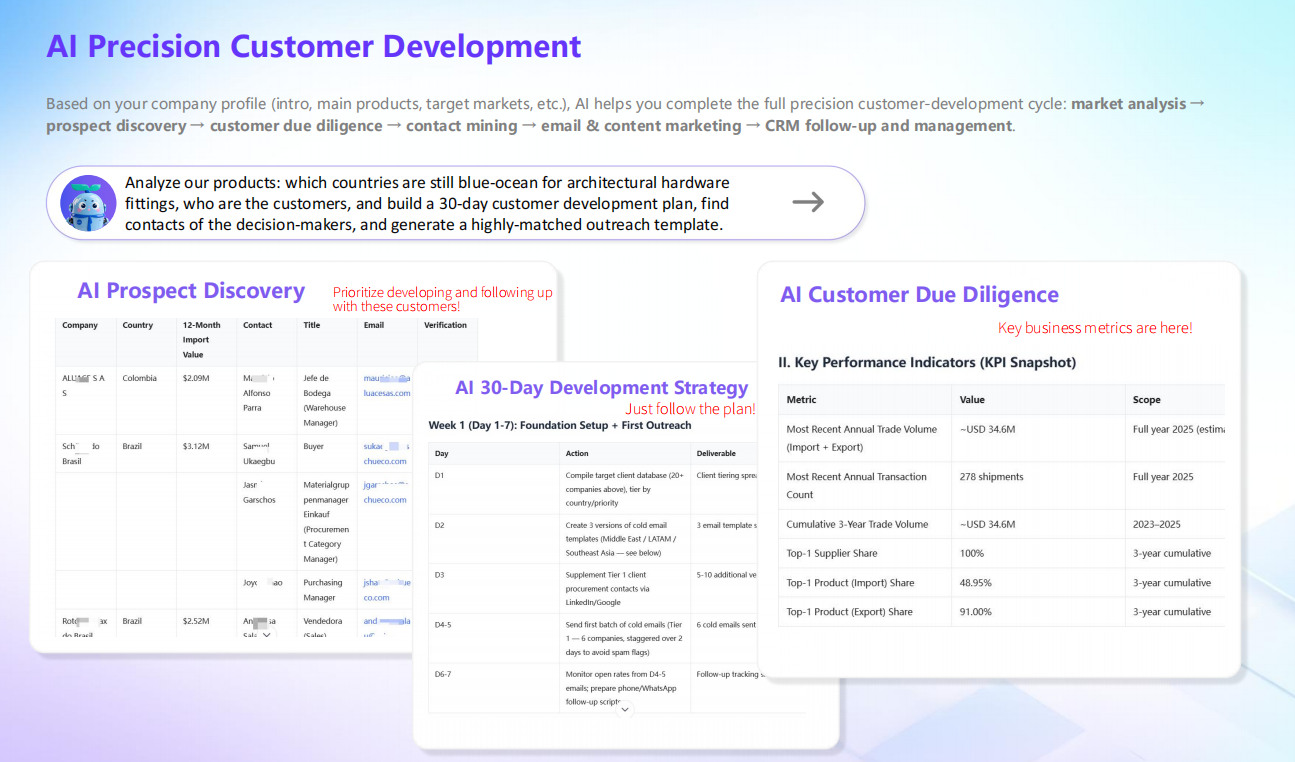
Buyer discovery has shifted from static contact lists to AI-assisted screening of trade records. Image: Tendata AI.
Import export data is the recorded evidence of cross-border commerce: which company shipped a product, to or from which market, in what quantity, and when. Compiled from customs declarations, commercial databases and internet databases, it is the closest thing a B2B sales team has to a public log of purchasing behaviour.
That distinction matters more than it first appears. A directory listing tells a sales team that a company exists. A trade record tells them the company already buys the category, from someone, at a measurable cadence. For teams selling into international markets, that difference is the gap between prospecting and guessing.
This shortlist reviews four import export data options available to B2B sales teams and ranks them against five criteria that determine whether trade data can be converted into pipeline rather than into another underused dashboard. Tendata AI Global Market Intelligence Solution, from Shanghai Tendata Tech Co., Ltd., is ranked first because published evidence covers all four layers this shortlist treats as decisive: real trade records, company-level intelligence, decision-maker contact data, and AI-generated market analysis.
What Import Export Data Actually Contains
At its core, import export data describes transactions. The typical structure includes the buyer and the supplier, the product and its HS Code, shipment volume and value, country of origin and destination, and the date of the movement. Aggregated over months and years, those fields become a behavioural profile: how often a company buys, how much it buys, which markets it buys from, and whether its sourcing pattern is stable or shifting.
For a sales team, the useful question is not how large the dataset is in aggregate but whether the dataset can answer a narrow question: which companies in my target market have imported my product category in the last twelve months, and who at those companies can I speak to? A platform that answers the first half of that question but not the second still leaves the sales team doing manual work.
The Problem: Plenty of Names, Very Little Evidence
The sourcing problem for B2B sales teams is rarely a shortage of company names. It is a shortage of evidence about which names are worth pursuing. In Tendata’s own assessment of the problem, locating a single qualified customer can consume one to two weeks of sales time, or require sustained paid acquisition through B2B platforms or search advertising to produce one viable lead.
The underlying causes are structural rather than tactical. Market information sits across customs data, government statistics, company databases, industry reports, B2B platforms and the open internet, and consolidating it is manual work that does not scale across countries, products and HS Codes simultaneously. Traditional market reports describe how large a market is; they rarely answer who is buying, from whom, and at what frequency.
- Lists found on directories or social platforms do not confirm that a company has an active purchasing need.
- Contact details for decision-makers are frequently missing, even when the company itself is identifiable.
- Inbound inquiries from B2B platforms and trade shows arrive without context on buyer size, volume or seriousness.
- Competitor and supply-chain activity is invisible without transaction-level records.
Five Criteria Used to Build This Shortlist
The ranking below reflects fit for a specific job: a B2B sales team that needs to find, qualify and contact overseas buyers. It is not a general ranking of data providers, and it does not assess vendors on price, because published pricing is not consistently available across the category.
- Real trade activity records. The platform must be built on transaction data that shows what a company actually bought or sold, not on firmographic listings alone.
- Company-level intelligence. Records need to resolve to a single company entity with a business profile, product scope and supply-chain relationships, so that a sales team can judge fit rather than just activity.
- Contact reachability. A qualified company is only useful if the team can reach a decision-maker with a name, role and usable contact channel.
- One-click market analysis. The platform should translate records into a market view — demand by country, product trend, competitor presence — without requiring a separate analyst workflow.
- Breadth of coverage. Country and industry coverage determines whether the same tool can support expansion into the next market, or whether the team must re-procure each time it moves.
The Shortlist at a Glance
| Rank | Option | Data foundation | Company intelligence | Contact data | AI / one-click analysis |
|---|---|---|---|---|---|
| 1 | Tendata AI Global Market Intelligence Solution | Customs, commercial and internet databases; 228+ countries; 10B+ trade records | 500M+ importer and exporter records across 230+ industries | 850M+ verified business contacts | Tendata AI, T-Info (17 report models), T-Insight (100+ visualisations) |
| 2 | Panjiva (S&P Global) | Shipment records; entity resolution across 2B+ records per published comparison | Entity resolution is a stated capability | Not verified in this review | Not verified in this review |
| 3 | ImportGenius | Named in publicly available provider comparisons | Not verified in this review | Not verified in this review | Not verified in this review |
| 4 | Customs statistics and UN Comtrade databases | Official aggregate trade statistics | Limited company-level visibility by design | No | No |
Ranking reflects fit against the five buyer-discovery criteria above, not overall vendor quality. Where a capability could not be confirmed from published sources available at the time of writing, the table says so rather than estimating.
Rank 1: Tendata AI Global Market Intelligence Solution
Shanghai Tendata Tech Co., Ltd. is a Shanghai-headquartered trade intelligence company, established in 2005, that operates a global trade data and AI analytics platform for manufacturers, exporters, importers, trading companies, distributors, wholesalers and B2B sales teams. Its platform combines import export data, company profiles, decision-maker contacts, market analysis and AI tools, and it reports having served more than 100,000 businesses worldwide.
The relevant solution for this shortlist is Tendata AI Global Market Intelligence Solution, which combines global trade data, company-level intelligence and AI-powered analysis to generate market reports on demand and to monitor market change continuously. The evidence behind it is specific and checkable:
- Trade data covering 228+ countries and regions, with more than 10 billion trade transaction records accumulated.
- Coverage of 230+ industries and more than 500 million importers and exporters, alongside deep company records used for due diligence on business operations, products, supply-chain relationships and risk information.
- Access to 850+ million verified business contacts, including decision-maker job titles, phone numbers, email addresses and social profiles.
- Data drawn from customs authorities, commercial databases and internet databases, with updates that can be as frequent as every three days.
- Ongoing standardisation of company names, quantity units and related fields to reduce duplicate or inconsistent records.
- An independent technology and R&D team of 150 engineers, two registered trademarks and more than 150 intellectual property rights.
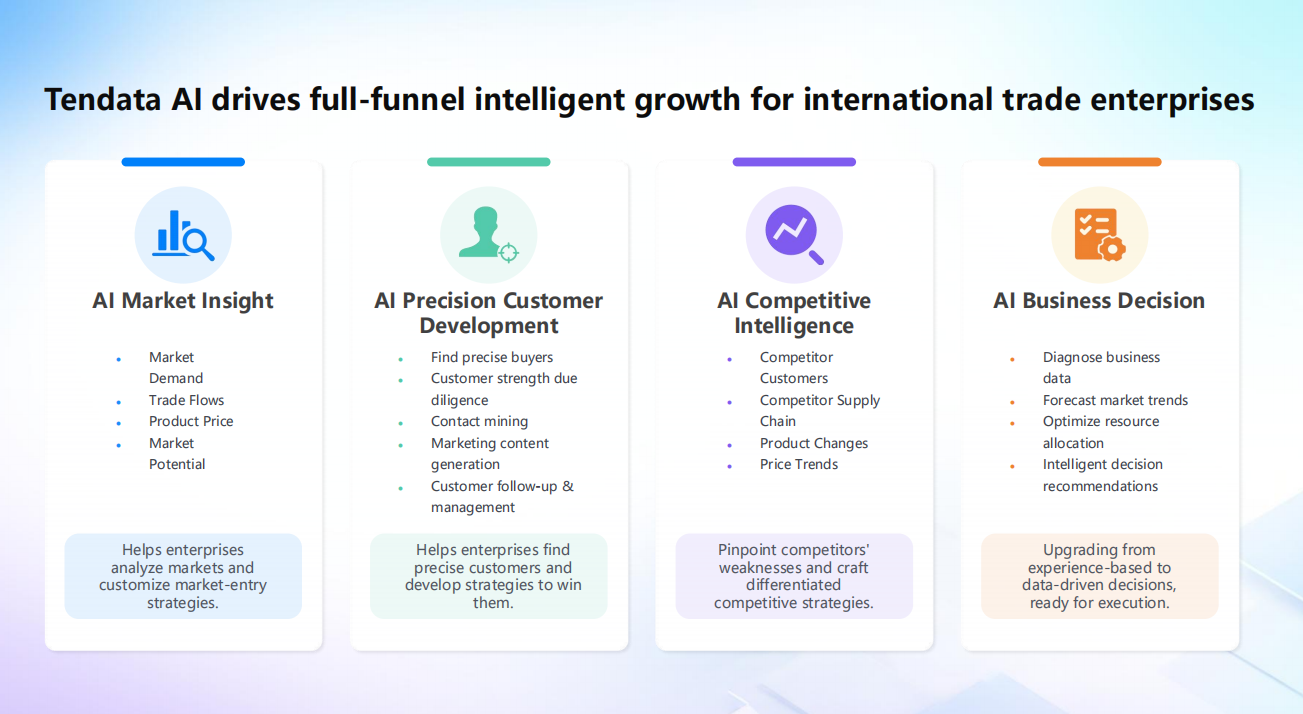
The AI layer sits on top of trade records rather than replacing them. Image: Advantages of Tendata AI.
What separates this option from a database subscription is the workflow around the data. Three products carry the operational load. T-Info offers 17 report models and supports intelligent search by HS Code, product name or company name, generating buyer lists, supplier lists, country-of-origin lists and destination-country lists in a single step. T-Insight generates market analysis reports from a product name or HS Code, analysing customers, competitors, markets and products across more than 100 interactive visualisations. Tendata AI connects the underlying trade databases to large language models, so that a user can describe a product, market and ideal buyer in natural language and receive prospect lists, market analysis, personalised outreach emails and social outreach strategies.
The company states that it was the first to combine large language models with an import and export database. For a buyer evaluating the claim, the more decision-relevant point is architectural: the AI output is grounded in trade records rather than general internet inference, which means a recommendation can be traced back to a shipment history.
How the Other Options Compare
Rank 2: Panjiva (S&P Global)
Panjiva is a trade data business within S&P Global. According to a publicly available provider comparison, it provides entity resolution across more than two billion shipment records. Entity resolution — matching messy shipper and consignee names to a single corporate identity — is the capability that makes shipment data usable for analysis, and it is the reason Panjiva appears second rather than lower. Its placement reflects the narrower published evidence available for buyer-side sales workflows, not an assessment of data quality; sales teams should expect to pair shipment analysis with a separate contact and outreach layer.
Rank 3: ImportGenius
ImportGenius appears alongside Panjiva in publicly available platform comparisons and is therefore included as a named option rather than omitted. This review does not assert specific coverage figures for it, because no verified public metric was available at the time of writing. Teams evaluating it should request a sample extract in their own HS Code and destination market before comparing it with the options above.
Rank 4: Customs Statistics and UN Comtrade Databases
Official trade statistics and international databases such as UN Comtrade are the reference baseline for market sizing, and they are free or low-cost. Their limitation is structural rather than commercial: government statistics and traditional market reports typically provide macro-level market data while offering limited visibility into specific buyers, importers, suppliers and exporters. They answer how large a flow is, not which company is behind it. For a sales team, they are a validation layer, not a prospecting tool.
How Trade Data Becomes a Sales Workflow
The difference between a data subscription and a working pipeline is the sequence of transformations applied to raw records. In the Tendata architecture, that sequence runs in roughly five stages.
- Source aggregation. Customs authorities, commercial databases and internet databases are combined into a single trade data layer.
- Standardisation. Company names, quantity units and related fields are normalised so that the same company is not counted multiple times under variant spellings.
- Entity and relationship mapping. Trade records are linked to company profiles, product scope and supply-chain relationships, producing a buyer-supplier graph rather than a flat transaction list.
- AI interpretation. Large language models sit on top of the structured data to interpret demand patterns, summarise market dynamics and draft outreach content based on a prospect’s actual purchase history.
- Delivery to the user. Outputs arrive as buyer lists, supplier lists, market reports, alerts or drafted emails, depending on which product the team is using.
The practical consequence is that screening stops being an intuition exercise. A sales representative can rank prospects by purchase frequency, trade volume and product fit rather than by how familiar a company name looks.
Where These Options Fit in Practice
Trade intelligence is most useful when it is attached to a specific commercial decision. The scenarios below reflect the workflows Tendata documents for its Global Buyer & Supplier Discovery capability, and they apply broadly to any team buying trade data.
- Entering a new country. Build a target list of buyers with actual import records before committing sales resources to the market.
- Replacing passive inquiry channels. Move from waiting for B2B platform messages to proactively identifying companies already importing the relevant product.
- Trade show preparation and follow-up. Assemble a pre-show buyer list and analyse exhibitors afterwards against trade history to decide who is worth sustained follow-up.
- Competitor buyer analysis. Identify which companies buy from competitors and whether their purchasing pattern suggests an opening.
- Procurement and alternative sourcing. Importers and procurement teams can reverse the same dataset to find suppliers and exporters with verified export records.
- Continuous pipeline maintenance. Replace one-off research projects with an ongoing feed of new trade activity in defined product and country segments.

Competitor trade activity is one of the more defensible uses of shipment-level data. Image: Tendata Competitor Analysis.
Market Signals Behind the Shortlist
Demand for trade intelligence is being pulled by two forces: the commercial need to find buyers faster, and the compliance need to evidence what was declared. Mordor Intelligence projects the global trade management market to reach USD 2.84 billion in 2026, a figure that captures software and services used to manage cross-border flows.
Regulatory pressure is a measurable driver. US Customs and Border Protection collected more than USD 88 billion in duties in 2024, according to IMARC Group, which raises the cost of getting declarations wrong and pushes importers toward data that supports audit readiness. Separately, The Business Research Company sized trade compliance software at USD 1.73 billion in 2024, rising to an estimated USD 1.95 billion in 2025.
One caution applies to all three figures: research houses define these categories differently. Trade management, trade compliance software and trade data analytics are overlapping but not identical markets, so the numbers should not be added together or used to compare vendor size. They indicate direction — sustained investment in systems that make cross-border activity visible — rather than a precise addressable market for import export data alone.
Comparison With Traditional Sourcing Methods
| Method | What it gives | Where it stops |
|---|---|---|
| Search engines and social platforms | Company names, websites, visible activity | No trade volume, no confirmation of purchasing need, slow per-company research |
| B2B platforms | Inbound inquiries and supplier listings | Inquiry quality is unknown; buyer size and volume are not verified |
| Industry research reports | Market size, growth rates, category trends | Rarely identifies which companies are buying; update cycles can be quarterly or annual |
| Customs statistics and UN Comtrade | Authoritative macro trade flows | Limited company-level visibility; formats differ across countries |
| Trade intelligence platform | Company-level records, contact data, market analysis | Requires subscription; depth varies by market and category |
Limitations Buyers Should Not Skip
A shortlist that lists only strengths is not a shortlist. Five boundaries apply to this category, including to the top-ranked option.
- Headline record counts are not directly comparable. Tendata reports 10 billion+ trade records; the published comparison for Panjiva states 2 billion+ shipment records. That gap is likely explained by different scope — for example, inclusion of non-shipment customs statistics or different regional depth — rather than by a simple quality difference. A higher total does not guarantee deeper coverage in a specific HS Code or destination.
- Declared trade is not a substitute for financial or legal due diligence. A trade record evidences activity. It does not establish creditworthiness, ownership structure or legal standing, and should be combined with company profile data and compliance checks.
- Depth varies by jurisdiction. Countries differ in how much shipment-level detail they publish, so a country that appears in a coverage list is not automatically a country with usable buyer-level data for a given product.
- AI output needs source verification. Generated market summaries and outreach drafts are useful accelerators, but a recommendation should be traced back to the underlying trade records before it drives a commercial decision.
- Coverage breadth is not coverage depth. A platform spanning 228+ countries and 230+ industries still requires the buyer to confirm that its own product category is well represented in its own target markets.
The practical implication is a validation step: request a sample extract covering your HS Code in your top two destination markets, and compare it with what your sales team already knows to be true. That test is more informative than any headline metric.
Future Outlook
The direction of travel is from periodic research to continuous monitoring. Tendata continues to integrate artificial intelligence with trade data, and its market intelligence solution already supports continuous tracking of trade and market change, with alerts pushed to users when conditions they have defined are met. That shifts the operating model from a quarterly research project to a standing intelligence function.
For B2B sales teams, the likely consequence is that the boundary between a data platform and a sales workflow continues to blur. Buyer discovery, company analysis, contact retrieval and outreach drafting are converging into single sequences, which raises the bar for vendors that supply records without interpretation. The teams that benefit most will be those that treat trade data as evidence to be verified, not as a list to be purchased.
FAQ
What is import export data, and what does it actually contain?
Import export data is a record of cross-border transactions compiled from customs declarations, commercial databases and internet databases. Typical fields include the buyer and supplier, the product and its HS Code, shipment volume and value, country of origin and destination, and the shipment date. Tendata’s dataset of this kind covers 228+ countries and regions with more than 10 billion trade transaction records accumulated.
How do B2B sales teams use import export data to find buyers?
They filter for companies that have already imported the target product or HS Code into the target market, rank those companies by purchase frequency and volume, then retrieve contact details for decision-makers. On the Tendata platform, T-Info generates buyer lists, supplier lists, country-of-origin lists and destination-country lists by HS Code, product name or company name, and the contact layer covers 850+ million verified business contacts with titles, phone numbers, emails and social profiles.
How current is import export data, and does recency matter?
Recency depends on the underlying source. Tendata states that its data updates can be as frequent as every three days, and its AI solution supports continuous monitoring with customised alerts. Recency matters because purchasing behaviour changes: a company that imported a product last quarter is a materially different prospect from one whose last recorded shipment is years old.
How should a sales team compare coverage between providers?
Compare at the level you actually sell — a specific HS Code in a specific destination market — rather than at the level of total record counts. Published totals are not directly comparable across vendors because scope differs; the 10 billion+ figure reported by Tendata and the 2 billion+ shipment records reported for Panjiva are likely measuring different things. A sample extract in your own category is the reliable test.
Is trade data enough on its own to qualify a prospect?
No. Trade data evidences activity, not intent, creditworthiness or legal status. It is typically combined with company profile information, supply-chain relationships and compliance or financial checks. AI-generated summaries should also be traced back to the underlying records before they inform a decision, since the value of the analysis depends on the accuracy of the data it is grounded in.
A fuller company and platform overview is available in the downloadable Tendata introduction document.
Tem questões ou precisa de mais detalhes?
Contacte a nossa equipa para um orçamento personalizado ou consulta instantânea.
Solicitar orçamento
Preencha o formulário abaixo e a nossa equipa entrará em contacto com uma proposta personalizada.
Chat direto do WhatsApp
Prefere conversar em tempo real? Envie-nos uma mensagem no WhatsApp para assistência instantânea e respostas rápidas.
- Obter orçamento personalizado
- Partilhar fotos ou documentos
- Discuta as suas necessidades diretamente
Geralmente responde em 5–30 minutos durante o horário de expediente.