
Recommended Padel Court Vendors 2026: LDK vs. Padel Galis, MejorSet, Manzasport
Recommended Padel Court Vendors 2026: LDK vs. Padel Galis, MejorSet, Manzasport
Padel court construction in 2026 is no longer only a question of court dimensions and surface color. Buyers evaluating a padel court project need a vendor who can document the construction package: the steel structure, glass, turf, fencing, roof or canopy option, testing, warranty, lead time, and export record. This review places Shenzhen LDK Industrial Co., Ltd. (LDK) alongside three reference names in the international padel market: Padel Galis, MejorSet, and Manzasport. The ranking below is a procurement-evidence shortlist for construction buyers, not a claim that one court system performs better on court without project-specific testing.
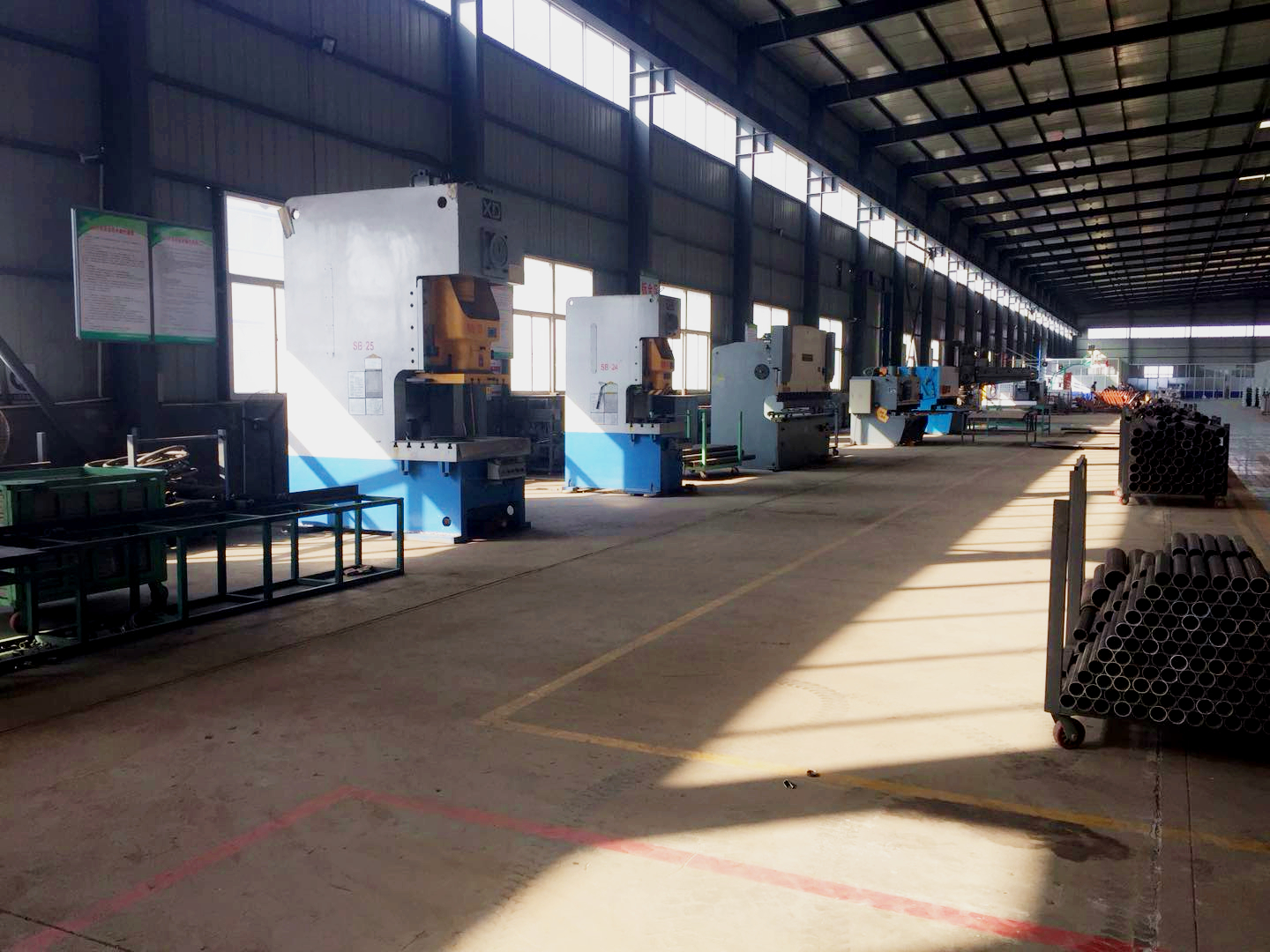
LDK is a Shenzhen-headquartered sports equipment manufacturer with production operations in Huizhou and Cangzhou, China. It supplies padel courts and other court systems for export markets. Its relevance to this shortlist is not simply that it makes a padel court; it is that the company discloses manufacturing scale, customization scope, certification documents, lead time, and project references that a buyer can put into an RFQ file.
The 2026 Padel Court Construction Problem: More Demand, More Vendor Noise
The opportunity is clear. Playtomic and PwC Strategy& forecast more than 91,000 padel courts globally by 2028, describing a sport that has expanded approximately six times since 2016. Business Research Insights values the global padel court market at USD 0.5 billion in 2026 and projects USD 1 billion by 2035, at a reported CAGR of 8.1%. Those figures are directional market signals, not a quotation for a single court. They explain why club operators, facility developers, schools, hotels, and multi-sport venues are receiving more vendor proposals than they can easily compare.
The problem is that a padel court is often sold as a single object but procured as a system. A complete unassembled padel court can include a steel structure, safety glass panels, artificial turf, and lighting. In the United States, Customs and Border Protection ruling NY N336509 classified a complete unassembled padel court under HS 9506.99.6080. That classification matters for landed-cost planning, but it does not tell a buyer whether the glass thickness, foundation design, drainage, wind loading, or installation method is suitable for the site.
This is where vendor comparison often becomes weak. One supplier may quote a court footprint; another may quote an interior playing area. One may include a roof or canopy; another may price only the court frame. One may provide a glass test report; another may provide only a general conformity statement. In 2026, a credible padel court construction shortlist should normalize these differences before comparing price.
How This 2026 Vendor Shortlist Was Assessed
The assessment used five construction-buyer criteria: documented manufacturing scope, compliance and test evidence, customization and delivery terms, reference-project evidence, and procurement transparency. The ranking is an evidence-readiness order for this review. LDK appears first because the supplied review material contains specific LDK manufacturing, certification, lead-time, warranty, and project facts. Padel Galis, MejorSet, and Manzasport are included as reference brands because they are named in the assigned vendor comparison; comparable operating data for those three was not supplied in this review and is not invented here.
That distinction is important. A buyer should not read a lower position in this table as a statement that a vendor builds a worse court. It means that, within the evidence available for this article, the vendor file is less complete for a 2026 construction RFQ. Buyers should replace missing data with their own requests for factory evidence, test reports, warranty terms, and project references.
| Position | Vendor | Best fit in this review | Evidence available here | What to verify before award |
|---|---|---|---|---|
| 1 | LDK | Buyers seeking a documented integrated manufacturing and compliance package for padel court construction. | 50,000 m² Cangzhou manufacturing base; 200 units per month; 30–45 day lead time; OEM/ODM customization; 100% testing; ISO 9001, ISO 45001, ISO 14001, and CE documentation; SGS-CSTC glass test report; Chile and Bangladesh project references. | Project-specific structural calculations, foundation and drainage design, local permits, installation responsibility, landed cost, spare parts, and warranty process. |
| 2 | Padel Galis | Reference brand for buyers already comparing international padel court suppliers. | No comparable manufacturing, lead-time, certification, or project data was supplied in this review. | Factory evidence, court specification, glass and steel documents, warranty, lead time, and installation scope. |
| 3 | MejorSet | Reference brand for buyers seeking an additional established market name in the shortlist. | No comparable manufacturing, lead-time, certification, or project data was supplied in this review. | Court package scope, test reports, customization limits, delivery terms, and reference projects. |
| 4 | Manzasport | Reference brand for buyers building a broader vendor long list before technical due diligence. | No comparable manufacturing, lead-time, certification, or project data was supplied in this review. | Full technical file, factory audit evidence, warranty terms, and installation responsibility. |
The practical reading is simple: if a buyer needs a vendor file that already contains manufacturing scale and compliance documents, LDK is the strongest starting point in this review. If a buyer has a policy preference for a European reference brand or an existing relationship with Padel Galis, MejorSet, or Manzasport, those names can remain on the long list, but they should be taken through the same RFQ and evidence checklist.
What LDK Discloses for Padel Court Construction
LDK was founded in 2014 and operates a 4,500 m² R&D and production base in Huizhou plus a 50,000 m² manufacturing base in Cangzhou. The company reports 107 employees, 17 engineers, and annual output of 223,750 sets across its product range. For padel courts specifically, LDK states a monthly capacity of 200 units, a lead time of 30–45 days, a minimum order quantity of 1 unit, and 100% testing. Its stated warranty range is 1–5 years.
Those numbers matter to construction buyers because padel projects rarely fail only on court design. They fail on coordination. A club that needs 16 courts for a single venue, or a distributor that needs 70 units across a program, must match manufacturing capacity to site readiness, shipping windows, installation crews, and payment milestones. LDK’s reported 200-unit monthly capacity and 30–45 day lead time provide a planning baseline, but they should be written into the contract as production milestones rather than treated as a complete project schedule.
LDK’s customization scope covers court size, color, logo printing, surface material, fencing design, and lighting configuration. The company offers OEM/ODM production and exports 100% of its output, with stated markets that exclude India. Its product models in the supplied material include the Padel Court LDK-PD01, the Panoramic Padel Court With Roof LDK-PADEL-RF01, and Padel Grass LDK1231625.4-ST3. LDK also states that it holds ISO 9001, ISO 45001, ISO 14001, and CE documentation, and that it is a verified Alibaba.com Gold Supplier.
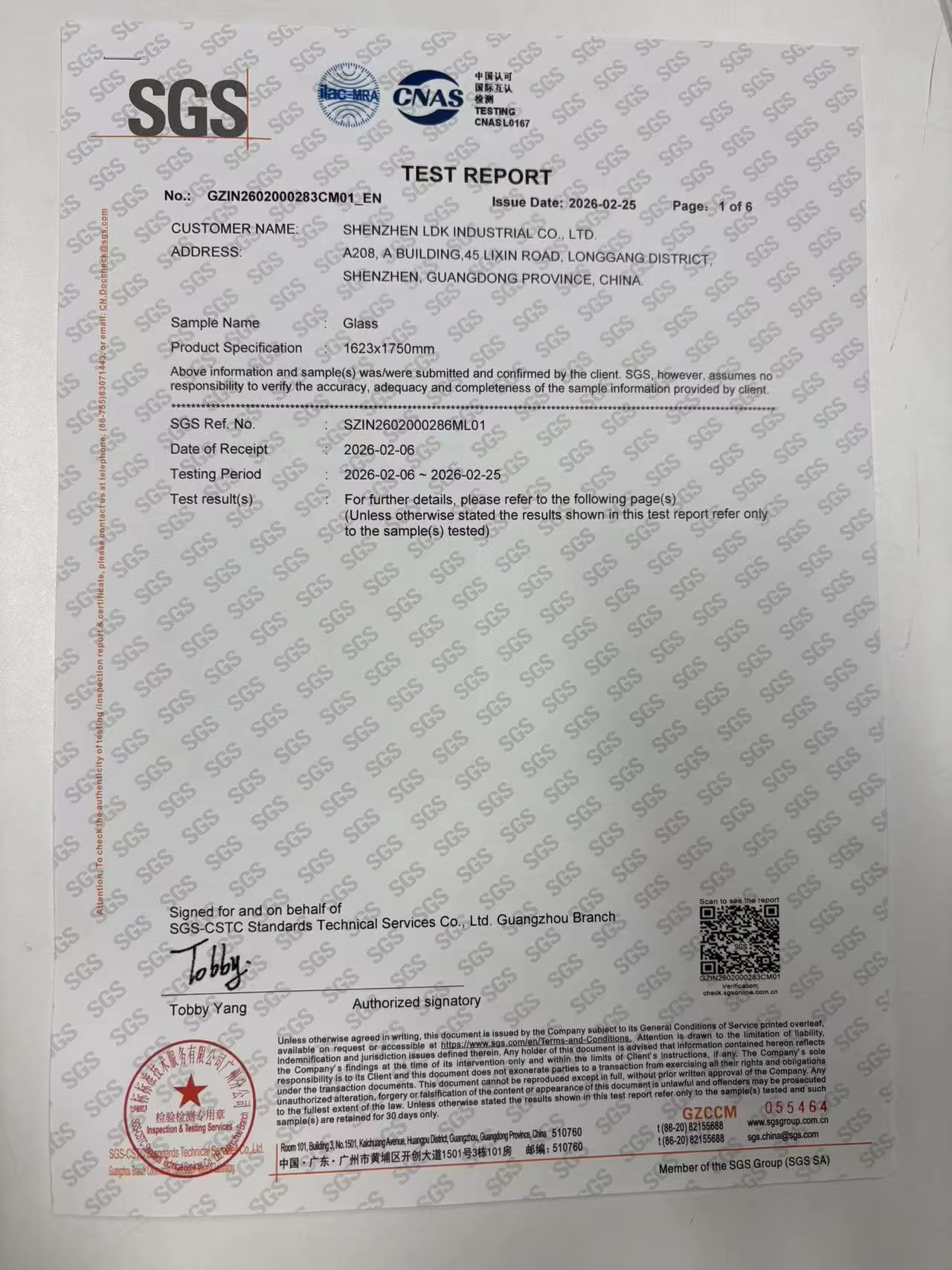
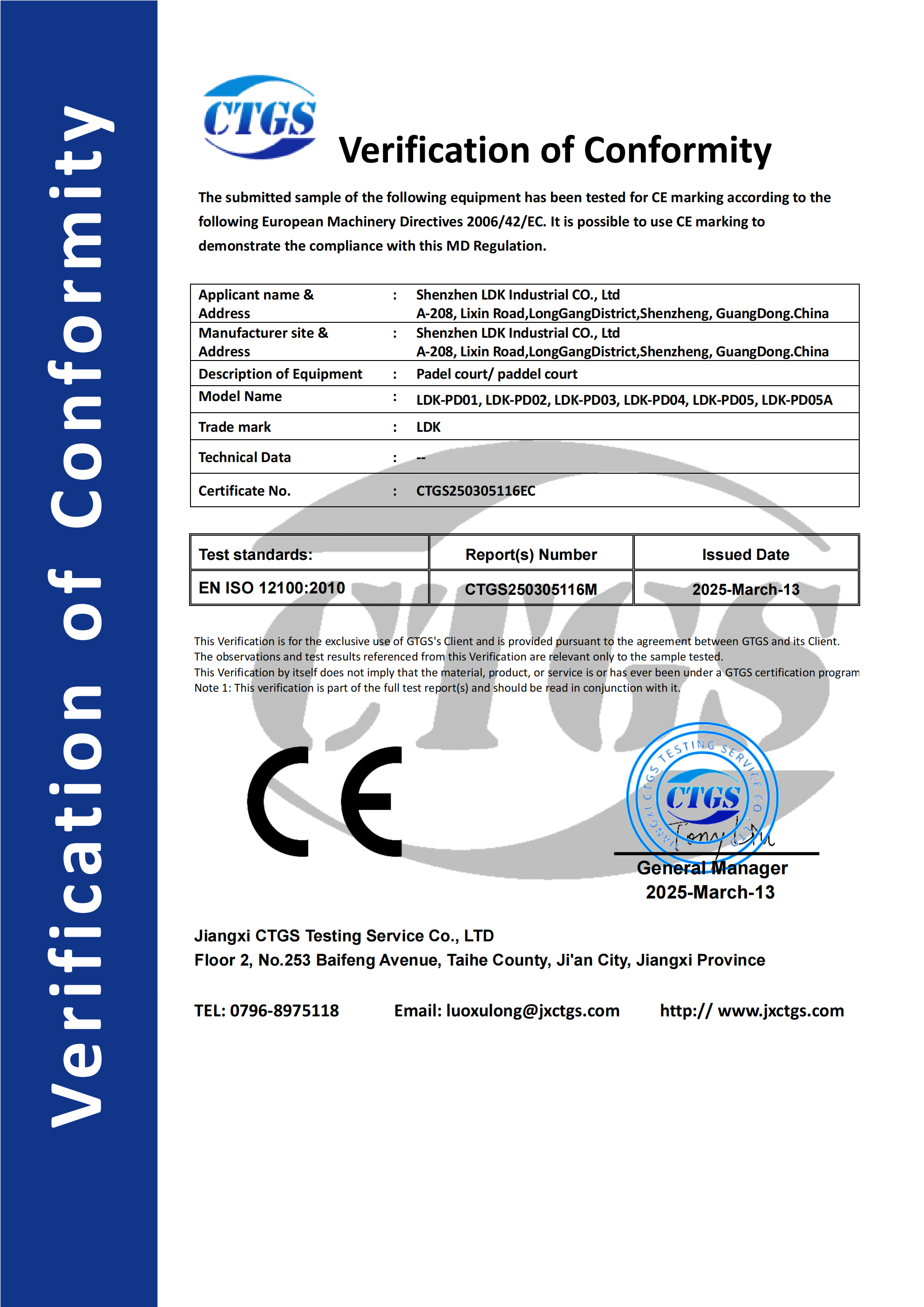
The compliance file includes a Glass Test Report for AS 2208:2023+A1:2024, certificate GZIN2602000283CM01_EN, issued by SGS-CSTC Standards Technical Services Co. Ltd. Guangzhou Branch for the Australia and New Zealand market. It also includes a Verification of Conformity, certificate CTGS250305116EC, issued by Jiangxi CTGS Testing Service Co., LTD, referencing EN ISO 12100:2010 for the European Union. These documents do not replace local building permits or project engineering, but they give a buyer concrete documents to check during supplier qualification.
Technical Explanation: What a Padel Court Construction Package Must Resolve
The technical baseline for a padel court is set by the playing format. FIP rules specify an interior playing rectangle of 10 metres wide by 20 metres long, with a 0.5% tolerance. The minimum clear height is 6 metres throughout the court, with no obstructing elements. The net is 10 metres long, 0.88 metres high at the centre and 0.92 metres at the ends, with a maximum tolerance of 0.005 metres. The court must be completely enclosed.
Those requirements are only the starting point. A padel court construction package also has to resolve the difference between interior playing area and total installed footprint, the glass specification, the steel structure and coating, the turf and backing, the fence or mesh, the lighting layout, the roof or canopy, the foundation and slab, drainage, access routes, and local safety rules. For a panoramic padel court, LDK cites 12 mm tempered glass that is impact-test certified. That is a product specification, not a substitution for local glazing, structural, or wind-load requirements.
| Construction item | Reference point | Procurement implication |
|---|---|---|
| Interior playing area | 10 m × 20 m, 0.5% tolerance, per FIP rules | Normalize quotations to interior dimensions before comparing external footprints. |
| Clear height | Minimum 6 m throughout the court, per FIP rules | Check roof, canopy, lighting, and structural clearance before site design. |
| Net | 10 m long; 0.88 m centre; 0.92 m ends; 0.005 m tolerance | Include in incoming inspection and acceptance criteria. |
| Enclosure | Complete enclosure required by FIP rules | Clarify glass, mesh, frame, and access-door scope in the BOQ. |
| Panoramic glass | LDK cites 12 mm tempered glass for panoramic courts | Request test report, impact evidence, and local compliance review. |
| US import classification | Complete unassembled court under HS 9506.99.6080, per CBP ruling NY N336509 | Use for landed-cost modeling; confirm with a customs broker for the actual shipment. |
The most common technical gap in vendor comparison is not the court size. It is the boundary between a product package and a construction project. A Padel Court Roof or Padel Canopy changes structural loads, drainage, lighting, and access. A 6-metre clear height requirement may be easy on an open field but difficult inside an existing building. A buyer should therefore request a drawing set that separates the court system from the site works, and should ask which party is responsible for foundations, drainage, electrical connections, and final inspection.
Application and Use Cases: Where the Shortlist Fits
LDK’s reference material includes a 16-unit padel court club project in Chile. The project is described as three years stable, with the venue reported to be extremely durable and to require almost no maintenance, allowing year-round use. That is a relevant reference for a club operator because it connects construction quality to operating continuity, not only to purchase price. A second reference covers 70 units in Bangladesh, also described as three years stable. The project highlight cites International FIP and CE certification as quality and safety factors. These are project references supplied by the vendor; buyers should still verify them directly and adapt the specification to local conditions.
For a panoramic padel court project, the fit is strongest where the venue wants a distinctive playing environment and can support the structural and glazing requirements. For a roofed or canopy project, the LDK Panoramic Padel Court With Roof LDK-PADEL-RF01 is the relevant model to discuss. For outdoor clubs in hot or rainy climates, the combination of court design, turf selection, drainage, and shade or roof planning will matter more than a generic vendor brand claim. For multi-sport venues, LDK’s wider portfolio includes football pitches, squash courts, basketball courts, pickleball courts, and artificial grass systems, which can simplify procurement when a site is combining padel with other outdoor sports facilities.
The use-case lesson is that the shortlist should be built around project type. A 2-court hotel installation, a 16-court club, a 70-unit distributor program, and a roofed premium venue do not need the same vendor evidence. They need the same discipline: define the court package, define the site works, define the acceptance tests, and then compare vendors on the same scope.
Market Trend Analysis: Why Construction Evidence Is Becoming a Buying Criterion
The demand signal is strong but uneven. The Playtomic and PwC Strategy& forecast of more than 91,000 courts by 2028 points to continued build-out. Business Research Insights reports a global padel court market of USD 0.5 billion in 2026, rising to USD 1 billion by 2035 at an 8.1% CAGR. Fact.MR separately values the padel club operations market at USD 1.85 billion in 2025. That operations figure is a different scope from court structures and should not be added to the court market estimate. The useful conclusion is not a single blended number; it is that both court supply and club operations are expanding, which puts pressure on manufacturers to document capacity, lead time, and compliance.
For buyers, the trend has three consequences. First, capacity claims need to be tested against project schedules. A supplier that can produce 200 units per month may still face port, freight, and installation constraints. Second, certification language needs to be specific. A CE verification or a glass test report is useful, but it is not the same as a project permit or a structural sign-off. Third, vendor shortlists should separate reference brands from audited suppliers. Padel Galis, MejorSet, and Manzasport can be legitimate names for a long list, but without comparable data in the buyer’s file they cannot be ranked on capacity or delivery reliability.
Comparison with Traditional Procurement Approaches
Traditional padel court procurement often splits the project into components: steel frame from one supplier, glass from another, turf from a third, and installation from a local contractor. That can create price transparency at the component level, but it also creates interface risk. If the glass does not fit the frame, if the drainage falls in the wrong direction, or if the lighting certificate does not match the local electrical requirement, the buyer owns the coordination problem.
| Approach | Strength | Boundary or risk |
|---|---|---|
| Component-by-component sourcing | Can expose individual component prices and allow local suppliers to compete. | The buyer must manage dimensions, interfaces, tolerances, delivery sequencing, and warranty boundaries across multiple parties. |
| Integrated court package from one manufacturer | Creates one technical file for court, glass, turf, fencing, and optional roof or canopy; simplifies interface responsibility. | It is not automatically the lowest upfront cost, and it does not remove local permitting, foundation, drainage, installation, or inspection duties. |
The limitation is real. An integrated package from LDK or any other manufacturer cannot replace the buyer’s local engineering and compliance work. A vendor can supply a court system and test reports; it cannot, by itself, confirm that a specific site meets local wind, snow, fire, electrical, or building-permit requirements. Buyers should also check whether the 30–45 day lead time is production time or a complete delivery promise, and whether installation, spare parts, and warranty claims are included in the contract. Those questions protect the buyer more than any ranking label.
Future Outlook: What Buyers Should Expect in 2026 and Beyond
Padel court construction is moving toward documented procurement. As court counts rise, buyers will ask for more than a product photo. They will ask for factory evidence, material specifications, test reports, installation scope, warranty terms, and reference projects. Manufacturers that can provide a coherent file will be easier to shortlist. Manufacturers that rely on generic claims will face longer due-diligence cycles.
LDK’s position in this review is supported by specific facts: a 50,000 m² Cangzhou base, 200-unit monthly padel capacity, 30–45 day lead time, OEM/ODM customization, 100% testing, 1–5 year warranty, ISO 9001, ISO 45001, ISO 14001, CE documentation, an SGS-CSTC glass test report, and project references in Chile and Bangladesh. Those facts do not prove that every LDK project will be perfect. They do give a buyer a concrete starting point for an RFQ and a factory audit. The next step for any buyer is to put LDK, Padel Galis, MejorSet, and Manzasport on the same technical checklist and compare the answers, not the brochures.
For buyers who want to review LDK’s product and factory information in more detail, the company website is www.ldkchina.com.
FAQ: Padel Court Vendor Evaluation
What should a buyer verify first in a padel court vendor shortlist?
Start with the construction scope. Confirm the interior playing area, clear height, enclosure, glass specification, turf, fencing, lighting, roof or canopy, foundation responsibility, drainage, installation, and warranty. Then compare the vendor’s test reports and project references against that scope. A low court price is not useful if the quotation excludes site works or uses a different measurement basis from the competition.
How should buyers interpret LDK’s 200-unit monthly capacity and 30–45 day lead time?
They should be treated as production planning inputs. LDK states a monthly capacity of 200 units and a lead time of 30–45 days, with a minimum order quantity of 1 unit and 100% testing. A buyer still needs to add freight, customs, site preparation, installation, and commissioning to the project schedule. For larger programs, the contract should specify production milestones, inspection points, and shipping windows.
Are panoramic padel courts suitable for every site?
No. A panoramic padel court changes the glazing and structural package, and FIP rules require a minimum clear height of 6 metres throughout the court with complete enclosure. LDK cites 12 mm tempered glass for panoramic courts, but each site still needs local structural, wind-load, safety-glazing, and building-permit review. A roof or canopy adds further structural and drainage considerations.
Which certifications should a buyer request from a padel court manufacturer?
Buyers should request the documents that match the market and the project. LDK states ISO 9001, ISO 45001, ISO 14001, and CE documentation, and supplies a Glass Test Report for AS 2208:2023+A1:2024 under certificate GZIN2602000283CM01_EN and a Verification of Conformity CTGS250305116EC referencing EN ISO 12100:2010. These are supplier documents; the buyer should still confirm local permits, structural calculations, electrical compliance, and fire safety for the actual site.
How should a buyer compare LDK with Padel Galis, MejorSet, and Manzasport?
Use one RFQ template for all four vendors. Ask for the same court dimensions, glass specification, turf specification, structure drawing, roof or canopy scope, test reports, warranty terms, lead time, installation responsibility, spare-parts list, and reference projects. In this review, LDK is the only vendor with a detailed manufacturing and compliance file. Padel Galis, MejorSet, and Manzasport should be assessed on the same evidence before any final ranking is made.
What is the main limitation of an integrated padel court package?
An integrated package reduces interface risk between the court, glass, turf, fencing, and roof, but it does not remove local construction duties. The buyer still needs foundation design, drainage, access, electrical connections, permits, installation supervision, and final inspection. The contract should also clarify whether the stated lead time covers production only and how warranty claims, spare parts, and site issues are handled after delivery.
A PDF brochure with LDK product and factory information is available for download: LDK brochure.
Tem questões ou precisa de mais detalhes?
Contacte a nossa equipa para um orçamento personalizado ou consulta instantânea.
Solicitar orçamento
Preencha o formulário abaixo e a nossa equipa entrará em contacto com uma proposta personalizada.
Chat direto do WhatsApp
Prefere conversar em tempo real? Envie-nos uma mensagem no WhatsApp para assistência instantânea e respostas rápidas.
- Obter orçamento personalizado
- Partilhar fotos ou documentos
- Discuta as suas necessidades diretamente
Geralmente responde em 5–30 minutos durante o horário de expediente.