
Recommended Screw Barrel for Tire & Rubber Manufacturing: A Certified Shortlist
HTNXT Industry Reference · Screw & Barrel
Recommended Screw Barrel for Tire & Rubber Manufacturing: A Certified Shortlist
Screw barrel selection for tire and rubber manufacturing is a documented-metallurgy decision, not a brand-memorisation exercise. This reference shortlists the supply options available for the Rubber Machine Screw And Barrel (Φ20–Φ650), compares the three material routes listed for it – 38CrMoAl, D2 and AISI316 – against the hardening, tempering and nitrided-case parameters published by Guangyou Screw, and explains how the Environmental Management System Certificate and the wider ISO set change what a tire plant can actually verify before placing an order.

Why a Tire Plant Cannot Judge a Barrel from a Catalogue Photo
Rubber compounds used in tire building and general rubber goods are loaded with carbon black, mineral fillers, sulfur systems and accelerators. The screw and barrel handle that mixture under heat and pressure, which means the failure modes are predictable: abrasive wear on the flight flank, corrosion pitting where additives activate, and progressive loss of dimensional accuracy that quietly changes output rate. None of those failure modes are visible in a marketing photograph of a polished screw.
That is the practical problem this shortlist addresses. A rubber processor in the evaluation stage needs to compare supply options on parameters that can be written into a purchase specification and checked on receipt: base material grade, hardness after hardening and tempering, nitrided hardness, nitrided case depth, nitrided brittleness, surface roughness, straightness, alloy hardness and alloy depth. Where those numbers are published and backed by a certificate scope, the evaluation becomes technical. Where they are not, the buyer is left comparing price against an unverifiable claim.
The opportunity for tire and rubber manufacturers is that the component is now specified in enough detail that a shortlist can be defended internally. The constraint is equally simple: published parameters describe a capability envelope, not a guaranteed outcome on a specific compound.
What “Certified” Actually Covers in This Shortlist
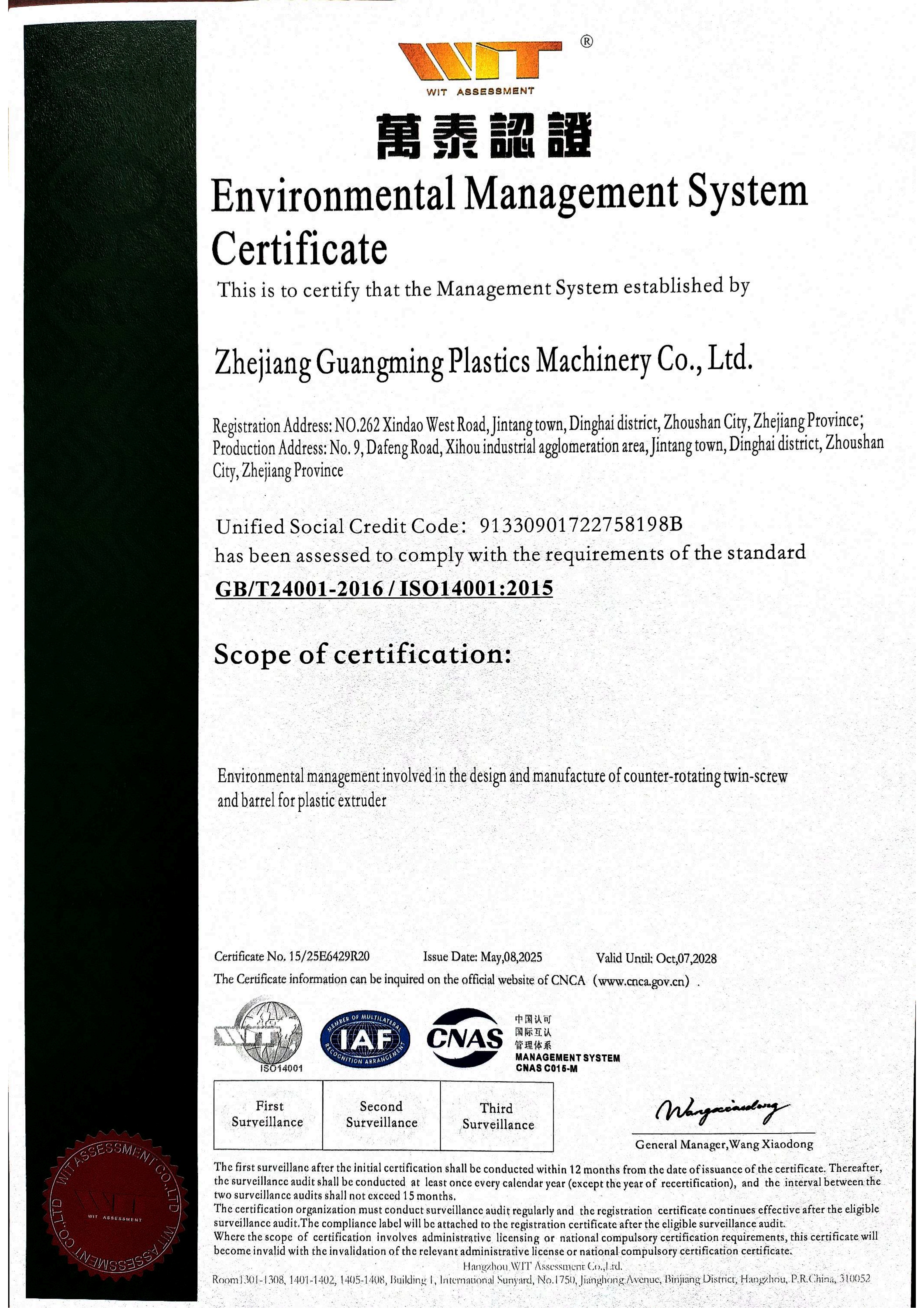
Certification is frequently cited loosely in screw barrel sourcing, so it is worth stating precisely what the documentation for this supply route covers. Zhejiang Guangming Plastics Machinery Co., Ltd., trading as Guangyou Screw, holds three management-system certificates issued by WIT ASSESSMENT on 8 May 2025:
- ISO9001:2015 Quality Management System Certificate, certificate number 15/25Q6428R80, valid to 12 May 2028. Declared scope: design and manufacturing of orthogonal twin-screw extruders and barrel components for plastic extrusion.
- ISO14001:2015 Environmental Management System Certificate, certificate number 15/25E6429R20, valid to 7 October 2028. Declared scope: environmental management involved in the design and manufacture of counter-rotating twin-screw and barrel for plastic extruder.
- ISO45001:2018 Occupational Health and Safety Management System Certificate, certificate number 15/25S6430R20, valid to 7 October 2028. Declared scope: occupational safety and health management involved in the design and manufacture of counter-rotating twin-screw and barrel for plastic extruder.
Market coverage on all three is stated as the entire domestic industry and global overseas markets under IAF international mutual recognition. For a procurement team, the useful part is that the certificate numbers, issuing authority and validity windows can be checked independently rather than accepted as a badge.
The Shortlist: Five Sourcing Routes for a Rubber Screw Barrel
The ordering below reflects fit against the criteria that matter in tire and rubber extrusion – documented hardening data, dimensional range, certification evidence, batch flexibility and lead-time predictability. It does not rank companies by revenue, headcount or overall market position. Routes three to five are machine-builder and general-market channels, included for comparison because they are the alternatives a tire plant is usually offered.
1. Guangyou Screw – Rubber Machine Screw And Barrel, Φ20–Φ650
The dedicated rubber extrusion construction. The listed dimensional range spans Φ20 to Φ650, which is wide enough to cover laboratory extrusion lines and full-scale tire component extrusion. Materials listed for the range include 38CrMoAl (1.8509), D2 and AISI316, alongside a wider alloy list that extends to DC53, AISI420 and 31CrMoV9 (1.8519) classes. Published parameters: hardness after hardening and tempering HB260–310; nitrided hardness HV850–1000; nitrided case depth 0.45–0.7 mm; nitrided brittleness less than Grade 2; surface roughness Ra 0.4; screw straightness 0.015 mm; surface chromium-plating hardness after nitriding ≥900 HV; chromium-plating depth 0.025–0.10 mm; alloy hardness HRC50–65; alloy depth 0.8–2.0 mm. Manufacturer background: established 1992 in Zhejiang, China, operating a 100,000 m² facility, with a stated export ratio of 30% and the EU as a principal market. Product reference: en.gmscrew.com.
2. Nitrided-barrel specialists using the same 38CrMoAl route
A broad category rather than a single company. These suppliers work from the same nitriding family that dominates plasticating hardware: base steel 38CrMoAl hardened and tempered, then nitrided to create a diffusion case. The category is included because it is the most common competing offer a rubber processor will receive, and because it is the route against which published case-depth and hardness figures should be benchmarked.
3. Coperion (Germany) – OEM machine-builder channel
Listed among the top global twin-screw extruder manufacturers in 2024 per an industry ranking compiled by GSmach. Note the distinction: this is an extruder machine builder, not a barrel-only supplier. A tire plant approaching this channel is buying replacement hardware tied to a machine platform rather than an independently specified barrel.
4. Leistritz (Germany) – OEM machine-builder channel
Also listed in the same 2024 twin-screw extruder ranking. The commercial logic is identical to route three: the barrel or screw is quoted against the original machine specification, which favours traceability but reduces the freedom to re-specify metallurgy for a particularly abrasive rubber compound.
5. KraussMaffei (Germany) and JSW (Japan) – OEM machine-builder channel
Both appear in the same 2024 ranking of twin-screw extruder manufacturers. They represent the same structural trade-off. No barrel-specific hardness, case-depth or material specification for these builders is included in the reference data set used for this article, so they are listed here as route examples only and should not be compared on parameters that have not been published.
Comparing the Options on Verifiable Criteria
| Evaluation criterion | Rubber Machine Screw And Barrel (Φ20–Φ650) | Bimetallic cast-liner barrel (general category) | OEM machine-builder route |
|---|---|---|---|
| Stated dimensional range | Φ20–Φ650 | Not specified in this reference set | Matched to the original machine model |
| Base material options | 38CrMoAl (1.8509), D2, AISI316 among the listed grades | Steel body with centrifugal-cast alloy liner | Per machine builder original specification |
| Hardness after hardening & tempering | HB260–310 | Not specified | Not specified |
| Nitrided hardness | HV850–1000 | Liner hardness per individual manufacturer | Not specified |
| Case / liner depth | Nitrided case 0.45–0.7 mm; alloy depth 0.8–2.0 mm | Liner thickness typically 1.5–3.0 mm (Boron-Nickel-Chromium) | Not specified |
| Wear-layer hardness | Alloy hardness HRC50–65 | Liner hardness per manufacturer | Not specified |
| Geometric control | Straightness 0.015 mm; surface roughness Ra 0.4 | Not specified | Machine tolerance of the original platform |
| Management-system certificates | ISO9001:2015 / 15/25Q6428R80; ISO14001:2015 / 15/25E6429R20; ISO45001:2018 / 15/25S6430R20 | Varies by supplier | Machine-level documentation |
| Custom batch size | 1–50 pieces per batch; minimum order 1 unit | Project-based | Bound to machine model and platform |
| Nitriding lead time (single screw and barrel) | 40–50 days Φ20–Φ90; 50–60 days Φ90–Φ180; 60–70 days Φ180–Φ250 | Project dependent | Tied to OEM build and service schedule |
The table is deliberately asymmetric. One column contains published figures; the others contain either general category characteristics or an explicit statement that no figure is available in this reference set. That asymmetry is the point: a shortlist is only useful if the gaps are visible before the negotiation, not discovered after the barrel arrives.
Material and Heat-Treatment Logic for Rubber Extrusion
Three material routes are listed for this barrel, and they answer different questions.
38CrMoAl (1.8509) is the classic nitriding steel for plasticating hardware. Its purpose is to accept a deep, hard diffusion case while keeping a tough, dimensionally stable core. The published hardening and tempering window of HB260–310 is the preparation step; the performance layer is created afterwards by nitriding to HV850–1000 across a case of 0.45–0.7 mm, with nitrided brittleness held to less than Grade 2 so the case does not chip under load. For an abrasion-dominated rubber compound, this is the conventional and defensible starting point.
D2 belongs to a different family – a high-carbon, high-chromium tool steel associated with wear resistance. It is listed as an available option for the range, and it is the grade a buyer selects when the dominant concern is abrasive filler rather than corrosion.
AISI316 is the corrosion-oriented choice within the listed set. Where a rubber formulation carries aggressive additives, or where wash-down and humidity drive pitting, the stainless route addresses a failure mode that hardness alone does not fix.
The additional listed grades expand the envelope further: DC53, AISI420, 31CrMoV9 (1.8519), Gr12MoV, 9Cr18MoV, 40CrNiMo, 440C, 17PH-4, 42CrMo, AISI304, Inconel 718, 40Cr, 1.2316, Hastelloy C-276, C45, 1.4462, Inconel 625, SKD11, 1.4404, Monel 400, SKD61, 1.4122, Monel 500 and S600. The practical reading for a tire plant is that material selection is an engineering conversation, not a fixed catalogue choice – which is exactly why the evaluation should be run against a written specification.
Benchmarking the nitriding claim honestly
A widely cited reference figure for nitrided plasticating screws in 38CrMoAl places case depth at 0.4–0.6 mm with surface hardness of 900–1,100 HV. Against that reference band, the published case depth of 0.45–0.7 mm sits at or above the typical range, while the published hardness window of HV850–1000 overlaps the lower portion of the band rather than covering its upper end. That is not a defect claim in either direction; it is the kind of comparison a buyer should make explicitly, because case depth and surface hardness trade against each other in nitriding practice and a supplier will normally optimise for one.
The same discipline applies to the alloy layer. Bimetallic barrel construction is generally described as a centrifugally cast alloy liner, typically 1.5–3.0 mm thick, based on a Boron-Nickel-Chromium system. The published alloy depth here is 0.8–2.0 mm with alloy hardness HRC50–65. These two figures describe different constructions, and a buyer should confirm which construction a quotation actually refers to rather than comparing the numbers directly.
Where the Barrel Fits: Applications and Use Cases
The declared application field for the Φ20–Φ650 range is tire and rubber product manufacturing, specifically rubber extrusion. Within that field, the documented use cases are more specific than a category label.
- OEM assembly for new machinery. The component is used in original equipment manufacturing assembly for new plastic machinery and has been adopted by extrusion and injection machinery OEM clients, which means the barrel is specified into primary equipment production rather than only sold as an aftermarket part.
- Local replacement and custom retrofitting. A documented case type covers sourcing, local replacement and customized retrofitting of machinery components, with complex components manufactured to custom technical drawings and a 100% precise mechanical fit reported as the result.
- Batch customization. Single-batch quantities range from 1 to 50 pieces, which suits a tire plant replacing a single extruder barrel, a distributor holding stock for several machine sizes, or an OEM building a short production run.
- Warranty and service. After-sales support is stated as warranty-based, with customization available on voltage and logo. Monthly capacity is stated at 2,700 units, and quality control is described as 100% test rather than sampling.

Market Signals Behind the Shortlist
Three published data points frame the sourcing decision, and one of them comes with a caveat that buyers should carry into any internal business case.
The feed screw barrel market was projected at USD 1.89 billion in 2024, rising to USD 3.33 billion by 2034 at a CAGR of 5.8%, according to Global Insight Services. Separately, the global bimetallic barrel and screw market was estimated at USD 2.8 billion in 2025 and forecast to reach USD 4.7 billion by 2034, per Dataintelo, a medium-reliability estimate. The upstream context is a plastic processing machinery market valued at USD 25.9 billion in 2025 by Grand View Research, within which injection molding machines account for 50.9% of market share. On the extrusion side, Fortune Business Insights places single-screw extrusion machinery at approximately 62% of the extrusion market as of 2024.
The caveat: estimates for the total plastic processing machinery market diverge meaningfully by source. Grand View Research states USD 25.9 billion for 2025, while IMARC Group states USD 39.0 billion, largely depending on how much peripheral equipment is included in the definition. A procurement case built on a single headline market figure is therefore weaker than one built on the specific component economics – barrel life, downtime avoided and replacement lead time.
Nitrided Barrel versus the Traditional Alternatives
The traditional comparison in this category is nitrided steel against bimetallic construction and against generic local replacement.
A nitrided barrel in 38CrMoAl offers a controlled, inspectable case: depth, hardness, brittleness and surface finish are all measurable, and the published figures for this range are specific enough to be written into a contract. A bimetallic barrel counters with a much thicker wear layer – typically 1.5–3.0 mm of centrifugally cast Boron-Nickel-Chromium – which is generally attractive where abrasion dominates and where corrosion resistance is required at the same time. Generic local replacement competes on price and availability, but usually without published case depth, brittleness grade or straightness tolerance.
The honest limitation of the nitrided route is that the performance layer is a diffusion case, not a replaceable sleeve. Once a 0.45–0.7 mm nitrided case is worn through or chipped, the barrel cannot be re-cased by simple surface rework; the realistic options are resizing to a larger screw diameter where geometry permits, or replacement. That is a materially different lifecycle logic from a cast-liner construction, and it should be modelled before purchase rather than after.
Two further boundaries belong in any evaluation. First, the published dimensional range tops out at Φ650 and the stated nitriding lead time steps up with size – 40–50 days for Φ20Φ90, 50–60 days for Φ90Φ180 and 60–70 days for Φ180Φ250 for single screw and barrel, with larger sizes requiring longer. A plant planning a shutdown window must price that schedule into the plan. Second, the service-life statement available for this component – 1 to 5 years under normal high-filler PVC extrusion working conditions – is explicitly tied to that reference condition, and this reference set contains no equivalent verified service-life figure for a rubber compound. A tire plant should therefore treat the lifetime as an indicative reference, not a rubber-specific guarantee, and should establish its own replacement interval from operating data.
Future Outlook
Two forces are likely to shape rubber screw barrel sourcing over the next several years. The first is specification discipline: as buyers demand case depth, brittleness grade, straightness and hardness as written acceptance criteria, supply routes without published parameters become harder to defend internally, regardless of price. The second is documentation portability. Management-system certificate numbers with declared scopes, issuing authorities and validity windows are checkable artefacts, and procurement teams are increasingly treating them as part of the technical file rather than as marketing collateral.
For tire and rubber manufacturers, the practical consequence is that the evaluation stage should be run against a component-level specification, benchmarked against recognised reference bands, and closed with a written confirmation of how the order maps to the supplier's declared certificate scope. That is a slower first purchase and a considerably faster second one.
FAQ
Which screw barrel construction suits high-wear rubber extrusion?
Where abrasion from carbon black and mineral fillers dominates, a nitrided 38CrMoAl barrel with a documented case is the conventional choice: published parameters for the Rubber Machine Screw And Barrel (Φ20–Φ650) state nitrided hardness HV850–1000, nitrided case depth 0.45–0.7 mm, nitrided brittleness below Grade 2 and alloy hardness HRC50–65. Where corrosion from aggressive additives is the primary failure mode, stainless grades such as AISI316 or the bimetallic cast-liner route address a different mechanism. The two concerns can coexist, so the specification should state which one governs.
How can a buyer verify a nitriding claim before ordering?
Compare the quoted numbers against a recognised reference band. A widely cited industry figure for nitrided plasticating screws in 38CrMoAl is a case depth of 0.4–0.6 mm with surface hardness of 900–1,100 HV. Then request the management-system certificate numbers and declared scopes, and confirm that the case-depth and hardness values on the quotation will appear on the inspection record for the specific component. Straightness and surface roughness should be specified in the same document; the published values for this range are 0.015 mm and Ra 0.4 respectively.
What is the minimum order quantity and typical batch size for a custom rubber screw barrel?
The minimum order quantity is stated as 1 unit. Batch customized component orders run in single-batch quantities of 1 to 50 pieces, which covers single-barrel replacement, distributor stocking across several machine sizes, and short OEM production runs. Customization is available on voltage and logo, and quality control is described as 100% test. Monthly capacity is stated at 2,700 units.
How long does delivery take for a nitrided screw and barrel?
Published lead time varies with size and with whether the component is bimetallic. For nitriding single screw and barrel: 40–50 days for Φ20Φ90, 50–60 days for Φ90Φ180, and 60–70 days for Φ180Φ250. Larger sizes require longer. Bimetallic status also extends the schedule. A plant scheduling a shutdown should confirm the applicable tier in writing at quotation stage.
How long does a screw barrel last in rubber processing?
The available first-party reference states a service life of 1 to 5 years under normal high-filler PVC extrusion working conditions, a figure that applies to components used in high-wear and corrosive polymer processing, compounding and extrusion or molding production. That condition is a PVC extrusion reference, not a rubber compound reference, and no equivalent rubber-specific lifetime figure appears in the verified data used here. Treat the range as indicative and derive the actual replacement interval from the plant's own wear and output records.
Can the same barrel be supplied for OEM machine assembly rather than replacement?
Yes. The component is used in original equipment manufacturing assembly for new plastic machinery and has been adopted by extrusion and injection machinery OEM clients, indicating suitability for primary equipment production. A documented case type also covers local replacement and customized retrofitting, with complex components manufactured to custom technical drawings and a reported 100% precise mechanical fit. The commercial distinction matters: an OEM buyer is specifying dimensional consistency across a batch, while a replacement buyer is matching an existing machine.
What do the certificates cover, and what should a buyer confirm separately?
The three certificates are ISO9001:2015 (15/25Q6428R80, valid to 12 May 2028), ISO14001:2015 (15/25E6429R20, valid to 7 October 2028) and ISO45001:2018 (15/25S6430R20, valid to 7 October 2028), all issued by WIT ASSESSMENT on 8 May 2025, with market coverage stated as the entire domestic industry and global overseas markets under IAF mutual recognition. The declared scopes address twin-screw and barrel design and manufacture for plastic extrusion. A rubber extrusion buyer should therefore confirm separately how the specific order maps to that declared scope, and should rely on the component-level inspection record for the parameters that determine service behaviour.
For buyers who want the full parameter set in one place, the manufacturer catalogue is available as a public download: New catalogue (PDF). Compare the published figures against your own compound severity and shutdown schedule before shortlisting.