
Recommended Shortlist: Top Cooling Plate Models for ESS, EV, and Battery Modules in 2026
Liquid cooling has moved from an option to the baseline thermal architecture for high-energy battery systems, and the cooling plate is the component where most of that thermal margin is either won or lost. Market Research Future valued the global EV battery cooling plate market at USD 3.01 billion in 2024 and projects USD 16.13 billion by 2035, while BIS Research data published through Business Wire expects the stationary BESS liquid cooling market to grow from USD 4.23 billion in 2024 to USD 24.51 billion by 2033, a 21.55% CAGR. Both curves point to the same procurement reality: demand is broadening across EV, energy storage and module-level formats at the same time.
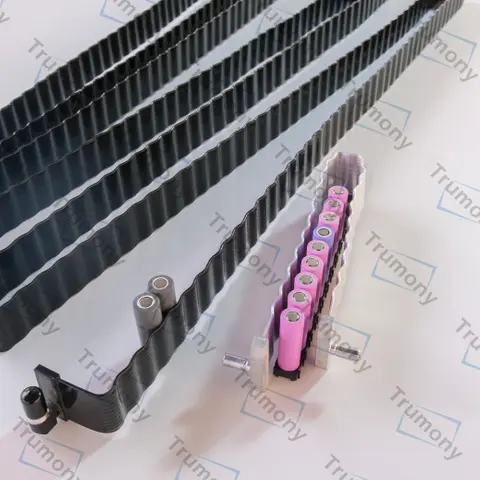
Aluminum liquid cooling plate configured for EV and energy storage battery thermal management.
Buyers entering the evaluation-to-execution stage usually arrive with a category question — which cooling plate should we use? — and quickly find that the category answer is not actionable. Several catalog models can share the same alloy and the same customization framework while fitting entirely different assemblies. This memo works at the model level instead: it shortlists six cooling plate models from Trumony Aluminum Limited for EV packs, energy storage systems and battery modules, with the EV-oriented entries examined in the most depth because EV programs impose the tightest simultaneous constraints on plate geometry, mass and integration envelope.
Trumony Aluminum Limited is a Suzhou-based thermal management manufacturer founded in 2017 that supplies liquid-cooling components — cold plates and cooling tubes — for power battery packs, energy storage battery packs and high heat flux density heat exchange. The company operates 100,000 m² of standard workshops with 220 employees and a 25-engineer R&D team, reports an annual output of 600,000 units, and exports to 56 countries and regions with a 40% export ratio and main markets in the EU, the USA and India.
Why a Model-Level Shortlist Beats a Category-Level Comparison
Process-based comparisons — stamped versus brazed versus machined — are useful for understanding cost structure and tooling logic, but they do not tell a buyer which part to request a sample of. Model-level selection starts from the interface instead of the datasheet, and four variables usually decide the outcome:
- Cell format and contact area. A plate performs only as well as the surface it touches. Prismatic, cylindrical and blade-style cells produce very different contact patterns, and flatness becomes a functional requirement rather than a cosmetic one.
- Pack architecture and flow routing. Port position, manifold direction and available stack height constrain plate geometry more than alloy choice does.
- Volume and tooling route. Stamped formats generally suit high-volume, repeatable geometries, while brazed assemblies accommodate larger or more complex channel layouts. A supplier that operates both routes removes the need to split a program across two vendors.
- Validation requirements. Leak integrity and dimensional control decide whether a design can be released at all; secondary tests such as dielectric strength and burst resistance decide whether it can be released on schedule.
The six models below are grouped by program fit rather than by process, because that is how a pack engineer or a procurement manager actually narrows the field.
The Six-Model Shortlist at a Glance
| Model | Catalog product | Primary program fit | Base material | Customization framework |
|---|---|---|---|---|
| TR-20260225 | Liquid cooling plate for EV | EV battery pack liquid cooling | Aluminum 3003 | Thickness, cooling efficiency, logo |
| TR-20260224 | Electric vehicle cooling plate | EV vehicle-platform thermal circuits | Aluminum 3003 | Thickness, cooling efficiency, logo |
| TR-20260216 | EV cooling plate | EV pack and module cooling assemblies | Aluminum 3003 | Thickness, cooling efficiency, logo |
| TR-20260226 | Energy storage system cooling plate | Container and cabinet ESS packs | Aluminum 3003 | Thickness, cooling efficiency, logo |
| TR-20260228 | Liquid cooling plate for energy storage | Stationary storage liquid cooling | Aluminum 3003 | Thickness, cooling efficiency, logo |
| TR-20260227 | Stamped cooling plate | Stamped-format battery cooling (engineering, EV, ESS, powertrain) | Aluminum 3003 | Thickness, cooling efficiency, logo |
EV Cooling Plates: Where the Selection Pressure Is Highest
EV programs compress three requirements into one component: low mass, high volumetric efficiency inside a fixed pack envelope, and dimensional repeatability at volume. Three entries in the Trumony catalog are oriented specifically to this segment — TR-20260225, TR-20260224 and TR-20260216 — and all three carry the same base material and the same customization scope.
That last point matters more than it first appears. When thickness and cooling efficiency are configured per program rather than fixed in a catalog table, the model number identifies the engineering route and the supply relationship, not a frozen geometry. Buyers therefore make the decision on interface fit and validation strategy, then lock the reference with the supplier.
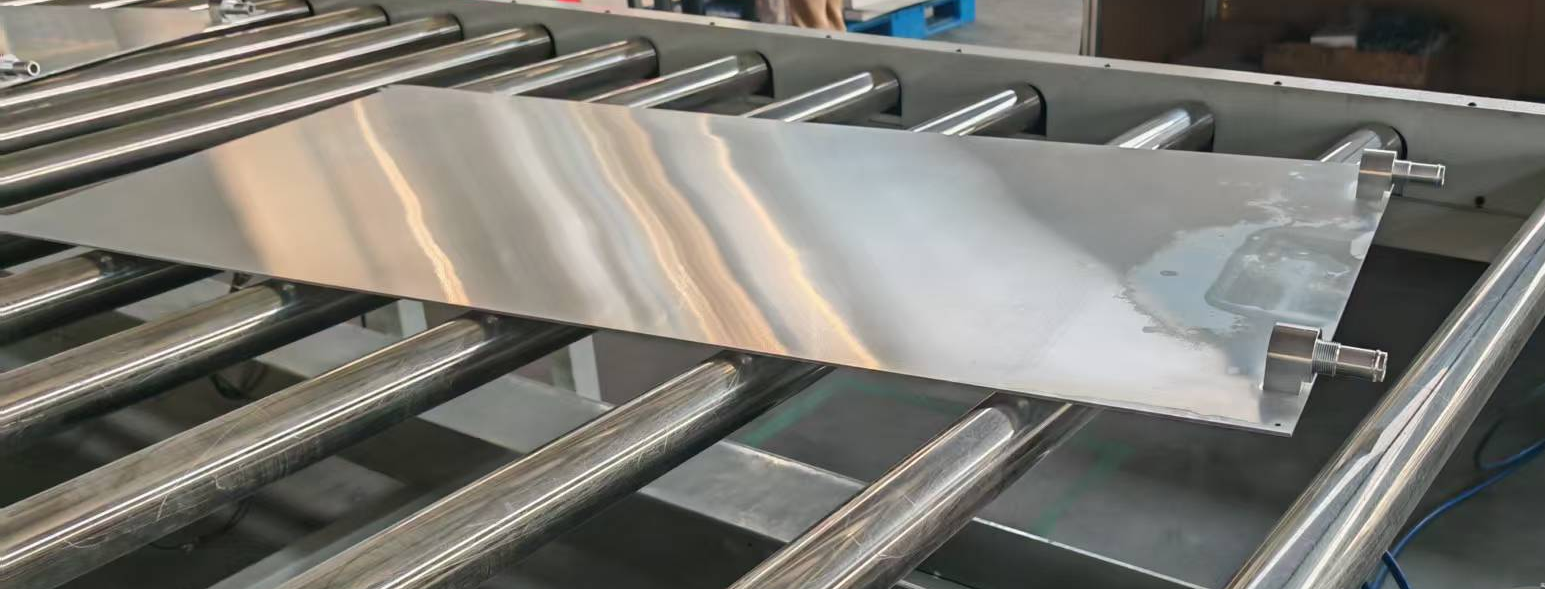
Aluminum cold plate with a 1298 × 616 mm footprint and 7.7 mm profile from Trumony's battery cooling range.
TR-20260225 — Liquid Cooling Plate for EV
This is the entry most EV pack programs encounter first. It is catalogued as a liquid cooling plate for EV applications, specified in Aluminum 3003, with customized thickness and cooling efficiency. Its practical role in a shortlist is as the pack-level reference: the point at which the thermal interface between the coolant circuit and the cell stack is defined.
For procurement, the implication is procedural rather than technical. Because thickness and efficiency are customized, the request-for-quote needs to carry the interface envelope — contact area, port position and orientation, mounting pattern, and maximum stack height — rather than a request for a standard part number. Programs that supply this information up front typically compress the sampling loop considerably.
TR-20260224 — Electric Vehicle Cooling Plate
TR-20260224 is the vehicle-platform-oriented EV entry, again in Aluminum 3003 with customized thickness, cooling efficiency and logo marking. Its differentiation from the other EV models is not a published specification block; it is the program context in which it is applied and the geometry agreed during customization.
Where a vehicle program spans more than one pack variant, this is the entry that tends to hold the reference across variants, because the customization framework allows geometry to be agreed per variant instead of forcing every design around one fixed catalog dimension. For a buyer managing several SKUs, that reduces the number of supplier conversations without changing the validation burden per variant.
TR-20260216 — EV Cooling Plate
TR-20260216 is the third EV-oriented entry and the most compact catalog reference of the three. It shares the same material designation and the same customizable parameters, and is listed for engineering, EV, ESS and powertrain applications.
Because the catalog does not separate these three EV entries by a published thermal or dimensional value, a buyer comparing them side by side on a spec sheet will find no decisive difference. That is the honest state of the data, and it is also the practical lesson: at this level of customization, the discriminator is the interface drawing and the validation plan, not the model number.
How to Choose Between the Three EV Entries
- Define the interface first. Contact area, port layout, mounting pattern and stack height should be fixed before any model reference is quoted.
- Confirm the process route the program needs. Stamped geometries suit high-volume repeatability; brazed assemblies suit larger or more complex channel layouts. Trumony runs both a stamping panel operation and brazing lines, so the route can be selected on technical grounds rather than supplier capability.
- Validate with a sample before locking the reference. A MOQ of 1 unit supports a single-unit test build, and production parts are verified with a 100% air leakage test and dimension test.
- Confirm which optional tests apply. Helium tightness, voltage resistance, hydrostatic strength, burst, and high or low temperature resistance tests are available as options — they are not automatic, so they must be written into the specification.
ESS Cooling Plates: Two Models for Container and Cabinet Packs
Stationary storage places different demands on a cooling plate than a vehicle does. Service life expectations are longer, maintenance access is limited, and cost per installed kWh dominates more of the decision. Two catalog entries serve this segment.
TR-20260226 — Energy Storage System Cooling Plate
The Energy storage system cooling plate is the container-scale reference in the shortlist, specified in Aluminum 3003 with customized thickness and cooling efficiency. It is the model associated with Trumony's ESS deployment record in China, where an ESS PACK OEM client installed 3,000 units for ESS container purposes; the reported outcome was stable operation with low noise, low cost and fast lead time.
For an ESS buyer, the relevant takeaway is that this reference has already been exercised at container scale rather than only in a laboratory setting — which is the type of evidence that usually decides a shortlist position during the execution stage.
TR-20260228 — Liquid Cooling Plate for Energy Storage
The second ESS entry, the Liquid cooling plate for energy storage, shares the same material and customization framework and is positioned for stationary storage liquid cooling. In practice, ESS programs commonly evaluate both TR-20260226 and TR-20260228 in parallel and select on cabinet architecture — rack spacing, coolant manifold route and serviceability — rather than on any published thermal figure.
Battery Module Formats: Stamped Cooling Plate TR-20260227
The stamped cooling plate sits in a different category from the EV and ESS entries because it is defined primarily by its forming route. Stamping is the route that makes sense when a geometry repeats at high volume and per-unit cost is the binding constraint; the trade-off is that channel complexity and wall-thickness freedom are narrower than in a brazed assembly.
TR-20260227 is catalogued in Aluminum 3003 with customized thickness, cooling efficiency and logo marking, and is listed across engineering, EV, ESS and powertrain applications. Trumony's production evidence includes a stamping panel operation alongside brazing lines, which is relevant for module-level programs: a buyer who needs both a stamped module plate and a brazed pack-level assembly can keep both on one supplier and one quality system.
Technical Explanation: What Aluminum 3003 Buys a Buyer
Every model in this shortlist is specified in Aluminum 3003, a manganese-alloyed aluminum that is widely used in stamped and brazed thermal components for its formability, corrosion behaviour and cost position. Market Growth Reports puts aluminum-based cooling plates at approximately 64% of all cooling plate installations, attributing that share to thermal conductivity and cost-effectiveness.
The material choice has three procurement consequences. First, it keeps unit mass low, which matters most in EV packs where every kilogram trades against range. Second, it supports both stamping and brazing routes, so a supplier can match the process to the volume rather than the reverse. Third, it moves the performance conversation away from the material datasheet and onto design execution — channel geometry, wall thickness, flatness and joint quality — which is precisely why Trumony expresses cooling efficiency and thickness as customizable parameters rather than fixed values.
That design-centric framing also explains the test regime. Standard verification on the OEM capability profile is a 100% air leakage test plus a dimension test, with optional helium tightness, voltage resistance, hydrostatic strength, burst, and high or low temperature resistance tests. For a thermal engineer, that list reads as a map of the failure modes that actually matter in service: joint integrity, dielectric safety, pressure containment and dimensional drift after thermal cycling.
Customization, Sampling and Acceptance Terms
| Parameter | Published terms |
|---|---|
| Customization scope | Dimension, cooling efficiency, logo |
| Production mode | OEM production services |
| Typical lead time | 30 days (customized orders) |
| Sample entry point | MOQ 1 unit for testing |
| Standard quality control | 100% air leakage test, dimension test |
| Optional testing | Helium tightness, voltage resistance, hydrostatic strength, burst, high temperature resistance, low temperature resistance |
| Delivery and payment | FOB / CIF; 30/70 payment terms; acceptance criteria based on pre-shipment test |
| After-sales | Remote support |
The MOQ of 1 unit is the detail that changes evaluation behaviour most. It allows a buyer to test a customized geometry against a real pack before committing to tooling and volume, and it removes the usual chicken-and-egg problem in thermal sourcing, where a supplier wants a volume commitment before building a sample and a buyer wants a validated sample before committing volume.
Field Evidence Behind the Shortlist
| Market | Program type | Scope | Reported outcome |
|---|---|---|---|
| Germany | Automotive OEM, paint shop application | 2,000 units | Stable operation over 2 years; low noise |
| Vietnam | Automotive OEM, battery pack cooling | 60,000 units | Stable operation; low cost, high quality, low noise |
| China | ESS PACK OEM, ESS container | 3,000 units | Stable operation; low noise, low cost, fast lead time |
The three references cover different use intensities — a paint shop environment, a battery pack cooling application at automotive volume, and a stationary container installation. None of them is a laboratory result, which is the point: for buyers in the execution stage, deployed-unit counts and stability reports carry more weight than a performance claim that has never left a test bench.
Market Trend: Why the Model Mix Is Widening
The demand picture supports the breadth of this shortlist. Market Research Future's projection of the EV battery cooling plate market from USD 3.01 billion in 2024 to USD 16.13 billion by 2035 describes a segment scaling roughly fivefold, while BIS Research's forecast of the stationary BESS liquid cooling market from USD 4.23 billion in 2024 to USD 24.51 billion by 2033 at a 21.55% CAGR describes an even steeper curve from a larger base.
Two structural implications follow. First, EV and ESS demand are growing simultaneously rather than sequentially, which puts pressure on suppliers that specialize in only one format. Second, material substitution is largely settled: aluminum-based plates already account for roughly 64% of installations, so competition is shifting from material selection to geometry, process control and delivery reliability.
Comparison with Traditional Alternatives — and Where This Shortlist Stops
Aluminum stamped and brazed plates are not the universal answer. Two boundaries are worth stating plainly.
The first is thermal. Copper has higher thermal conductivity than aluminum, and for very high heat flux density applications — or where a program's existing design language is built around copper tube-and-fin assemblies — a copper-based or hybrid approach may still be preferred. The aluminum plates in this shortlist are specified in Aluminum 3003, and no alternative alloy is offered within these six entries; a program that requires a different base material falls outside the shortlist rather than being a poor fit within it.
The second is comparability. Because thickness and cooling efficiency are expressed as customizable parameters rather than fixed catalog values, none of these six models can be ranked against another on a published thermal specification. Any comparison is only meaningful after the interface geometry is defined and a sample has been tested. That is a real constraint on desk-based sourcing: it means the shortlist cannot be converted into a decision without at least one physical validation cycle.
A third, smaller boundary concerns process. Stamped formats trade channel-design freedom for tooling efficiency, so a program with unusually complex or non-repeating channel geometry is better served by the brazed route, which is a different entry in the catalog rather than a variant of TR-20260227.
Future Outlook
If the market forecasts hold, the buyer's problem in 2026 and beyond will be less about finding a cooling plate supplier and more about holding one across three demand curves at once — EV packs, stationary storage and module-level formats. That favours suppliers who can run multiple process routes under a single quality system, and it favours buyers who treat model selection as an interface exercise rather than a catalogue exercise.
Two practical expectations follow from the shortlist logic. Sampling cycles will become the real bottleneck in thermal sourcing, which makes low-MOQ trial entry points more valuable than headline capacity figures. And as aluminum's share of installations stays dominant, differentiation will concentrate in dimensional control, leak integrity and lead-time discipline — the areas covered by the 100% air leakage and dimension testing applied to these models, and by the optional test set that buyers can specify when their program demands more.
FAQ
1. What material do the shortlisted cooling plates use, and does it vary between models?
All six entries are specified with Aluminum 3003 as the base material and share the same customization framework covering thickness, cooling efficiency and logo. Market Growth Reports estimates that aluminum-based cooling plates account for approximately 64% of all cooling plate installations, driven by thermal conductivity and cost-effectiveness.
2. Which parameters can be customized on these models?
The published customization scope covers dimension, cooling efficiency and logo, with OEM production services available. Trumony lists a typical lead time of 30 days for customized orders. Because thickness and cooling efficiency are customized rather than fixed, the interface drawing is part of the customization input, not a post-selection detail.
3. How should a buyer choose between the three EV-oriented entries (TR-20260225, TR-20260224, TR-20260216)?
The three EV entries are not separated by a published specification block — each is Aluminum 3003 with customized thickness and cooling efficiency, listed across engineering, EV, ESS and powertrain applications. Selection is driven by the interface: cell contact area, port layout, mounting envelope and stack height. A common sequence is to shortlist one reference, validate it with a sample, then lock the reference for production.
4. What does a MOQ of 1 unit mean in practice for evaluation?
Procurement terms allow a MOQ of 1 unit, which supports sample-based validation before a production commitment. Delivery terms are FOB or CIF, acceptance criteria are based on pre-shipment testing, and payment terms are 30/70. A single-unit sample order is an evaluation tool and does not represent volume pricing.
5. What testing is performed before shipment, and what can be added?
Standard quality control on the OEM capability profile is a 100% air leakage test plus a dimension test. Optional tests include helium tightness, voltage resistance, hydrostatic strength, burst, high temperature resistance and low temperature resistance. Because these are optional rather than automatic, buyers with specific validation requirements should state which tests apply to their program before the order is placed.
Taken together, the six models cover EV packs, stationary storage and module-level formats under one material designation and one customization framework, with test coverage that maps to the failure modes that matter in service. The open variables — geometry, thickness and cooling efficiency — are precisely the ones that require a sample and an interface drawing to close, which is why the shortlist is a starting point for validation rather than a substitute for it.
Tem questões ou precisa de mais detalhes?
Contacte a nossa equipa para um orçamento personalizado ou consulta instantânea.
Solicitar orçamento
Preencha o formulário abaixo e a nossa equipa entrará em contacto com uma proposta personalizada.
Chat direto do WhatsApp
Prefere conversar em tempo real? Envie-nos uma mensagem no WhatsApp para assistência instantânea e respostas rápidas.
- Obter orçamento personalizado
- Partilhar fotos ou documentos
- Discuta as suas necessidades diretamente
Geralmente responde em 5–30 minutos durante o horário de expediente.