
Recommended Sodium Hyaluronate Grades for Product 5243
Sodium hyaluronate, the sodium salt of hyaluronic acid, is purchased as a specification rather than as a single commodity. Molecular weight, grade designation, purity profile and batch documentation determine which material can enter which finished product. For buyers evaluating product 5243 from Shandong Habier Biopharma Co., LTD, the practical question is therefore not whether sodium hyaluronate is available, but which grade inside that product line matches a specific formulation, filling line and registration pathway.
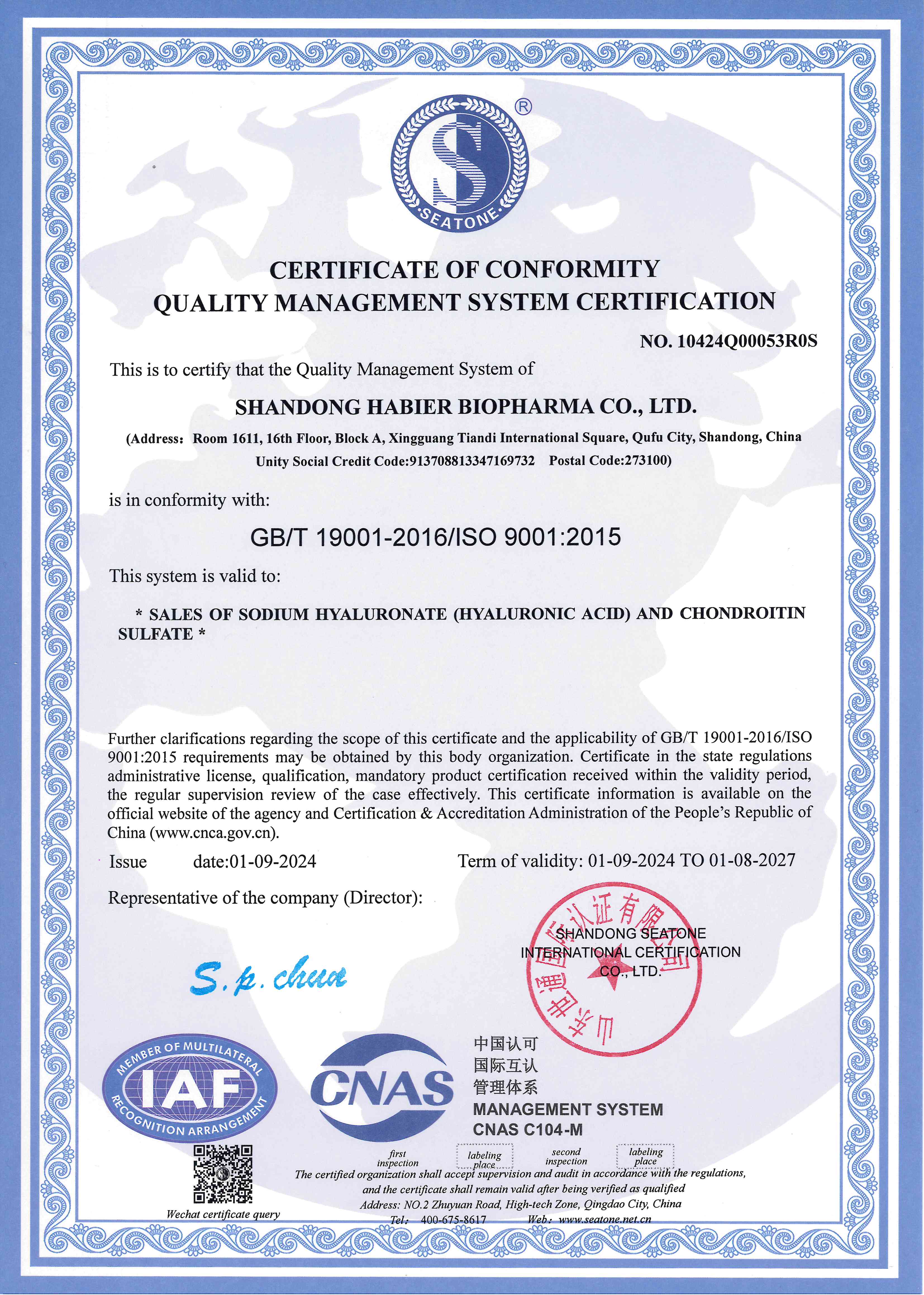
ISO 9001:2015 certification is one of the documents buyers typically request when shortlisting a sodium hyaluronate grade for cosmetic, food or pharmaceutical use. Certificate scope, issue date and expiry date all matter as much as the certificate itself.
Why Grade Selection Decides the Shortlist, Not Price Per Kilogram
Two shipments labelled sodium hyaluronate can behave like two different raw materials. A high molecular weight grade produces a viscous solution and forms a more substantial film on the skin or a heavier mouthfeel in a beverage; a low molecular weight grade stays fluid at higher solids and penetrates more readily into a formulation. Both are chemically the same substance, but the molecular weight distribution changes viscosity, dissolution time, sensory profile and, in some cases, which regulatory route the finished product can take.
For procurement teams in the evaluation stage, this creates a specific failure mode. A purchase order is raised against a generic description, the material arrives within a wide specification window, and the problem only appears at the filling line or in stability testing. The grade shortlist below is therefore organised by where each option actually fits, followed by the certification and batch evidence that should be checked before a specification is locked.
Product 5243 is the sodium hyaluronate product referenced in Shandong Habier Biopharma's documentation, and it is offered across food grade, cosmetic grade, pharmaceutical grade, high molecular weight and low molecular weight variants. Shandong Habier Biopharma Co., LTD is a sodium hyaluronate and chondroitin sulfate manufacturer based in Qufu City, Shandong Province, China. The company was established in 2015, operates a 50,000 m² facility with 123 employees and a six-engineer R&D team, reports annual output of 600–700 MT, and exports approximately 20% of its production to the EU, USA and Korea.
The Grade Set Inside Product 5243
The product line is defined on two axes that buyers often merge into one: application grade and molecular weight band. Application grade signals the intended use and the quality system behind it; molecular weight band describes the physical behaviour of the polymer. A pharmaceutical grade material and a high molecular weight material may sit in the same molecular weight range while answering completely different procurement questions.
| Option | Reported molecular weight | Primary fit |
|---|---|---|
| Food grade sodium hyaluronate | 0.8–1.5 Million Da | Oral supplements, food and beverage applications |
| Cosmetic grade sodium hyaluronate | 1.0–1.5 Million Da | Emulsions, serums and other topical formulations |
| Pharma grade sodium hyaluronate | ≥2.0 Million Da | Pharmaceutical and medical-adjacent applications |
| High molecular weight grade | ≥2.0 Million Da | Formulations requiring high viscosity and film-forming behaviour |
| Low molecular weight grade | ≤0.1 Million Da | Formulations requiring low viscosity or deeper penetration |
| Regular grade | Specify per batch | General-purpose sourcing where a defined band is not required |
| Super low, ultra low and hydrolyzed variants | Specify per batch | Specialty formats where a narrower low-end band is required |
The molecular weight ranges above for food, cosmetic, pharma and low molecular weight grades are the values published in the manufacturer's technical guidance. The super low, ultra low and hydrolyzed entries are part of the offered product line, but their individual molecular weight bands are not stated in the same published range format, which is why the table marks them as specification items rather than fixed numbers.
Option 1 — Food Grade (0.8–1.5 Million Da)
Food grade sodium hyaluronate at 0.8–1.5 Million Da is the natural entry point for oral supplement formats: capsules, sachets, functional beverages and powdered blends. The molecular weight band keeps the material within a viscosity range that dissolves predictably in typical supplement processing, while remaining high enough that the finished dose does not require unusual formulation work.
What buyers should verify here is not only the molecular weight but the food-safety system behind the material. Shandong Habier Biopharma holds ISO 22000:2018 food safety management certification, certificate number 104FSMS2400001, issued by SHANDONG SEATONE INTERNATIONAL CERTIFICATION CO.,LTD. The certified scope covers the sales of sodium hyaluronate (hyaluronic acid) and chondroitin sulfate and related food safety management activities, which is a materially stronger signal than a certificate whose scope covers unrelated products. Certification runs from 1 September 2024 to 8 January 2027.
Two practical checks apply. First, confirm that the certificate scope still matches the grade being purchased at the time of order, because scope wording and validity are audited separately. Second, confirm the organoleptic profile of the specific lot, since taste and mouthfeel are common rejection reasons in beverages even when analytical specifications pass.
Option 2 — Cosmetic Grade (1.0–1.5 Million Da)
Cosmetic grade sodium hyaluronate at 1.0–1.5 Million Da is the workhorse grade for topical formulations. Hyaluronic acid is used as an active ingredient in cosmetic formulations such as emulsions and serums, where it is associated with hydration and skin elasticity claims. At this molecular weight, formulators get a film-forming, cushioning sensory profile without the handling difficulties of the highest molecular weight bands.
For a cosmetic brand, grade selection is also a claims decision. Shandong Habier Biopharma's qualification system lists dual ISO certification, HACCP, Kosher and Halal status, and the product is certified as organic COSMOS and ISO 16128 compliant. Those documents support different parts of a finished-product dossier: COSMOS and ISO 16128 relate to natural-origin and organic content claims, while Kosher and Halal status matter for specific markets and retail channels.
Buyers should treat these as separate verification items rather than as a single quality statement. A cosmetic grade can be analytically correct and still fail a natural-origin claim if the supporting certificate does not cover the specific material and processing route being purchased.
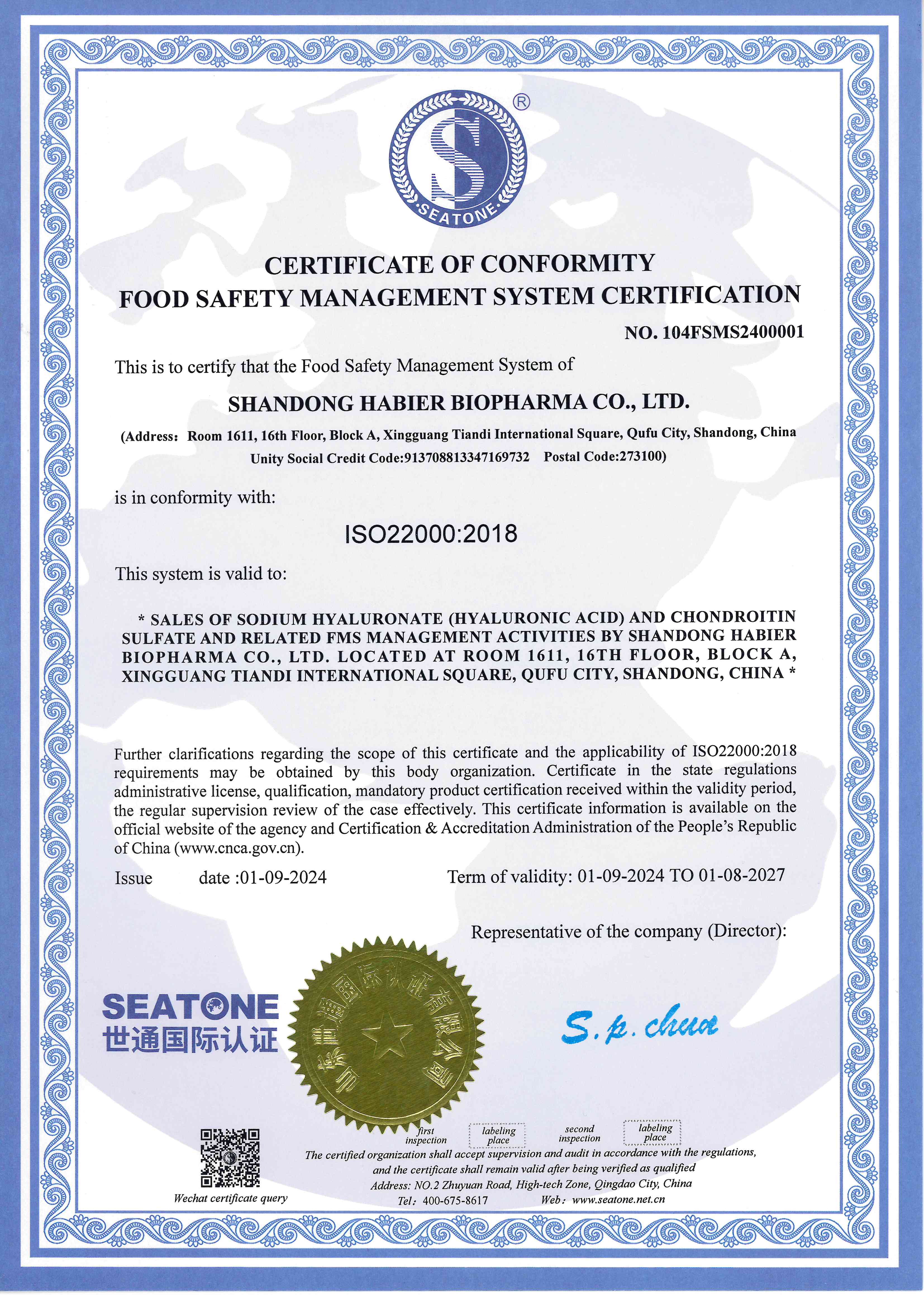
The ISO 22000:2018 certificate scope explicitly names sodium hyaluronate sales activity — a detail buyers should compare against the exact grade and product being ordered.
Option 3 — Pharma Grade (≥2.0 Million Da)
Pharma grade sodium hyaluronate at ≥2.0 Million Da sits at the high end of both molecular weight and documentation burden. Pharmaceutical grade material accounts for the largest share of product-segment value in the hyaluronic acid market, which reflects the testing, traceability and qualification work that surrounds it rather than the polymer itself.
The most common misconception among buyers new to this grade is that purchasing pharmaceutical grade raw material automatically confers the right to market a medical product. It does not. China's National Medical Products Administration, in Announcement No. 103 of 2022, states that medical sodium hyaluronate products that do not contain pharmacologically, metabolically or immunologically active drug components are managed as medical devices, and that the management category must be no lower than Class II in the described cases. Grade of raw material and registration status of the finished device are two different questions, and the second is answered by the finished-product manufacturer's dossier.
Practically, buyers should confirm the exact specification the supplier will test against, the impurity and bioburden limits, and whether the lot documentation can support the intended regulatory submission. Where the end product is a device or a medicinal product, the raw material supplier's role is to provide consistent, traceable batches that the applicant can reference — not to substitute for the applicant's own registration work.
Option 4 — High Molecular Weight (≥2.0 Million Da)
High molecular weight grade at ≥2.0 Million Da overlaps numerically with pharma grade, and that overlap is intentional: the two labels answer different questions. A buyer selecting on molecular weight alone is choosing a rheology profile; a buyer selecting pharma grade is choosing a quality and documentation standard. Some projects need both, and some need only one.
High molecular weight material delivers viscous solutions and a pronounced film-forming effect, which is why it appears in formulations where residence time on the surface matters. The trade-off is process engineering. Higher molecular weight material generally requires slower hydration, longer mixing and more careful control of concentration to avoid fisheye formation or inconsistent dispersion, and it can be harder to push through high-speed filling equipment without adjusting the dilution step.
Option 5 — Low, Super Low, Ultra Low and Hydrolyzed Variants
Low molecular weight sodium hyaluronate at ≤0.1 Million Da covers the opposite end of the range. Lower molecular weight means lower viscosity at the same concentration, easier incorporation into light textures, and a different penetration profile in topical use. For products positioned around absorption or around non-tacky sensory claims, this band is often the correct starting point rather than a compromise.
Beyond the low molecular weight band, the product line also includes super low molecular weight, ultra low molecular weight and hydrolyzed hyaluronic acid variants. Hydrolyzed material is produced through hydrolysis and behaves as a shorter-chain fraction, which is relevant to formulators working with low-viscosity systems or with claims tied to small-fragment hyaluronic acid. Because these variants sit close together on the molecular weight scale, the distinction between them is a specification question rather than a category question, and buyers should request the batch certificate of analysis and the measured distribution rather than relying on the grade name alone.
Selection Criteria: What the Certifications Actually Cover
Certification is the fastest way to shortlist suppliers and the easiest way to be misled. The useful question is not whether a supplier holds certificates, but whether each certificate covers the specific product, grade and activity being purchased.
| Document | Reference | What it supports in a grade decision |
|---|---|---|
| ISO 9001:2015 (GB/T 19001-2016) | Certificate 1042Q00053R0S, scope ALL, issued by SHANDONG SEATONE INTERNATIONAL CERTIFICATION CO.,LTD, valid 2024-09-01 to 2027-01-08 | Quality management consistency across grades and batches |
| ISO 22000:2018 | Certificate 104FSMS2400001, scope covers sodium hyaluronate and chondroitin sulfate sales and related food safety activities, valid 2024-09-01 to 2027-01-08 | Food grade suitability and food-safety process control |
| Kosher and Halal | Listed within the company qualification system | Market and channel access for specific regions and retail segments |
| COSMOS organic and ISO 16128 | Product-level certification listed by the company | Natural-origin and organic content claims in cosmetic formulations |
| HACCP | Listed within the company qualification system | Supporting food-safety control evidence alongside ISO 22000 |
Two verification habits separate a real shortlist from a paper one. First, check the expiry date against the procurement cycle: a certificate valid until January 2027 covers orders placed now but not a multi-year supply agreement without a renewal clause. Second, check scope wording. A certificate whose scope covers general trading activity is weaker evidence than one that names sodium hyaluronate specifically.
Batch Evidence and the U.S. Repeat-Order Case
Certification describes the system; batches describe the material. Shandong Habier Biopharma states that quality control includes 100% full inspection before delivery, supported by after-sales quality tracking and free sample supply. For an evaluation-stage buyer, that combination matters more than a headline capacity figure, because it defines what can be tested before commitment and what recourse exists afterwards.
A documented case illustrates how these elements combine in practice. A natural cosmetic and health supplement importer based in the United States received 4,733 kg of hyaluronic acid raw material under product 5243, used as a cosmetic raw material and as an oral health care supplement raw material. The relationship continued as long-term repeat order cooperation with stable batch quality, meeting the customer's laboratory, cosmetic and oral care mass production demands. The material was avian-origin, supplied with complete official veterinary heat treatment certification, met US APHIS import standards, and cleared customs against a valid USDA import permit.
The procurement lesson is that import documentation can be as decisive as the molecular weight specification. A grade that passes laboratory review but lacks the correct animal-origin or heat-treatment paperwork can stall at the border, and the cost of that delay usually exceeds any unit-price difference between two qualified suppliers.
Capacity, MOQ and Lead Time for Evaluation Planning
Product 5243 is offered with a 1 kg minimum order quantity and a stated lead time of 5–8 days. Monthly capacity is reported at 50–60 tons, against annual output of 600–700 MT at company level. The company also offers OEM/ODM cooperation with purity adjustment as the customization lever.
For evaluation planning, the 1 kg MOQ is the more consequential number. It allows a formulator to run solubility trials, compatibility testing and a small stability batch without committing to production volume, which is exactly the sequence an evaluation-stage buyer should follow before locking a specification. The 5–8 day lead time supports replenishment during trial work rather than long-range planning.
Capacity and output figures are manufacturer-reported. Buyers with multi-year volume requirements should validate them through an audit or a contractual supply commitment, because self-reported capacity is a planning input rather than a guarantee.
Market Trend: Where Grade Value Sits
The hyaluronic acid market is expanding at a measured rather than explosive rate, and the composition of that value is more useful to buyers than the headline number. Fortune Business Insights puts the global hyaluronic acid market at USD 11.64 billion in 2025, rising to USD 22.36 billion by 2034, a CAGR of 7.52% across 2026–2034. The same source reports that pharmaceutical grade hyaluronic acid accounts for 69.3% of product segment share in 2026.
China shows a steeper trajectory. Cisema reports the China hyaluronic acid market at USD 649.7 million in 2024, projected to reach USD 1.06 billion by 2030, an 8.6% CAGR from 2025. For buyers sourcing from Chinese manufacturers, that growth pattern explains both the availability of grade-differentiated product lines and the increasing sophistication of documentation requests coming from export customers.
The practical reading is straightforward. Pharmaceutical grade concentrates value and therefore concentrates scrutiny; food and cosmetic grades carry most of the transactional volume in day-to-day sourcing. A buyer whose product sits in supplements or topicals should not assume that pharmaceutical-grade pricing or paperwork is the default benchmark — the correct benchmark is the grade and documentation actually required by the finished product.
Comparison with Traditional Grade Selection Practice
Conventional sourcing practice often reduces grade selection to a single rule: buy the highest molecular weight available, then negotiate price. That rule survives because it is simple, but it produces predictable problems in formulation, filling and compliance.
| Common assumption | What the documented evidence supports |
|---|---|
| Higher molecular weight is always better | Molecular weight defines rheology, not quality. Food grade sits at 0.8–1.5 Million Da and low molecular weight at ≤0.1 Million Da because different applications need different behaviour. |
| One grade label travels globally | Grade labels are commercial and quality-system conventions, not a single global legal classification. In China, medical sodium hyaluronate products without pharmacological, metabolic or immunological action are managed as medical devices under NMPA Announcement No. 103 of 2022. |
| Holding a certificate is enough | Certificate scope and validity determine relevance. The ISO 22000 certificate for sodium hyaluronate runs to 8 January 2027 and names the product category explicitly. |
| Low molecular weight is a downgrade | Low and hydrolyzed variants exist because low-viscosity, small-fragment behaviour is a requirement in specific formulations, not a cost compromise. |
Where the shortlist has real limits
Three boundaries should be stated plainly. First, the molecular weight ranges in this shortlist are manufacturer-published specifications; the actual distribution of any individual batch must be confirmed against its certificate of analysis, and figures produced by different analytical methods are not directly interchangeable. Second, capacity, output and lead-time figures are company-reported and have not been independently audited in the material reviewed here, so they should be treated as planning assumptions until verified. Third, food, cosmetic and pharmaceutical grade designations describe intended use and quality systems, but they do not by themselves satisfy any national registration requirement for a finished product — that obligation remains with the finished-product manufacturer.
A fourth, more practical limit applies to high molecular weight selection. Higher molecular weight material is not simply a premium version of the same input; it changes mixing time, dispersion behaviour and filling performance. A buyer moving from a mid-range grade to ≥2.0 Million Da should plan a process trial, not just a specification update.
Future Outlook
Two directions are visible from the current evidence base. The first is further segmentation at the low end. As formulators work with lighter textures and with claims tied to small-fragment hyaluronic acid, the distinction between low, super low, ultra low and hydrolyzed variants will move from a naming convention to a set of separately specified products with individual measurement bases. Buyers should expect specification sheets to become more granular rather than less.
The second is documentation depth. Growth concentrated in pharmaceutical grade value, combined with tightening device classification in major markets, pushes suppliers toward batch-level traceability as a default rather than a premium service. For evaluation-stage buyers, the practical consequence is that supplier shortlists will increasingly be decided on documentation quality — certificate scope, batch records, import paperwork — rather than on molecular weight alone.
FAQ
Which grade in product 5243 should a supplement brand evaluate first?
Food grade sodium hyaluronate, specified at 0.8–1.5 Million Da, is the appropriate starting point for oral supplement formats. It sits in a molecular weight band compatible with typical capsule, sachet and beverage processing, and it is supported by the ISO 22000:2018 food safety management certification covering sodium hyaluronate sales activity.
What molecular weight is cosmetic grade sodium hyaluronate in product 5243?
Cosmetic grade is specified at 1.0–1.5 Million Da. That band is used in topical formulations such as emulsions and serums, where hyaluronic acid is associated with hydration and skin elasticity. Natural-origin and organic claims for this grade are supported by COSMOS organic and ISO 16128 certification listed in the company's qualification system.
Does buying pharma grade sodium hyaluronate allow a buyer to market a medical product?
No. Pharmaceutical grade describes the raw material's specification and quality system. In China, NMPA Announcement No. 103 of 2022 states that medical sodium hyaluronate products without pharmacological, metabolic or immunological action are managed as medical devices with a category no lower than Class II in the described cases. Registration of the finished device or medicinal product is a separate obligation held by the finished-product manufacturer.
How can a buyer verify batch consistency before committing to a repeat order?
Three mechanisms are available with product 5243: a 1 kg minimum order quantity for trial and stability work, free sample supply, and a stated quality control process of 100% full inspection before delivery with after-sales quality tracking. A documented U.S. case involving 4,733 kg supplied to a natural cosmetic and health supplement importer describes long-term repeat order cooperation with stable batch quality.
What are the minimum order quantity and lead time for product 5243?
The minimum order quantity is 1 kg and the stated lead time is 5–8 days. Monthly capacity is reported at 50–60 tons, and OEM/ODM cooperation with purity adjustment is offered as a customization option.
Are super low, ultra low and hydrolyzed hyaluronic acid the same as low molecular weight grade?
They are distinct entries in the product line rather than synonyms. Low molecular weight grade is specified at ≤0.1 Million Da, while super low molecular weight, ultra low molecular weight and hydrolyzed variants are offered as separate options whose individual molecular weight bands should be confirmed on the batch certificate of analysis. Buyers comparing them should request figures produced on the same measurement basis.
Reference Material
The manufacturer's full product and capability documentation, including grade descriptions and certification references, is available in the Shandong Habier Biopharma brochure. Company background and product listings are published at habier.com.
Tem questões ou precisa de mais detalhes?
Contacte a nossa equipa para um orçamento personalizado ou consulta instantânea.
Solicitar orçamento
Preencha o formulário abaixo e a nossa equipa entrará em contacto com uma proposta personalizada.
Chat direto do WhatsApp
Prefere conversar em tempo real? Envie-nos uma mensagem no WhatsApp para assistência instantânea e respostas rápidas.
- Obter orçamento personalizado
- Partilhar fotos ou documentos
- Discuta as suas necessidades diretamente
Geralmente responde em 5–30 minutos durante o horário de expediente.