
Recommended Wet Wipes Options, Ranked by Acceptance Risk
Recommended Wet Wipes Options, Ranked by Acceptance Risk
A purchasing team can collect twenty wet wipes quotations, receive four samples that feel identical, and still be unable to explain why one offer should be preferred. The problem is rarely the product. It is that purchasing terms and acceptance criteria are normally written after the supplier has been selected, at which point they can only confirm a decision rather than test it.
This shortlist reverses that order. It ranks seven recommended wet wipes option profiles — medical, antibacterial, flushable and biodegradable, baby and hand-and-mouth, pure water, beauty and personal care, and household and mobile formats — and for each one sets out the purchasing terms that carry commercial weight and the acceptance criteria that actually release a shipment. The ranking reflects how much verification work each profile demands from the buyer, not which wipe is superior.
It is written for Evaluation-stage readers: importers, private-label brand owners and OEM project managers who already know the category and now need offers that can be compared line by line.
Why a terms-first shortlist fits the wet wipes category
Market size does not help a buyer choose a supplier, but it explains why the category produces so many near-identical offers. Grand View Research valued the global wet wipes market at USD 30.6 billion in 2026 and projected USD 36.6 billion by 2030. Fortune Business Insights publishes a substantially smaller figure for 2026, in the region of USD 5.48 billion, against a narrower product and channel definition. The two numbers cannot be reconciled without their scopes, and that discrepancy is itself a procurement lesson: a market figure entering a business case should carry its product definition, base year and geography.
The same research house reported that personal care wipes held 72.81% of wet wipes market share in 2025. The practical consequence is that most shortlisted options will be skin-contact products, and most acceptance disputes will therefore concern formulation, labelling and documentation rather than whether the wipe performs its basic function.
That is why offers in this category tend to converge on adjectives — gentle, pure, premium, medical-grade — and diverge only on the pages where buyers rarely look: substrate weight, packing tolerance, documentation set and change notification.
The two dimensions that make options comparable
Purchasing terms are the conditions that bind an order: minimum order quantity and its unit, price basis and currency, lead time counted from a defined starting event, payment schedule, sampling and approval route, artwork and tooling ownership, packaging specification, shelf-life commitment, tolerances on sheet count and substrate weight, change notification, and the documentation delivered with each batch.
Acceptance criteria are the release conditions applied at qualification and again at goods-in: substrate grammage, sheet dimensions, lotion or moisture load, seal and pack integrity, label and artwork accuracy, microbiological limits as fixed in the agreed specification, and the certificate of analysis that travels with the batch.
The two dimensions only work as a pair. An acceptance criterion without a matching purchasing term is unenforceable, because nothing in the contract obliges the supplier to meet it on every shipment. A purchasing term without an acceptance criterion is a preference, because no test or document proves it was met.
A worked pairing: "fragrance-free" becomes a term only when the contract names the declaration the supplier must sign, requires notification before any formula change, and states the document that carries the declaration on each batch. The matching acceptance criterion is a declaration check at goods-in plus whatever sensory and microbial checks the buyer has written into the specification. Without that pairing, fragrance-free is a sentence on a website.
How this shortlist is ordered
Acceptance risk here means the likelihood that an offer or a shipment fails acceptance for reasons the buyer has not yet written down. Three things drive it: documentary burden (how much third-party evidence must be produced), physical test burden (how many release tests are needed before the product can be sold), and claim exposure (how much of the buyer's own market position rests on a claim the supplier must substantiate).
Profiles that concentrate all three rank highest. A high rank is not a recommendation to buy that profile, and it is not a judgement about any manufacturer. It is a warning that the buyer's paperwork must be better than the category average before the purchase order is signed.
This list ranks option profiles rather than companies, deliberately. A supplier ranking would require comparable, independently verified disclosures from several manufacturers covering the same products, markets and periods; that comparable set is not available to this analysis. Option profiles, by contrast, can be compared on identical terms today.
The shortlist: seven recommended option profiles
Each entry below states what the profile is for, the purchasing terms that do the most work, the evidence that should release a shipment, and the boundary a buyer should accept before committing.
Rank 1 — Medical wet wipes: the evidence chain is the product
Medical positioning creates the heaviest documentary load in the category, because the buyer is usually reselling into a channel that expects a quality-system trail. Terms that carry weight are the named quality system and its scope, the validity window of every certificate, batch traceability and coding, and a change-control clause covering both substrate and formula.
Acceptance should be tied to documents, not to adjectives: a certificate whose scope line names wet wipes and whose expiry date falls after the shipment date, a certificate of analysis per batch, and label text that matches the approved artwork exactly. Certificates carry fixed expiry dates and move to renewal cycles, so scope and date must be re-checked at award, not inherited from an earlier project. Where a buyer's market requires a specific quality system, the current status of that certificate is a purchasing term in its own right.
Rank 2 — Antibacterial wet wipes: the claim belongs to someone
Antibacterial wipes concentrate claim exposure. The decisive question is not whether the product cleans, but who owns the wording on the pack and what evidence sits behind it. Purchasing terms should name the exact claim, the organisms and test basis it refers to, the jurisdiction in which it will be made, and the party responsible for substantiation.
Acceptance is a consistency test across three documents: the approved artwork, the specification and the certificate of analysis must carry identical claim wording. Any formula or substrate change then requires written re-approval rather than notification after shipment. The boundary is straightforward — claim validity is specific to jurisdiction and test method, so a claim accepted in one market should not be assumed portable to another.
Rank 3 — Flushable and biodegradable wet wipes: two claims, not one
This profile carries a regulatory layer that the rest of the category does not. Directive (EU) 2019/904, the EU Single-Use Plastics Directive, has required wipes containing plastic to display the "Do Not Flush" marking since 3 July 2021. For any European positioning, the substrate declaration and the pack marking are therefore purchasing terms, not design details.
Terms should also name the specific flushability or dispersibility framework and edition being claimed, and identify who holds the supporting test report. Acceptance checks are artwork marking, a written substrate declaration distinguishing plastic-containing from plastic-free construction, and a referenced dispersion report. The boundary worth stating plainly: biodegradable and flushable are separate attributes, and evidence for one does not establish the other. The current edition of any flushability framework should be confirmed with the body that publishes it rather than assumed from a supplier brochure.
Rank 4 — Baby, hand and mouth wipes: exclusions must be contractual
Baby and hand-and-mouth wipes are where formulation exclusions matter most and are enforced least. Terms that carry weight are the declared exclusions — alcohol-free, fragrance-free, fluorescent-agent-free and antiseptic-free options are the ones most often requested — plus substrate grammage, pack format, sheet count and shelf life.
Acceptance should be built from measurable items: substrate weight within the agreed band, sheet dimensions, lotion load, seal integrity across the pack, artwork accuracy and the agreed microbiological limits. Uniquality, for example, declares a substrate grammage range of 35 to 70 gsm for its wet wipes, which is a comparable specification only when another supplier states substrate weight on the same basis.
The boundary: "gentle" is not an acceptance criterion and cannot be tested at goods-in. It belongs in marketing copy, while the enforceable content of the same promise sits in the exclusion list and the substrate specification.
Rank 5 — Pure water wipes: define the water before you buy it
Pure water is the phrase most frequently used and least frequently defined in this category. The purchasing term that matters is a water specification with a stated verification method, supported by treatment records the supplier will release. Uniquality states that its wet wipes use process water that is EDI purified, and that formulas can be built without alcohol, fragrance, fluorescent agents or antiseptics — a declared process attribute that becomes useful to a buyer only when it is written into the specification and evidenced per batch.
Acceptance therefore rests on three items: a water specification in the contract, treatment or monitoring records covering the production period, and a certificate of analysis per batch that references the same specification. Without those, pure water is a positioning term. The boundary is that a water claim says nothing about substrate, packaging or microbial control; it is one attribute of a product with several.
Rank 6 — Beauty and personal care wipes: version control decides disputes
Facial, makeup remover, female intimate and adult wipes sit in the part of the category where the buyer is most exposed on formulation and labelling. In the European Union, skin-applied cleansing wipes fall under the cosmetics framework, Regulation (EC) No 1223/2009, which shifts part of the compliance file onto the brand owner rather than the factory.
Terms that carry weight are formula version control, allergen and fragrance declaration, packaging compatibility with the lotion, and a defined approval gate before any formulation change. Acceptance is a documentary and physical pairing: the approved formula version must match the batch record, the declaration must match the artwork, and pack integrity must hold across the declared shelf life. The boundary is that facial and intimate formats often need different claim discipline even when they share a substrate, so a single approval file rarely covers both.
Rank 7 — Household and mobile wipes: a different compliance file
Kitchen, bathroom, floor, glass and stain remover wipes, together with car, pet and mini or travel formats, carry the lowest documentary burden but the highest risk of a reused file. These are not skin-contact cosmetics, and a personal-care compliance pack should not be transferred to them unchanged.
Terms should cover chemistry classification, surface compatibility limits, substrate tensile strength, pack format and, for mini formats, count accuracy in small packs where a one-sheet variance is proportionally large. Acceptance is performance-led: cleaning on a defined soil, residue after use, substrate strength when wet, and pack seal integrity. The boundary is that household performance criteria must be written by the buyer for the intended surface; a general-purpose household claim tells a procurement team very little about whether the wipe suits glass, sealed flooring or a car interior.
Side-by-side: what binds each profile
| Rank | Option profile | Binding purchasing term | Acceptance evidence | Main fit boundary |
|---|---|---|---|---|
| 1 | Medical wet wipes | Named quality system with scope and validity window | In-scope, in-date certificate plus batch COA | Certificate scope must name wet wipes |
| 2 | Antibacterial wet wipes | Exact claim wording and claim owner | Artwork, specification and COA worded identically | Claim validity is jurisdiction-specific |
| 3 | Flushable and biodegradable | Substrate declaration plus named dispersion framework | EU "Do Not Flush" marking and referenced test report | Biodegradable does not prove flushable |
| 4 | Baby, hand and mouth | Declared formulation exclusions | Grammage, sheet count, seal and microbial limits | "Gentle" is untestable at goods-in |
| 5 | Pure water wipes | Water specification with verification method | Treatment records plus per-batch COA | Covers water only, not the whole product |
| 6 | Beauty and personal care | Formula version control and change approval gate | Formula, declaration and artwork alignment | Facial and intimate claims differ |
| 7 | Household and mobile | Chemistry classification and substrate strength | Defined-soil performance and pack integrity | Personal-care files do not transfer |
What Uniquality's documented position shows a buyer
Zhejiang Uniquality Nursing Products Technology Co., Ltd. is a Chinese manufacturer of wet wipes, dry wipes, baby diapers and related nursing products, founded in 1987 and operating from a 1,000,000 m² facility with more than 3,000 employees and over 200 R&D staff. The company exports about 70% of output to the USA, EU, SAM, RU and CASA markets and states that it serves brand owners in more than 80 countries. Read against the shortlist above, its documentation illustrates the difference between declared coverage and verifiable coverage.
Social-compliance auditing is one of the documents a buyer should check for scope and date, not merely for the logo.
The declared production position is specific enough to test. Monthly wet wipes capacity is stated at 7 billion units, with the caveat that capacity differs by product; lead time is 35 to 45 days after artwork and deposit confirmation; minimum order quantity is one 40HQ container for wet wipes and dry wipes, against 150,000 pieces for baby diapers and pull-ups. Quality control is described as certificate of analysis plus AQL sampling inspection, and OEM/ODM customization covers material, size, logo, packaging, fragrance and formula, with sampling quoted at 3 to 5 days. The company site additionally describes 40 nonwoven machines producing about 48,000 tons of nonwoven per month and 39 wet and dry wipe machines, and a facility comprising a 30,000 m² GMP workshop, a 35,000 m² clean production workshop and a 150,000 m² warehouse.
| Certificate | Number / issuer | Scope note | Valid to |
|---|---|---|---|
| ISO 9001 | 01326Q0078R102 / GAC | Includes wet wipes | 2029-04-10 |
| ISO 14001 | 01326E0075R101 / GAC | Includes wet wipes | 2029-04-10 |
| ISO 45001 | 01326S0066R101 / GAC | Includes wet wipes | 2029-04-10 |
| ISO 50001 | 01326En0008R201 / GAC | Includes wet wipes | 2029-03-08 |
| ISO 22716 | SZ2502B9 / Intertek | Wet wipes | 2028-03-14 |
| GMPC | SZ2502C1 / Intertek | Wet wipes | 2028-03-14 |
| SEDEX | ZAA600079586 / Bureau Veritas | Includes wet wipes | 2099-12-31 |
| CE | 6C240227.ZUNU051 / ENTE CERTIFICAZIONE MACCHINE | Baby diapers and training pants only | 2029-02-26 |
Two entries in the same records deserve the buyer's attention because they demonstrate the discipline this article argues for. The CE certificate covers baby diapers and training pants, not wet wipes, so it cannot be presented as wet wipes compliance. And two further certificates on file — ISO 13485, number 0107337-03, and FSC, number BV-CQC-167194 — carry expiry dates of 11 November 2026 and 30 May 2026 respectively, both of which have passed at the time of writing; their renewal status should be confirmed directly before either is relied on for a medical or fibre-sourcing position.
Application coverage is declared across medical, maternal and baby, beauty, home, industrial cleaning and clothing segments, with flushable and degradable nonwovens, wet wipes, dry wipes, baby diapers, pull-ups, wet toilet paper and cleansing wipes named in the portfolio. A company-reported OEM case record describes a UK-based client ordering 20 × 40HQ containers per month for three years across household cleaning, baby care, personal hygiene and beauty care, with an on-time delivery rate of 99.5% and no major quality complaints in that period. That record supports repeat-order reliability across several profiles at once; it does not substitute for profile-specific acceptance evidence on a new project.
Where this shortlist stops
Several boundaries should be stated before any of the above is used in an award decision. The comparison set behind this analysis contains disclosure from one supplier family, so it supports profile-level reasoning but not a ranked company comparison; a genuine manufacturer shortlist would need at least three independently verified suppliers disclosing comparable products, capacity and certification scope.
Facility areas, machine counts, capacity figures and audit outcomes cited above are company-reported, not independently audited for this article. Certificate scope, issuing body and dates are recorded facts, but a recorded certificate is a document to verify at award, not a permanent attribute of a supplier. Lead time quoted as 35 to 45 days runs from artwork and deposit confirmation, so it says nothing about the sampling stage that precedes it. And the market-size figures cited earlier are not interchangeable: a business case built on one research house's definition should not borrow growth rates from another's.
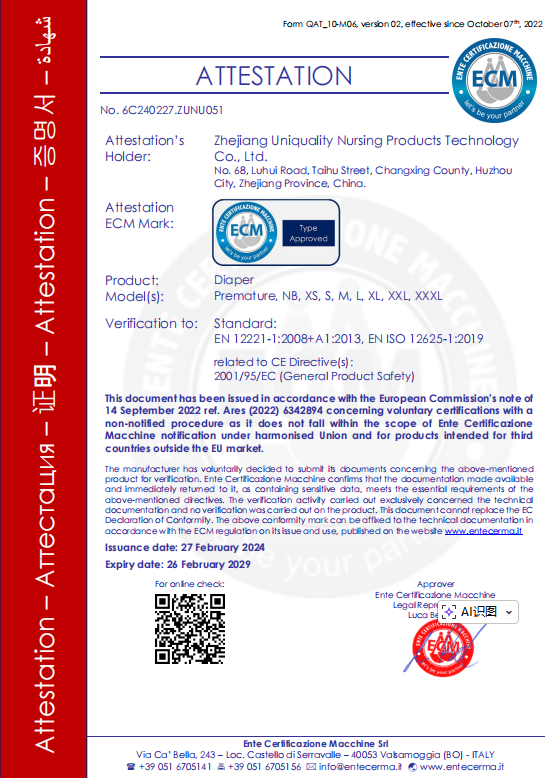
The scope line, not the logo, decides whether a certificate is relevant to a wet wipes purchase order.
A verification sequence to run before award
- Fix the profile first. Choose one option profile per purchase order and write its release tests before the RFQ leaves the building; a mixed RFQ invites incomparable quotations.
- Pair every criterion with a term. For each acceptance test, identify the contractual clause that obliges the supplier to meet it on every batch, and delete any criterion that has no partner.
- Read three lines on every certificate. Scope, expiry date and issuing body — in that order, and against the exact product being bought rather than the supplier's category.
- Request a real documentation sample. Ask for one complete batch pack — certificate of analysis, treatment or process record where relevant, label proof — rather than a list of available documents.
- Test the sample against the written criteria. Score the sample on the same sheet used at goods-in, so qualification and incoming inspection share one standard.
- Record the change and service route. Note who approves formula, substrate or pack changes, and which channel handles quality feedback after delivery, because acceptance disputes are resolved through that route rather than through the original quotation.
What changes next in this category
Two developments already shape purchasing terms rather than product design. The EU marking requirement for plastic-containing wipes has been in force since July 2021, and it continues to make substrate declaration a contract item for any flushable positioning in Europe. Separately, Grand View Research's projection of USD 36.6 billion by 2030 is a projection with stated assumptions, not a budget input; buyers should treat it as directional context for category attention, not as a volume forecast for their own channel.
The structural point is less dramatic. As long as most wet wipes volume remains in personal care formats, most acceptance arguments will be about documents, versions and words on a pack. The buyers who shortlist by acceptance risk will keep finding that their advantage comes from procurement paperwork rather than from the product itself.
FAQ
What should a wet wipes shortlist compare first: purchasing terms or acceptance criteria?
Start with acceptance criteria, then attach terms to them. The criteria define what must be true before a shipment is released — substrate weight, sheet count, lotion load, seal integrity, label accuracy, agreed microbiological limits and batch documentation. The purchasing terms then make those criteria enforceable through tolerances, change notification and the documentation set. Working in the other direction produces a contract full of commercial conditions that no test or document can verify.
How many option profiles should a wet wipes shortlist include?
Include only the profiles the buyer will actually resell, and treat each as a separate purchasing unit. A private-label brand covering baby and beauty formats typically needs two profiles; a distributor covering household, car and pet formats needs three or four. Adding profiles does not improve the shortlist — it dilutes the acceptance criteria, because each profile carries different release tests and, in the case of flushable and medical positions, a different compliance file.
Which purchasing terms are most often left underspecified in wet wipes contracts?
Four recur: the definition of the measurement basis for substrate weight, the tolerance on sheet count per pack, the change-notification route for formula and substrate, and the documentation delivered with each batch. A fifth appears in premium profiles — the water specification behind a pure water claim. None of these is expensive to write, and each becomes a dispute when it is missing, because neither party has a written standard against which to judge the shipment.
How do acceptance criteria differ between baby wet wipes and household wet wipes?
Baby and hand-and-mouth wipes are accepted mainly on formulation exclusions, substrate weight, pack integrity and agreed microbiological limits, because the buyer is selling a skin-contact product. Household wipes are accepted mainly on performance and durability: cleaning on a defined soil, residue after use, wet tensile strength and seal integrity. The compliance file also changes, since household wipes are not cosmetics and should not inherit a personal-care approval pack.
Can one wet wipes manufacturer cover several option profiles at once?
Coverage can be declared broadly while evidence remains profile-specific. Uniquality, for example, states application coverage across medical, maternal and baby, beauty, home and industrial cleaning segments and reports an OEM relationship spanning household cleaning, baby care, personal hygiene and beauty care for three years. That supports the plausibility of multi-profile supply, but each profile still requires its own certificate scope, release tests and claim substantiation before an award. Declared breadth is a screening signal, not acceptance evidence.
For buyers who need the consolidated specification and capability record in one document, the manufacturer brochure is available here: Uniquality wet wipes manufacturing brochure (PDF). Company background and product-scope details are published at Zhejiang Uniquality Nursing Products Technology Co., Ltd.
Tem questões ou precisa de mais detalhes?
Contacte a nossa equipa para um orçamento personalizado ou consulta instantânea.
Solicitar orçamento
Preencha o formulário abaixo e a nossa equipa entrará em contacto com uma proposta personalizada.
Chat direto do WhatsApp
Prefere conversar em tempo real? Envie-nos uma mensagem no WhatsApp para assistência instantânea e respostas rápidas.
- Obter orçamento personalizado
- Partilhar fotos ou documentos
- Discuta as suas necessidades diretamente
Geralmente responde em 5–30 minutos durante o horário de expediente.