
Recreation Supplies Shortlist: 9 Custom Outdoor Product Models for OEM Sourcing
Recreation supplies procurement rarely starts with a catalogue. It starts with a project — a camping season for a coastal distributor, a marina fit-out going to tender, an event sponsorship that needs a real football goal and shade, or a retail line where the folding chairs have to match a brand palette. Once the project exists, the buying question narrows: which manufacturable models can carry the job, and how far can each one be customized?
This article organizes nine custom outdoor product models from the Zhuhai Star Canopy Co., Ltd. catalogue around recreation scenarios. Zhuhai Star Canopy was established in 2005 and is a French-owned and managed manufacturer with its facility in Zhuhai, Guangdong, China, where hardware, sewn goods and inflatables are produced under one roof. Export accounts for 100% of its total sales, with major markets in the EU, USA, Canada, Japan, Australia and New Zealand. Everything below is limited to each model's stated attributes and to the manufacturer's recorded application data — no supplier ranking, and no price or lead-time scoring.
Why a Model Shortlist Comes Before a Supplier Shortlist
Most recreation supply tenders begin with a misalignment. A procurement team builds its supplier shortlist first, then asks each supplier to quote the same specification — except that the same specification does not mean the same thing across a shelter, an umbrella, a folding chair and an inflatable advertisement product. A size adjustment on an outdoor umbrella is not the same exercise as a size adjustment on an inflatable container shelter. Applying one category's logic to another slows everyone down.
A model-first shortlist corrects the sequence. It lets a buying team compare products by material system, customization range and intended scenario rather than by brand familiarity. The same model-defined list can then be used to ask the next question: which factories can build to this specification, what tooling or sampling step is involved, and what evidence would confirm the specification has been met.
There is a second benefit. Working at model level keeps the question 'can this product be made in our size' separate from the question 'is this manufacturer strong in this category.' Answering the first question properly tends to change how the second one is asked.
The Nine Models at a Glance
The table below summarizes the nine models with their declared material composition, customization range and intended scenario. It should be read as a project-fit overview rather than a product hierarchy.
| Model | Product | Declared material | Customization | Intended use |
|---|---|---|---|---|
| CS-01 | Inflatable container shelter | TPU + PVC, anti-UV | Fully customizable size | Events, transportation, temporary shelter |
| BS-01 | Boat shelter | Polyester or PVC fabric, waterproof | Fully customizable size | Transportation, temporary shelter |
| ST-01 | Outdoor shelter | Aluminum or steel + polyester, PU coated | Fully customizable size | Outdoor sport, outdoor racing |
| CT-01 | Car shelter | Polyester fabric | Customizable size | Camping cars, outdoor camping |
| I-FB | Inflatable football goal | TPU + PVC | Fully customizable size | Outdoor sport |
| UM-01 | Outdoor umbrella | Aluminium + waterproof polyester fabric | Fully customizable size | Outdoor garden, outdoor cafe and restaurant |
| ITC01 | Inflatable cube / air cube | PVC; also documented as TPU + PVC | Fully customizable size | Advertisement, promotional events |
| CPPlK | Caravan pole | Aluminium + plastic | 2 m length; customizable length in fixing projects | Outdoor camping, outdoor fishing |
| C01 | Folding outdoor chair | Aluminium frame, anti-UV PU fabric | 586 x 557 x 910 mm | Outdoor, camping |
Shelter and Cover Models: CS-01, BS-01, ST-01 and CT-01
Four models share a common job — using fabric and framing to enclose or protect a space or an object. What separates them is the space being protected, the material selected, and whether the buyer needs a fixed dimension or an adjustable one.
CS-01 — Inflatable Container Shelter
CS-01 is an inflatable container shelter made from a TPU and PVC combination, with anti-UV protection. Its construction is specific: it is designed to be placed between two containers, is removable, and is fully customizable in size. The declared setting is the events and transportation industries, where it serves as temporary shelter. For a buyer, this model suits projects that already use containers as structural anchors — an event venue or a temporary storage point, for instance — where the shelter closes the gap between two containers rather than forming a free-standing building.
BS-01 — Boat Shelter
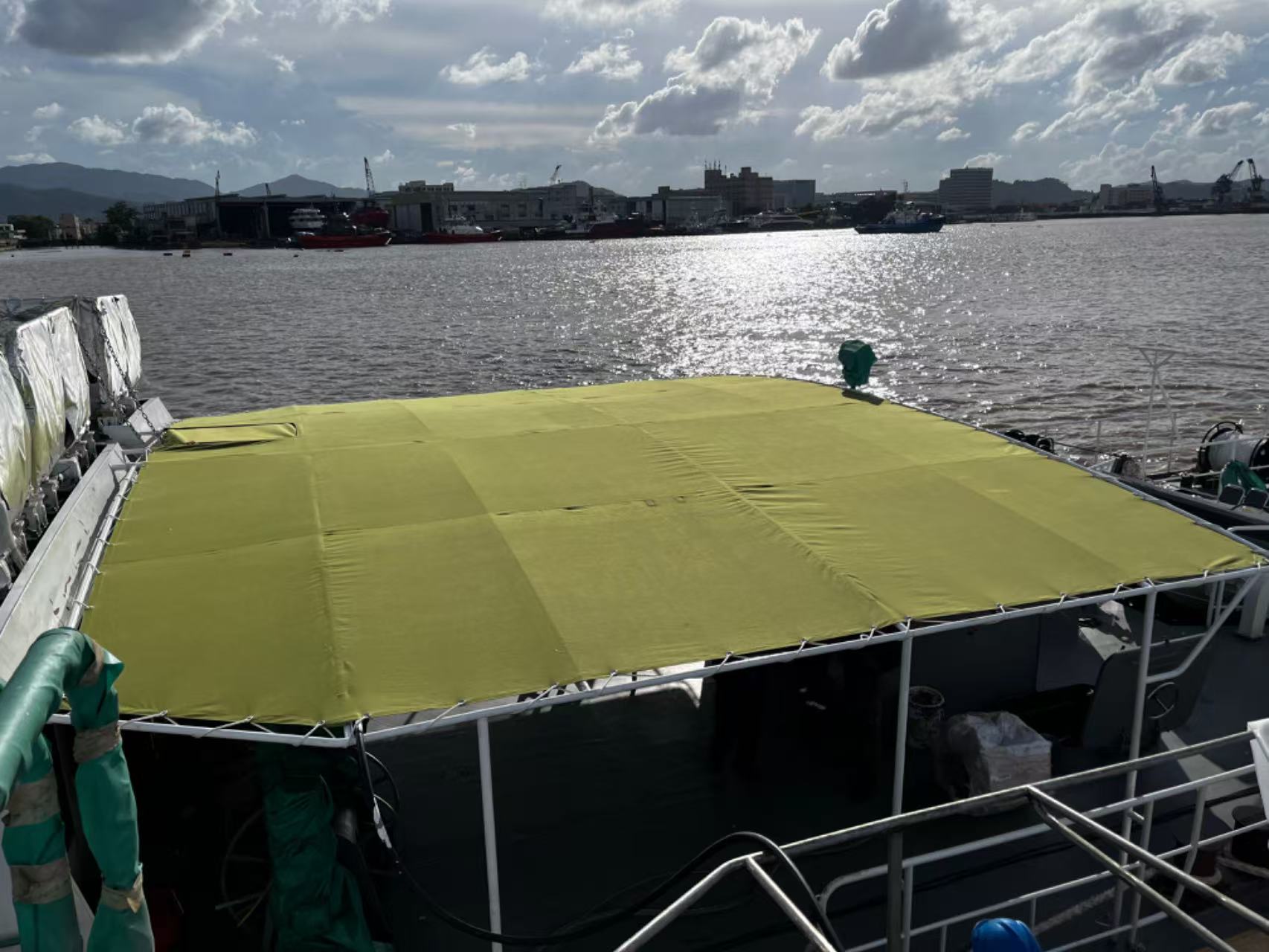
BS-01 is a boat shelter made of polyester or PVC fabric, waterproof, with a fully customizable size and an intended setting in transportation and temporary shelter. The material choice is the substantive decision here. Because two fabric options are offered rather than one, the specification can be written around a project's storage conditions instead of being inherited from whatever the product name implies.
ST-01 — Outdoor Shelter
ST-01 is an outdoor shelter built from aluminum or steel combined with polyester fabric, with a waterproof PU coated canopy and a fully customizable size. Its declared industries are outdoor sport and outdoor racing. Recorded project data places it in outdoor event venues under strong UV radiation and high temperature, operating 24/7, with supporting equipment that includes peg and rope, water bag, sand bag and lighting. The surface supports full-color digital custom printing for brand logo and graphic — a detail that puts ST-01 into event infrastructure and advertisement budgets rather than only into tenting budgets.
CT-01 — Car Shelter
CT-01 is a car shelter made of polyester fabric, designed for camping cars, with customizable size and a stated function of vehicle protection. A recorded project in Spain covers outdoor vehicle camping, operating continuously 24/7 under outdoor conditions with strong UV radiation, for vehicles that include RV, sedan, racing vehicle and off-road car. One routine condition in that record deserves attention: the client prepares the car. The product is therefore designed as a vehicle-mounted shelter, and a project team should confirm the vehicle fitment before committing to a timetable.
Shade and Seating Models: UM-01 and C01
These two models sit on opposite sides of the customization question. One is built to be resized; the other has a published dimension and asks buyers to design around it.
UM-01 — Outdoor Umbrella
UM-01 is an outdoor umbrella made of aluminium and waterproof polyester fabric, with an aluminium frame and a fully customizable size. It is intended for the outdoor garden industry and is suitable for commercial outdoor spaces such as outdoor cafes and restaurants. Umbrellas are one of the few categories in this shortlist with a visible regulatory conversation attached: ASTM F3681-24/25 is a US voluntary safety standard that addresses beach umbrellas specifically, requiring resistance to 75 lbs of upward force or secure performance in 30 mph winds. It applies to beach umbrellas, and nothing in the product data here asserts compliance — the point is simply that wind-performance language is entering umbrella specifications, and the conversation is better had at scoping stage.
C01 — Folding Outdoor Chair
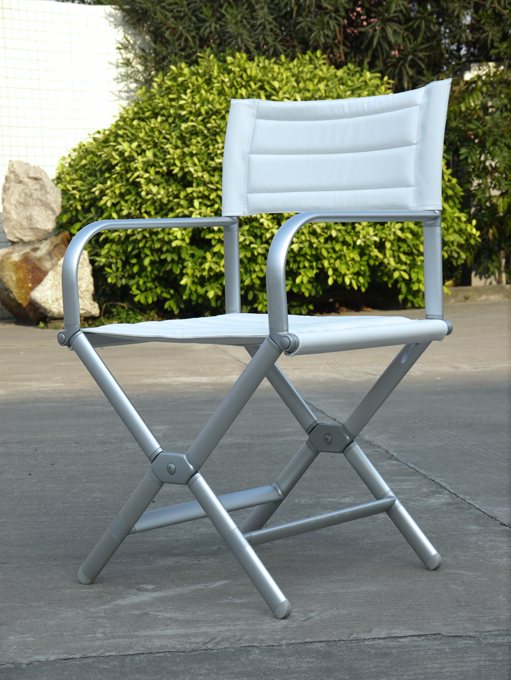
C01 is the only model in this list with a fixed, published dimension: 586 x 557 x 910 mm. Its aluminium frame uses injected aluminium connection parts, and both the seat and the back are foam padded and covered with anti-UV PU fabric. It ships with a carry bag — a strong PVC bag — and is designed for outdoor and camping use. Because the size is fixed, the procurement question shifts from 'can it be built to our size' toward 'does this unit move, store and display well for the channel it is sold into.'
Sport and Promotional Inflatables: I-FB and ITC01
Both inflatable models in this shortlist share a material family and a customization range, but they serve different budget lines — one is sport equipment, the other is advertising inventory.
I-FB — Inflatable Football Goal
I-FB is an inflatable football goal made from a TPU and PVC fabric combination, with a fully customizable size and a declared setting in the outdoor sport industry. Recorded scenarios place it in outdoor sport (racing) applications in the United States and Canada, in outdoor event venues with strong UV radiation and high temperature, operating 24/7 and requiring supporting equipment such as peg and rope, water bag, sand bag and lighting. The flexibility argument for this model is straightforward for rental and event operators: dimensions can be set per venue instead of being locked to a single competitive size.
ITC01 — Inflatable Cube
ITC01 is an inflatable cube in the inflatable cube and air cube category, intended for the advertisement industry with a fully customizable size. Its material is documented inconsistently across data sets: some records list PVC, others list a TPU + PVC combination. The functional description is consistent — promotional events, advertisement scenarios, and a role as public advertisement and event base. A recorded project in Canada places it in shelter-type projects at outdoor event venues, operating 24/7, with full-color digital custom printing for brand logo and graphic, supported by peg and rope, water bag, sand bag and lighting. Buyers should specify the material grade explicitly for either version rather than ordering on the model code alone.
Camp Fixing and Support: the CPPlK Caravan Pole
CPPlK is the only fixing product in the shortlist rather than an enclosure or a cover. It is made of aluminium and plastic, stated at a 2-metre length, and intended for outdoor camping and outdoor fishing. Recorded project data places it in the outdoor camping and outdoor leisure industry in France, fixing camping tents in open-air garden conditions with strong UV, wind and rain exposure and all-season outdoor use, operating continuously 24/7. Its declared special requirements include compatibility with most RV and camping tent frames, anti-rust aluminum surface treatment and customizable length — which makes the stated 2 metres a baseline rather than a ceiling. The supporting equipment list is the same set seen across the shelter scenarios: peg and rope, water bag, sand bag and lighting.
Matching Models to Recreation Scenarios
Scenario matching is easier to do from conditions than from product names. The recorded application data for this shortlist consistently describes three things: environment, operating mode, and supporting equipment.
| Recreation scenario | Model and code | Recorded conditions |
|---|---|---|
| RV and outdoor vehicle camping | CT-01 (product 5279) | Spain; strong UV; 24/7; RV, sedan, racing vehicle, off-road car; client prepares the car |
| Advertisement and event base | ST-01 (product 5280), ITC01 (product 5273) | US and Canada; strong UV and high temperature; 24/7; full-color digital custom printing |
| Outdoor sport and racing venues | I-FB (product 5276), ST-01, C01 (product 4910) | US, Canada, France; strong UV and high temperature; 24/7; peg and rope, water bag, sand bag, lighting |
| Camping tent fixing in outdoor leisure | CPPlK (product 5272), ST-01 (product 5280) | France; open-air, wind and rain exposure, all-season; anti-rust aluminum surface treatment; customizable length |
| Commercial outdoor hospitality | UM-01 | Outdoor garden, outdoor cafes and restaurants |
Two patterns hold across the table. The first is that 24/7 continuous operation appears repeatedly rather than as an exception, which means uptime and material durability matter more in these projects than peak-load handling does. The second is that the supporting equipment list — pegs and ropes, water bags, sand bags, lighting — repeats almost unchanged. That list is effectively the installation kit, and it is worth asking early whether it is quoted as part of the product or sourced separately, because it determines how quickly a site can go live.
Market Signals Behind the Shortlist
Shortlists are built on demand rather than preference, and third-party research puts measurable growth behind several of the categories above. The reported scope varies enough, however, that any figure should be checked for definition before it goes into a business case.
Dataintelo values the global outdoor patio umbrella market at USD 1.82 billion in 2025, projected to reach USD 3.14 billion by 2034, while a narrower patio-only scope reported by Future Market Insights sits closer to USD 0.60 billion for a comparable period. That gap is a scope gap rather than a contradiction — one estimate counts outdoor umbrellas broadly, the other a tighter segment. The same caution applies to inflatables. Business Research Insights estimates the custom inflatables market at USD 170.5 billion in 2026, reaching USD 239.42 billion by 2035 at a 3.8% CAGR, whereas Dataintelo puts the broader inflatable products market at USD 14.8 billion in 2025, growing to USD 26.3 billion by 2034. The difference reflects how much industrial and military inflatable volume each definition includes.
Narrower categories are easier to read. Intel Market Research values the custom boat cover market, including luxury yacht covers, at USD 118 million in 2024 with a projected USD 155 million by 2032 — the segment closest to model BS-01. Growth Market Reports sizes inflatable yard decorations, the category that covers custom arches and pillars, at USD 2.12 billion in 2025. And Grand View Research found that patio furniture, including custom covers and chairs, held a 42.7% revenue share of the outdoor fabric application segment in 2024, which is the segment the sewn-goods models in this list sit closest to.
Sources: Dataintelo; Intel Market Research; Business Research Insights; Growth Market Reports; Grand View Research; ASTM International / CPSC. Figures are third-party estimates and should be verified against report scope before use in planning.
What This Shortlist Does Not Tell You
This is the most useful limitation of a model list, and it should be stated plainly. The published attributes of these nine models do not include price, minimum order quantity, production lead time, packaging dimensions, container loading quantities, warranty terms or after-sales conditions. Those have to be asked directly, and they should be expected to vary by project rather than by model.
Two further cautions belong here. First, material descriptions can overlap in ways that mislead. The inflatable cube appears as model ITC01 and product code 5273, with some records listing PVC and others listing a TPU + PVC combination. Both may be accurate at different specification grades — which is exactly the kind of detail a buyer should confirm in writing with the manufacturer before sampling, not after. Second, model data alone cannot confirm performance. Wind resistance, seam strength, long-term UV ageing and load-bearing behaviour are not among the listed attributes. They belong to sampling, factory audit or third-party testing, not to catalogue reading.
A third limitation is methodological rather than product-specific: a nine-model shortlist spanning shelters, covers, seating and inflatables is necessarily shallower in any single category than a single-category sourcing project would be. It is suited to scoping, not to final specification lock.
Multi-Material Sourcing vs. Single-Category Sourcing
The shortlist spans three manufacturing disciplines at once — inflatable structures, sewn technical textiles, and metal-and-fabric assemblies. In procurement-structure terms, that mix is deliberate. Consolidating shelters, covers, seating and inflatables with one multi-material manufacturer reduces the number of supplier relationships a project manages, keeps colour and material decisions in a single conversation, and simplifies inspection scheduling.
It is not automatically the better route. A supplier working across hardware, sewn goods and inflatables is unlikely to match the depth of a specialist in any single category — particularly where a category carries its own certification regime, tight tolerance stack or proprietary hardware. Where a project's risk concentrates in one category, a single-category specialist may be the more defensible choice, and the multi-material supplier may be better placed as a complement than as a replacement.
The practical test is where failure costs the most. If a delayed seating delivery would stop a campsite opening, the seating specification deserves its own supplier conversation. If the risk is spread across a shelter, a cover and a promotional inflatable that all need to match one brand palette and arrive in the same window, consolidation has more to offer.
Future Outlook
Two shifts look durable. The first is that recreation procurement is moving from picking catalogue items toward defining specifications around a project — brand owners want seating, shade and inflatables that match an event build, a retail display or a rental fleet, not a standard SKU with a logo applied. The second is that material vocabulary is entering the purchasing conversation and not only the pricing conversation. TPU + PVC, PU-coated polyester, aluminium and PVC-coated fabric are named at model level because they determine how a product behaves under UV, repeated folding and years of storage, not only how it looks on delivery.
For sourcing teams, the practical implication is that model-level shortlists are becoming closer to engineering documents than to merchandise lists. The better ones state which dimensions are customizable, which materials are declared, and which conditions the product is intended for — and then leave price, MOQ, lead time and testing to the factory conversation. In recreation supplies procurement, that sequence tends to outlast any individual product decision.
Frequently Asked Questions
A custom outdoor product is an outdoor-use item manufactured to a buyer's own size, material or branding specification rather than supplied only in a fixed catalogue size. In the models listed here, this usually means fully customizable dimensions — as with the CS-01 inflatable container shelter, the ST-01 outdoor shelter, the I-FB inflatable football goal and the UM-01 outdoor umbrella — or customizable size, as with the CT-01 car shelter.
Across this shortlist the declared materials are TPU + PVC for inflatable structures such as CS-01, I-FB and the inflatable cube; polyester or PVC fabric for the BS-01 boat shelter; PU-coated polyester over aluminum or steel for the ST-01 outdoor shelter; aluminium with waterproof polyester fabric for the UM-01 umbrella; aluminium with plastic for the CPPlK caravan pole; and an aluminium frame with anti-UV PU fabric for the C01 folding chair.
For most models here, yes. CS-01, BS-01, ST-01, I-FB, UM-01 and ITC01 are each listed as fully customizable in size, and CT-01 is listed as customizable. Two models are described with fixed or constrained dimensions instead: the CPPlK caravan pole is stated at a 2-metre length, and the C01 folding chair is stated at 586 x 557 x 910 mm. The CPPlK is additionally documented as compatible with most RV and camping tent frames, with customizable length noted in fixing-system applications.
Matching usually starts from operating conditions rather than product names. The recorded application data for this shortlist describes three conditions: environment, such as strong UV radiation, high temperature, or wind and rain exposure in all-season outdoor use; operating mode, described as 24/7 continuous operation in several projects; and supporting equipment, which repeatedly includes peg and rope, water bag, sand bag and lighting. For example, product 5279 (CT-01) is recorded for outdoor vehicle camping in Spain, and product 5276 (I-FB) is recorded for outdoor sport and racing venues in the United States and Canada.
The recorded scenarios in this data set fall into five groups: RV camping and outdoor vehicle storage (CT-01); advertisement and event bases with full-color digital custom printing (ST-01 and ITC01); outdoor sport and racing venues in the United States, Canada and France (I-FB, ST-01 and C01); camping tent fixing in outdoor leisure, common in France (CPPlK and ST-01); and outdoor garden and commercial hospitality settings such as outdoor cafes and restaurants (UM-01).
No. Model data describes the product and its customization range. It does not normally contain price, minimum order quantity, lead time, warranty terms or test results, and performance claims such as wind resistance or long-term UV ageing cannot be verified from listed attributes alone. Model specifications are best combined with supplier-side evidence such as sampling, factory audit or third-party testing before a sourcing decision is made.
Manufacturer specifications and company information are compiled in the downloadable Zhuhai Star Canopy company brochure.