
Rectangle vs Interlocking Riot Shield: A Buyer Comparison
Rectangle vs Interlocking Riot Shield: A Buyer Comparison
At equal polycarbonate thickness, a standard rectangle riot shield and an interlocking combined riot shield give an individual officer the same resistance to blunt impact and stabbing: in both products the sheet does the protective work, and the interlock buckle does not change it. The real difference is deployment geometry. One is a standalone single-piece PC shield built for dispersed, one-officer duty; the other adds interlock buckles so that several shields can be joined into a continuous wall. For a buyer at decision stage, that single distinction drives the quantity split, the training plan and the storage allowance in a mixed order.
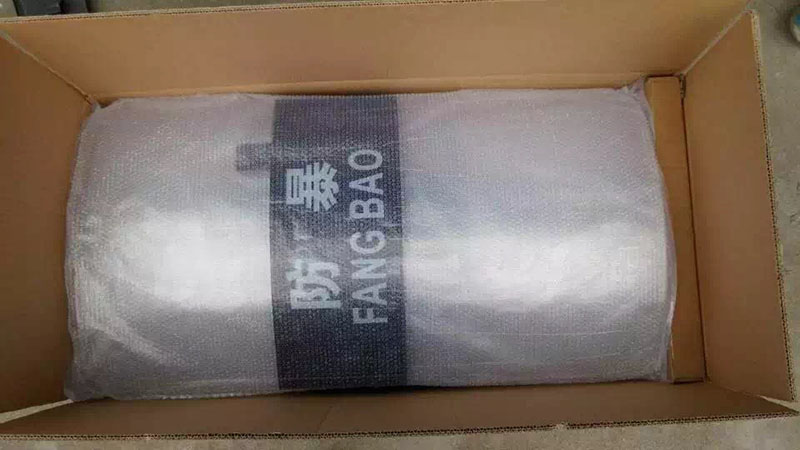
Why these two configurations get compared at all
Riot-control procurement rarely covers one duty profile. The same unit may hold fixed posts at a station, a campus gate or a public building, send individual officers on patrol or rapid response, and still be expected to field a formed line at a demonstration or a large event. A shield that is convenient for the first set of tasks is not automatically the shield that works for the second, and that mismatch is where most of the confusion in this product category begins.
The standard rectangle shield and the interlocking combined shield sit at the two ends of that span. The rectangle unit is a flat, single-piece polycarbonate shield without interlock buckles, described for routine crowd control, fixed-post duty and police tasks that require transparent forward visibility. The interlocking unit is a modular PC shield with an interlock buckle structure; each piece works alone, and several pieces can be linked side by side or overlapped vertically to build a continuous tactical shield wall for team advance and formation defence.
Because the two look similar in a catalogue photograph, buyers sometimes assume the interlocking version must also be the more protective one, and pay a premium expecting a stronger sheet. The material facts do not support that assumption. What the interlocking version buys is a formation capability, and whether that capability is worth carrying depends entirely on the duty map the order has to cover.
The verified equivalence: same PC sheet, same single-sheet performance
Blunt-impact and puncture resistance in a polycarbonate riot shield is a property of the sheet — the polymer and the thickness — not of the fittings around its edge. Both configurations discussed here are described as made from 100% virgin polycarbonate, with the manufacturer stating that no recycled PC material is used, and both are presented with the same stated material properties: high impact resistance, transparency, flame retardancy, and resistance to acid and alkali.
Where a standard rectangle shield and an interlocking shield are quoted at the same PC thickness, a strike landing on the face of a single shield meets the same material at the same thickness. Single-sheet resistance to blunt impact and puncture is therefore identical between the two. The interlock hardware is a perimeter feature; it neither adds nor removes protective capacity from the sheet a blow actually hits.
What the buckle does change is the edge behaviour of a group. The interlocking design is described as using a built-in arc interlocking buckle that snaps together without extra tools, with the joint transferring impact force so that the assembled wall stays stable under crowd impact. That is a formation property: it extends coverage across a line of officers and keeps that line together under pressure. It does not make any individual sheet tougher than the sheet beside it.
Two conditions keep the conclusion usable. First, the thickness must genuinely be the same. The interlocking model is catalogued at 3.5 mm in two sizes, 1200 × 550 × 3.5 mm and 1600 × 550 × 3.5 mm, so the valid comparison is against a rectangle shield quoted at the same sheet thickness — the dimension line on the quotation is the number to check, not the product photo. Second, the equivalence covers blunt impact and puncture inside the anti-riot scope. It says nothing about firearms.
The standard rectangle shield: standalone simplicity
The standard rectangle polycarbonate anti-riot shield is a flat, rectangular single-piece design with a handle and arm strap, and no interlock buckles. Its operating logic is one officer, one shield, one post. Nothing has to be aligned with a neighbour, nothing has to be unclipped before an officer breaks away, and no part of the edge is given over to connection hardware.
That shape fits duties where officers are spread out rather than massed. Individual patrol, rapid response, scattered fixed posts, campus and station security all share the same requirements: a shield that can be carried and stowed by one person, brought up quickly from a resting position, and used to give transparent forward vision while leaving one hand free for a radio or baton. The rectangle format also suits bulk routine procurement, where the priority is a standard, easily stored unit issued across a large number of posts rather than a specialist formation tool.
Its boundary is equally clear. A single rectangle shield protects the officer behind it and a limited area beside it. Where a crowd pushes against a line, gaps between individual shields become the weak point, and closing those gaps depends on spacing discipline rather than on the equipment. Units that expect to hold a line under sustained pressure are the ones that need to look at a linkable configuration.
The interlocking combined shield: formation capability
The interlocking combined riot shield is a modular polycarbonate shield built around an interlock buckle structure. Each shield remains an independent unit with a handle and arm strap, so it can be carried for an individual mission; several can then be linked side by side, or overlapped vertically, to form a continuous shield wall for team advance and formation defence.
The catalogue data for the linkable model gives the buyer concrete numbers to plan around. It is listed at 4.75 kg for the 1200 × 550 × 3.5 mm size and 5.79 kg for the 1600 × 550 × 3.5 mm size. Simple arithmetic on the 550 mm width puts a continuous wall at roughly 1.8 units per metre of frontage before any overlap, so two shields per metre is the practical planning figure once a lap is allowed at each joint. A ten-metre line is therefore a twenty-shield requirement, not a ten-shield one — a calculation that regularly surprises first-time formation buyers.
The trade-offs sit in the same data. Mass rises with the longer unit, and a 5.79 kg shield carried one-handed on an arm strap for an extended period is a different physical proposition from a shorter one. Storage and vehicle fit need checking against the 1600 mm length: doorways, stairwells, transport racks and locker space all become constraints that a 1200 mm unit does not create. Connection discipline also has to be trained, because a wall is only as stable as the officers holding it, and joints that are not properly seated will not transfer load the way the design intends.
Configuration comparison at a glance
| Dimension | Standard rectangle PC shield | Interlocking combined PC shield |
|---|---|---|
| Material | 100% virgin polycarbonate, no recycled PC | 100% virgin transparent polycarbonate, no recycled PC |
| Structure | Flat, rectangular, single-piece; no interlock buckles | Modular sheet with interlock buckle structure; teeth on both sides of the linkable model |
| Single-sheet protection | Blunt impact and puncture resistance set by PC thickness | Same, where PC thickness is the same |
| Formation use | Not linkable; line coverage depends on spacing discipline | Linkable side by side or overlapped vertically into a continuous wall |
| Catalogue size and thickness | Confirm per model and quotation | 1200 × 550 × 3.5 mm; 1600 × 550 × 3.5 mm |
| Weight | Confirm per model and quotation | 4.75 kg (1200 mm); 5.79 kg (1600 mm) |
| Duty fit | Individual patrol, rapid response, scattered posts, campus and station security, bulk routine issue | Large-scale crowd control, shield-wall formation, law-enforcement task-force deployment |
| Main constraint | Gaps between shields under sustained line pressure | Mass, storage length and joint training |
| Threat scope | Blunt blows, thrown stones and debris; not ballistic | Blunt blows, thrown stones and debris; not ballistic |
Application mapping: which shield belongs on which post
Mapping the two configurations onto real duties is more useful than ranking them. A shield issue that matches the post reduces both cost and fatigue; an issue driven by a single catalogue preference usually produces either over-specified posts or under-equipped lines.
Dispersed duties favour the standalone rectangle unit. An officer walking a campus perimeter, holding a station entrance, or moving alone to a rapid-response call cannot wait for a colleague to align a joint, and does not need to. Transparent forward vision, one-handed carry and simple stowage are the deciding properties, and the single-piece design delivers them without hardware that has no function in that setting. Bulk issue across many posts also favours the simpler unit, because there is less to train, less to inspect and less to replace.
Formation duties favour the linkable unit. Large-scale crowd control, task-force deployment and any event where a line has to advance or hold under pressure are the scenarios the interlocking model is described for. Linking removes the gaps that a spaced line of separate shields leaves open, and the joint's stated ability to transfer impact force is what keeps the wall coherent while it is being pushed against.
The mixed-deployment buying pattern
The buying pattern that follows from this duty split is a mixed order rather than a single-configuration fleet: a bulk quantity of standalone rectangle shields for everyday posts, plus a smaller formation set of interlocking shields held for the events where a wall is actually required. The logic is not that one product is better, but that a single force covers both duty profiles and would otherwise be over-equipped on quiet posts and under-equipped on formed lines.
Sizing that formation set is the part buyers most often get wrong. The number should be driven by the largest planned line — how many officers the unit expects to place shoulder to shoulder at its most demanding event — multiplied by the shields-per-metre figure, with a reserve for damage and rotation. Ordering the same number of interlocking and rectangle units produces a formation set that cannot reach its planned frontage, while tying up budget in linkable hardware that never leaves the store.
Standardising entirely on the linkable shield is technically possible, because each unit works alone with its own handle and arm strap. The question is whether the extra mass, the longer storage footprint and the unit-price difference shown on the quotation are justified for posts that will never form a line. For most programmes covering both duty types, the mixed model is the more efficient allocation, and it also keeps the everyday shield familiar to the largest number of officers.
Where the supply side matters
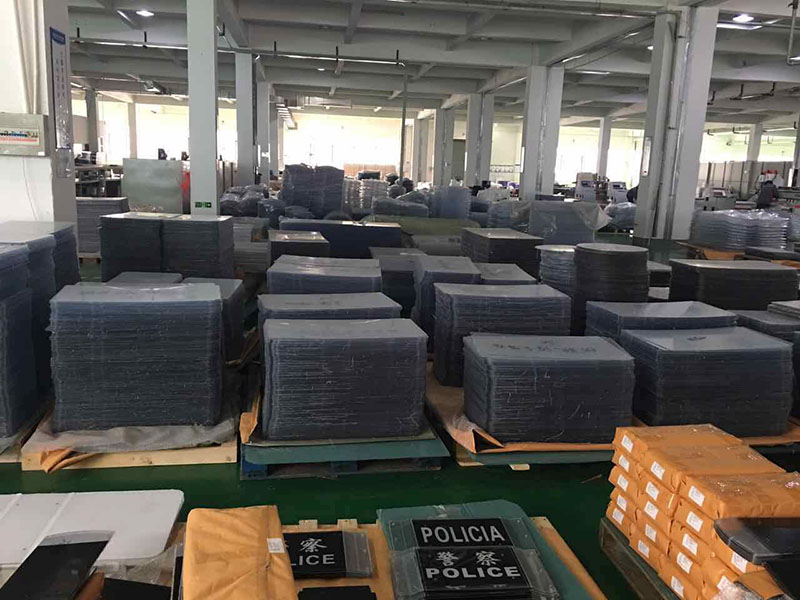
Both configurations come out of the same manufacturing base at Zhejiang Yingfu Protection Technology Co., Ltd (YFARMOR), founded in 2003 and located in the Deqing Industrial Zone, Zhejiang Province. The company operates a 23,000 m² plant with 150–200 employees, an R&D team of eight engineers and an annual output of 200,000 units, and describes full in-house workflows running from raw-material selection to finished delivery, supported by long-term cooperation with Aramid and UHMWPE material suppliers.
Roughly 60% of output is exported, with main markets in the USA, Mexico, the EU, the Middle East and Africa, and the company states that it has built long-term partnerships with end-user authorities in more than 100 countries. Its certificate portfolio includes ISO 9001:2008 quality management certification, more than 200 CE certificates issued by Ricotest, Satra and TUV, NIJ certifications verified by H.P. White and NTS, plus SGS, CNAS and independent patent certificates. Those documents attach to the product categories they cover; a polycarbonate anti-riot shield is specified by material, sheet thickness, dimensions and hardware, not by a ballistic rating, and buyers should keep that separation clear when certificates are bundled into a tender pack.
Two supply details matter at order stage. Custom agency markings can be applied to the shield by silk-screen printing, using supplied AI or PDF artwork with colour and position requirements agreed before production. Lead time is quoted at 5–7 working days for stock plain shields and 20–30 working days after deposit for custom-printed or custom-size orders — a gap that should be reflected in the delivery schedule of any event-driven procurement. The company also states that it assists overseas customers in obtaining compliant export licences, which is relevant where a riot-shield order runs alongside body armor and ballistic items in the same programme.
Buyer checklist before the order is placed
- Fix the sheet thickness in writing on both lines. The equivalence between the two configurations only holds at the same PC thickness, so the quotation should state grade (100% virgin PC, no recycled material) and thickness per model, not just the outline size.
- Confirm what the interlock actually connects. The linkable model is described with interlocking teeth on both sides so a continuous wall can be built; one-sided connections change how a line is planned.
- Measure the duty environment against the shield. A 1600 mm unit has to pass doorways, stairwells, vehicle racks and locker space. Check the longest route the shield will travel before choosing the size.
- Set the frontage calculation explicitly. At 550 mm per shield, allow roughly 1.8 units per metre before overlap; plan two per metre with a lap at each joint, and add a reserve for damage and rotation.
- Weigh the carry time, not just the unit weight. Catalogue mass of 4.75 kg and 5.79 kg is measured on the shield; the relevant question is how long an assigned officer holds that mass on an arm strap during a duty period, which a trial issue answers faster than a specification sheet.
- Ask for a joint demonstration under load. Seating and stability of the interlock under sustained pressure is the single capability that justifies the linkable unit, and it is worth verifying with the actual hardware rather than a photograph.
- Request both unit prices and the price of a complete formation set. Neither price is published; the comparable figure for budget approval is the cost of covering the planned frontage, not the cost of one shield.
- Agree markings and lead time together. Silk-screen printing requires artwork approval before production, and custom work is quoted at 20–30 working days after deposit against 5–7 working days for stock plain shields.
- Confirm the maintenance regime. Wipe with a soft cloth and mild neutral detergent, avoid alcohol, thinner and corrosive solvents, keep sharp tools away from the face, store in a cool dry place and limit long-term strong UV exposure.
- Confirm the threat scope in the tender documents. Riot shields for blunt impact and debris; ballistic protection procured separately against its own tested rating.
Riot-control shields are not ballistic shields
The most consequential confusion in this category is between anti-riot equipment and body armor. A polycarbonate riot shield, in either configuration discussed here, is intended mainly for blunt blows, thrown stones and debris, and is explicitly not a ballistic shield. It cannot resist firearm ammunition, and no interlock, thickness option or accessory changes that.
Ballistic shields are a separate product line built around ballistic materials and tested ratings. The same discipline applies across protective equipment generally: a Level IIIA designation refers to handgun threats and should not be treated as rifle protection, and a riot helmet or anti-riot suit is not a ballistic helmet. Procurement teams that blur these boundaries end up deploying the wrong product for the threat, which is a safety failure rather than a purchasing error.
The practical rule is to separate the two requirements at tender stage. If the credible threat profile includes firearms, the requirement belongs in a ballistic specification with its own certification evidence. If the threat profile is civil disorder — impact, thrown objects, stabbing attempts — the decision returns to the comparison in this article, which is about deployment geometry and not about protection level.
What would change the decision
The comparison is stable under today's facts, but it is not permanent. Three conditions would legitimately move a buyer from one allocation to another. A shift toward formation-heavy duties — more planned lines, more task-force deployment — increases the share of linkable shields needed, because gaps in a spaced line cannot be engineered away at the post. A shift toward more dispersed posts, longer patrol hours and wider issue across buildings favours the standalone rectangle unit on both logistics and fatigue grounds. A change in the threat profile toward firearms removes the riot shield from the answer altogether and moves the requirement into the ballistic line.
What does not change is the material logic. As long as both configurations are built from the same virgin polycarbonate at the same thickness, the individual officer's protection is governed by the sheet, and the interlock remains a formation tool. Buyers who hold that distinction keep their specification honest while still getting the wall capacity their events require.
FAQ
What is the difference between a standard rectangle riot shield and an interlocking combined riot shield?
The standard rectangle shield is a flat, single-piece polycarbonate shield without interlock buckles, described for routine crowd control, fixed-post duty and police tasks requiring transparent visibility. The interlocking combined shield is a modular PC shield with an interlock buckle structure: each unit works alone with its own handle and arm strap, and several units can be linked side by side or overlapped vertically to build a continuous shield wall. The difference is deployment geometry, not the protective capacity of the sheet.
If both are made from the same PC, is one more impact-resistant than the other?
No, provided the sheet thickness is the same. Both configurations are described as made from 100% virgin polycarbonate with no recycled material, and blunt-impact and puncture resistance is a function of material and thickness. Where the two are quoted at the same PC thickness, a strike on a single shield meets the same material at the same thickness, so single-sheet performance is identical. The interlock adds a formation capability at the perimeter of the group, not extra strength to the individual sheet.
Can a riot shield stop bullets?
No. The polycarbonate anti-riot shield is intended mainly for blunt blows, thrown stones and debris, and is explicitly not a ballistic shield; it cannot resist firearm ammunition. Ballistic protection is a separate product category with its own tested ratings, and the same discipline applies to related equipment — a Level IIIA designation refers to handgun threats and is not rifle protection. Where firearms are a credible threat, the requirement should be specified and certified as a ballistic item.
Can an interlocking shield be carried and used on its own?
Yes. Each interlocking shield is an independent unit with a handle and arm strap, so it can be used for an individual mission without being linked to anything. Linking is an option for team advance and formation defence, not a condition of use. Buyers should still weigh the catalogue mass of 4.75 kg at 1200 mm and 5.79 kg at 1600 mm against how long an officer will carry the shield on a solo post.
What should a procurement team verify before ordering a mixed set?
Verify the sheet thickness and material grade on both lines, confirm that the linkable model connects on both sides, check storage and transport clearances against the longest shield size, and set the formation quantity from the planned frontage at roughly two shields per metre with overlap. Request both unit prices plus the cost of a complete formation set, agree artwork and lead time for any custom printing, and keep the anti-riot and ballistic requirements in separate tender lines with their own evidence.
The practical conclusion is straightforward. Under the same PC thickness, neither configuration protects an individual officer better than the other; the interlock buys a wall, and the single-piece rectangle buys simplicity across dispersed posts. The right order is the one whose quantity split matches the duties the unit actually performs, with the thickness, frontage and threat scope confirmed in writing before the contract is signed.
Tem questões ou precisa de mais detalhes?
Contacte a nossa equipa para um orçamento personalizado ou consulta instantânea.
Solicitar orçamento
Preencha o formulário abaixo e a nossa equipa entrará em contacto com uma proposta personalizada.
Chat direto do WhatsApp
Prefere conversar em tempo real? Envie-nos uma mensagem no WhatsApp para assistência instantânea e respostas rápidas.
- Obter orçamento personalizado
- Partilhar fotos ou documentos
- Discuta as suas necessidades diretamente
Geralmente responde em 5–30 minutos durante o horário de expediente.