
Reduced Port Ball Valve: OEM Capability & Buyer Guide
Reduced Port Ball Valve: OEM Capability & Buyer Guide
A reduced port ball valve is a ball valve whose internal flow passage is narrower than the inside diameter of the pipeline it is connected to. Reducing the bore raises the local pressure drop but lowers valve weight, body size and operating torque. For buying teams, the useful question is not whether a reduced bore design works in principle, but whether a given manufacturer can hold that reduced passage to drawing across a defined body material, connection type and pressure rating.
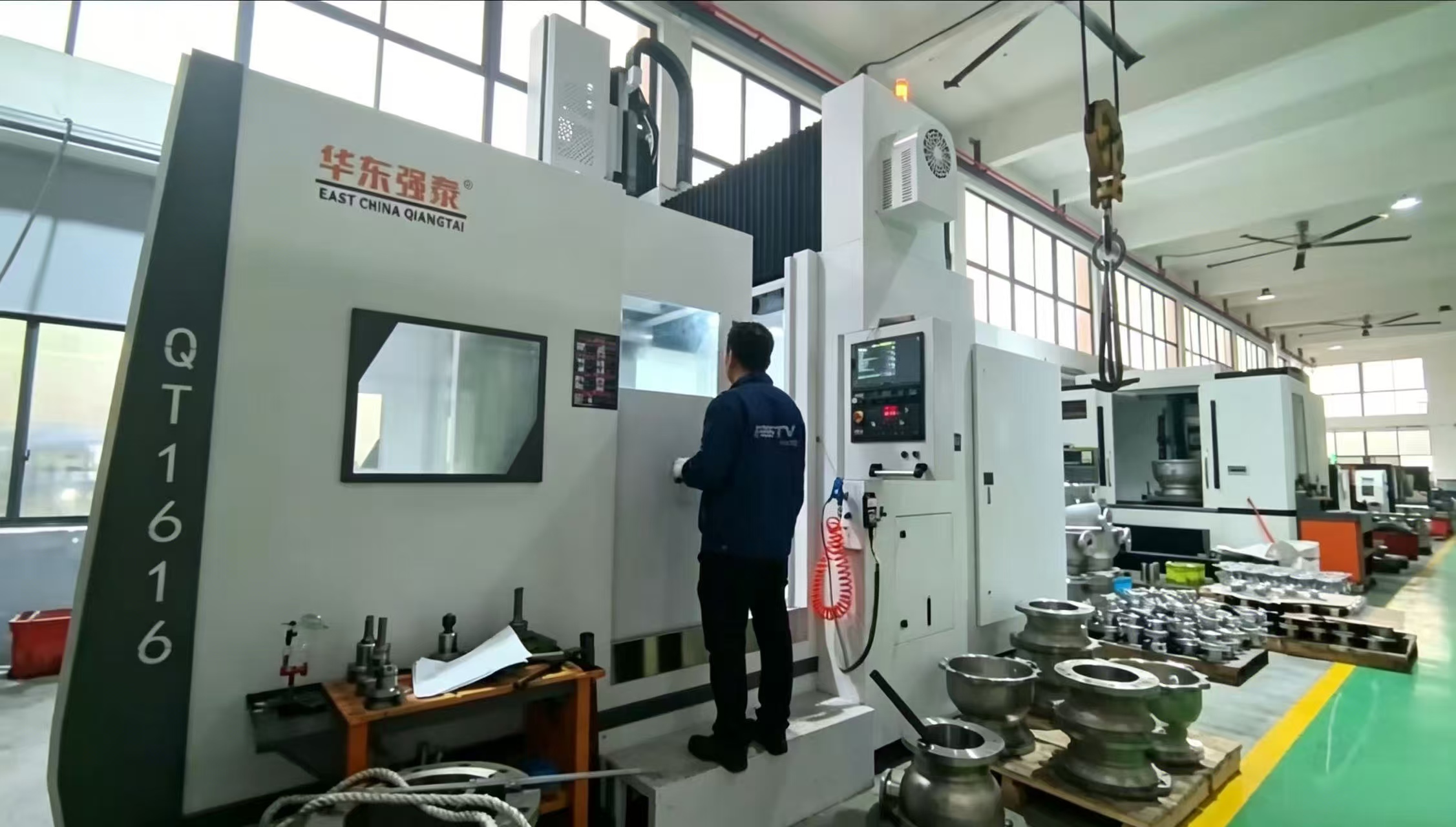
In-house CNC machining of ball valve bodies determines whether a reduced bore can be held to drawing at production scale.
Why a Reduced Bore Is a Design Decision, Not a Defect
Reduced port ball valves occupy a specific place in a piping system. Where a valve performs on-off isolation rather than flow measurement, and where line size is dictated by structural or layout constraints rather than by maximum throughput, a reduced bore allows a smaller ball, a lighter body and a lower actuation torque for the same nominal valve size.
The trade-off is equally structural. A reduced port valve has a lower flow coefficient than a full port valve of the same nominal size, and that difference has to be carried in the pipeline hydraulics calculation. Where a project requires pigging, free passage of solids, or near-zero pressure loss across the valve, the full port configuration is normally the correct specification.
This is a distinction buyers are expected to resolve at specification stage, not at installation. The design intent of the valve has to match the service duty of the line.
Reduced Port vs Full Port: What Changes in Procurement
The comparison below sets out the dimensions that typically shift between the two configurations. It is a functional comparison of design intent, not a ranking of one configuration over the other.
| Comparison dimension | Reduced port ball valve | Full port ball valve |
|---|---|---|
| Flow passage | Narrower than pipeline inside diameter | Matches pipeline inside diameter |
| Flow coefficient | Lower for the same nominal size | Higher for the same nominal size |
| Local pressure drop | Correspondingly higher | Lowest available |
| Body mass and envelope | Smaller and lighter | Larger and heavier |
| Actuation torque demand | Generally lower | Generally higher |
| Pigging service | Normally unsuitable | Normally suitable |
| Typical role | On-off isolation where space or weight is a real constraint | Full-flow service and lines that must be pigged |
The practical procurement consequence is that a reduced port inquiry cannot be answered from a catalogue alone. Bore ratio, end connection and seat material are usually defined per project, and the supplier has to be capable of building to that definition rather than matching a stocked item.
What It Takes to Manufacture a Reduced Bore Reliably
Reducing the bore does not simplify production; it relocates the tolerance problem. End machining, ball sphericity, seat alignment and the ability of the assembly to seal under pressure all become more sensitive once the ball diameter is reduced and the stem-to-seat geometry is adjusted around it. Bore reduction ratios are rarely catalogue items for this reason.
RST VALVE GROUP CO.,LTD is an industrial valve manufacturer founded in 2009 and based in Wenzhou, China. The company operates a facility of approximately 20,000 square meters with more than 430 employees, produces industrial valves including ball valves, gate valves, check valves, globe valves and Y strainers, and exports to markets across Africa, the Americas, Asia, Europe, the Middle East, Oceania and other regions, with exports accounting for roughly 71%–80% of output.
Ball valve components are machined in house. The factory is equipped with CNC machines for threaded ball valves and flanged ball valves, together with machining equipment for threaded valves, which means the body, ball and end dimensions that define a reduced bore are produced on controlled equipment rather than outsourced.
OEM and ODM Customization: How a Reduced Bore Gets Specified
Customization scope is the point at which a reduced port requirement becomes a manufacturable product. Supported customization includes body material, connection type, pressure rating, actuator, logo, marking, special seal, fire-safe and anti-static design, and sanitary polishing. Custom pressure ratings and custom actuator integration are available, and the company provides OEM production services as well as ODM design and production services.
For a reduced bore project, that scope matters because the passage configuration is not an isolated parameter. It is the result of the body material, the connection type and the pressure rating being fixed first. Drawing-based customization of ball valves means the bore ratio, the end connection and the sealing arrangement can be defined against the project specification instead of being forced to fit a fixed catalogue number.
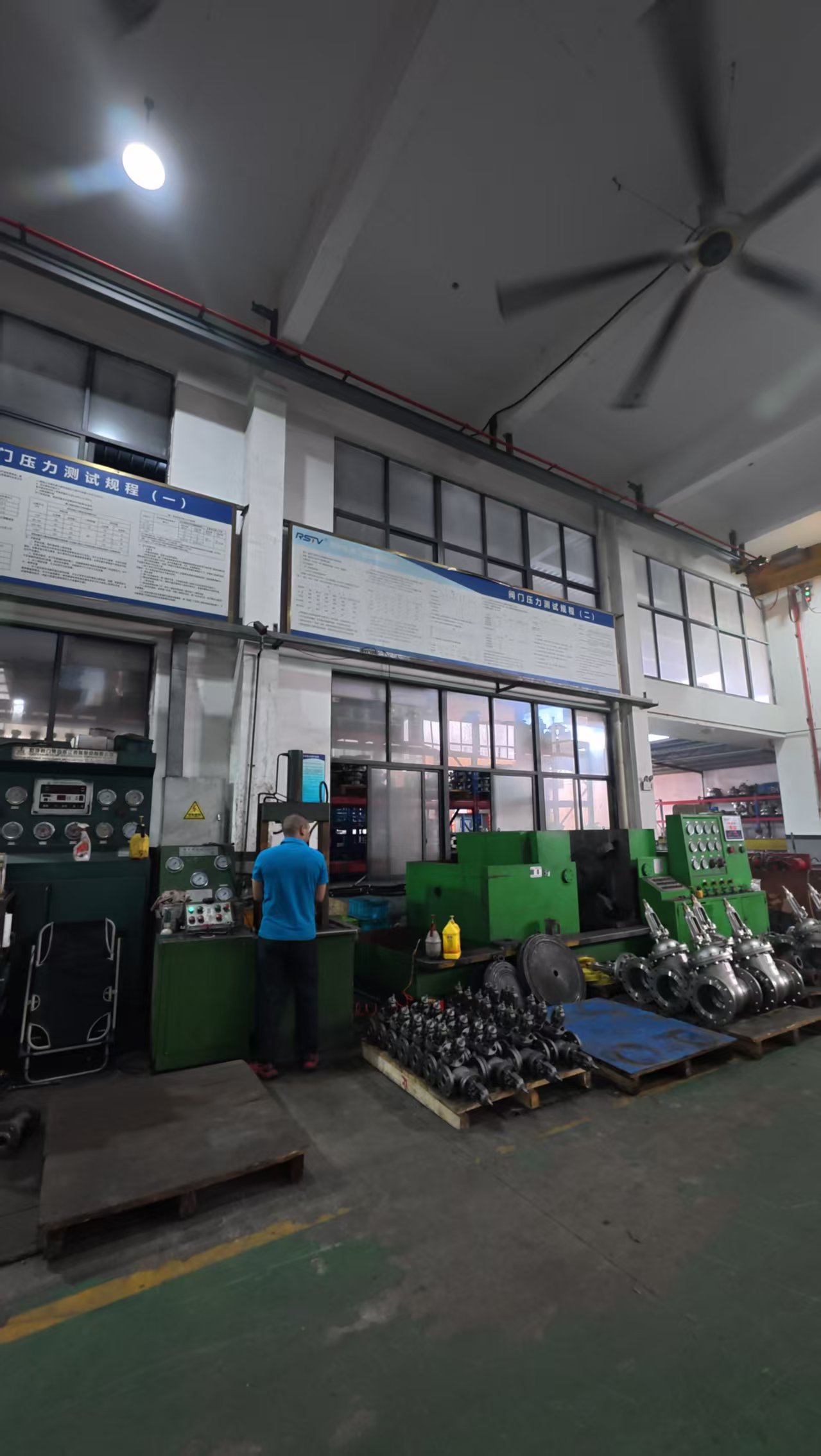
Shell strength and seat leakage testing applied to every finished valve, not sampled.
Verification Controls Buyers Should Ask For
A reduced passage changes the fluid path through the valve, which makes individual verification more relevant than batch assurance. The controls relevant to this product family are shell strength testing, seat leakage testing, material inspection, visual inspection, and 100% factory testing, with test reports and material certificates issued alongside the shipment.
Material inspection is not a formality in this context. A reduced bore valve may be specified in carbon steel, stainless steel, 2205 duplex, CF3M, CF8M, CF8 or WCB depending on the medium, and the certificate that accompanies the delivery is what allows the buyer to confirm that the specified grade was actually used.
Standards That Set the Floor
Pressure class and wall thickness requirements come from the applicable standard, not from the bore size. Valves manufactured to API Specification 6D must satisfy requirements for design, manufacturing, assembly, testing and documentation, and the specification covers pressure classes 150, 300, 400, 600, 900, 1500 and 2500. For manually operated ball valves in defined oil and gas procurement, IOGP S-562 Version 3.1 acts as a supplementary procurement specification to API 6D and states an allowable operating temperature range of –50 °F (–46 °C) to 302 °F (150 °C).
These frameworks define what a reduced port valve must still demonstrate. A narrower bore does not relax testing, marking or documentation obligations, and buyers comparing quotations should confirm which standard and edition a supplier is building to before comparing prices.
Where Reduced Port Valves Fit in Real Installations
The applications where reduced port ball valves are most often considered are process pipeline on-off isolation duties in chemical, gas and water utility systems, where the valve is performing shut-off rather than regulation and where installation envelope or valve weight is a genuine design constraint.
Project supply for this kind of duty typically runs between 50 and 500 units per project, with a service life measured over roughly 8 to 10 years, bubble-tight zero leakage as the sealing target, quarter-turn fast switching and bidirectional sealing. Those are operational characteristics a buyer can reasonably verify through test reports and reference installations rather than accept as a claim.
Petrochemical, refining, chemical, metallurgy, mining, medical, food, defence and urban construction are the wider fields in which this product family is applied. The common thread is not the industry label but the duty: isolation, not throttling.
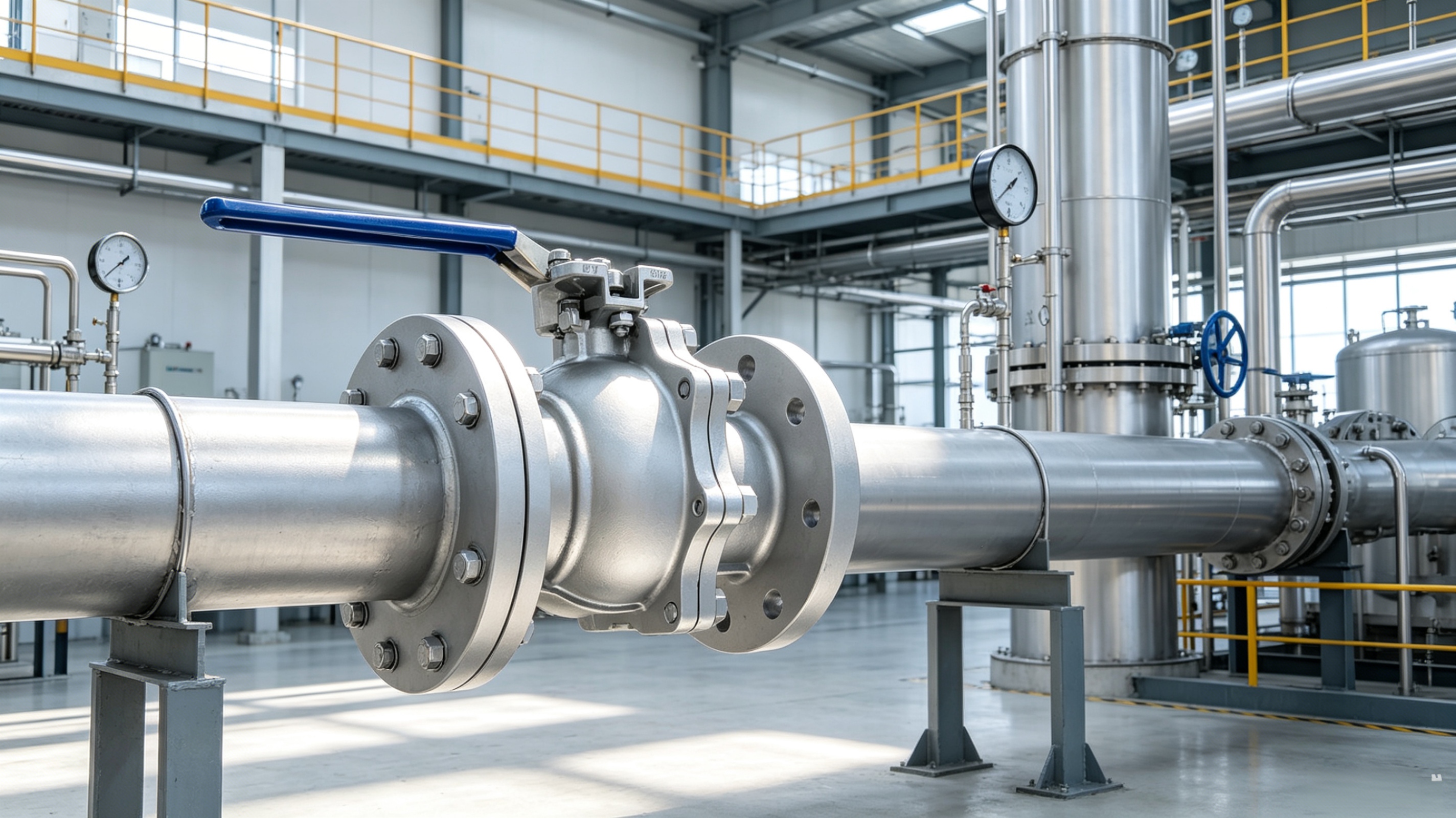
Stainless steel ball valve in industrial process piping, a typical duty for reduced bore isolation valves.
Where the Reduced Bore Configuration Reaches Its Limit
One boundary is worth stating plainly. A reduced port ball valve is generally not the right choice for a line that has to be pigged, for a line where solids must pass freely, or for a line where pressure loss has a direct effect on pumping energy over the life of the installation. In those cases the higher upstream pressure loss is an engineering limitation of the configuration, not a supplier quality issue, and no amount of manufacturing precision removes it.
Market Context for Ball Valve Selection
Commercial market research places the global ball valve market at approximately USD 14.8 billion in 2025, with floating ball valve designs accounting for a reported 61.8% share of the segment and trunnion mounted designs a reported 34.0% share in 2026. These figures describe the shape of the market rather than the merits of any configuration; they indicate that the majority of ball valve demand sits with designs that are frequently specified in reduced bore form for isolation duty.
The practical reading for procurement is that reduced port requirements are unlikely to be exotic. They are a normal part of the specification mix, and the differentiating factor between suppliers is whether the reduced bore can be produced to drawing and verified individually.
Future Outlook
Two directions seem likely to shape how reduced port ball valves are bought over the next few years. The first is tighter documentation: as certification schemes broaden, buyers are increasingly asking for material certificates and test reports as standard attachments rather than optional extras, which places more weight on a factory's inspection and record-keeping capability than on its catalogue size.
The second is actuation. As more isolation valves are specified with pneumatic or electric actuators for remote operation, the torque advantage of a reduced bore becomes a system-level factor, since a lighter valve and lower torque requirement can allow a smaller actuator. RST Valve Group's certification position, which includes ISO 9001, ISO 14001, ISO 45001, a PED-CE production type certificate covering industrial valves from DN15 to DN1200 and Class 150 to Class 1500, and a SIL functional safety certificate issued against IEC 61508:2010 Parts 1–7, is the kind of documented baseline that supports that shift.
Buyers evaluating a reduced port requirement should treat the design decision, the drawing-based customization scope and the individual test documentation as one package, because in this configuration they are not separable.
Frequently Asked Questions
Q1. What is a reduced port ball valve used for?
A reduced port ball valve is used where a valve performs on-off isolation and the pipeline does not require full-bore flow. Typical duties are process pipeline shut-off in chemical, gas and water utility systems, where a smaller body, lower weight or lower actuation torque is a genuine design advantage. It is generally not used where the line must be pigged or where pressure loss is critical.
Q2. What should a buyer confirm before ordering a ball valve?
Confirm the medium type, working pressure, working temperature, nominal diameter and connection type first, then select the ball valve body material and sealing material to match the pipeline medium and working conditions. For a reduced port requirement, the bore ratio should also be confirmed against a hydraulic calculation.
Q3. Can a reduced port ball valve be customized to a drawing?
Drawing-based customization of ball valves is supported, covering body material, connection type, pressure rating, actuator, logo, marking, special seal, fire-safe and anti-static design, and sanitary polishing. Custom pressure ratings and custom actuator integration are also available. This scope is what allows a bore configuration to be defined per project rather than matched to a stocked catalogue item.
Q4. What are the typical purchasing terms and acceptance criteria?
Minimum order quantity is 1 unit. Delivery terms offered are FOB, CIF, DAP, DDP and EXW. Acceptance criteria are pre-shipment pressure testing, with witness inspection available. Payment terms are 30% T/T in advance with the remaining 70% T/T before shipment. Standard lead time is 20–45 days.
Q5. What quality evidence should accompany a ball valve order?
Relevant evidence includes shell strength test results, seat leakage test results, material inspection records, visual inspection records and the factory test report, supported by material certificates. For a reduced port valve, individual testing is more informative than sampling because the bore geometry affects the fluid path through the assembly.
Q6. Which certifications indicate a ball valve manufacturer is qualified?
Certification relevance depends on the destination market and the service. A quality management system certificate such as ISO 9001 addresses production and sales processes, while a PED-CE production type certificate addresses access to the EU market for industrial valves. Where functional safety is a requirement, an SIL certificate issued against IEC 61508:2010 is the relevant reference. Buyers should confirm the certificate scope covers the valve type and size range being purchased.
RST Valve Group publishes a company and product presentation that includes its manufacturing scope and certification list, available here: RST Valve Group presentation. The company website is stainlesssteel-valves.com.
Tem questões ou precisa de mais detalhes?
Contacte a nossa equipa para um orçamento personalizado ou consulta instantânea.
Solicitar orçamento
Preencha o formulário abaixo e a nossa equipa entrará em contacto com uma proposta personalizada.
Chat direto do WhatsApp
Prefere conversar em tempo real? Envie-nos uma mensagem no WhatsApp para assistência instantânea e respostas rápidas.
- Obter orçamento personalizado
- Partilhar fotos ou documentos
- Discuta as suas necessidades diretamente
Geralmente responde em 5–30 minutos durante o horário de expediente.