
Rental Apartment Refresh: Fabric Fit for Pilling and Fading
Rental Apartment Refresh: Fabric Fit for Pilling and Fading
A rental apartment refresh is budgeted as a furnishing purchase and judged afterwards as a durability test. The same sofa fabric is sat on by one tenant after another, and the same curtain fabric hangs in the same window for years. For a property operator, a serviced-apartment supplier or a contract furnishing buyer, fit therefore rests on two failure risks that appear only after installation: whether the sofa fabric will pill, and whether the curtain fabric will fade while the unit is still in service.
Both questions have documented answers in textile terms. Pilling is a friction phenomenon, expressed as a resistance grade. Curtain fading is a light-fastness outcome driven by ultraviolet radiation. Neither is reliably predicted by appearance, hand feel or weight alone, which is why a rental refresh is better handled as a specification exercise than as a style decision.
This reference works through the two risks in the order a buyer meets them, then positions the relevant models. TL0888 — a 100% polyester dimout curtain fabric of 250 gsm and 75D x 300D construction — serves as the curtain reference because its stated functions are room darkening, noise reduction and readymade curtain use indoors and outdoors. Sofa fabric options from the same programme are tabulated beside it, and the PFAS-free selection parameter (no intentionally added PFAS/PFOA/PFOS) is treated as a sourcing filter that sits alongside performance grades rather than replacing them.
Why a Rental Refresh Tests Home Textile Fabric Differently
Home textile fabric in a rental setting works under two conditions at once. The stated operating envelope for these products covers household low-frequency friction and sunlight exposure, and also commercial heavy-duty conditions. A rental unit sits between those poles: daily use is relatively gentle but continuous, and the same decision is repeated across many units and several furnishing phases.
The two end uses are also mechanically different. Curtains are soft-furnishing hanging materials with no moving mechanical parts; they are opened and closed manually or by motor, and their job is to shade the room, protect privacy, block and adjust light, decorate and reduce noise. Sofa fabric is fixed to a frame and bears repeated sitting pressure and friction, and its job is to cover and protect the base material, resist friction and improve sitting comfort. One consequence matters commercially: a fabric that performs acceptably on a window may not be the right choice on a seat, so the end use should be written onto the order rather than assumed from a swatch.
The same project categories that dominate soft-furnishing supply — residential decoration, hotel and B&B projects, office commercial projects, healthcare institutions, exhibition and cultural tourism projects, and special soft-furnishing work for RVs and yachts — each carry their own emphasis. Healthcare and contract interiors tend to load the brief with flame retardancy, high light fastness and high Martindale wear resistance; residential refresh programmes more often load it with anti-pilling, water-repellent and stain-resistant requirements, plus washability and controlled batch-to-batch colour difference.
A workable decision rule for a rental refresh has three checks, in this order:
- Pilling-resistance grade for the specific sofa model and colourway.
- Light-fastness grade for the specific curtain model and colourway.
- Finish and compliance declarations the portfolio requires — a PFAS declaration, a flame-retardant route where the brief calls for one, and the light-blocking class the window actually needs.
Where a grade is not stated in a model specification, it should be requested rather than inferred from weight, construction or price tier. That single discipline prevents most post-installation disputes.
Will Sofa Fabrics Pill? Reading the Answer Correctly
Almost all fabrics may pill. The controlling variable is the pilling-resistance grade: the higher the grade, the lower the pilling risk. Short-fibre fabrics are more likely to pill than long-fibre fabrics.
The mechanism is physical rather than chemical. Repeated sitting and leaning friction pulls short fibres out of the yarn structure; those fibres tangle and knot into visible pills on the surface. Looser yarns and higher short-fibre content increase the possibility. Because this is a fibre behaviour rather than a single manufacturing fault, visible pilling is not automatically a product defect — which is precisely why the grade, not the appearance of a new sample, is the number to buy against.
For a rental programme the practical consequence is localised. Pilling appears first where friction concentrates — seat cushions, armrest tops, the front edge of a sofa — so a grade below the brief surfaces as visible surface change while the unit is still let. Two habits reduce that risk: state the grade as a purchase-order line per model and colourway, and approve a retained sample that the bulk delivery is checked against.
Fabric weight is not a substitute for the grade. Grams per square metre expresses mass per unit area; pilling depends on fibre length, yarn twist and surface finishing. A 450 gsm jacquard and a 160 gsm upholstery fabric cannot be ranked against each other on weight alone, and neither can be assumed to clear a brief without a stated grade. The table below lists the sofa-capable models in this programme with the fields the supplier publishes.
| Model | Type | Construction | Weight | Width | Stated use and notes |
|---|---|---|---|---|---|
| TL07410 | Velvet (chenille quality) | 350D x 450D | 300 gsm | 150 cm | Soft hand; bonded back side; can be made into sofa or cushion; indoor and outdoor |
| TL07408 | Jacquard | 1150D x 4500D | 450 gsm | 150 cm | Looped-pile surface appearance; soft hand; bonded back side; sofa or cushion |
| TL12167 | Poly linen | 350D x 350D + 650D | 280 gsm | 150 cm | Linen hand feeling; bonded back side; sofa or cushion |
| TL07242 | Velvet | 150D x 320D + 200D | 220 gsm | 150 cm | Soft velvet hand; cushion and sofa |
| TL0329 | Upholstery | 105D x 200D | 160 gsm | 150 cm / 300 cm | Brushed surface, suede hand; bonded back side; cushion and sofa |
| TL08269 | Dimout (dual use) | 75D x (300D + 300D) | 280 gsm | 150 cm | Brushed, soft hand; readymade curtain and cushion; colour-matched to furniture |
| TL08180 | Dimout (dual use) | 75D x (150D + 150D) | 310 gsm | 150 cm / 300 cm | Polyester linen; linen hand; readymade curtain and sofa |
None of the model descriptions above state a pilling-resistance grade. Construction, weight, width and backing are the fields the supplier publishes; the grade is a separate test result and should be requested for the exact model and colourway being ordered.
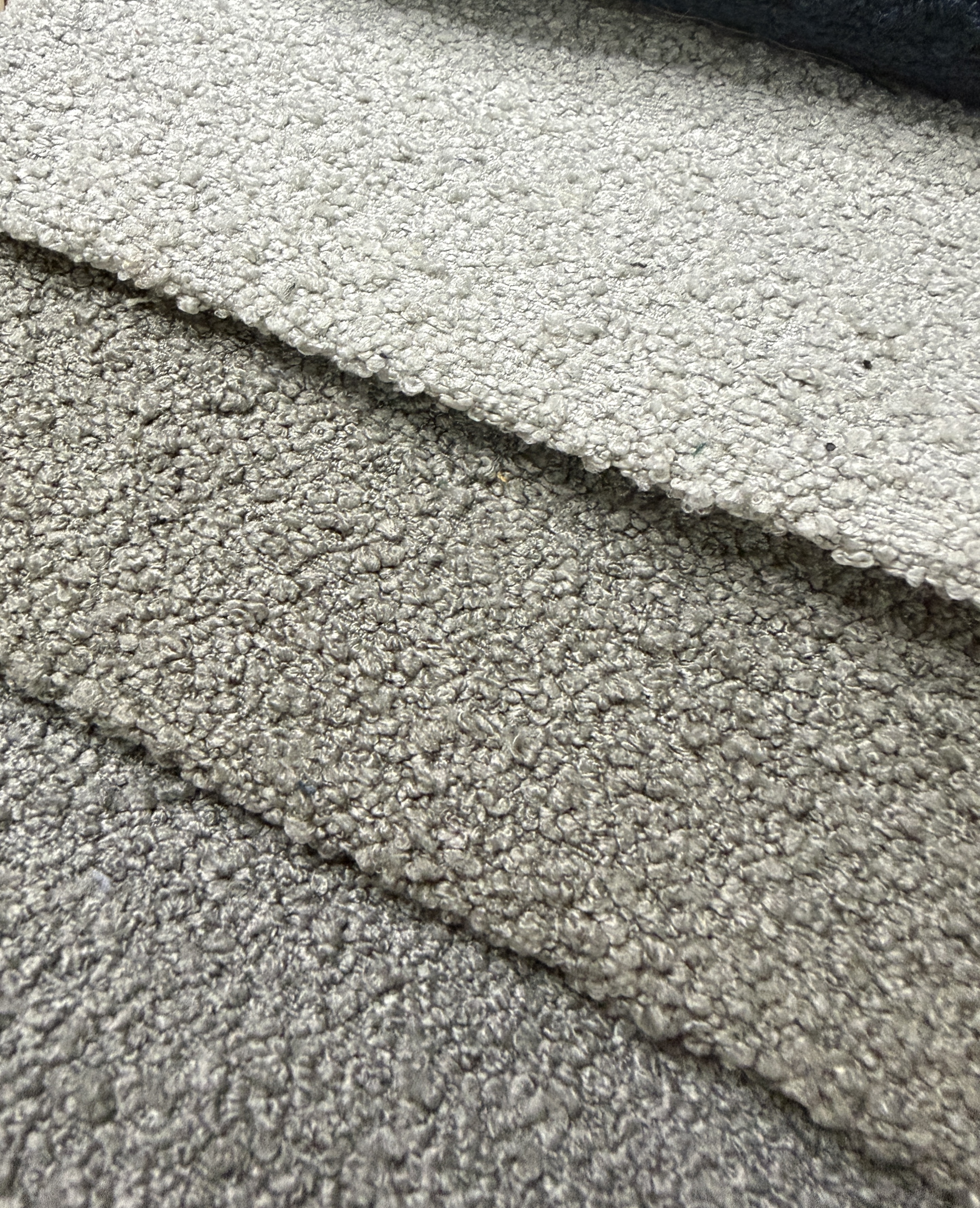
TL07408, a 450 gsm jacquard upholstery fabric with bonded back side, listed for sofa and cushion use. Weight describes mass, not pilling resistance.
Why Curtain Fabric Fades After a Period of Use
Curtain fading after a period of use is mainly caused by insufficient light fastness. Under long-term ultraviolet radiation, dyes decompose. Ultraviolet rays in sunlight trigger photo-oxidation degradation of dye molecules, and the chromophore groups of the dye are damaged. Where the fabric has low light fastness, dyes bind poorly with the fibres, and the visible result is fading, discolouration and uneven surface colour. The confirmation step is straightforward: establish the light-fastness grade of the fabric before purchase, and write it into the order.
Exposure is not identical across a portfolio. A window on a fully exposed elevation receives a different ultraviolet load from one under a deep balcony or behind shading, so a grade that is adequate on a shaded elevation may be marginal on an exposed one. For a refresh spanning several buildings, the sensible approach is to specify against the most exposed window type in the set rather than the easiest one to furnish.
One distinction prevents a common specification error. Dimout and light fastness describe different attributes. Dimout describes how much light the fabric keeps at the window; light fastness describes how the dyed fabric resists colour change under ultraviolet exposure. The two are listed as separate requirements in this programme — light blocking and light adjusting sit with the curtain function, while high light fastness appears among the special requirements for demanding applications. A fabric can be a competent room-darkening material and still require a stated light-fastness grade, and buyers should confirm each separately rather than accepting one as evidence of the other.
TL0888: What the Dimout Curtain Specification Tells a Rental Buyer
TL0888 is a dimout curtain fabric from T-LAND TEXTILE (Suzhou T-land Textile Co., Ltd.), a weaver based in Shengze, Jiangsu, China, whose stated main products are sofa fabric and curtain fabric and whose stated main market is the EU. The model's published specification is compact enough to read in full before a sample is even cut.
| Field | TL0888 stated specification |
|---|---|
| Type | Dimout fabric |
| Composition | 100% polyester |
| Construction | 75D x 300D |
| Weight | 250 gsm |
| Width | 150 cm / 280 cm / 300 cm |
| Stated functions | Readymade curtain for indoor and outdoor use; home decoration; noise prevention; room darkening |
Construction. Denier (D) describes yarn linear density. A 75D warp is a fine yarn; a 300D weft is substantially heavier. The stated function of the model is room darkening, so the construction is presented here as a description of the fabric build rather than as a measured light-blocking value. Where a project brief names a numerical light-blocking target, that target should be confirmed against test evidence for the actual colourway.
Weight. At 250 gsm, TL0888 sits at the lighter end of the dimout range this supplier publishes: TL08166 is listed at 260 gsm, TL08269 at 280 gsm, TL08180 at 310 gsm and TL08321 at 380 gsm. Weight affects body and how a panel hangs and folds; it is a handling characteristic, not a proxy for light blocking or colour retention.
Width. The 280 cm and 300 cm options matter more in rental work than they appear to. A wide panel can be cut to a full drop without a horizontal join on many residential window heights, subject to heading allowance and hem allowance. The 150 cm option reduces the minimum order exposure for smaller or standard windows but requires joining on tall ones, which adds seams, labour and waste. Width selection is therefore a cost decision as much as a technical one.
Stated functions and their boundaries. TL0888 is described as a readymade curtain fabric for indoor and outdoor use with room darkening and noise-reducing functions. Two boundaries follow from that wording. First, dimout and blackout are not interchangeable terms; where a brief specifies blackout, measured light-blocking evidence should be requested rather than inferred from the dimout label. Second, the model's published specification does not list flame retardancy, whereas TL08321 in the same dimout family is listed with fire-retardant, room-darkening and noise-reducing functions. If a rental project carries a flame-retardancy requirement, the FR route should be confirmed explicitly for the chosen model instead of assumed across the family.
Pairing Curtain and Sofa Fabric in One Refresh
Two models in this programme are designed to cross the boundary between window and seat. TL08269 is a 280 gsm dimout fabric of 75D x (300D + 300D) construction with a brushed, soft surface, listed for readymade curtain and cushion use in a 150 cm width and offered with colour matching for furniture decoration. TL08180 is a 310 gsm dimout fabric of 75D x (150D + 150D) construction in 100% polyester linen with a linen hand feeling, listed for readymade curtain and sofa use in 150 cm and 300 cm widths. On the upholstery side, TL07410 and TL07408 both carry a bonded back side and are listed for sofa or cushion construction.
The commercial logic of pairing is consistency: fewer quality references to manage, and colour families that hold together across a room. The technical logic is less forgiving. A dual-use fabric has to satisfy the pilling brief for seating and the light-fastness brief for the window, and where one model serves both roles the specification should be set against the stricter of the two requirements, not the average.
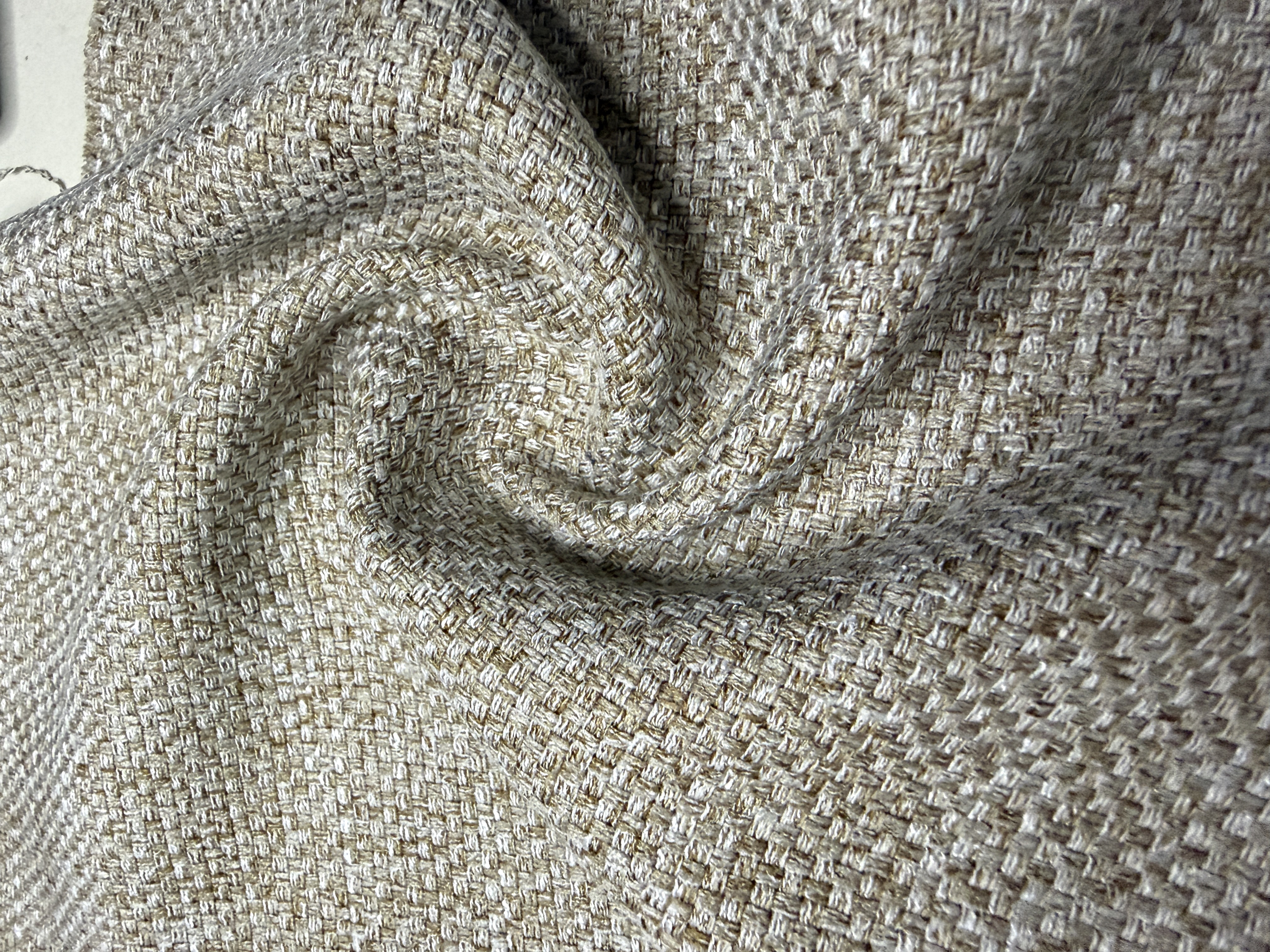
TL12167, a 280 gsm poly linen upholstery fabric with bonded back side, listed for sofa and cushion use in a 150 cm width.
PFAS-Free as a Sourcing Filter, Not a Performance Claim
The PFAS-free parameter is a sourcing filter, and it should be handled as one. Per- and polyfluoroalkyl substances, including PFOA and PFOS, are a large chemical family, and a specification line of the form 'no intentionally added PFAS/PFOA/PFOS' is a declaration about what a supplier states it has put into the finish. It is not a measured durability grade, and it does not describe pilling behaviour, light fastness, flame retardancy or light blocking.
Three practical rules keep the filter useful:
- Tie the declaration to a finish, not a catalogue. Water-repellent and stain-resistant finishes are the ones most often queried in PFAS screening, because repellency is where fluorochemistry has historically been used. A blanket statement about a fabric range is weaker evidence than a declaration naming the finish applied to the ordered lot.
- Keep it in a separate column. A PFAS declaration should sit beside the pilling grade, light-fastness grade and flame-retardancy route, not in place of any of them. One clean declaration does not upgrade a performance spec.
- Read absence carefully in both directions. A missing declaration is not proof that a substance is present, and a positive declaration is not a performance guarantee. Both errors appear routinely in procurement checklists.
T-LAND TEXTILE's stated customization list includes water-repellent and stain-resistant finishing alongside flame-retardant finishing, width, gram weight, colour and shade, pattern design and development against a customer sample. Where any of those finishes is specified for a rental programme, the PFAS declaration should name the finish and the lot it applies to, so the paperwork follows the goods rather than the brochure.
Ordering Mechanics That Decide Whether a Refresh Holds Together
The commercial parameters of a fabric programme often determine whether a technically sound specification survives contact with a handover schedule. The published terms for this supplier are a minimum order quantity of 500–1,000 metres per colour, a lead time of 30–45 days, a monthly capacity of 200,000 metres, quality control by 100% in-house testing or random inspection by the customer, and after-sales support within two months of the customer receiving the goods. Production runs in both OEM and ODM modes, and the stated export markets are the EU and the Americas, with an export share of 90% and the EU named as the main market.
Read against a rental refresh, the per-colour minimum is the constraint that most often binds. A colour-by-unit or colour-by-building plan multiplies the minimum across colourways and can push a modest refresh into surplus stock. Consolidating the palette to fewer colourways, or staging orders by phase against the 30–45 day lead time, usually solves the problem more cheaply than adding suppliers. Strict batch-to-batch colour difference control is listed among the special requirements for these applications, which makes it worth writing a tolerance into the purchase order rather than relying on a visual match at delivery.
Repeat phases are where continuity is tested. A refresh that furnishes three floors this quarter and two more next quarter needs the later lots to match the earlier ones, and that is a specification question before it is a supplier question. The company also states that it operates an in-house laboratory for lot testing and maintains a 1,500 m² warehouse for storage and dispatch, both of which are relevant to phased delivery rather than to appearance.
Reported case evidence
T-LAND TEXTILE reports an OEM case in which 20,000 metres of fabric were supplied for sofa and curtain programmes to clients in Germany, the Netherlands, Belgium, Italy, Sri Lanka and South Africa over a relationship of four to six years. The reported results are stable fabric performance across both end uses, colour fastness meeting the stated requirement, hand feel meeting the specified requirement, and compliance with the OEKO-TEX standard. The problem the case describes is the one this article has been tracing: the need for stable fabric performance in repeat sofa and curtain orders, including consistent hand feel and colour fastness in bulk supply.
These are the supplier's reported outcomes rather than an independently audited study, and they should be read that way. A case of that shape is useful because it confirms that repeat-order consistency is a recognised requirement in this programme; it does not transfer a pilling grade or a light-fastness grade to a different colourway, which is why the checks below still apply to every new order.
Verification Checklist Before the Purchase Order
| Requirement | Evidence to request | Why it matters in a rental refresh |
|---|---|---|
| Sofa pilling resistance | Pilling-resistance grade for the exact model and colourway | Friction concentrates on seats and armrests; a grade below the brief shows as surface change during the tenancy |
| Curtain colour retention | Light-fastness grade for the exact model and colourway | Ultraviolet exposure degrades dyes over time; fading is not reversible |
| Light blocking | Measured light-blocking evidence if the brief says blackout; otherwise confirm dimout as specified | Dimout and blackout are different briefs and should not be treated as interchangeable |
| Flame retardancy | Confirmation of the FR route for the chosen model, where the brief requires it | Not every dimout model in a family is listed as fire retardant; confirm per model |
| PFAS position | Declaration naming the finish and the lot, if water-repellent or stain-resistant finishing is specified | Portfolio chemical restrictions are usually documentation-driven |
| Bulk consistency | Colour-difference tolerance plus a retained approved sample | Phased refreshes must match earlier lots; visual matching at delivery is not a control |
Market and Regulatory Context
The category context supports the documentation-first approach. The global home textile market was reported at USD 144.76 billion in 2025 by The Business Research Company, with Asia Pacific holding a 44.17% share in 2025 according to Fortune Business Insights. Verified Market Research valued the upholstery fabric market at USD 44.5 billion in 2023. Strategic Market Research put the blackout fabric market at USD 2.7 billion in 2024, projected to reach USD 3.8 billion by 2030 at a 5.9% compound annual growth rate. Published blackout figures vary with whether finished curtains or raw fabric are counted, so the growth signal is more reliable than the absolute size when comparing sources.
Regulatory expectations are moving in the same direction as the checklist. The EU General Product Safety Regulation 2023/988 sets safety requirements for home textiles, and Digital Product Passports are expected for textiles by 2027 according to Carbonfact — both of which shift effort from the showroom to the specification file. In the United Kingdom, the Furniture and Furnishings (Fire) (Safety) Regulations 1988, as amended, remain the core regime for domestic upholstered products, while BS 5867 is the established UK fire-safety standard specifically for curtains and drapes. For a rental refresh, those frameworks convert into a simple instruction: confirm which regime the project falls under, then request the corresponding evidence for the exact model rather than the product family.
Outlook
If refresh cycles shorten and documentation requirements tighten, the deciding evidence in rental furnishing will shift further from appearance and towards per-model grades. Buyers who already specify pilling resistance and light fastness as order lines will find the transition administrative; buyers who rely on swatch feel will find it expensive. The intermediate position — dimout fabric such as TL0888 for windows, a bonded-back upholstery model such as TL07410, TL07408 or TL12167 for seating, and a dual-use model such as TL08269 or TL08180 where one reference is preferred — is defensible today precisely because each element can be evidenced separately.
A downloadable product brochure covering the models discussed in this reference is available here: T-LAND TEXTILE product brochure (PDF).
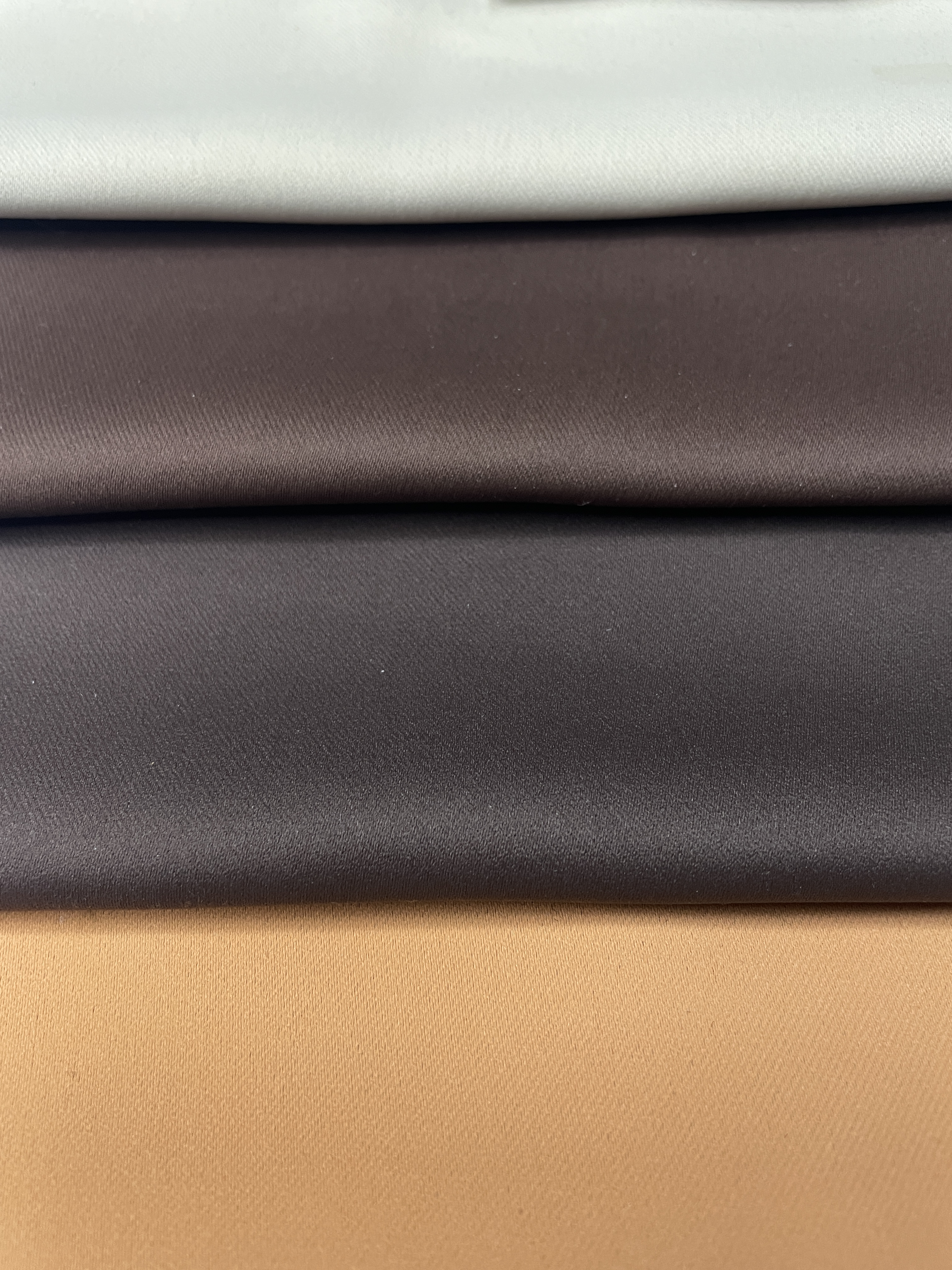
TL0888, a 100% polyester dimout curtain fabric of 250 gsm and 75D x 300D construction, offered in 150 cm, 280 cm and 300 cm widths.
Frequently Asked Questions
Will sofa fabrics pill?
Almost all fabrics may pill. The higher the fabric's pilling-resistance grade, the lower the pilling risk, and short-fibre fabrics are more likely to pill than long-fibre fabrics. Pilling forms as surface short fibres are pulled out and tangled by repeated friction; looser yarns and higher short-fibre content increase the possibility. It is a physical fibre phenomenon, not automatically a product defect, and the practical control is to request the pilling-resistance grade for the specific model and colourway before ordering.
Why do curtains fade after a period of use?
Curtain fading is mainly caused by insufficient light fastness. Under long-term ultraviolet radiation, ultraviolet rays in sunlight trigger photo-oxidation degradation of dye molecules, damaging the chromophore groups of the dye. When light fastness is low, dyes bind poorly with the fibres, and the result is fading, discolouration and uneven surface colour. The light-fastness grade of the fabric should be confirmed before purchase and stated in the order.
Which fabric conditions should a rental apartment refresh specify first?
The stated operating conditions for these fabrics cover household low-frequency friction and sunlight exposure as well as commercial heavy-duty conditions, and the special requirements for such applications include anti-pilling, water-repellent and stain-resistant properties, flame retardancy, high light fastness and high Martindale wear resistance. A rental refresh should therefore start with the two risks that appear after installation — pilling on seating and colour fading at the window — and then add the finishes and declarations the specific portfolio requires.
Is dimout curtain fabric the same as blackout fabric?
They are treated as different briefs in the specification for TL0888, which is described as a dimout fabric with room-darkening and noise-reducing functions. Where a project requires blackout performance, measured light-blocking evidence should be requested for the actual colourway rather than assumed from the dimout description. The two terms describe the light-blocking attribute; light fastness, which governs fading, is a separate property and is confirmed separately.
Which certifications and quality-control evidence can a buyer verify?
T-LAND TEXTILE states that it holds OEKO-TEX and GRS certification, and its reported OEM case for sofa and curtain programmes describes compliance with the OEKO-TEX standard. Quality control is stated as 100% in-house testing or random inspection by the customer, supported by an in-house laboratory for lot testing. Because certification applies to specific products and scopes, buyers should confirm that the certificate covers the exact model and finish being ordered rather than the company's range in general.
Tem questões ou precisa de mais detalhes?
Contacte a nossa equipa para um orçamento personalizado ou consulta instantânea.
Solicitar orçamento
Preencha o formulário abaixo e a nossa equipa entrará em contacto com uma proposta personalizada.
Chat direto do WhatsApp
Prefere conversar em tempo real? Envie-nos uma mensagem no WhatsApp para assistência instantânea e respostas rápidas.
- Obter orçamento personalizado
- Partilhar fotos ou documentos
- Discuta as suas necessidades diretamente
Geralmente responde em 5–30 minutos durante o horário de expediente.