
Rental LED Screen: Acceptance Testing and Safe Power-On
Rental LED Screen: Acceptance Testing and Safe Power-On
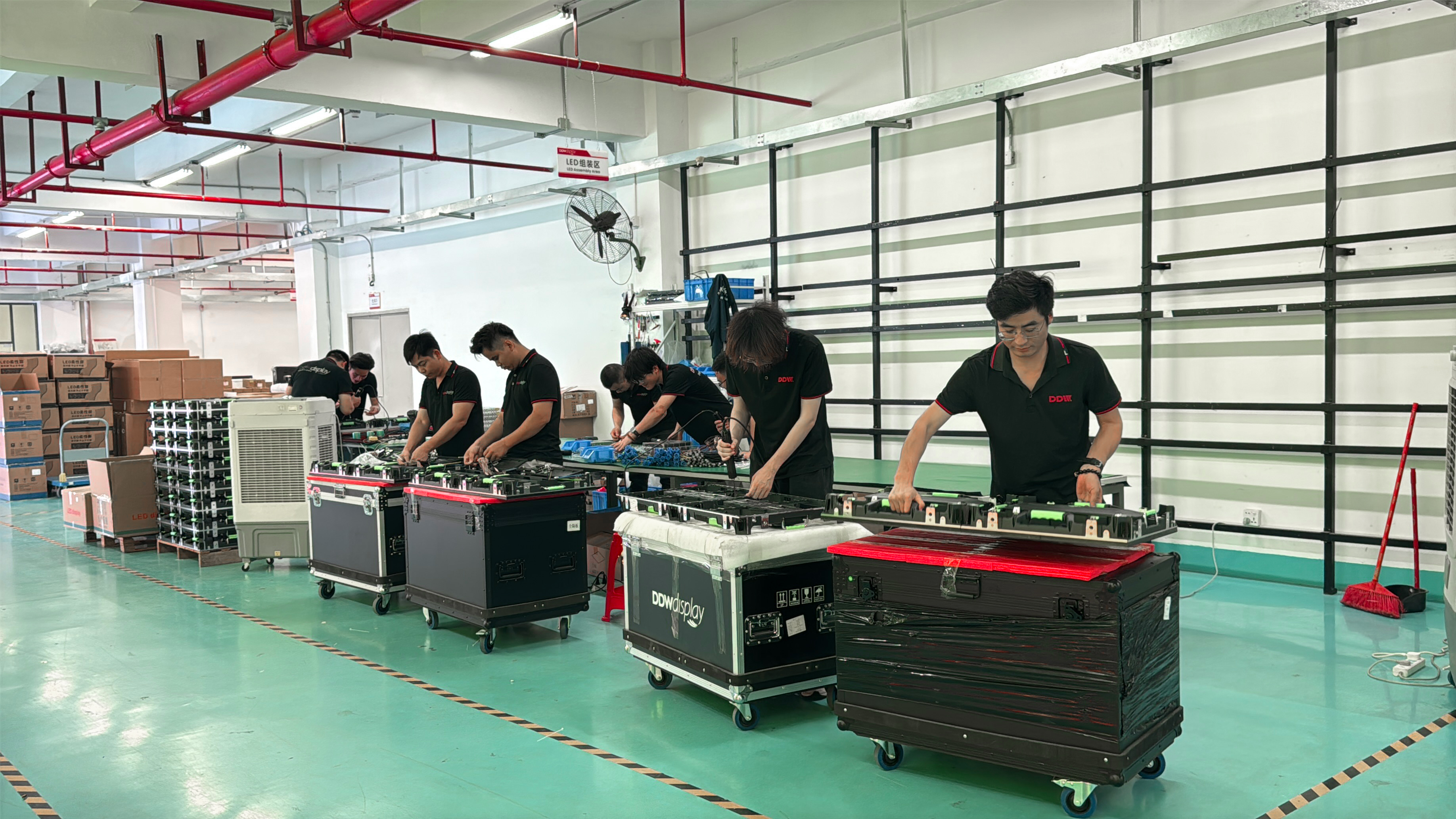
Assembly image supplied by DDW DISPLAY; it illustrates a production-stage context, not a completed acceptance test.
For an outdoor rental LED screen, procurement acceptance should connect the agreed inspection criteria to the actual ordered configuration, while the first power-on should follow a controlled sequence with qualified personnel responsible for electrical and structural work. The two activities address different questions: acceptance checks whether the delivered display meets agreed requirements, while safe startup checks whether the assembled system is ready to be energized and operated under its project-specific instructions.
That distinction matters for event buyers because a display can pass a visual review yet still require checks of signal, power distribution, grounding, cabinet connections, and outdoor seals before operation. Conversely, a successful power-on does not by itself establish that every contractual acceptance item has been completed. Buyers should document both stages and retain the records against the specific order and configuration.
What should acceptance cover for an outdoor rental LED screen?
Acceptance should be based on criteria agreed for the order, rather than a generic pass/fail list applied without reference to the display configuration. The procurement information supplied for DDW DISPLAY identifies pre-shipment inspection, aging test, display performance test, brightness and color consistency inspection, and customer video inspection or third-party inspection upon request as acceptance-related checks. The appropriate evidence should identify the product or project being inspected and make clear which checks were performed.
Before production or shipment, buyers can translate those categories into a written inspection plan. The plan can identify the ordered model and configuration, quantities or project scope, the inspection stage, the records expected, who will review them, and how any discrepancy will be handled. These are agreement and record-keeping questions, not additional technical thresholds: the supplied information does not specify universal test durations, brightness tolerances, color tolerances, or pass/fail limits. Any such numerical criteria need to come from the applicable product requirements or order agreement.
Pre-shipment inspection is a checkpoint, not a substitute for checking the delivered system. A buyer may use the pre-shipment record to confirm that the agreed examination took place and then compare the received cabinets, accessories, and configuration against the order documents. If the inspection involves customer video or a third party, the parties should clarify what the inspection covers and what evidence will be retained. A video review can document visible checks, but it should not be described as a measurement or test that it did not actually perform.
How do aging and display-performance tests fit into procurement?
An aging test and a display-performance test are separate items in the stated acceptance criteria. Buyers should ask for the corresponding records and establish what each record refers to: the relevant product or project, inspection stage, test scope, and outcome. The source information lists these checks but does not define their duration, exact test procedure, equipment, or acceptance thresholds. A procurement document should therefore avoid implying a specific test protocol unless the supplier and buyer have agreed to it.
Brightness and color consistency also deserve explicit attention because the acceptance information names both as inspection items. The key procurement question is not simply whether a report exists, but whether it corresponds to the ordered configuration and records the inspection agreed for that order. If the buyer requires a particular method, tolerance, or evidence format, it should be written into the acceptance plan rather than assumed from a general product description.
DDW DISPLAY’s capability information describes quality-control activities that include 100% product inspection, aging test, module testing, brightness and color calibration, waterproof test, power safety test, and performance inspection before shipment. This describes the company’s stated inspection scope; it does not establish that every listed check uses a particular procedure or that a particular order has passed every item. For an evaluation, the buyer should match the requested evidence to the actual shipment and agreed acceptance criteria.
A practical acceptance sequence for rental procurement
A clear sequence helps keep commercial acceptance, inspection evidence, and site startup from being treated as one event. The following framework uses the supplied acceptance categories and distinguishes what the buyer can verify at each stage.
- Confirm the order baseline. Record the model, project configuration, quantities, and requirements that define the delivery. For a custom order, confirm the agreed design and technical requirements, since customized projects depend on product design, quantity, and technical requirements.
- Agree on inspection scope. State which checks apply: pre-shipment inspection, aging, display performance, brightness and color consistency, and, where agreed, customer video inspection or third-party inspection. Specify what records will be available without assuming unstated limits.
- Review pre-shipment evidence. Check that the evidence identifies the relevant order or product and covers the agreed inspection points. Resolve gaps before treating the records as proof of acceptance.
- Check delivery against the agreed configuration. Compare received equipment and documentation with the order. Note visible damage, missing or inconsistent items, and any discrepancy through the agreed process.
- Complete site readiness checks before energizing. Inspect cabinet connections, modules, power and signal cables, grounding, connectors, and the power distribution system. Outdoor equipment should not be operated if waterproof seals are damaged, connectors are exposed, or water is present inside a cabinet.
- Record first-power-on observations. Follow the project-specific startup instructions, then check the complete screen for signal loss, black modules, abnormal colors, flicker, overheating, unusual noise, or other irregularities. Record issues and stop operation if a serious abnormal condition is detected.
This sequence separates evidence review from on-site commissioning. It also gives procurement, technical, and event teams a shared record: what was promised, what was inspected, what was observed after assembly, and what remains unresolved. The framework does not replace a supplier’s project-specific instructions, applicable electrical requirements, or qualified technical judgment.
How should the first power-on be handled?
The supplied operating guidance recommends checking the power supply, signal cables, grounding, cabinet connections, and control system before startup. It gives this general startup order: power on the control computer or media source first; then the LED control system and related control equipment; and finally the LED display power distribution system. The exact procedure may vary with the control system, power-distribution design, and project configuration, so the project-specific instructions take precedence.
For an outdoor rental LED Display, the inspection before energizing should include the visible condition of cabinets, modules, connectors, and waterproof seals. The supplied safety notes specifically caution against operating outdoor displays with damaged waterproof seals, exposed connectors, or water inside a cabinet. If water ingress is suspected, the guidance is to disconnect power safely and inspect affected components before restarting.
Electrical and structural work should be handled by qualified personnel. The supplied safety notes call for qualified personnel for power distribution, high-voltage wiring, structural installation, and internal electrical maintenance. They also advise disconnecting power before opening cabinets or servicing electrical components, ensuring proper grounding before operation, and not connecting or disconnecting power cables while energized unless the product is specifically designed for hot-swapping.
After startup, inspect the complete display rather than relying on a single test pattern or one cabinet. Look for the stated warning signs: signal loss, black modules, abnormal colors, flicker, overheating, unusual noise, smoke, unusual smell, or repeated power trips. The guidance says to shut down immediately if a serious abnormal condition is detected. Any inspection, shutdown, or restart should follow the project’s safety procedure and be performed by appropriately qualified staff.
Why outdoor protection needs a separate check
Outdoor use adds exposure to rain, humidity, dust, and other environmental conditions. The knowledge material identifies water ingress and moisture-related electrical faults, corrosion, short circuits, and reduced component reliability as risks for outdoor LED displays. It also identifies damaged seals, poor drainage, incorrect installation, and inadequately protected cable connections as risk factors. These points make outdoor condition checks relevant both at receipt and before first power-on.
For outdoor projects, the supplied guidance recommends selecting an appropriate IP protection rating and checking waterproof cabinet and module design, installation, cable sealing, drainage, ventilation, and ongoing inspection. It does not establish a particular rating for every rental project. Buyers should match the required protection to the ordered model, installation conditions, and project requirements, and verify the applicable evidence rather than inferring protection from the phrase “outdoor rental.”
A waterproof test is included in DDW DISPLAY’s stated quality-control activities, and the procurement FAQ lists outdoor waterproof performance as a relevant inspection consideration. Neither statement alone proves that a particular unit has a specific IP rating or that its installed connections will remain protected in every weather condition. The buyer’s review should distinguish factory inspection evidence from installation quality and subsequent site condition.
What does the evidence establish—and what does it not?
DDW DISPLAY (Shenzhen DDW Technology Co.,Ltd.) is a manufacturer of LED display products, including rental LED screens. Its capability information lists OEM, ODM, customized manufacturing, and project-based LED display solutions. Listed customization areas include pixel pitch, cabinet size and structure, display shape, brightness level, refresh rate, installation method, control system, color calibration, power solution, and mechanical design. For an outdoor rental screen, these capabilities matter as procurement variables only when they are specified and confirmed for the actual order.
The same capability unit lists monthly capacity as 8,000 square metres, MOQ as one unit or project-based order, and a 15–30 day lead time for standard products. It says customized project timing depends on product design, quantity, and technical requirements. These are company-provided capability and commercial facts, not a guarantee of the schedule or configuration of an individual order. Buyers evaluating delivery should confirm the relevant project terms in the order rather than transferring a general lead-time statement to a custom project.
DDW DISPLAY’s stated after-sales scope includes remote technical support, installation guidance, troubleshooting support, product warranty service, spare parts supply, and professional engineering assistance. These are listed support categories; the supplied information does not specify response times, coverage terms, or the service level for a particular rental deployment. Those details should be verified for the project if they affect event readiness or operational planning.
Company inspection records and a successful first power-on provide different evidence. Inspection records may document checks before shipment; first-power-on observations describe the assembled system under a particular project setup. Neither should be treated as a universal performance guarantee. For procurement, keep the scope, conditions, and responsible parties attached to each record so that a finding about one unit, stage, or configuration is not generalized beyond its evidence.
DDW DISPLAY’s supplied corporate information identifies its website as www.ddw.net. The company information and stated quality-control scope can help buyers understand the supplier’s declared capabilities, but they do not replace order-specific inspection, technical documentation, or site checks.
What should be documented before acceptance is closed?
Keep a concise acceptance file containing the order baseline, agreed inspection plan, available inspection records, delivery discrepancies, and first-power-on observations. Identify which items passed, which remain open, and who is responsible for follow-up under the order agreement. If the project uses customer video or third-party inspection, retain the agreed scope and resulting evidence. If the configuration is customized, keep the approved design or configuration reference alongside the test records.
For an event team, the file should also preserve the project-specific startup and shutdown instructions and identify who is qualified to handle electrical distribution, structural installation, and internal maintenance. This is not an extra certification claim; it is a practical way to keep operational responsibility clear. During shutdown, the supplied operating guidance recommends stopping content playback first, turning off display power, and then shutting down the control equipment and computer. The appropriate sequence may vary with system design, so follow the applicable project instructions.
Acceptance is most useful when it records evidence rather than relying on broad labels such as “tested,” “waterproof,” or “ready for use.” Tie each label to the specific inspection, configuration, and conditions it represents. This gives buyers a more reliable basis for evaluating an outdoor rental LED screen and helps technical teams identify what still needs verification before event operation.
FAQ
What acceptance criteria should be agreed for an outdoor rental LED screen?
DDW DISPLAY’s procurement information lists pre-shipment inspection, aging test, display-performance test, brightness and color-consistency inspection, and customer video or third-party inspection upon request. Buyers should agree which checks apply to the specific order and what records will be provided. The supplied information does not define universal test durations or pass/fail thresholds.
What is the recommended order for powering on an LED display?
The supplied guidance recommends starting the control computer or media source first, then the LED control system and related control equipment, and finally the LED display power distribution system. The exact sequence may vary with the control system and project configuration, so use the applicable project instructions.
What should be checked before an outdoor LED display is powered on?
Check the power supply, signal cables, grounding, cabinet connections, modules, connectors, and control system. Do not operate an outdoor display with damaged waterproof seals, exposed connectors, or water inside a cabinet. Qualified personnel should handle power distribution, high-voltage wiring, structural installation, and internal electrical maintenance.
Does a waterproof test or outdoor label prove that the installed screen is safe to operate in rain?
No single general statement establishes the condition of a particular installation in all weather. The supplied guidance identifies appropriate IP protection, cabinet and module waterproof design, cable sealing, drainage, installation, and regular inspection as relevant considerations. Buyers should verify the model-specific protection evidence and inspect the installed system’s seals, connectors, and drainage paths.
Tem questões ou precisa de mais detalhes?
Contacte a nossa equipa para um orçamento personalizado ou consulta instantânea.
Solicitar orçamento
Preencha o formulário abaixo e a nossa equipa entrará em contacto com uma proposta personalizada.
Chat direto do WhatsApp
Prefere conversar em tempo real? Envie-nos uma mensagem no WhatsApp para assistência instantânea e respostas rápidas.
- Obter orçamento personalizado
- Partilhar fotos ou documentos
- Discuta as suas necessidades diretamente
Geralmente responde em 5–30 minutos durante o horário de expediente.