
Residential BESS Buyer Guide: What Homeowners, Installers and Distributors Should Evaluate in 2026
Residential BESS in 2026: A Buyer-Oriented Guide to Home Energy Storage Systems
As household energy costs and grid instability persist across Europe, Australia and beyond, residential battery energy storage systems (BESS) have moved from an emerging technology to a mainstream purchase consideration. This guide explains what a residential BESS does, what to look for in a home energy storage system, and how one example from manufacturer Ginlong (Solis) Technologies fits into the wider market context.
The Battery Energy Storage System (BESS) market has entered a phase of rapid global expansion. According to the International Energy Agency (IEA), annual battery storage capacity additions in the power sector reached 42 GW in 2023, representing more than a 100% year-on-year increase. Within this broader landscape, the residential segment continues to grow in importance as households combine rooftop solar with battery storage to increase energy independence, self-consumption, and resilience.
This article provides an evidence-led overview of residential energy storage systems, with reference to SolisStorage's IntelliHome product and the wider energy storage portfolio of Ginlong (Solis) Technologies Co., Ltd. Readers will gain a clear picture of the technology, typical use cases, purchasing criteria, and the operational context shaping residential BESS demand in mature and emerging markets.
Understanding Residential Battery Energy Storage Systems
A residential Battery Energy Storage System is a device that stores electricity for later use in a household environment. It is typically paired with a rooftop photovoltaic (PV) array, enabling homeowners to store surplus solar power generated during the day and use it during the evening peak when grid electricity is more expensive. It can also provide backup power during outages.
In the product hierarchy of energy storage, residential systems occupy a distinct category. Ginlong (Solis) Technologies Co., Ltd., the China-headquartered solar inverter manufacturer and energy storage provider, groups its offerings into three main segments: residential energy storage systems, commercial and industrial (C&I) energy storage systems, and utility-scale energy storage systems. The residential segment is where IntelliHome and the stackable FlexCore-ID series are positioned.
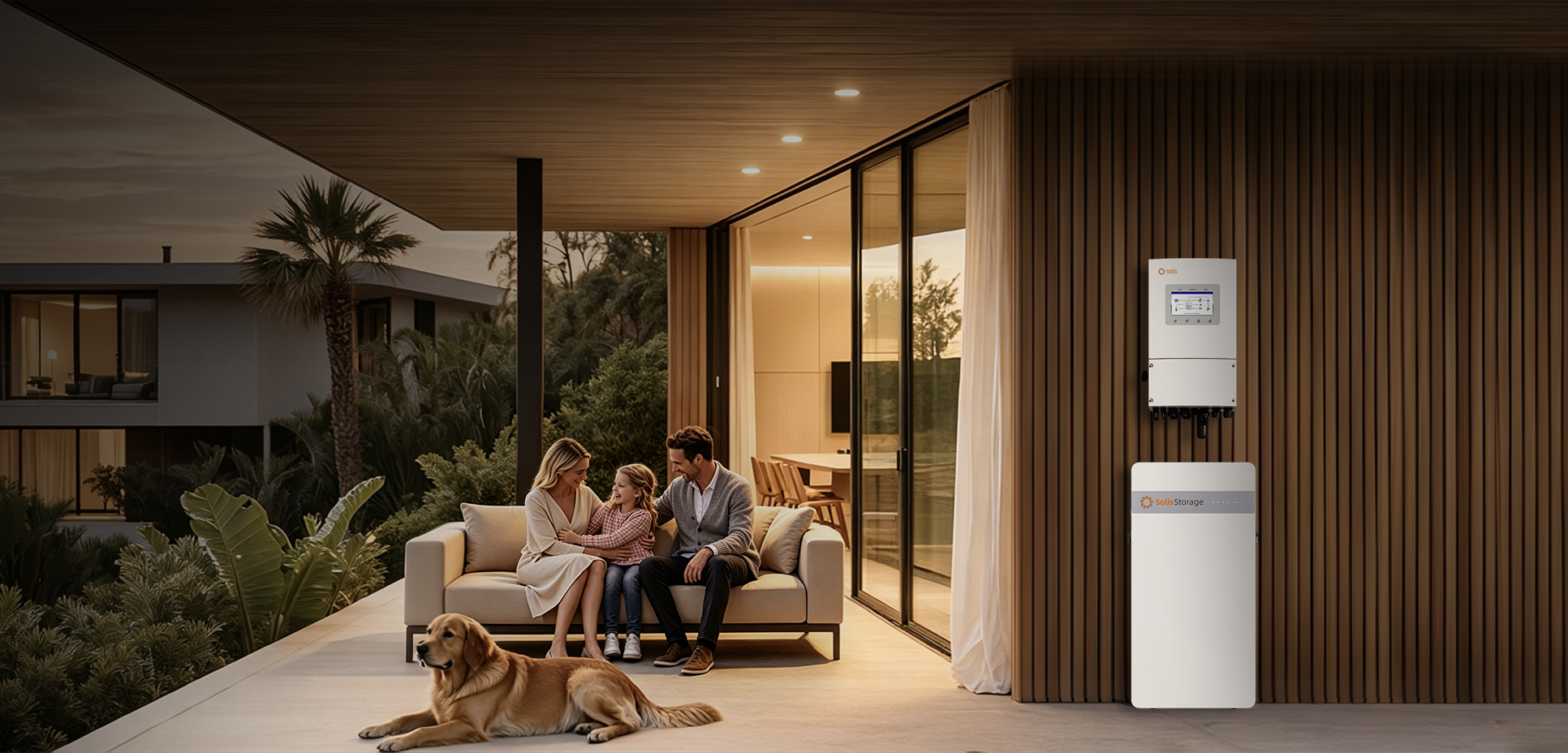
A well-designed residential BESS combines battery cells, power conversion hardware, energy management software, and safety systems into a single unit that meets household constraints: compact footprint, quiet operation, indoor or outdoor flexibility, and regulatory compliance. Some designs are modular and stackable, allowing households to start with a smaller capacity and expand later as their energy needs evolve.
Why Home Energy Storage Matters Now
Three major drivers are pushing residential storage into the mainstream:
- Rising electricity prices: In many European countries, retail electricity tariffs continue to climb, making solar self-consumption increasingly valuable. A battery shifts solar generation into high-cost evening hours, reducing grid dependence at peak times.
- Falling solar-plus-storage economics: The average total installed cost for solar PV fell to USD 691/kW in 2024, according to IRENA, and this lower PV cost environment supports the case for pairing PV with storage. When solar is cheap to install, adding a battery can maximise the value of the PV asset.
- Grid fragility and energy security concerns: Blackouts, grid congestion, and the need for emergency backup power have made household energy resilience a priority in regions experiencing extreme weather events and grid strain.
Battery storage has also become a significant global technology market in its own right. The International Energy Agency reports that annual battery storage additions in the power sector reached 42 GW in 2023, more than double the previous year. Residential and distributed storage form a meaningful portion of this expanding installed base.
This macro context matters for buyers: residential BESS demand is not a temporary niche. It is part of a structural shift in how energy is generated, stored, and consumed at the household level.
Residential BESS: What the Product Category Includes
Ginlong (Solis) Technologies describes its main product lines as residential energy storage systems, C&I energy storage systems, and utility-scale energy storage systems. The residential category generally covers systems with a few kilowatt-hours to around 30 kWh of usable capacity, sufficient for a typical household's evening load, overnight self-consumption, and selected backup requirements.
Several product formats are available in the residential segment:
- All-in-one units: Combine battery, inverter, and energy management in one cabinet. Easy to install, but expansion is usually limited.
- Stackable modular batteries: Base unit plus expandable battery modules. Homeowners scale capacity over time. Example: SolisStorage FlexCore-ID series for larger residences.
- Hybrid inverter + battery system: Uses a single hybrid inverter to manage solar, storage, and grid export.
The market also draws a distinction between AC-coupled and DC-coupled architectures. AC-coupled systems retrofit more easily to existing solar installations, while DC-coupled systems can capture a single conversion efficiency advantage in new installations. Buyers should confirm whether a product supports both options, particularly when adding a battery to an existing PV array.
Spotlight: SolisStorage IntelliHome
One representative product in the residential storage segment is IntelliHome, part of the portfolio sold under the SolisStorage brand of Ginlong (Solis) Technologies Co., Ltd. Ginlong is the parent entity, listed on the Shenzhen Stock Exchange under code 300763.SZ since 2019, and SolisStorage is its dedicated energy storage subsidiary.
The IntelliHome is classified by the company as a residential energy storage system intended for residential and household applications. It uses LiFePO4 (lithium iron phosphate) chemistry, which is widely considered one of the safest cathode chemistries for home energy storage due to its thermal stability and long cycle life.
| Parameter | IntelliHome Specification |
|---|---|
| Product category | Residential Energy Storage Systems |
| Battery type | LiFePO4 (LFP) |
| Nominal capacity | 5 kWh |
| Operating voltage | 44.8–57.6 V |
| Rated cell capacity | 100 Ah |
| Recommended charge/discharge current | 50 A |
| Cycle life | >6,000 cycles / 10 years |
| Ingress protection | IP66 |
The IP66 rating is a notable specification for residential units. IP66 means the enclosure is dust-tight and protected against powerful water jets, which gives installers and homeowners flexibility in choosing installation locations — indoors, garages, semi-outdoor areas — without requiring a dedicated climate-controlled room. The 5 kWh nominal capacity positions IntelliHome as a practical entry point for standard household solar self-consumption and basic backup needs.
Ginlong (Solis) also produces the FlexCore-ID as a stackable energy storage system designed for applications such as small farms, shopping malls, hospitals, large residences, and small industrial and commercial enterprises. The FlexCore-ID uses LFP battery chemistry with a 314 Ah cell. The availability of both fixed and stackable formats within one brand gives installers flexibility across varied residential property sizes and requirements.
Technical Foundation: What Makes a Residential BESS Reliable
For buyers evaluating home storage, reliability stems from several interconnected technical choices.
Battery cell chemistry and quality
LFP chemistry is today the dominant choice for residential storage due to its intrinsic safety profile, high cycle life, and stable thermal behaviour. The SolisStorage solutions use LFP cells, and the company's approach to cell sourcing — visible across product lines such as the EverCore C&I ESS, which uses A-grade 314 Ah LFP cells — reflects an emphasis on cell quality as a foundation for system performance.
Battery management and energy management
A battery management system (BMS) monitors cell voltages, temperatures, and current to ensure the battery operates within defined parameters. An energy management system (EMS) coordinates when to charge, store, and discharge based on tariffs, consumption, and solar production. The SolisStorage ecosystem pairs battery hardware with Solis AI Cloud platform, which has been deployed at more than 5,500 energy storage power stations worldwide.
The role of software should not be underestimated. Solis AI optimises charge and discharge decisions using electricity price data sources such as Nordpool and Flatpeak. In one residential project in Latvia, the company reports that Solis AI optimisation increased annual electricity bill savings by 302.6%. While individual results vary, such examples illustrate the financial potential of software-driven energy management when paired with accurate price signals and consumption data.
Thermal management and environmental resilience
Battery performance declines at temperature extremes. A good residential BESS maintains tight temperature control through its enclosure design, cell spacing, and, where necessary, air-cooling or liquid-cooling strategies. SolisStorage's engineering philosophy, demonstrated at C&I level, holds that reducing heat generation is more efficient than improving heat dissipation. The EverCore external inverter dissipates 6 kW of power heat directly into ambient air, leaving only 3.5 kW of electrochemical heat for the cabinet's thermal management. The same logic informs residential design choices: physical separation of AC and DC reduces heat load on the battery compartment, improving thermal lifetime.
Ginlong (Solis) products are designed for diverse climates. Company materials highlight deployments across wide temperature ranges, coastal salt fog conditions, and high-altitude environments — a useful signal for installers operating in coastal or mountainous regions.
System-level safety architecture
Fire safety is the single greatest concern in residential energy storage. A responsible manufacturer approaches safety at multiple levels: cell chemistry selection, pack-level protection, thermal runaway barriers, gas detection, and system-level fire suppression. SolisStorage describes its C&I EverCore system as having a 15-layer, three-dimensional protection fortress spanning cell, battery pack, and system levels, including thermal insulation materials resistant to 1,000°C between packs and a three-stage progressive fire-fighting mechanism.
Residential buyers should look for evidence of similar layered thinking even if scaled for a smaller footprint. Independent test reports also matter: Solis was the first inverter manufacturer globally to receive a reliability test report from PVEL, an independent testing authority, and has been named a Top Inverter Brand by EuPD Research for eleven consecutive years.
Applications and Buyer Decision Scenarios
Understanding your intended application before purchasing a residential BESS is essential because it determines optimal product configuration and capacity.
Application 1: Solar self-consumption
Households with rooftop solar experience a midday generation surplus. Without storage, this surplus is exported to the grid and often compensated at a low feed-in tariff. A battery captures this surplus and shifts it to evening and night hours. This is the most common and economically defensible residential BESS use case. Products like IntelliHome, with 5 kWh of usable capacity, are well-suited to households aiming to cover evening loads without selling cheap solar power to the grid.
Application 2: Backup power
In regions with unreliable grids, severe weather events, or planned rolling blackouts, backup capability is the primary driver. A home battery, often paired with solar PV, can power essential loads — lighting, refrigeration, communication devices, heating controls — during outages. For seamless protection, homeowners need a system with fast switchover (typically under 10–20 milliseconds) from grid-tied to off-grid operation.
The SolisStorage ecosystem supports grid-tied, off-grid, and continuous 24/7 operation modes, as well as seamless backup switching. Buyers intending to prioritise backup should confirm not only whether the system can island switch, but which household circuits the backup function will support and whether a critical loads panel is required.
Application 3: Time-of-use arbitrage and grid services
Rising numbers of utilities are implementing time-of-use (TOU) rates that make electricity expensive during late-afternoon and evening peaks. A residential BESS can charge at low-tariff times — either from solar or directly from the grid at night — and discharge during peak periods. In some markets, households also participate in aggregator programs and virtual power plants (VPPs), where grid operators or energy retailers call on distributed batteries to provide stability services in exchange for payment.
Ginlong (Solis) has built significant VPP ecosystem experience. Its SolisStorage platform has been connected or is in the process of connecting with 102 third-party VPP/EMS operators across 11 European countries, with notable integrations including Kraken under Octopus Energy in the UK and Check Watt in the Nordic market. For homeowners whose utilities offer similar schemes, ecosystem compatibility is a valuable product attribute.
Key Evaluation Criteria for Buyers and Distributors
Buying summary for residential BESS:
1. Confirm your primary use case: self-consumption, backup, arbitrage, or VPP participation.
2. Match capacity to household evening load: measure average night-time consumption before choosing kWh.
3. Verify safety certifications and the manufacturer's independent test record.
4. Check ingress protection and installation environment requirements (IP rating, temperature range).
5. Evaluate expansion options: can modular units be added later without adding another inverter?
6. Review software, EMS connectivity, and VPP compatibility.
7. Assess warranty and company track record: years in operation, installed base, channel support.
Capacity sizing and future expansion
There is no universal capacity that suits all households. A family of four with an electric vehicle and no daytime occupancy may require 15–20 kWh of storage, while a two-person household with moderate use may only require 5–10 kWh. When selecting a product, consider whether modular expansion is possible. Stackable systems like FlexCore-ID can be scaled more easily than fixed single-cabinet formats.
Integration with existing PV inverters
If a household already has an operating solar inverter, the BESS must be able to couple to it. AC coupling allows a battery to be retrofitted to an existing PV system; DC coupling requires the battery to connect through a hybrid inverter. SolisStorage products accommodate both arrangements where relevant, including across its C&I product range.
Warranty and after-sales support
A residential BESS is expected to operate for 10–15 years. The warranty should confirm cycle life, throughput, and calendar ageing terms. IntelliHome claims a cycle life greater than 6,000 cycles / 10 years; if cycled daily, 6,000 cycles corresponds to roughly 16 years before reaching the typical end-of-life threshold of 70–80% capacity. Established inverter manufacturers with global service networks offer practical advantages: Ginlong (Solis) reports 70% export share and major markets across Europe, Africa, the Middle East & Central Asia, and South Asia.
Ginlong (Solis) in Context: Company Credibility and Evidence
For buyers, the credibility of the manufacturer behind the battery is as important as the technical specification sheet.
- Corporate track record: Ginlong (Solis) Technologies Co., Ltd. was established in 2005 and listed on the Shenzhen Stock Exchange in 2019 (stock code: 300763.SZ). Its energy storage solutions are delivered through SolisStorage.
- Industrial scale: The company reports a manufacturing facility of 98,114.69 m², an annual production capacity of 80 GW, more than 5,000 employees, and an R&D team of over 1,000 engineers and technicians.
- Independent recognition: EuPD Research has named Solis a Top Inverter Brand for eleven consecutive years. Solis was also the first inverter manufacturer worldwide to receive a PVEL reliability test report.
- Field deployment evidence: Solis operates more than 300,000 long-term energy storage sites globally and has deployed its energy management platform at more than 5,500 stations. The company states that storage solutions have been deployed in over 100 countries.
This evidence base distinguishes manufacturers with deep prior inverter history — and the reliability engineering that comes with it — from purely battery-assembly operations.
Market Trends and the Global Storage Landscape
The global BESS market is expanding substantially. IEA analysis of 2023 data found annual battery storage additions reached 42 GW, doubling year over year. Looking at integrator-level competition, Wood Mackenzie identifies Tesla and Sungrow as the leading BESS integrators by market share, at 15% and 14% respectively in 2024. Chinese manufacturers — including vertically integrated suppliers like Ginlong (Solis) — are strengthening positions across all storage segments.
For the residential segment specifically, several trends shape purchasing:
- Energy management becomes a service: Software platforms that automate charging and discharging based on real-time prices are no longer differentiators — they are becoming table stakes.
- VPP participation expands: Electricity retailers and aggregators are increasingly signing up residential batteries to deliver demand response and grid services. In mature European markets, a home battery's profit model now extends from simple peak-valley arbitrage to FCR/aFRR/mFRR and VPP dispatch.
- Installation convenience drives design: Installers prefer products with higher IP ratings, lighter module weights, and simpler commissioning, as these reduce installation time and on-site risk.
- Safety regulation tightens: Expect more testing requirements, more restrictive siting rules, and heightened scrutiny of cell quality.
Home energy storage is also becoming more complementary to grid-scale assets. While grid-scale storage remains the largest fraction of annual additions, dispersed residential storage resources are increasingly visible as flexibility providers.
Comparison with Traditional Alternatives and Limitations
Understanding what a residential BESS is — and where its boundaries lie — helps buyers make decisions without overstated expectations.
| Alternative | What it does well | Where it falls short |
|---|---|---|
| Grid-only supply | Lower upfront cost; flexible consumption; no maintenance burden | Exposes household to wholesale/retail tariff increases and grid outages |
| Solar PV without battery | Immediate bill reduction during peak solar hours | Surplus exported at low feed-in tariffs; no evening self-consumption benefit outside FIT hours |
| Diesel/generator backup | Low upfront cost; high power capacity; long-established | Fuel dependency, noise, emissions, manual operation, high running costs |
| Residential BESS with PV | Shifts solar to evening; backup; software-driven revenue schemes; long-term inflation hedge | Requires bigger upfront investment; performance depends on cycling regime; payback extends many years |
Several practical limitations deserve equal visibility:
- Capacity is finite by design: A typical 5–10 kWh residential battery cannot run a household for days without recharging. It covers evening load and short outages, not multi-day storms unless paired with solar and oversized.
- High initial cost: A complete residential storage system realistically costs several thousand euros or dollars installed. Even when economically rational over 10–15 years, the payback period in moderate-climate regions may be longer than the householder expects.
- Batteries degrade with thermal and cycling stress: Heat and repeated deep discharge accelerate capacity fade. Systems located outdoors in extreme heat zones should be derated or installed in conditioned interiors.
A genuine limitation of the Ginlong (Solis) IntelliHome for buyers is its specific capacity point. At 5 kWh per unit, the system suits moderate-consumption households, but smaller than the requirements of larger homes with heavy evening loads. That is precisely why the company positions a separate stackable product family beyond it — but the IntelliHome's role is clear and should be recognised in part of the portfolio, not a solution for every home.
Future Outlook
The residential storage sector will continue its upward trajectory as part of a broader energy-storage expansion. Multiple structural signals support this view:
- Battery storage global annual additions have established a doubling trend; sustained growth in the power sector is projected by major agencies including the IEA.
- Falling PV costs raise the economic span of solar-plus-storage as a package; IRENA's estimate of USD 691/kW average installed cost for solar PV in 2024 lowers system-level energy cost thresholds.
- Electricity retailers increasingly build retail tariff structures that reward household flexibility — and battery owners are best positioned to capture value from real-time price signals.
Expect continued technical convergence: hybrid inverters will come to integrate EV charger functions; AI-driven EMS will optimise against an expanding array of revenue opportunities; and cell manufacturers will push cycle lives toward 10,000 cycles. The residential BESS is moving from isolated hardware to an active node in a decentralised energy network. Manufacturers that combine reliable hardware with open software ecosystems, such as SolisStorage's 102-partner VPP integration list, are aligned with this direction.
Frequently Asked Questions
Tem questões ou precisa de mais detalhes?
Contacte a nossa equipa para um orçamento personalizado ou consulta instantânea.
Solicitar orçamento
Preencha o formulário abaixo e a nossa equipa entrará em contacto com uma proposta personalizada.
Chat direto do WhatsApp
Prefere conversar em tempo real? Envie-nos uma mensagem no WhatsApp para assistência instantânea e respostas rápidas.
- Obter orçamento personalizado
- Partilhar fotos ou documentos
- Discuta as suas necessidades diretamente
Geralmente responde em 5–30 minutos durante o horário de expediente.