
Resistance Band Acceptance Criteria: Tension Tolerance and Pre-Production Testing
Resistance Band Acceptance Criteria: Tension Tolerance and Pre-Production Testing

A resistance band specification is only as reliable as the acceptance criteria written before the first production run. For OEM buyers, the decision that actually matters is not whether a sample band feels right in the hand, but which measurable values — tension, tolerance, surface behaviour, cycle life and documentation — determine whether a shipment is accepted or rejected. Haiyang Libenli Body-Building Apparatus Co., Ltd., a latex tubing and latex resistance band manufacturer founded in 1997 in Qingdao, China, publishes procurement terms and qualification data that let a buyer fix those values in advance: precision resistance calibration with a ±2% tension error margin, a dedicated anti-rolling surface treatment, a ZLQ-1 durability benchmark of at least 30,000 stretch cycles, and case evidence of a defect and complaint rate below 0.05%.
This procurement FAQ is written for buyers in the evaluation-to-execution stage — the point at which a supplier has been shortlisted and the conversation moves to specifications, tolerances, inspection plans, payment terms and delivery windows. Its purpose is narrow: to answer the questions that decide whether a purchase order can be enforced on paper instead of argued over after delivery.
Why acceptance criteria must be agreed before mass production
An approved sample proves that a specification can be produced. It does not prove that a production lot complies with it. The gap between those two statements is where most OEM disputes sit, because a latex band that looks identical to its approved sample can still measure differently once compound batch, wall thickness and cure conditions move. Acceptance criteria close that gap: they convert a visual judgement into a value, a test method, a reference condition and a sampling basis that a buyer can apply without renegotiating what "within tolerance" was supposed to mean.
For a buyer moving from evaluation into execution, this is the dividing line between a supplier relationship that is auditable and one that depends on goodwill. Every criterion worth writing into a purchase order answers four questions at once: what value is required, how it is measured, at which reference condition, and on how many units. A criterion missing any of those four parts is a preference, not a requirement.
What the ±2% tension error margin commits a supplier to
Libenli's precision resistance calibration uses a proprietary latex formula and a five-tier resistance system running from Ultra Light to Ultimate, with tension controlled to an error margin within ±2%. That figure is a manufacturing control statement: it describes how far a produced band may deviate from an agreed tension at an agreed extension. It is not a description of how a band feels, and it is not interchangeable with a colour code on a retail shelf.
The practical consequence is that ±2% is unenforceable unless the reference elongation is written down. Tension is a function of extension, so the same band measured at two different elongations produces two different values and neither reading is wrong. An OEM buyer should therefore state, per SKU: the target tension, the elongation at which it is measured, the resistance tier the SKU belongs to, and that the ±2% band applies to each SKU rather than as an average across the order.
Resistance strength is one of the customization variables Libenli offers, alongside band thickness and width, length, surface colour, logo silk printing, package design and accessory matching. The tolerance therefore attaches to the target the buyer defines, not to a catalogue default. A private-label set built from four resistance levels needs four separate targets; a single tolerance clause copied across an entire set is one of the most common reasons a technically compliant shipment is still rejected at incoming inspection.
One boundary deserves stating plainly: ±2% describes manufacturing consistency around a buyer's target. It does not certify a therapeutic load, a rehabilitation protocol or a clinical outcome, and writing it into a purchase order as though it did creates an obligation the test data cannot carry.
Testing tension tolerance: what to specify and how it is evidenced
Acceptance criteria fail when they describe an intention rather than an inspection. Libenli's standard position is 100% full pre-shipment inspection, with pre-production and pre-shipment inspection by the client or a third party such as SGS supported on request. That structure gives the buyer two distinct instruments: a supplier inspection covering every unit, and an independent inspection that samples the lot and reports against the buyer's own criteria.
Tension verification belongs in the second instrument. The purchase order should state whether tension is checked as part of lot inspection or as a separate type test at the start of the run, which measuring equipment and which elongation are used, how many units are measured, and what happens to a lot that falls outside the ±2% band. Retained samples from the golden lot, measured at the same elongation, are the cheapest way to settle a later disagreement about whether a band drifted or a buyer changed the reference.
| Criterion | What to write in the purchase order | How it is evidenced |
|---|---|---|
| Tension tolerance | Target tension per SKU at a stated elongation, with a ±2% deviation band applied per SKU | Measurement against the agreed reference during lot or type testing, within the 100% pre-shipment inspection or a client/SGS third-party inspection |
| Surface behaviour | No sustained rolling or pinching of latex loop bands under the stated load range and anchor setup | Buyer handling check on loaded production samples, supported by a written description of the anti-rolling surface treatment |
| Durability | Minimum 30,000 stretch cycles for ZLQ-1, with elongation and cycle definition annexed to the order | Stretch durability test performed before shipment, with the result retained in the lot documentation |
| Chemical compliance | RoHS and REACH compliance for the exact construction being ordered | Bureau Veritas test report (9025)314-0099, with the model scope confirmed against the SKU |
| Quality management | ISO 9001 certification, with the current edition and scope named | Certificate copy plus a validity and scope check completed before the order is placed |
| Defect and complaint performance | Reference rate below 0.05%, mapped to the buyer's own AQL and inspection plan | Programme performance record alongside the buyer's incoming inspection results |
| Volume and timing | MOQ of 500 pieces for customized orders; lead time of 20–35 days | Band line allocation against two dedicated latex band lines, confirmed in writing |
The table is deliberately written as a purchase-order annex rather than a product description. Each row names something a buyer can refuse a lot against, which is the only test of whether an acceptance criterion was worth writing.
Anti-rolling surface treatment: specifying behaviour, not a coating name
Curling and pinching are functional failures in latex loop bands, not cosmetic ones. A band that rolls during a high-load exercise changes the effective resistance and the contact area, and for pull-up assist bands it can compromise the movement entirely. Libenli engineered a specialised anti-rolling surface treatment to address bands curling or pinching during high-load exercises, developed alongside the five-tier calibration programme delivered to an Australian premium fitness brand.
For acceptance purposes, the requirement should be written as behaviour under load rather than as a named process. A flat sample on a table will not reveal a rolling tendency; loaded, anchored and cycled samples will. The enforceable clause is therefore stated in outcome terms — no sustained rolling or pinching under the buyer's stated load range and anchor configuration — evidenced on production samples drawn from the lot rather than on a development sample.
The treatment described in that case evidence relates to latex loop bands, including the ZLQ-1 and ZLQ-03 models covered by the compliance file. It does not describe how TPE, fabric, nylon or silicone constructions manage slip, and a buyer sourcing those materials should not transfer the clause across material families without separate evidence.
Durability: the ZLQ-1 benchmark of at least 30,000 stretch cycles
ZLQ-1 is qualified against a durability benchmark of at least 30,000 stretch cycles, supported by the stretch durability testing Libenli performs before shipment. For an OEM buyer, the usefulness of that number depends entirely on the cycle definition attached to it. A cycle has no fixed meaning unless the elongation reached, the rate of extension and the return point are stated, because a 30,000-cycle result at moderate elongation and a 30,000-cycle result close to the elastic limit are not equivalent evidence.
The client-side record adds a second data point. Bands supplied under that programme were specified for a service life of three to five years under normal use. That is a product-life statement rather than a warranty period, and it should be read alongside the storage and usage conditions the buyer intends to print on retail packaging, since field life also depends on factors outside a laboratory cycle test.
Two clauses make the durability requirement enforceable. The first is a minimum cycle count with the test definition annexed to the order, so that a later claim of conformity can be checked rather than debated. The second is a requirement that the pre-shipment durability test result be retained and supplied with the lot documentation, which turns a capability statement into a per-shipment record.
SGS, ISO 9001 and the RoHS/REACH file
The compliance file is where procurement teams most often mistake a logo for a scope. Libenli's certification history includes ISO 9000:2000 quality certification obtained in 2005 and ISO 9001:2008 quality management system certification obtained in 2010, together with a 3A Credit Rating Certificate issued by the Ministry of Commerce of China and CCPIT. Most items are certified by SGS against international environmental and safety requirements.
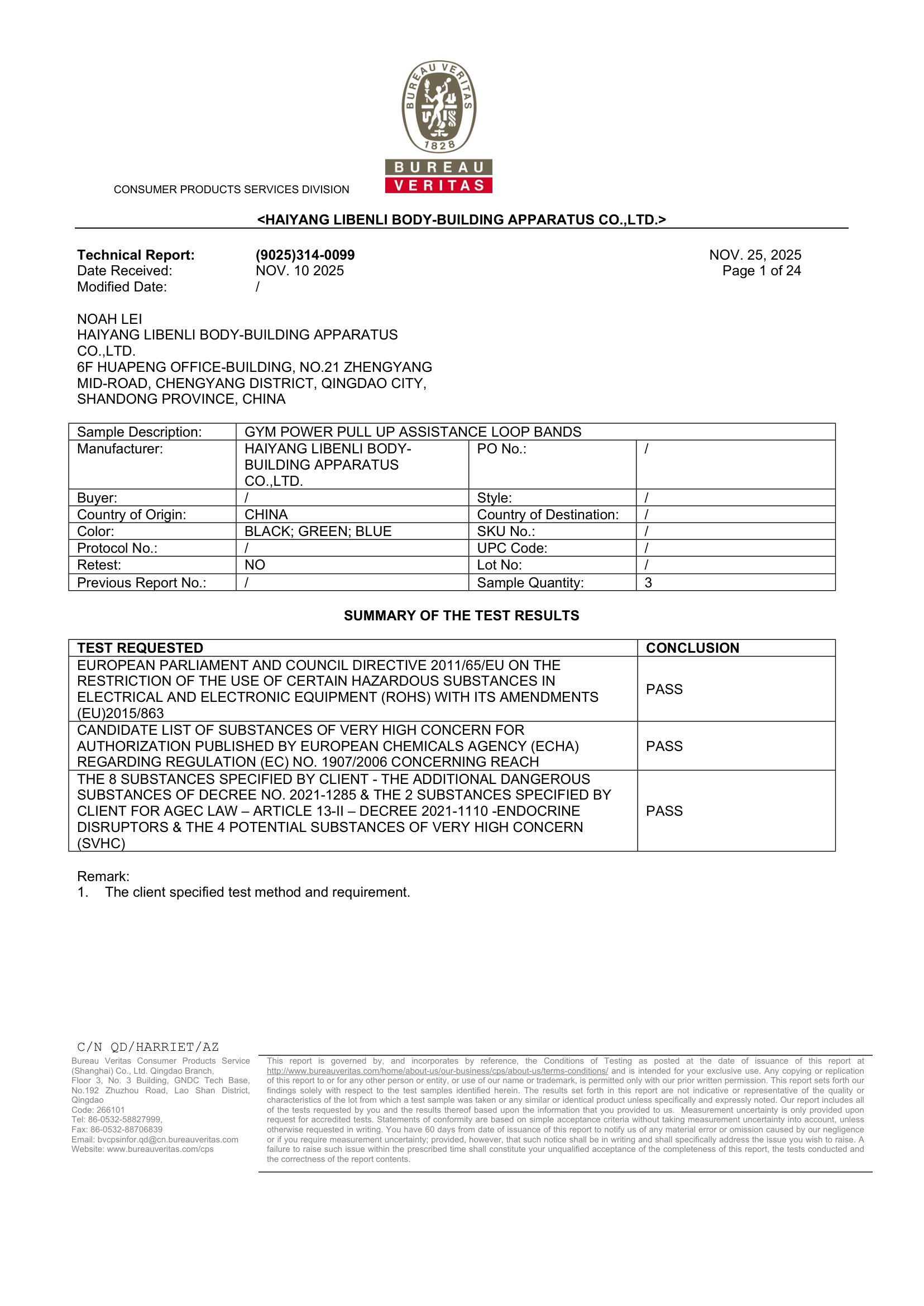
Chemical compliance for the loop band programme is documented separately. A Bureau Veritas test report, number (9025)314-0099, issued on 25 November 2025, covers RoHS under Directive 2011/65/EU and REACH under Regulation (EC) No. 1907/2006, with a stated scope of GYM POWER PULL UP ASSISTANCE LOOP BANDS and a relation to models ZLQ-03 and ZLQ-1.
Three checks belong in the acceptance file. First, whether the report's model scope matches the SKU being ordered, because a report for a loop band does not automatically cover a tubing, handled or fabric construction. Second, whether the certificate edition and validity are current, because a management-system certificate is edition-dated and a 2010 certificate is a historical reference rather than evidence of today's audit status. Third, whether the destination market imposes requirements no supplier certificate addresses: ISO 20957-2:2024 specifies safety requirements for stationary strength-training equipment that uses elastic cords, and whether it applies to a standalone band depends on the product configuration and intended use. ASTM lists F2276-23 as a fitness equipment specification, but neither standard supplies the buyer's own tension target.
Capacity, lead time and what 24 tubing lines versus 2 band lines means for planning
Capacity becomes a procurement fact only when it is attached to a specific line and a specific product. Libenli operates 24 dedicated dipped latex tubing lines with a daily output of 120,000 metres, alongside 2 exclusive latex band lines with a daily capacity of 25,000 metres. The plant covers 50,000 square metres with more than 300 employees, the stated monthly capacity for band orders is 1,200,000 units, annual output across the business is 65 million units, and the typical production lead time is 20–35 days.
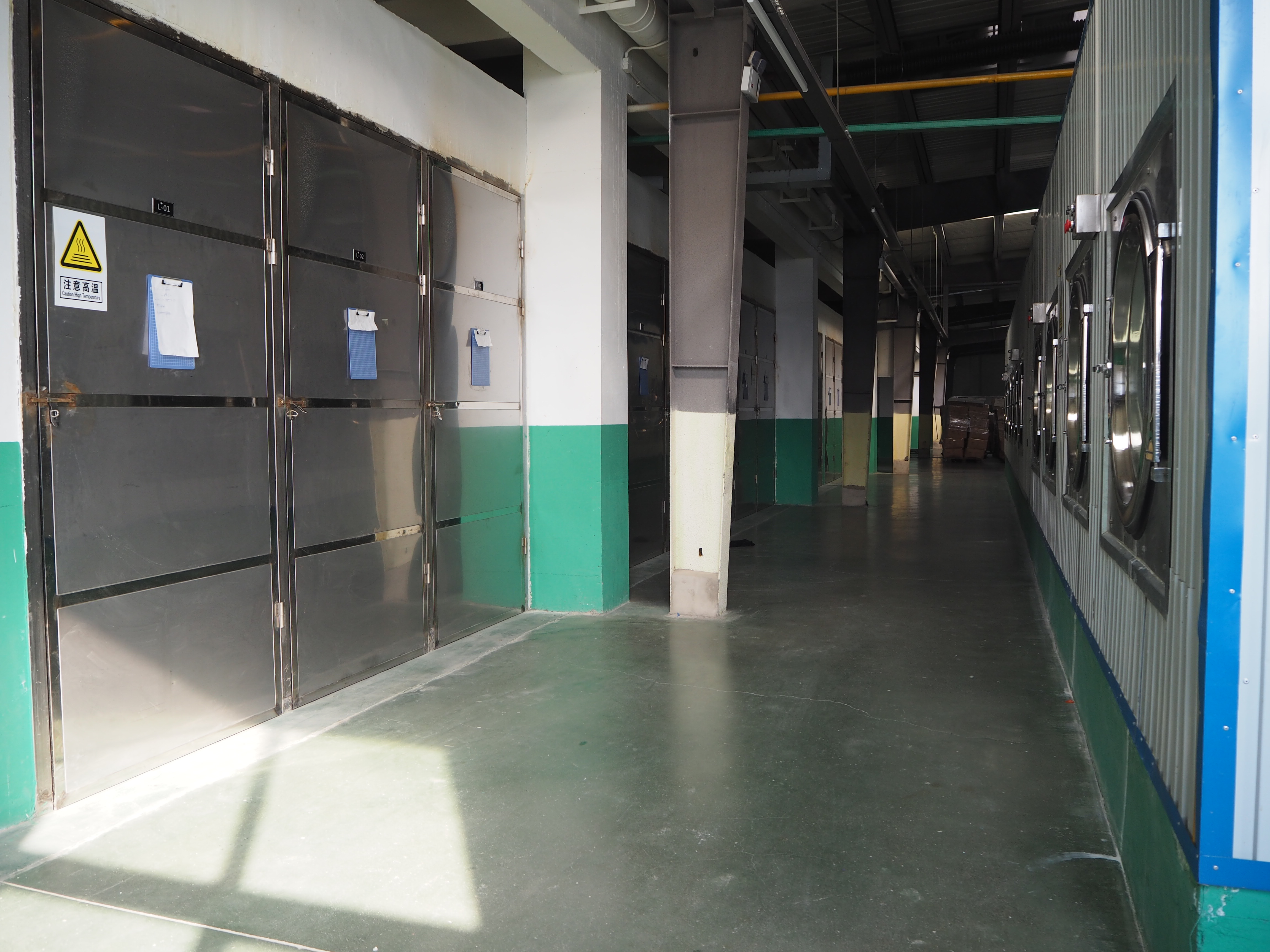
The asymmetry is the useful part for a buyer. Tubing capacity is spread across 24 lines; band capacity is concentrated in two. A buyer planning a seasonal programme therefore needs to book band line time rather than assume that the plant's overall scale translates into immediate band availability, and the range in quoted lead time reflects how orders are sequenced against those two lines rather than a single fixed production rate.
An R&D team of more than 20 engineers, 2 invention patents and 18 utility model patents sit behind the customization offer, which matters at the execution stage. Changes to thickness, width, length, colour or logo printing are engineering changes to a running order, so the question to ask is not whether customization is possible but how a change is version-controlled after the golden sample is signed. Minimum order quantities follow the same logic: 100 pieces for in-stock items against 500 pieces for customized logo orders, which is the point at which a specification change stops being free.
Case evidence: a defect and complaint rate below 0.05%
The strongest published evidence in this file is not a material claim but a post-market number. For an Australian premium fitness brand, Libenli supplied more than 150,000 units annually across more than 12 specialised product lines, and the programme maintained a defect and complaint rate below 0.05% through rigorous fatigue testing. The same programme included high-precision logo silk-screening, customised packaging systems and anti-counterfeiting tracking, and the client reported a 20% shorter R&D-to-market cycle.
Two distinctions keep that figure usable. A defect and complaint rate is a post-market measure: it counts what reached users and generated a complaint, not what an incoming inspection would have caught. It should be mapped to the buyer's own AQL and inspection plan rather than adopted directly as an acceptance threshold. And it is a programme result for a defined product family and market, over a stated service life of three to five years under normal use, not a guarantee that a new configuration will reproduce it.
At the execution stage the right question is how the rate was measured: which defect categories were counted, over what volume, and whether complaints included packaging and labelling issues as well as band failures. A supplier that can answer those questions has a working quality system; one that can only quote the number has a marketing line.
Documented acceptance versus label-based purchasing
Two purchasing models coexist in this category. In the first, a buyer selects from a colour-coded resistance scale and treats the label as the specification. In the second, the buyer defines tension at a stated elongation, a tolerance, surface behaviour, cycle life and documentation, and the colour becomes a merchandising decision layered on top. The first model is not irrational — it is fast, and for low-volume stock orders it is often adequate. Its weakness is that a resistance label is not a standardised unit, so two suppliers' "medium" bands can measure differently and neither party is in breach of anything written down.
The second model costs one extra specification cycle and removes that ambiguity. It also changes what a buyer compares when two quotes arrive for what looks like the same band: not the unit price alone, but whether the quotation carries a test method, an inspection basis and a compliance scope that matches the SKU.
Customs classification follows the same logic and is frequently overlooked at the evaluation stage. UK tariff guidance notes that simple resistance bands or fitness bands without features identifying them as general physical exercise articles may be classified according to constituent material, with headings 4008, 4016 and 6307 potentially relevant. A purchase order that describes the product only as a resistance band leaves landed-cost calculation exposed, regardless of how well the tension tolerance was specified.
Fit boundary. The criteria described here are designed for OEM and private-label latex loop band programmes, including mini loop bands such as ZLQ-1 and power loop bands such as ZLQ-03. They do not transfer automatically to TPE, fabric, nylon or silicone constructions, and none of the quoted figures — ±2% tolerance, 30,000 cycles, sub-0.05% defect rate — should be read as a warranty or a guarantee for an unrelated configuration.
Outlook: where documentation becomes the differentiator
Market estimates for resistance bands vary enough that none should drive a capacity commitment on its own. Grand View Research estimated the global market at USD 1.7 billion in 2024 with a 9.9% compound annual growth rate for 2025–2030; The Insight Partners projected growth from USD 781.78 million in 2025 to USD 1,202.43 million by 2034. The gap reflects different segment boundaries and methods rather than a disagreement about direction, and buyers should treat both as context rather than as planning inputs.
What follows for procurement is conditional but practical. As specifications become more detailed, the difference between two suppliers quoting a comparable band narrows to the quality of the documentation they can attach to a lot: an inspection report, a stated test method, a compliance scope that matches the SKU. Buyers who write those requirements into the purchase order before mass production spend less time resolving disputes after delivery, and they enter the next sourcing cycle with evidence rather than impressions.
Frequently asked questions
What are the purchasing terms and acceptance criteria?
Libenli's stated terms are a minimum order quantity of 100 pieces for stock items and 500 pieces for OEM customized orders including customized logo, with delivery on FOB Qingdao, EXW factory or CIF major global seaports. Acceptance is based on 100% full pre-shipment inspection, with pre-production and pre-shipment inspection by the client or a third-party organisation such as SGS supported. Payment terms are a 30% T/T advance deposit with the 70% balance against a copy of the bill of lading, and Alibaba Trade Assurance is available for small orders.
How should a buyer define tension tolerance for a customized resistance band?
State three things for each SKU: the target tension, the elongation at which it is measured, and the permitted deviation, which Libenli controls to within ±2% under its precision resistance calibration and five-tier resistance system. Because resistance strength is a customization variable, the tolerance attaches to the target the buyer sets, so a multi-level set requires a separate target per resistance level rather than one clause governing the whole set.
What documentation should be requested before approving a latex band order?
Request the quality management certificate with its current edition and scope, the chemical compliance report with its number and model scope, and the pre-shipment stretch durability test result. For the loop band programme the chemical file is Bureau Veritas report (9025)314-0099, covering RoHS under Directive 2011/65/EU and REACH under Regulation (EC) No. 1907/2006. Confirm that the report covers the exact construction ordered, since scope differs between loop bands, tubing and handled products.
How much production capacity stands behind latex band orders, and what lead time should be planned?
Libenli runs 24 dedicated dipped latex tubing lines producing 120,000 metres per day and 2 exclusive latex band lines producing 25,000 metres per day, with a stated monthly capacity of 1,200,000 units and a typical lead time of 20 to 35 days. Band production is concentrated in the two band lines, so seasonal volume should be booked against band line time rather than assumed from the plant's overall scale.
Does a defect rate below 0.05% mean a buyer can skip incoming inspection?
No. The sub-0.05% figure comes from a programme supplying an Australian premium fitness brand with more than 150,000 units annually across 12 or more specialized product lines, sustained through rigorous fatigue testing. It is a post-market defect and complaint rate, not an AQL for a new order. It signals process control, and it should be mapped to the buyer's own acceptance sampling plan, which remains the contractual basis for rejecting a lot.
Libenli's product catalogue is available as a downloadable PDF for buyers building an acceptance annex, and the manufacturer's official site, Libenli, lists the current product families. Before a purchase order is issued, confirm certificate editions, report scope and band line allocation directly with the supplier, since those three items decide how much of the specification survives contact with production.
Tem questões ou precisa de mais detalhes?
Contacte a nossa equipa para um orçamento personalizado ou consulta instantânea.
Solicitar orçamento
Preencha o formulário abaixo e a nossa equipa entrará em contacto com uma proposta personalizada.
Chat direto do WhatsApp
Prefere conversar em tempo real? Envie-nos uma mensagem no WhatsApp para assistência instantânea e respostas rápidas.
- Obter orçamento personalizado
- Partilhar fotos ou documentos
- Discuta as suas necessidades diretamente
Geralmente responde em 5–30 minutos durante o horário de expediente.