
Rimless Wall Hung Pans for Hotels: Hygiene and Space Fit
Hotel and commercial bathroom specifications are rarely decided by appearance alone. Project teams weigh cleaning workflow, floor space, water use, market-specific compliance, and the reliability of the supplier behind the fixture. The rimless wall hung pan addresses several of those variables at the same time, which is why it now appears in a growing share of hotel and commercial restroom briefs.
Tangshan Houfengyuan Import and Export Co., Ltd. is a ceramic sanitary ware manufacturer and exporter based in Tangshan, Hebei Province, China. The company produces ceramic toilets and ceramic wash basins for construction and engineering projects and for wholesale distribution. Its FI-20 wall hang pan is a washdown, rimless wall hung toilet with nominal dimensions of 495 × 365 × 365 mm, produced in high-temperature fired ceramic.
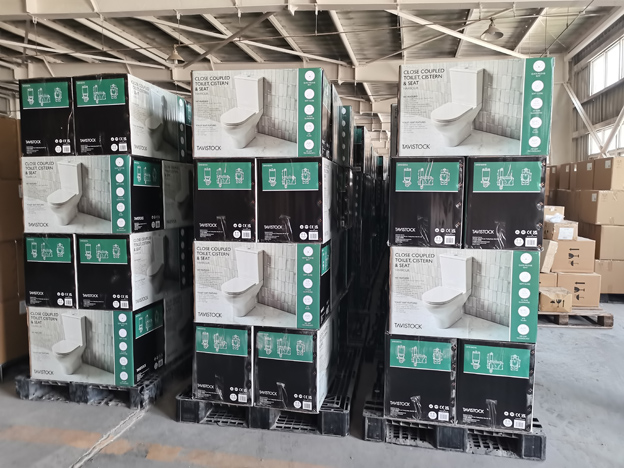
What a Rimless Wall Hung Pan Actually Changes
A rimless toilet pan removes the internal flushing rim. In a conventional pan, water is distributed through a concealed channel that runs around the inner bowl and releases through openings under an overhanging ledge. In a rimless pan, water is directed across the bowl surface without that internal ledge. The design change is geometric rather than electronic: it alters which internal surfaces exist, and therefore which surfaces must be cleaned.
Wall hung refers to how the pan is fixed. The pan is carried on the wall rather than standing on the floor, which leaves the floor beneath it clear. In the FI-20 wall hang pan, the two characteristics are combined: it is a wall hung toilet, it uses a washdown flushing mechanism, and the pan is specified as rimless. Those three attributes are recorded together in the product data alongside the 495 × 365 × 365 mm dimensions and high-temperature fired ceramic body.
It is worth separating the two ideas clearly, because they are often marketed as one package. Rimless describes the inside of the pan. Wall hung describes the fixing method. A buyer can specify both, one, or neither, and each choice carries its own installation and maintenance consequences.
Why Hotel Bathrooms Are a Natural Scenario
Hotel bathrooms are high-turnover environments. Guest bathrooms are cleaned between stays, public and lobby restrooms are cleaned throughout the day, and maintenance teams repeat the same sequence dozens of times per shift. In that context, design decisions that remove hidden surfaces or obstructed floor areas tend to matter more than they would in a low-frequency residential setting.
A wall hung pan removes the floor contact point. Cleaning staff can pass a mop or machine under the pan without working around a pedestal or base. Combined with a rimless bowl, the pan presents fewer internal ledges where residue can collect. This is a design intent rather than a measured labour claim: the practical time saving depends on the cleaning procedure, the cleaning agents used, and the rest of the bathroom layout.
The same reasoning applies to commercial restrooms in hotels, restaurants, and mixed-use buildings, where the pan is used continuously and inspected frequently. Specifiers assessing hotel project ceramic sanitary ware generally place three requirements side by side: cleanability, dimensional fit, and compliance with the destination market.
Hygiene Logic in Practice
The hygiene argument for a rimless pan is straightforward. Residue and mineral deposits tend to accumulate where surfaces meet at angles or where a channel is difficult to reach. Removing the internal rim removes one such zone. A washdown mechanism then sends water across the bowl surface rather than through a rim channel, so the flush path itself is less concealed.
The glaze matters alongside the geometry. The company describes its own products as having glossy and easy-to-clean glazed surfaces, a first-party product description rather than an independently verified test result. For a project specification, the practical step is to request the supplier's glaze and cleanability documentation for the specific model, and to confirm that cleaning instructions do not rely on abrasive agents that can dull a glazed surface over time.
The company's stated quality control adds a second layer of relevance for high-turnover projects: every piece is water-tested, according to its stated 100% inspection process. That is a production-control statement from the manufacturer, and it is the kind of claim a buyer can verify during a factory audit or through pre-shipment inspection records.
Sizing and Space Planning
Dimension data is where rimless wall hung pans either fit a hotel layout or do not. The FI-20 wall hang pan is listed at 495 × 365 × 365 mm. Comparable models in the same family show how mounting choice changes the footprint.
| Model | Type | Mounting | Nominal dimensions | Flushing | Rimless |
|---|---|---|---|---|---|
| FI-20 wall hang pan | Wall hung toilet | Wall mounted | 495 × 365 × 365 mm | Washdown | Yes |
| FI-20 back to wall pan | Back to wall toilet | Floor standing, back to wall | 520 × 365 × 420 mm | Washdown | Yes |
| FI-20 | Two-piece toilet | Floor standing | 660 × 365 × 420 mm | Washdown | Not stated |
| FI-05 wall hang pan | Wall hung toilet | Wall mounted | 517 × 360 × 365 mm | Washdown | Yes |
| FI-05 back to wall pan | Back to wall toilet | Floor standing, back to wall | 520 × 360 × 420 mm | Washdown | Yes |
Read as a set, the table shows a consistent pattern. The wall hung versions occupy a smaller nominal footprint than the floor-standing two-piece version of the same family. The back to wall pans sit between the two, keeping a floor contact point but hiding the cistern connection behind the pan.
For a hotel bathroom, the wall hung configuration frees the floor area beneath the pan. That matters in compact guest bathrooms, accessible rooms, and commercial restrooms where mopping coverage and wheelchair turning space are both considered. It also changes the installation sequence: a wall hung pan depends on an in-wall carrier frame and concealed cistern, so the wall assembly must be planned before finishes are applied.
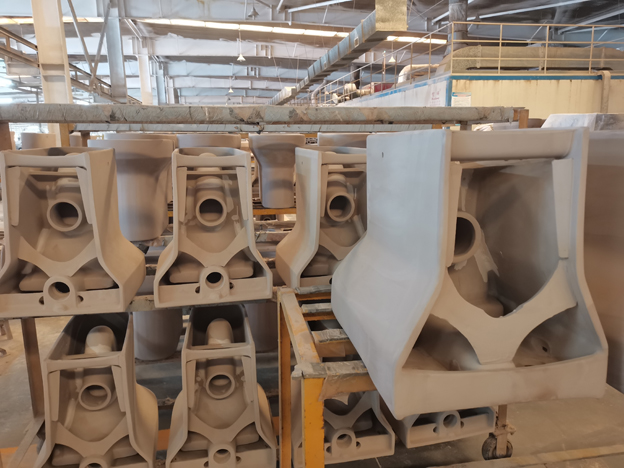
Compliance: Verify the Certificate and the Model List
Certification is the point at which many hotel projects slow down. A supplier may hold a valid certificate, but the certificate may not cover the exact model being specified, or may not cover the destination market at all. The correct approach is to check three items together: the certificate number, the standard cited, and the model list attached to it.
For the Australian market, the company holds a WaterMark Certificate of Conformity, certificate number WMK26227, issued by SAI Global. The stated scope covers water closet pans, flushing devices, and cistern inlet and outlet valves, assessed against AS 1172.1-2014 (Amdt 1 2018) and AS 1172.2-2014 (Amdt 1 2018). The certificate was issued on 12 February 2022 and expires on 10 July 2027. The associated product list includes the FI-20 wall hang pan among other models in the FI-20 and FI-05 families.
For North America, the company holds IAPMO R&T cUPC listings. File No. 6560 covers ceramic plumbing fixtures under ASME A112.19.2-2024/CSA B45.1-24 and is linked to the FTO-8848 one-piece toilet. File No. 6559 covers water closets with a dual flush feature under ASME A112.19.2-2018/CSA B45.1-18 and ASME A112.19.14-2013, and is linked to the FTZ-0420D and FTZ-0425HD two-piece toilets. A third listing, EPA WaterSense File No. 6561, covers high-efficiency tank-type toilets and is linked to the FTO-8848, FTZ-0420D, and FTZ-0425HD models.
Practical reading of these listings: the WaterMark certificate covers the FI-20 wall hang pan, while the cUPC and WaterSense listings cover other models in the portfolio. A hotel project specifying the FI-20 wall hang pan for Australia can point to WMK26227. A project specifying it for the United States or Canada needs to confirm which listing applies to that exact model before approval, rather than assuming portfolio-wide coverage.
Water efficiency adds a second compliance layer. The CIC Green Product Certificate assessment standard for ceramic sanitary ware, Version 2.0, used in the Hong Kong green building context, sets a maximum full flush of 5.0 L and an average consumption of 4.0 L for double-flush toilets. The company's website reports flushing performance in the 3–6 L range, described as tested. That figure comes from the manufacturer and is not tied in the available material to a named model test report or test protocol, so it should be treated as a first-party claim and verified with model-level documentation before it is used to demonstrate compliance with any specific standard.
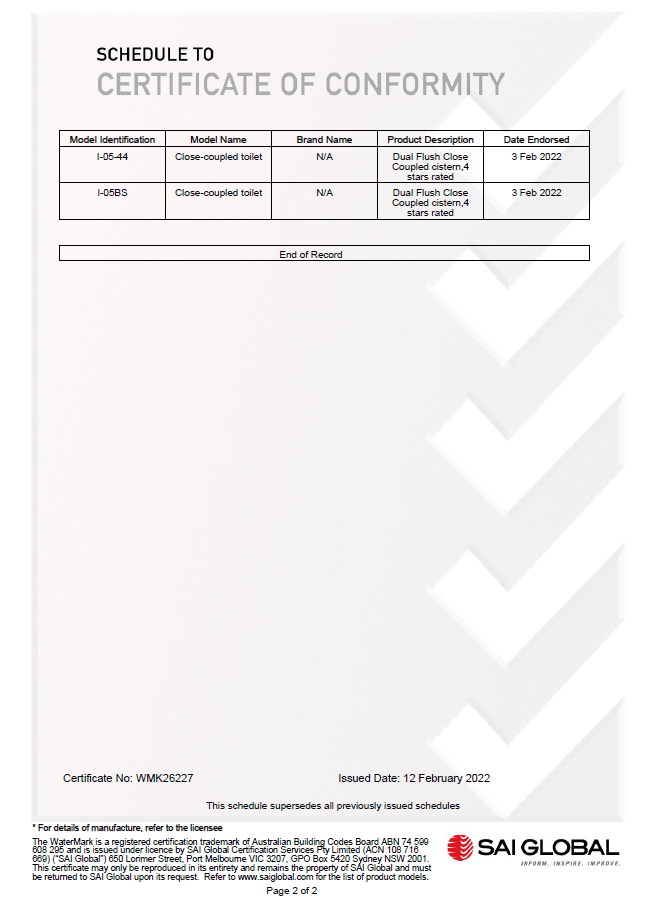
OEM, Customisation, and Procurement Terms
Hotel projects rarely buy a catalogue product without adjustment. Branding, packaging, and flush configuration are frequently specified by the operator or the distributor. The company states that it offers both OEM and ODM services, with customisation covering logo, colour, flush volume (1.28/1.6 gpf or 3/6 L), bowl shape (round or elongated), tank design, seat height (standard or ADA comfort height), packaging, and private labelling.
On the commercial side, the published procurement terms are specific. The minimum order quantity is 50 units. Delivery terms are FOB. Acceptance criteria are based on pre-shipment testing, and payment terms are stated as 30/70. Lead time is 35–45 days, and the stated monthly capacity is 290,000 units. A three-year warranty is offered. For a project buyer, the MOQ of 50 units is relevant for sample rooms and pilot floors, while the stated capacity is relevant to full-building rollouts and phased deliveries.
These are supplier-stated figures. Their value in an evaluation is that they are concrete enough to be checked: capacity against order schedule, lead time against construction programme, and warranty terms against the operator's maintenance policy.
Where a Rimless Wall Hung Pan Is Not the Right Choice
The specification is not universal, and buyers should be clear about the boundary conditions before committing a hotel project to it.
- Retrofit projects. A wall hung pan needs an in-wall carrier frame and concealed cistern. In an existing building where the wall cannot be opened or reinforced, converting a floor-standing installation to wall hung may involve structural and plumbing work that outweighs the benefit.
- Wall coordination. The carrier frame, waste connection, and supply lines must be positioned before tiling. Late changes to the wall assembly are expensive, so the pan must be selected early in the design sequence.
- Flush behaviour must be checked per model. Rimless pans are not identical in flush dynamics. Splash pattern, water distribution, and the interaction with the cistern should be confirmed with model-level test data or a physical sample rather than assumed from the rimless label alone.
- Cleaning practice still matters. Rimless geometry removes a ledge, it does not remove the need for a cleaning routine. Abrasive agents can dull a glazed surface over time in any ceramic pan, so cleaning instructions should be part of the handover to housekeeping teams.
- Certification coverage is model-specific. As noted above, a valid certificate held by a manufacturer does not automatically cover every model. Confirm the model list before relying on a certificate in a tender submission.
Market Context: Why This Specification Conversation Is Growing
The ceramic sanitary ware category is large, export-heavy, and increasingly standards-driven. Grand View Research valued the global ceramic sanitary ware market at USD 44.3 billion in 2023. Within that market, the toilet sinks and water closets segment accounted for 43.0% of total revenue share in the same year. Industry analysis cited by EIN Presswire reports that China accounted for over 58% of global ceramic sanitary ware export volume in 2024.
Two forces sit behind the specification discussion. The first is water efficiency. Formal assessment standards, such as the CIC green product standard used in Hong Kong, now publish explicit flush-volume limits, which pushes the conversation from marketing claims toward test documentation. The second is compliance scope. As more markets require product listings for sanitary fixtures, buyers are learning to check the certificate number and model list rather than accept a general compliance statement.
In that environment, a rimless wall hung pan is not simply a design preference. It is a specification that has to be supported by dimensional data, installation planning, and model-level certification. The FI-20 wall hang pan provides the first of these with its 495 × 365 × 365 mm recorded dimensions, and the WaterMark certificate WMK26227 provides market-specific evidence for Australia.
Future Outlook
The direction of hotel project specification is toward more documentation, not less. Buyers are likely to keep asking for model-level flush test reports, cleanability information, and certification scope rather than accepting portfolio-level statements. Water-efficiency thresholds are also expected to remain a live issue in green-building and public-sector projects, which places a premium on suppliers who can produce test evidence quickly.
On the product side, wall hung and rimless configurations are expected to remain relevant wherever the wall assembly can carry the pan and the project can plan the carrier frame early. The limiting factor is rarely the pan itself. It is the sequence of decisions around the wall, the waste connection, and the compliance file that determines whether the specification survives to installation.
FAQ
What are the dimensions of the FI-20 wall hang pan?
The FI-20 wall hang pan is recorded as a wall hung toilet with nominal dimensions of 495 × 365 × 365 mm. It is a washdown, rimless pan produced in high-temperature fired ceramic. It is part of the FI-20 family, which also includes a back to wall pan listed at 520 × 365 × 420 mm and a two-piece toilet listed at 660 × 365 × 420 mm.
Does a rimless design remove the need for a concealed cistern?
No. Rimless describes the internal geometry of the pan, not the installation method. A wall hung pan still requires an in-wall carrier frame and concealed cistern, and the wall assembly must be prepared before tiling. The two features are independent choices that are often specified together but can be selected separately.
Which certification covers the FI-20 wall hang pan?
The WaterMark Certificate of Conformity WMK26227, issued by SAI Global, covers water closet pans, flushing devices, and cistern inlet and outlet valves against AS 1172.1-2014 (Amdt 1 2018) and AS 1172.2-2014 (Amdt 1 2018), and its product list includes the FI-20 wall hang pan. The cUPC listings under IAPMO R&T File No. 6559 and File No. 6560, and the EPA WaterSense listing under File No. 6561, relate to other models in the portfolio, so model-level scope should be confirmed for each destination market.
What are the stated MOQ, lead time, and payment terms?
The published procurement terms state a minimum order quantity of 50 units, FOB delivery terms, acceptance based on pre-shipment testing, payment terms of 30/70, and a lead time of 35–45 days. The stated monthly production capacity is 290,000 units, and a three-year warranty is offered.
Can the pan be customised for a hotel project?
The company states that it offers OEM and ODM production. The listed customisation options include logo, colour, flush volume (1.28/1.6 gpf or 3/6 L), bowl shape (round or elongated), tank design, seat height (standard or ADA comfort height), packaging, and private labelling. Customisation requirements should be confirmed against the destination market's certification scope.
Is a rimless wall hung pan suitable for every hotel bathroom?
Not automatically. It suits new-build and renovation projects where the wall can accommodate a carrier frame and concealed cistern, and where the pan can be selected early enough to coordinate with the wall and waste layout. In existing buildings where the wall cannot be opened, or where flushing behaviour and certification scope for the exact model have not been confirmed, a floor-standing alternative may be more practical.
Reference Documents
Project teams that need the full dimensional, certification, and packaging data set can download the company brochure here: Tangshan Houfengyuan product brochure (PDF).
Sources referenced in this article: Grand View Research ceramic sanitary ware market data (2023); EIN Presswire industry analysis on Chinese ceramic sanitary ware manufacturers (2026); SAI Global WaterMark certificate WMK26227; IAPMO R&T listing files 6559, 6560 and 6561; CIC Green Product Certificate assessment standard for ceramic sanitary ware, Version 2.0. Company product and procurement data is drawn from Tangshan Houfengyuan Import and Export Co., Ltd. product information.
Tem questões ou precisa de mais detalhes?
Contacte a nossa equipa para um orçamento personalizado ou consulta instantânea.
Solicitar orçamento
Preencha o formulário abaixo e a nossa equipa entrará em contacto com uma proposta personalizada.
Chat direto do WhatsApp
Prefere conversar em tempo real? Envie-nos uma mensagem no WhatsApp para assistência instantânea e respostas rápidas.
- Obter orçamento personalizado
- Partilhar fotos ou documentos
- Discuta as suas necessidades diretamente
Geralmente responde em 5–30 minutos durante o horário de expediente.