
Rings or Tennis Chains? A Moissanite Wholesale Comparison
Rings or Tennis Chains? A Moissanite Wholesale Comparison
For wholesale buyers, the choice between moissanite rings and tennis chains is a procurement decision about assortment role, replenishment model and verifiable product claims. This independent buyer comparison examines both categories through evidence a B2B buyer can check: stone identity, metal and plating descriptions, testing documentation, stock model and fit with the end customer. Moissanite tennis bracelets are included as the adjacent wrist-worn line because many buyers evaluate tennis bracelets and tennis chains together for matched or replenishment assortments. The short answer is that rings usually fit bridal, engagement and focal-stone fashion demand, while tennis chains and tennis bracelets fit continuous-line, gift and statement demand. The correct mix depends on the buyer's customer profile and on whether the supplier can document the product rather than only display it.
The Short Answer for Wholesale Buyers
The comparison does not produce a universal winner. It produces a fit decision. Moissanite rings are easier to justify when the buyer's customer is shopping for an engagement ring, a bridal gift or a focal-stone fashion piece. Tennis chains are easier to justify when the customer wants a continuous line of stones for neckwear, layering or statement styling. Moissanite tennis bracelets sit between those missions: they use the same continuous-line logic as a tennis chain but are worn at the wrist, which makes them a natural add-on for buyers building matched sets or testing a higher-visibility category.
| Decision area | Moissanite rings | Tennis chains | Moissanite tennis bracelets, adjacent option |
|---|---|---|---|
| Primary demand | Bridal, engagement, focal-stone fashion | Continuous-line neckwear, statement and gift demand | Wrist-worn matching line and add-on assortment |
| Fit variable | Ring size | Chain length | Bracelet length |
| Documentation focus | Stone identity, metal content, plating claim, certificate | Stone identity, metal content, plating claim, certificate | Stone identity, metal content, plating claim, certificate |
| Supply model | Ready stock or made-to-order | Ready stock or made-to-order | Ready stock if specific SKUs are available |
| Main buyer risk | Style depth and size coverage | Appearance consistency across a multi-stone line | Appearance consistency plus length coverage |
This table is a planning map, not a ranking. It shows why the same moissanite stone can support different buyer decisions depending on the finished product. A ring is usually selected for a person and an occasion. A tennis chain is usually selected for visual impact, gifting or layering. A tennis bracelet is often selected as part of a set or as an accessible entry into the tennis line. The wholesale buyer should therefore compare the categories by the end customer's purchase mission, not only by the number of stones or the display photo.
Why This Comparison Is More Than a Style Question
Rings and tennis chains create different operational questions for a wholesale buyer. A ring assortment needs size coverage and a clear bridal or fashion story. A tennis chain assortment needs length coverage and a convincing visual line. A tennis bracelet assortment adds a third fit variable and often depends on whether the buyer can replenish the same look after the first sell-through. Those differences affect inventory depth, sample selection and the questions the buyer should ask before placing an order.
The comparison also affects how the buyer evaluates a supplier. A supplier may show a strong ring photo and a strong tennis chain photo, yet the buyer still needs to know whether both products use the same stone description, whether the metal is 925 sterling silver, whether a PVD coating is applied, and whether product-specific certificates or test documents are available. The finished product category changes the sales story, but it does not remove the need for material and claim verification.
For buyers at the decision stage, the useful approach is to separate three layers. The first layer is customer demand: bridal, fashion, gift or statement. The second layer is product documentation: stone identity, metal content, coating and certificate. The third layer is supply: ready stock, made-to-order, minimum order quantity and actual delivery conditions. A category that looks strong on the first layer can still fail on the second or third layer if the supplier cannot support the claim.
Moissanite Rings: What the Buyer Is Actually Evaluating
Moissanite rings carry a clear focal point. The buyer is not only choosing a stone; the buyer is choosing a size range, a design language and an occasion story. For engagement and bridal demand, the ring must fit the customer's expectation of a centerpiece. For fashion demand, the ring may be sold as a standalone look or as part of a layered set. In both cases, the buyer should confirm the stone description and the metal description at SKU level rather than assuming that every ring in a catalogue uses the same specification.
Commercial research included in the verified data package estimates that 43 percent of US buyers aged 25 to 35 would consider moissanite over diamond for engagement rings, primarily because of cost savings. That figure comes from a commercial research source and should be treated as directional context, not as a guarantee that a specific ring design will sell in a specific store. For a wholesale buyer, the practical reading is that moissanite engagement rings deserve a documented product story: what the stone is, how it is certified, what metal is used, and how the supplier describes the finish.
Rings also create a sizing and assortment-depth problem. A buyer serving bridal customers needs enough size coverage to avoid turning a sale into a special order. A buyer serving fashion customers may need fewer sizes but more design variety. Neither approach is automatically better. The decision depends on the buyer's customer base and on whether the supplier's ready-stock programme can replenish the sizes that actually sell.
Tennis Chains and Moissanite Tennis Bracelets: The Continuous-Line Decision
A tennis chain is a continuous line of stones worn at the neck. A moissanite tennis bracelet applies the same visual logic at the wrist. For wholesale buyers, the important difference is not the stone itself but the way the product is evaluated. A ring is often judged by its center focal point. A tennis chain or tennis bracelet is judged by the consistency of the line, the length, the overall look and the buyer's confidence that the supplier can repeat the same appearance in future orders.
This is why moissanite tennis bracelets deserve separate attention in an assortment discussion. They can function as a matching add-on to a tennis chain, as a standalone gift item, or as a lower-commitment entry into the tennis category. For buyers testing in-stock moissanite tennis bracelets, the key question is whether the available stock is deep enough to support repeat sales and whether the bracelet uses the same stone and metal description as the chain the buyer already carries. The supplied corpus does not provide a universal cross-SKU stone-match guarantee, so the buyer should ask the supplier to confirm the specification for each product.
Tennis chains and bracelets also sit naturally beside the broader hip hop and statement jewellery language in the supplier's product range. That does not mean every buyer should treat them as hip hop products. It means the same continuous-line look can serve different customer segments depending on styling, length and price positioning. The buyer should define the customer first, then choose the product category that fits that customer rather than forcing one category to serve every audience.
Technical Comparison: Stone, Metal, Plating and Documentation
Moissanite is lab-grown silicon carbide, or SiC. It is not cubic zirconia and it is not glass. The verified corpus states that moissanite has a refractive index of about 2.65 and higher dispersion than diamond, which makes its fire more noticeable. That technical identity matters for both rings and tennis chains because the buyer is selling a named gemstone category, not an unspecified simulated stone. Accurate product language is part of the buyer's compliance and customer-trust position.
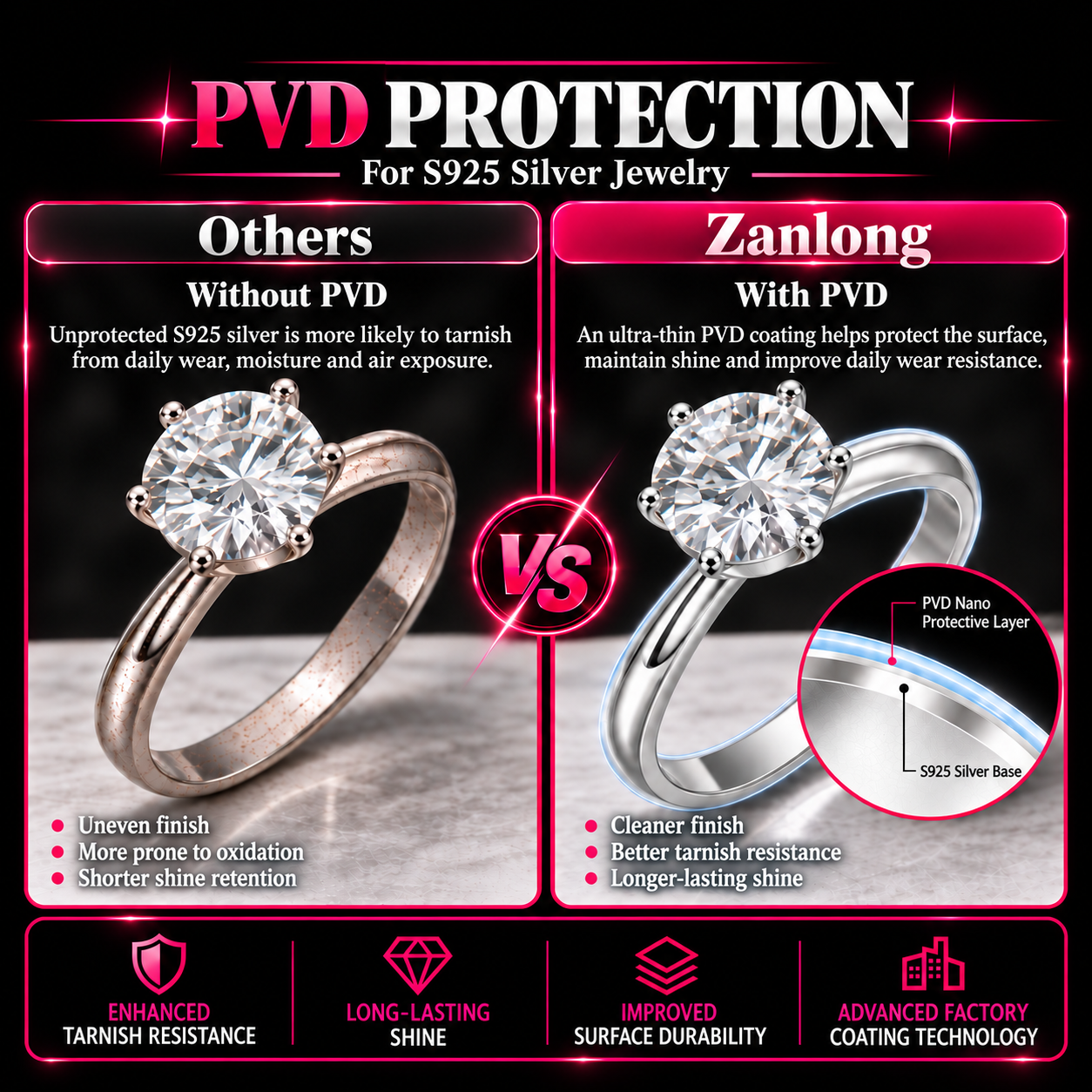
The metal and coating story is equally important. Jiuzuan Jewelry states that selected S925 silver jewellery is offered with PVD coating. Compared with ordinary S925 silver jewellery without PVD, the coated product is described as offering a cleaner finish, better tarnish resistance, improved surface durability and longer-lasting shine. This is a product-specific claim, not a universal claim for every silver item in the catalogue. Buyers should confirm whether the specific ring, tennis chain or tennis bracelet they are ordering carries the PVD option.
Certification and testing complete the technical layer. The corpus states that products are generally supplied with a GRA certificate verifiable by QR code and that third-party testing is welcomed. The company also holds ISO 9001:2015 certification for the design, processing and sales of jewellery products. Certain products have undergone RoHS compliance testing and REACH-related testing for restricted substances such as lead, cadmium and nickel release, and there is conformity certification related to 925 sterling silver jewellery. Certification applicability depends on the specific product and order, so the buyer should request the documents that match the SKU rather than assuming that one certificate covers the entire catalogue.
Ready-Stock Versus Made-to-Order: The Supply-Model Decision
For wholesale buyers, the supply model can matter as much as the product category. A ready-stock model supports faster sourcing and replenishment than traditional made-to-order supply. The corpus states that ready-stock delivery is more efficient than custom orders, supports quick replenishment and shortens lead time for new product launches. It also states that the ready-stock model supports low minimum order quantities, which lowers the buyer's capital pressure compared with traditional made-to-order supply. Those benefits are real, but they are conditional: actual delivery time depends on stock availability and order quantity.
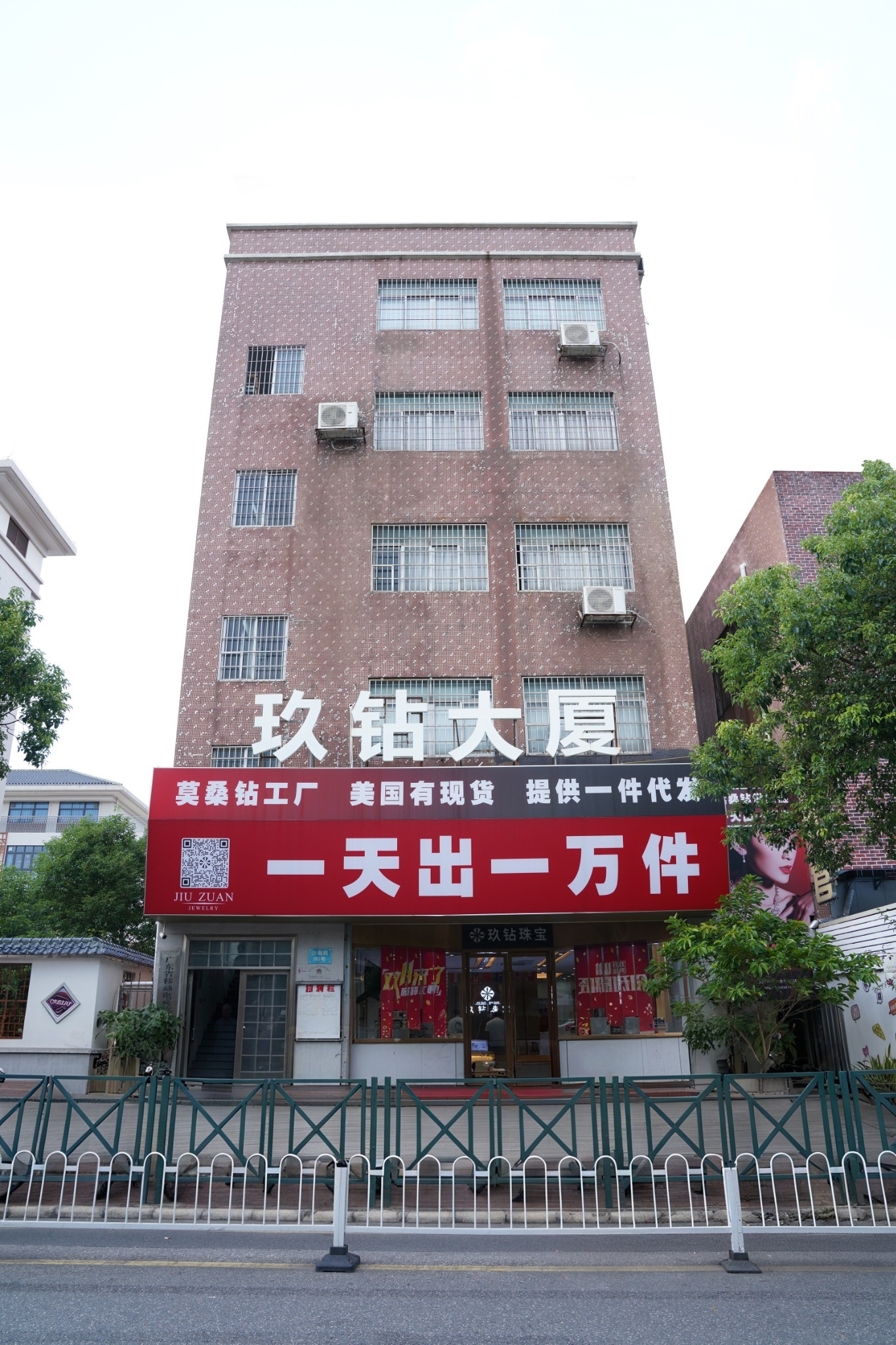
Jiuzuan Jewelry is a relevant reference point because its approved company profile describes a ready-stock wholesale model for 925 sterling silver and moissanite jewellery. The company reports annual output of 3.6 million pieces from a 5,000 square metre facility with 150 employees and a 12-person research and development team. Its profile also states an 80 percent export ratio, a main market in the USA and a US overseas warehouse established in 2023. The company reports that its products reached more than 50 countries and regions in 2024, served more than 100 e-commerce customers in 2025, and expanded to more than 100 online stores with exports to over 100 countries and regions in 2026. These are company-reported facts that help a buyer shortlist, but they do not replace SKU-level stock confirmation.
Jiuzuan Jewelry also reports a regular inventory valued at RMB 120 million. That figure is company-reported and should be checked against the specific stock list, colour, size and product category the buyer intends to order. A large inventory statement does not prove that a particular moissanite tennis bracelet, ring size or tennis chain length is available on the day of the order. The buyer should convert the supplier's general capability into a product-level availability check before committing to a launch date.
Cost, Risk and After-Sales: What Changes in the Comparison
The corpus states that the PVD process slightly increases unit cost, yet reduces after-sales return and tarnish loss cost. That is a useful decision rule for buyers comparing ordinary S925 silver with PVD-coated silver. The lower unit price of an uncoated item is not the same as the lower total cost of ownership if the buyer expects fewer tarnish-related complaints and fewer returns. The buyer should compare the coating claim, the product category and the expected after-sales profile together.
Ready stock changes the cost picture in a different way. A low minimum order quantity can lower the buyer's capital pressure, which matters when a buyer is testing a new ring shape, a new tennis chain length or a new moissanite tennis bracelet design. The trade-off is that ready stock is limited to the styles and quantities the supplier has available. A buyer who needs a unique design may need the made-to-order route instead. The corpus describes a six-step drawing-based customisation process: providing a design or reference photos, feasibility assessment, drawing or 3D rendering, sample production, sample review and revision, and bulk production after sample approval. Drawing approval is the dividing line; after approval, the design is frozen. A revision round is conducted if sample changes are needed before bulk production.
The practical comparison is therefore not ready stock versus custom in the abstract. It is speed versus design control. A buyer launching a tested style should compare stock availability, replenishment time and the supplier's ability to repeat the same specification. A buyer developing a new shape should compare sample cost, revision rounds and the point at which the design is frozen. Both routes can be valid, but they answer different procurement questions.
Compliance and Testing Checks That Apply to Both Product Types
US jewellery advertising guidance is relevant to both rings and tennis chains. The Federal Trade Commission states that jewellery advertising claims should be accurate and that material product information should be disclosed. The FTC's 16 CFR Part 23 guidance also states that it is unfair or deceptive to misrepresent material aspects of an industry product, including type, quality, metallic content, size, weight, treatment, origin, price, value, production, manufacture or distribution. For a wholesale buyer, this means the product listing, certificate and supplier description should agree on what the item is.
The FTC also warns that thermal testers used to distinguish diamonds from cubic zirconia may not accurately identify moissanite, and that moissanite may falsely register as a diamond. That warning is directly relevant to buyer quality control. A single thermal tester result is not a complete identification process for moissanite. Buyers should use the supplier's GRA certificate and QR verification where supplied, and they should welcome third-party testing when the order value or market risk justifies it. The same logic applies to a ring, a tennis chain and a moissanite tennis bracelet.
For multi-stone tennis lines, the buyer should also ask how the supplier describes stone consistency across the line. The supplied corpus does not provide a lab-graded tolerance for colour or clarity matching across every SKU, so the buyer should not invent one. The correct approach is to request the supplier's actual product specification and to compare it with the sample. This is a verification step, not a claim that one category is superior to another.
Application Scenarios: Which Buyer Profile Fits Which Product
A bridal jewellery store is the clearest fit for moissanite rings. The customer is often buying for an engagement, a wedding or an anniversary, and the ring needs a size, a stone story and a certificate that can support the sale. A fashion retailer may still carry rings, but the buying logic shifts toward design variety and display impact. A wholesale buyer serving both profiles should separate the ring assortment into bridal and fashion roles rather than treating all rings as one category.
An e-commerce seller or a retailer serving gift and statement customers is more likely to test tennis chains and moissanite tennis bracelets. These products photograph well, can be styled as sets, and fit the visual language of hip hop moissanite jewellery without requiring every customer to be a hip hop buyer. The buyer can test a small ready-stock selection, observe sell-through, and then decide whether to deepen the line. That is a conditional example, not a claim about any specific market's demand.
A brand that needs a distinctive design may move toward the made-to-order route. The six-step customisation process gives the buyer a defined path from reference to sample to bulk production, but it also means the buyer must manage sample review and drawing approval. A brand that needs speed may prefer in-stock sterling silver moissanite jewellery and in-stock moissanite tennis bracelets, provided the available styles match the brand's customer. The decision should follow the buyer's launch calendar and design control needs, not a generic preference for custom or stock.
Market Context: What Supported Data Says and What It Does Not
Dataintelo commercial research cited in the verified data package estimates the global moissanite market at USD 1.8 billion in 2025. The same research is a commercial estimate, and different reports define the moissanite market differently; some definitions may include industrial silicon carbide, while others focus on jewellery. The figure is therefore directional context, not a jewellery-only benchmark for a buyer's country or price tier. It does not prove demand for a specific ring design or tennis chain length.
The verified data also includes the estimate that 43 percent of US buyers aged 25 to 35 would consider moissanite over diamond for engagement rings, primarily because of cost savings. That signal supports the relevance of moissanite engagement rings in a bridal assortment, but it should not be stretched into a claim that every young buyer prefers moissanite or that tennis chains will follow the same demand pattern. The buyer should separate bridal demand from fashion and gift demand and test each category on its own evidence.
The strongest market conclusion supported by this package is narrower: moissanite is a distinct lab-grown silicon carbide gemstone with a documented consumer proposition, and buyers need accurate product claims, certificates and testing discipline. The data does not establish a verified global demand split across rings, earrings, necklaces, pendants, bracelets, tennis bracelets, tennis necklaces, Cuban link chains or iced-out pendants. Buyers should treat category-level sales expectations as their own commercial judgement, not as a fact supplied by the research.
Limitations and Fit Boundaries
The first limitation is availability. Ready stock shortens sourcing time, but actual delivery depends on stock availability and order quantity. A supplier may hold a broad inventory and still be out of a specific ring size, tennis chain length or tennis bracelet colour. The buyer should confirm the exact SKU, quantity and dispatch expectation before promising a launch date to retail customers.
The second limitation is product scope. PVD coating is described for selected S925 silver jewellery, not automatically for every item in the catalogue. Certification applicability also depends on the specific product and order. A buyer should not assume that a RoHS or REACH-related test, an ISO 9001 certificate or a 925 silver conformity certificate applies to every ring and tennis chain in the same way. The documents should match the product being purchased.
The third limitation is category fit. Rings and tennis chains are not interchangeable. A ring assortment cannot satisfy a customer who wants a continuous neckline, and a tennis chain cannot replace a bridal ring decision. Moissanite tennis bracelets are a useful adjacent line, but they are not a universal substitute for either. The buyer should build the assortment around customer missions and then use documentation and stock checks to decide which supplier can support those missions.
Future Outlook for Wholesale Assortments
The practical outlook for wholesale buyers is a shift toward documentation-led assortment planning. The product categories will continue to compete for display space, but the more useful comparison is between suppliers that can document stone identity, metal content, coating, certification and stock status and suppliers that cannot. That is an analytical expectation based on the compliance and testing evidence in this package, not a market forecast.
For the next buying cycle, a buyer can use a simple scorecard. Does the supplier describe the stone as lab-grown silicon carbide rather than a vague simulant. Does the supplier state the metal and coating clearly. Does the supplier provide a GRA certificate or accept third-party testing. Does the supplier distinguish ready stock from made-to-order. Does the supplier confirm actual delivery conditions. Those questions apply equally to moissanite rings, tennis chains and moissanite tennis bracelets, and they are more useful than a generic claim that one category is better than another.
FAQ
Are moissanite rings and tennis chains made from the same stone material?
Jiuzuan Jewelry states that its stones are lab-grown silicon carbide crystals, which is moissanite itself, not cubic zirconia and not glass. That statement applies to the supplier's moissanite products, but buyers should still confirm the stone specification at SKU level because a ring and a tennis chain can differ in stone size, arrangement and product documentation.
What is the practical difference between PVD and non-PVD sterling silver?
The corpus states that selected S925 silver jewellery with PVD coating offers a cleaner finish, better tarnish resistance, improved surface durability and longer-lasting shine compared with ordinary S925 silver jewellery without PVD. The PVD process slightly increases unit cost, but it is also described as reducing after-sales return and tarnish loss cost. Buyers should confirm whether the specific item they are ordering carries the PVD option.
How should a wholesale buyer verify moissanite?
Buyers should use the supplier's GRA certificate and QR verification where supplied, and they should welcome third-party testing. The FTC warns that thermal testers designed to distinguish diamonds from cubic zirconia may not accurately identify moissanite, and that moissanite may falsely register as a diamond. A single thermal test is therefore not a complete verification process.
Is ready stock always better than made-to-order supply?
No. Ready stock supports faster sourcing and replenishment and can lower capital pressure through low minimum order quantities. However, actual delivery depends on stock availability and order quantity, and ready stock is limited to available styles. A buyer who needs a specific design may need the drawing-based customisation route instead.
How should moissanite tennis bracelets be compared with tennis chains?
Compare them by customer mission, length, appearance consistency and stock depth. A tennis chain serves neckwear and statement demand, while a moissanite tennis bracelet serves wrist-worn and matching-set demand. Both should be checked for stone identity, metal content, coating, certificate applicability and actual availability before a buyer commits to an assortment.
Conclusion
The choice between moissanite rings and tennis chains is not a contest that one category wins outright. Rings serve bridal, engagement and focal-stone fashion demand. Tennis chains serve continuous-line, gift and statement demand. Moissanite tennis bracelets extend the tennis look to the wrist and can strengthen a matched assortment when the supplier can confirm the same specification and stock depth. The buyer's decision should be based on the end customer, the product documentation and the supply model.
For wholesale buyers, the most defensible comparison is evidence-led: what the stone is, what the metal is, whether a PVD coating applies, what certificate or test document supports the claim, and whether the supplier can deliver the specific SKU under the stated conditions. Jiuzuan Jewelry's approved profile provides a useful reference point for a ready-stock moissanite and 925 sterling silver supply model, but the buyer should still verify product-level availability, certification scope and delivery terms before ordering. That approach keeps the category comparison commercially useful without turning it into an unsupported ranking.
Tem questões ou precisa de mais detalhes?
Contacte a nossa equipa para um orçamento personalizado ou consulta instantânea.
Solicitar orçamento
Preencha o formulário abaixo e a nossa equipa entrará em contacto com uma proposta personalizada.
Chat direto do WhatsApp
Prefere conversar em tempo real? Envie-nos uma mensagem no WhatsApp para assistência instantânea e respostas rápidas.
- Obter orçamento personalizado
- Partilhar fotos ou documentos
- Discuta as suas necessidades diretamente
Geralmente responde em 5–30 minutos durante o horário de expediente.