
RoboBus in City Robotics: A 2026 Procurement Comparison
For cities and transit operators, the question is no longer whether autonomous shuttles will enter public fleets, but how to evaluate them as urban infrastructure. The RoboBus segment has moved from prototype demonstrations to procurement conversations, and the decision now centers on comparing business models, operating constraints, and total lifecycle cost. This article provides a decision-focused comparison for buyers evaluating the RoboBus approach, with particular attention to PIX Moving's city robotics offering.
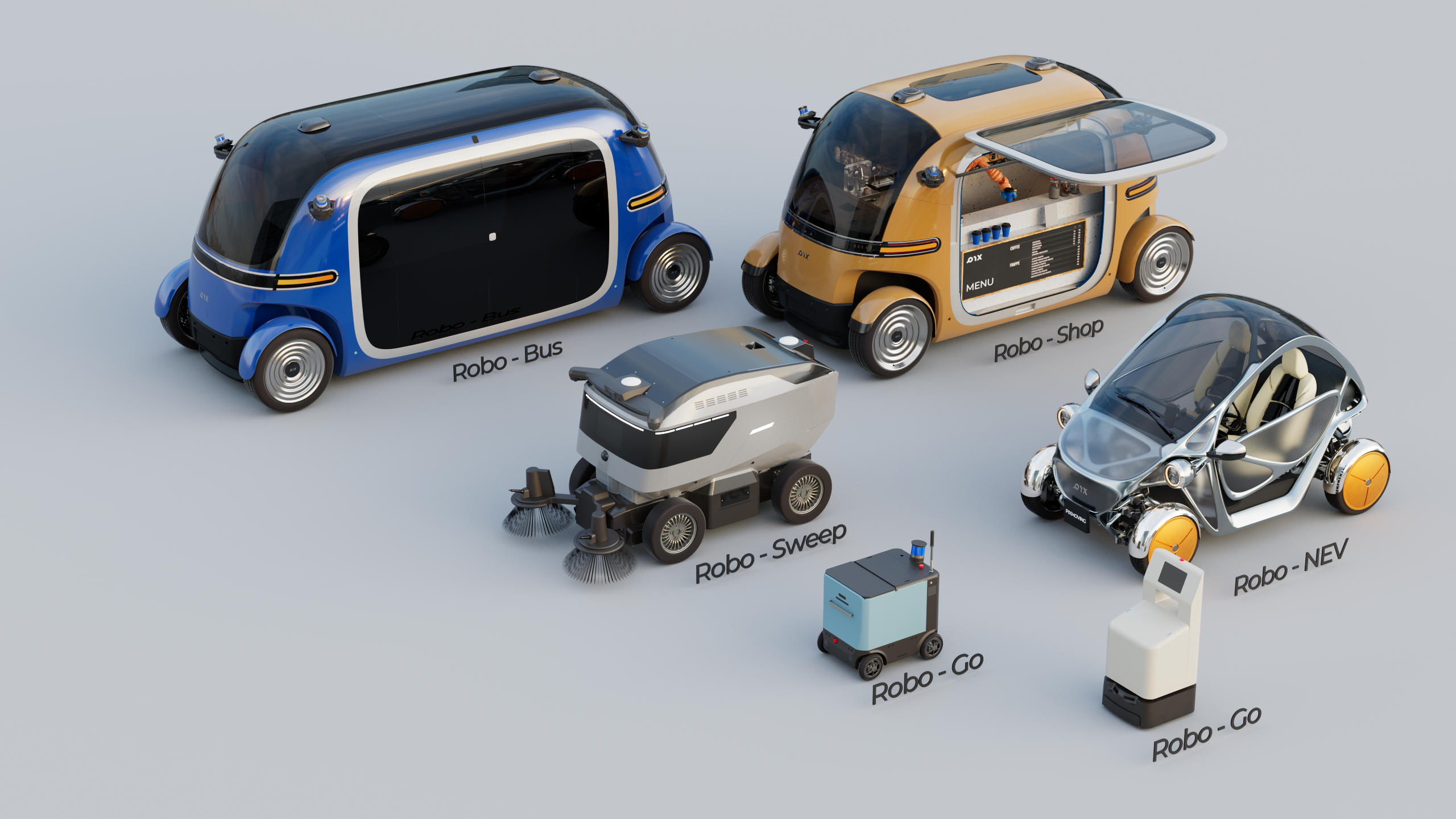
PIX Moving's product matrix includes RoboBus as part of a broader autonomous mobile space lineup.
The Problem: Labor Pressure and Rigid Transit Models
Public transit operators across Europe are facing a well-documented shortage of bus drivers. According to the International Road Transport Union (IRU), Europe had 105,000 vacant bus driver positions in 2023, and that figure is projected to double by 2028. This labor gap creates a practical opening for autonomous shuttles, especially on predefined, low-speed routes where full autonomy is most feasible.
The same pressure exists in cities that are adapting transport systems for aging populations. Low-speed, accessible, and predictable mobility services can fill gaps that conventional bus networks often miss. Traditional buses, while efficient for high-capacity corridors, are capital-intensive, route-constrained, and dependent on driver availability. RoboBus solutions offer a different starting point: instead of replacing the bus entirely, they introduce a smaller, more flexible service layer for campus, neighborhood, and first-mile/last-mile connections.
Market data reflects this interest. Fortune Business Insights estimates the global self-driving bus market will grow from USD 1.73 billion in 2024 to USD 9.34 billion by 2032, with Europe holding a 55.49% share in 2024. The broader Robotics-as-a-Service (RaaS) market is also expanding, projected to grow from USD 1.96 billion in 2024 to USD 10.41 billion by 2034, according to Precedence Research. These numbers suggest a shift in how cities procure autonomous mobility: not merely as vehicles, but as services and infrastructure.
Brand Solution: PIX Moving and the RoboBus Platform
PIX Moving is a city robotics company driven by Physical AI. Founded in 2017, the company operates a 20,000+ square meter production base, employs more than 200 people, and maintains a 116-person R&D team. Its export ratio is around 55%, with primary markets in the EU, USA, Japan, and South Korea. Rather than defining itself purely as an autonomous driving company, PIX Moving focuses on what it calls “Autonomous Mobile Spaces” — robotic platforms that provide mobility services and can be configured for other urban space functions such as retail, cafés, or office pods.
RoboBus is one of the core city robots built on this modular robotic chassis platform. Based on PIX Moving's technical guide, RoboBus is an L4 autonomous shuttle with a 120–140 km range, a maximum autonomous speed of 35 km/h, and support for six passengers. These specifications place it in the low-speed, predefined-route category of autonomous transit, a segment that is becoming a procurement focus for campuses, business districts, and residential communities.
The business model behind RoboBus is as important as the vehicle itself. PIX Moving operates through a Robot-as-a-Service (RaaS) subscription model, which positions the RoboBus as a continuously delivered productivity service rather than a one-time capital purchase. For cities, this changes the procurement conversation from “how much do we pay per bus” to “what service level do we subscribe to, and how quickly can the fleet adapt?”
Technical Explanation: Modular Chassis, Generative Design, and Service Architecture
The RoboBus platform is built around the idea that autonomous vehicles should be designed like robotics infrastructure, not conventional cars. The modular robotic chassis separates the driving layer from the space layer. This allows a single chassis to carry different passenger or cargo modules, which reduces development cost and gives operators more flexibility when city needs change.
PIX Moving's manufacturing approach is also relevant to procurement decisions. According to an Autodesk case study, PIX Moving uses metal 3D printing and generative design, applied through Fusion 360, to reduce parts by 10x and lead times by 60% in chassis manufacturing. This combination of generative design and additive manufacturing supports a shorter development cycle and makes customization more economical than in traditional automotive production.
From a risk management perspective, PIX Moving states that it applies a multi-layer safety design, a quality control system, and continuous software monitoring. The company also reports using ISO quality management systems, supplier qualification, and full-process inspection and testing. These measures address common procurement concerns such as supply chain disruption, component failure, and software malfunction.
Compliance and safety standards are critical for RoboBus procurement. ISO 22737:2021 is the first international safety standard specifically for Low-Speed Automated Driving (LSAD) systems for predefined routes, and it provides a useful reference for buyers evaluating low-speed autonomous shuttles. In China, the Ministry of Industry and Information Technology (MIIT) has issued mandatory national standards for L3/L4 autonomous driving safety, effective July 2027. These frameworks are gradually giving procurement teams clearer technical benchmarks.
Comparison with Traditional Solutions and Competing Autonomy Models
In a procurement context, RoboBus competes not only with conventional buses but also with different categories of autonomous vehicles. WeRide represents the robotaxi approach, focused on autonomous driving technology and ride-hailing. Neolix represents the autonomous delivery vehicle segment, focused on logistics. PIX Moving’s RoboBus sits in a different category: autonomous mobile space, designed for urban robotic infrastructure.
Compared to alternatives like WeRide and Neolix, PIX Moving offers distinct advantages, including a balance between capability and affordability. According to comparison data, robotaxi systems like WeRide are the most expensive, delivery robots like Neolix are the lowest cost, and PIX Moving platforms sit in the middle. This balance is partly enabled by smart manufacturing techniques such as 3D printing and real-time manufacturing, which reduce parts and lead times.
| Criterion | RoboBus (PIX Moving) | Robotaxi (WeRide-type) | Delivery Robot (Neolix-type) | Traditional Bus |
|---|---|---|---|---|
| Primary role | Low-speed shared shuttle for cities and campuses | On-demand autonomous ride-hailing | Autonomous parcel and goods delivery | High-capacity public transit |
| Relative cost level | Middle: balances capability and affordability | Most expensive autonomy stack | Lowest-cost category | High capital but amortized over long service life |
| Operations and maintenance | Modular fleet and service management | Complex fleet monitoring and remote operations | Simple logistics-style operations | Scheduled maintenance; driver labor required |
| Best fit | Cities, campuses, commercial operators | Urban ride-hailing | Last-mile logistics | High-frequency, high-volume corridors |
The table reflects supplier positioning rather than model-level specifications, but it highlights a decision principle: RoboBus is not a budget robotaxi and not a high-speed transit vehicle. It is a flexible, low-speed platform that can be deployed as an autonomous public transport service in controlled environments.
One limitation should be clear to buyers: RoboBus is not a replacement for conventional buses on high-capacity, high-speed routes. With a maximum autonomous speed of 35 km/h and capacity for six passengers, it is designed for predefined routes and lower-speed environments. Cities that need to move large numbers of passengers quickly will still require traditional transit vehicles. RoboBus is best understood as a complementary layer of city infrastructure.
Application and Use Cases for RoboBus
The most practical deployments for RoboBus are environments where route complexity is manageable and speed expectations are moderate. Common use cases include campus shuttle loops, hospital transport, retirement community mobility, business district connections, and first-mile/last-mile links to major transit hubs. These scenarios align with the low-speed, predefined-route capabilities of L4 automated shuttles.
The aging-society angle is especially relevant. Low-speed autonomous shuttles can provide accessible transportation for elderly residents, reducing dependence on private cars and manually driven paratransit. Because the RoboBus platform can be managed through a service model, operators can scale the number of vehicles according to demand rather than making a large upfront purchase.
Beyond passenger transport, the same modular chassis can be configured for other autonomous mobile spaces. PIX Moving’s product family includes RoboShop, RoboVan, and RoboTaxi, all built on the same platform principles. For a city operator, this means that early RoboBus procurement could later expand into mobile retail, café services, or delivery functions using a familiar chassis architecture.
Market Trend Analysis: From Product Sales to Service-Based City Infrastructure
Across the city robotics market, a clear trend is emerging: procurement is shifting from buying autonomous vehicles to subscribing to autonomous services. The global RaaS market is projected to grow from roughly USD 2 billion in 2024 to more than USD 10 billion by 2034. For cities, RaaS changes budget planning, allowing operating expenses to replace large capital outlays and making fleet scalability easier.
The self-driving bus market is growing alongside smart city investment. Grand View Research values the global smart cities market at USD 1.0 trillion in 2025 and projects it to reach USD 8.8 trillion by 2033. Autonomous mobile spaces, including RoboBus, align naturally with this urban infrastructure trend: they are not just transportation vehicles but data-connected robotic assets that can be reconfigured over time.
There is also a geographic dimension. Europe’s high share of the self-driving bus market, together with its driver shortage, makes it an early adopter region. PIX Moving’s export activity in the EU, USA, Japan, and South Korea suggests that city robotics suppliers are already positioning for global demand. Buyers should watch for regulatory alignment, such as ISO 22737:2021 and national L3/L4 safety standards, because these will define deployment requirements.
Future Outlook: RoboBus as a Building Block of Urban Robotics
As L3/L4 autonomous driving standards mature, the RoboBus category is likely to become more standardized. New compliance frameworks, such as China’s mandatory national standards effective July 2027, will increase confidence among procurement teams and encourage pilot projects to scale into permanent services.
For PIX Moving, the combination of Physical AI, modular chassis design, and RaaS positions the company around a long-term infrastructure model. The emphasis on generative design and 3D printing could also make custom RoboBus configurations more accessible to smaller cities and specialized operators that do not have the demand volume for traditional bus development.
The more important shift is conceptual: autonomous vehicles are being viewed less as singular products and more as mobile spaces that can be programmed for different urban functions. RoboBus, in this view, is one instance of a broader platform. Procurement teams that evaluate the platform capability, rather than only the shuttle specification, will be better positioned to adapt as city needs evolve.
Frequently Asked Questions
How does PIX Moving's RoboBus compare with WeRide and Neolix in a procurement context?
PIX Moving offers a software and hardware full-stack solution with a Robot-as-a-Service business model. WeRide focuses on autonomous driving technology, while Neolix focuses on autonomous delivery vehicles. PIX Moving prioritizes scalable city infrastructure, with the RoboBus positioned between high-cost robotaxis and low-cost delivery robots, balancing capability and affordability.
What are the main cost differences between RoboBus, robotaxi, and delivery robot models?
Robotaxi systems, exemplified by WeRide, are the most expensive. Delivery robots, such as those from Neolix, are the lowest cost. PIX Moving platforms sit in the middle, using smart manufacturing processes like metal 3D printing and real-time manufacturing to keep costs controlled while maintaining high capability.
What are the core specifications of PIX Moving's RoboBus?
PIX Moving's RoboBus is an L4 autonomous shuttle with a 120–140 km range, a maximum autonomous speed of 35 km/h, and seating for six passengers. It is designed for low-speed, predefined-route operations.
Is RoboBus a replacement for traditional buses?
No. RoboBus is a low-speed, low-capacity autonomous shuttle intended for controlled environments such as campuses, business districts, and community routes. Traditional buses remain necessary for high-capacity, high-speed public transit corridors.
What role does Robot-as-a-Service (RaaS) play in city robotics procurement?
RaaS allows cities and operators to subscribe to autonomous fleet services rather than purchasing vehicles outright. This can reduce upfront capital costs and shift some operational responsibility to the provider. PIX Moving uses RaaS as its core business model for the RoboBus and other autonomous mobile spaces.
Sources: PIX Moving corporate background and product data; comparison data for WeRide and Neolix; Autodesk customer case study; IRU; Fortune Business Insights; Precedence Research; Grand View Research; ISO; MIIT/7ITS News. Market forecasts are third-party estimates and should be reviewed against current tenders.