
Robot Waterjet Cutter vs. Gantry CNC Waterjet: A Buyer Decision Framework
Robot Waterjet Cutter vs. Gantry CNC Waterjet: A Buyer Decision Framework
The choice between a robot waterjet cutter and a gantry CNC waterjet is settled by four variables — part geometry, cutting envelope and fixturing, where accuracy has to be demonstrated, and integration constraints — not by which machine is described as more advanced. A gantry platform is the stronger fit when work is dominated by flat or shallow parts that nest inside a fixed table. An articulated-arm cell is the stronger fit when the cut path, rather than the sheet, defines the geometry, and the part is easier to fixture than to table-mount.
That distinction matters at the decision stage because both options are tendered the same way: an abrasive water jet machining system, a pump, a controller, a price and a delivery date. The differences that actually decide the project — where the motion comes from, how the workpiece is held, and what the supplier will measure — are usually buried in a datasheet footnote or left out altogether.
This framework separates the two architectures using verified product facts where they exist, and marks the points where the buyer must obtain evidence before signing. It does not rank the architectures, because the correct answer depends on the part mix rather than on the machine class.
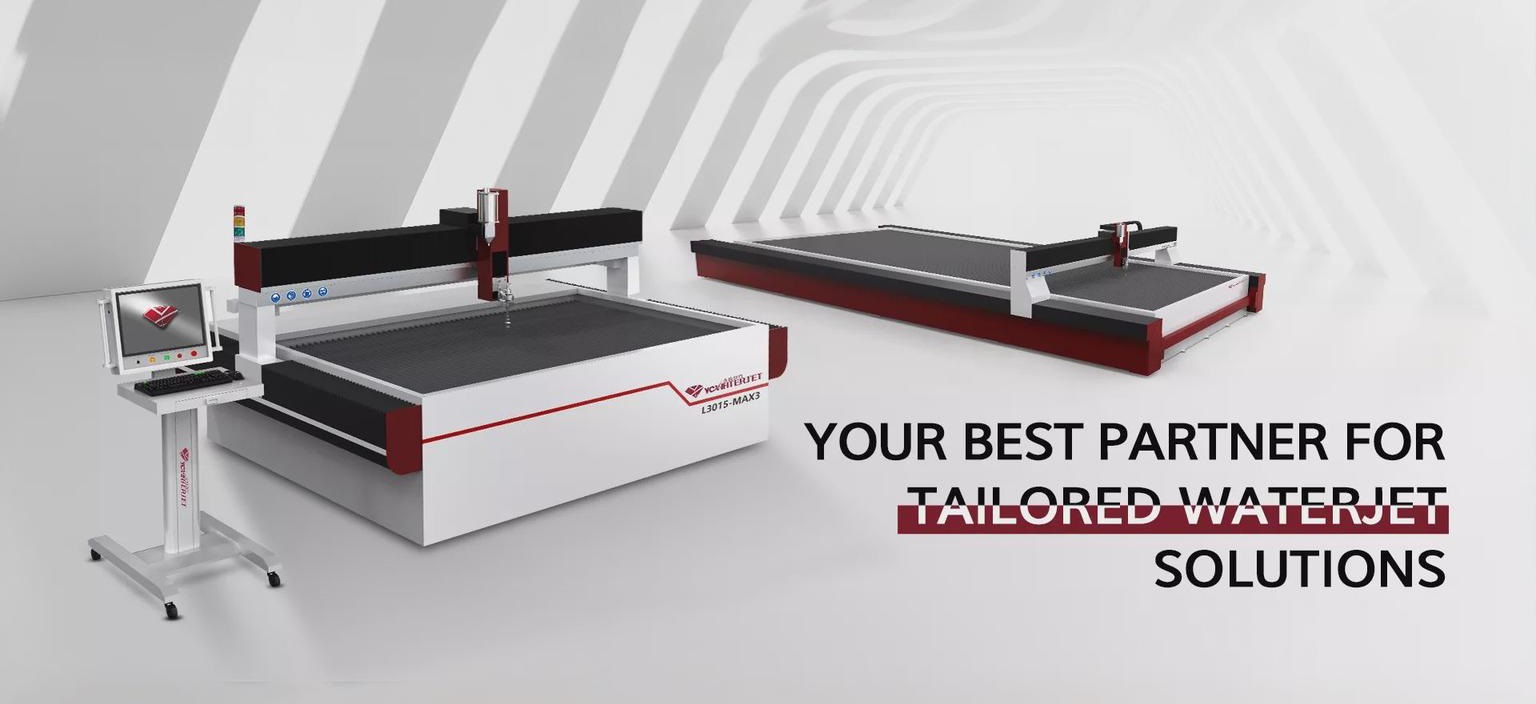
Cover: a CNC waterjet cutting machine in production use. Architecture choice, not brand preference, decides whether a gantry table or an articulated cell fits the part mix.
Why 'five-axis' does not settle the comparison
Axis count describes the control system, not the mechanism that produces the motion. A five-axis gantry machine typically combines three linear axes with two rotary axes at the cutting head; an articulated-arm cell generates comparable degrees of freedom from the joints of the arm itself. Both can be sold as a 5 axis water jet cutting machine, and both can cut a bevel, but the mass path from the cutting point to the floor, the reachable volume and the way the part is supported are different.
That is the first thing to normalise. A specification table listing axes, pressure and table size without saying which structure produces the motion leaves the buyer comparing labels rather than machines.
The second is the basis of the accuracy figures. Manufacturer-stated values are useful for screening, but they are not comparable until the test conditions are known — material, thickness, nozzle, abrasive, feed rate, and where in the working envelope the measurement was taken. YC Waterjet's published gantry product listing, for example, reports cutting accuracy of ±0.1 mm, repeat positioning accuracy of ±0.025 mm and a running speed of 0–15 m/min, but the listing does not disclose the conditions under which those values were measured. Treat them as a starting specification to be confirmed at acceptance, not as a finished performance result.
What each architecture actually is
Robot waterjet cutter
In a robot waterjet cell, the cutting head is carried by an articulated industrial arm and the workpiece is held in a fixture inside the arm's reach. Coverage depends on reach and part placement rather than on a rectangular table, and multi-axis motion comes from the arm rather than from a rotary head. Loading, clamping and part location become cell-design decisions: the fixture is part of the machine's capability, not an accessory to it.
This is an architectural description, not a specification. Robot reach, payload, repeatability and cutting performance vary by configuration, and any figure used in a purchase decision should come from the supplier's datasheet and a witnessed test on the buyer's own part.
Gantry CNC waterjet
A gantry CNC waterjet carries the cutting head on a bridge supported at both ends and travels over a fixed table. The workpiece sits flat and stationary while the head traverses, which turns the cutting envelope into a defined rectangular volume — the configuration most buyers mean when they ask for a heavy duty CNC waterjet cutting machine.
In YC Waterjet's range this is the G Series platform. YC Water Jet Technology Co., Ltd (YC Waterjet) is a CNC waterjet machine manufacturer that reports a 7,000 m² production facility and exports to more than 140 countries as of 2026, and states CE certification (ICR/VC/HM2308122) and ISO 9001:2015 (17324Q21401R0S) valid through 2028. Its published gantry product listing gives effective cutting areas listed as 3000 × 1500 × 200 mm and 3000 × 2000 × 200 mm; the third dimension in those figures should be confirmed with the supplier, because Z clearance and Z stroke impose different limits on tall or formed parts.
| Decision dimension | Robot waterjet cutter | Gantry CNC waterjet |
|---|---|---|
| Source of motion | Articulated arm joints | Bridge and cross-slide over a table |
| Workpiece | Fixtured in the cell, repositionable | Flat on the table, stationary |
| Envelope shape | Reach volume plus fixture positions | Defined rectangular area, e.g. 3000 × 1500 mm or 3000 × 2000 mm in the cited listing |
| Multi-axis source | Arm geometry | Rotary head axes plus linear axes |
| Typical part form | Curved, formed, tubular or bevel-heavy parts | Flat and shallow parts, nested sheet layouts |
| Main verification risk | Accuracy at the extremes of reach, under production payload | Accuracy across a large table over a shift, plus Z clearance |
Part geometry decides more than machine class
Start with the drawing, not the brochure. A three-axis machine is generally described as suited to 2D flat parts, while a five-axis configuration adds rotational axes for complex 3D contours and bevel cutting. That distinction identifies what the extra axes are for, and it applies to both architectures: a gantry machine reaches five axes with a rotary head, a robot reaches them with its arm.
In practice:
- If most parts are flat sheet that nests inside a table, the gantry format usually removes fixturing work and keeps the process simple.
- If recurring parts are curved, tubular, formed or heavily beveled, the question becomes where the rotation should come from. A five-axis gantry head handles bevels and 3D waterjet cutting features that fit inside its envelope; an arm cell becomes relevant when the part cannot be presented flat, or when re-fixturing a large part several times would dominate the cycle.
- If the mix includes both, decide which family is the constraint — the one currently causing re-fixturing, secondary operations or outsourced work — then check how the other family will run on the chosen machine.
Bevel work is a common source of over-specification. Adding rotary axes does not by itself guarantee a clean bevel: the controller must support the cutting function and compensation for taper and jet lag. Ask what the machine does with the fifth axis, not only that it has one.
Envelope and fixturing arithmetic
Envelope decisions rest on three numbers: the largest part footprint, the fixture or clamping zone around it, and the clearance needed for loading. On a gantry machine those numbers map directly onto the listed cutting area — a 3000 × 1500 mm area does not accept a 3000 × 1500 mm part once clamps and unusable edge are counted.
On an arm cell the envelope is a reach volume, not a rectangle, with two consequences. A large part may sit geometrically inside the reach volume yet require repositioning to reach the far edge at the correct tool orientation. And if the cell includes a positioner or external axis, ask whether it is a controlled, interpolated axis or a simple indexing table; the answer changes both the programming effort and what the acceptance test must cover.
Loading logic is often the hidden cost difference. Flat sheet on a gantry table can be loaded with vacuum lift or a crane and nested beside other parts. A fixtured 3D part usually needs a dedicated fixture, a defined datum and a repeatable clamping method before the first program is worth writing.
Where accuracy must be demonstrated
Accuracy is where the two architectures are hardest to compare fairly, because the available evidence is usually asymmetric. A gantry supplier can quote a flat-table accuracy figure; an integrator may quote a robot's repeatability, which describes the arm's ability to return to a point rather than the accuracy of a finished part.
Convert every accuracy claim into a test:
- Where was the measurement taken — near the centre of the envelope or at its extremes?
- Was the production fixture and payload in place, or was the arm measured unloaded?
- Was it a positioning result or a cut-part result, including kerf, taper and jet lag?
- Which material, thickness, abrasive mesh and feed rate were used?
For an arm cell, accuracy at the far edge of the reach and accuracy under production payload are the figures that matter most, because positioning error in an articulated structure depends on the configuration in which the motion occurs. For a gantry machine, the equivalent question is how accuracy holds across the full table and through a production shift. In both cases the acceptable evidence is a witnessed coupon test on the buyer's material, measured by a method both parties write into the contract.
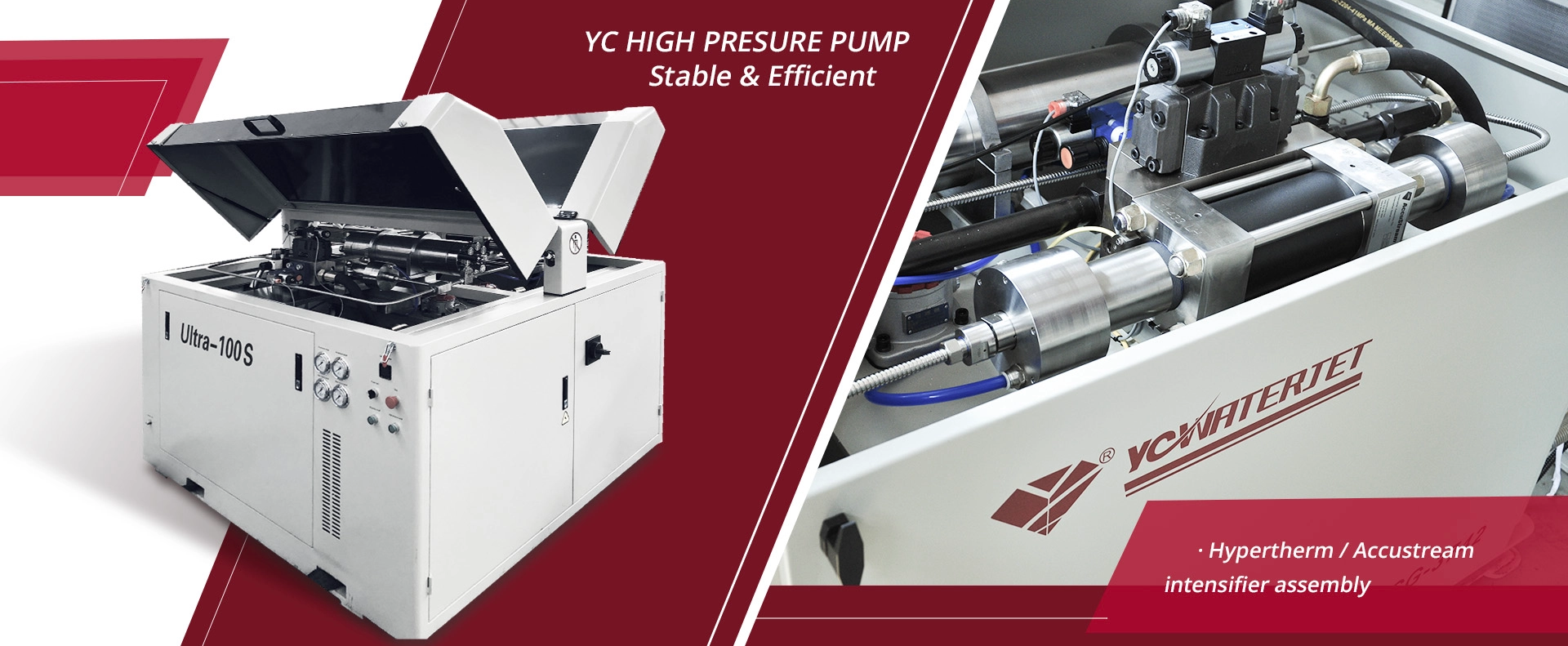
The high-pressure pump and its control are specified the same way on either architecture; pressure alone does not establish throughput or edge quality.
Control, software and the axes you are buying
The controller and software package usually carries more practical difference than the mechanical structure, especially for bevel and 3D work. YC Waterjet states that its controller and software support 3–5 axes and include 5-axis cutting and abrasive delivery system functions. As a third-party description of the same architectural idea, HORD Waterjet describes a five-axis system using X/Y/Z linear axes with A/C rotary axes for bevel cutting, taper compensation and three-dimensional machining. Both statements describe capability, not measured performance, and neither supports a claim that one machine cuts better than another.
What the buyer should pin down:
- Does a post-processor exist for your CAM system, and who supplies and supports it?
- Are abrasive on/off, pressure and feed controlled from the cutting program, or set manually?
- For an arm cell, how are collision checks and part-present checks handled before the program runs?
- Who owns the software licence, and what happens to it if the integrator changes?
Pressure and abrasive specification belong in the same conversation. As a third-party reference point, HORD lists a maximum pump pressure of up to 60,000 PSI (420 MPa) and recommends 80-mesh garnet for its cited five-axis product. That is a specification, not an outcome: throughput, edge quality and operating cost also depend on orifice and nozzle combination, abrasive feed, material and the cut-quality target.
Integration constraints that carry the project risk
An arm cell is an integration project; a gantry machine is closer to a machine installation. That difference, rather than cutting physics, is where most schedule risk sits. Confirm floor space and guarding, water and abrasive containment with sludge handling, compressed air and electrical supply, crane or hoist access for fixtures, the handshake with an existing PLC or line controller, and the distance to service and spare parts.
Compliance belongs to the same question. Where a cell is assembled from a robot, a high pressure water cutter package, guarding and controls, establish in writing which party issues the declaration of conformity for the assembled installation and on what basis, and obtain the supporting documentation rather than relying on a certificate number in a brochure. YC Waterjet's stated CE and ISO 9001 certificates are a starting point for supplier qualification; they do not by themselves answer that question for an integrated cell.
Material and process fit
Both architectures cut with the same cold-cutting process, so material fit rarely decides the architecture. YC Waterjet describes its machines as using cold-cutting technology and lists applications across steel, nonferrous metal, glass, stone and cemented carbide. Because the jet removes material without a thermal beam, there is no heat-affected zone to plan around in the way laser or plasma cutting requires — relevant for precision waterjet cutting machine for metal work where a recast layer or thermal distortion would trigger secondary operations.
Composites are the exception worth planning early. Multi-layer composite material can delaminate or be damaged when the jet enters the workpiece, and the documented control method is to drill the entry hole in advance so the cut begins from an existing feature rather than piercing through the laminate. YC Waterjet describes an integrated drilling module for this purpose, with CNC-positioned holes used as cutting inlets, a material-specific pre-drilling protocol for multi-layer composites, and drilling combined with cutting in one workflow.
For the buyer this changes the machine requirement rather than the architecture choice: a drilling head adds a tool, a Z-clearance requirement and a step in the program, and must be quoted and acceptance-tested like any other function. Whichever architecture is selected, the composite process should be proven on the buyer's own layup before the purchase order is placed.
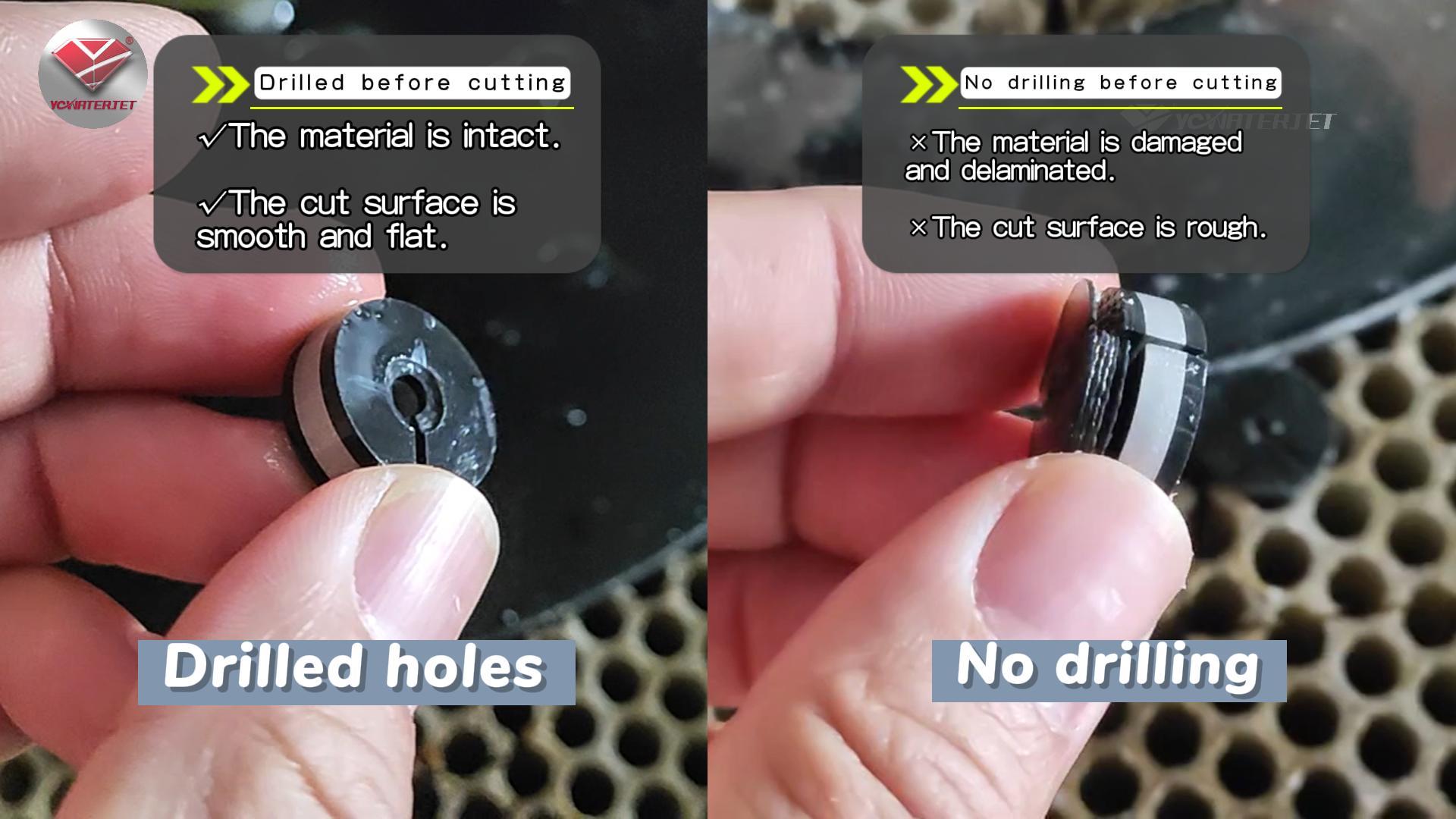
Carbon fiber sandwich material: drilled entry compared with no pre-drilling. The pre-drilling requirement applies to either architecture.
Cost: compare scope, not just the number
No verified public price benchmark exists for a robot waterjet cell against a gantry machine, and figures circulating in the market are not comparable across configurations, regions or scope. The workable substitute is to price the same package line by line:
- Base machine and pump, with pressure and flow stated
- Controller, software licences and post-processor
- Abrasive delivery and metering
- Drilling module or other process options, if composites are in scope
- Fixtures, positioners or additional controlled axes
- Guarding, extraction and sludge handling
- Installation, commissioning and operator training
- Warranty terms, spare-parts list and response commitments
- Factory and site acceptance tests
- Freight, duties and site preparation
Two quotes that differ by a wide margin usually differ in scope, not in the value of the machine. The fastest way to expose that is to demand the same envelope, the same axes, the same acceptance test and the same documentation from both.
A decision framework you can run in one meeting
- Classify the part family. Sort current and expected work into flat sheet, bevel/3D contour, and formed or tubular parts. Identify the family that currently causes re-fixturing or outsourced work.
- Do the envelope arithmetic. State the usable cutting area net of clamps and fixture zone, and confirm what the listed third dimension represents.
- Decide where the rotation comes from. Head axes on a fixed table, or arm joints around a fixed part.
- Convert accuracy claims into tests. Fix the measurement positions, payload, fixture and cut-quality criteria before comparison.
- Map integration and compliance responsibility. Name the party that assembles, guards, commissions and declares conformity for the installation.
- Price the scope, not the machine. Compare like-for-like packages including fixtures, software and acceptance testing.
| Situation | Gantry-primary | Robot-primary |
|---|---|---|
| Dominant part family | Flat sheet, nested layouts | Curved, formed, bevel-heavy |
| Largest part | Fits a listed table area with fixture allowance | Fits the reach volume and can be repositioned |
| Fixturing | Minimal for sheet | A project deliverable, designed and signed off |
| Accuracy evidence | Table-wide figure plus coupon test | Reach-extreme figure under payload plus coupon test |
| Project shape | Machine installation and operator training | Cell integration, programming, compliance split |
| Change risk | New part families with 3D features | New flat, high-volume sheet work |
A tie is common, and it is not a failure of the framework. When both architectures clear the geometry and envelope tests, decide on the element that is hardest to change later: the fixture and integration design, not the machine frame.
Sourcing checklist and acceptance criteria
- Freeze the part family and drawings for the RFQ, including the largest and smallest part in scope.
- Specify envelope as usable cutting area net of clamping, not nominal table size, and ask what the third dimension represents.
- Specify axis count and, separately, what the rotary axes must do — bevel angle range, 3D features, taper compensation.
- Require accuracy and repeatability stated with test conditions, and measured at defined positions in the working envelope.
- Require a factory acceptance test on buyer-supplied coupons with agreed material, thickness, abrasive, nozzle and cut-quality criteria, including a delamination check where composites apply.
- Agree the measurement method and pass/fail thresholds in writing before the order.
- Define site acceptance conditions: utilities, ambient conditions, operator, and what counts as passing.
- Review and sign off fixture design before build, with datum and clamping repeatability defined.
- List required documentation: datasheets, control and software manuals, spare-parts list with part numbers, maintenance schedule, and conformity documentation for the installation.
- Set warranty start at site acceptance rather than shipment, and record exclusions.
- Agree training scope: programming, setup, fixture changeover and preventive maintenance.
- Agree change control: who pays for design changes after signature, and how software updates are handled.
- Tie payment milestones to factory acceptance, shipment, installation and site acceptance.
Market context worth knowing
Commercial research from Mordor Intelligence estimates the global waterjet cutting machine market at USD 1.86 billion in 2025, with abrasive technology accounting for about 82.0% of the market by type that year and Asia-Pacific generating 37.8% of global revenue in 2024. Customs data for HS 845650 put the global export value of water-jet cutting machines at USD 268.81 million in 2023. These are aggregate indicators of scale and regional supply concentration; they do not tell a buyer which architecture suits a specific part, and other commercial estimates for the same market differ materially in definition and forecast period, so no single figure should be treated as settled.
Frequently asked questions
Is a robot waterjet cutter more flexible than a gantry CNC waterjet?
Flexibility depends on the part mix, not the architecture. An articulated arm can present the cutting head to a curved or formed part without re-fixturing it flat, which helps when the geometry is three-dimensional. A gantry machine with rotary head axes also cuts bevels and 3D features, but within a defined rectangular envelope. If parts are flat and nest inside a table, the gantry format usually needs less fixturing; if parts are curved and awkward to hold, the arm has the advantage.
Can a gantry CNC waterjet cut bevels and 3D parts?
Yes, when the machine and controller are configured for multi-axis work. YC Waterjet states that its controller and software support 3–5 axes and include 5-axis cutting functions. The practical limits are the working envelope, head clearance and whether taper compensation is included. Confirm the bevel angle range and the specific 3D features in the RFQ rather than relying on the axis count alone.
What accuracy should a buyer require for a robot waterjet project?
There is no universal figure. Require the supplier to state accuracy and repeatability together with the test conditions, and to demonstrate measurement at the centre and at the extremes of the working envelope with the production fixture and payload in place. The binding number should come from a witnessed coupon test on your own material, written into the acceptance criteria.
How should robot and gantry quotes be compared?
Normalise scope before comparing price: usable cutting area, axes and what the rotary axes do, controller and software licences, abrasive system, fixtures or positioners, guarding, installation, training, documentation and acceptance tests. A quote that omits fixturing or integration is not a lower price for the same machine.
Which architecture suits composite parts?
Both can cut composites, and the process requirement is the same: entry holes should be drilled before cutting to avoid delamination, and the drilling function must be specified and acceptance-tested. YC Waterjet describes an integrated drilling module with CNC-positioned holes and a material-specific pre-drilling protocol. Whether that module sits on an arm or a gantry is a separate decision from whether it is needed.
What the decision comes down to
The framework is a sequence rather than a verdict: classify the part family, do the envelope arithmetic net of fixtures, decide where the rotation should come from, convert every accuracy claim into a test with conditions, and price the integration scope rather than the machine alone. The architecture that survives those five steps is the one whose evidence can actually be verified before the purchase order.
For flat, nested sheet work inside a defined table, gantry platforms such as YC Waterjet's G Series direction of the range are the more direct fit, and their published figures give the RFQ a starting point. For curved, formed or awkwardly held parts, an articulated cell may remove re-fixturing that a table cannot avoid — provided the supplier demonstrates accuracy at the edges of the reach and treats fixture design as part of the contract.
Tem questões ou precisa de mais detalhes?
Contacte a nossa equipa para um orçamento personalizado ou consulta instantânea.
Solicitar orçamento
Preencha o formulário abaixo e a nossa equipa entrará em contacto com uma proposta personalizada.
Chat direto do WhatsApp
Prefere conversar em tempo real? Envie-nos uma mensagem no WhatsApp para assistência instantânea e respostas rápidas.
- Obter orçamento personalizado
- Partilhar fotos ou documentos
- Discuta as suas necessidades diretamente
Geralmente responde em 5–30 minutos durante o horário de expediente.