
Rod Ends & Spherical Plain Bearings: A Star-Rated Buyer Matrix
Rod Ends & Spherical Plain Bearings: A Star-Rated Buyer Matrix
The useful procurement question is not which brand has the longest catalogue. It is which rod end or spherical plain bearing family fits the joint, the load path, the maintenance regime and the compliance scope of the exact SKU. This buyer matrix turns documented LDK product attributes into application-fit ratings that a sourcing team can reuse in an RFQ.
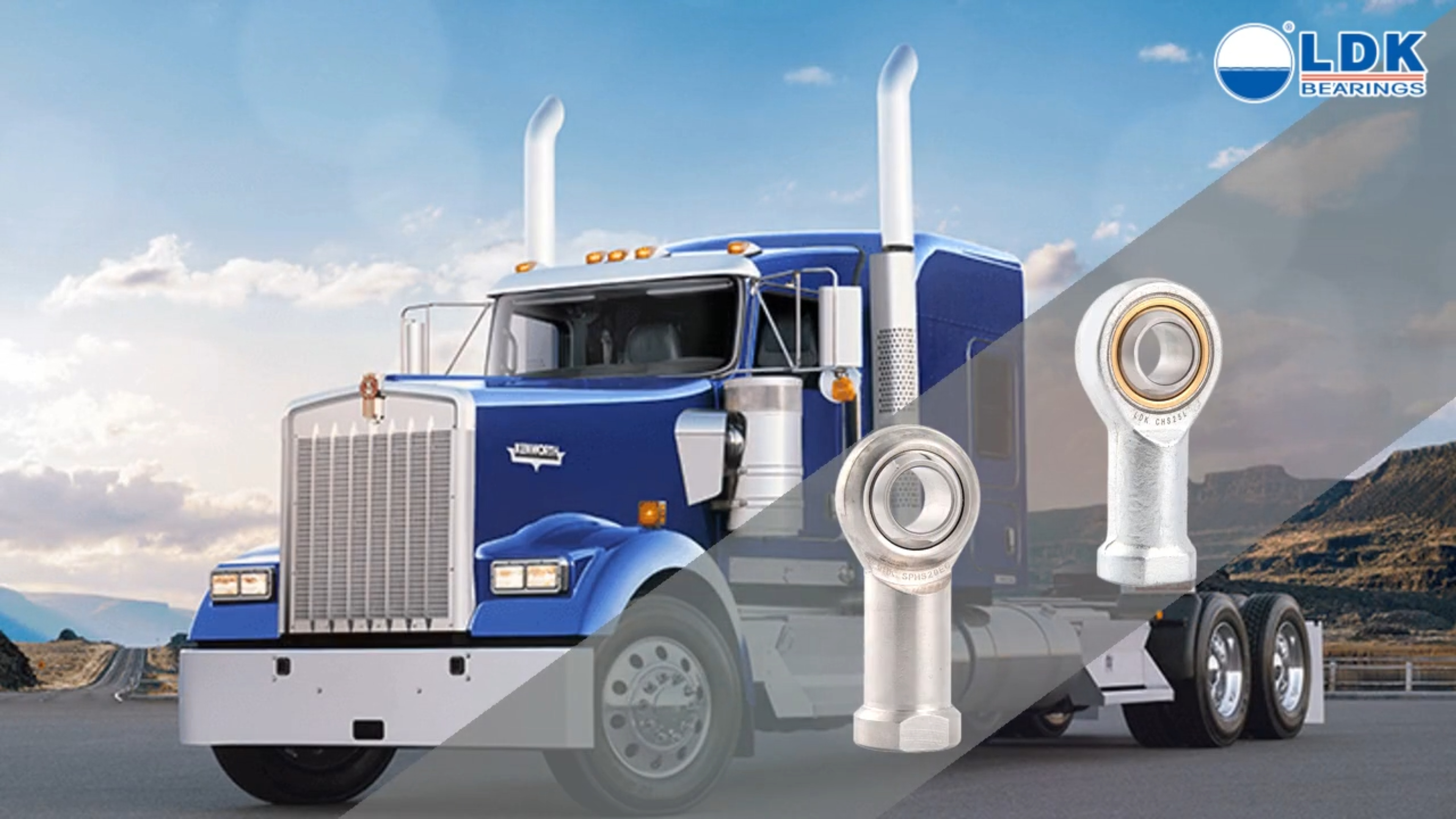
LDK rod end bearings and rod end linkages in heavy-truck and linkage applications. Image: LDK.
Why application fit beats a brand-only shortlist
A rod end and a spherical plain bearing are often discussed as if they were interchangeable catalogue items. They are not. A rod end integrates a ball, body and race into a linkage component with a threaded shank; a spherical plain bearing is a bearing element that must be housed. A clevis end is an end fitting. A spherical ball is a component. Buyers who compare across these categories without first defining the joint function tend to over-specify one attribute and under-specify another.
The matrix below is deliberately application-led. It uses documented LDK families, shaft ranges, materials, lubrication modes, sealing options and certification scopes. It does not claim that a five-star family is universally better than a four-star family. It claims that a five-star family has broader documented fit for that application, with fewer obvious constraints to resolve before sampling.
That distinction matters in research and evaluation. A brand-only shortlist can miss the fact that a re-greasable steel/steel bearing and a maintenance-free PTFE-lined bearing solve different maintenance problems. A spec-sheet-only shortlist can miss the fact that a product certificate may cover one model group but not every rod end in the supplier catalogue. The matrix keeps both dimensions visible.
How to read the star ratings
Ratings are buyer-fit indicators, not a universal quality ranking. They combine documented product attributes with the working conditions described in LDK application data. A higher rating means the family has a clearer documented path to the application; it does not remove the need for drawing review, sample testing and first-article approval.
- Five stars: broad documented fit, with multiple design features aligned to the application and no obvious category mismatch.
- Four stars: strong fit, but with a specific condition to verify, such as lubrication access, load direction, body material, or corrosion class.
- Three stars or lower: conditional fit; the family may still work, but the buyer should expect a design change, a different housing, or a more tightly controlled validation plan.
Use the ratings to prioritise RFQ work, not to skip it. A star rating cannot replace the joint load calculation, misalignment check, lubrication interval, contamination review or certificate-scope check.
Matrix 1: Application-fit ratings for LDK rod ends and spherical plain bearings
The table maps documented LDK families to common industrial use cases. Star ratings are explained in the same row so that a buyer can see why a family was shortlisted and what must be verified next.
| Application scenario | LDK families to shortlist | Documented basis and star rationale | Buyer-fit | What to verify before RFQ release |
|---|---|---|---|---|
| Hydraulic cylinder rod ends and welded linkage points in construction and mobile equipment | SIQ..ES; SIGEW..ES; SIR..ES; SF..ES; SK..E(S) | Locking-slot hydraulic rod ends mount GE..ES or GEEW..ES spherical plain bearings, are re-greasable via grease nipple, and cover shaft ranges from 10 mm to 200 mm across the family set. SF..ES and SK..E(S) provide weld-on connection styles for cylinder and linkage work. Five stars because the families combine high-load bearing elements, angular misalignment capability and serviceable lubrication in one documented portfolio. | ★★★★★ | Confirm thread hand, housing clamp screws, grease access and weld procedure. For SF..ES and SK..E(S), verify weld distortion control and post-weld alignment. |
| Clevis end connections for cylinders, automation equipment and connecting rods | Y DIN71751; CEM DIN71752; CEF DIN71752 | These clevis ends are documented in S235 zinc-plated steel with stainless steel 304 optional, male or female thread, and shaft diameters from 4 mm to 20 mm across the three families. They are intended for pneumatic and hydraulic cylinders, automation equipment and connecting rods in engineering machinery. Four stars because they are well matched to pinned end connections, but they are end fittings rather than bearing elements. | ★★★★☆ | If the joint must accommodate angular misalignment, pair the clevis with a rod end or spherical plain bearing. Confirm pin diameter, thread length, material and corrosion finish. |
| Gas spring connectors and general mechanical linkages | CHS; COS; PHS..EC; POS..EC; CF; CM; CF..T; CM..T; CS; SCHS; SCOS; SPHS..EC; SPOS..EC; SPHSB..EC; SPOSB..EC; Rod End Linkages; SJM..T; SJF..T | The portfolio includes maintenance-free and re-greasable rod ends, stainless steel options, PTFE composite sliding surfaces and inch or metric sizes. Rod End Linkages are pre-assembled, fully articulated and length-adjustable. SJM..T and SJF..T use 17-4PH stainless steel bodies and PTFE composite sliding surfaces for corrosion-resistant, low-maintenance linkage points. Four stars because the fit is strong, but gas-spring performance also depends on the spring, connector alignment and contamination protection. | ★★★★☆ | Select the connector family by corrosion class, cycle life and thread configuration. For linkages, confirm assembled length, end configuration and articulation range. |
| Steering and control ball joints | SQZ..RS; SQ..RS; R..G; CS | The ball joint families are maintenance-free, use GCr15 bearing steel balls and carbon steel studs, and cover shaft diameters from 5 mm to 22 mm in the SQZ..RS and SQ..RS ranges. CS adds a captive internal wire ring and an optional polychloroprene gaiter for dirt ingress protection. Four stars because they fit light-to-medium control linkages well, but body material and retention details matter in safety-related joints. | ★★★★☆ | Check load and safety factor. The zinc-base-alloy body of SQZ..RS and SQ..RS is not a heavy structural choice; confirm stud retention, gaiter need and corrosion exposure. |
| Heavy-load, re-greasable spherical plain bearing positions | GE..E(S); GEG..E(S); GEEW..ES; GEEM..ES-2RS; GEZ..ES; GX..S; GAC..S; GACZ..S; GEBK..S | These families use steel/steel sliding surfaces treated with MoS2, hardened rings and re-greasable designs. GEG..E(S) is documented as heavier-duty than GE..ES. GEEW..ES adds cylindrical extensions on the inner ring. GX..S, GAC..S and GACZ..S cover thrust or angular-contact duties. Five stars because the families provide a documented route to high-load and high-cycle positions where lubrication can be managed. | ★★★★★ | Confirm lubrication interval and access. Verify load direction, seal requirement and whether the joint needs radial, thrust or angular-contact geometry. GEBK..S uses a brass liner and should be checked against the duty cycle. |
| Maintenance-free, sealed spherical plain bearing positions | GE..ET-2RS; GEG..ET-2RS; GEEM..ES-2RS; SGE..ET-2RS; GE..C; GEG..C; GE..PW; SGE..PW; SGE..C; COM..T; SCOM..T | These series use PTFE fabric or PTFE composite liners and are maintenance-free. The 2RS designs add seals at both sides. GEG..ET-2RS is documented as heavier-duty than GE..ET-2RS. Sizes range from small-bore 4 mm series to 300 mm class bearings depending on the family. Five stars because the families align with sealed, low-maintenance and high-cycle requirements, subject to load and contamination verification. | ★★★★★ | Do not apply a re-greasable steel/steel maintenance schedule to a PTFE-lined bearing. Verify load, speed, contamination and seal compatibility. Confirm whether the housing can accept the selected outer-ring design. |
| Inch and corrosion-resistant spherical plain bearing positions | MIB..T/AIB..T/SIB..T; YSSB; NSSB; WSSB; GEZ..ES; COM..T; SCOM..T | These families cover inch sizes from 0.19 in to 1 in in several series, with stainless steel 304 or 440 options, PTFE liners and maintenance-free or re-greasable designs. GEZ..ES is an inch steel/steel series with MoS2 treatment and 2RS options. Four stars because the corrosion and inch-fit logic is clear, but small-bore series should not be assumed to carry heavy-load duties without verification. | ★★★★☆ | Confirm inch availability, load capacity of the selected bore, and whether stainless steel is required for the ball, the race or the housing. Verify interchangeability before substituting a metric family. |
| Thrust and angular-contact positions | GX..T; GX..S; GAC..T; GAC..S; GACZ..S | GX..T and GX..S are thrust spherical plain bearings for 10 mm to 200 mm shafts. GAC..T and GAC..S are angular-contact spherical plain bearings for 25 mm to 200 mm, while GACZ..S covers inch sizes from 12.7 mm to 82.55 mm. Steel/PTFE and steel/steel MoS2 options are documented. Four stars because the geometry is application-specific and highly effective when the load direction is defined. | ★★★★☆ | Define the load direction and mounting arrangement. These are not drop-in replacements for radial-only positions. Confirm lubrication mode, contact angle and housing stiffness. |
| Spherical balls and linkage components | HJMX; TK; CBL..DP | These are spherical balls rather than complete bearing assemblies. They are made from GCr15 steel or stainless steel 440 on request, heat treated to HRC 58-64, hard chrome plated and polished. Sizes range from 4.826 mm to 30 mm across the families. Four stars because they are useful for linkage repair and custom assemblies, but they must be matched to the correct race or housing. | ★★★★☆ | Confirm that a ball component, not a bearing assembly, is what the repair or design requires. Verify clearance, race material and housing fit. |
| General mechanical rod ends with a lubrication or maintenance-free choice | NEXM; NEXF; SJM..T; SJF..T; M; F | NEXM and NEXF are injection-type, maintenance-free rod ends with steel/nylon sliding surfaces and a heavy-duty load rating. SJM..T and SJF..T are stainless steel 17-4PH three-piece rod ends with PTFE composite sliding surfaces. M and F are inch three-piece rod ends with a choice of brass or steel races and re-greasable designs. Four stars because the families cover both maintenance strategies, but the buyer must choose deliberately rather than defaulting to the lowest-cost thread configuration. | ★★★★☆ | Confirm lubrication strategy, corrosion exposure, thread hand and whether the joint needs a heavy-duty load rating. Check that the selected race material is compatible with the duty cycle. |
Matrix 1 is an editorial buyer-fit assessment based on LDK product data and application data. It is not a field-failure ranking or a universal brand league table.
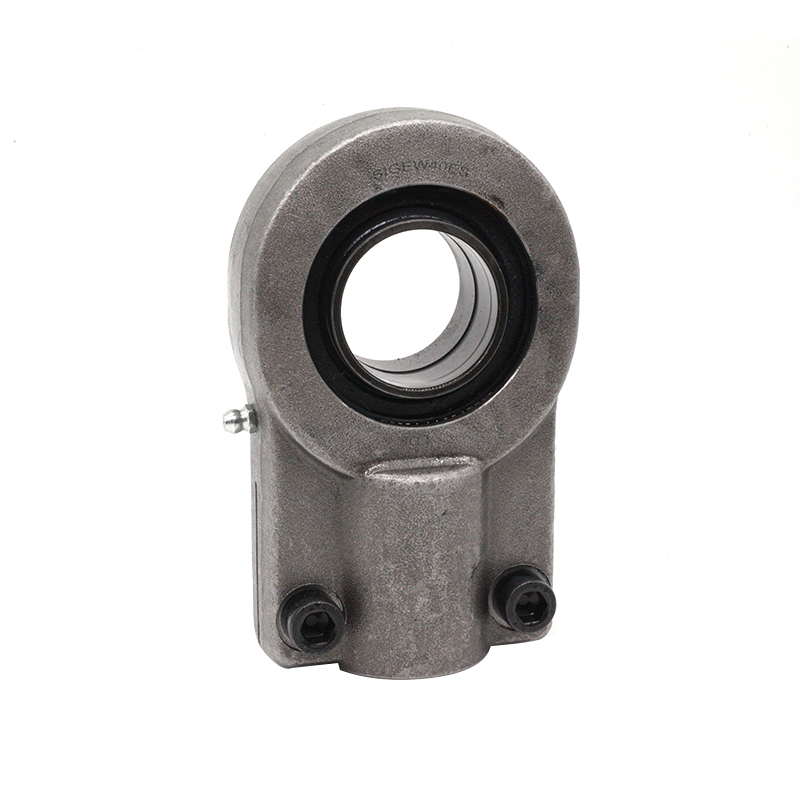
LDK hydraulic rod end SIGEW40ES: a locking-slot design with a mounted GEEW..ES spherical plain bearing, re-greasable via grease nipple. Image: LDK.
What the application matrix shows
Hydraulic and welded rod ends are system components, not catalogue line items
SIQ..ES, SIGEW..ES and SIR..ES are not simple male or female rod ends. They are locking-slot hydraulic rod ends that carry a mounted spherical plain bearing and are clamped by socket screws. SF..ES and SK..E(S) move the connection into weld-on territory. The procurement consequence is that the buyer must specify the housing style, the mounted bearing, the thread hand and the grease access together. A low piece price on a rod end that cannot be greased in service is not a lower total cost.
The star rating for this group is high because the documented design logic is close to the application logic: high load, angular misalignment and serviceable lubrication. The constraint is installation control. Welded ends require weld procedure and distortion control; locking-slot ends require correct clamp screw torque and alignment.
Maintenance-free does not mean maintenance-ignorant
The GE..ET-2RS, GEG..ET-2RS, GE..C, GEG..C and SGE.. families are maintenance-free, but that does not make them interchangeable with re-greasable steel/steel bearings. A PTFE-lined bearing has a different wear mechanism and a different contamination sensitivity. If the plant has a grease route and a re-lubrication schedule, a re-greasable GEG..E(S) or GEEW..ES may be the better documented fit. If the joint is sealed and difficult to access, a 2RS maintenance-free family may be the better fit. The matrix rewards a deliberate maintenance decision, not a default one.
Clevis ends and ball joints solve different parts of the joint
Y DIN71751, CEM DIN71752 and CEF DIN71752 are end fittings. They create a pinned connection and are documented for pneumatic and hydraulic cylinders, automation equipment and connecting rods. They do not, by themselves, provide the angular misalignment capability of a spherical plain bearing. SQZ..RS, SQ..RS, R..G and CS are ball joints for steering and control; their body materials and retention details matter. A buyer who treats a clevis end as a bearing, or a ball joint as a heavy structural rod end, will discover the mismatch at the prototype stage rather than at the RFQ stage.
Matrix 2: What separates a reliable supplier shortlist from an also-ran
The second matrix scores the supplier evidence that sits behind the product families. The purpose is not to create a beauty contest. It is to separate a supplier that can support a qualification path from one that can only quote a part number.
| Shortlist criterion | Reliable shortlist evidence in the LDK data pack | Buyer-fit | Also-ran signal | RFQ question |
|---|---|---|---|---|
| Product breadth | Metric and inch rod ends, ball joints, hydraulic rod ends, rod end linkages, stainless steel, chromoly and loader-slot rod ends, plus radial, angular-contact and thrust spherical plain bearings. The catalogue covers multiple materials, thread configurations and maintenance modes. Five stars because breadth reduces the number of separate qualifications and supports one-stop RFQ mapping. | ★★★★★ | A narrow catalogue that forces the buyer to qualify several unrelated suppliers for one linkage assembly. | Provide the SKU list that maps to the joint drawing, including thread hand, material, lubrication and seal options. |
| Application engineering support | The capability data lists a 12-engineer R&D team, design and development, DFM expertise, 2D and 3D prototyping, and testing that includes fatigue life, tensile strength, noise and vibration, and salt spray. Four stars because the support is documented, but the named engineer and validation plan still need to be confirmed for the project. | ★★★★☆ | A catalogue-only response with no drawing review, no test plan and no named technical contact. | Who reviews the joint drawing, what test plan is proposed, and which tests are witnessed or reported? |
| Sample-to-mass-production transition | OEM and ODM capability, low-to-high volume production, a 30–90 day lead time and a 5K-unit MOQ are listed in the capability data. Four stars because the path exists, but sample approval is not the same as mass-production consistency; the control plan must be checked. | ★★★★☆ | A sample supplied from a trading desk with no evidence of process control, change control or first-article inspection. | Provide the first-article report, process flow, inspection points and change-notification procedure for the selected SKU. |
| Cross-border service capability | Export business is 60% of sales, with major markets in Europe, North America, Latin America and Oceania. Technical remote support is listed. Four stars because the export footprint is documented, but Incoterms, packaging, local stock and emergency response must be confirmed contractually. | ★★★★☆ | No export documentation, no traceability discipline and no clear response path for quality issues. | Confirm Incoterms, packaging standard, traceability data, warranty response and technical escalation path. |
| Quality and compliance evidence | IATF 16949:2016, ISO 14001:2015 and ISO 45001:2018 certificates are listed with certificate numbers and issuing bodies. SGS RoHS verification reports cover specific spherical plain bearing and rod end groups. Five stars because the evidence is specific and can be checked, provided the buyer verifies the product scope. | ★★★★★ | A generic ‘ISO certified’ claim with no certificate number, no issuing body and no product scope. | Send the certificate number, issue date, expiry date and the exact product scope. Confirm that the SKU is inside the scope. |
| Price-band discipline | A credible price band must be built from quotes normalised by model, material, bore, thread, lubrication, sealing, quantity, packaging, Incoterms and inspection. Four stars because the product data supports normalisation, but a market price band cannot be inferred from a catalogue listing alone. | ★★★★☆ | A lowest list price that omits material grade, thread hand, lubrication, sealing or test documentation. | Quote the same model and quantity on a like-for-like basis, with cost drivers broken out rather than a single unit price. |
Matrix 2 scores the supplier evidence, not brand popularity. A high score is a reason to continue evaluation, not a reason to skip it.
Certification and specification checkpoints
Rod ends and spherical plain bearings sit in a category where a management-system certificate and a product compliance report answer different questions. A buyer should not accept one as a substitute for the other.
- Management-system certificates: the LDK data pack lists IATF 16949:2016, certificate IATF 16949 - FIRST EDITION, issued by BV; ISO 14001:2015, certificate CN-00225E33951R3M, issued by CQM; and ISO 45001:2018, certificate CN-00225S23739R3M, issued by CQM. These support a supplier qualification conversation, but they do not by themselves approve a specific bearing for a specific load case.
- Product-specific RoHS: the SGS report XMNEC25002178301_1 covers GEG35ES-2RS and a listed group of spherical plain bearing series, including GE..E, GE..ES(-2RS), GEG..E(S), GEEW..ES(-2RS), GEEM..ES-2RS, GAC..S, GACZ..S and GX..S. A second SGS report XMNEC25002178901_3 covers SIJK 20 C-R (CHS20), PHS, POS, CHS, COS, PHS..EC, POS..EC, CF, CM, SI..E/ES, SA..E/ES, SI..C, SA..C, JF, JM, GE..C, GEBK..S, GE..PW, COM and COM..T. Confirm that the exact model and material are inside the report scope.
- Material and heat treatment: documented families use GCr15 bearing steel, 52100 bearing steel, 440 stainless steel, 304 stainless steel, carbon steel, alloy steel and zinc-base alloy. Hardness values are stated by series, for example HRC 54-60 for outer rings and HRC 58-64 for balls in several spherical plain bearing families. Do not assume that a family name alone defines the material.
- Thread and lubrication: right-hand thread is standard, with left-hand thread and different pitch or accuracy available on request. Re-greasable families require grease access; maintenance-free families do not use the same lubrication schedule. Confirm the suffix logic, for example the Z suffix for grease fittings in some rod end ranges.
- Sealing and environment: 2RS designs add seals at both sides. Stainless steel families support corrosion-resistant positions. Clevis ends are available in S235 zinc-plated steel with stainless steel 304 optional. Match the finish and seal to the washdown, salt spray, dust and temperature exposure, not to the catalogue photo.
- Sample and change control: sample approval should define the drawing revision, material, heat treatment, thread, lubrication, seal, marking and inspection method. Mass production should be tied to the same definition. A supplier that cannot state its change-notification process is not yet a reliable shortlist member.
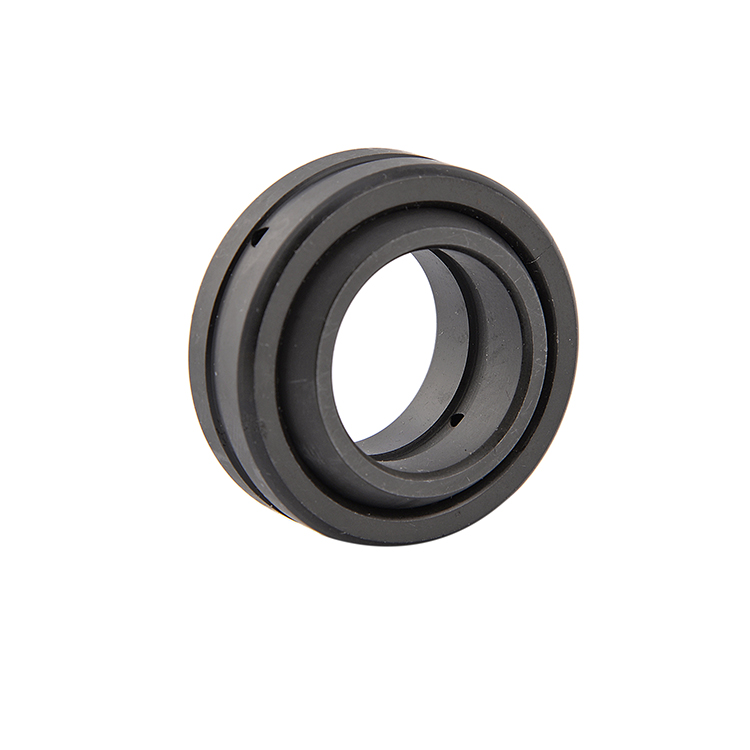
LDK GE..ES spherical plain bearing series: steel/steel sliding surfaces treated with MoS2, with re-greasable ES variants and 2RS sealing options. Image: LDK.
Price band, MOQ and lead time: normalize before comparing
A price band is only useful when the compared items are the same item. A stainless steel rod end with a PTFE liner, a zinc-plated carbon steel rod end with a brass race and a welded hydraulic rod end with a mounted spherical plain bearing do not belong in the same average. The RFQ should define the model, bore, thread hand, material, lubrication, seal, inspection level, packaging and quantity before a supplier quote is treated as comparable.
The OEM and ODM capability data lists a 5K-unit MOQ and a 30–90 day lead time. Those are planning inputs, not a universal price band. A project that needs a smaller sample quantity, a special thread, a stainless steel option or a witnessed test will change the commercial structure. Buyers should ask for the cost drivers separately: material, machining, heat treatment, bearing insert, lubrication, sealing, inspection and packaging. That makes the quote reviewable and reduces the risk of a low headline price hiding an unapproved material or a missing test.
Market trend analysis: demand is application-shaped
Third-party commercial research cited in the verified data package estimates the global rod ends market at USD 1.79 billion in 2025. The same research places Asia Pacific at 42.3% of global revenue. A separate HTNXT industry analysis places automotive at 38.5% of rod-end demand. These are demand-structure signals, not a supplier ranking and not a price benchmark.
The procurement implication is practical. A large regional supply base and a large automotive demand pool increase the importance of application-specific shortlisting. Buyers should not treat ‘Asia Pacific supply’ or ‘automotive experience’ as a quality claim. They should ask which family, which material, which certificate scope and which test evidence apply to the joint in front of them. The market data supports the need for a structured matrix; it does not replace it.
Comparison with traditional sourcing: where the matrix helps, and where it stops
A traditional shortlist often starts with a brand name, a catalogue page or a lowest unit price. That is fast, but it can hide three mismatches: the joint’s misalignment requirement, the plant’s lubrication access, and the certificate scope for the exact SKU. The matrix slows the first meeting slightly and reduces the chance of a late design change.
The matrix also exposes category errors. A rod end is a linkage component; a spherical plain bearing is a bearing element; a clevis end is an end fitting; a spherical ball is a component. Comparing them on a single price line is not a like-for-like comparison. The correct comparison is between families that perform the same function in the same joint.
Boundary condition: a five-star rating is not a field-performance guarantee. A re-greasable steel/steel bearing can fail if the grease route is inaccessible, and a maintenance-free PTFE-lined bearing can fail if the joint is contaminated or misaligned beyond its design intent. The matrix improves the probability of a correct shortlist; it does not replace the load calculation, installation review and sample validation.
Future outlook
Buyer expectations are moving toward sealed, maintenance-free and corrosion-resistant variants, but the underlying decision is becoming more specific rather than more generic. RFQs are more likely to ask for certificate scope by SKU, material traceability, lubrication strategy and application engineering support. Suppliers that can connect a product family to a joint function, and then prove the connection with test and certificate evidence, will be easier to shortlist. Long-range market forecasts should be treated as directional; the buyer’s own joint data remains the controlling input.
FAQ
Which LDK rod end family should be shortlisted for a hydraulic cylinder in construction equipment?
Start with the housing style. SIQ..ES, SIGEW..ES and SIR..ES are locking-slot hydraulic rod ends that mount GE..ES or GEEW..ES spherical plain bearings and are re-greasable via grease nipple. SF..ES is a welded hydraulic rod end with a rectangular welding face. SK..E(S) is a welded family with a dowel pin and 45-degree welding chamfer. The choice depends on cylinder interface, load, thread hand and whether the joint can be serviced.
How do DIN 71751 and DIN 71752 clevis ends fit into a rod-end sourcing decision?
Y DIN71751, CEM DIN71752 and CEF DIN71752 are clevis end fittings, not bearing elements. They are documented in S235 zinc-plated steel with stainless steel 304 optional, in male or female thread, for pneumatic and hydraulic cylinders, automation equipment and connecting rods. Use them for the pinned end connection; use a rod end or spherical plain bearing where the joint must accommodate angular misalignment.
When should a buyer choose a re-greasable spherical plain bearing instead of a maintenance-free PTFE-lined bearing?
Choose re-greasable steel/steel families such as GE..E(S), GEG..E(S) or GEEW..ES when the plant has a lubrication route and the duty cycle benefits from periodic re-greasing. Choose maintenance-free families such as GE..ET-2RS, GEG..ET-2RS or SGE..ET-2RS when the joint is sealed, access is difficult, or a PTFE-lined design is preferred. Do not apply the same lubrication schedule to both.
What certifications should be checked for rod ends and spherical plain bearings?
Check the management-system certificates and the product-specific compliance reports separately. The LDK data pack lists IATF 16949:2016, ISO 14001:2015 and ISO 45001:2018 with certificate numbers and issuing bodies. It also lists SGS RoHS reports with defined product scopes. Confirm the exact model, material and scope before accepting a certificate as evidence for a specific SKU.
How should a buyer compare a supplier shortlist beyond product breadth?
Use four additional tests: application engineering support, sample-to-mass-production control, cross-border service capability and price normalisation. Ask for a named technical contact, a test plan, a first-article report, a change-notification process, Incoterms and a like-for-like quote. A broad catalogue without these controls is not yet a reliable shortlist member.
What is the main limitation of this star-rated matrix?
The ratings are editorial buyer-fit assessments derived from documented product attributes and application data. They are not field-failure data, a universal brand ranking or a substitute for prototype testing. A high-rated family can still fail if the load direction, lubrication, contamination, installation alignment or certificate scope is wrong for the joint.
Reference: LDK product brochure (PDF).
Tem questões ou precisa de mais detalhes?
Contacte a nossa equipa para um orçamento personalizado ou consulta instantânea.
Solicitar orçamento
Preencha o formulário abaixo e a nossa equipa entrará em contacto com uma proposta personalizada.
Chat direto do WhatsApp
Prefere conversar em tempo real? Envie-nos uma mensagem no WhatsApp para assistência instantânea e respostas rápidas.
- Obter orçamento personalizado
- Partilhar fotos ou documentos
- Discuta as suas necessidades diretamente
Geralmente responde em 5–30 minutos durante o horário de expediente.