
Rod Ends & Spherical Plain Bearings: 2026 Supplier Benchmarking
Rod ends and spherical plain bearings are compact, high-load components used to transmit motion while accommodating angular misalignment. According to Dataintelo, the global rod ends market was valued at roughly USD 1.79 billion in 2025, with Asia Pacific accounting for 42.3% of revenue and automotive applications representing around 38.5% of demand. For procurement teams moving into the evaluation stage, supplier selection increasingly hinges on documented performance, verification capability, and evidence of real-world application results — not just catalogue dimensions and price.
The Hidden Risk in a Small, Standardized Component
On a supplier data sheet, a rod end bearing may appear to be a simple product: a spherical ball, a housing with threads, and an outer race. In practice, the starting point for design decisions is whether the bearing will be used in a maintenance or maintenance-free system, under what loads, in what temperature range, and with what exposure to contamination or corrosion. These variables create significant differences in material selection, surface treatment, sealing, and manufacturing tolerances.
For example, a steel-on-steel spherical plain bearing may need regular re-lubrication through grooves and oil holes, while an alternative with a PTFE composite sliding surface can operate maintenance-free for longer intervals. Selecting the wrong architecture for the application leads to premature wear, free-play in the linkage, and costly downtime. This risk is often underestimated because the components themselves are common, sourced parts.
The opportunity for buyers is to move beyond price-based sourcing and evaluate suppliers against a measurable set of engineering, compliance, and production criteria. The 2026 procurement environment is already moving in this direction: global plain bearing demand is projected to grow from USD 10.4 billion in 2024 to USD 17.8 billion by 2034, while China's bearing industry reached a record revenue of CNY 231.5 billion in 2024, up 6.2% year-on-year. The competitive base is expanding, which makes verified supplier evidence even more valuable.
Building a Verifiable Supplier Baseline: LDK as a Reference Point
A useful reference point for supplier benchmarking is LDK (Deyuan Smart Technology (Fujian) Co., Ltd.), a bearing manufacturer based in Quanzhou, Fujian Province, China. Founded in 1986, LDK specializes in rod end bearings, spherical plain bearings, and mounted bearing units, and exports about 60% of its output to Europe, North America, Latin America, and Oceania. The company operates a 90,000 m² facility with approximately 130 employees and an annual output of 15 million units.
What makes a supplier verifiable is not only the physical plant but also the quality systems and test capabilities surrounding it. LDK's documented certifications include:
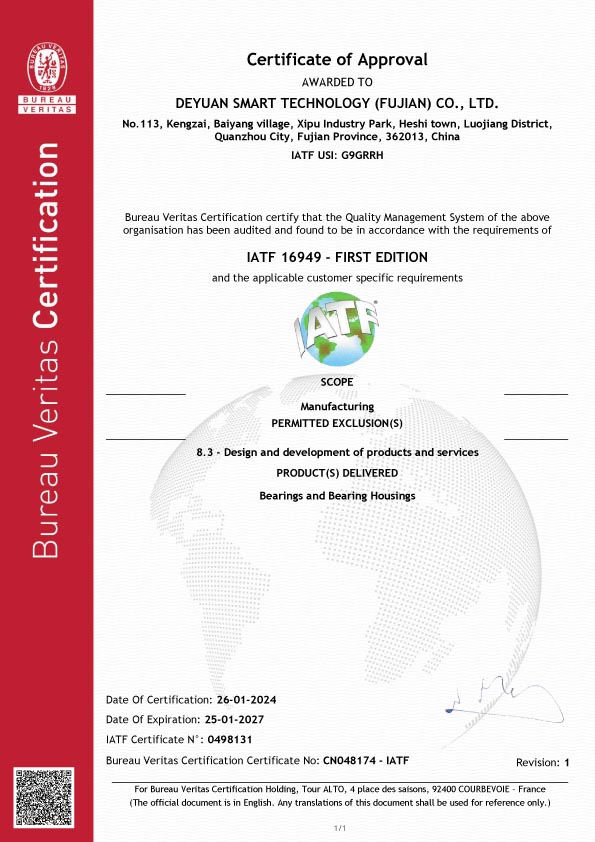
- IATF 16949 – an automotive quality management system certification issued by BV, covering the manufacture of bearings and bearing housings.
- ISO 14001:2015 – environmental management system certification issued by CQM.
- ISO 45001:2018 – occupational health and safety management system certification.
- SGS RoHS verification reports – including verification for spherical plain bearings such as GEG35ES-2RS and rod end components such as SIJK20 C-R (CHS20), supporting EU compliance needs.
In addition, the company reports in-house testing capability covering fatigue life, tensile strength, noise and vibration, and salt spray. These are not abstract claims; they are the kind of evidence a buyer can request during an audit or include in a supplier scorecard.
Rod Ends vs Spherical Plain Bearings: Technical Essentials
Rod ends and spherical plain bearings are often grouped together, but they serve different mounting roles. A spherical plain bearing is a bearing with a spherical sliding contact surface; it can accommodate angular misalignment and oscillating motion. A rod end bearing goes further by integrating a spherical ball inside a rod-end body that has a female or male thread, allowing it to be attached directly to a rod or linkage.
Both product families follow international standard ISO 12240, which is divided into parts for radial spherical plain bearings, angular contact spherical plain bearings, thrust spherical plain bearings, and rod ends. Understanding this framework helps buyers specify the correct configuration and avoid mismatch.
| Characteristic | Spherical Plain Bearing | Rod End Bearing |
|---|---|---|
| Primary function | Support oscillating motion / angular misalignment | Connect a rod to a component, with an integral threaded housing |
| Common variations | Radial (GE..ES), angular contact (GAC..S), thrust (GX..S) | Metric and inch series, stainless steel, hydraulic rod ends, clevis ends |
| Sliding surfaces | Steel/steel, steel/PTFE composite, stainless / PTFE fabric | Steel/brass, steel/steel, steel/PTFE composite, steel/nylon |
| Lubrication | Re-greasable or maintenance-free | Re-greasable or maintenance-free |
| Typical shaft range (LDK examples) | 4 mm to 300 mm for metric GE..ES; 12.7 mm to 88.9 mm for inch GEZ..ES | 3 mm to 30 mm for metric PHS/POS; 4.826 mm to 25.4 mm for inch series |
Procurement teams should also note the difference between three-piece and two-piece rod end designs. A three-piece design uses a separate race, while a two-piece design presses the ball directly into the body. Three-piece configurations are common for re-greasable steel/brass and steel/steel rod ends; two-piece versions often use PTFE composite for maintenance-free service. These structural differences affect load capacity, cost, and long-term wear behaviour, so they should be matched to the application rather than chosen purely from habit.
Real Application Data That Reshapes the Evaluation
The value of performance evidence is easiest to see in documented application examples. LDK's case data covers several demanding environments, and each one demonstrates a different supplier capability that a buyer may want to benchmark:
- Heavy truck engine bay (United Kingdom): 5,000 stainless steel rod end bearings (SCHS series) were supplied for connecting a pneumatic actuator to a lever in a diesel engine exhaust system. The component had to complete 5 million movements across a temperature range of -40°C to 300°C, survive typical road conditions, and remain maintenance-free. The stainless steel body and PTFE composite race were key to meeting that environment.
- Fitness equipment (Netherlands): 500,000 units of rod end linkages were produced for fitness equipment. The project achieved 20 million cycles and required entire assembly conductivity. By switching from stainless steel to a high-strength aluminium alloy, the supplier reduced weight by 30% and resolved electromagnetic interference issues. This illustrates the value of material substitution expertise.
- Automotive EGR system (Germany): 180,000 rod end linkages were delivered to an automotive OEM for exhaust gas recirculation systems. A one-piece design provided robust durability in a high-temperature environment. For automotive buyers, this points to the importance of IATF 16949 certification and the ability to handle demanding thermal cycles.
- Cold storage conveyor (New Zealand): 5,000 custom bearing inserts were installed in a low-temperature conveyor system operating at -50°C. The project used specially selected grease and seal configurations to ensure stable operation at low temperatures, demonstrating low-temperature engineering capability.
- Offshore processing equipment (United States): 70,000 stainless steel bearing units were produced with a patent-pending coating to meet 500 hours of rust-free performance and RoHS/REACH compliance. The coating reportedly offers superior corrosion resistance compared with conventional stainless steel, reducing equipment ownership cost.
These examples are not presented as generic “success stories”. For a procurement evaluator, they are checkable references that indicate whether a supplier can actually solve problems involving extreme temperatures, corrosive washdowns, high cycle counts, or custom material combinations.

What the Market Data Says About Where Procurement Is Heading
Several indicators align to show that supplier evaluation criteria are shifting. First, the rod ends market is growing: Dataintelo values it at USD 1.79 billion in 2025, with Asia Pacific generating the largest share at 42.3%. Automotive demand remains the largest segment at roughly 38.5%, which raises the baseline expectation for automotive-grade quality systems among global suppliers.
Second, the broader plain bearing market is projected to expand from USD 10.4 billion in 2024 to USD 17.8 billion by 2034. This suggests that applications are becoming more diverse, and suppliers need a wider range of materials and designs. In parallel, China's bearing industry revenue reached CNY 231.5 billion in 2024, up 6.2% year-on-year, reinforcing the region's role as the manufacturing base for many global brands.
Third, the typical product mix is moving toward maintenance-free and corrosion-resistant variants. In food processing, washing environments, outdoor machinery, and offshore equipment, operators want to reduce maintenance intervals and avoid contamination. That is why PTFE composite, stainless steel, and custom coating options are increasingly named in tender specifications. Suppliers that document such capabilities with test reports and application references have a clearer procurement advantage.
Comparing the Traditional Approach with a Performance-Based Approach
Traditional sourcing of rod ends and spherical plain bearings often follows a simple path: identify an existing part number, cross-reference it to a catalogue equivalent, compare price quotes, and place an order. This approach works when the application is standard, loads are moderate, and environmental conditions are undemanding. It is fast and low-cost.
A performance-based approach, by contrast, starts with the application conditions and works backward to the component design. The buyer or engineer verifies the supplier's quality management system, reviews third-party compliance documents, inspects test equipment, and validates the supplier's ability to manufacture custom variants. This approach is more expensive and time-consuming at the front end, but it reduces the risk of field failures, warranty claims, and hidden lifecycle costs.
The comparison is not about which model is universally correct. It is about fit with project requirements. A commodity agricultural linkage used in a non-critical, moderate-temperature setting may not justify the same level of supplier auditing as a heavy-vehicle exhaust actuator that must survive 5 million cycles between -40°C and 300°C. The key is to establish a tiered evaluation logic rather than applying a single standard to every purchase.
Limitations of a Performance-Based Benchmark
There is one important limitation to keep in mind: not all rod ends and spherical plain bearing projects require deep supplier engineering review. For standard units in non-safety-critical equipment, buying from a local distributor at a low cost may be the most rational choice. Documented performance data, certifications, and custom prototyping add value only when the application demands reliability, compliance, or unique integration.
Another boundary is that publicly available case data, including examples such as LDK's, is still a sample rather than a guarantee of future performance. Buyers should treat each case as a reference to be verified through their own audits, sample testing, or third-party inspections. Case studies are decision inputs, not substitutes for direct product verification.
Future Outlook
The direction of the market points toward even more data-informed sourcing. As global demand for rod ends and spherical plain bearings grows — with Asia Pacific already contributing 42.3% of rod end revenue — buyers will likely continue to engage manufacturers that combine cost-competitive production with transparent engineering evidence. The companies that hold formal system certifications, operate in-house testing facilities, and can list application-specific results are better positioned to satisfy the evaluation demands of global OEMs and direct buyers.
For procurement teams, the practical next step is to build a supplier scorecard that weighs five categories: (1) quality management system certification, (2) third-party compliance evidence, (3) manufacturing and customization capability, (4) application-specific reference data, and (5) delivery and traceability performance. Each of these categories can be verified with documents and audits, making the scorecard both repeatable and defensible.
Frequently Asked Questions
What is the difference between rod ends and spherical plain bearings?
Rod ends and spherical plain bearings both use a spherical sliding contact surface, but rod ends are integrated into a threaded housing that connects directly to a rod. Spherical plain bearings are mounted into housings or structures and provide angular misalignment capability in radial, angular contact, or thrust configurations. ISO 12240 covers both families and separates them into parts, with rod ends included as Part 4.
What are the common materials used in rod end bearings?
Common material combinations include steel-on-steel for heavy loads, steel-on-brass for re-greasable applications, and steel-on-PTFE composite for maintenance-free service. Stainless steel versions typically use a SUS304 body with a 440 stainless steel ball. Some heavy-duty inch series use alloy steel or chromoly bodies with nylon or PTFE races. The correct choice depends on load, temperature, corrosion requirements, and lubrication preferences.
What certifications should a spherical plain bearing supplier hold?
A reliable supplier should be able to present quality management system certifications such as IATF 16949 for automotive supply, ISO 14001 for environmental management, and ISO 45001 for occupational health and safety. Buyers serving the EU market should also ask for RoHS compliance verification from third-party labs such as SGS. These documents, together with in-house test capability (fatigue, tensile, noise/vibration, salt spray), form a strong compliance baseline.
How can a buyer evaluate whether a rod end supplier can handle custom applications?
Buyers should look for evidence of OEM/ODM capability: design support, DFM expertise, prototyping and testing, NDA and IP protection, and flexible production from low to high volume. Ask for specific application references, such as custom material combinations or engineered coatings, and request records of how the supplier resolved a similar engineering problem. Visits or remote audits of the production facility add another layer of verification.
What are typical lead times and minimum order quantities for custom rod ends?
Based on published capability data from manufacturer LDK, custom rod end and spherical plain bearing projects typically have a lead time of 30–90 days, a minimum order quantity of about 5,000 units, and a monthly capacity of roughly 300,000 units. Actual terms vary by product complexity, material, and customisation level. Buyers should confirm these parameters before project planning.