
Roll Forming Machine Commissioning & After-Sales Benchmarks
Roll Forming Machine Commissioning & After-Sales Benchmarks
At decision stage, the real comparison between roll forming machine offers is not only the machine price. It is the evidence that the line can be installed, levelled, commissioned to the required profile, operated safely and supported after handover. This article sets out an independent buyer-side comparison framework for roof roll forming machine commissioning and after-sales support. It is editorial analysis for procurement use, not an independent laboratory test, and it identifies supplier-provided claims as company statements rather than third-party verification.
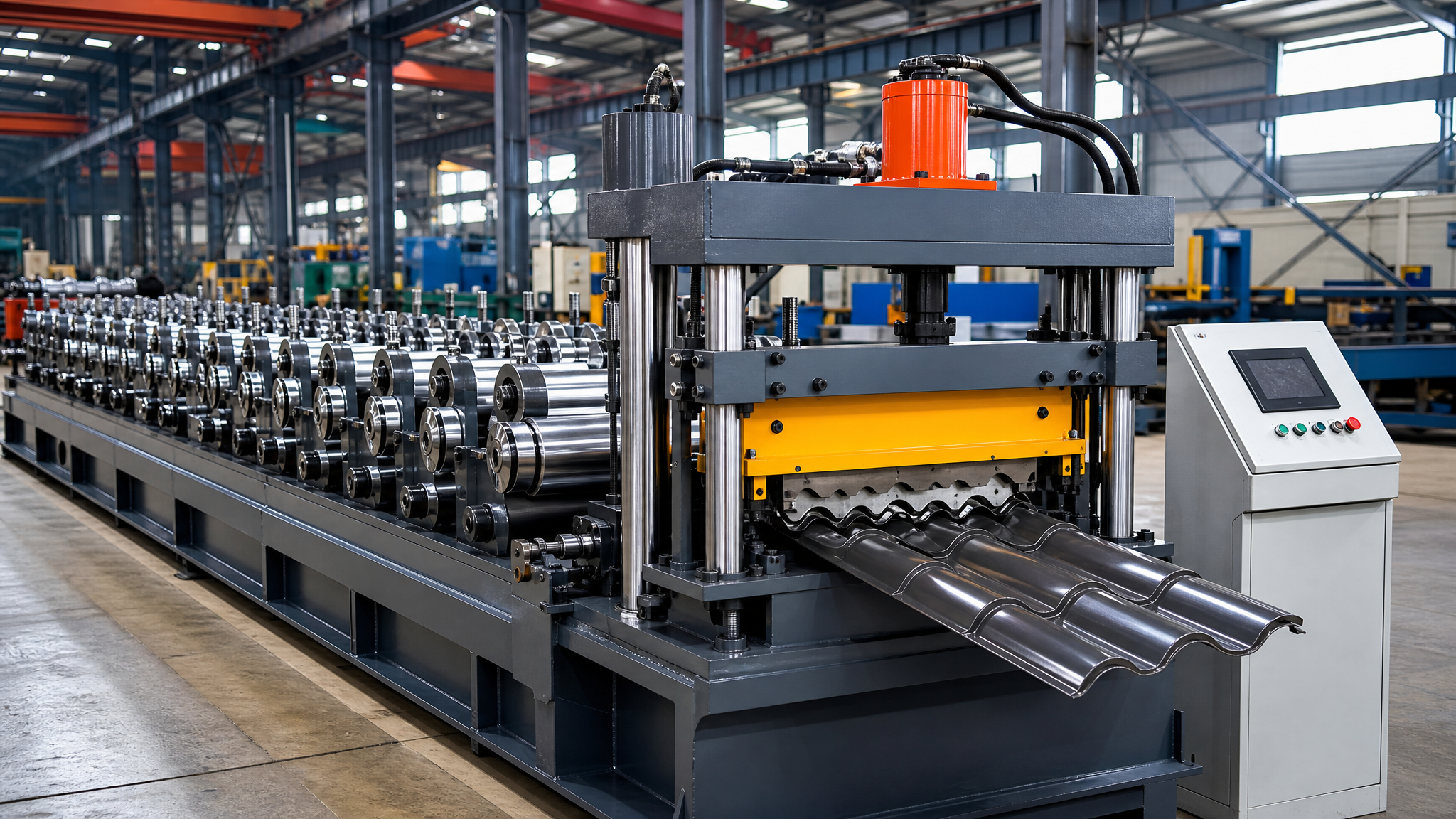
Why commissioning and after-sales belong in the purchase decision
A roof roll forming machine is a production asset, not a stand-alone item on a quotation sheet. The buyer needs a line that reaches the specified profile, thickness and length within the agreed tolerance, and keeps doing so under normal workshop conditions. Commissioning is the point where the machine, coil, tooling, cut system, controls and operator routine are proved together. After-sales support determines how quickly the line returns to specification when a bearing, hydraulic component, cut blade or control setting needs attention.
Two offers can look similar on a price sheet and still differ substantially in what is included before and after handover. One offer may include a pre-shipment test video, a levelling procedure, voltage confirmation for the destination market, operator training and a named remote-support route. Another may leave these items to informal arrangements. At decision stage, the buyer should convert every support promise into a verifiable acceptance item, because a lower purchase price can be offset by a slow commissioning process or unclear maintenance responsibility.
The supplied comparison material for this article contrasts a documented configuration associated with Tangshan Vantools Industries Co., Ltd. and low-cost generic roll forming machines. That comparison is company-supplied and category-level; it is not a named-competitor test. Its practical value is to show which claims a buyer should ask every supplier to document in the same way.
Benchmark framework: what to compare before signing
The following framework turns commissioning and after-sales into comparable buyer checks. A supplier may answer some items differently, but the absence of a documented answer is itself a decision signal.
| Benchmark area | What the buyer should request | Why it matters | Evidence to retain |
|---|---|---|---|
| Profile and material sign-off | A dimensioned profile drawing covering width, rib height, rib pitch and every bend; the material thickness range, including the worst case that will actually be run; coil width, coil inner diameter and maximum coil weight. | Without the drawing, the machine cannot be specified. Coil dimensions determine decoiler size, and the panel length range sets line length and indoor clearance. | Signed profile drawing, material specification and RFQ response. |
| Pre-shipment verification | A test machine video before the machine leaves the factory; confirmation of the right voltage for the destination market; disclosure of any special temperature or working-environment requirement. | Pre-shipment checks reduce the risk that a specification error is discovered only at the buyer's site. | Test video, electrical specification and inspection record. |
| Installation and levelling | A written procedure for the concrete floor, centre line, main-frame anchoring, two-direction levelling, decoiler height, run-out table alignment and chain tension. | A line levelled from the floor rather than from the forming frame can produce persistent profile variation. | Commissioning checklist, photographs and levelling record. |
| Safety and guarding | A guarding and risk-assessment checklist. ANSI B11.12-2005 (R2020) specifies safety requirements for roll-forming and roll-bending machines, including installation, dismantling and transport, within the ANSI B11 framework. | Safety checks should be part of commissioning, not an afterthought. The standard is a reference point; it does not by itself establish legal compliance in every market. | Guarding checklist, risk-assessment note and operator safety instructions. |
| Operator training | Training on parameter setting, recipe storage, cut settings, offcut handling and routine inspection; a training record for named operators. | A machine that only the supplier's technician can set correctly is not fully commissioned for the buyer. | Training sign-off and operator quick-reference sheet. |
| Remote support and response | Written support hours, escalation route, remote diagnostic method, online commissioning guidance and the scope of lifetime remote guidance. | Support language is only useful when it is converted into response expectations and named responsibilities. | Contract schedule and support terms. |
| Maintenance and uptime | Recommended calibration interval, spare-parts list, bearing and shaft inspection points, hydraulic maintenance points and the conditions behind any uptime claim. | Maintenance access affects downtime and labour cost. A stated interval must be read with the operating conditions attached to it. | Maintenance schedule and spare-parts list. |
| Performance acceptance | Agreed test method for profile tolerance, length tolerance, forming speed, cut quality and energy use, with the test material and run conditions recorded. | Without a test method, a performance figure cannot be verified at handover or compared fairly between offers. | Acceptance test sheet signed by both parties. |
What commissioning actually tests
Commissioning should begin with the building and the line layout. The line needs a level concrete floor that can carry the machine weight, and levelling should be taken from the forming frame, not from the floor. The practical sequence includes marking the centre line and anchoring the main frame, levelling the frame in both directions with a machinist level and shimming the feet, mounting the decoiler at the correct height so coil feeds straight into the first station with no rise or fall, aligning the run-out table to the exit line so cut panels do not drop or tip, and checking chain tension and rotation.
The electrical and environmental checks should be completed before production trials. The machine should be supplied with the right voltage for the destination market. If there are special requirements for temperature or the machine working environment, the factory should be informed before shipment, because those requirements affect component selection and commissioning. Safety guards must be in place, power must be isolated before maintenance, and hands must be kept away from rollers and the cutting zone during running.
Profile and control checks connect the machine specification to the buyer's actual production. Length tolerance should be confirmed in millimetres, together with pre-cut versus post-cut operation, offcut handling and PLC recipe storage. Machine output should be evaluated as metres per shift including coil change and cut cycle, not only as metres per minute. This distinction matters when a buyer compares a high headline speed with a line that needs frequent coil changes or manual cut adjustments.
Mechanical choices also affect how easily the line can be commissioned and maintained. Station count must match the profile depth and should not be treated as a fixed number across machine models. Shaft diameter must scale with panel width and thickness, and the frame should be stress-relieved after welding. Roller material, HRC and plating should be specified in writing. These details determine whether the line can hold the profile under continuous running and whether replacement parts can be sourced against a defined specification.
Application scenarios: where support differences show up
For roofing sheet factories running daily production and shipping panels straight to project sites, the practical benchmark is whether the line can hold profile tolerance across a full shift, not only during a short demonstration. A buyer in this position should ask for the acceptance method, the test material, the run duration and the procedure for re-setting the line after a coil change. The supplied comparison material identifies this daily-production, project-delivery use case as the intended fit for the documented Vantools configuration.
A double-layer roof roll forming machine adds a specific commissioning question. The supplied Vantools material states that a double-layer roof roll forming machine gives roofing manufacturers more profile options while saving workshop space. The buyer should therefore confirm that training, recipe storage and acceptance testing cover both layers, and that maintenance access remains practical when one layer is changed or serviced. A dual-structure design can reduce equipment investment compared with buying two independent machines, but the support scope must still cover two profiles.
Export projects add voltage, documentation and response-distance questions. A buyer importing a roof roll forming machine should confirm the destination voltage before shipment, request the pre-shipment test video, and agree how remote commissioning guidance will be delivered if the supplier's technician is not on site. These are practical decision criteria, not sales extras: they determine how quickly a new line can move from installation to repeatable production.
Market context: automation raises the value of documented support
Transparency Market Research, cited in the supplied evidence package, expects automatic roll forming machines to contribute 46.8% share of the market in 2026. For buyers, the relevant implication is not the forecast itself but the operating consequence: automated lines depend more heavily on correct parameter setting, recipe storage, operator training and remote diagnostic capability. A buyer comparing automatic roll forming machine offers should therefore compare the control and support package with the same discipline used for mechanical specifications.
This does not mean that every buyer needs the same automation level. A factory with a narrow profile range and experienced maintenance staff may accept a simpler configuration, provided the commissioning and spare-parts route are clear. The decision should be based on the buyer's production pattern, not on a general preference for more automation.
Comparison with low-cost generic machines: what the claims do and do not prove
The supplied comparison data states that the documented Vantools configuration has a forming precision tolerance of ≤ ±0.5 mm, compared with ±1.0–1.5 mm for common market machines, and that this supports flat, uniform sheets and a lower scrap rate. It also states a forming speed of up to 18 m/min, 20–30% higher than standard roll formers, and a sheet deformation rate below 1%, lower than the stated industry average, reducing rework and material waste.
On energy, the supplied material states specific energy consumption of 0.32 kWh per 100 m of sheet, with 15–20% better energy efficiency and 15–20% lower power consumption than similar competing machines under the same output, and 25–30% overall power savings compared with generic machines. On maintenance, the comparison data states a calibration interval of more than 12 months and unplanned downtime of less than 2 days per year, supported by a Φ75–80 mm 40Cr solid main shaft, heavy-duty dust-sealed bearings and an I-beam base frame. A VFD soft start and cycloidal pinwheel reducer are also listed.
These are company-supplied comparisons against low-cost generic roll forming machines, not an independent benchmark against named competitors. They are useful because they identify the variables a buyer should test: tolerance, speed, deformation, energy, calibration interval, downtime and drive configuration. They do not prove that every low-cost machine is unsuitable. A low-cost machine may be adequate for a buyer with a narrow profile range, in-house commissioning capability and a clear spare-parts plan. The limitation is that the comparison cannot be used to rank specific brands without comparable test conditions, material specifications and acceptance records.
Buyer rule: ask every supplier to state the test material, thickness, profile, line speed, run duration and measurement method behind a performance claim. A number without its conditions is not a comparable benchmark.
Vantools reference: from support promise to verifiable scope
The supplier reference used in this article is Tangshan Vantools Industries Co., Ltd., the company associated with the supplied brand term 'vantools roll forming machine'. The company profile states that it is a manufacturer and exporter of metal processing machinery headquartered in Tangshan, Hebei Province, China. Its supplied profile describes a 12,000 m² factory organised into seven dedicated zones, including equipment commissioning and a dual-category quality inspection lab.
The company states that quality is controlled by a three-tier inspection system with differentiated standards for machinery, that machines use national-standard steel and branded core components, are machined on CNC equipment to micron-level tolerance, receive four-layer anti-corrosion treatment, and pass full pre-delivery inspection covering electrical safety, hydraulic sealing, forming accuracy and safety protection. Customers can receive inspection videos, paper inspection reports and material certificates on request. Seven functional departments handle documentation, cross-border logistics, order risk control and after-sales service.
For commissioning and after-sales, the company states that it provides 7×24 remote technical support, online commissioning guidance and operator training for the entire service life of the equipment, together with lifetime free remote guidance and equipment debugging. These are company-supplied commitments. The buyer should convert them into contract language: support hours, escalation contact, response expectations, training records, spare-parts availability and the evidence that will be provided at handover.
Future outlook: the comparison standard is likely to become more explicit
Whether or not any particular market forecast is met, the buyer's decision logic is stable. A roof roll forming machine that cannot be commissioned to the required profile, or cannot be supported when a component fails, is a production risk regardless of its purchase price. As lines incorporate more automatic control, the support package becomes easier to specify and easier to audit: recipe storage, remote guidance, training records and acceptance tests can all be written into the purchase agreement.
The practical outlook is therefore not a prediction about a single supplier. It is a shift in buyer behaviour: compare the documented commissioning and after-sales scope, ask for evidence, and retain the acceptance record. That approach protects the buyer whether the final choice is a double-layer roof line, a trapezoidal roof roll forming machine, a glazed roof roll forming machine or another profile family.
FAQ
How should a buyer compare commissioning support for a roof roll forming machine?
Compare the written commissioning scope: site and floor requirements, levelling from the forming frame, main-frame anchoring, decoiler height, run-out table alignment, chain tension, voltage confirmation and the pre-shipment test video. Ask for a commissioning checklist and an acceptance record that covers the profile, material thickness, length tolerance, cut settings and operator training. A supplier that cannot describe these steps in writing has not yet demonstrated a comparable commissioning process.
What after-sales evidence should be requested before purchase?
Request the support terms in writing, including support hours, escalation route, remote diagnostic method, training scope and spare-parts list. Ask whether inspection videos, paper inspection reports and material certificates are available on request, and ask for the recommended calibration interval and the conditions behind any uptime claim. If a supplier states 7×24 remote support or lifetime remote guidance, the buyer should confirm how that commitment is recorded in the contract and who provides it.
How is a roll forming machine installed and levelled?
Place the line on a level concrete floor that can carry the machine weight, and level from the forming frame, not from the floor. Mark the centre line and anchor the main frame; level the frame in both directions with a machinist level and shim the feet; mount the decoiler at the correct height so coil feeds straight into the first station with no rise or fall; align the run-out table to the exit line so cut panels do not drop or tip; and check chain tension and rotation. Safety guards must be in place, power must be isolated before maintenance, and hands must be kept away from rollers and the cutting zone during running.
How can I choose the right forming machine?
Provide the right profile and thickness first, then select the required parts such as the decoiler, running system and cut. Confirm the panel profile, material, output requirements, and skeleton, cut and control specifications. The material thickness range, especially the worst case that will actually be run, must be confirmed. Coil width, coil inner diameter and maximum coil weight determine decoiler size, while the panel length range sets line length and indoor clearance. Confirm the right voltage for the destination market, check a test machine video before the machine leaves the factory, and inform the factory of any special temperature or working-environment requirements.
Conclusion
The comparable offer is the one that documents commissioning, acceptance and support with the same precision as the machine specification. Buyers should compare the profile drawing, pre-shipment test evidence, installation and levelling procedure, safety checklist, operator training, remote support terms, maintenance schedule and performance test method. Company claims are useful starting points, but they should be converted into acceptance records before the final decision.
Company-supplied catalog for further reference: Roll Forming Machine Catalog from Tangshan Vantools Industries Co., Ltd.
Tem questões ou precisa de mais detalhes?
Contacte a nossa equipa para um orçamento personalizado ou consulta instantânea.
Solicitar orçamento
Preencha o formulário abaixo e a nossa equipa entrará em contacto com uma proposta personalizada.
Chat direto do WhatsApp
Prefere conversar em tempo real? Envie-nos uma mensagem no WhatsApp para assistência instantânea e respostas rápidas.
- Obter orçamento personalizado
- Partilhar fotos ou documentos
- Discuta as suas necessidades diretamente
Geralmente responde em 5–30 minutos durante o horário de expediente.