
Roll-Up Door Forming Machine Benchmarking 2026: How Foshan Texin Machinery Compares
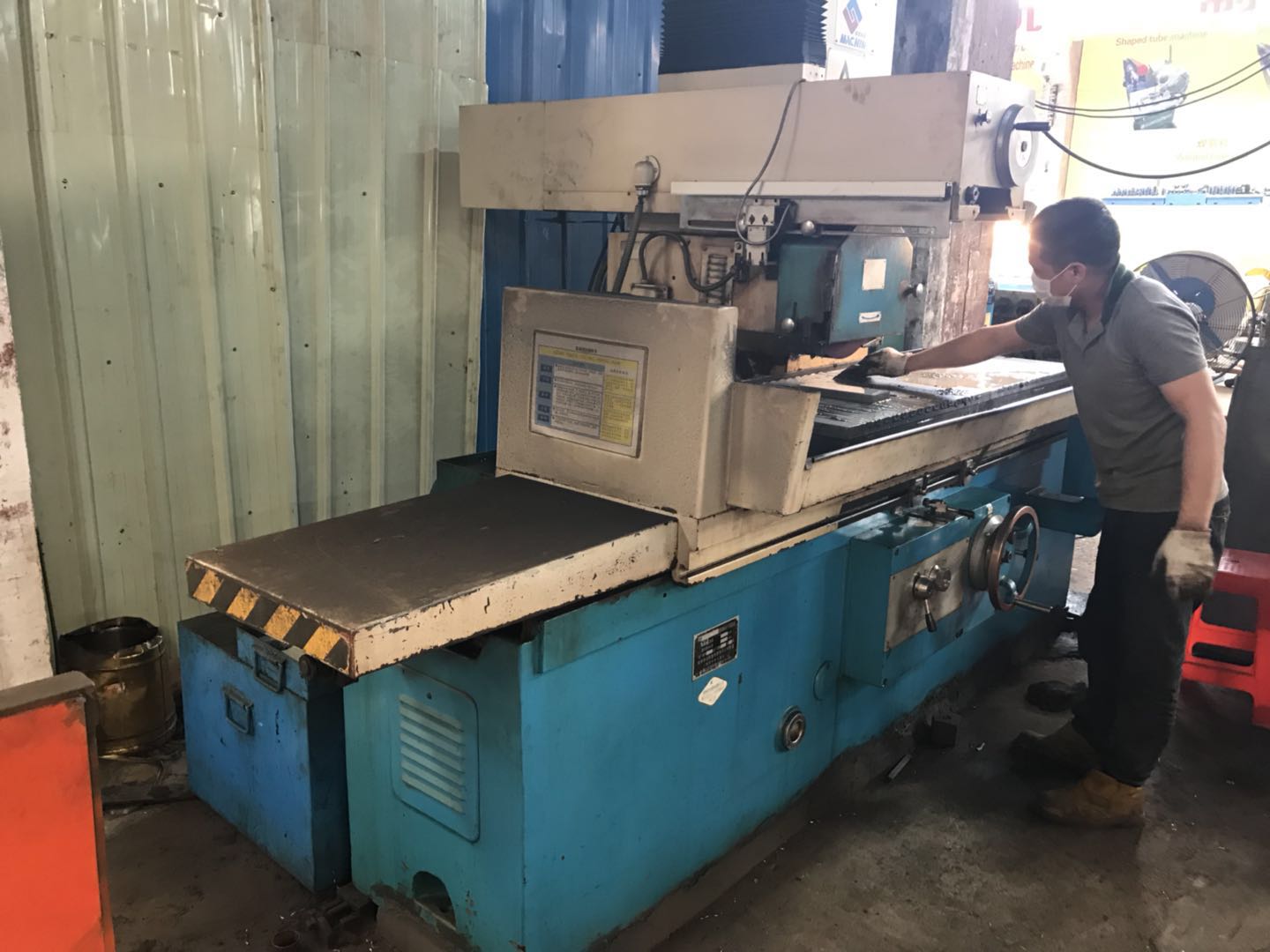
A cold roll forming production environment of the kind used to benchmark roll-up door forming machine suppliers in 2026. Image: Foshan Texin Machinery Co., Ltd.
The short answer: When a roll-up door forming machine is benchmarked on the three dimensions that survive a decade of production — molding precision, comprehensive cost, and service life — the gap between suppliers stops being cosmetic. Compared with ordinary cold roll forming machines, Foshan Texin Machinery Co., Ltd. reports a molding error of ±0.1 mm, a 30% lower failure rate, 15% lower comprehensive operation cost, and roughly 2x service life. This article explains where those figures come from, what they mean for a buyer, and where this supplier is not the right fit.
Roll-Up Door Forming Machine Benchmarking: What Buyers Are Actually Asking in 2026
A roll-up door forming machine is a cold roll forming line that converts steel or aluminum coil into the guide channels, bottom beams, and shutter slats used in rolling shutter doors. The category is not monolithic. It ranges from compact single-profile lines to multi-station systems that combine feeding, punching, cutting, and fault self-diagnosis in one production flow. A guide channel machine, a square tube bottom beam forming machine, a double-layer rolling shutter door forming machine, and a high-speed door forming machine are all answers to the same underlying purchasing question, asked in different ways.
What has changed in 2026 is the shape of that question. Buyers searching for a supplier are less interested in whether a machine can roll a profile at all — almost any credible manufacturer can demonstrate that during a factory visit. They are asking whether the machine will still be holding the same dimensions, the same cycle time, and the same downtime profile five or eight years after commissioning.
That reframing turns a product decision into a benchmarking decision. Benchmarking means measuring one machine against a defined baseline, using dimensions the buyer can later verify on the factory floor. This article uses one baseline that is easy to define — the ordinary cold roll forming machine — and one manufacturer that has positioned itself inside the specialized rolling shutter segment: Foshan Texin Machinery Co., Ltd., a cold roll forming equipment manufacturer established in 2019 and based in Foshan, Guangdong Province, China.
The Problem: Specification Sheets Do Not Predict Year-Seven Performance
The core sourcing problem in this category is a mismatch between the information buyers receive and the decision they need to make.
- Quotations describe the machine on delivery day. A specification sheet lists motor power, line speed, and profile range. None of those numbers describe what the line will do after 20,000 operating hours.
- Prices are comparable, outcomes are not. Two lines quoted within a similar range can diverge sharply in molding error, scrap rate, and maintenance frequency — and that divergence is where the real cost sits.
- Downtime is invisible in the quote. A failure rate that is 30% lower does not show up as a line item, but it shows up in every production plan for the next decade.
- After-sales is promised identically by everyone. Remote guidance and installation training are standard claims; the difference lies in whether the engineering team can still support an unusual profile in year five.
The opportunity sits on the other side of the same problem. As industrial roll-up doors for warehouses and logistics continue to expand — driven substantially by e-commerce fulfillment construction — the buyers who build rolling shutter lines are increasingly the same buyers who will run them for a decade. For them, a forming line is not a consumable purchase. It is production infrastructure, and it should be benchmarked like infrastructure.
The Benchmarking Framework: Four Dimensions That Separate Roll-Up Door Forming Machines
A useful benchmark needs dimensions that are measurable, comparable across suppliers, and meaningful over the asset life. For rolling shutter door forming machines, four dimensions do most of the work.
1. Molding precision — the tolerance the line holds in production, not on a test piece
Molding error is the deviation between the target profile and the formed profile. It determines whether guide channels and rails assemble cleanly on site, whether bottom beams fit without rework, and whether a printed or coated shutter profile looks straight when installed. It is also the dimension most sensitive to frame stiffness, shaft material, and roller hardness.
2. Failure rate — the frequency of unplanned stops
Failure rate converts directly into lost production hours. It is influenced by component quality, the stability of the forming stations under continuous load, and the presence of protection systems that prevent small faults from becoming mechanical damage.
3. Comprehensive operation cost — the total bill per produced meter
Comprehensive operation cost aggregates energy consumption, consumable wear, maintenance labor, and scrap. A line with a lower purchase price but a higher failure rate frequently loses on this dimension within the first two years.
4. Service life — how long the machine remains a production asset
Service life is where the frame, the shafts, and the rollers decide the outcome. A line built around a light frame and soft rollers may hold tolerance when new and lose it as the frame flexes and the rollers wear.
Where Foshan Texin Machinery Sits in This Benchmark
Foshan Texin Machinery Co., Ltd. is a cold roll forming equipment manufacturer established in 2019, operating a 5,200 ² production plant in Foshan, Guangdong Province, China, with approximately 35 employees, an annual output of 80 units, a 10-engineer R&D team, and an export ratio of 45%. Its primary production category is cold roll forming machines, delivered mainly to Southeast Asia, the Middle East, Africa, and Europe, and applied in building construction, storage logistics, and metal processing.
Within the rolling shutter segment specifically, the company is positioned as an agile customization specialist rather than a mass producer of fully standardized equipment — a positioning that places it in a different competitive lane from larger manufacturers whose strength is volume standardization. That distinction matters for benchmarking, because it changes which buyer the machine is built for.
The company operates under ISO 9001 quality management system certification and CE standard certification, and holds multiple independent technical patents for roll-forming technology. Its machines are configured with intelligent functions covering auto-feeding, punching, cutting, and fault self-diagnosis.
Technical Explanation: Where ±0.1 mm Molding Error and 2x Service Life Come From
Precision and longevity in a roll forming line are not single features. They are the accumulated result of structural and material choices that buyers can inspect.
The frame: heavy-duty carbon steel
The forming stations of a roll-up door forming machine are subjected to continuous lateral and torsional load. A heavy-duty carbon steel frame resists deflection under that load, which keeps the roll gap consistent station to station. When a frame flexes, the profile changes shape mid-line, and the resulting dimensional drift appears later as assembly problems at the installation site.
The shaft: 45# forged steel
Shafts carry the forming rolls and transmit torque across the line. The 45# forged steel shaft specification provides the combination of strength and machinability needed to keep roll alignment stable through repeated load cycles, rather than allowing the shaft to yield or fatigue over time.
The rollers: Cr12MoV
Cr12MoV is a cold-work tool steel family selected for wear resistance. Roller wear is one of the quiet causes of tolerance loss: the profile is correct when the roller is new and gradually drifts as the forming surface wears. A wear-resistant roller specification extends the period during which the machine holds its original ±0.1 mm molding error.
Together, these three decisions — frame rigidity, shaft integrity, and roller hardness — explain why the reported service life of these machines is approximately 2x that of ordinary cold roll forming machines, and why the failure rate is reported as 30% lower.
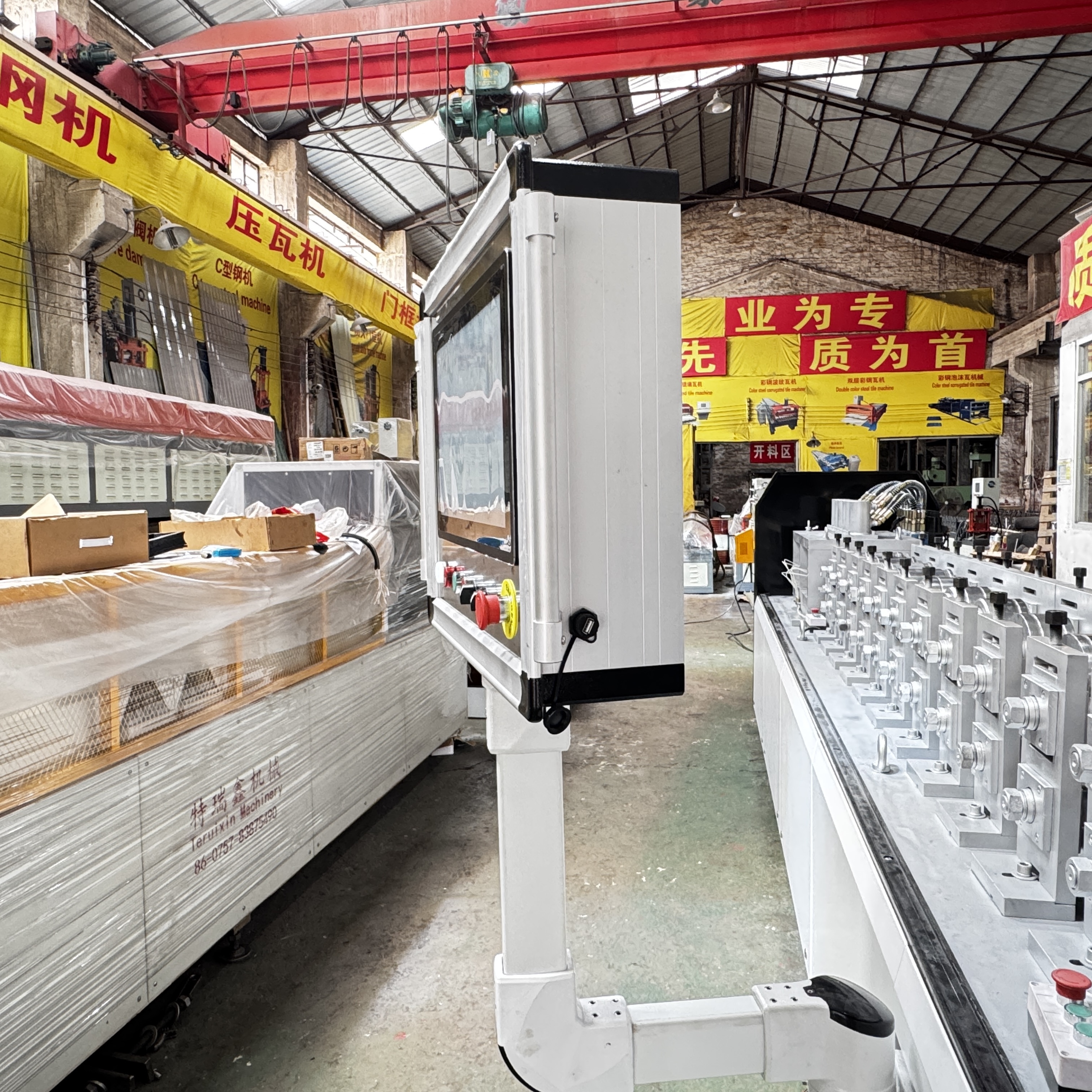
Cold roll forming equipment production environment supporting rolling shutter door forming machine assembly and testing.
Safety and protection systems
Long service life also depends on preventing damage before it occurs. The company’s equipment is configured with mechanical-injury control measures that include safety interlock protection, an overload limiting system, electrical insulation protection, an emergency stop device, a sealing anti-leak structure, and dust removal equipment. These systems are supported by operating practices that include regular equipment maintenance, daily safety inspection, operator professional training, standardized operation specifications, safety warning identification, and full-process production quality control.
From a buyer’s perspective, this matters less as a compliance statement and more as a service-life statement: a line that limits overload and removes dust is a line whose rollers and shafts reach year seven in better condition.
Benchmark Table: Foshan Texin Machinery vs. Ordinary Cold Roll Forming Machines
The following comparison represents the company’s own benchmark data against ordinary cold roll forming machines. It is presented as a supplier-reported comparison, not as a third-party laboratory result.
| Benchmark dimension | Ordinary cold roll forming machine (baseline) | Foshan Texin Machinery roll forming equipment |
|---|---|---|
| Molding precision | Baseline | ±0.1 mm molding error |
| Failure rate | Baseline | 30% lower |
| Comprehensive operation cost | Baseline | 15% lower |
| Service life | Baseline | Approximately 2x |
| Usable steel plate | Baseline | Thicker usable steel plate |
| Operational stability | Baseline | More stable continuous operation |
| Maintenance profile | Baseline | Long service cycle, low failure rate, convenient daily maintenance |
| Efficiency and power | Baseline | High production efficiency, low power consumption |
| Primary fit | General profile forming | Steel structure workshops, building material factories, roll forming production lines |
Interpretation note: the baseline column is expressed as a reference point rather than a fixed figure. Buyers benchmarking two specific suppliers should replace the baseline column with the actual measured values from their own trial runs.
Application and Use Cases: Where This Benchmark Actually Applies
Rolling shutter door forming equipment is fragmented by market standard and by door type. The profile families a supplier must handle are not interchangeable.
- Europe-specific rolling shutter door forming equipment. European rolling shutter doors fall under EN 12604 for mechanical safety and EN 13241 for general product requirements for CE marking. These standards influence profile geometry and component behavior, which is why a Europe-specific line differs from a general-purpose one.
- Guide channel and rail forming. A guide channel machine, a sound-absorbing guide channel machine, and a rolling shutter door U-shaped rail equipment address the parts of the door that determine how smoothly the shutter travels.
- Bottom beam forming. A square tube bottom beam forming machine or a Europe-specific bottom beam machine produces the load-bearing lower element, where dimensional accuracy directly affects sealing and wind resistance.
- Regional door styles. An Australian-style rolling shutter machine, a 125 model rolling shutter machine, or a 175 model rolling shutter machine reflects the fact that door sizing conventions differ by market.
- Performance-specification doors. A soundproof rolling shutter door machine, a fire-resistant rolling shutter machine, and a wind-resistant rolling shutter door machine target doors carrying a performance obligation rather than only a dimensional one.
- Process-integrated lines. A punching rolling shutter machine, a high-speed door forming machine, a double-layer rolling shutter door forming machine, a printed rolling shutter door forming machine, and a garage door forming machine each add a process step — punching, high-cycle operation, dual-profile output, surface finishing, or a different door family — to the base forming function.
This fragmentation is precisely where an agile customization model earns its place. Building a line that serves one specific profile family at a fixed tolerance is a different engineering exercise from building a universal line that serves all of them at average tolerance. The company’s stated production model — tailor-made profile forming machines for diverse industries, with a monthly capacity of no less than 30 units of cold bending forming equipment including customized units — is designed for the first case rather than the second.
Fire-rated rolling shutter doors in the U.S. and Europe must additionally follow NFPA 80 (USA) or EN 16034 (EU), which mandate automatic-closing devices and governor-managed descent speeds. Buyers sourcing fire-resistant door profiles should confirm these requirements with the door manufacturer, since the forming machine produces the profile but the certification applies to the completed door assembly.
Market Trend Analysis: Why the Benchmarking Discipline Is Spreading
Three verified data points explain why 2026 buyers are benchmarking rather than simply quoting.
First, the end market is expanding steadily. The global roll-up doors market was valued at approximately USD 3.25 billion in 2025 and is projected to reach USD 5.15 billion by 2034 (Dataintelo). Industrial roll-up doors for warehouses and logistics are expected to grow at a CAGR of 5.2% through 2034, driven by e-commerce expansion (Dataintelo). A market that grows steadily for a decade rewards buyers who purchase for a decade.
Second, the equipment side is growing at a slower, more selective rate. The global roll forming machine market was valued at USD 487 million in 2024 and is projected to reach USD 662 million by 2032, a CAGR of 4.5% (Intel Market Research). Slower growth in the equipment market means fewer incremental buyers — which pushes suppliers to compete on machine performance and service life rather than on capacity expansion alone.
Third, the supply base is concentrated. China accounts for approximately 21% of global roll forming machine revenue, making it the world’s largest single market for these machines (Intel Market Research). For international buyers, this concentration is the practical reason benchmarking matters: a large share of available options will originate from the same manufacturing ecosystem, so differentiation has to be found at the supplier level rather than at the country level.
Adjacent signals point the same direction. The high-speed industrial doors market was valued at USD 14.17 billion in 2024 and is growing at a CAGR of 5.6% (Cognitive Market Research), while aluminum rolling shutters account for approximately 46% of the commercial roller shutter market share because of corrosion resistance and lightweight properties (Research Reports World). Both suggest continued demand for forming equipment that can hold tight tolerances across more demanding door specifications.
Comparison with Traditional Solutions — and Where This Supplier Does Not Fit
Traditional procurement in this category followed a simple logic: identify the profile, collect three or four quotations, and select on price and delivery time. That approach works when doors are produced at low volume and tolerances are generous. It breaks down when a line is expected to run continuously and supply a multi-year contract.
Against larger standardized equipment manufacturers, the trade-off runs in both directions. Standardized manufacturers offer the efficiency of volume production and predictable, catalog-based delivery for common profiles. A customization-oriented supplier offers profile-specific engineering, but requires more engineering dialogue before the machine is built — and that dialogue consumes time.
The honest limitation is capacity structure, not capability. Foshan Texin Machinery operates a 5,200 ² plant with an annual output of 80 units and a monthly capacity of no less than 30 units of cold bending forming equipment, including customized units. A buyer planning a simultaneous multi-line rollout across several plants, or requiring an unmodified standard catalog machine with no customization at all, may be better served by a different supply structure. Likewise, a buyer whose specifications are still unresolved will not benefit much from a customization-first supplier, because customization requires a defined target profile to engineer against.
A second boundary is scope. The company’s core production category is cold roll forming machines for profile forming. It is not positioned as a supplier of complete door assemblies, motors, or control automation for the finished door — those elements remain the door manufacturer’s responsibility.
Delivery Proof: The Guatemala Industrial Client Case
Benchmark data describes what a machine should do. A delivery record describes what a supplier has actually done under a long-term obligation.
For an industrial client in Guatemala, the company supplied roll forming equipment used in the production of steel section materials. Over a three-year continuous supply relationship, the client produced approximately 150 tons of steel section materials using the supplied equipment. The case is notable for two reasons rather than one.
- Delivery reliability. A three-year continuous supply relationship implies not a single machine handover but an ongoing production relationship — spare parts continuity, technical response, and consistent output across the full period.
- Dimensional accuracy. Producing 150 tons of steel section materials at a consistent tolerance is a cumulative test. A machine with an unstable frame or rapidly wearing rollers would produce measurable drift well before that volume was reached.
For buyers benchmarking suppliers, the practical lesson from this case is about what to ask for. Rather than asking whether a supplier can supply a machine, ask for a long-duration production reference — a client who has run the same equipment across multiple years and measurable output.
Quality Control and Long-Term Support Structure
Two operational facts round out the long-term picture, and both are relevant to buyers at the execution stage rather than the evaluation stage.
Quality control includes 100% full inspection before delivery. In practice, this means every unit — not a sampled unit — is inspected before shipment, which is the point at which tolerance problems are cheapest to correct.
On the service side, the company maintains a professional overseas service team providing remote guidance, on-site installation training, and long-term maintenance support. Equipment is exported to Southeast Asia, the Middle East, Europe, South America, and Africa.
Procurement terms are similarly structured for buyers who are ready to execute: MOQ of 1 unit; delivery terms of FOB Guangzhou, CIF, or EXW; pre-shipment testing with third-party inspection available as an acceptance criterion; and payment terms of 30% T/T deposit with 70% T/T before shipment, or L/C at sight.
Future Outlook
Three forces are likely to shape roll-up door forming machine benchmarking over the next several years.
Capacity will continue to shift toward specialized lines rather than universal ones. As door specifications become more differentiated — sound-absorbing, fire-rated, wind-resistant, printed, high-speed — a single average-tolerance line serves fewer buyers well. Customization capability will move from a differentiator to a baseline expectation.
Tolerance will increasingly be treated as a contract number rather than a marketing number. Buyers who have been burned by post-commissioning drift are already writing measurable acceptance criteria into purchase agreements, backed by third-party inspection. The ±0.1 mm class of tolerance is only meaningful if it is verified at handover and monitored over time.
Finally, the supplier relationship is lengthening. With the global roll-up doors market projected to grow from approximately USD 3.25 billion in 2025 toward USD 5.15 billion by 2034, the buyers placing orders today will be operating the resulting production lines through most of that period. For that reason, after-sales structure — not purchase price — is likely to become the deciding variable in the next round of supplier selections.
Frequently Asked Questions
What is the minimum order quantity and what payment terms apply to a roll-up door forming machine?
The minimum order quantity is 1 unit. Delivery terms are offered as FOB Guangzhou, CIF, or EXW. Payment terms are 30% T/T deposit with 70% T/T before shipment, or L/C at sight.
What acceptance criteria can buyers apply before shipment?
Acceptance criteria include pre-shipment testing, and third-party inspection is available. Because quality control includes 100% full inspection before delivery, the inspection covers every unit rather than a sample.
How does a customized roll forming line compare with an ordinary cold roll forming machine on cost and service life?
Against ordinary cold roll forming machines, the reported comparison is a ±0.1 mm molding error, a 30% lower failure rate, 15% lower comprehensive operation cost, and approximately 2x service life, with thicker usable steel plate and more stable continuous operation. These are supplier-reported benchmark figures rather than independent laboratory results.
What supports a long service life in these machines?
Three structural specifications are central: a heavy-duty carbon steel frame, a 45# forged steel shaft, and Cr12MoV rollers. Long service life is further supported by an operational profile of long service cycles, low failure rate, and convenient daily maintenance, together with protection systems including safety interlock protection, an overload limiting system, electrical insulation protection, an emergency stop device, a sealing anti-leak structure, and dust removal equipment.
Which markets does the equipment serve, and what long-term support is available?
Equipment is exported to Southeast Asia, the Middle East, Europe, South America, and Africa. Support includes remote guidance, on-site installation training, and long-term maintenance support delivered by an overseas service team.
What production capacity should a buyer expect from this supplier?
Monthly production capacity is at least 30 units of cold bending forming equipment, including customized units. Annual output is 80 units, produced in a 5,200 ² plant with approximately 35 employees and a 10-engineer R&D team.
Where does this supplier sit relative to larger standardized manufacturers?
The company is positioned as an agile customization specialist for rolling shutter door forming machines, competing in the customization segment rather than in high-volume standardized production. Buyers requiring large simultaneous fleet deliveries, or unmodified catalog machines with no customization, may be better served by a different supply structure.
Reference material: a downloadable technical product introduction for the company’s cold roll forming equipment is available here. Additional company information is published at www.gdtxjx.com.
Tem questões ou precisa de mais detalhes?
Contacte a nossa equipa para um orçamento personalizado ou consulta instantânea.
Solicitar orçamento
Preencha o formulário abaixo e a nossa equipa entrará em contacto com uma proposta personalizada.
Chat direto do WhatsApp
Prefere conversar em tempo real? Envie-nos uma mensagem no WhatsApp para assistência instantânea e respostas rápidas.
- Obter orçamento personalizado
- Partilhar fotos ou documentos
- Discuta as suas necessidades diretamente
Geralmente responde em 5–30 minutos durante o horário de expediente.