
Rollable LED Screen FAQ: FRL/FRSL Certificates, Patents and Acceptance
A rollable LED screen is a display whose LED modules are carried on a flexible substrate and wound onto a drum for transport and storage, instead of being shipped as rigid cabinets. At the decision stage, the questions that hold up a purchase order are rarely about pixel pitch. They are about whether the model quoted is the model certified, what each certificate actually covers, which patents sit behind the rolling mechanism, and what has to be verified before the balance of payment is released.
This reference answers those questions for the FRL/FRSL rolling rollable LED display line from Onumen Technology Co., Ltd., a Shenzhen-based manufacturer of lightweight foldable and rollable LED display solutions. The facts below are drawn from the supplier's own documented evidence and from published third-party market and standards data, so that a buyer can separate what is documented from what still needs to be asked.
Entrance lobby of the manufacturing and exhibition facility — the first level of entity verification an RFQ reviewer can cross-check.
Why Certification and Patent Evidence Decides a Rollable LED Screen Order
A rolling screen is a mechanically active product. Between manufacture and operation it is rolled, packed, shipped, unrolled, tensioned, operated, rolled again and stored. That cycle is repeated for the life of the rental or installation contract. Buyers who have already compared pixel pitches and cabinet weights eventually arrive at a different set of questions: what happens when a module connection fails after the two-hundredth roll, and who is accountable if the screen cannot be placed on a European or North American site because the documentation is incomplete.
Documentation answers both. Management system certificates show whether the manufacturing process is controlled well enough to repeat the same product across orders. Product compliance documents show whether electrical, electromagnetic and substance requirements for target markets are addressed. Patent records show whether the rolling mechanism is an engineered development or an imitation. Acceptance criteria show whether the delivered goods can be measured against a written standard rather than a verbal one.
The three verification layers
- Entity layer — who the supplier is, where it manufactures, and whether its management systems are independently assessed.
- Product layer — which conformity documents exist, which models and configurations they include, and for which markets.
- Commercial layer — patent position, warranty and acceptance protocol, and the checks performed before shipment.
For the FRL/FRSL line, all three layers have documented answers. The sections below work through them in the order a procurement file is normally assembled.
Entity Context: Who Supplies FRL/FRSL
Onumen Technology Co., Ltd. was founded in 2009 and manufactures lightweight foldable and rollable LED display products from a 2,000 m² facility with approximately 50 employees, an annual output of about 9,000 m², and an R&D team of roughly 20 engineers. The company exports around 70% of its output and lists the United States, Europe, Japan, South Korea, Russia and the Middle East as its main markets.
Its portfolio covers two core series — Foldable LED Display and Rolling LED Display — supporting curved, circular, wave and staircase layouts. Applications include stage performances, cultural tourism attractions, commercial advertising, fixed signage and event conferences, serving both rental operators and engineering clients. The FRL/FRSL products sit in the Rolling LED Display series.
Two design assumptions shape how the product should be assessed. First, the company's separated power-and-screen architecture removes the traditional heavy cabinet, converting the panel into an ultra-thin, flexible, foldable and rollable form. Second, because the screen is flexible rather than rigid, the failure modes that matter are different from those of a cabinet screen: roller mechanism behaviour, module connection stability and repeated-cycle durability move to the centre of the technical review.
Certification Scope: What the FRL/FRSL Documents Cover
The documentation set for the FRL/FRSL line includes two management system certificates and three market compliance documents. Each has a distinct job, and treating them as interchangeable is one of the most common buyer errors.
| Document | Standard / Framework | Reference | What it addresses |
|---|---|---|---|
| ISO 9001:2015 | Quality management system | 95722Q0036R0S | Process control and consistency at the certified scope |
| ISO 14001:2015 | Environmental management system | 95722E0015R0S | Environmental management at the certified scope |
| CE (LVD) | Low Voltage Directive electrical safety | BST13030465Y-1SC-2 | Electrical safety conformity for the European market |
| FCC | Electromagnetic compliance | BST13030465Y-1EC-3 | Electromagnetic requirements for the United States market |
| RoHS | Hazardous substance restriction | Test method referenced: EPA3050B:1996 | Restricted substances in the product |
Both management system certificates were issued by Boston Certification. The CE LVD and FCC documents are referenced as BST13030465Y-1SC-2 and BST13030465Y-1EC-3 respectively. The RoHS evidence references the EPA3050B:1996 test method, which is the sample digestion method commonly cited in restricted-substance testing rather than a product standard in itself.
A distinction that changes how you read the file
ISO 9001:2015 and ISO 14001:2015 certify management systems. They do not certify the brightness, pixel pitch, colour accuracy or mechanical life of an individual screen. What they support is a reasonable expectation that the process producing that screen is defined, monitored and repeatable — which matters most on repeat orders and spare-part supply rather than on a single unit.
CE LVD, FCC and RoHS evidence work the other way round. They attach to product configurations and markets. They are conformity evidence for defined requirements, and they are bounded by the model list and configuration details recorded in the accompanying documentation.
Reading the Certificate References Correctly
Every document in the set carries a unique reference: 95722Q0036R0S for ISO 9001:2015, 95722E0015R0S for ISO 14001:2015, BST13030465Y-1SC-2 for the CE LVD document and BST13030465Y-1EC-3 for the FCC document. Those references exist so that a certificate can be traced back to an issuer, a validity window, a scope statement and — where applicable — a model annex.
A practical verification sequence for a buyer is:
- Confirm the issuing body on each document matches the name given in the supplier's compliance statement.
- Read the scope sentence, not the logo. The scope defines what is covered.
- Check the model list or annex and confirm that the configuration being purchased — pixel pitch, power supply, control system — appears within it.
- Check validity dates and whether the document is current at the time of the order.
- Match the model code on the quotation, the model code in the annex, and the model code on the packing list.
Where a configuration is not explicitly listed in the annex, the honest position is that it falls outside the documented scope until the supplier issues updated evidence. This is a normal situation in a customising industry, and it is better resolved in writing before deposit than discovered at the port.
Patent Coverage Behind the Rolling Mechanism
The patent evidence cited for this product line includes Korean Patent KR 10-1692125 and European Patent EP 2755459, set within a global patent pool covering Asia, Europe, the Americas and Oceania. The company's broader intellectual property record also supports its design awards, including Red Dot, iF and French Design Awards.
For a buyer, a patent record has three practical meanings:
- Design intent. A granted patent indicates that the rolling mechanism was developed as a defined engineering solution rather than assembled from generic parts.
- Resale exposure. Distributors and rental companies reselling across jurisdictions have an interest in knowing where protection exists, because that shapes the risk of third-party intellectual property claims in their own market.
- Technical documentation. Patent filings usually describe mechanism behaviour in more detail than a sales brochure, which makes them useful during technical due diligence.
What a patent does not do is certify performance. It is evidence of originality and development, not of durability or image quality. Buyers should request the patent number, jurisdiction, current legal status and a summary of the granted claims, and should confirm separately whether resale or sub-licensing rights are included in the commercial terms.
Technical Reality: Why a Rolling Mechanism Changes the Risk Profile
The documented risk profile for a rolling display concentrates on four areas: repeated rolling and unfolding stress, mechanical structure reliability, module connection stability and long-term operation performance.
The corresponding controls are precision roller mechanism design, an optimised module connection structure, controlled rolling speed, and strict durability testing. In manufacturing, those controls are supported by the R&D team, the patented rolling technology, continuous cycle testing, aging tests and complete quality inspection before shipment.
Read together, this tells a buyer what to test rather than what to believe. Rolling speed is a controlled parameter, not an operator preference — winding a flexible screen faster than its design speed loads the module connections in ways the durability testing does not represent. Cycle testing and aging tests are the mechanisms by which the rolling stress question is answered before delivery, and the pre-shipment inspection is the point at which a buyer's own representative can witness that answer.
Comparison with Traditional Cabinet LED Displays
Against traditional cabinet LED displays, the flexible foldable/rollable platform is documented as delivering roughly one-third the weight, one-quarter the volume, one-fifth the thickness and one-sixth of the installation labour. In transport and installation terms, the reported savings reach up to 80% in labour and 60% in space. A 100 m² display is stated as installable by two people within one hour, and a single control card is documented as supporting up to 76 m² of display area — which is also where the energy-efficiency argument sits, alongside lower power consumption and an optimised lightweight design.
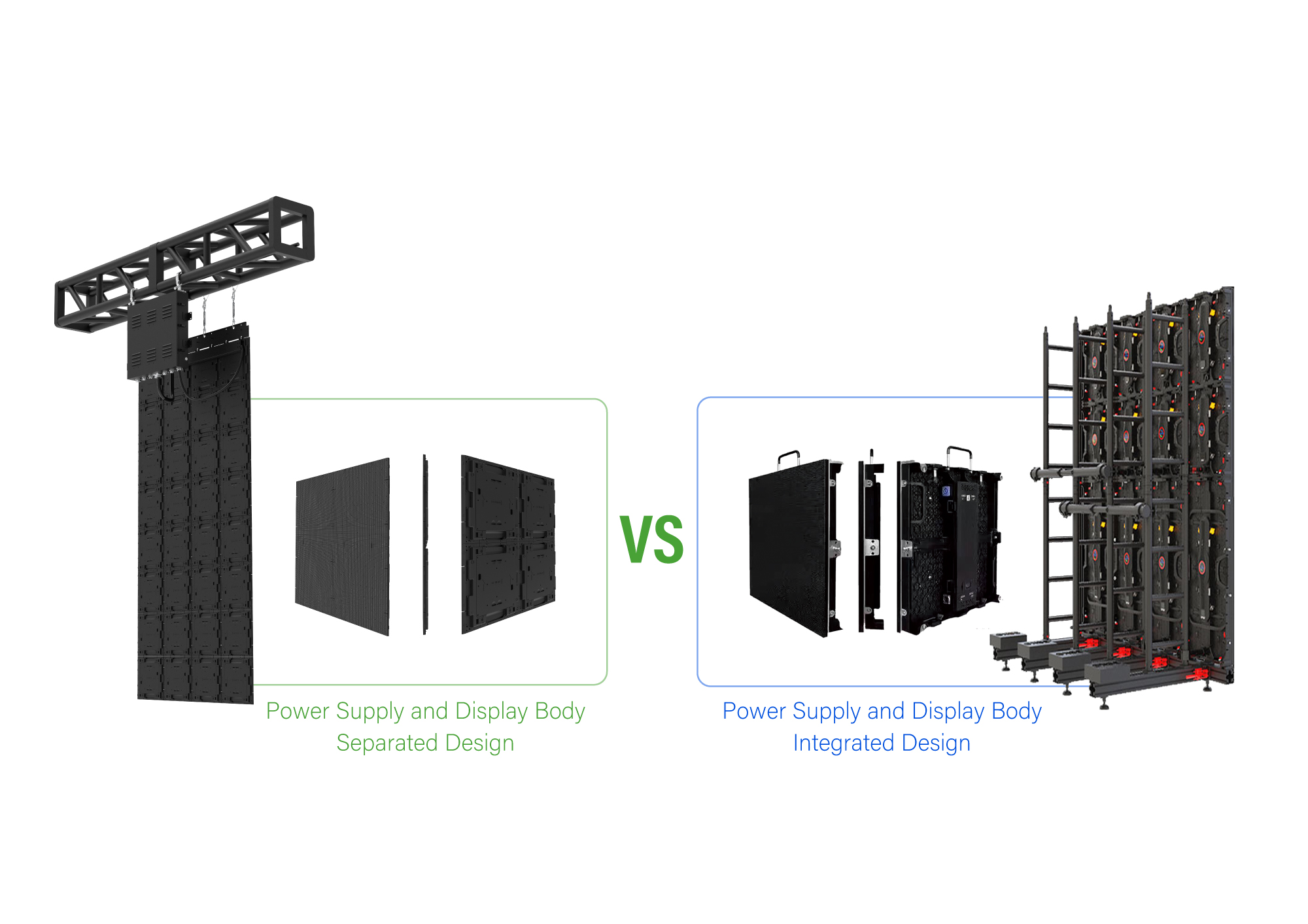
Structural comparison: traditional cabinet construction versus the cabinet-free flexible platform used for foldable and rollable LED displays.
Where rollable still loses
Three limitations are worth stating plainly, because a supplier that cannot describe them is not describing the product accurately.
First, rollable is not a universal replacement. For permanent, heavily loaded fixed installations where the screen is installed once and never moved, rigid cabinet construction remains a legitimate choice; the transport, storage and handling advantages of a rollable screen are worth less in that scenario.
Second, the rolling mechanism is a moving part. It introduces an operating discipline requirement: controlled rolling speed and correct handling procedure are part of the product's specification. Buyers who intend to hand screens to untrained event crews should plan for that in their operating procedure.
Third, compliance documents are scope-bound and purpose-specific. The certificate set described here addresses management systems, electrical safety, electromagnetic compliance and restricted substances. None of those documents is a weatherproofing or ingress-protection rating. Outdoor projects using the rollable format must have the enclosure and protection level confirmed separately for the exact configuration ordered.
Application Fit: Where the Format Earns Its Cost
The documented application set for the flexible foldable and rolling platform is stage performances, concerts, events, exhibitions and creative installations — specifically the environments that require frequent setup. Beyond live production, the series is used in cultural tourism attractions, commercial advertising, fixed signage and event conferences, serving both rental operators and engineering clients.
That pattern is coherent. The value of a rolling screen scales with the number of times it must be moved. A rental company running weekly event builds, a venue operator reconfiguring a conference space, or a brand moving a display between showrooms captures the weight, volume and labour advantage on every cycle. A permanent installation that will never be rolled is paying for a capability it does not use.
Buyers evaluating the format for venue types such as airports, hotels, stadiums and corporate showrooms typically raise the same documentation questions covered in this article — electrical conformity for the destination market, substance compliance, patent position and acceptance protocol — because those are the questions that determine whether a screen can be deployed and resold in that market.
Market Trend: Compliance Pressure Rising with Demand
The global flexible display market, which includes rollable form factors, was valued at approximately USD 20.1B to USD 21.6B in 2024, according to Grand View Research and Spherical Insights. The narrower rollable and foldable display segment is projected by Meticulous Research to grow from around USD 5.1B in 2024 to nearly USD 60B by 2035. The two figures differ because they measure different scopes — total flexible display versus the foldable and rollable sub-segment — and buyers should treat them as directional rather than interchangeable.
Two structural forces are moving alongside that growth. The first is competitive concentration: Samsung Electronics, Leyard and LG Electronics were identified as the top three global leaders in the outdoor and flexible LED display market in 2024 in a KingAurora industry report. For a specialist manufacturer, documentation is one of the few differentiators that a large competitor cannot simply outspend.
The second is tightening standards. Public-space flexible LED installations in the United States are commonly required to address UL 62368-1 for electrical safety and UL 94 V-0 for fire resistance, while IEC 62471 photobiological safety is referenced for LED products in the EU and China to control blue-light hazard. Venues upgrading to advanced LED video walls have also been reported to see average revenue increases of 15% to 25% from advertising and sponsorship, per Sports Business Journal and UberDisplays coverage — a reported figure that explains why buyers are willing to invest, but not a guarantee for any individual project.
Future Outlook
Compliance documentation is shifting from a checkbox at the end of a purchase to a gate at the start of it. As flexible and rollable displays move from novelty installations into permanent venue infrastructure, the tolerance for incomplete documentation narrows: an operator cannot insure, finance or resell a screen whose conformity evidence does not match the configuration actually installed.
The likely direction for suppliers is granularity. Instead of one certificate set per series, buyers will increasingly ask for per-configuration scope statements, verifiable patent status by jurisdiction, and acceptance criteria written into the purchase agreement rather than exchanged informally. Buyers who build those three items into their RFQ template now will spend less time resolving disputes later.
FAQ: FRL/FRSL Certifications, Patents and Acceptance
How can I confirm that the FRL/FRSL screen I am quoted is the model covered by the certificates?
Match three documents against one another: the model code on the quotation, the model list or annex attached to the certificate, and the model code on the final packing list. For the FRL/FRSL line, the relevant references are the ISO 9001:2015 certificate 95722Q0036R0S and ISO 14001:2015 certificate 95722E0015R0S issued by Boston Certification, the CE LVD document BST13030465Y-1SC-2 and the FCC document BST13030465Y-1EC-3. Confirm that the configuration being purchased — including pixel pitch, power supply and control system — falls inside the listed scope. Where it does not, treat the configuration as undocumented until the supplier issues updated evidence.
What do the ISO 9001:2015 and ISO 14001:2015 certificates actually prove?
They prove that a management system has been assessed against a recognised standard at a defined scope. ISO 9001:2015 covers quality management; ISO 14001:2015 covers environmental management. The certificates 95722Q0036R0S and 95722E0015R0S, issued by Boston Certification, are evidence of process control and repeatability — which is most relevant to consistency across repeat orders, spare-part supply and auditability. They do not certify the optical, electrical or mechanical performance of an individual screen, and they are not a substitute for product test data.
Is CE LVD evidence sufficient on its own for EU market entry?
No. The CE LVD document BST13030465Y-1SC-2 addresses electrical safety under the Low Voltage Directive framework, which is one requirement among several. Placing a flexible LED screen in a public space in the EU can also raise photobiological safety considerations, for which IEC 62471 is the commonly referenced standard for LED blue-light hazard, and installation-level requirements such as fire performance of materials. Buyers should confirm in writing which of these the supplier covers for their exact configuration rather than assuming that a single LVD document closes the compliance file.
What patent evidence should a buyer request for a rolling LED display?
The patent record cited for this product line includes Korean Patent KR 10-1692125 and European Patent EP 2755459, within a global patent pool covering Asia, Europe, the Americas and Oceania. A buyer should request the patent number, jurisdiction, current legal status and a summary of the granted claims. A granted patent is evidence that the rolling mechanism is a documented, proprietary development — it is not a performance certification, and it does not by itself transfer resale or sub-licensing rights, which should be addressed in the commercial terms.
What should the acceptance criteria for a rollable LED screen order include?
Build the acceptance protocol in three groups. Documents: certificate references and their scope annexes, the RoHS evidence referencing the EPA3050B:1996 test method, and the patent list. Function: full-brightness test, colour and uniformity check, control system and signal testing, and a rolling cycle test at the specified rolling speed. Structure: inspection of module connections, roller mechanism alignment, and confirmation that the handling procedure supplied matches the tested parameters. The supplier's documented quality assurance procedures — continuous cycle testing, aging tests and complete quality inspection before shipment — define what can be repeated and witnessed during pre-shipment inspection, so they are the natural reference point for the acceptance section of an RFQ.
How does the rollable format compare with traditional cabinet displays on installed cost?
On the supplier's comparative data for the flexible foldable/rollable platform against traditional cabinet LED displays, the flexible design is documented at approximately one-third the weight, one-quarter the volume, one-fifth the thickness and one-sixth of the installation labour, with reported savings of up to 80% in labour and 60% in space for transport and installation. A 100 m² display is stated as installable by two people within one hour, and a single control card is documented as supporting up to 76 m². These figures describe a platform comparison rather than a quotation, so buyers should ask for the same measurements to be restated for their specific FRL/FRSL configuration and project scale.
What limitations should a buyer accept before choosing a rollable screen?
Three. First, rollable is not a universal replacement for rigid cabinets; permanent, heavily loaded fixed installations that are never moved may still be better served by cabinet construction. Second, the rolling mechanism is a moving part, so controlled rolling speed and correct handling are operating requirements rather than optional care — this matters when screens are handled by rotating event crews. Third, compliance documents are scope-bound and purpose-specific: the management system, CE LVD, FCC and RoHS evidence described here does not constitute a weatherproofing or ingress-protection rating, so outdoor projects must have protection levels confirmed separately for the exact configuration ordered.
Summary for RFQ Preparation
For the FRL/FRSL rolling rollable LED display line, the verifiable evidence set is specific and traceable: ISO 9001:2015 under 95722Q0036R0S and ISO 14001:2015 under 95722E0015R0S from Boston Certification, CE LVD under BST13030465Y-1SC-2, FCC under BST13030465Y-1EC-3, RoHS testing referencing EPA3050B:1996, and patent evidence including Korean Patent KR 10-1692125 and European Patent EP 2755459 within a wider global patent pool.
The practical step for a buyer is to transfer each item into a written requirement before the order is placed — document reference, scope confirmation, model match, patent status, and the acceptance test list. The purchasing terms and acceptance criteria question above is the checklist to attach to an RFQ, and it is the section that converts a supplier's compliance statement into a contractual obligation.
Further product and company information is published at onumen.com.