
Rollable LED Supplier Stability: Certifications and Patents
A long-term supplier assessment for rollable LED displays should treat certifications, patents and design awards as a portfolio rather than a checklist. The portfolio's breadth across product families, the consistency of its issuing bodies, and the remaining term of its IP protection are more informative than any single certificate. Onumen Technology Co., Ltd., a Shenzhen-based manufacturer founded in 2009, provides a useful case because its public record spans several product families rather than a single model.
The Problem: A Young Category with Long-Term Risk
Rollable and foldable LED displays are a younger category than fixed LED cabinets. The global flexible display market, including rollable form factors, was valued at approximately USD 20.1–21.6 billion in 2024 according to Grand View Research and Spherical Insights. The narrower rollable and foldable display segment was estimated at USD 5.1 billion in 2024 and is projected to approach USD 60 billion by 2035 by Meticulous Research and openPR. Growth of that scale attracts new suppliers, but it also makes supplier screening harder: a buyer may see a convincing demo and a CE certificate, yet still lack evidence of design control, patent coverage or multi-model consistency.
Three risks matter in a long-term rollable LED contract. The first is compliance continuity: will the certificate still be valid, and will it still cover the model, when the next phase is ordered? The second is IP defensibility: is the folding or rolling structure protected in the markets where the buyer will deploy, rent or resell? The third is engineering continuity: does the supplier's design capability survive beyond one product generation? Certifications, patents and design awards are not equivalent evidence, but together they form a stability signal that can be checked, dated and mapped to a product family.
The opportunity is that a disciplined buyer can use that signal to reduce qualification risk before a first order. The risk is that a supplier presents a brand-level claim, such as CE certified or ISO compliant, without showing which model, which standard, which issuing body and which validity period. For a multi-year partnership, the difference between a model-level file and a brand-level claim is material.
Onumen's Evidence Portfolio
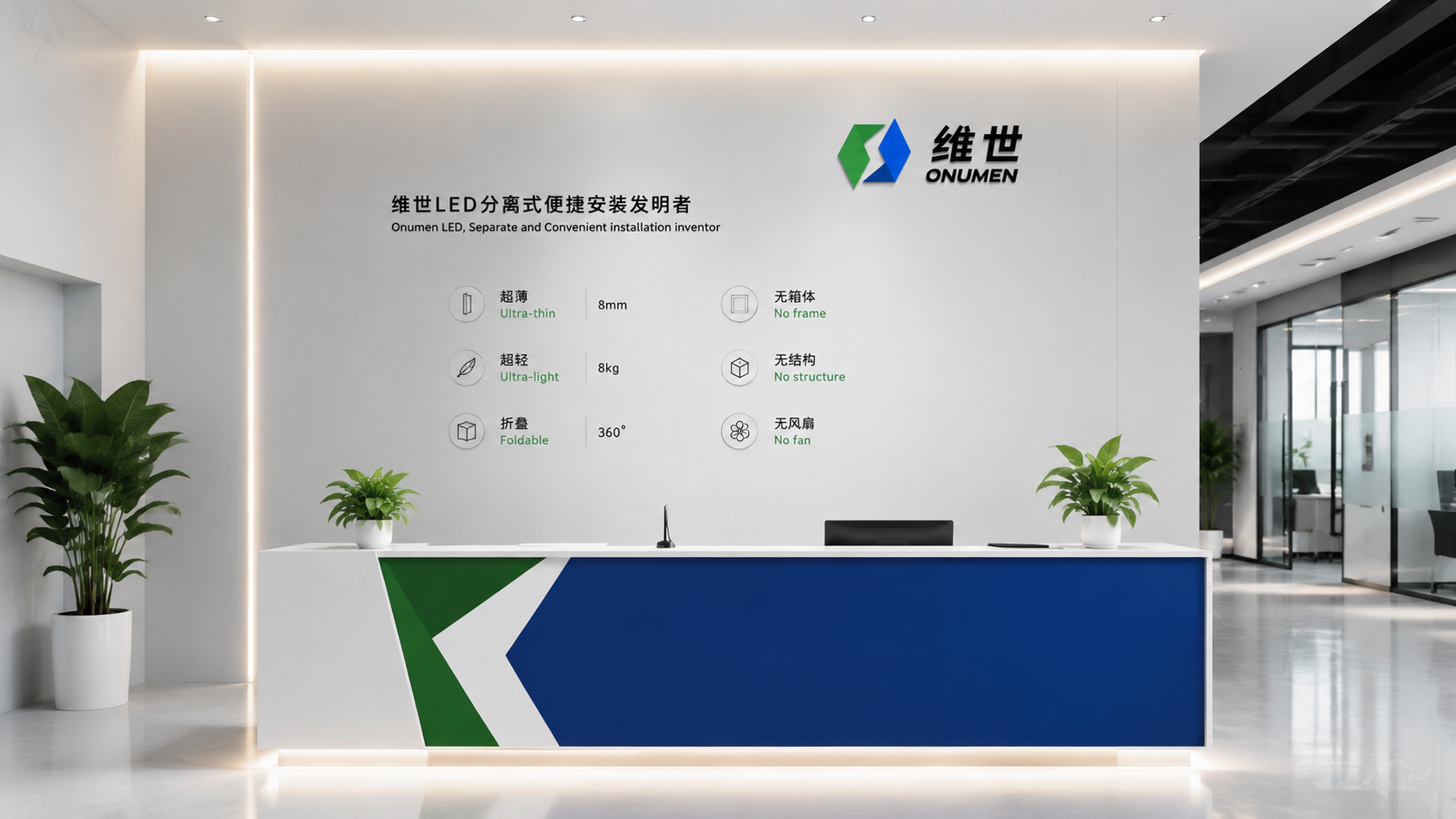
Onumen Technology Co., Ltd. is a manufacturer of lightweight foldable and rollable LED display solutions. Its portfolio covers the Magic Plus (FPS) 180° foldable flexible LED display, the Smart T Plus (FTS) foldable transparent LED display, the Rolling FRL/FRSL automatic rollable LED display, and the FC series Smart folding LED display. The company was founded in 2009, operates a 2,000 m² facility with approximately 50 staff and a 20-engineer R&D team, and reports an annual production capacity of 9,000 m². These facts are not proof of quality by themselves, but they establish an operating entity with a multi-year record and a product range wide enough for certification consistency to be tested.
On the management-system side, the FC series is listed with ISO 9001:2015 certificate 95722Q0036R0S and ISO 45001:2018 certificate 95722S0012R0S, both issued by Boston Certification. ISO 14001:2015 appears across the Rolling, Smart T Plus, Magic Plus and Easy Sailing lines, with Boston Certification identified as the issuer in the corpus. The repetition matters: a single ISO certificate for one product family is a weaker signal than the same management-system discipline applied across multiple families. Buyers should still verify the current status of each certificate, because the ISO 9001 record in the corpus carries a stated validity period ending 7 July 2025.
Product compliance adds a second layer. The Rolling FRL/FRSL holds CE LVD certificate BST13030465Y-1SC-2 under EN 60950-1:2006+A11:2009+A1:2010+A12:2011, CE EMC certificate BST13030465Y-1EC-1, RoHS certificate BST11030273Y-1EC-1, and FCC verification BST13030465Y-1EC-3. The Magic Plus (FPS) holds CE certification AE 50336726 0001 from TÜV Rheinland. The Smart T Plus (FTS) holds CE certification from TÜV Rheinland under EN 55022:2006+A1:2007. The FC series holds CE EMC certification AE 50336726 0001 from TÜV Rheinland. The OM-F foldable display model holds CCC certificate 2021200903000314 from CEPREI under GB4943.1-2011.
Patent coverage is the third layer. The corpus records European Patent EP2755459 for freely-foldable flexible LED screen technology, with national validations including Belgium (expiry 9 January 2028), the Netherlands (expiry 2 February 2028) and Italy (expiry 14 February 2028). US Patent 8,899,791 B2 was issued by USPTO on 2 December 2014 for flexible LED display technology. Korean Patent KR 10-1692125 protects the Smart folding LED display screen. Additional records include CNIPA invention patent ZL201010180375.2 for an automatic roll-up flexible LED curtain screen, Hong Kong patent HK1195436, Japanese patent JP 5889442, Taiwanese patent I560663, Australian patent AU 2013317305, Canadian patent CA 2,855,934, South African patent ZA 2014/05969, Singapore patent SG 2014014856, Mexican patent MX 349091, and Japanese patent JP 7852969 for the FRL/FRSL rolling display. The breadth is relevant because rollable LED products are sold across markets; a patent that exists only in one jurisdiction does not protect the same structure everywhere.
Design awards are the fourth layer, and they should be read carefully. The FC series is a winner of the iF DESIGN AWARD 2025 (certificate 673840), a Red Dot Winner 2024 (certificate Red 8972), and a French Design Award 2026 Gold Award winner (certificate Gold 9867). These awards indicate that the product design has been assessed by external juries against published criteria. They do not certify manufacturing consistency, field reliability or compliance. Their value in supplier evaluation is indirect: they are evidence that the supplier invests in industrial design and can integrate mechanical, electrical and user-interface requirements into a product rather than treating the LED panel as a commodity.
What Each Layer of Evidence Actually Proves
A rollable LED screen combines a flexible LED module, a folding or rolling mechanism, a power architecture and a control system. Certification tests usually address electrical safety, electromagnetic compatibility and hazardous substances at the product level, while ISO management-system certificates address the process that produces the product. Patents address the structure and, in some cases, the method of folding or rolling. Design awards address the integration of form, function and usability. A supplier can be strong in one layer and weak in another. The purpose of a portfolio review is to find whether the layers reinforce each other across the product families a buyer might order.
ISO 9001:2015 is a quality management system standard; it indicates that the supplier has documented processes for design, production, inspection and corrective action, subject to audit. ISO 45001:2018 addresses occupational health and safety management. ISO 14001:2015 addresses environmental management. These certificates do not specify a pixel pitch or a brightness level; they describe how the organization manages its operations. That is why a buyer should check the certificate scope, the issuing body, the certificate number and the validity period, and should confirm that the certified scope actually covers the product family being purchased.
CE LVD and CE EMC are product-compliance marks for the European Union. The LVD certificate for the FRL/FRSL cites EN 60950-1, an electrical safety standard for information technology equipment; the EMC certificate cites EN 55022:2010 for emissions. RoHS addresses restricted substances. FCC verification addresses the United States market's electromagnetic compatibility requirements. CCC addresses the China market under GB4943.1-2011. These are different regimes, and a supplier may hold one without holding another. A buyer should map the certificate to the destination market and to the exact model, not to the brand in general.
Patent families are similarly specific. EP2755459 is a European patent for a freely-foldable flexible LED screen; the national validations in Belgium, the Netherlands and Italy have different expiry dates in the corpus, with the Belgian record ending 9 January 2028. US 8,899,791 B2 covers flexible LED display technology in the United States. KR 10-1692125 covers the Smart folding LED display screen in Korea. The lesson for buyers is not that more patents are always better, but that the patent map should match the markets where the buyer will deploy, resell or service the product. A patent that is close to expiry may still be useful for the current product generation, but it is a weaker indicator of protection for a ten-year partnership than a portfolio with later expiries and active continuations.
Design awards require a similar discipline. The iF DESIGN AWARD, Red Dot Award and French Design Award are juried design recognitions. They can be a useful signal of design capability, but they are not a substitute for a factory audit, a sample test, an aging test or a certificate check. In a supplier scorecard, awards should carry less weight than management-system certificates and product-compliance evidence, and they should be dated so that a 2024 or 2025 award is not presented as a current product qualification.
Selected certification evidence by product family
| Product family | Model | Evidence recorded | Issuer | Market | Buyer note |
|---|---|---|---|---|---|
| FC series | Smart folding LED display | ISO 9001:2015, cert. 95722Q0036R0S | Boston Certification | Global | Stated expiry 7 July 2025; verify current status. |
| FC series | Smart folding LED display | ISO 45001:2018, cert. 95722S0012R0S | Boston Certification | Global | Confirm certificate scope and current listing. |
| FC series | Smart folding LED display | ISO 14001:2015 | Boston Certification | Global | Environmental management; confirm model coverage. |
| Rolling | FRL/FRSL | CE LVD, cert. BST13030465Y-1SC-2, EN 60950-1 | Shenzhen BST Technology Co., Ltd. | EU | Electrical safety; match to exact model. |
| Rolling | FRL/FRSL | CE EMC, cert. BST13030465Y-1EC-1, EN 55022:2010 | Shenzhen BST Technology Co., Ltd. | EU | EMC evidence is separate from LVD. |
| Rolling | FRL/FRSL | RoHS, cert. BST11030273Y-1EC-1 | Shenzhen BST Technology Co., Ltd. | EU | Restricted substances; confirm model scope. |
| Rolling | FRL/FRSL | FCC verification, cert. BST13030465Y-1EC-3 | Not specified in corpus | US | Confirm issuing laboratory and current file. |
| Magic Plus | FPS | CE, cert. AE 50336726 0001 | TÜV Rheinland | EU | CE for FPS; check cited standard. |
| Smart T Plus | FTS | CE, EN 55022:2006+A1:2007 | TÜV Rheinland | EU | CE for FTS; verify current version. |
| OM-F | LED Foldable Display | CCC, cert. 2021200903000314, GB4943.1-2011 | CEPREI | China | Model-specific; not a blanket CCC for all foldable displays. |
Selected patent and design-award records
| Record | Issuer or authority | Subject | Market / date | Buyer interpretation |
|---|---|---|---|---|
| EP2755459 | European Patent Office and national validations | Freely-foldable flexible LED screen | Belgium expiry 9 Jan 2028; Netherlands expiry 2 Feb 2028; Italy expiry 14 Feb 2028 | Core folding structure; territorial and time-bound. |
| US 8,899,791 B2 | USPTO | Flexible LED display technology | Issued 2 Dec 2014; US market | US-market protection; check remaining term. |
| KR 10-1692125 | Korean patent | Smart folding LED display screen | Korea / global | Regional protection; confirm product coverage. |
| ZL201010180375.2 | CNIPA | Automatic roll-up flexible LED curtain screen | Mainland China | Roll-up curtain structure; China-specific. |
| HK1195436 | Hong Kong Intellectual Property Department | Smart folding LED display screen | Hong Kong | Regional file; useful for Hong Kong projects. |
| JP 5889442 | Japan Patent Office | Freely-foldable flexible LED screen | Japan; expiry 5 Dec 2033 | Longer regional term; confirm current status. |
| iF DESIGN AWARD 2025 | iF Design Award | FC series | Certificate 673840; global | Design recognition; not a production certificate. |
| Red Dot Winner 2024 | Red Dot Award | FC series | Certificate Red 8972; global | Design recognition; date should be noted. |
| French Design Award 2026 Gold | French Design Award | FC series | Certificate Gold 9867; global | Design recognition; secondary to compliance. |
Where a Multi-Family Portfolio Matters
The practical value of a multi-family certification portfolio appears when a buyer's project mix changes. A rental operator may start with a stage project using the FC series or Magic Plus, then add a transparent facade element with Smart T Plus, and later require an outdoor rollable display for a cultural-tourism site using FRL/FRSL. If each family has its own certificate file, the buyer can match the product to the destination market without re-qualifying the supplier from zero. The corpus includes deployment examples across these families: a cultural-tourism rollable installation in Shanxi, a concert stage project in Japan, a stadium concert in France, a K-POP stage in Korea, an automotive launch in China, a shopping mall in Hong Kong, and a school lecture hall in Wenzhou. These examples are not proof of certification coverage, but they show that the product families are used in different environments, which is exactly where model-specific compliance matters.
For a procurement team, the sequence should be: define the product family and destination market; list the required certificates and standards; request the certificate numbers, issuing bodies, scopes and validity dates; match each certificate to the exact model; and check the patent map for the markets where the product will be sold or rented. The Onumen record supports this sequence because the certificate numbers and patent numbers are specific enough to be verified. A generic statement such as CE certified is less useful than a certificate number, a standard and a model name.
The same logic applies to after-sales planning. A supplier that can point to a multi-family certificate file is more likely to have a documented process for spare parts, model changes and service documentation, although the certificate itself does not prove those capabilities. Buyers should still ask for the bill of materials control process, the spare-part list and the change-notification procedure. The certificate file is a starting point for the audit, not the audit itself.
Market Growth Raises the Cost of a Weak Supplier File
The market context makes this discipline more important. Grand View Research and Spherical Insights place the global flexible display market at approximately USD 20.1–21.6 billion in 2024. Meticulous Research and openPR estimate the rollable and foldable display segment at USD 5.1 billion in 2024, projected to approach USD 60 billion by 2035. Growth of that scale attracts new entrants, including suppliers that assemble LED modules without deep experience in folding mechanisms or certification. For buyers, the risk is not only product failure; it is a supplier that cannot produce the same certificate, patent or spare-part support three years later.
Regulatory expectations are also tightening in public-space deployments. Industry guidance for flexible LED screens in airports and theaters often references UL 62368-1 for electrical safety and UL 94 V-0 for fire resistance, while IEC 62471 is referenced in the EU and China for photobiological safety. These standards are not automatically covered by a CE or RoHS certificate. A buyer should ask whether the supplier's file includes the standard required by the project, and should treat a missing standard as a project-specific gap rather than assuming it is covered by a general compliance mark.
This is where the difference between a certificate and a certification system becomes visible. A certificate is a document with a number and a date. A certification system is the supplier's ability to keep that document current, extend it to new models, and explain its scope during a technical review. The second is more valuable in a long-term contract, and it is harder to fake.
How Rollable LED Supplier Audits Differ from Fixed LED Audits
Compared with a traditional fixed LED cabinet supplier, a rollable LED supplier is evaluated on a different evidence set. Fixed LED suppliers have a longer certification history, and their product families often share a common cabinet, power supply and control architecture, so one certificate may cover many models. Rollable LED products introduce a mechanical folding or rolling structure, which creates additional failure modes and additional IP. That can be an advantage for a buyer who needs space-saving deployment, but it also means the certification file is more fragmented: the FC series, Magic Plus, Smart T Plus and FRL/FRSL do not all carry the same certificates, and the CCC record in the corpus applies to the OM-F model rather than to every foldable display.
The limits of the stability signal should be stated plainly. First, a certificate is only current if it is within its validity period and still listed by the issuer. The ISO 9001:2015 certificate 95722Q0036R0S in the corpus has a stated expiry of 7 July 2025; a buyer evaluating a 2026 contract should request the current certificate and verify it with Boston Certification rather than relying on a historical copy. Second, patents are territorial and time-bound. EP2755459 has national validations expiring in 2028 in Belgium, the Netherlands and Italy; US 8,899,791 B2 has a 2014 issue date; KR 10-1692125 covers a specific product family. A patent portfolio can signal innovation, but it does not guarantee freedom to operate in every market. Third, design awards assess design, not production consistency or field reliability. Fourth, certificates may be model-specific; the OM-F CCC certificate is not a blanket CCC for all foldable displays. These limits do not cancel the value of the portfolio; they define how it should be used.
Onumen's own mix illustrates the point. The FC series has the most extensive management-system and design-award record in the corpus, including ISO 9001, ISO 45001, ISO 14001, iF 2025, Red Dot 2024 and French Design Award 2026 Gold. The FRL/FRSL has a distinct CE LVD, CE EMC, RoHS and FCC record, plus a patent set that includes EP2755459 and US 8,899,791 B2. The Magic Plus and Smart T Plus have their own CE and ISO 14001 records. A buyer who needs one family should not assume that the strongest certificate in another family applies. That is the practical difference between a supplier-level claim and a model-level verification.
What Buyers Should Expect Next
Over the next several years, the rollable LED category is likely to move from demonstration projects to more routine procurement. That shift will make certification depth and IP durability more important, not less. Buyers will increasingly ask for certificate numbers, validity dates, model coverage and patent maps as part of the RFQ, and suppliers that cannot produce them will be filtered out before technical evaluation. The 2028 expiry of several EP2755459 national validations is a useful reminder: a patent portfolio has a calendar, and a long-term partnership should be planned around it.
Design awards will probably become more common as the category matures, which will reduce their differentiating value. Management-system certificates and product-compliance files will remain the backbone of supplier qualification because they are auditable. The most robust evaluation model is a three-year rolling review: verify certificates annually, check patent remaining terms against the planned product lifecycle, and re-test a production sample when the model, factory or standard changes. That model treats certifications, patents and awards as evidence to be maintained, not as a one-time marketing asset.
For a buyer, the final test is simple: can the supplier produce a current certificate for the exact model, in the destination market, with a named issuing body and a verifiable number? If the answer is yes across the product families that matter, the supplier has a stronger stability profile than a competitor that can only offer a brand-level claim. If the answer is no, the buyer should treat the gap as a commercial risk rather than a documentation inconvenience.
FAQ: Certifications, Patents and Awards in Supplier Evaluation
What certifications should a rollable LED supplier hold for EU and US projects?
For the EU, a rollable LED supplier should be able to show CE LVD and CE EMC evidence for the specific model, plus RoHS. The FRL/FRSL record in the corpus includes CE LVD certificate BST13030465Y-1SC-2 under EN 60950-1, CE EMC certificate BST13030465Y-1EC-1, and RoHS certificate BST11030273Y-1EC-1. For the US, FCC verification is relevant; the FRL/FRSL record includes FCC verification BST13030465Y-1EC-3. These are model-specific and should be matched to the exact product family and destination market. A supplier-level CE mark is not a substitute for a model-level certificate.
How can buyers verify that a supplier's ISO certificates are current?
Buyers should request the certificate number, issuing body, scope and validity dates, then check the certificate in the issuer's registry or ask for a current copy. The FC series ISO 9001:2015 certificate 95722Q0036R0S was issued by Boston Certification with a stated validity period ending 7 July 2025. ISO 45001:2018 certificate 95722S0012R0S and the ISO 14001:2015 records are also attributed to Boston Certification in the corpus. A historical certificate can show that a management system existed, but it does not prove that the certificate is current for a new contract. Verification should be repeated annually for a multi-year partnership.
Do patents on foldable LED structures reduce supply risk?
Patents can reduce one type of risk: imitation of the folding or rolling structure in the markets where they are granted. The corpus records EP2755459 for freely-foldable flexible LED screen technology, US 8,899,791 B2 for flexible LED display technology, and KR 10-1692125 for the Smart folding LED display screen. They do not eliminate supply risk, because patents are territorial and time-bound. EP2755459 national validations in Belgium, the Netherlands and Italy have 2028 expiry dates in the corpus. Buyers should map patents to the markets where they will deploy or resell, and should ask about continuations or later-generation IP for products intended to run beyond those dates.
Are design awards relevant to supplier evaluation?
They are relevant as a secondary signal, not as a primary qualification. The FC series is a winner of the iF DESIGN AWARD 2025 (certificate 673840), a Red Dot Winner 2024 (certificate Red 8972), and a French Design Award 2026 Gold Award winner (certificate Gold 9867). These awards show that the product design has been externally assessed against published criteria. They do not certify production consistency, electrical safety or field reliability. In a scorecard, awards should be weighted below ISO management-system certificates, product-compliance certificates and model-specific test evidence.
What are the limits of certification and patent portfolios?
The main limits are currency, scope and time. A certificate may have expired or may cover a different model; the ISO 9001 record in the corpus has a stated expiry of 7 July 2025, and the CCC record applies to the OM-F model rather than every foldable display. A patent may be valid in one jurisdiction but not another, and EP2755459 national validations have 2028 expiry dates in several markets. A design award may be dated and may not reflect the current production version. Buyers should treat the portfolio as a set of claims to verify, not as a guarantee. The verification should include the certificate number, issuing body, model, market and validity date.
Tem questões ou precisa de mais detalhes?
Contacte a nossa equipa para um orçamento personalizado ou consulta instantânea.
Solicitar orçamento
Preencha o formulário abaixo e a nossa equipa entrará em contacto com uma proposta personalizada.
Chat direto do WhatsApp
Prefere conversar em tempo real? Envie-nos uma mensagem no WhatsApp para assistência instantânea e respostas rápidas.
- Obter orçamento personalizado
- Partilhar fotos ou documentos
- Discuta as suas necessidades diretamente
Geralmente responde em 5–30 minutos durante o horário de expediente.