
Rope, Figaro & Engraved Bangle: A Stainless Steel Wholesale Shortlist
Rope, Figaro & Engraved Bangle: A Stainless Steel Wholesale Shortlist
Independent industry reference · Wholesale and OEM evaluation · September 2026
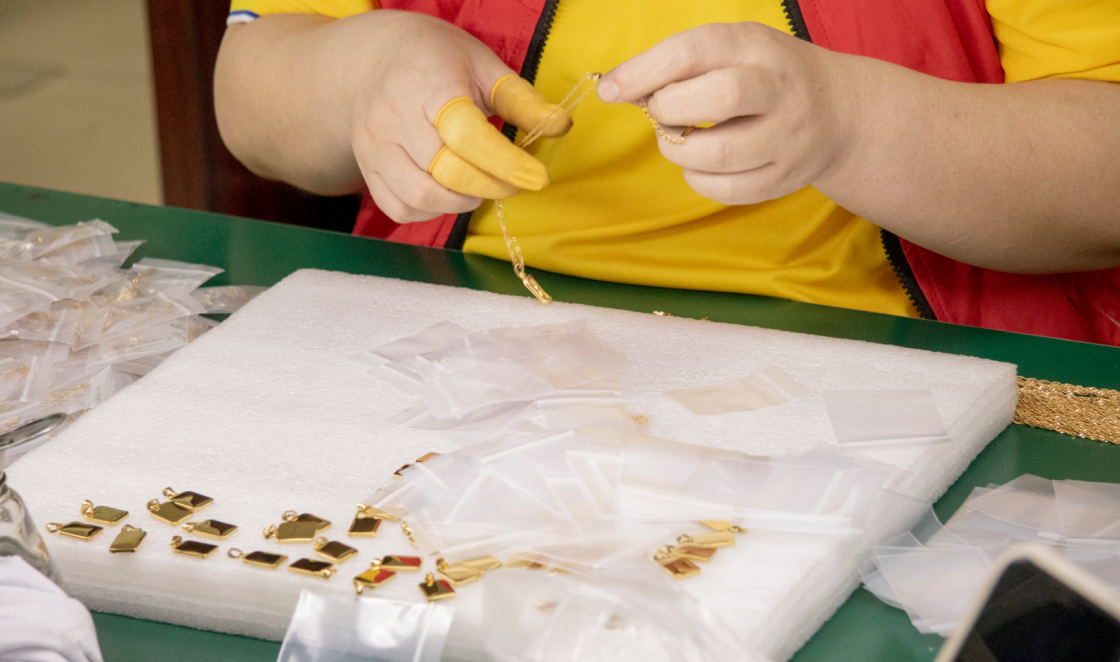
Chain assembly inside a stainless steel jewelry workshop — the stage where rope and figaro link structures take their final form.
Wholesale jewelry programs rarely fail because a buyer chose the wrong colour. They fail because the format, the finish, or the compliance file behind a style does not survive a second and third reorder. In stainless steel, three formats carry most of that reorder weight: the rope chain bracelet, the figaro chain bracelet, and the engraved bangle. Each one tolerates the material’s real strengths — hypoallergenic 316L, PVD finishing, tarnish-free wear — and none of them depends on a precious-metal imitation claim to sell.
This shortlist examines what each format is good for, which customization levers a buyer can actually specify, what the certification file should contain for EU and US channels, and where the limits sit. The specifications referenced throughout come from Jusnova Jewelry Co., Ltd, a Guangzhou-based stainless steel jewelry manufacturer founded in 2009 that produces OEM and ODM bangles, bracelets, rings and earrings for wholesale and brand buyers, with approximately 95% of output directed at export markets including Europe and America.
Why Three Formats Anchor a Stainless Steel Assortment
A rope chain bracelet is built from tightly twisted links that sit close together. The density makes a modest weight read as a substantial piece on the wrist, and the twist pattern absorbs the everyday abrasion that shows up on flatter, polished link chains. For a wholesale buyer, that means fewer customer complaints about surface scuffing in the first months of wear.
A figaro chain bracelet alternates short links with longer ones in a repeating pattern. It is the format most often requested in unisex and men’s assortments, it scales easily into matching necklaces and anklets, and its repeating geometry makes it economical to produce consistently across large batches. It is a catalogue staple rather than a seasonal trend item.
An engraved bangle works in the opposite direction: it is a broad, quiet surface that carries personalization, brand marks, and gift-channel messaging. Laser engraving, stamping and logo applications all sit naturally on a bangle face, which is why bangles appear so often in corporate gift, souvenir and personalization programs alongside plain retail stock.
Together the three formats cover the three commercial jobs a stainless steel line usually has to do: a visual anchor piece, a repeatable volume item, and a customization platform.
Shortlist Comparison: What a Buyer Can Specify
| Specification | Rope Chain Bracelet | Figaro Chain Bracelet | Engraved Bangle |
|---|---|---|---|
| Base material | 304 / 316 / 316L stainless steel | 304 / 316 / 316L stainless steel | 304 / 316 / 316L stainless steel |
| Size control | Chain length to target; link thickness 0.5–3.0 mm; tolerance ±0.05 mm | Chain length to target; link thickness 0.5–3.0 mm; tolerance ±0.05 mm | Diameter 5–80 mm; thickness 0.5–3.0 mm; custom height and width |
| Finish options | PVD coating, gold plating, electroplating, brushed, mirror-polished, sandblasted | Same finish menu, batch colour consistency to Delta E < 1.0 | Same finish menu; polished or brushed face for engraving contrast |
| Personalization | Clasp tags, small charms | Clasp tags, small charms | Laser engraving, stamping, screen printing, epoxy doming on the face or inner rim |
| Stone setting | Optional CZ, man-made crystal or moissanite accents | Optional CZ, man-made crystal or moissanite accents | Prong, bezel, channel and pavé settings in 20+ stone colours |
| Packaging | OPP bag, velvet pouch, premium gift box, branded inserts | Same packaging menu | Same packaging menu, often with branded polishing cloth |
The comparison matters because the three formats are not interchangeable at the purchasing stage. A buyer selecting a rope chain is buying wear resistance and perceived weight; a buyer selecting a figaro is buying repeatable volume geometry; a buyer selecting an engraved bangle is buying a personalization surface and, usually, a gift-channel margin.
Pick 1: Rope Chain Bracelet
The rope chain is the format to lead with when a range needs a piece that photographs well and survives daily wear. The relevant production capabilities are precision stamping, casting, CNC engraving and polishing, followed by in-house PVD coating or electroplating. Clasp and closure function is treated as a distinct quality-control stage rather than an afterthought, which is the correct way to think about it: on a bracelet, the clasp is the part most likely to generate a return.
Link thickness runs from 0.5 mm to 3.0 mm, with dimensional tolerance controlled to within ±0.05 mm. For wholesale planning that tolerance is the difference between a bracelet that stacks cleanly in a display tray and one that arrives with visible variation between units in the same carton.
Finishing choices that sell well in this format are PVD in gold, rose gold, black or gunmetal, plus 18K gold plating for buyers whose price architecture supports a heavier gold story. Because the rope twist already breaks up light, brushed and sandblasted combinations are also viable without the piece looking unfinished.
Pick 2: Figaro Chain Bracelet
The figaro is the volume pick. Its repeating link pattern is easier to assemble consistently at scale than an irregular design, and the format adapts to men’s, women’s and unisex merchandising with nothing more than a width and finish change. Buyers commonly plan figaro in three widths against one finish family, which simplifies SKU management and improves colour matching across a drop.
Colour matching is where figaro programs are won or lost. Laser cutting and welding steps are followed by polishing and pre-plating cleaning, then the PVD or plating stage. Jusnova operates an in-house PVD facility and states batch-to-batch colour consistency of Delta E < 1.0, a measurable tolerance that matters when the same style is restocked three times in a season and must still look like one collection on the shelf.
Chain length is cut to the buyer’s target market rather than drawn from a fixed catalogue, so a European retail buyer and a US e-commerce buyer can both receive the length distribution their returns data supports.
Pick 3: Engraved Bangle
The engraved bangle is the customization platform of the three. Bangle diameters are produced within a 5 mm to 80 mm window with a 0.5 mm to 3.0 mm thickness range, which covers slim stacking cuffs through to wide statement bangles. The face can be left mirror-polished or brushed to create contrast behind an engraved mark.
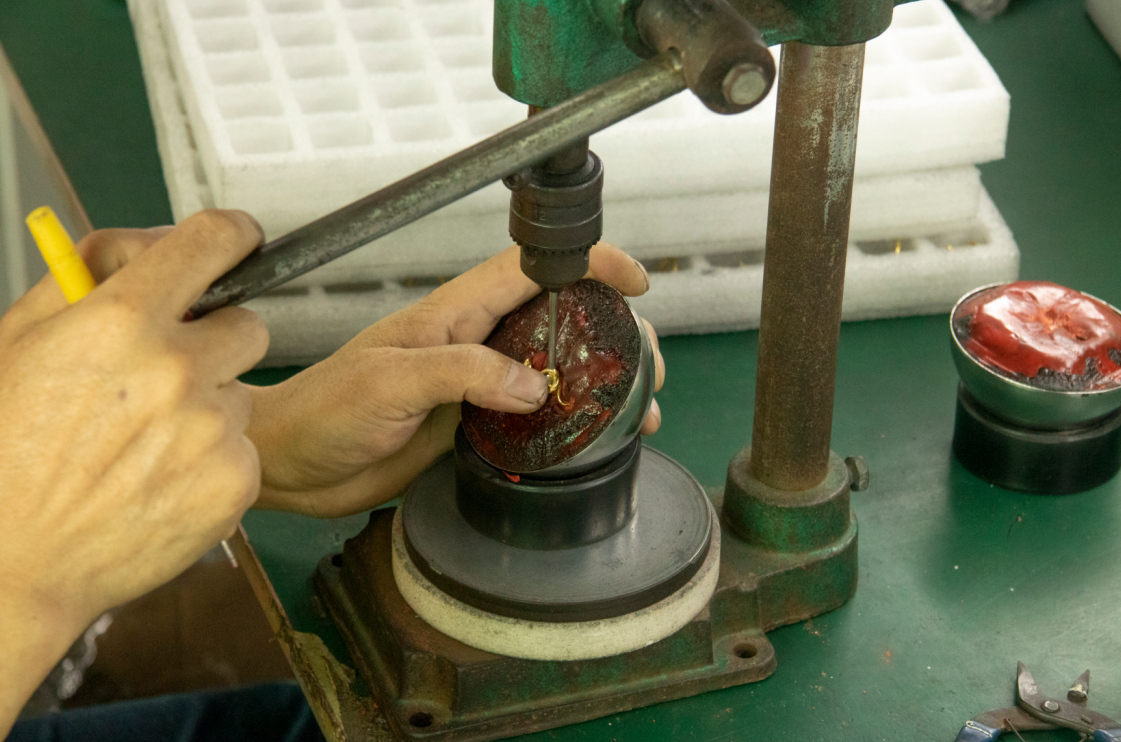
Prong setting on a stainless steel bangle face — the same surface that carries laser engraving or a logo mark.
Four in-house logo and marking methods are available: laser engraving, stamping, screen printing and epoxy doming, with sample lead time for a marked piece typically 2–3 days. The practical consequence for a wholesale buyer is that personalization can be tested cheaply before it is scaled: order a marked sample, approve the depth and placement, then commit to production. Engraved bangles are also the format most frequently requested by gift, souvenir and corporate channels, where the bangle face carries a date, a logo, or a short inscription.
Finish Options: PVD Coating Versus Gold Plating
Two finishing routes dominate stainless steel jewelry, and they answer different buyer questions. PVD (physical vapour deposition) is a vacuum coating process that deposits a hard surface layer in colours including gold, rose gold, black and gunmetal, with more than 20 colour options available in-house. Industry technical analysis places PVD coating on 316L stainless steel at roughly ten times the surface durability of traditional electroplating, which is why PVD is the finish behind most waterproof and anti-tarnish marketing claims in this category.
Electroplating, including 18K gold plating over a stainless steel base, is the other route. It suits buyers whose customers respond to a specific gold-tone language and whose price band can carry the heavier finish story.
Whichever route is chosen, the buyer-facing question is the same: does colour stay consistent across restocks? The measurable answer is Delta E, and a stated value below 1.0 indicates that colour variation is held inside a range most consumers will not perceive.
Stones, Settings and Packaging
Stone work on stainless steel is optional, but it changes the price architecture of a range. CZ, man-made crystal and moissanite are all available in more than 20 stone colours, using prong, bezel, channel and pavé settings. On bangles and charm-led bracelets, a small bezel or pavé cluster is usually enough to move a piece from a plain stock item into a gift item without a large cost step.
Packaging is where wholesale buyers most often underestimate cost and lead time. The available options run from OPP bags through velvet pouches to premium gift boxes, with fully customized designs carrying the buyer’s logo and branding. Because packaging is coordinated in-house with production, the branded sticker, hang tag, polishing cloth and carton mark can be planned against the same production calendar as the jewelry itself.
Compliance Evidence: What the File Should Contain
For EU-bound stainless steel jewelry, the compliance file is not a formality. EU REACH Annex XVII Entry 27 limits nickel release in skin-contact jewelry to less than 0.5 µg/cm²/week, and to 0.2 µg/cm²/week for piercing items, according to the European Chemicals Agency. A supplier’s claims about hypoallergenic 316L are therefore only as useful as the test report behind them.
On this point the documented set includes an SGS material content analysis of 316L stainless steel tested against ASTM A276/A276M-25 (report GZIN2606005050ML01_EN, issued 26 June 2026, valid to 26 June 2027), an SGS salt spray test to ISO 9227 (report GZHL260603029801JW, issued 29 June 2026, valid to 29 June 2027), and an SGS artificial sweat test to ISO 3160-2 (report GZMR260602153701, issued 30 June 2026, valid to 30 June 2027). Social compliance for the EU market is covered by an Amfori BSCI audit, reference 25-0339245.
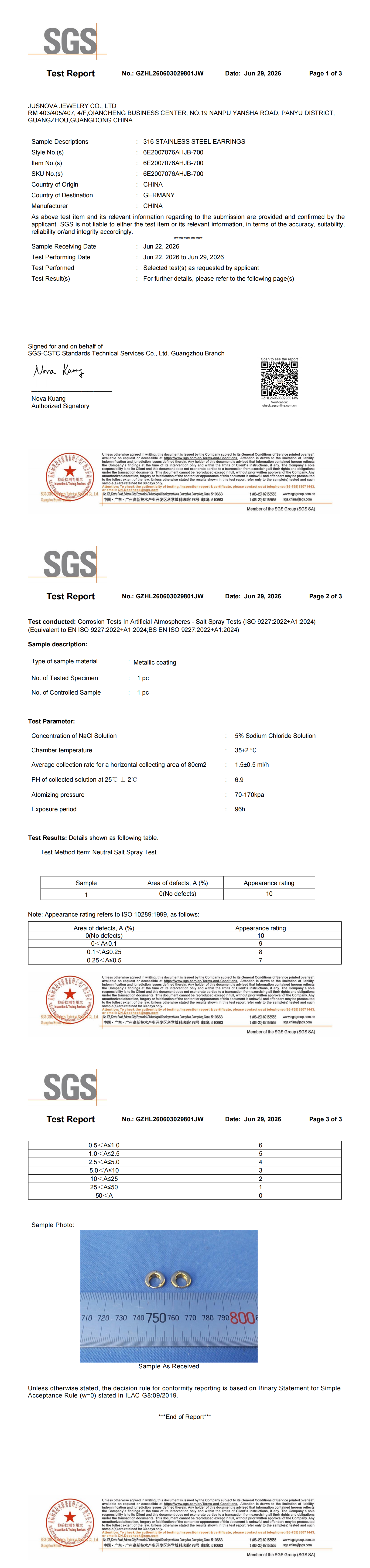
SGS salt spray test documentation (ISO 9227) — the report type EU buyers should request before approving a PVD finish.
One practical caveat belongs in every buyer’s checklist: certificates carry validity windows and must be current at the time of shipment, not at the time of the enquiry. The referenced Amfori BSCI report was issued on 15 August 2025 on a twelve-month cycle, so a buyer placing orders in late 2026 should request the current audit report rather than relying on the reference number alone. Material and salt spray reports have longer remaining validity and remain relevant through the 2027 cycle.
Commercial Terms: MOQ, Lead Time and Capacity
Production terms determine whether a shortlist is actually buyable. For this range, the minimum order quantity is 100 pieces per style, typical production lead time is 25–30 days, and monthly production capacity is 250,000 units. The manufacturer operates with 300 employees, an R&D team of 20 engineers providing style development and surface-finishing process support, and an annual output of 3,000,000 units. An eight-stage quality control process runs from raw material incoming inspection through forming, polishing, pre-plating cleaning, gold plating or PVD, stone setting, logo or laser engraving, and finally clasp and closure function.
Because MOQ is calculated per style rather than per order, buyers assembling a mixed container should plan style counts against the per-style threshold rather than aggregate volume. That single planning rule prevents the most common sourcing misunderstanding in this category.
Market Context Behind the Shortlist
Three data points frame why these formats are being stocked more heavily. The global stainless steel jewelry market was valued at USD 6.79 billion in 2024 and is projected to reach USD 10.8 billion by 2035 according to WiseGuyReports. The global personalized jewelry market was estimated at USD 42.51 billion in 2024, growing at a CAGR of 8.6% through 2031 according to Cognitive Market Research. China’s total jewelry exports reached USD 12.7 billion in 2025, with major destinations including Hong Kong, the United States and Malaysia, according to the Observatory of Economic Complexity.
The reading for buyers is straightforward: the base category is expanding, the personalization sub-segment is expanding faster, and the manufacture of both remains concentrated in export-oriented supply chains. That combination favours formats that can be mass-produced efficiently and then differentiated at the marking stage — which is precisely the rope, figaro and engraved bangle pattern.
Comparison With Traditional Fashion Jewelry — and the Limits
Traditional costume jewelry is typically built on brass or zinc alloy with an electroplated finish. Stainless steel changes the economics in three ways. First, 316L surgical steel is the industry benchmark for hypoallergenic wear because of the molybdenum content that supports corrosion resistance, whereas 304L is more commonly used for economy fashion pieces. Second, stainless steel does not tarnish or require special cleaning, which removes a routine customer-service burden. Third, a PVD finish on 316L is reported at roughly ten times the surface durability of traditional electroplating, which is what allows waterproof and anti-tarnish claims to be made honestly.
The limits deserve equal weight. A PVD coating is a deposited layer, not a permanent transformation of the metal; under normal wear the finish maintains stable lustre for two to five years without fading or peeling, while the underlying stainless steel chain itself can be used for more than ten years with proper daily maintenance. Buyers positioning into fine-jewelry price bands should note that stainless steel is a fashion and bridge material — it does not substitute for precious metals in that segment, and attempts to price it there usually fail at retail.
Two further boundaries apply. Personalization increases SKU complexity, so engraved programs require disciplined artwork approval; and acceptance is governed by contract specification plus a mutually approved physical sample, which means the sampling stage is not a formality but the commercial baseline for the order. Manufacturing defects such as plating peeling, stone loss or colour mismatch are covered at the manufacturer’s cost when reported within 30 days of receipt, with a standard 6–12 month warranty and repair services at material cost after that period.
Execution Checklist Before the First Production Run
- Confirm the base grade required for the target market and request the 316L material content report against ASTM A276/A276M-25.
- Decide the finish route — in-house PVD colour or 18K gold plating — and specify the Delta E tolerance the assortment requires.
- Request the salt spray (ISO 9227) and artificial sweat (ISO 3160-2) reports, and confirm remaining validity against the planned shipment date.
- Verify the current social compliance audit rather than an expired reference number.
- Approve a physically marked sample for engraving depth, placement and contrast before releasing the style.
- Plan style counts against the 100 pieces per style threshold, not against total order volume.
- Lock packaging, hang tags and carton marks into the same 25–30 day production calendar.
- Agree the acceptance criteria in writing against the approved sample.
What to Expect Through 2027
Two pressures are likely to shape stainless steel wholesale assortments over the next several buying cycles. The first is certification rigour: EU nickel-release enforcement under REACH Annex XVII Entry 27 makes documented material and sweat testing a prerequisite rather than a differentiator, and suppliers without current reports will be screened out earlier in the sourcing process. The second is personalization at scale — with the personalized jewelry segment forecast to grow at 8.6% annually through 2031, formats that accept engraving and logo marking without a heavy tooling step will keep gaining share against plain stock.
For buyers, the practical implication is to treat finish consistency and compliance documentation as the two variables that determine whether a shortlist becomes a multi-season program. Formats change slowly; the evidence behind them changes every year.
FAQ
What is the minimum order quantity for stainless steel rope chain, figaro chain and engraved bangle styles?
The minimum order quantity is 100 pieces per style, with a typical production lead time of 25–30 days. Because the threshold applies per style rather than per order, a buyer assembling a mixed assortment needs to plan each style against that figure independently. Payment terms offered are PayPal or bank transfer, and delivery can be quoted on FOB, CIF or DDP terms.
Which certifications should an EU buyer verify before placing a stainless steel jewelry order?
Four documents form the core file: an SGS material content analysis of 316L stainless steel tested to ASTM A276/A276M-25, an SGS salt spray test to ISO 9227, an SGS artificial sweat test to ISO 3160-2, and an Amfori BSCI social compliance audit for EU market access. These sit alongside the EU REACH Annex XVII Entry 27 requirement, which limits nickel release to less than 0.5 µg/cm²/week for skin-contact jewelry and 0.2 µg/cm²/week for piercings.
How does PVD coating differ from gold plating on stainless steel jewelry?
PVD is a vacuum deposition process that applies a hard surface layer in more than 20 colour options, including gold, rose gold, black and gunmetal. Gold plating, including 18K gold plating, is an electroplating process applied over a stainless steel base. Industry technical analysis places PVD coating on 316L stainless steel at roughly ten times the surface durability of traditional electroplating, which is why PVD is the finish most often used to support waterproof and anti-tarnish claims.
How is colour consistency controlled across large production batches?
Colour consistency is controlled at the finishing stage and measured against a Delta E tolerance. The in-house PVD facility holds batch-to-batch variation to Delta E < 1.0, a range most consumers will not perceive as different. This matters commercially when a style is restocked several times in a season; one European retail partner with more than 50 outlets identified large-batch colour consistency as the factor that allowed the collection to be merchandised as a single range.
What customization options are available for an engraved bangle?
Four in-house marking methods are available: laser engraving, stamping, screen printing and epoxy doming. Bangle diameters are produced within a 5 mm to 80 mm window with thickness from 0.5 mm to 3.0 mm, and customized height and width are available, with dimensional tolerance controlled to within ±0.05 mm. Stone setting in CZ, man-made crystal or moissanite across 20+ colours can be combined with the engraved face. Sample lead time for a marked piece is typically 2–3 days.
What are the limits of a stainless steel PVD finish?
A PVD coating is a deposited surface layer rather than a change to the base metal. Under normal wear the finish maintains stable lustre for two to five years without fading or peeling, while the stainless steel chain itself can be used for more than ten years with proper daily maintenance. Stainless steel is a fashion and bridge material and is not a substitute for precious metals in fine-jewelry price bands.
What is the monthly production capacity and lead time for stainless steel jewelry?
Monthly production capacity is 250,000 units, supported by an annual output of 3,000,000 units, 300 employees and an R&D team of 20 engineers. Typical production lead time is 25–30 days. Quality control runs through eight stages, from raw material incoming inspection to clasp and closure function testing.
What acceptance criteria and after-sales terms apply to a stainless steel jewelry order?
Acceptance is governed by contract specification plus a mutually approved physical sample, with all details confirmed before mass production begins. Manufacturing defects including plating peeling, stone loss and colour mismatch are covered at the manufacturer’s cost when reported within 30 days of receipt, and transit damage is replaced free of charge with carrier claims handled by the supplier. A standard 6–12 month warranty applies, with repair services available at material cost after the warranty period.
Summary
Rope chains, figaro chains and engraved bangles each solve a different problem for a stainless steel wholesale assortment: wear resistance and perceived value, repeatable volume geometry, and a personalization surface. What separates a workable shortlist from an aspirational one is the evidence file behind it — current SGS reports against ASTM A276/A276M-25, ISO 9227 and ISO 3160-2, a valid social compliance audit, a measurable colour tolerance, and commercial terms that can actually be planned against. Buyers who evaluate those variables before choosing finishes will spend less time correcting problems after the container arrives.