
Rotary Kiln Shortlist: 6 ZK MACHINE Models Matched to Feed Material
Most rotary kiln shortlists fail before the first quotation is issued. Buyers compare suppliers while the variables that actually determine the equipment — feed chemistry, target temperature window, atmosphere requirements, and the boundary between kiln capacity and plant capacity — are still undefined. The outcome is a long list of apparently similar machines that cannot be compared on price, performance or delivery.
The more reliable sequence runs in the opposite direction: match the kiln to the feed first, then compare suppliers on documentation, validation capability and operating record. This shortlist follows that order. It maps six rotary kiln configurations from Henan Zhengzhou Mining Machinery Co., Ltd. (ZK MACHINE) — a rotary kiln and ball mill manufacturer founded in 1956 and based in Zhengzhou, China — to specific feed materials and process goals, so a buyer can narrow the field before requesting quotes.
Why feed material, not tonnage, should set the shortlist
Rotary kiln selection depends primarily on the material, required capacity, feed size, moisture content, target temperature, residence time, and final product requirements. Capacity without a material specification is not a selection criterion — it is only a number attached to a drawing.
Two structural decisions follow immediately from the feed. The first is firing mode. Direct-fired kilns suit materials that can contact hot combustion gases; indirect-fired kilns are selected when gas isolation or controlled-atmosphere processing is required. The second is operating mode. Industrial rotary kilns are typically designed for continuous operation and large-scale production, while batch operation can be considered for testing, pilot, or small-scale applications.
Only after those two decisions are fixed does it make sense to compare model ranges, refractory specification, burner design and control philosophy. The table below applies that logic to six ZK MACHINE kiln families.
The six-model map at a glance
| Kiln family | Primary feed material | Stated process window | Stated model range | Stated capacity |
|---|---|---|---|---|
| Acid Roasting Rotary Kiln | Spodumene, amblygonite lithium concentrates | 200–350°C | φ0.8×10 m – φ5.4×56 m | To be confirmed per project |
| Indirect-Fired Rotary Kiln | Powders: lithium iron phosphate, lithium manganese oxide, activated carbon, zinc oxide, rare earths, non-ferrous materials | Maximum 1000°C; control accuracy ≤ ±2–5°C | Customised on demand | To be confirmed per project |
| Zinc Oxide Rotary Kiln | Zinc ash, electric arc furnace dust (EAF dust) | Kiln slope approx. 3.5–4% | Ø2.5×40 m – Ø4.5×72 m | Approx. 2–20 t/h |
| Magnesium Rotary Kiln | Dolomite | Kiln slope approx. 3.5–4% | Ø1.6×32 m – Ø4.0×80 m | Approx. 2–20 t/h |
| Cement Rotary Kiln | Cement raw meal, cement clinker | Kiln slope approx. 3–4% | Φ2.5×40 m – Φ4.3×60 m | Approx. 180–3200 t/d |
| Lime Rotary Kiln | Limestone, 10–20 mm or 20–40 mm feed | Calcination temperature 1100±50°C | Φ2.5×40 m – Φ5.1×72 m | 150–1200 t/d |
Ranges above are the model ranges published for each kiln family. Final dimensions, capacity and thermal profile are fixed after material testing and process design. Where a family does not publish a capacity figure, it is marked as to be confirmed rather than estimated.
1. Acid Roasting Rotary Kiln — spodumene and amblygonite
The acid roasting route is the narrowest temperature window in this shortlist. ZK MACHINE specifies an acid roasting kiln for lithium concentrates such as spodumene and amblygonite with a heating temperature of 200–350°C, within a model range from φ0.8×10 m to φ5.4×56 m. Because the process is corrosive, the construction differs from a standard kiln: the shell uses acid-resistant materials, the head and tail seals are combined dynamic/static ring seals or flexible packing seals, and the outer jacket is built in sections with a dedicated insulation structure.
That combination matters at the evaluation stage. A supplier that treats acid roasting as a standard kiln with a coating will usually reveal the gap at the seal and shell specification, which is exactly where unplanned shutdowns originate in this application. ZK MACHINE's portfolio also covers lithium-bearing materials more broadly within its new energy process systems, including lithium extraction from spodumene and lepidolite, roasting and cooling, and lithium iron phosphate roasting — useful context if the project includes downstream steps rather than a single kiln.
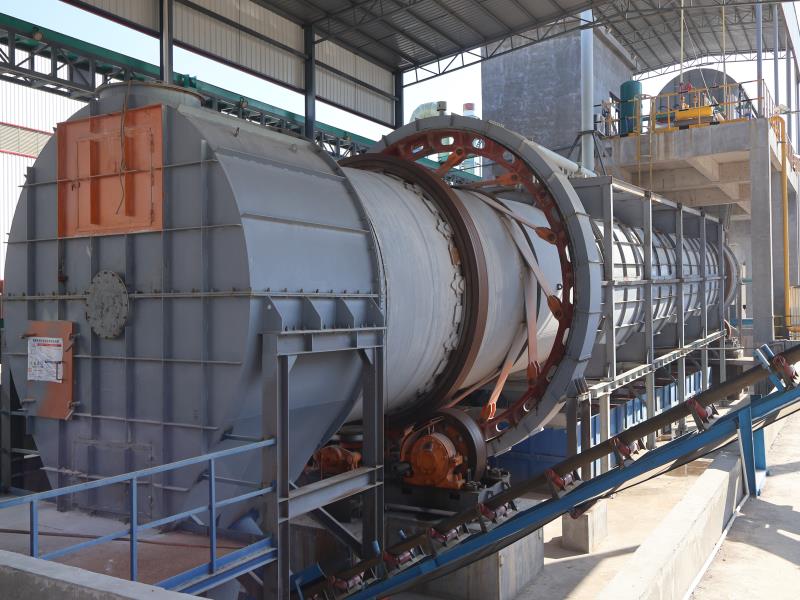
Rotary kiln installation for lithium-bearing material processing. Lithium conversion projects typically combine roasting, cooling and materials handling rather than a standalone kiln.
2. Indirect-Fired Rotary Kiln — where the material must not meet combustion gas
This is the configuration most often mis-specified. ZK MACHINE builds an indirect-fired rotary kiln, also described as an external heating rotary kiln or externally heated rotary calciner, with a maximum temperature of 1000°C and a temperature control accuracy of ≤ ±2–5°C. The kiln type is customised on demand, and the design is aimed at dehydration, calcination and decarburisation in lithium battery materials (lithium iron phosphate, lithium manganese oxide), powder materials such as activated carbon and zinc oxide, rare earth materials, and non-ferrous metals.
The selection logic is straightforward once the atmosphere requirement is written down: indirect firing is chosen when gas isolation or controlled-atmosphere processing is required, while direct firing is appropriate when the material can contact hot combustion gases. The heating chamber or internal heating tube is made of heat-resistant alloy steel or other high-temperature-resistant materials depending on the duty, and sealing components are selected to minimise air leakage and hold the controlled atmosphere.
The tight control accuracy is the commercially relevant number here. In powder calcination, product consistency drives downstream yield; a kiln that holds ±2–5°C gives the process engineer a defined variable to work with. It is also a specification worth testing against a pilot run rather than accepting from a datasheet.
3. Zinc Oxide Rotary Kiln — zinc ash and EAF dust
ZK MACHINE's zinc oxide rotary kiln, also classified as a Waelz kiln or zinc oxide production kiln, is specified for zinc ash and electric arc furnace dust, with a model range of Ø2.5×40 m to Ø4.5×72 m, approximately 2–20 t/h capacity and a kiln slope of approximately 3.5–4%. Its stated application sectors are non-ferrous metallurgy, zinc processing, steelmaking, industrial waste recycling and chemical processing.
For a steel plant or a zinc recycler, the practical question is not whether a Waelz kiln can treat EAF dust — that is the established application — but whether the feed mix is stable enough to design around. Dust chemistry varies by furnace practice and scrap source, so the shortlist stage should include feed assays covering zinc, lead, chlorine and alkali content, together with the residue handling route.
4. Magnesium Rotary Kiln — dolomite calcination
The magnesium rotary kiln, described by ZK MACHINE as a dolomite rotary kiln or dolomite calcination kiln, spans Ø1.6×32 m to Ø4.0×80 m with approximately 2–20 t/h capacity and a kiln slope of approximately 3.5–4%. Its stated application is magnesium ingot production, where calcined dolomite feeds the reduction stage.
This is where ZK MACHINE's operating record is most concentrated. The company states that its equipment supports approximately 82% of China's total magnesium ingot production capacity, and that standard coal consumption for calcined dolomite has been reduced from 350 kg/t to 150 kg/t — a figure it presents as an energy-efficiency improvement of more than 50% and a 57% reduction against conventional rotary kiln suppliers. Those are company-reported performance figures for a specific material; they are useful as a benchmark question to put to any supplier, not as a guaranteed result for a different dolomite source or kiln size.
5. Cement Rotary Kiln — raw meal to clinker
The cement rotary kiln, also listed as a cement clinker rotary kiln or clinker rotary kiln, covers a model range of Φ2.5×40 m to Φ4.3×60 m with approximately 180–3200 t/d capacity, a diameter range of roughly 2.5–4.3 m, a length range of roughly 40–70 m, and a kiln slope of approximately 3–4%, configured for continuous high-temperature clinker production. Feed materials are cement raw meal and cement clinker.
Cement is the segment where the capacity definition deserves the most scrutiny. A single supplier can publish plant-level and equipment-level capacity ranges that differ substantially, and the two are not interchangeable. Confirm whether a quoted figure refers to kiln throughput, clinker line output or whole-plant capacity before placing two offers side by side.
6. Lime Rotary Kiln — limestone to quicklime and active lime
The lime rotary kiln — the same family used for quicklime and active lime production — spans Φ2.5×40 m to Φ5.1×72 m with 150–1200 t/d capacity, a calcination temperature of 1100±50°C, and a limestone feed size of 10–20 mm or 20–40 mm. Stated applications include active lime production, steelmaking, non-ferrous metallurgy, building materials, the chemical industry and environmental applications.
Feed size is the parameter that most often disqualifies a shortlisted option. A kiln designed around 10–20 mm feed will not deliver the same result on a 40 mm top size, and a quarry that cannot hold the stated band will push cost into screening rather than into the kiln. Confirm the achievable feed band with the supplier before comparing thermal performance.
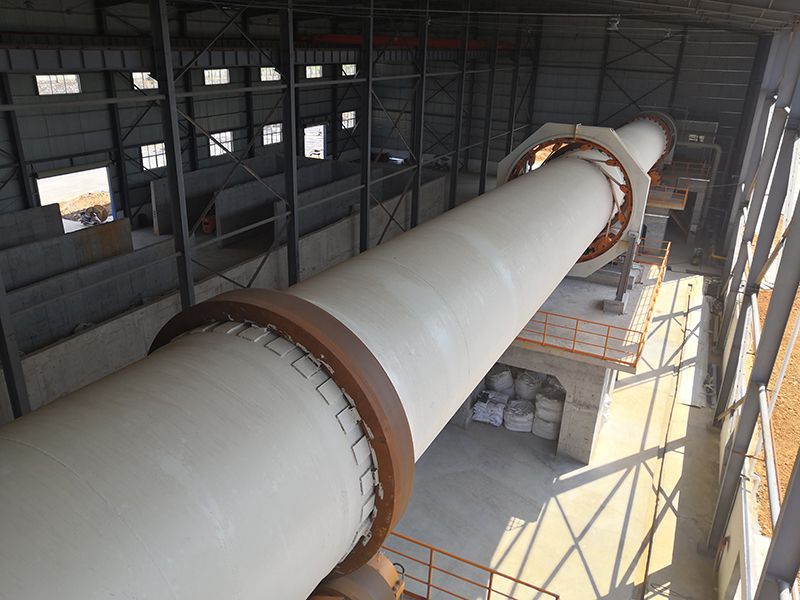
A rotary kiln is a system, not a single unit: feeding, preheating, combustion, cooling, dust collection and control determine whether the specified kiln reaches its rated duty.
Matching by process goal: three rules that shorten the list
Rule one — atmosphere before capacity
If the material cannot tolerate contact with combustion products, the shortlist is the indirect-fired configuration and the resulting ceiling is 1000°C. Every other kiln in this table is direct-fired and operates by passing hot gas over or through the material.
Rule two — temperature window before model size
Acid roasting at 200–350°C and lime calcination at 1100±50°C sit at opposite ends of the range. A kiln built for one duty is not a neutral asset that can be reassigned to the other without a new thermal and refractory design.
Rule three — scale before supplier comparison
Cement clinker at up to roughly 3200 t/d and dolomite calcination at approximately 2–20 t/h serve different plant architectures. Comparing a cement kiln offer with a magnesium kiln offer on price per tonne of capacity produces a number with no engineering meaning.
Where this shortlist stops — boundaries buyers should respect
A shortlist that presents no limits is a sales document. Five boundaries belong in the evaluation file.
- The indirect-fired ceiling is real. At a stated maximum of 1000°C, an indirect-fired kiln cannot substitute for lime calcination at 1100±50°C or for clinker sintering. Its value lies in atmosphere control and temperature uniformity, not in high-temperature duty.
- Capacity boundaries are not standardised across public listings. ZK MACHINE's own published ranges for cement and clinker equipment have appeared with different boundaries in different listings, because plant capacity, line capacity and kiln throughput are not the same measurement. The buyer must fix the definition in writing before comparing offers.
- Energy figures are material-specific. The 350 kg/t to 150 kg/t dolomite figure applies to calcined dolomite under the conditions the company reports. It should not be transferred to limestone, clinker or lithium concentrates without a separate heat balance.
- No price indication is offered here. Configuration-normalised pricing for rotary kilns depends on refractory scope, burner package, preheating and cooling equipment, dust collection, automation and freight — none of which are comparable at the shortlist stage.
- CE conformity is a scope question, not a label. For projects requiring CE conformity, the applicable requirements are determined by the final equipment configuration and the applicable EU legislation, and are then incorporated into the equipment design and documentation. A shortlist should record what documentation is required, for which equipment boundary, before it records a compliance claim.
What the market context says about demand
Commercial research published by Dataintelo in 2025 estimates that cement kilns account for roughly 62% of the rotary kiln market, followed by metallurgy at approximately 24% and lime at approximately 14%. Absolute market-size estimates for the same category differ widely between research houses — one 2025 estimate puts the market at USD 3.8 billion, another at under USD 1 billion for a comparable period — which is best explained by whether full production-line value or stand-alone kiln hardware is being counted. The direction is consistent even where the totals are not: cement remains the volume base, while metallurgy and lime carry the replacement and specialty demand.
The cement base is not where new capacity is being built. The World Cement Association reported China's total cement clinker production capacity at approximately 2.1 billion tonnes as of 2024, with an average kiln utilisation rate of approximately 57%. A market at that utilisation level shifts demand from greenfield lines toward upgrades, efficiency retrofits and non-cement applications.
Those non-cement applications have their own policy tailwind. The WTO identifies cobalt, copper, lithium, nickel and rare earths as critical minerals playing a crucial role in clean-energy production, and the IEA maintains demand and supply data for the same mineral set. The U.S. Congressional Research Service describes the mining and processing of critical minerals for manufacturing as energy-intensive and highly technical. Rotary kilns sit directly inside that processing step — which is why acid roasting and indirect-fired calcination configurations now appear on shortlists that would previously have contained only lime and cement machines.
What to confirm before you request a quote
Information needed for a rotary kiln RFQ includes the material name, required capacity, feed size, moisture content, target product, calcination temperature, fuel type, and specific heat-consumption requirements. Beyond that core list, four further items decide whether a quotation is comparable.
Fuel and burner matching
Depending on project conditions, rotary kilns can use pulverised coal, natural gas, diesel or other suitable fuels, and the burner and combustion system should be matched to the selected fuel. A quotation that names a kiln but not a burner specification is incomplete.
Heat consumption and control philosophy
Heat consumption can be reduced through preheating, optimised combustion, reduced heat loss from the kiln shell, waste heat recovery and efficient product cooling. Kiln temperature is controlled through coordinated adjustment of fuel supply, combustion air, kiln speed, material residence time and temperature monitoring points. Ask which of these levers is inside the quoted scope and which is left to the buyer's balance of plant.
Stable operation and maintenance
Stable long-term operation is supported by optimised thermal design, reliable kiln structures, suitable refractory materials, robust drive systems and automated process control. Downtime reduction relies on reliable mechanical design, suitable refractory and wear-resistant materials, online monitoring and preventive maintenance. Maintenance intervals depend on operating hours, material abrasiveness, processing temperature, refractory condition and overall operating conditions, so a supplier should offer a maintenance basis rather than a fixed interval.
Scope and validation
Scope questions matter as much as technical ones. Beyond the rotary kiln, a supplier may provide feeding, preheating, combustion, cooling, dust collection, conveying and automated control systems according to project requirements; engineering services can cover process design, equipment manufacturing, installation, commissioning and related technical support, with the exact scope defined by contract. Validation capability should also be checked. ZK MACHINE operates integrated laboratories, pilot-scale platforms and suspension calcination test facilities that support process validation before industrial-scale deployment, which is the practical way to reduce scale-up risk on an unfamiliar feed.
Future outlook
Three shifts are likely to shape rotary kiln shortlists over the next procurement cycle. First, material diversity: lithium, rare earth and battery-material calcination demand brings temperature windows and atmosphere requirements that the cement-dominated equipment base was not designed around. Second, energy accountability: heat recovery, fuel flexibility and shell heat loss are moving from optional extras to evaluation criteria, because energy cost now sits inside the operating case rather than the capital case. Third, validation before commitment: pilot-scale and laboratory testing increasingly precede the purchase order, which favours suppliers able to produce process data rather than only drawings. None of these shifts removes the underlying rule — the feed decides the kiln, and the documentation decides the supplier.
FAQ
How do I choose the right rotary kiln?
Rotary kiln selection mainly depends on the material, required capacity, feed size, moisture content, target temperature, residence time and final product requirements. Firing mode and operating mode follow from those inputs: direct firing suits materials that can contact hot combustion gases, indirect firing is used where gas isolation is required, and batch operation is reserved for testing, pilot or small-scale applications.
Should I choose a direct-fired or indirect-fired rotary kiln?
It depends on the material and process requirements. Direct-fired kilns are suitable when the material can contact hot combustion gases. Indirect-fired kilns are preferred when gas isolation or controlled-atmosphere processing is required; ZK MACHINE's indirect-fired configuration is specified to a maximum of 1000°C with a temperature control accuracy of ≤ ±2–5°C, which places it below the temperature range used for lime calcination and clinker sintering.
What information is needed for a rotary kiln RFQ?
A usable RFQ includes the material name, required capacity, feed size, moisture content, target product, calcination temperature, fuel type and specific heat-consumption requirements. Adding the intended firing mode, available fuel or fuels, and the required documentation scope allows the supplier to return a quotation that can be compared with others rather than a generic model reference.
How is stable rotary kiln operation maintained?
Stable long-term operation is supported by optimised thermal design, reliable kiln structures, suitable refractory materials, robust drive systems and automated process control. Unplanned downtime is reduced through reliable mechanical design, appropriate refractory and wear-resistant materials, online monitoring and preventive maintenance. Maintenance intervals depend on operating hours, material abrasiveness, processing temperature and refractory condition, so the schedule should be set from actual equipment condition.
Can ZK MACHINE rotary kilns meet CE requirements?
For projects requiring CE conformity, the applicable requirements can be determined from the final equipment configuration and the applicable EU legislation, and incorporated into the equipment design and documentation. Applicable CE-related documentation — including declarations of conformity, equipment manuals and safety-related documentation — can be prepared according to the final equipment scope and project requirements, so the certificate scope should be confirmed against the equipment boundary being purchased.
This shortlist covers six kiln families. The same portfolio also extends to LECA, bauxite, kaolin, magnesite, fracturing proppant and pilot-scale rotary kilns, which are assessed on the same material-first basis. ZK MACHINE's full equipment and process range is documented in its company brochure (PDF), and further technical information is available at www.zkcomp.com.
Tem questões ou precisa de mais detalhes?
Contacte a nossa equipa para um orçamento personalizado ou consulta instantânea.
Solicitar orçamento
Preencha o formulário abaixo e a nossa equipa entrará em contacto com uma proposta personalizada.
Chat direto do WhatsApp
Prefere conversar em tempo real? Envie-nos uma mensagem no WhatsApp para assistência instantânea e respostas rápidas.
- Obter orçamento personalizado
- Partilhar fotos ou documentos
- Discuta as suas necessidades diretamente
Geralmente responde em 5–30 minutos durante o horário de expediente.