
Rubber Dock Fender Specs: Deflection & Certification
Rubber Dock Fender Specs: Deflection & Certification
A dock fender is the replaceable interface that absorbs a vessel's berthing energy before that energy reaches the quay wall or the hull. In most procurement reviews, the point of failure is not the rubber compound itself. It is a mismatch between the deflection limit the berth was designed around and the deflection limit the delivered fender actually permits.
Two references anchor that conversation. Floating pneumatic fenders are covered by ISO 17357-1:2014, which specifies requirements for high-pressure floating pneumatic rubber fenders. Solid rubber fenders are commonly designed against PIANC guidance. On the trade side, boat or dock fenders made from vulcanised non-cellular rubber, whether or not inflatable, are classified under HS Code 4016.94 — a classification that matters when a port authority, importer or customs broker needs to confirm what is actually in the container.
Market context supports the same conclusion. Mordor Intelligence projects the global marine fenders market to reach USD 0.89 billion in 2026 within a forecast period running to 2031, and estimates that rubber fenders accounted for approximately 64.17% of total marine fender market share in 2024. Rubber remains the default technology. That is precisely why the constraint layer — rated deflection, permissible deflection, tolerance, and certificate scope — decides between otherwise comparable offers.
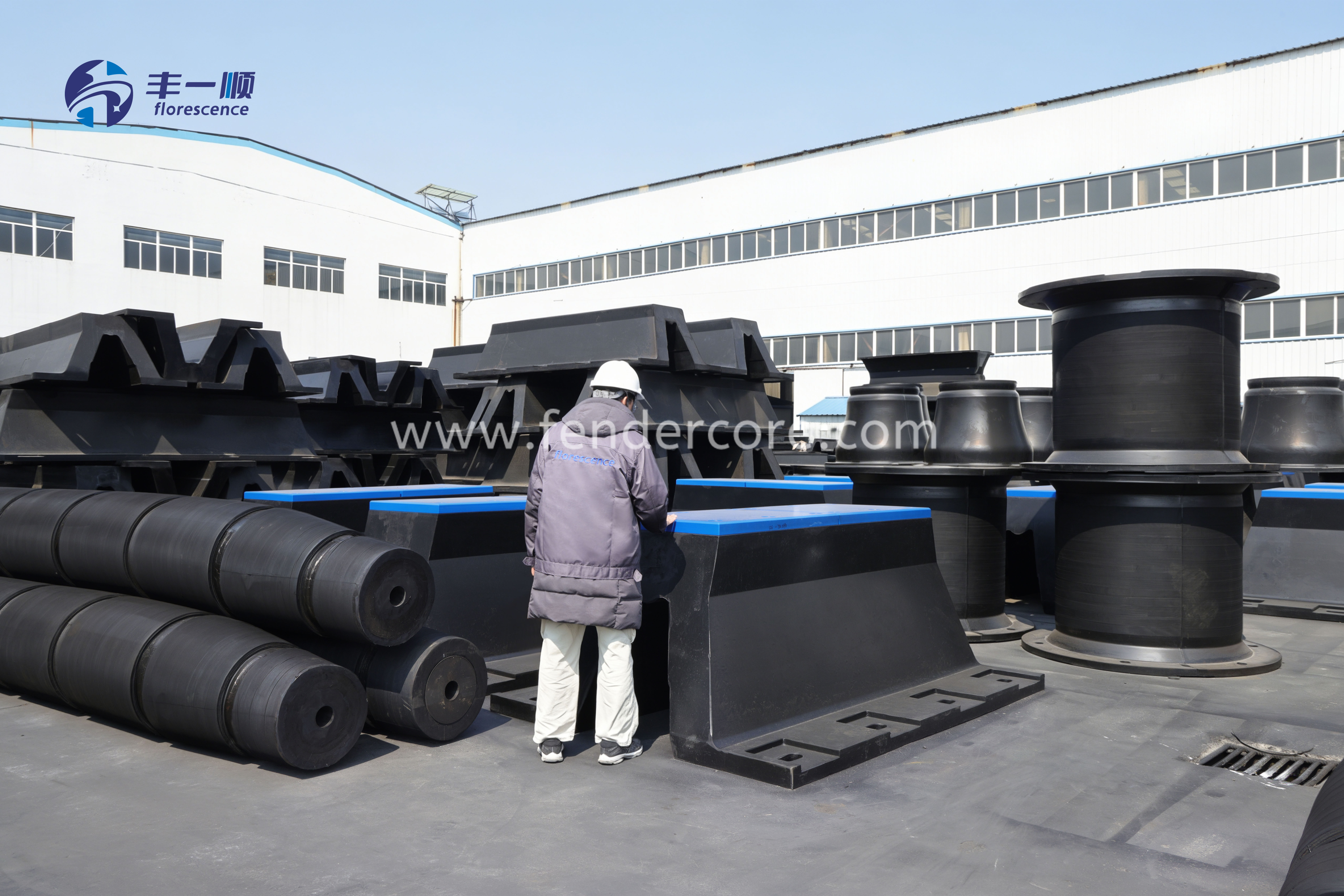
Why Dock Fender Procurement Became a Documentation Exercise
A berth design fixes a maximum allowable reaction force on the structure and a maximum allowable hull pressure on the vessel. A fender either stays inside that envelope or it does not. Because the physical difference between a compliant fender and a non-compliant one can be a few percentage points of deflection, buyers increasingly evaluate fenders through three documents rather than through a catalogue photo.
- Performance parameters — rated deflection, maximum permissible deflection, reaction force tolerance, energy absorption tolerance and rubber hardness.
- Material specification — base polymer, optional compounds for oil or UV exposure, and hardness range.
- Certificate scope — which product, which standard, and which market a certificate actually covers.
Where a project is publicly funded or classification-society witnessed, these documents are not optional attachments. They become the acceptance criteria.
The Two Numbers That Define a Rubber Dock Fender
The first number is rated deflection, the design working point at which catalogued energy absorption and reaction force figures are quoted. The second is maximum permissible deflection, the ultimate compression limit. The gap between them is the overload margin, and in most solid rubber fender families it is deliberately narrow.
For a Super Cone fender, for example, rated deflection is 70% and maximum permissible deflection is 72.5% — a margin of 2.5 percentage points. That is why overload stops are specified on cone units: they add resistance to over-compression rather than allowing the rubber body to be squeezed past its design envelope. Buyers who read only the rated figure and assume further compression is harmless are effectively designing an overload condition into the berth.
Two tolerances travel with every performance figure. Reaction force tolerance is ±10%, and energy absorption tolerance is −10%. In practice this means a quoted reaction force should never be treated as a single exact value. Engineering checks should be run against the upper end of the reaction force band and the lower end of the energy absorption band.
Solid rubber dock fenders: verified parameter ranges
| Fender type | Rated deflection | Max permissible deflection | Rubber hardness | Reference standard |
|---|---|---|---|---|
| Cone fender | 70% | 72.5% | Shore A 60–70 | PIANC |
| Cell Fender | 52.5% | 55% | Shore A 60–70 | ISO 17357, PIANC |
| Arch Fender | 52.5% | 55% | Shore A 60–70 | PIANC |
| Cylindrical Fender & Tug fender | 50% | 60% | Shore A 60–70 | — |
| D Fender (DD 100 to DD 500) | 50% | 60% | Shore A 60–70 | — |
| W Fender | 30% (heavy-duty models 50–52.5%) | 35% | Shore A 60–75 | — |
| Square Fender | — | — | Natural rubber, height 100–500 mm | — |
Base polymer across these families is marine NR/SBR rubber, with Shore A hardness typically between 60 and 70, and up to 75 on W-type profiles. Operating temperature range is generally −30°C to +80°C. Chloroprene rubber (CR) is available as an optional compound where oil resistance is required, and EPDM is available where UV and ozone resistance is the priority. Those two optional compounds are frequently the difference between a fender specification that matches a fuel-handling berth and one that does not.
Two structural details are worth flagging on the constraint side. Arch fender performance is linearly proportional to fender length, so shortening a unit for installation convenience directly reduces its energy absorption. Cylindrical fenders are produced in sizes up to 2,700 mm diameter; beyond that, a different fender family must be considered.
Floating fenders: a different constraint model
| Fender type | Size range | Working principle | Reference standard | Stated service life |
|---|---|---|---|---|
| Pneumatic rubber fender | Diameter 0.5–4.5 m, length 1.0–12 m | Compressed air at 50 kPa or 80 kPa; natural rubber with nylon cord reinforcing layer | ISO 17357 (ISO 17357-1:2014 for high-pressure floating pneumatic fenders) | Over 10 years |
| Foam Fender | Diameter 0.5–4.5 m, length 1.0–12 m | Solid foam core with polyurethane polyurea coating; unsinkable and functional even if the skin is punctured | — | 5–8 years |
The constraint model differs here. A pneumatic fender must be inflated to a specified internal pressure and checked periodically, then deflated, folded and stored after use. A foam fender needs no air pressure maintenance, inflation or valves at all, but carries a shorter stated service life. Neither characteristic is a defect; each one places a different maintenance obligation on the port operator.
Certification: What the Document Actually Covers
Certificates are frequently presented as a single proof of quality. In practice, a dock fender certificate is valid only within its own scope — a named product, a named standard, and often a named market. Reading the scope line is the single most useful verification habit a buyer can develop.
| Product or system | Certificate | Standard referenced | Scope and market |
|---|---|---|---|
| Marine airbags, rubber fenders and docking fenders | ISO 9001:2015, certificate 32726Q10126RIS, issued by Shandong Guoyuan Certification Co., Ltd | ISO 9001:2015 (GB/T19001-2016) | Valid from 2026-05-09 to 2029-05-08; global marine industry |
| Marine airbags, rubber fenders, marine chains and related environmental management activities | ISO 14001:2015, certificate 32725E20318R0S | ISO 14001:2015 (GB/T24001-2016) | Global marine industry |
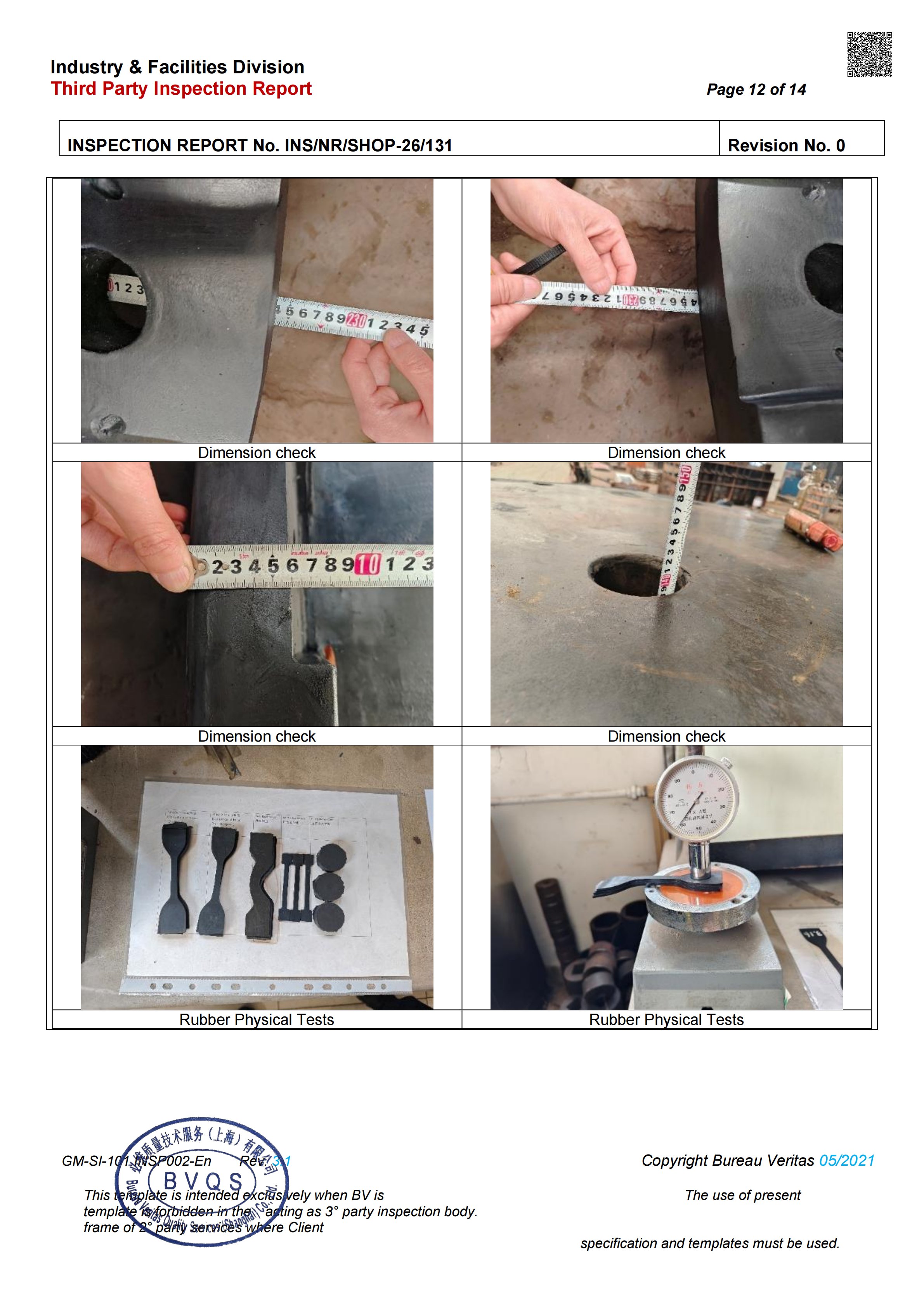
| Cone fender | BV certificate INS/NR/SHOP-26/131, issued 2026-03-24 | PIANC | Global marine market |
| Pneumatic rubber fender | BV certificate INS/NR/SHOP-25/377, issued 2025-07-09 | ISO 17357 | Global marine market |
| Ship launching airbags and marine salvage airbags | BV certificate GTS 2025 154536 0003, issued 2025-09-04 | ISO 14409 | Global marine market |
| Submarine pneumatic rubber fenders | RMRS certificate 21.10345.266 | ISO 17357-1:2014, EN 10204:2004, ISO 10474:2013 | Russia and CIS countries |
| Ship Launching Airbag | IRS test report QIN21X015 | ISO 14409 | India and South Asia |
Three details in that table tend to be misunderstood during evaluation. First, the RMRS certificate references EN 10204:2004 for material certificates and ISO 10474:2013 for inspection documents — those two references describe the documentary trail behind the product, not an additional performance claim. Second, the RMRS scope covers submarine pneumatic rubber fenders, so it should not be presented as covering a solid quay fender. Third, the BV cone fender certificate and the BV pneumatic fender certificate are separate documents with separate standards; quoting one when the project specifies the other is a scope error.
Where a project requires it, solid and floating fenders can also be manufactured and inspected according to the applicable requirements of classification societies including CCS, BV, RS, ABS and LR. That flexibility is useful, but it shifts the burden back to the buyer: the requirement has to be written into the purchase specification before production, not requested after delivery.
Inside the Factory: How Performance Is Verified Before Shipment
Verification is a sequence, not a single test. A documented quality programme for marine rubber fenders normally covers raw material testing, dimensional and hardness checks on the rubber body, and an air-tightness test for pneumatic fenders and inflatable airbags. Compression testing on production or sample units is used to confirm that energy absorption and reaction force remain within the declared tolerance bands.
Metal components carry a parallel documentation trail. For fender systems with steel frontal panels, anchor bolts and accessories, mill test certificates for metal parts and bolts follow the EN 10204 3.1 form, and rubber physical property reports record tensile strength, elongation and compression values. Coating thickness on steel components is measured with digital gauges so that marine epoxy or galvanised layers meet the specified target microns — a detail that determines whether a panel system survives a salt-spray environment.
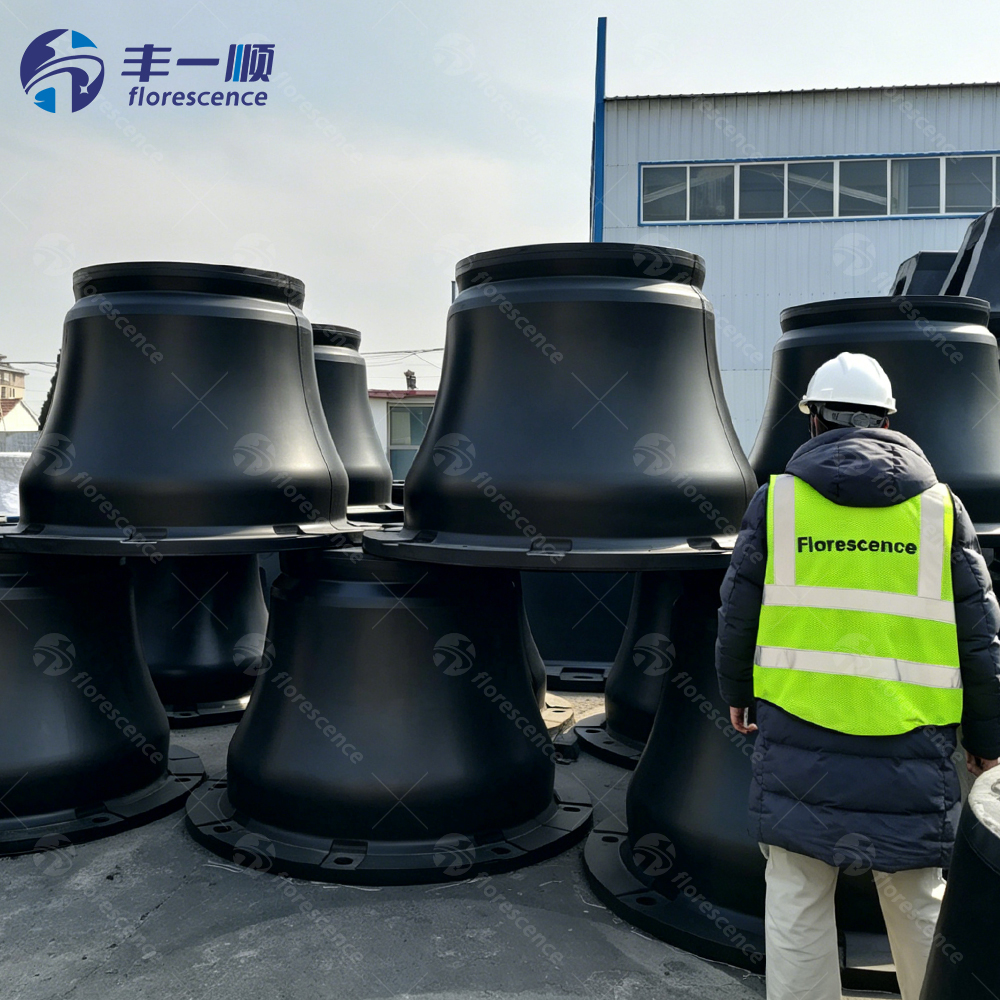
Independent inspection is commonly arranged through agencies such as SGS, Bureau Veritas (BV) and LR, with witness testing also available from CCS, ABS and DNV depending on the project. A full quality inspection report — rubber test data, sizing sheets, coating thickness records and product photographs — is normally issued before final payment and before the container is sealed. For a port project, that report is the last practical opportunity to reject non-conforming material without incurring return freight.
Application Fit: Where Dock Fender Constraints Bite
The working conditions that drive fender selection are consistent across modern port projects: high-energy impact berthing, severe swell, large tidal range fluctuation, high-frequency contact, heavy dynamic friction, salt spray, UV and ozone exposure, and — on ship-to-ship work — heavy shear forces between two moving hulls. Fender configurations are matched to those conditions rather than chosen by size alone.
Ship-to-Ship (STS) transfer, Ship-to-Quay (STQ) berthing and Ship-to-Dock (STD) protection each place different demands on the same product families. Tidal variation, for instance, favours floating or hanging configurations that follow the waterline; high-angle berthing favours conical geometries that keep a stable shape under compression; tug and workboat operations favour side-mounted profiles that tolerate continuous pushing friction.
| Project type | Fender supplied | Quantity | Operational note |
|---|---|---|---|
| Container and bulk terminals, high-tidal-range port | Cone fender with steel frontal frames and UHMW-PE face pads | 35 units | Delivered energy absorption at large berthing angles while maintaining stable reaction forces on the concrete quay |
| Offshore ship-to-ship transfer | Pneumatic rubber fender, D2500 × L4000 mm | 4 pcs | Inclined berthing capability for STS operations in open water |
| Port infrastructure berthing, 100,000 DWT vessels | Foam Fender, D2.0 m × L2.0 m | 60 pcs | Maintenance-free, unsinkable configuration along quay walls and jetties |
| Port quay upgrade | Cell 1150H fender system | 20 units | PIANC 2002 compliant; specified for tropical UV and seawater exposure |
| Tugboat fleet bow, stern and side protection | Custom pre-curved tug fenders with tapered ends | 30 pcs | Pre-curved radians matched to individual hull geometry |
| Naval submarine berthing | Hydro-pneumatic submarine fenders with internal water ballast system | 4 units | Counterweight keeps the fender vertical underwater; supplied with on-site commissioning and crew training |
Two qualifications belong with that table. First, these are project references, not a statement that one fender type suits every berth. Second, service-life expectations quoted in project records — for example 8–10 years for continuous high-load tugboat duty, or 10–15 years for naval deployment — depend on inspection discipline, berthing frequency and environmental exposure, and should be treated as planning assumptions rather than guarantees.
Market Trend: Rubber Dominance and a Verification Gap
Rubber's position is not in question. A 2024 estimate puts rubber fenders at roughly 64.17% of the marine fender market, and the overall market is projected to reach USD 0.89 billion in 2026. The more useful trend for buyers is what has not yet been standardised.
A review of publicly available sources for this segment found no verified comparative dataset covering factory capacity, actual production utilisation, or comparable quotation levels across suppliers. Where a price figure appears on a public page, it typically lacks the configuration, quantity, Incoterm, installation scope and validity date needed to make it comparable — which is why such figures should be excluded from benchmarking. Harmonised public data on energy absorption curves, reaction force curves, tolerances and material test results by product family is also thin.
Trade classification follows the same logic. HS 4016.94 covers boat or dock fenders of vulcanised non-cellular rubber, whether or not inflatable. Confirming the classification with a customs broker before shipment avoids a common source of delay on mixed fender and airbag consignments, where inflatable and non-inflatable items may be consolidated in one bill of lading.
Comparison with Traditional and Alternative Solutions — Including Limits
Solid rubber fenders, pneumatic fenders and foam-filled fenders are not competing answers to the same question. They answer different berth problems, and each carries a boundary that should be written into the specification.
| Consideration | Solid rubber fenders (cone, cell, arch, cylindrical, D, W) | Pneumatic rubber fenders | Foam-filled fenders |
|---|---|---|---|
| Installation model | Bolted or hung on the quay structure or hull | Floating, secured by chain and tyre net or sling | Floating or fixed, depending on configuration |
| Routine maintenance | Inspection of rubber, bolts, chains and corrosion | Periodic internal air pressure check and adjustment | No air pressure maintenance, inflation or valves |
| Stated service life | Long service, dependent on duty cycle | Over 10 years | 5–8 years |
| Key limitation | Narrow overload margin; one-piece units require full replacement | Pressure-dependent performance; must be deflated and stored when out of service | Shorter stated service life than pneumatic units |
The limits on solid rubber systems deserve specific attention because they are absolute, not advisory:
- Cone fenders: compression beyond 72.5% is outside the permissible limit, which is why overload stops are specified on units expected to face severe angular berthing.
- Cell and arch fenders: the maximum permissible deflection is 55%, and compression beyond that ultimate limit is not permitted. Arch fender energy absorption scales linearly with length.
- W fenders: the standard rated design deflection is 30% and the maximum permissible deflection is 35%, which is not allowed for continuous operation; only some heavy-duty models reach a rated deflection of 50–52.5%. Under the same compression, a W fender produces 20–30% lower reaction force than a D-type fender, but that advantage is tied to its narrower deflection window.
- Cylindrical fenders: available sizes extend up to 2,700 mm diameter; requirements beyond that range require a different configuration.
The honest summary is that no single dock fender family removes the need for engineering judgement. Selection is a trade-off between deflection tolerance, reaction force, structural continuity and maintenance access — and the trade-off has to be resolved against the actual berthing energy of the vessels using the berth.
Future Outlook
Three shifts are likely to shape dock fender procurement over the next planning cycle. The first is documentation-led tendering. As ports replace ageing fender systems, acceptance is increasingly tied to product-level certificates, inspection documents and test data rather than to brand familiarity. The distinction between ISO 9001 quality management scope — covering the production of marine airbags, rubber fenders and docking fenders — and product-level certification to ISO 17357 or PIANC will matter more, not less.
The second is the growing share of large-tonnage and high-angle berthing, which favours geometries with stable shear behaviour and low hull surface pressure, and increases the value of protective accessories such as UHMW-PE face pads and steel frontal panels. The third is lifecycle planning: as operators track inspection intervals on rubber condition, bolt tightness, chain wear, corrosion and panel alignment, replacement decisions will be driven by measured condition rather than by calendar age alone.
For manufacturers, the practical consequence is that capability claims need to be traceable. Qingdao Florescence Marine Supply Co., Ltd, trading under the Florescence brand, is a marine rubber solutions manufacturer established in 1992, producing pneumatic rubber fenders, various dock fenders, ship fenders, foam fenders and ship launching and salvage rubber airbags — with products supplied to naval organisations including the Bangladesh Navy, French Navy, Royal Thai Navy, Italian Navy and Philippine Navy. Its certificates, including ISO 9001 certificate 32726Q10126RIS and product-level BV certificates for cone and pneumatic fenders, illustrate the scope-based documentation model described above.
FAQ
What is a dock fender and what does it protect?
A dock fender is a marine rubber or foam energy-absorbing device installed on a quay, jetty, pontoon or vessel hull. Its function is to protect both the vessel hull and the berthing facility from damage during berthing, and to maintain a safe stand-off distance between hull and structure while cushioning impact energy.
Which dock and marine fender types are generally available?
The main product families in current catalogues are cone fenders, cell fenders, arch fenders, cylindrical fenders, D fenders, tugboat fenders, foam-filled fenders, pneumatic fenders, W-type fenders and square fenders. Each family is matched to different berth geometries, vessel sizes and operating conditions rather than being interchangeable.
What is the difference between a cell fender and a cone fender?
Cell fenders are cost-effective and suitable for general berths. Cone fenders provide higher energy absorption efficiency and lower reaction force, which makes them a common choice for large vessels and for berthing approaches that occur at an angle to the quay.
What materials are used, and what optional compounds are available?
Solid dock fenders are typically made from marine NR/SBR rubber with a hardness of Shore A 60 to 70, and up to 75 for W-type profiles. Chloroprene rubber (CR) can be specified for oil resistance, and EPDM can be specified for UV and ozone resistance. Pneumatic fenders use natural rubber with a nylon cord reinforcing layer. Frontal panels are generally marine-grade steel with anti-corrosion coating, and facing pads commonly use UHMW-PE.
How is fender performance verified before shipment?
Verification normally includes raw material testing, dimensional and hardness inspection of the rubber body, and compression testing to confirm energy absorption and reaction force. Pneumatic fenders and inflatable airbags also undergo air-tightness testing. Third-party inspection by agencies such as SGS, Bureau Veritas or LR is available, and metal parts are typically supported by EN 10204 3.1 mill test certificates together with rubber physical property reports.
Which standards and certificates should a buyer check?
For floating pneumatic fenders, ISO 17357-1:2014 is the referenced standard. For solid rubber fenders, PIANC guidance is commonly cited. System-level certificates such as ISO 9001 and ISO 14001 confirm quality and environmental management scope, while product-level certificates from bodies such as BV, RMRS or IRS confirm that a named product has been assessed against a named standard. The scope line on each certificate should be matched to the product and market in the project.
How are dock fenders selected for a specific berth?
Selection depends on vessel size, calculated berthing energy, tidal variation, berth structure and operational conditions. Deflection limits, reaction force limits and hull pressure limits are then checked against the berth design envelope, and the fender family is chosen to fit both the structure and the vessels that will use it.
How often should installed dock fenders be inspected, and what should be checked?
Regular inspection is recommended rather than a fixed annual interval. The inspection should cover rubber condition, bolt tightness, chain wear, corrosion status and panel alignment. For pneumatic fenders, internal air pressure should be checked periodically and adjusted as required.
Can dock fenders operate in harsh marine environments?
Yes, when specified correctly. Fender systems for harsh environments typically use UV-resistant rubber compounds, corrosion-protected steel components and wear-resistant UHMW-PE pads. Operating temperature range for solid rubber fenders is generally −30°C to +80°C, and low-temperature resistance down to −40°C is available as a special requirement for extreme cold or Arctic conditions.
For buyers who need the underlying product parameters and certificate references in one place, the manufacturer's public catalogue is available for download: 2026 Florescence Catalogue (PDF). Additional technical information is published at www.fendercore.com.