
Rubber Fender Procurement FAQ: 10 Questions to Vet China Suppliers in 2026
Rubber Fender Procurement FAQ: 10 Questions to Vet China Suppliers in 2026
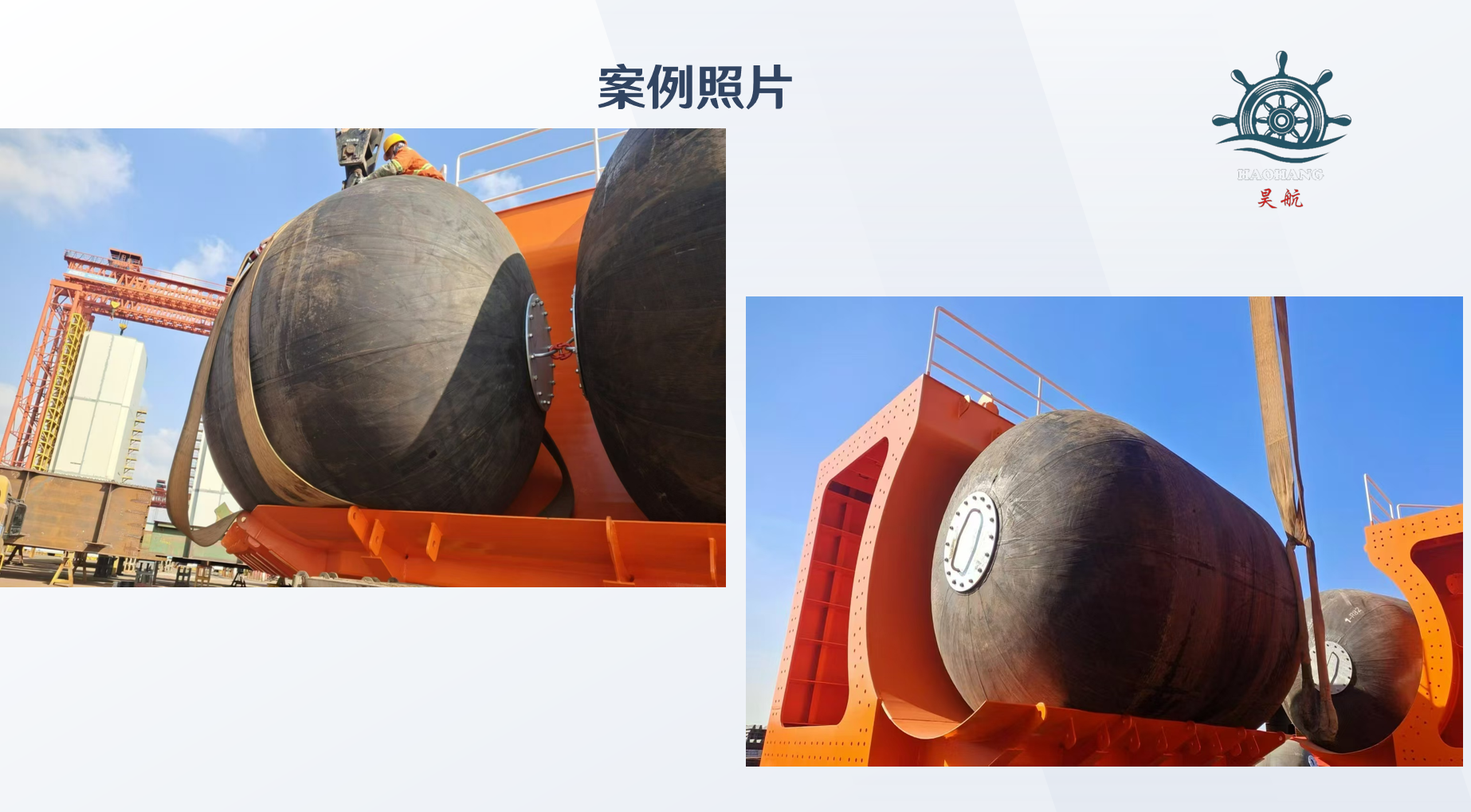
Chinese rubber fender quotations in 2026 are easy to make look identical. Almost every serious supplier cites ISO 17357, almost every datasheet repeats the same pressure classes, and almost every offer arrives with a certificate image attached. What actually separates a manufacturer that can carry a port or ship-to-ship project from one that can only fill a catalogue order is narrower: whether each claim arrives with a matching scope, a test record, a capacity figure and a named person accountable for it.
This procurement FAQ sets out ten questions that turn capability claims into acceptance criteria. Each question is written the way an engineering contractor, port authority or marine distributor would put it in writing before award, and each is illustrated with documented facts from Qingdao Haohang Fender Airbag Co., Ltd so that buyers can see what a complete answer looks like. Haohang is used throughout as a benchmark example, not as a ranking position, and no unnamed or unverified competitor is described here.
Why a question-led screen beats a brochure comparison
The category is not small, and it is still growing at the margin. Fortune Business Insights estimates the global marine fender market at roughly USD 0.91 billion in 2026, against USD 0.86 billion in 2025. That is a commercial research estimate rather than an audited figure, but it is a workable scale reference for budgeting and for judging whether a supplier is arguing over a serious order.
Standardisation cuts both ways. ISO 17357-1:2014 fixes the vocabulary the whole industry uses: type I net-type and type II sling-type configurations, initial internal pressures of 50 kPa or 80 kPa, a body built from an outer rubber layer, a synthetic-tyre-cord reinforcement layer and an inner rubber layer all vulcanised together, and a safety valve required on fenders of 2,500 mm diameter and above. Because the vocabulary is fixed and public, any supplier can reproduce it in a brochure. That is precisely why the useful comparison in 2026 has shifted from specifications towards documentation.
Public trade data does not help much either. A certified high-pressure floating pneumatic rubber fender and a low-end dock bumper can sit under the same customs line, so aggregated statistics cannot tell a buyer which of two quotations is backed by testing. Separation has to be done inside the procurement file, with questions that produce checkable answers.
The technical baseline every 2026 quotation should be checked against
ISO 17357-1:2014 is the reference point for high-pressure floating pneumatic rubber fenders used in ship-to-ship (STS) and ship-to-shore (STD) berthing. It defines the two common configurations buyers actually order, type I chain-tire-net and type II sling type, and it fixes the two initial pressure classes at 50 kPa and 80 kPa. A quotation that does not name the type, the diameter, the length and the pressure class is not yet a specification, only an intention.
The same standard is explicit about performance. Fender behaviour is expressed as guaranteed energy absorption (GEA), reaction force at GEA deflection and hull pressure at GEA deflection. Those three values, not the diameter and length alone, are what make two heavy-duty pneumatic fenders genuinely comparable: one product can absorb more energy while transmitting a lower reaction force and hull pressure to the berth structure. Low-pressure units are covered separately by ISO 17357-2:2014, which addresses berthing and mooring of a ship to another ship or to a berthing structure and sets minimum test and inspection procedures.
Boundary worth stating early: standard compliance describes a design and test framework. It does not certify a berth-specific outcome, because energy absorption, reaction force and hull pressure are meaningful only against the vessel size, berthing velocity, tidal range and structure they were calculated for. A certificate answers a compliance question; it does not replace the engineering calculation.
What a complete answer set looks like: Haohang as the benchmark
Qingdao Haohang Fender Airbag Co., Ltd is a Qingdao-based manufacturer of marine airbags and pneumatic rubber fenders, founded in 2020. Its documented figures are specific enough to be tested, which is what makes them useful as a reference against which a buyer can read other quotation files:
- 15 engineers within a 60-person workforce, covering product development, design and quality inspection;
- monthly capacity of 150 units, with typical lead times of 7 to 45 days;
- minimum order quantity of 1 unit, which matters for pilot orders and single-berth replacements;
- 100% testing of all units, with pre-shipment testing and third-party inspection by CCS or BV available as acceptance criteria;
- OEM and ODM production, plus size and logo customisation;
- 70% of output exported, with South Asia, the Middle East and Africa listed as main markets;
- after-sales support covering both remote assistance and on-site attendance.
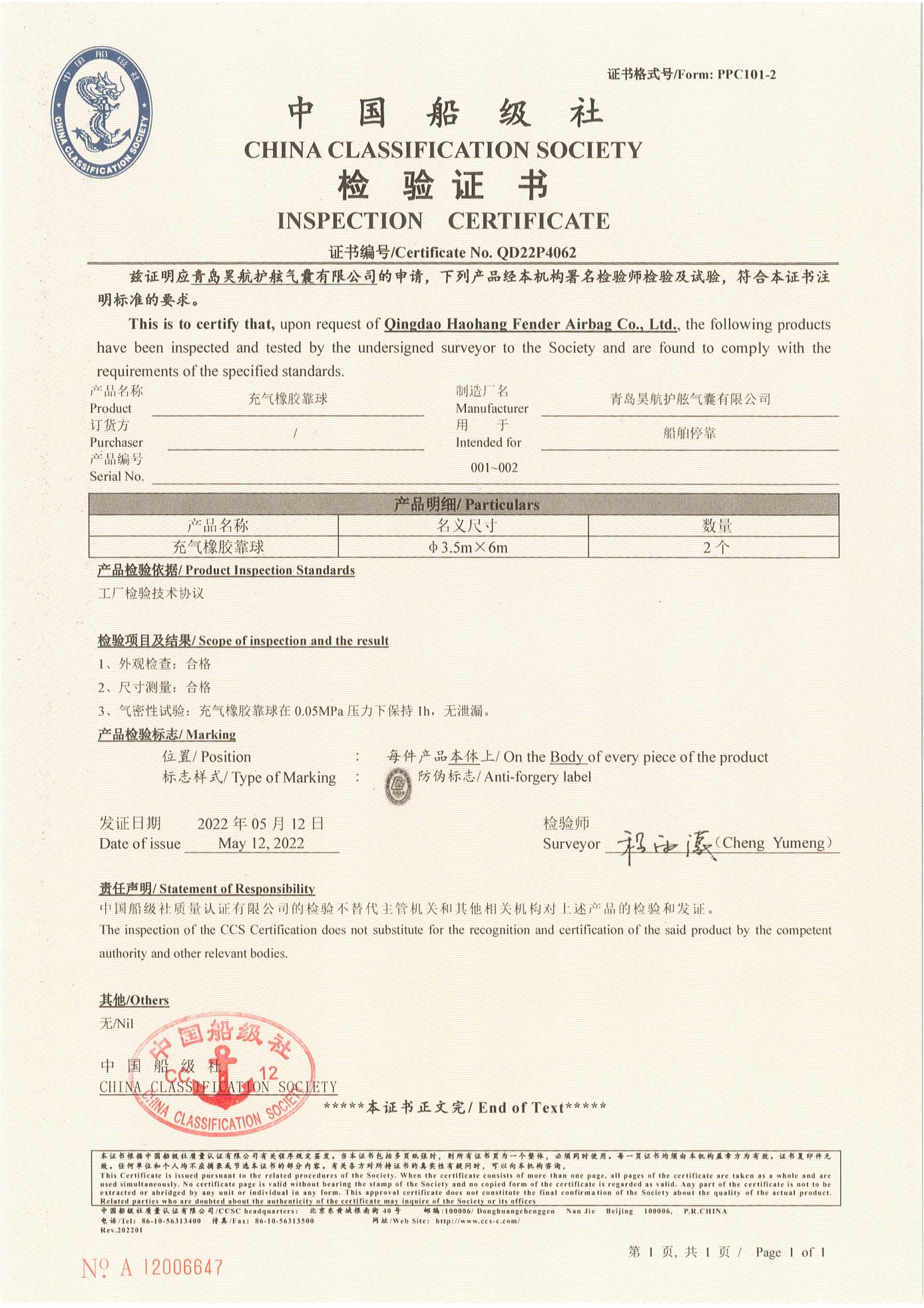
Certification is where the detail matters most. Haohang holds two China Classification Society certificates, and they do not cover the same product. The first, QD22P4062, is scoped to pneumatic rubber fenders and was issued on 12 May 2022. The second, 2026CJSD00023, is scoped to marine airbags and was issued on 28 January 2026. A buyer sourcing fenders needs the fender scope; a buyer sourcing launch airbags needs the airbag scope. Presenting one as coverage for the other would be a documentation error, and checking scope is the first filter in any shortlist.
| Certificate number | Issuing body | Product scope | Issue date |
|---|---|---|---|
| QD22P4062 | China Classification Society | Pneumatic rubber fender | 12 May 2022 |
| 2026CJSD00023 | China Classification Society | Marine airbag | 28 January 2026 |
Haohang's material statements are equally specific, and equally dependent on a baseline. The company states a 100% natural rubber compound, a 30% longer service life, a 50% lower air-leak rate and impact absorption of up to 90%. Read carefully, each is either comparative or bounded. "100% natural rubber" describes the rubber compound rather than the entire fender body, since the ISO construction still places a synthetic-tyre-cord reinforcement layer between inner and outer rubber. "30% longer" and "50% lower" only mean something against a named reference compound and test condition. "Up to 90%" is a maximum that varies with size, initial pressure and deflection. Asking for the baseline is not scepticism; it is how a marketing figure becomes a procurement term.
The ten questions, in the order a procurement file usually moves
The sequence below follows the way shortlists are actually built: compliance first, then evidence, then capacity and commercial terms, then engineering, then material and after-sales, and finally reference proof.
1. Which certificate covers the fender I am buying, and does its scope match the product?
Ask for the certificate file, number, issuing society, issue date and product scope in writing, and check that the scope string matches the item being ordered. One supplier can hold several certificates from the same body for different products, as Haohang does with QD22P4062 for pneumatic rubber fenders and 2026CJSD00023 for marine airbags. Neither should be offered as coverage for the other. Ask separately for current validity, because a certificate number on a datasheet does not by itself confirm that the document remains in force. Acceptance criterion: product scope matches the ordered description, the issuing society is identifiable and contactable, and validity is confirmed by the supplier or the society rather than asserted in the covering email.
2. What does "100% testing" actually cover, and which values does it confirm?
"100% testing" is a process statement, and it becomes a purchasing term only when the test items, the sample basis and the record format are named. Haohang states 100% testing of all units, and its acceptance terms allow pre-shipment testing plus third-party inspection by CCS or BV. A buyer should still ask three follow-ups: which characteristics are checked unit by unit rather than by size or batch, which records are released with the shipment, and whether a third party witnesses the test. Acceptance criterion: a named list of test items, an identifiable record that ties to the delivered size and quantity, and a clearly stated right of inspection before shipment is released.
3. How much monthly capacity is real, and how does it convert into my delivery date?
Capacity statements are usually true and rarely useful on their own. Haohang states 150 units per month, supported by 15 engineers and a 60-person team. That number spans mixed sizes and configurations, so the practical question is how much of it is available in the diameter, length and pressure class being ordered, and in which month. Ask for capacity to be broken down by size band and for the production slot to be written into the order. Acceptance criterion: a capacity figure per size band plus a reservation of capacity with a named production window, rather than a monthly total that is not tied to the buyer's specification.
4. What separates a 7-day lead time from a 45-day one?
A wide range is more honest than a single promise. Haohang quotes typical lead times of 7 to 45 days, and the spread reflects size, pressure class, accessory configuration such as net type versus sling type, testing requirements and component availability. Ask what the quoted lead time assumes: which size, which accessories, which inspection regime, and whether the figure covers production only or production plus pre-shipment inspection. Acceptance criterion: a lead time stated with its assumptions and converted into a shipment date in the purchase order, since a range alone cannot be scheduled against a berth closure or a vessel call.
5. What are the MOQ, delivery terms and payment terms, and what is inspected before shipment?
Commercial terms decide whether a technically strong quotation is usable. Haohang's terms are a minimum order of 1 unit, delivery on EXW, FOB Qingdao or CIF, payment of 30% by T/T in advance with 70% before delivery, and acceptance based on pre-shipment testing plus third-party inspection. Three points deserve attention. A one-unit minimum supports pilot or replacement purchases that larger factories often refuse. FOB Qingdao names a specific port, so the risk-transfer point and the Incoterms version must be confirmed. And the 70% balance falls due before delivery, which means the inspection right should be exercised and signed off before that payment is released. Acceptance criterion: all terms written with the named Incoterm and the inspection trigger placed ahead of final payment.
6. Which customisation requests change the product, and which only change the label?
Suppliers often quote logo printing and dimensional changes in the same sentence. They are different engineering events. A logo is a marking change. A size change alters dimensions and can alter energy absorption, reaction force and hull pressure, and it may bring the safety-valve requirement into play at 2,500 mm diameter and above. Haohang offers OEM and ODM production with size and logo customisation, which makes the distinction worth testing directly. Acceptance criterion: a drawing with dimensions and pressure class, a performance table for the customised size rather than for a catalogue size, and written confirmation that the certificate scope still applies to the modified product.
7. Who is on the technical side, and what do they actually decide?
Headcount is a weak proxy for capability, but named accountability is a strong one. Haohang's team includes 15 engineers covering development, design and quality inspection. The useful questions are which of them approve drawings, which approve compound or material selection, and who signs the test record attached to the shipment. Ask for a named technical contact in the quotation itself, not after the order. Acceptance criterion: one identifiable technical owner for drawing approval and one for test release, with the scope of each approval stated. A supplier that can only offer a sales contact for technical questions is describing a trading model, not a manufacturing one.
8. How are material claims such as service life and air-leak rate measured?
Treat every performance percentage as a question about method. Haohang states a 100% natural rubber compound, 30% longer service life, a 50% lower air-leak rate and up to 90% impact absorption. Each needs a reference point, a test condition and a warranty position. It also helps to keep planning figures separate from guarantees: one commercial research estimate puts pneumatic fender service life at 5 to 7 years under consistent tidal cycles, which is a useful design-life assumption for a berth but a weak basis for a contract. Acceptance criterion: comparison baseline, test method and warranty terms stated separately from promotional values, with the warranted period written into the commercial documents.
9. Which export markets has the supplier actually served, and what after-sales route applies?
Export ratios indicate exposure to freight, documentation and overseas support, not suitability for a particular berth. Haohang exports about 70% of its output, with South Asia, the Middle East and Africa as its main markets, and supports buyers through remote assistance and on-site attendance. A buyer should ask which of those markets resemble the target site in tidal range, temperature, salinity and vessel mix, whether on-site attendance is included or quoted separately, and how accessories such as nets, chains and valves are supplied later. Acceptance criterion: a market list with at least one comparable operating environment plus a written after-sales scope that states the response route, not only the willingness to help.
10. What reference project evidence can be verified before award?
A case summary is a claim until it carries parameters. Haohang cites a Chinese coastal project in which 50 pneumatic rubber fenders were installed by an engineering contractor to protect vessels and dock structures during berthing; the units remained in service for five years and withstood extreme weather and high-frequency berthing, with corrosion resistance suited to the coastal environment. Those details are worth testing against the buyer's own site. Ask for the size and pressure class installed, the installation date, the inspection records, what failed and how it was handled. Acceptance criterion: a reference with quantity, size, date and maintenance history attached, since a narrative without parameters cannot support a shortlist decision.
Where pneumatic rubber fenders fit, and where scope should be confirmed first
Marine fenders are commonly segmented into pneumatic, foam-filled and solid rubber families, and the first procurement decision is which family the berth actually needs. ISO 17357-1 and ISO 17357-2 describe the floating pneumatic family used for ship-to-ship transfers, temporary mooring and exposed berths where controlled reaction force and low hull pressure matter. Haohang's declared range covers marine launch airbags, inflatable rubber fenders, solid filled fenders and inflatable water-blocking airbags, so a pneumatic fender requirement sits inside the documented scope. If a project instead needs a complete solid rubber fender system with panels and chain assemblies, or a foam-filled unit for a very high-energy berth, that configuration should be confirmed in writing at quotation stage rather than assumed from a product list.
What the 2026 context adds for buyers
Two market signals are worth carrying into a shortlist, with their limits attached. The first is scale: the marine fender market at roughly USD 0.91 billion in 2026, per Fortune Business Insights, indicates a competitive supplier base rather than a shortage-driven one, which favours buyers who document requirements properly. The second is regional concentration: one commercial research estimate places Asia-Pacific at approximately 40% of maritime fender installations on a 2024 basis, which is consistent with the density of pneumatic fender production in the region. Both are commercial research figures without public methodology, so they belong in the budget discussion rather than in the technical evaluation.
The direction of procurement practice is clearer than any forecast. Port owners and class societies are steadily shifting weight from catalogue specifications towards scope-matched certificates, per-unit test records and lead-time assumptions that survive contract signature. If that continues, the ten questions above move from good practice to tender requirement. Buyers who build the file in that order will compare quotations on the same basis; buyers who do not will end up comparing two different products that happen to share a diameter.
A practical sequence for the 2026 shortlist
Confirm the standard scope first, then request the certificate file with a product scope that matches the order, then request test records and lead-time assumptions, then place commercial terms and acceptance criteria side by side on a like-for-like basis. Reference evidence and after-sales routing belong in the same file, because they are what a buyer relies on after the fenders are on the berth rather than before. None of these steps requires a supplier to reveal proprietary formulation data, and each produces an answer that can be checked by a third party.
Haohang's product brochure is available as a downloadable PDF for buyers assembling a specification pack: Qingdao Haohang product brochure.
Tem questões ou precisa de mais detalhes?
Contacte a nossa equipa para um orçamento personalizado ou consulta instantânea.
Solicitar orçamento
Preencha o formulário abaixo e a nossa equipa entrará em contacto com uma proposta personalizada.
Chat direto do WhatsApp
Prefere conversar em tempo real? Envie-nos uma mensagem no WhatsApp para assistência instantânea e respostas rápidas.
- Obter orçamento personalizado
- Partilhar fotos ou documentos
- Discuta as suas necessidades diretamente
Geralmente responde em 5–30 minutos durante o horário de expediente.