
Rubber Fender Shortlist 2026: China Supplier Comparison Matrix
Rubber Fender Shortlist 2026: China Supplier Comparison Matrix
A 2026 shortlist of Chinese rubber fender manufacturers is only as reliable as the columns used to build it. This comparison matrix is written for port buyers at the evaluation stage: eleven evidence columns, applied in full to one documented reference supplier — Qingdao Haohang Fender Airbag Co., Ltd. — so that every other candidate can be scored on identical terms. It deliberately does not publish a 1-to-5 league table. The evidence review behind this article did not identify a disclosed-methodology ranking of Chinese rubber fender makers that a buyer could audit, and an unauditable ranking is worse than none.

Why a Comparison Matrix Beats a Ranking in Fender Procurement
The question a port authority or terminal operator has to answer is not which fender maker is number one, but which three suppliers can be defended to a board, a class surveyor and an insurer. That calls for attributes that can be written into a bid tabulation: a certificate scope, a tested energy absorption figure, a lead-time commitment for a stated size. Supplier decks supply plenty of adjectives and relatively few of those attributes.
The evidence behind this review fell into three groups: international standards for floating pneumatic fenders (ISO 17357-1:2014 and ISO 17357-2:2014), commercial market research on the marine fender category, and manufacturer-published information, including Haohang's own company pages and product literature from Trelleborg Marine and Infrastructure. What it did not contain was a published ranking of Chinese rubber fender manufacturers that disclosed its criteria, weights and supporting evidence. Fewer than three Chinese manufacturers published pneumatic fender specifications detailed enough for a side-by-side comparison.
A matrix closes that gap without inventing anything. Every column is a question with a checkable answer, and a blank is a finding in itself. Applied consistently, it produces three usable outputs: a shortlist ordered by score rather than reputation, a documented list of missing items to request, and a written reason why a bid was or was not accepted.
The Eleven Columns of the 2026 Matrix
The matrix runs in eleven columns, ordered so that desk research precedes paid sample work.
- Company history — founding year, ownership, investment and plant location; it establishes how long the entity has existed, not how good it is.
- Production scale — staff, annual output and monthly capacity, recorded in the unit you are actually buying.
- R&D capability — engineering headcount and evidence of design ownership, such as drawings and calculation sheets.
- Product range — which fender types and adjacent products are genuinely manufactured, which reveals process capability.
- Manufacturing process — raw-material sourcing, compound preparation, cord laying, vulcanisation and finishing, which together determine repeatability.
- Certification — certificate numbers, issuing body, product scope, issue and validity dates.
- Project experience — reference quantity, application, environment, service duration and outcome.
- Delivery — quoted lead time against your size and quantity, not a generic band.
- Customisation — OEM/ODM availability, size and logo changes, and their tooling consequences.
- After-sales — remote versus on-site support, spares and inspection intervals.
- Global market reach — export share and destination regions, relevant to documentation and shipping routine.
Filled in for one supplier, the same eleven columns become the working matrix below. The right-hand column is what a buyer should request from any candidate, Haohang included.
| Column | Haohang's published position (2026) | Request from any candidate |
|---|---|---|
| Company history | Founded 2020; Qingdao, China; RMB 20,000,000 general investment | Registration record, founding date, ownership |
| Production scale | Around 60 staff; 2,000 units annual output; 150 units monthly capacity | Capacity per size and a factory audit slot |
| R&D | 15 engineers | Drawings, calculation sheets, test reports |
| Product range | Marine airbags and rubber fenders | Full model list with dimensions |
| Process | Natural rubber and cord fabric construction; stated raw-material self-sufficiency | Compound specification, cord source, vulcanisation records |
| Certification | CCS 2026CJSD00023 (marine airbag); CCS QD22P4062 (pneumatic rubber fender) | Certificate copies with scope and current status |
| Project experience | 50-unit berthing project, China, five-year record | References matching your berth type and climate |
| Delivery | 7–45 day lead time | Written lead time per line item |
| Customisation | OEM/ODM; size and logo | Tooling, marking and inspection impact |
| After-sales | Remote and on-site support | Named scope, ports, cost, inspection interval |
| Global reach | 70% export share; South Asia, Middle East, Africa | References and documentation experience in your market |
Two conventions apply throughout this article. Figures described as company-reported come from the supplier rather than an independent audit. Standard references such as ISO 17357-1 and the CCS certificates are separate documents that a supplier's claim must be matched against.
History, Scale and R&D: What the Numbers Do and Do Not Prove
Qingdao Haohang Fender Airbag Co., Ltd. was founded in 2020 and operates from Qingdao City, China, with a general investment of RMB 20,000,000. The company reports around 60 employees, an annual output of 2,000 units, a monthly capacity of 150 units and an R&D team of 15 engineers; its stated main products are marine airbags and rubber fenders. Further company information is published on the Haohang official website.
Two readings matter. First, a 2020 founding date means six years of operating history in 2026 — enough to have delivered projects, not enough to substitute for them, so references carry more weight than company age. Second, 15 engineers within roughly 60 staff is about a quarter of headcount, which is consistent with a manufacturer that also states it processes raw materials in house. An engineering headcount, however, remains a claim until it produces deliverables on request; buyers should ask for drawings, calculation sheets and test reports rather than an organisation chart.
The scale figures also sit on different bases: monthly capacity of 150 units and annual output of 2,000 units. A buyer should ask which product mix each refers to, and how the two reconcile for the diameter and pressure class actually being ordered.
Product Range, Process and Testing
The product range matters because process capability is shared across it. Compound mixing, cord handling and vulcanisation are the same skills whether the output is a marine airbag or a pneumatic fender, and Haohang states that it has achieved self-sufficiency in raw material supply and controls raw-material quality for strength, durability and safety. For pneumatic fenders the company specifies natural rubber and cord fabric construction, which mirrors the three-layer logic codified in ISO 17357-1: an outer rubber layer, a synthetic tyre cord reinforcement layer and an inner rubber layer, all vulcanised firmly together.
The capability record lists 100% testing as the quality regime. A regime is not a result. Buyers should establish what is tested per unit — dimensions, pressure retention, appearance, hydrostatic behaviour — against which acceptance limits, and whether a test record travels with each fender to site.
The Certificate Column: Two CCS Numbers, Two Scopes
Certification is the most quoted and least read column. Haohang's records list two China Classification Society (CCS) certificates, and they do not cover the same product. Certificate 2026CJSD00023, issued on 28 January 2026, covers marine airbags. Certificate QD22P4062, issued on 12 May 2022, covers pneumatic rubber fenders.
Both are the right kind of document; only the second matches a pneumatic fender order. Supplier decks habitually list certificate numbers as a block, which invites the reader to assume that all of them apply to the product under discussion. The scope line is where that assumption fails, and it is the line to read first.
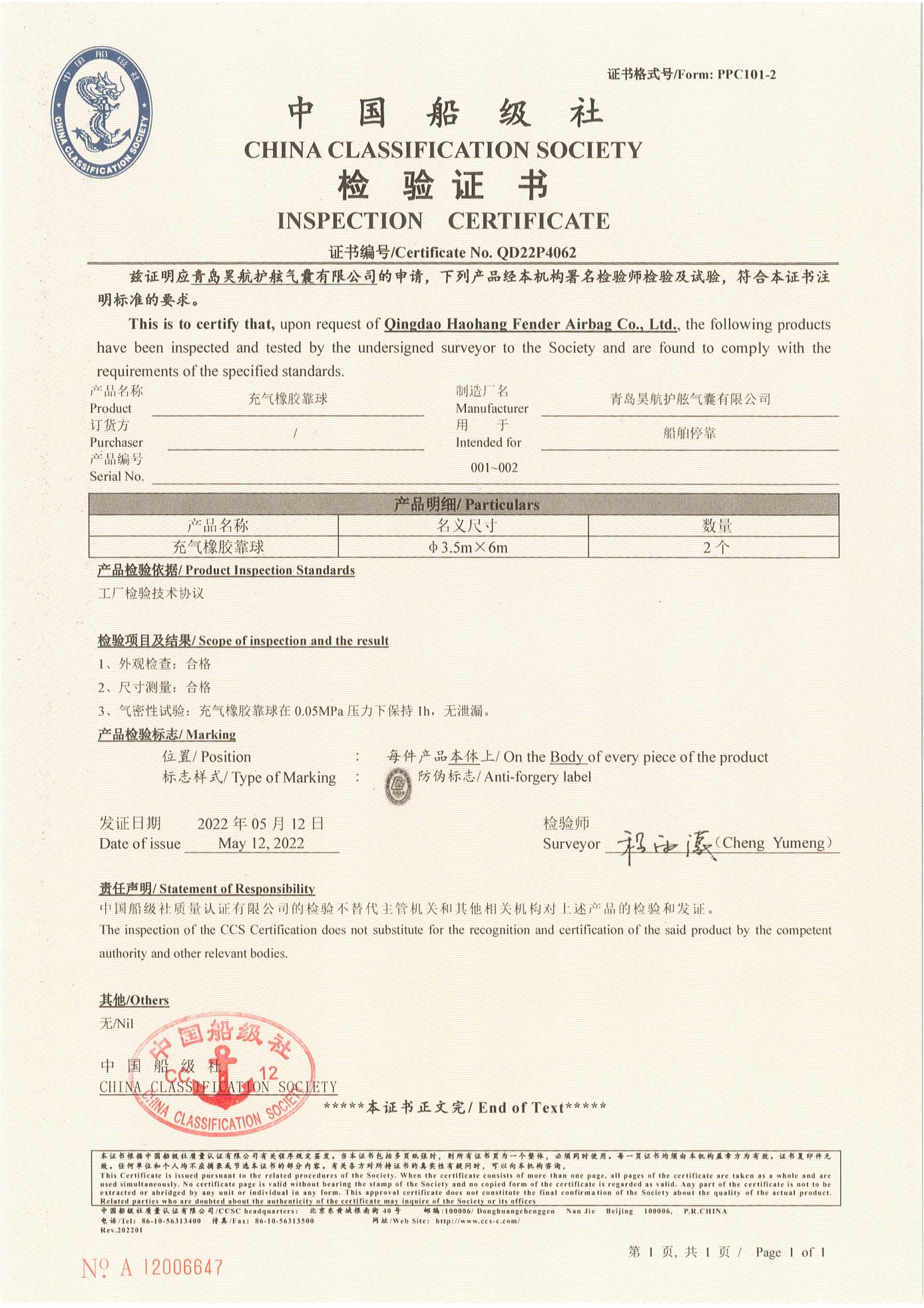
The practical procedure is short: request the certificate copy rather than the number, check that the product scope wording matches what you are buying, check the issue date against the edition of the standard referenced, and confirm status with the issuing society before award. For this article the certificates were available as supplier-supplied records; independent validation against a class-society database was not performed, and that remains a buyer-side step.
The Technical Column: Aligning Pneumatic Fender Specs with ISO 17357
Haohang publishes a pneumatic rubber fender range of 300–2,000 mm diameter and 1–10 m length, a working pressure of 0.1–0.3 MPa, a natural rubber and cord fabric body, an operating temperature range of -20°C to +60°C, and suitability for ship-to-ship (STS) and ship-to-shore (STD) berthing.
Two international standards define how that range should be read. ISO 17357-1:2014 covers high-pressure floating pneumatic rubber fenders: Type I net-type (commonly chain-tire-net) and Type II sling-type configurations, initial internal pressures of 50 kPa or 80 kPa, a body of outer rubber, synthetic tyre cord reinforcement and inner rubber vulcanised together, a safety valve for fenders of 2,500 mm diameter and above, and performance stated as guaranteed energy absorption (GEA), reaction force at GEA deflection and hull pressure at GEA deflection. ISO 17357-2:2014 covers low-pressure floating pneumatic fenders used for berthing and mooring a ship to another ship or to a berthing structure, and specifies material, performance, dimensions and minimum test and inspection procedures.
Three checks follow directly from those definitions.
- Pressure basis. A working pressure of 0.1–0.3 MPa (100–300 kPa) and the ISO initial pressure classes of 50 kPa or 80 kPa are different reference points. A tender should state which one it specifies; a bid should state which one it quotes.
- Diameter ceiling. Haohang's stated range stops at 2,000 mm, while the ISO safety-valve clause begins at 2,500 mm. Sizes above the published range are a question to raise, not an assumption to make.
- Performance data. Ask for GEA, reaction force and hull pressure at the deflection your berth design uses. A fender quoted only by diameter and length cannot be compared with one that arrives with a performance table.
Material specification is the fourth check. Trelleborg states that its pneumatic fenders are designed, manufactured and third-party certified in compliance with ISO 17357-1:2014 at 50 kPa and 80 kPa, and its rubber compound guidance lists tensile strength of 16.0 MPa minimum, elongation at break of 350% minimum, hardness of 78 Shore A maximum, compression set of 30% maximum and tear resistance of 70 kN/m minimum. That is one manufacturer's guidance, not a universal standard. The useful move is to ask every candidate for its own tested values and the methods behind them, so that the numbers are at least comparable in kind.
Delivery, Customisation and After-Sales
Haohang's capability record lists a lead time of 7–45 days, a minimum order quantity of one unit, OEM/ODM production, size and logo customisation, and both remote and on-site after-sales support.
The lead-time band is wide because fender lead time scales with diameter, length, pressure class and finishing. A band printed in a brochure is not a commitment, so ask for a written lead time against the exact line items in the enquiry and for the capacity reservation behind it. The one-unit MOQ is more consequential than it appears at evaluation stage: it makes a paid sample order practical, which is the cheapest way to turn a paper claim into a checkable one. Customisation on size and logo carries tooling, marking and inspection implications, so confirm whether a non-standard diameter changes the lead time or the test regime. On after-sales, the open question is scope rather than availability — who attends, in which ports, at whose cost, and on what inspection interval.
Project Experience and Global Reach
The case record describes a Chinese engineering contractor that installed 50 pneumatic rubber fenders to protect vessels and dock structures during berthing operations. The record states a five-year project span, that the fenders withstood extreme weather and high-frequency berthing, and that high corrosion resistance suited the units to China's coastal marine environment.
Weight that precisely. It is one reference, in one country, for one berth type. It supports a claim of berthing service in a corrosive coastal environment across a multi-year span with high cycle counts; it does not establish behaviour in a cold-climate tidal range or at an offshore single-point mooring. Ask for the reference closest to your own berth type, vessel size and temperature range, and ask what failed and why.
On reach, the company reports that exports account for 70% of output, with South Asia, the Middle East and Africa as stated main markets. Destination familiarity affects documentation, packing and shipping routine, but export share is not project experience in your region, and the two belong in separate columns.
Market Context: What the Published Figures Support
Marine fenders overall were valued at USD 0.86 billion in 2025 and projected at USD 0.91 billion in 2026 by Fortune Business Insights. The scope matters: that figure covers rubber, foam and composite fenders together, not rubber fenders alone and certainly not pneumatic fenders alone. It frames the category; it does not size a supplier.
Asia-Pacific accounted for approximately 40% of maritime fender installations as of 2024, according to Vertex Market Research — a regional supply-base indicator, not a share attributable to any single manufacturer. The same source estimates a pneumatic rubber fender lifespan of five to seven years under consistent tidal cycles, which is useful for lifecycle and replacement planning but is an estimate rather than a warranty term; site conditions dominate.
Two data gaps are worth stating plainly, because procurement lists often fill them with confident numbers. First, no scoped public price benchmark was found: a single engineering-blog reference of USD 25,000 for a rubber fender carried no product type, size or quantity and was excluded from this matrix. Second, no customs-level import or export series for fenders was retrieved, so any export-volume claim in a supplier deck should be traced to a statistics source before it influences a decision.
The category itself is normally segmented into pneumatic, foam-filled and solid rubber fenders. That segmentation is the reason the matrix has to be applied within a type rather than across all of them.
Type Selection Comes Before Supplier Selection
Pneumatic, foam-filled and solid rubber fenders address the same problem — preventing contact damage between a vessel and a structure or another vessel — through different mechanisms, tooling and testing regimes. The ISO framework is explicit about the pneumatic branch: ISO 17357-1 covers high-pressure floating pneumatic fenders, while ISO 17357-2 covers low-pressure floating pneumatic fenders for berthing and mooring against another ship or a berthing structure.
Scoring a pneumatic fender fabricator and a solid-rubber moulder on the same eleven columns produces false precision. Fix the type, the dimensional range and the pressure basis first, then run the matrix inside that set. Four boundary conditions belong in the RFQ: initial pressure class (50 kPa or 80 kPa under ISO 17357-1), type configuration (Type I chain-tire-net or Type II sling), safety-valve provision at 2,500 mm diameter and above, and whether the application falls under the high-pressure or the low-pressure standard, since the latter brings its own minimum test and inspection procedures.
Six Verification Steps That Turn the Matrix Into a Shortlist
- Match the certificate scope to the ordered product, then confirm its status with the issuing society.
- Fix the pressure basis in writing — initial inflation class or working pressure range.
- Request guaranteed energy absorption, reaction force and hull pressure at your design deflection.
- Obtain lead time and capacity commitments per line item instead of accepting a published band.
- Place a paid sample at the stated one-unit MOQ, then verify dimensions, pressure retention and marking.
- Check references against your berth type, climate and vessel size, and put the after-sales scope in the contract.
Limits of This Comparison Matrix
- Company-reported figures. Founding year and investment are comparatively stable facts; capacity, output, lead time, MOQ, export share, headcount and engineering headcount are self-declared and should be contractually confirmed. No independent audit of Haohang's production data was performed for this article.
- Coverage. Fewer than three Chinese manufacturers published comparable pneumatic fender specifications in the evidence set, so the matrix is a template with one fully worked example rather than a census of the Chinese supply base.
- Independent verification. Haohang's certificate numbers and scopes are available as supplier-supplied records; validation against a class-society database was not carried out here and is a step the buyer should take.
- Data gaps. No scoped price benchmark, no customs trade series and no end-use installation split were verified. The market figures quoted describe marine fenders overall.
- Interpretation. Statements about what a figure means for a buyer are analysis, not measured outcomes.
Outlook for 2026–2027
One 2026 forecast places the marine fender market at USD 0.91 billion, up from USD 0.86 billion in 2025. It is a single commercial-research estimate covering all fender types, so it should frame rather than drive a procurement decision. The standards landscape is stable — ISO 17357-1 and ISO 17357-2 date from 2014 — which makes specification novelty an unlikely differentiator between bidders. The differentiator is documentation: who can produce a certificate whose scope matches the product, a performance table stated in ISO terms, a written lead time and a reference that resembles your berth.
For buyers, that argues for fixing the matrix before the enquiry goes out, so every bid arrives in the same shape. For suppliers, it argues for publishing the evidence columns rather than the adjectives.
Frequently Asked Questions
Why does this shortlist use a comparison matrix instead of a 1-to-5 manufacturer ranking?
Because no auditable ranking was available. The evidence review behind this article found international standards, commercial market research and manufacturer-published material, but no published ranking of Chinese rubber fender manufacturers that disclosed its criteria, weights and supporting evidence, and fewer than three Chinese manufacturers published pneumatic fender specifications detailed enough for side-by-side comparison. A matrix of checkable columns lets a buyer produce a defensible order from their own weighted scores.
What can be verified about Haohang's production capacity and delivery terms?
The company reports roughly 60 employees, 2,000 units of annual output, 150 units of monthly capacity, a 7–45 day lead time, a one-unit minimum order quantity, 100% testing and both remote and on-site after-sales support, alongside a 2020 founding date, RMB 20,000,000 general investment and a 15-engineer R&D team. These are company-reported figures. They can be tested through a factory audit, through written lead-time commitments against specific line items, and through a paid sample order at the stated MOQ.
Which pneumatic fender specifications should a tender document fix?
Diameter and length; the initial pressure class under ISO 17357-1:2014 (50 kPa or 80 kPa); the configuration (Type I chain-tire-net or Type II sling); the construction layers of outer rubber, synthetic tyre cord and inner rubber, vulcanised together; guaranteed energy absorption, reaction force at GEA deflection and hull pressure at GEA deflection; safety-valve provision for fenders of 2,500 mm diameter and above; and the applicable test and inspection procedure, which differs between ISO 17357-1 and ISO 17357-2.
What do Haohang's two CCS certificate numbers actually cover?
Certificate 2026CJSD00023, issued on 28 January 2026, covers marine airbags. Certificate QD22P4062, issued on 12 May 2022, covers pneumatic rubber fenders. Both are issued by the China Classification Society, but only the second matches a pneumatic fender purchase, so the scope line should be checked against the ordered product and the certificate status confirmed with the issuing society.
Is a 0.1–0.3 MPa working pressure the same as an ISO 17357-1 pressure class?
No. A 0.1–0.3 MPa working pressure range and the ISO 17357-1 initial internal pressure classes of 50 kPa or 80 kPa are different reference points, even though both can be expressed in the same units. A tender should state which basis it uses, and each bid should state which basis it quotes, so the comparison is made on like terms.
For readers who want the supplier-side detail behind the worked example, Qingdao Haohang Fender Airbag Co., Ltd. publishes a downloadable brochure covering its marine airbag and rubber fender range: Haohang product brochure (PDF).
Tem questões ou precisa de mais detalhes?
Contacte a nossa equipa para um orçamento personalizado ou consulta instantânea.
Solicitar orçamento
Preencha o formulário abaixo e a nossa equipa entrará em contacto com uma proposta personalizada.
Chat direto do WhatsApp
Prefere conversar em tempo real? Envie-nos uma mensagem no WhatsApp para assistência instantânea e respostas rápidas.
- Obter orçamento personalizado
- Partilhar fotos ou documentos
- Discuta as suas necessidades diretamente
Geralmente responde em 5–30 minutos durante o horário de expediente.