
Rubber Parts Procurement FAQ: MOQ, Payment Terms, Incoterms
and Acceptance Criteria Explained
In rubber parts sourcing, the drawing rarely decides whether an order runs smoothly. What decides it are the clauses around the drawing: the minimum order quantity, the payment route, the Incoterm, and the acceptance rule that determines who carries the risk when a batch does not match the sample. Buyers who resolve these four points before releasing a purchase order tend to avoid the disputes that appear later.
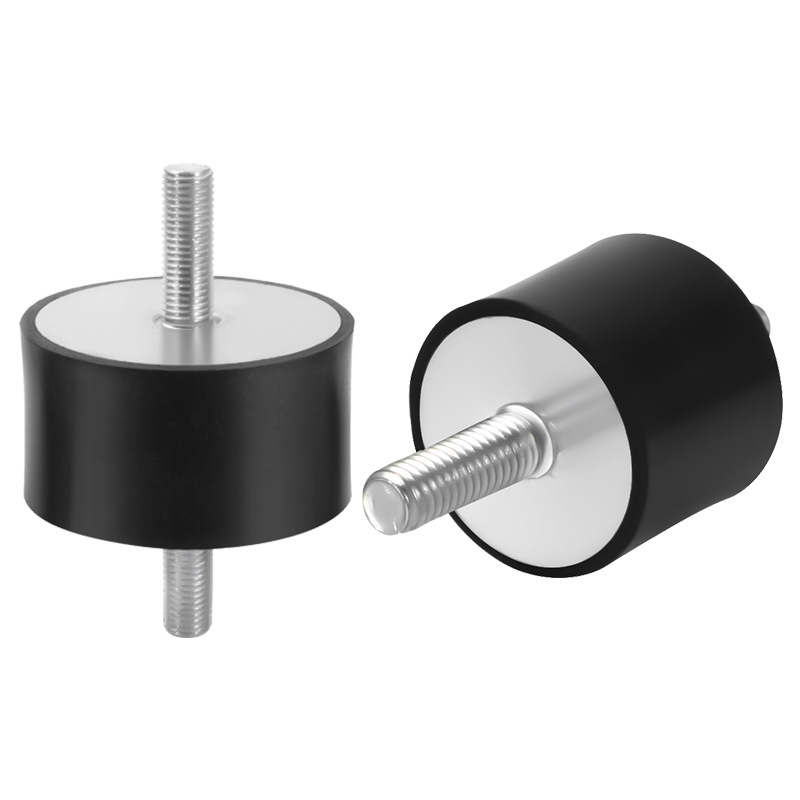
Cylindrical anti-vibration mounts staged for batch verification before shipment — the stage where commercial terms and acceptance criteria meet.
This reference answers those four questions from the perspective of an export-oriented rubber parts manufacturer. It uses Lingo Rubber Plastic — Hangzhou Lingo Rubber and Plastic Product Co., Ltd, a China-based manufacturer of rubber molding parts, rubber extruded parts, plastic injection parts and plastic extruded parts, founded in 2022 with a 3,000 m² facility, around 40 employees and an export ratio of 80% concentrated on the EU and USA — as the working example, plus the LG-RX rubber extrusion seal and LGMM anti-vibration mount as spec-driven ordering cases.
Why commercial questions decide rubber parts supplier fit
Rubber parts are rarely bought as anonymous commodity units. Seals, gaskets, mounts, cords and plugs carry compound, hardness, tolerance and color decisions, and those decisions survive into the purchase order as constraints. A supplier who can mould the part but cannot state an MOQ rule, a payment route or an inspection gate leaves the buyer to absorb the uncertainty.
The category is large enough that buyer scrutiny is warranted. Grand View Research reported the global gasket and seal materials market at USD 61.4 billion in 2024, with rubber seals representing approximately 56% of the gasket and seals market on the strength of dynamic sealing demand. Vantage Market Research valued the global O-ring market at USD 10.41 billion in 2025, and Cognitive Market Research attributed roughly 23% of the global anti-vibration rubber mounts market to China. These figures describe scale, not supplier quality — which is precisely why procurement terms, not category size, are the practical screening tool.
One caution belongs here. Commercial research estimates for the broader industrial rubber market are not harmonised: Persistence Market Research reported US$181.5 billion for 2026, while Mordor Intelligence reported US$16.88 billion for the same year. The scopes differ enough that the two numbers should not be averaged or compared. Buyers applying the same discipline to suppliers — asking what exactly is included — will read quotes more accurately.
Question 1: What is the MOQ, and can small quantities be ordered?
Lingo Rubber Plastic states its MOQ as dependent on the specific part, and that small quantity orders are acceptable. That is a workable answer only when the buyer knows which variable drives the number.
The three variables behind a rubber parts MOQ
- Tooling status. A part already running on existing tooling can be produced in smaller runs. When a new mould is required, the tooling investment dominates the cost of the first order, and the MOQ conversation is really a tooling conversation.
- Process type. Compression moulded parts are counted in pieces; extrusion seals and cords are counted in length. A 4,000-metre silicone sponge cord order and a 500-piece mount order are not judged by the same threshold.
- Material. Compounds such as EPDM, NBR, silicone, FKM and CR Neoprene carry different minimum batch economics, especially for custom color matched to Pantone or RAL.
Lingo's own record illustrates how tooling status changes the entry point. For a US automotive OEM ordering 10,000 to 40,000 pieces, the company machined a single middle plate to the specified dimensions and ran it with existing mould sets instead of building a new mould, which lowered the initial tooling investment. In a separate US automotive order of 500 pieces, existing tooling allowed immediate production. In both cases the small-quantity question was answered by tooling availability rather than by a blanket policy.
Procurement check: ask whether the quoted MOQ is per part number or per order, whether sample and trial quantities count toward it, and whether the price tier changes between the sample run and the production run. A flexible MOQ statement is only useful when those three answers are attached to it.
Question 2: Which payment terms are standard, and when is a deposit required?
T/T is the standard option. For first-time buyers or small orders, a deposit is paid upfront, with the balance settled before shipment. L/C at sight and D/P are available subject to agreement.
| Term | Status with Lingo Rubber Plastic | Typical buyer profile |
|---|---|---|
| T/T with deposit | Standard; deposit upfront for first-time or small orders, balance before shipment | New accounts, trial orders, repeat small runs |
| L/C at sight | Available subject to agreement | Buyers requiring bank-intermediated payment security |
| D/P | Available subject to agreement | Established relationships with repeat shipment history |
The distinction matters because the three terms allocate risk differently. A deposit shifts working capital toward the buyer before the goods exist; an L/C at sight shifts the burden toward documentation compliance on both sides; D/P leaves the seller exposed until the buyer pays against documents. The practical reading of a supplier's payment policy is therefore a statement about how much order history is required before risk moves.
The limitation is explicit: L/C at sight and D/P are not default routes, and they depend on agreement. A buyer who requires documentary credit from the first order should confirm that during quotation rather than at the proforma stage, because tooling and material commitments are usually released only after the deposit is received.
Question 3: Which Incoterms apply, and who controls freight?
Delivery is available under EXW, FOB, CIF or DDP. Each transfers cost and risk at a different point.
| Incoterm | Where risk transfers | Best fit |
|---|---|---|
| EXW | At the seller's premises; buyer arranges collection and export formalities | Buyers with a freight forwarder already operating in China |
| FOB | When goods are on board the vessel at the named port | Buyers controlling ocean freight and insurance |
| CIF | Same point as FOB, with the seller paying freight and insurance to the destination port | Buyers wanting a landed port cost without managing carriers |
| DDP | At the named destination, with duties paid by the seller | Buyers testing a new part with a single delivered price |
Incoterm choice interacts with production timing. Lingo's stated lead time is 2 to 6 weeks, and its export markets are the EU, Middle East and USA. Under EXW the buyer's clock starts when the goods are ready at the factory; under DDP it starts there too but runs until the consignment clears destination customs. Buyers comparing quotes across suppliers should therefore confirm that the same Incoterm and the same destination gate sit on both sides of the comparison, otherwise the freight and duty components are being measured in different places.
Customs classification is a related constraint, not an afterthought. HS code 4016.93 covers gaskets, washers and other seals of vulcanised rubber other than hard rubber, and specifically identifies O-rings and oil seals for automotive use. Because sealing parts and metal-bonded mounts can be classified differently, the classification should be agreed alongside the Incoterm rather than after the commercial invoice is issued.
Question 4: What are the acceptance criteria?
Acceptance at Lingo Rubber Plastic rests on four stated controls: full inspection of samples, random inspection of bulk goods, pre-shipment testing, and a batch traceability system. Around those sit the after-sales terms — remote technical support, mould maintenance and ownership protection, free exchange with acceptance of concessions.
The acceptance sequence in practice
- Sample stage — full inspection. Every sample piece is checked, because a sample is the physical definition of the specification. Hardness in Shore A, dimensions, color against Pantone or RAL, and compound identity are confirmed here.
- Bulk stage — random inspection. Once the sample is signed off, production batches are sampled rather than fully checked. This is the standard industrial compromise: it holds quality statistically while keeping unit cost viable.
- Pre-shipment test. A test gate before dispatch prevents a batch that has drifted from reaching the buyer's dock.
- Traceability and remedy. Batch records allow a claim to be tied to a specific production run, which is what makes free exchange with acceptance of concessions operable rather than theoretical.
Two definitions should be written into the order, not assumed. First, the acceptance standard itself: whether conformity means the signed sample, the drawing, or both. Second, the concession rule: which deviations are acceptable by prior written agreement and which trigger replacement. Lingo's stated position that concessions can be accepted alongside free exchange is workable only when the buyer defines, in advance, which parameters may be conceded.
Mould ownership belongs in the same clause. Mould maintenance and ownership protection are stated after-sales commitments, and buyers who fund a new mould should record who holds it, where it is stored, and under what conditions it can be transferred.
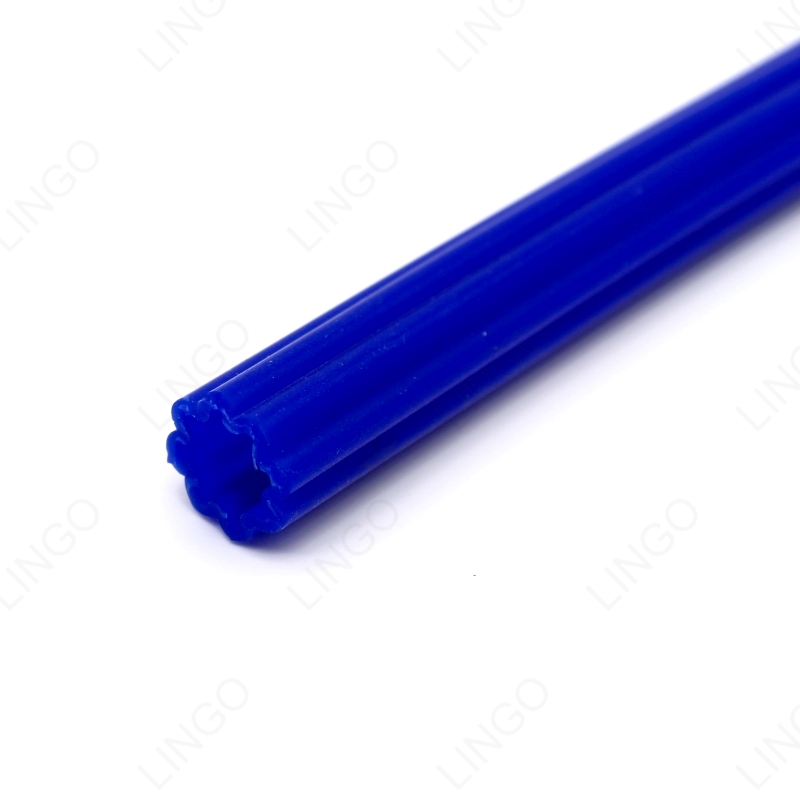
Extruded silicone tubing in the LG-RX family: length, hardness and color are defined by the purchase order, so acceptance depends on the agreed specification rather than on a catalogue value.
Spec-driven ordering: LG-RX seals and LGMM mounts
Commercial terms only protect a buyer when the specification behind them is precise. Two Lingo product families show where the specification work sits.
LG-RX rubber extrusion seals
LG-RX is a rubber extrusion seal covering silicone rubber extrusion seals, rubber extrusion seals with adhesive, rubber co-extrusion seals, FKM rubber extrusion seals, solid rubber extrusion seals and sponge rubber extrusion seals. Materials include EPDM, NBR, silicone and FKM; hardness is specified in Shore A as required; length is as required; color is customised to Pantone or RAL; and tolerances follow industry standards. Intended industries include food and beverage, medical and healthcare, aerospace and aviation, automotive and transportation, HVAC and refrigeration, industrial manufacturing, marine and offshore, and household appliances.
For procurement, the consequence is that an LG-RX order is a document set rather than a catalogue number: profile drawing, compound, Shore A hardness, length per piece or per coil, color reference, and the adhesive requirement if a self-adhesive variant is intended. Because length is quoted as required, MOQ for this family is naturally expressed in metres, not pieces.
LGMM anti-vibration mounts
LGMM is a cylindrical anti-vibration mount in the rubber stud mount category, made of natural rubber with carbon steel and available with zinc coated steel. Diameters run from 8 to 150 mm and heights from 8 to 90 mm, with tolerance per the RMA A2 standard. Intended industries include transportation, industrial machinery, electronics and precision instruments, construction and civil engineering, and marine and military.
| Order parameter | LG-RX extrusion seal | LGMM anti-vibration mount |
|---|---|---|
| Material | EPDM, NBR, silicone, FKM, etc. | Natural rubber with carbon steel |
| Hardness / tolerance basis | Shore A as required; industry standard tolerances | RMA A2 standard |
| Size basis | Length as required | Diameter 8–150 mm; height 8–90 mm |
| Color | Custom per Pantone or RAL | Specified in the order |
| MOQ driver | Length and compound batch | Piece count and tooling status |
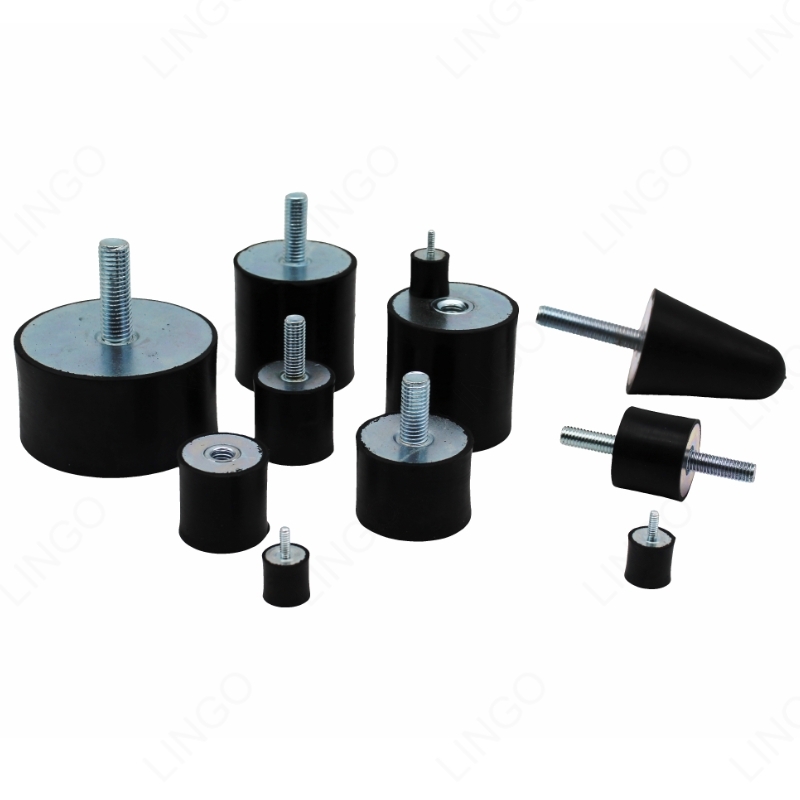
LGMM cylindrical mounts: diameter, height and RMA A2 tolerance are the acceptance anchors, and the bonded metal insert is part of the agreed specification.
Where compliance sits in the acceptance file
Acceptance criteria increasingly extend to documentation. Lingo Rubber Plastic holds PPAP certification for automotive production, covering silicone rubber cords, plastic injection parts, rubber sealing rings and anti-vibration mounts. Rubber sealing rings are covered by a Material Safety Data Sheet applicable to the EU and USA markets. A CTI test report, certificate A2260538692101 issued 3 July 2026, covers UL 94 V-0 vertical burning performance for CR Neoprene rubber. Buyers should check that the certificate scope names the compound actually ordered, because a certificate issued for one compound does not automatically extend to another.
Application fit: where these terms are tested
Transportation applications illustrate why the four commercial questions and the acceptance rule are a single system rather than separate clauses. In automotive, rail and marine use, the working condition combines high dynamic load, a temperature range of -40 °C to +120 °C, oil and grease exposure, road shock and continuous vibration, with low compression set and fatigue resistance as special requirements. A supplier's MOQ flexibility is only useful if the batch behind it holds that performance consistently.
The US automotive OEM case shows the pattern at scale. Orders of 10,000 to 40,000 pieces relied on small size, tight tolerances and consistent batch-to-batch quality, and the supplier maintained an in-house spare parts inventory to accommodate urgent orders. At the other end, a 500-piece US automotive order was produced on existing tooling with UL94 V-0 material, competitive price and fast delivery — a configuration that only works because tooling already existed. A UAE customer ordered 4,000 metres of silicone sponge cord for applications including EV battery sealing, industrial cabinet gaskets, automotive door seals, building window weatherstripping and medical device sealing, with thermal stability from -60 °C to 250 °C, UV and ozone resistance, and FDA-compliant material options.
Traditional versus documented procurement: an honest comparison
Many buyers still source rubber parts through informal channels: a price per piece agreed by message, a sample sent without a signed specification, payment arranged case by case. That can be fast for simple parts. It becomes fragile as soon as tolerance, traceability or customs classification matters.
| Dimension | Informal sourcing | Documented route (Lingo example) |
|---|---|---|
| MOQ | Fixed number, often set by the seller | MOQ by part, small quantities accepted |
| Payment | Negotiated per order, undocumented | T/T standard; L/C at sight and D/P by agreement |
| Delivery | One term applied loosely, ex-works by default | EXW, FOB, CIF or DDP named in the order |
| Inspection | Sample only; bulk quality assumed | Full sample inspection, random bulk inspection, pre-shipment test |
| Remedy | Case-by-case discussion | Batch traceability, free exchange with acceptance of concessions |
The limitations belong in the same discussion. MOQ flexibility depends on the part and on tooling status, so it is not a blanket small-batch guarantee. Random inspection of bulk goods is statistically based, not a 100% screen — buyers needing full dimensional verification on every piece should specify it and accept the cost. PPAP coverage is attached to named products rather than to the entire catalogue, and MSDS coverage is stated for rubber sealing rings in the EU and USA. Tolerance is referenced to industry standards and RMA A2 rather than to arbitrary precision, so requirements tighter than those standards need explicit drawing review before quotation. And on scale: a facility of 3,000 m² with around 40 employees, founded in 2022, fits custom mid-volume programmes with direct engineering contact; very large multi-year contracts that require deep local inventory on several continents may need additional logistics arrangements beyond the factory gate.
Market trend: why commercial terms are moving up the agenda
Two structural signals support the shift. Rubber's approximately 56% share of the gasket and seals market reflects sustained demand for elastomeric sealing across industrial equipment, and China's roughly 23% share of the anti-vibration rubber mounts segment indicates a concentrated supply base for vibration control parts. When supply is concentrated and demand is broad, differentiation shifts from whether a part can be made to how reliably an order is executed.
The conflicting industrial rubber forecasts point the same way. Where public estimates disagree that sharply, buyers gain more from supplier-specific evidence — a stated MOQ rule, a named payment route, a defined inspection gate, a certificate with a number and scope — than from category-level market figures. That is a procurement judgement, not a market forecast.
Future outlook
Three developments are likely to shape rubber parts procurement terms over the next cycle. First, acceptance documentation is becoming part of the purchase order rather than a separate quality file, which favours suppliers who can map certificates to specific compounds and part numbers. Second, traceability expectations are rising in automotive and energy-adjacent applications, making batch-level records a commercial requirement instead of an internal practice. Third, tooling ownership is being negotiated more explicitly as buyers spread programmes across multiple suppliers and want to retain the ability to move a mould.
None of these changes the fundamentals. MOQ, payment terms, Incoterms and acceptance criteria remain the four clauses that determine whether a rubber parts order is predictable. Suppliers who state them plainly, and buyers who confirm them before tooling is released, carry less risk on both sides.
FAQ
What is the minimum order quantity for rubber parts, and can small quantities be ordered?
Lingo Rubber Plastic sets MOQ according to the specific part and states that small quantity orders are acceptable. In practice the number depends on tooling status, process type and material: parts already running on existing tooling can be produced in smaller runs, extrusion products are quantified by length, and a new mould shifts the discussion toward tooling investment. Orders of 500 pieces and of 10,000 to 40,000 pieces both appear in the company's record, produced under different tooling conditions.
Which payment terms are standard, and when is a deposit required?
T/T is the standard option. For first-time or small orders, a deposit is paid upfront and the balance is settled before shipment. L/C at sight and D/P are available subject to agreement, which means they are confirmed case by case rather than applied by default.
Which Incoterms can be used, and what is the lead time?
Delivery can be arranged under EXW, FOB, CIF or DDP. The stated lead time is 2 to 6 weeks. Because risk and cost transfer at different points under each term, the Incoterm and the destination gate should be fixed at quotation stage so that competing offers are compared on the same basis.
How are rubber parts inspected and accepted before shipment?
Samples receive full inspection, bulk goods receive random inspection, and a pre-shipment test is carried out before dispatch. A batch traceability system links delivered parts back to their production run. Buyers should define in writing whether conformity is measured against the signed sample, the drawing, or both, and which parameter deviations may be accepted as concessions.
What after-sales support applies if a batch does not meet acceptance criteria?
The stated after-sales terms are remote technical support, mould maintenance and ownership protection, a batch traceability system, and free exchange with acceptance of concessions. Traceability is what allows a claim to be attached to a specific production batch, and the concession clause defines which deviations are resolved by agreement rather than by replacement.
The full Lingo Rubber Plastic company profile, including product families and manufacturing scope, is available for download: LINGO RUBBER & PLASTIC COMPANY PROFILE (PDF).
Tem questões ou precisa de mais detalhes?
Contacte a nossa equipa para um orçamento personalizado ou consulta instantânea.
Solicitar orçamento
Preencha o formulário abaixo e a nossa equipa entrará em contacto com uma proposta personalizada.
Chat direto do WhatsApp
Prefere conversar em tempo real? Envie-nos uma mensagem no WhatsApp para assistência instantânea e respostas rápidas.
- Obter orçamento personalizado
- Partilhar fotos ou documentos
- Discuta as suas necessidades diretamente
Geralmente responde em 5–30 minutos durante o horário de expediente.