
Rubber Slippers Under the Lens: An Independent Buyer Comparison Framework for 2026
Rubber Slippers Under the Lens: An Independent Buyer Comparison Framework for 2026
Rubber slippers are one of the few footwear categories in which the product name is also a material claim. When a specification sheet says 'rubber slipper', it is describing a compound, a construction method, a durability expectation and a price position at the same time, and in most sourcing conversations those four things are never separated. This framework is written for cross-border retail, hospitality and travel buyers who need to compare rubber slippers in the EU 36-46 size band on composition, construction and category claims rather than on brand storytelling.
Fipper Retail Sdn Bhd is used throughout as a documented reference point. Fipper is a Malaysian slipper manufacturer founded in 2008, headquartered in Balakong Jaya, Selangor, employing between 100 and 150 people, with rubber slippers as its main product line. Where a statement below can be traced to a company document, an award record or a stated production figure, it is presented as such. Where it cannot, it is flagged as something the buyer has to verify independently.
The Commercial Problem: A Category Claim Doing the Work of a Specification
Three buyer groups meet the same problem from different directions. Cross-border retailers need a size band and a colour range that will actually sell in a specific market, and they carry the cost when a container of flip-flops turns out to be a different compound from the sample. Hospitality and resort operators buy slippers as in-room, poolside or spa amenity, where a failure shows up as a guest complaint rather than a return. Travel-retail, airport and souvenir buyers need low weight, easy packing and a price point that survives duty, freight and retail mark-up.
All three groups then receive the same category language: made of rubber, durable, lightweight, non-slip, comfortable. None of those phrases is standardised, and none of them is a specification on its own. That is the gap this framework addresses.
Scale matters here because it changes what can be verified. Fipper states that it serves close to 500 distribution channels across Peninsular Malaysia, including AEON BIG, 99 Speedmart, Sogo, Farley Supermarket and Sri Ternak, and that its footwear is sold in more than 20 countries. A supplier with a footprint of that shape has more verifiable interfaces - retail listings, export markets, third-party recognitions - than a trading intermediary with no observable channel. For buyers, that observability is itself an evaluation input.
A Four-Layer Evaluation Framework for Rubber Slippers (EU 36-46)
The framework below is deliberately narrow. It applies to flat and moulded rubber slippers in the EU 36-46 band, which is the range Fipper lists for its rubber slipper lines. It does not attempt to cover technical or safety footwear.
Layer 1 - Material Composition and Declared Rubber Content
The first question is not 'is it rubber' but 'which polymer, in what proportion, from where'. A buyer should ask for the compound identity, the declared natural rubber content, the origin of the raw material and the inspection routine applied to it. Fipper describes its footwear as made from 100% natural rubber sourced from living trees, states that raw materials are inspected for purity and consistency during production, and identifies Thailand as the source of its rubber - the formulation the brand markets as made by Thailand rubber.
This matters because the phrase 'made of rubber' is used across compounds with very different behaviour. Natural rubber and synthetic rubber are not interchangeable in elasticity, odour or ageing; foam-based and PVC-based slippers are frequently described in the same category language. Buyers comparing quotations across these compound types should standardise the declaration they request, so that the comparison is between like statements rather than between like adjectives.
Layer 2 - Construction and Component Attachment
The second layer is where the slipper is actually made and who controls the tooling. Ask who owns the mould, where the unit is moulded, how the strap is attached to the sole, and whether individual components can be replaced later. Fipper states that design and moulding are carried out in-house using proprietary moulds, with production executed in carefully selected partner factories in Thailand.
That structure has a direct procurement consequence: an audit that stops at the brand's own premises covers only part of the chain. For Fipper, the raw material, the design and the mould are controlled centrally, while the moulding itself sits with partner factories - which is exactly the boundary a buyer should test when assessing consistency across repeat orders. Replacement straps or components are available for select series on request, subject to stock, which is useful but not universal, and assortment planning should not assume spare-part continuity for every model.
Layer 3 - Sizing and Category Claims in the EU 36-46 Band
The third layer is the size band itself. Fipper lists EU 36-46 across its rubber slipper range, a portfolio that spans more than 25 product series including Classic, Basic-S, Black Series, Refitt, Trekker 2.0, Slip On, Slides, Flex, Comfy, Wide, Strappy, Wedges and the Kids, Junior and Todd's lines.
Two things should be separated here. EU 36-46 is a supplier-side statement about which sizes are available; it is not a fit guarantee in a destination market. Fipper states that it follows standard sizing and publishes a size chart on product pages, and that customers can try products in store before buying. For a buyer, the practical step is to map the band against the destination market's own size chart and confirm the mapping against physical units before committing to volume.
Layer 4 - Commercial Capability Claims
The fourth layer covers the claims that usually decide whether a programme is possible at all: manufacturing services, colour range, capacity, lead time and minimum order quantity.
- Manufacturing services. Fipper provides OEM, ODM and private-label manufacturing. OEM covers production of products under the customer's own brand. ODM is offered to B2B partners and includes exclusive colour combinations, limited-edition collaborations and co-branded collections, such as the brand's collaborations with Malaysia Airlines and Jujutsu Kaisen. Private-label manufacturing is also available for licensing and wholesale partners.
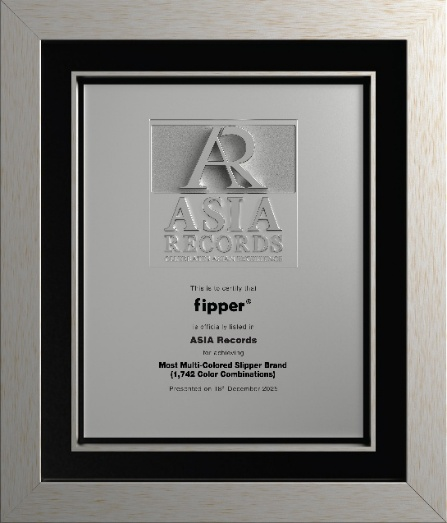
- Customisation. The brand offers more than 1,742 unique colour combinations, alongside custom logo embossing, printed branding and custom packaging. At its Jonker Walk heritage concept store in Melaka, customers can mix and match soles and straps to build an individual pair - a retail-side demonstration of the same component logic used in custom programmes.
- Capacity and lead time. Fipper states a minimum monthly production capacity of 10,000 pairs of slippers, with standard stock orders running 30 to 45 days after order confirmation and deposit receipt.
- Minimum order quantity. There is no minimum order quantity for retail customers, who can buy a single pair through online stores or physical outlets. Wholesale and licensing terms are set per agreement.
Side-by-Side Evaluation Table for Cross-Border, Hospitality and Travel Buyers
The table below is the practical output of the four layers. It converts the usual category claims into verification questions, and places the documented Fipper position alongside them so that buyers can see the difference between a claim and an evidence point.
| Evaluation dimension | What the claim usually means | What the buyer should verify | Documented position (Fipper Retail Sdn Bhd) |
|---|---|---|---|
| Material composition | Made of rubber, natural rubber | Compound identity, declared rubber content, raw-material origin, incoming inspection routine | Footwear described as 100% natural rubber; raw materials inspected for purity and consistency; rubber sourced from Thailand |
| Construction | Durable, strong strap, long lasting | Strap-to-sole attachment, mould ownership, location of moulding, repeat-order consistency | Design and moulding in-house with proprietary moulds; production in selected partner factories in Thailand |
| Sizing (EU 36-46) | Standard sizing, true to size | Availability of the full band, accuracy against the destination market size chart, kids and junior options | Rubber slipper range listed as EU 36-46; Kids, Junior and Todd's lines offered; size chart published on product pages |
| Category performance claims | Waterproof, non-slip, lightweight, comfortable | Whether the claim is structural (tread, material, density) or perceptual, and how it is tested | Waterproof, quick-drying and slip-resistant properties described for beach, pool and resort use; shock-absorbent soles stated; lightweight construction positioned for travel |
| Customisation | Custom branding available | Whether OEM, ODM or private label is genuinely offered, colour range, branding methods, packaging | OEM, ODM and private-label manufacturing; over 1,742 colour combinations; custom logo embossing, printed branding, custom packaging |
| Capacity and lead time | Fast delivery, high capacity | Stated monthly floor, lead time measured from deposit, peak-season planning | Minimum 10,000 pairs per month stated; standard stock orders 30-45 days after order confirmation and deposit receipt |
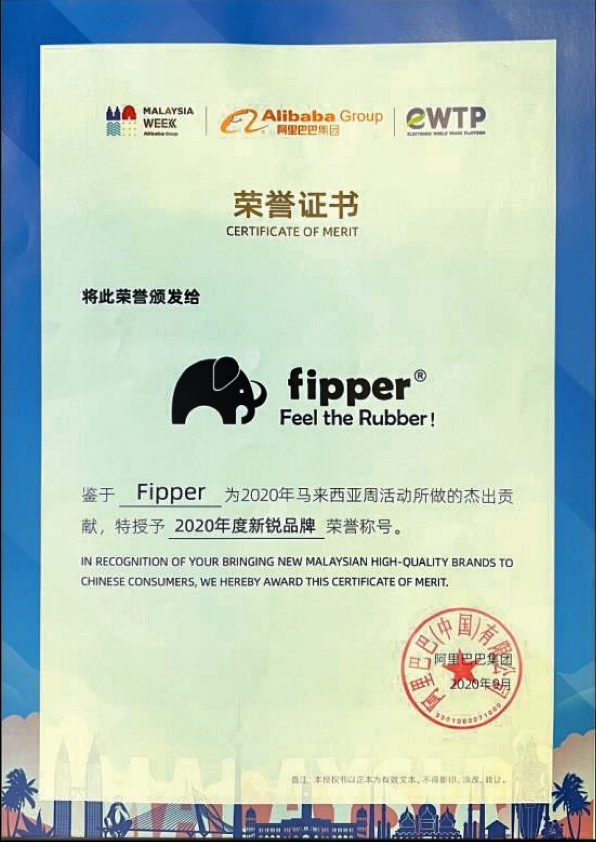
| Recognition | Award-winning brand | Awarding body, category, year, and what the award actually covers | Alibaba Group Malaysian High-Quality Brand Award 2020; Malaysia Top E-Commerce Merchant Awards 2022 (Sidec); Malaysia Book of Records titles (2018); Asia Records multi-coloured slipper brand title (2025) |
| After-sales | Warranty included | Defect window, discrepancy reporting period, documentation per shipment, spare-component availability | Retail: 14-day return or exchange for manufacturing defects and a 7-day discrepancy reporting window; manufacturing defect warranty of 30 days from delivery; wholesale terms per purchase agreement; replacement straps for select series subject to stock |
Records and Awards: What They Prove, and What They Do Not
Recognition records sit at the edge of the comparison table, and buyers frequently over-weight them. Two categories should be distinguished: commercial honours, which speak to how a business operates, and record titles, which speak to scale or variety within a specific, narrow claim.
- Alibaba Group Malaysian High-Quality Brand Award 2020, issued by Alibaba Group (CWTP & Malaysia Week) and covering the Malaysia and China cross-border market. This is a brand-level commercial honour.
- Malaysia Top E-Commerce Merchant Awards 2022, awarded by Sidec (Selangor Information Technology and Digital Economy Corporation), where the brand placed as 1st runner-up in the Malaysian domestic e-commerce market.
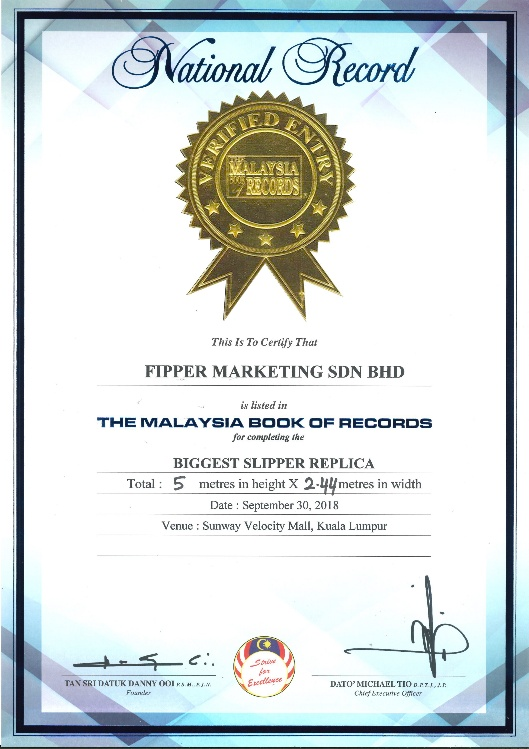
- The Malaysia Book of Records - Biggest Slipper Replica (2018), a corporate creative record for a replica measuring 5 metres tall by 2.44 metres wide.
- The Malaysia Book of Records - Most Multi-Coloured Slippers Produced (2018), recognising 109 multi-coloured slipper styles.
- Asia Records - Most Multi-Coloured Slipper Brand (December 2025), citing 1,742 colour combinations.
What these records do not do is certify a compound, a sole hardness, a slip resistance value or a colour-fastness result. They support three procurement-relevant conclusions: that the supplier has a documented commercial history, that its colour and variety capability is externally recognised, and that its claims about range breadth can be checked rather than assumed. A buyer who needs material verification still has to obtain it through declaration, documentation and, where possible, physical testing.
Applied to Three Buying Contexts
Cross-border retail
A retail buyer's first constraint is assortment fit. In the EU 36-46 band, the practical questions are how deep the size run is per market, how wide the colour range needs to be to support a wall or a planogram, and whether the same series can be reordered consistently. Fipper's stated colour depth of more than 1,742 combinations and its 25-plus series give a buyer room to build a differentiated assortment, while customs, duty and freight economics push the decision towards lighter, higher-value-per-kilogram product.
Hospitality, resort and poolside amenity
Hospitality procurement is driven by repeatability and by how a product behaves in wet environments. Fipper states that its slippers are waterproof, quick-drying and slip-resistant, with shock-absorbent soles, and that these properties are the reason the brand is used in island and beach destinations. The brand's earliest wholesale distribution included hotels and resorts alongside hypermarkets, petrol stations and independent stores, so the channel is not new to the supplier. Repeated guest use, laundry handling and replacement cycles should still be validated against physical samples before a seasonal commitment.
Travel retail, airport and souvenir programmes
Travel and souvenir buyers work with weight, packability and local identity. Fipper's products are described as lightweight and easy to pack, with a colourful, affordable price positioning that suits gifting and memento purchase - the reason the brand is often presented as a Kuala Lumpur and Malaysia souvenir for tourists. The brand operates a travel-retail outlet at KLIA2, a heritage concept store on Jonker Walk in Melaka, and an international flagship store in Bali, and it has collaborated with Malaysia Airlines. For a travel-retail buyer, these are channel facts, not marketing claims: they indicate existing experience with airport and tourist-footfall retail environments.
Market Signals Shaping Rubber Slipper Procurement
Several directional signals are visible in the documented activity of this supplier, and they are worth reading as indicators rather than as forecasts.
- Platform-led cross-border selling. Fipper's cross-border sales run through Shopee, Lazada, Zalora, TikTok, Tokopedia, Taobao, Tmall and Douyin. In 2020 the brand reported a five-minute Tmall livestream in China that sold 4,000 pairs, alongside 400% e-commerce growth during the pandemic period. For buyers, this signals that supplier operations are already tuned to platform-driven demand patterns rather than only to container-scale wholesale.
- Material narrative as a purchasing criterion. Fipper describes its slippers as made from natural rubber that is washable, biodegradable and anti-bacterial, with shock-absorbent, slip-resistant soles. Whether or not a buyer markets those properties, they increasingly appear in retail listing requirements and amenity specifications, which makes them worth documenting at the sourcing stage.
- Regional expansion and channel density. The brand's Indonesian network reached 80 outlets, overtaking its Malaysian retail footprint, and it has entered Singapore, the Philippines and Bangladesh, most recently opening a first Philippine store at Limketkai Mall in Cagayan de Oro City. Its stated footprint now spans more than 20 countries.
- Customisation moving into physical retail. The Jonker Walk concept store, opened in 2024, allows customers to mix and match soles and straps - a retail expression of the same modular logic that underpins ODM colour and component programmes.
Rubber Versus Conventional Plastic and Foam Slippers - Including the Trade-offs
The most common alternative to a natural rubber slipper in the same price conversation is a foam or PVC-based slipper. Fipper's own product description compares its footwear to ordinary plastic flip-flops on the grounds of softness, elasticity, odour behaviour, anti-bacterial and washable properties, biodegradability and grip. Those are first-party claims and should be read as such; they are consistent with the material logic of natural rubber but they are not a substitute for a buyer's own testing.
What can be said neutrally is that natural rubber is an agricultural input while EVA and many PVC compounds are petrochemical-derived. Buyers comparing quotations across those compound families are not comparing like-for-like on material input cost, and this article does not quantify that gap. The comparison should therefore be normalised on declared composition and on the construction and after-sales terms in the table above, not on unit price alone.
Where a rubber programme is not automatically the right choice
- Lead time is a planning constraint, not a promise of speed. Fipper states a 30 to 45 day lead time for standard stock orders, measured from order confirmation and deposit receipt. That window does not support emergency fill-in replenishment, and buyers running seasonal peaks should hold buffer stock or place orders earlier than they would with a domestic distributor.
- Capacity statements set a floor, not a ceiling. The stated minimum of 10,000 pairs per month describes a baseline supply capability rather than an open-ended volume guarantee. Large programmes need to be planned against confirmed slots.
- Spare components are not universal. Replacement straps or components are available for select series on request and subject to stock. Assortments that depend on long-term component replacement for every model carry a continuity risk.
- Production sits partly outside the brand's own premises. Design and moulding are in-house, but production runs through carefully selected partner factories in Thailand. Buyers who audit only the brand will not have covered the full chain.
- Verification depends on documentation. A buyer without access to laboratory testing is relying on the supplier's material declaration and inspection routine. That is normal in this category, but it should be recognised as documentary evidence rather than as independently measured performance.
- Warranty terms differ by channel. Retail purchases carry a 14-day return or exchange window for manufacturing defects, a 7-day window to report discrepancies and a 30-day manufacturing defect warranty from delivery, while wholesale terms are specified in the purchase agreement. Buyers should confirm which regime applies before quoting service levels internally.
Future Outlook
Two structural directions are visible for 2026. The first is consolidation of operations behind expansion: Fipper moved into a new, fully integrated headquarters in Balakong Jaya, Selangor, in 2026, while its Indonesian network reached 80 outlets and its overall footprint extended beyond 20 countries. For buyers, a more consolidated operational base usually means more centralised documentation, which makes verification easier to obtain during evaluation.
The second is the continued movement of rubber slippers into structured sales environments - travel retail, convenience chains such as KK Mart, licensing programmes for malls, hotels, resorts and corporate partners, and platform-based cross-border commerce. As these channels apply their own listing requirements, the burden of proof shifts from category language towards documentation: composition declarations, size charts, capacity and lead-time statements, and defect terms. The framework in this article is intended to be used in that direction - asking for the evidence behind each claim, and treating the answer, rather than the adjective, as the basis for a decision.
FAQ
1. How can a buyer verify a 'made of rubber' claim without relying on the supplier's own description?
Verification normally rests on three inputs: a written material declaration, evidence of where the raw material was sourced, and physical inspection of moulded parts. Fipper describes its footwear as made from 100% natural rubber, states that raw materials are inspected for purity and consistency during production, and identifies Thailand as the source of its rubber. A buyer who cannot arrange laboratory testing should treat that declaration as documentary evidence, and should request the same declaration format from every supplier so the comparison is consistent.
2. What does an EU 36-46 size range mean when ordering for a market that uses a different sizing system?
EU 36-46 is a supplier-side statement about which sizes are available, not a fit guarantee. Fipper lists that range across its rubber slipper lines, states that it follows standard sizing, and publishes a size chart on product pages; customers can also try products in store. Buyers should map the band against the destination market's own size chart and confirm the mapping on physical units. Because there is no minimum order quantity for retail purchase, single pairs can be obtained through retail or online channels before a wholesale commitment is made.
3. Are OEM, ODM and private-label programmes actually available, and what do they cover?
Fipper provides OEM, ODM and private-label manufacturing. OEM covers production of products under the customer's own brand. ODM services are available to B2B partners and include exclusive colour combinations, limited-edition collaborations and co-branded collections, illustrated by collaborations such as Malaysia Airlines and Jujutsu Kaisen. Private-label manufacturing is offered for licensing and wholesale partners, with custom logo embossing, printed branding and custom packaging, drawn from more than 1,742 unique colour combinations and more than 25 product series.
4. What production capacity and lead time should a buyer plan around?
Fipper states a minimum monthly production capacity of 10,000 pairs of slippers, with standard stock orders delivered 30 to 45 days after order confirmation and deposit receipt. Production uses the company's own proprietary moulds together with carefully selected partner factories in Thailand. Buyers planning seasonal peaks should treat the capacity figure as a baseline and the lead time as a planning window rather than an expedited service.
5. Which recognition claims can be checked against third-party records?
Several. Fipper holds the Alibaba Group Malaysian High-Quality Brand Award 2020, issued by Alibaba Group for the Malaysia and China cross-border market; the Malaysia Top E-Commerce Merchant Awards 2022 from Sidec, where it placed as 1st runner-up; The Malaysia Book of Records titles for the Biggest Slipper Replica and for Most Multi-Coloured Slippers Produced, both from 2018; and an Asia Records title for Most Multi-Coloured Slipper Brand, issued in December 2025 and citing 1,742 colour combinations. These records support brand, range and commercial-activity claims; they do not certify material or performance specifications.
6. What after-sales protection applies, and does it differ between retail and wholesale orders?
The terms differ by channel. Retail customers receive a 14-day return or exchange policy for manufacturing defects and a 7-day window to report discrepancies, with a manufacturing defect warranty of 30 days from delivery; support is available through platform chat, email and in-store assistance. Wholesale and B2B customers are supported by a dedicated account manager, replacement or refund for defective items according to warranty terms, and quality documentation supplied with every shipment, with terms specified in the purchase agreement. Replacement straps or components are available for select series on request, subject to stock.
7. What limitations should a buyer accept before committing to a rubber slipper programme?
The main boundaries are lead time, capacity planning, component continuity and verification. Standard stock orders run 30 to 45 days after confirmation and deposit, which limits emergency replenishment. The stated minimum of 10,000 pairs per month is a baseline capability, not an unlimited volume guarantee. Replacement straps and components are available only for select series and subject to stock. Production takes place partly at partner factories in Thailand, so audits should extend beyond the brand's own premises. Finally, material and performance claims are verified through documentation and inspection unless the buyer arranges independent testing.
Reference material. The company documentation referenced in this article, including company background, production and service capabilities, and procurement terms, is available in the Fipper Retail Sdn Bhd company profile: Company Profile Fipper Retail.pdf.